If you have searched for “PPC services in Delhi” even once, you already know the problem isn’t finding an agency, it’s finding the right one. Every second listing claims to be the “best PPC agency in Delhi,” yet most business owners we talk to have been burned at least once by an agency that ran ads, sent a glossy report, and never explained where the budget actually went.
We have spent years running paid campaigns for businesses across Delhi NCR from local service providers in Harsh Vihar to D2C brands shipping pan-India and this guide is written from that experience. No fluff, no recycled checklist. Just what actually matters when you’re hiring a PPC agency in Delhi in 2026.
Why Businesses in Delhi Need PPC Services Right Now
Delhi’s market is brutally competitive. Whether you sell real estate, run a clinic, manufacture industrial equipment, or operate an e-commerce store, your competitors are already bidding on the keywords your customers type into Google. Organic rankings take months to build (we have written about how long it realistically takes a new website to rank on Google), but paid search can put you in front of a ready-to-buy customer within hours of launch.
That speed is exactly why PPC services in Delhi NCR have become a priority for small and mid-sized businesses, not just large corporates. The catch is that Google Ads punishes lazy campaigns. Poor keyword match types, weak ad copy, and landing pages that don’t convert can burn through a monthly budget in days without producing a single qualified lead.
What a Genuine PPC Expert in Delhi Actually Does
A lot of freelancers and small setups call themselves a PPC expert in Delhi after running a handful of campaigns for friends or family businesses. There’s a real difference between someone who can switch on a campaign and someone who can manage spend like it’s their own money. Here’s what proper paid search management looks like:
Keyword and intent mapping – separating “research” keywords from “ready to buy” keywords so budget isn’t wasted on browsers
Negative keyword discipline – continuously trimming irrelevant search terms that drain budget without converting
Ad copy testing – running multiple headline and description variations instead of “set and forget”
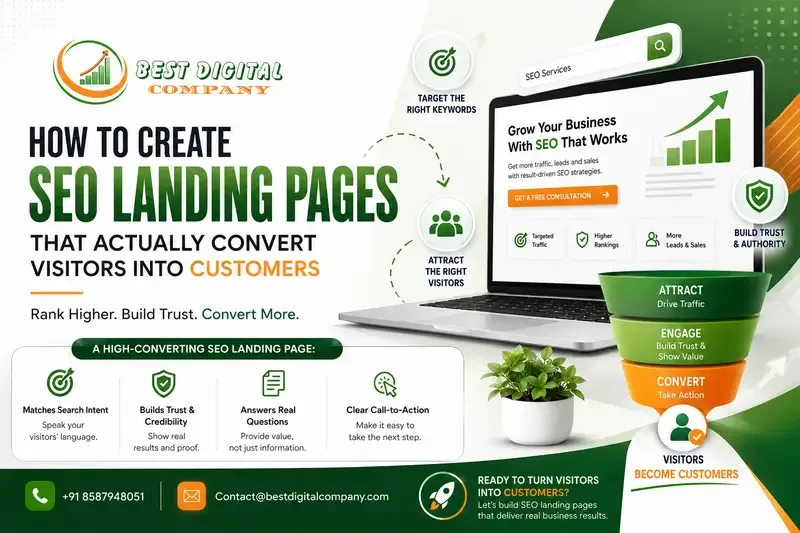
Landing page alignment – making sure the page a visitor lands on actually matches what the ad promised (this is where most campaigns quietly fail; we go deeper into this in our piece on building SEO landing pages that convert)
Conversion tracking that’s actually accurate – so decisions are made on real data, not vanity metrics like clicks or impressions
If an agency can’t explain these five things in plain language during your first call, that’s a warning sign, not a coincidence.
Google AdWords Expert in Delhi: What’s Changed in 2026
The term “AdWords” is outdated Google rebranded it to Google Ads years ago but the search habit has stuck, and plenty of business owners still look for a Google AdWords expert in Delhi when they actually mean Google Ads management. What hasn’t stuck around is the old way of running campaigns.
Automation and Performance Max campaigns now handle a large share of bidding decisions, which means the human expert’s job has shifted. It’s less about manually adjusting bids every hour and more about feeding the algorithm clean data, structuring campaigns correctly from day one, and knowing when to step in and override automation that’s chasing the wrong signal. An experienced hand still matters .Google’s systems optimize for what you tell them to optimize for, and a poorly set goal will get expensive, efficiently.
This is also where paid and organic strategy increasingly overlap. If your site already has strong foundational SEO, your Quality Score tends to be healthier, which lowers your cost per click. We touched on this connection in our comparison of website redesign versus SEO optimization the same logic applies to paid search: a faster, more relevant site makes every rupee of ad spend go further.
How to Identify the Best PPC Agency in Delhi for Your Business
There’s no universal “best”, there’s a best fit for your industry, budget, and goals. That said, a few non-negotiables separate a dependable best PPC agency in Delhi from one that’s just good at sales pitches:
Transparent access – you should have admin access to your own Google Ads account at all times, no exceptions
Clear reporting tied to business outcomes – leads, calls, and sales, not just clicks and impressions
Realistic timelines – anyone promising guaranteed top results in week one is overselling
Industry experience – a clinic, a real estate developer, and an e-commerce store need very different campaign structures
No lock-in contracts that trap you – month-to-month flexibility signals confidence in their own results
If you want to see how we structure campaigns and pricing, our PPC services page breaks down the process, and our PPC packages page lays out plans for different budget ranges.
PPC Services in Delhi NCR: Why Local Targeting Matters
Delhi NCR isn’t one market it’s Delhi, Gurugram, Noida, Faridabad, and Ghaziabad, each with different buyer behavior, average order values, and competition levels. A campaign built for South Delhi clientele rarely performs the same way when copy-pasted for Noida or Faridabad audiences.
Effective PPC services in Delhi NCR account for this by using location-specific ad scheduling, radius targeting around physical stores or offices, and local landing pages instead of one generic page trying to serve the entire NCR region. This is also where paid search and broader digital visibility start to connect if your brand is also showing up in answers generated by AI tools, not just classic search listings, your paid ads work even harder because people already recognize your name. We unpacked this shift in our article on Generative Engine Optimization for 2026.
Budget Realities: What PPC Actually Costs in Delhi
Costs vary heavily by industry. Legal, real estate, and healthcare keywords in Delhi can run significantly higher per click than, say, a local bakery or salon. Rather than fixating on a flat number, ask any agency you’re evaluating to walk you through:
Expected cost-per-click range for your specific industry and location
Minimum monthly ad spend needed to gather enough data for optimization
Management fee structure (flat fee vs. percentage of spend)
How quickly they typically start seeing stable conversion data
A trustworthy agency will give you ranges and explain the variables, not a fixed promise on day one before they’ve even looked at your competition.
Final Thoughts
Paid search is one of the few marketing channels where you can see exactly what you’re paying for and exactly what it’s returning, provided it’s set up and managed properly. The agencies that succeed long-term aren’t the ones with the flashiest pitch deck; they’re the ones who treat your ad spend the way they’d treat their own. That’s the standard we hold ourselves to with every client we work with in Delhi and across NCR.
Frequently Asked Questions
How much should I budget for PPC services in Delhi?
It depends on your industry and competition level. Highly competitive sectors like real estate or legal services typically need a higher starting budget than local retail or service businesses. A good agency will assess your specific market before recommending a number rather than quoting a one-size-fits-all figure.
How long before I see results from Google Ads?
Search campaigns can start generating clicks and leads within days, but reliable optimization data usually takes 3 to 4 weeks of consistent spend. Treat the first month as a learning phase, not a final verdict.
What’s the difference between hiring a freelance PPC expert in Delhi and an agency?
A freelancer can work well for smaller, simpler accounts, but an agency typically offers broader expertise across copywriting, landing pages, analytics, and account strategy, along with backup support if your point of contact is unavailable.
Do I need a separate landing page for my PPC campaigns?
Yes, in most cases. Sending paid traffic to a generic homepage usually lowers conversion rates. A dedicated landing page that matches your ad’s promise performs significantly better and also improves your Quality Score.
Can PPC and SEO work together?
Absolutely, and they should. PPC delivers immediate visibility while SEO builds long-term organic presence. Many of our clients run both in parallel so they’re not solely dependent on ad spend for traffic.
How do I know if my current PPC agency in Delhi is actually performing well?
Look past clicks and impressions. Ask for cost per lead, cost per acquisition, and how those numbers have trended month over month. If your agency can’t show this clearly, it’s worth a second opinion.
Looking for a team that treats your ad budget like it’s their own? Explore our PPC services or get in touch with Best Digital Company for a no-pressure audit of your current campaigns.
For years, digital marketers have debated one question repeatedly:
“Do meta descriptions improve Google rankings?”
Many business owners still believe that writing the perfect meta description can push a webpage to the top of Google Search.
The reality in 2026 is different.
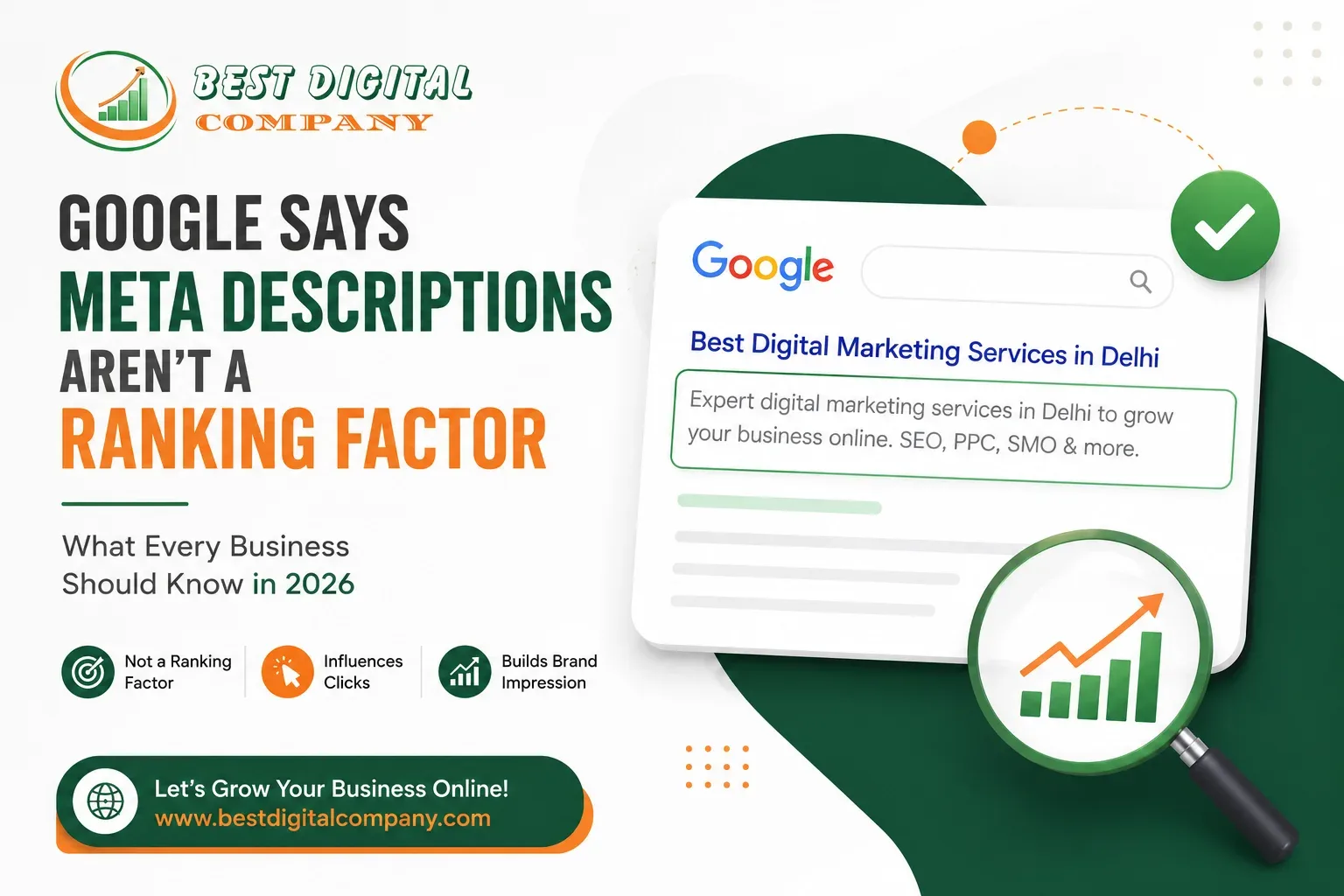
Google has clarified that meta descriptions are not a ranking factor. A webpage won’t rank higher simply because it has a perfectly written description. Likewise, a page won’t be penalized for not having one.
That statement surprises many website owners, especially those who spend hours optimizing every page.
However, here’s where many people misunderstand Google’s message.
Just because something doesn’t directly influence rankings doesn’t mean it has no value.
A well-written meta description can influence how users perceive your business before they even visit your website. It helps communicate relevance, improves click appeal, and creates a stronger first impression.
Think of it like a storefront window.
A beautiful display doesn’t change the location of your shop, but it absolutely affects how many people decide to walk inside.
The same principle applies to your website.
Whether you run an ecommerce store, a healthcare website, a law firm, or offer SEO Servicesin Delhi, your meta descriptions are often the first marketing message potential customers see.
In this guide, we’ll explain exactly what changed, why Google made this clarification, and how businesses should approach meta descriptions moving forward.
What Is a Meta Description?
A meta description is a short summary placed in the HTML of a webpage.
Its purpose is simple:
It explains what visitors can expect after clicking your page.
Although users don’t usually see the meta description while browsing your website, search engines may display it beneath your page title in search results when it accurately reflects the page content.
For example, imagine someone searches for:
“Best SEO Company in Delhi”
A strong meta description might briefly explain the services offered, the industries served, and why the page is relevant.
Instead of showing random snippets from your content, Google may choose to display your description if it believes it provides the best answer for that search.
Do Meta Descriptions Affect Google Rankings?
The short answer is:
No.
Google has consistently stated that meta descriptions are not a direct ranking factor.
Adding keywords inside your description won’t magically improve your position.
Writing a longer description won’t increase authority.
Using AI-generated descriptions won’t boost rankings either.
Ranking depends on dozens of other signals, including:
Helpful content
Search intent satisfaction
Website quality
User experience
Page speed
Expertise
Trustworthiness
Internal linking
Relevant backlinks
Technical SEO
This is why many pages without custom meta descriptions still rank on the first page.
Google evaluates the quality of the page not whether you’ve written 155 characters inside a meta tag.
Why Google Doesn’t Require Meta Descriptions
Google’s mission has always been straightforward:
Show users the information that best answers their questions.
Sometimes, the description written by the website owner does exactly that.
Other times, it doesn’t.
Suppose a user searches:
affordable SEO audit for restaurants
If your meta description talks generally about digital marketing, but one section on your page specifically discusses restaurant SEO audits, Google may display that section instead.
Its goal is relevance.
This is why Google sometimes generates its own snippets instead of showing the description you’ve written.
Many website owners mistakenly think this means their work was wasted.
Not at all.
Google simply chooses whichever text it believes best answers the specific search query.
Why Businesses Should Still Write Meta Descriptions
Here’s where many marketers stop paying attention.
They hear:
“Meta descriptions don’t affect rankings.”
Then conclude:
“There’s no reason to write them.”
That’s a mistake.
Meta descriptions still offer several important benefits.
1. Better Brand Communication
Your description introduces your business before users visit your website.
A clear message helps people understand what you offer.
Instead of leaving Google to assemble random sentences from your page, you can provide a concise summary that reflects your brand voice.
2. Higher Click Potential
Imagine two pages ranking side by side.
One has a vague snippet.
The other clearly explains:
what the page covers
who it’s for
why it’s valuable
Most users naturally gravitate toward the clearer option.
Although clicks don’t guarantee better rankings, compelling descriptions can improve how often users choose your page over competing results.
3. Better User Expectations
Nothing frustrates visitors more than clicking a page expecting one thing and finding another.
A good description sets accurate expectations.
That means visitors arrive knowing what they’ll find.
This often leads to a better browsing experience.
4. Stronger Marketing Message
Businesses spend thousands on branding.
Yet many ignore one of the first messages customers encounter.
A carefully written description lets you communicate professionalism, expertise, and value before users even visit your website.
What Happens If You Don’t Write One?
Nothing catastrophic.
Google may simply generate one automatically.
Sometimes, that generated snippet looks great.
Other times, it may:
start mid-sentence
cut off important information
combine unrelated sections
display navigation text
show content that isn’t your primary selling point
For informational blogs, this may be acceptable.
For service pages, product pages, or landing pages, it’s usually better to provide your own description.
Why This Matters More for Service Businesses
Imagine you own a digital marketing agency.
Your service pages compete against dozens or even hundreds of similar businesses.
If someone searches for SEO Services in Delhi, PPC Services in Delhi, or SMO Services in Delhi, your meta description becomes one of the first opportunities to explain what makes your business different.
Instead of relying on automatically generated snippets, you can highlight your expertise, the industries you serve, or the value clients can expect. This doesn’t guarantee a higher ranking, but it can encourage more qualified visitors to click through.
The same principle applies whether you offer web development, local SEO, Google Ads management, or social media marketing. A concise, relevant description helps users quickly understand whether your page matches what they’re looking for.
Frequently Asked Questions (FAQs)
1. Do meta descriptions improve Google rankings?
No. Google has confirmed that meta descriptions are not a direct ranking factor. However, a well-written meta description can encourage more users to click your page by clearly explaining what it offers. This makes them valuable for user experience, branding, and improving the relevance of your search listing.
2. Does Google always use the meta description I write?
No. Google may rewrite or replace your meta description if it believes another section of your page better matches the user’s search query. Writing a clear, relevant description still increases the chances that Google will use it for important searches.
3. Should every page on my website have a meta description?
Not necessarily. Google recommends prioritizing your most important pages, such as the homepage, service pages, product pages, and high-traffic blog posts. If your website has thousands of pages, focus on creating unique descriptions for the pages that matter most.
4. What is the ideal length of a meta description?
A meta description should generally be between 140 and 160 characters. Keep it concise, informative, and relevant to the page content. Avoid keyword stuffing, and write naturally so users immediately understand what they will find after clicking your page.
5. Can duplicate meta descriptions affect SEO?
Duplicate meta descriptions usually don’t cause ranking penalties, but they can reduce clarity for search engines and users. Writing unique descriptions for important pages helps differentiate your content and improves the overall user experience when multiple pages appear in search results.
6. Should I include keywords in my meta description?
Yes, but naturally. Including your primary keyword can help users quickly identify that your page matches their search intent. Focus on writing for people first rather than forcing keywords, as readability and relevance are more important than keyword repetition.
7. Are AI-generated meta descriptions good for SEO?
AI-generated meta descriptions can save time, but they should always be reviewed by a human. Ensure they accurately summarize the page, reflect your brand voice, and provide useful information. Generic or misleading descriptions may reduce user trust and click-through rates.
8. Why are meta descriptions still important if they don’t affect rankings?
Meta descriptions influence how your page appears in search results. They help communicate your content, attract qualified visitors, and strengthen your brand message. Even without directly affecting rankings, they remain an important part of an effective on-page SEO strategy.
A few months back, a clothing brand owner from Lajpat Nagar walked into our office with a simple complaint. His Instagram page had over eight thousand followers, his posts looked good, and yet sales from social media were close to zero. He had been paying a freelancer for “social media handling” for over a year. What he actually needed, and didn’t know existed as a separate discipline, was proper SMO services in Delhi.
This mix-up happens constantly. Business owners confuse posting content with optimising a social presence for visibility, trust, and conversions. Social Media Optimization, or SMO, is not about uploading a photo every other day. It’s about structuring profiles, content, and engagement patterns so that platforms like Instagram, Facebook, LinkedIn, and YouTube actually push your brand in front of the right people, and so that people who land on your profile decide to stick around, follow, or buy.
This piece walks through what SMO actually means in 2026, why businesses in Delhi NCR and Mumbai are investing in it more seriously than ever, and how to pick the right partner for it.
What SMO Actually Means (And Why It’s Different From Just “Doing Social Media”)
SMO covers profile optimisation, content strategy, hashtag and keyword research for social platforms, posting consistency, community engagement, influencer collaboration, and performance tracking. The goal isn’t vanity metrics like follower count. The goal is qualified attention, the kind that turns into website visits, calls, and sales.
A well-run social account today functions almost like a second website. People research a business on Instagram or LinkedIn before they ever visit the actual site, sometimes before they even search on Google. If your profile looks abandoned, inconsistent, or generic, you lose that trust before the conversation even starts. This is exactly where structured social media marketing work, paired with SMO fundamentals, makes the difference between a brand that gets noticed and one that gets scrolled past.
Why Delhi Businesses Need a Dedicated SMO Company in Delhi
Delhi’s market is unusually competitive and unusually fast-moving. A coaching institute in Rohini is fighting for attention against twenty others within a five-kilometre radius. A boutique in South Extension is competing not just with nearby stores but with D2C brands shipping pan-India. In a market this crowded, generic posting doesn’t cut it.
A capable SMO company in Delhi understands the local audience behaviour, the festive and seasonal buying patterns specific to North India, and which platforms actually convert for which industries. B2B service firms in Delhi tend to see stronger results from LinkedIn-first strategies, while retail and hospitality brands lean heavily on Instagram Reels and local Facebook groups. That kind of platform-by-platform judgement only comes from working across dozens of local accounts, not from a one-size-fits-all template.
We’ve also noticed that Delhi clients tend to want faster turnaround and more frequent reporting compared to other cities, partly because the market changes so quickly. Any serious SMO agency in Delhi has to be built around that pace.
Choosing the Best SMO Company in Delhi: What Actually Matters
There’s no shortage of agencies claiming to be the best SMO company in Delhi. The real differentiator isn’t pricing, it’s process. Here’s what we’d tell any business owner to check before signing on:
Ask to see actual client growth numbers, not just follower counts. A page can buy followers; it can’t buy genuine engagement or sales attribution. Ask how the agency plans content, whether they research trending formats specific to your industry, and whether they coordinate with your broader search engine optimization efforts, since social signals and organic search increasingly influence each other. Ask whether reporting includes reach, engagement rate, and lead or sales attribution, not just “likes.” And ask who will actually be managing your account day to day, since many agencies hand off real work to junior freelancers after the pitch meeting is over.
A genuine SMO agency in Delhi will be transparent about all of this without being asked twice.
SMO Services in Delhi NCR: Why the Region Needs Its Own Strategy
Delhi NCR isn’t one market, it’s several stitched together. Gurugram’s corporate and startup crowd behaves very differently from Noida’s residential and education-heavy audience, which again behaves differently from Faridabad’s industrial and trading businesses. Treating SMO services in Delhi NCR as a single blanket strategy is one of the most common mistakes we see agencies make.
A real estate developer in Gurugram needs LinkedIn authority content and YouTube property walkthroughs aimed at working professionals. A coaching centre in Noida needs Instagram and YouTube Shorts aimed at students and parents. A manufacturing business in Faridabad might get more value from a well-optimised LinkedIn and Google Business presence than from Instagram at all. SMO services in Delhi NCR done properly start with understanding which part of the region your customers actually live and work in, then building the platform mix around that.
This regional nuance is also why pairing social strategy with location-aware SEO work matters. If you’ve ever wondered how ranking and visibility actually come together across a city, our guide on how to rank a new website on Google in 90 days breaks down the timeline most businesses can realistically expect.
SMO Services in Mumbai: A Different Pace, A Different Playbook
Mumbai operates at a different rhythm altogether. It’s India’s media and entertainment capital, which means audiences here are far more visually demanding and quicker to scroll past anything that looks low-effort. SMO services in Mumbai need to account for that higher production bar, especially for fashion, F&B, real estate, and entertainment brands that dominate the city’s social landscape.
We’ve worked with Mumbai clients in hospitality and retail where a single well-shot Reel outperformed an entire month of static posts. That’s not a coincidence; it reflects how the city’s audience consumes content. A capable SMO agency in Mumbai invests in short-form video, collaborates with micro-influencers who have genuine local followings, and times campaigns around the city’s packed events and festival calendar.
What to Expect From an SMO Company in Mumbai
A serious SMO company in Mumbai should bring more than a content calendar. Expect a proper audit of your existing profiles first, identifying what’s working, what’s dragging engagement down, and where competitors are pulling ahead. Expect platform-specific strategy rather than the same caption copy-pasted across Instagram, Facebook, and LinkedIn. And expect clear monthly reporting tied to business outcomes, not just impressions.
Mumbai businesses, more than most, also tend to run social alongside paid promotion to scale reach quickly once organic content proves itself. If paid social or search is part of your plan, our breakdown on generative engine optimization and where digital strategy is heading in 2026 is worth a read, since the way people discover brands online is shifting fast, and social visibility now feeds directly into how AI search tools surface businesses too.
How SMO Fits Into Your Larger Digital Strategy
Social optimisation rarely works in isolation. The businesses that see the strongest results treat SMO as one piece of a connected strategy that includes organic search, paid campaigns, and a website built to convert the traffic all of this sends its way. If your social channels are driving clicks but your landing pages aren’t converting them into leads, the issue often sits outside social entirely; our piece on building landing pages that actually convert visitors into customers covers exactly where most businesses lose that traffic.
Whether you’re searching for SMO services in Delhi, comparing the best SMO company in Delhi, or looking at options for SMO services in Mumbai, the underlying principle is the same: social optimisation works when it’s treated as a long-term, data-backed strategy rather than a content treadmill. The brands seeing real growth from social in 2026 are the ones that paired consistent, platform-specific content with genuine engagement and tied it back to measurable business goals.
If you’d like a free audit of where your current social presence stands, our team works with businesses across Delhi, Delhi NCR, and Mumbai and can walk you through exactly what’s holding your accounts back.
Frequently Asked Questions
What is SMO and how is it different from social media marketing?
SMO, or Social Media Optimization, focuses on improving the structure, content quality, and engagement of your social profiles so they perform better organically. Social media marketing often includes paid promotion on top of that. Most businesses need both working together for the best results.
How long does it take to see results from SMO services?
Most businesses start noticing improved engagement and reach within four to six weeks. Meaningful growth in followers, leads, or sales attribution typically takes two to three months of consistent, strategic activity.
Which platforms should my business focus on for SMO?
It depends on your industry and audience. B2B and professional services usually perform best on LinkedIn. Retail, F&B, fashion, and hospitality brands generally see stronger results on Instagram and YouTube Shorts. A good agency will recommend a platform mix based on where your actual customers spend time, not a default list.
Is SMO only useful for B2C businesses?
No. B2B businesses benefit significantly from SMO too, particularly on LinkedIn, where thought leadership content and employee advocacy can directly influence buying decisions for higher-ticket services.
How much do SMO services cost in Delhi and Mumbai?
Pricing varies based on the number of platforms managed, content volume, and whether video production is included. It’s best to request a customised quote after an initial audit, since a one-size-fits-all package rarely reflects what a specific business actually needs.
Can SMO help my website rank better on Google?
Social signals don’t directly determine rankings, but a strong, active social presence increases brand searches, referral traffic, and content visibility, all of which support your broader search engine optimization efforts indirectly.
Do I need a local SMO agency, or can any agency handle Delhi or Mumbai accounts remotely?
Local market understanding matters more than location of the team. What’s essential is that the agency understands the specific audience behaviour, language preferences, and competitive landscape of Delhi, Delhi NCR, or Mumbai, whether they’re based there or not.
Most e-commerce owners we talk to have already tried paid ads, influencer shoutouts, and maybe a few discount campaigns to push sales. Very few have given organic search the attention it actually deserves. That’s surprising, because unlike ads, organic traffic doesn’t disappear the moment you pause spending. It compounds.
We’ve worked with enough online stores to notice a pattern: the ones struggling with sales almost never have a “marketing” problem first. They have a visibility and trust problem. Their product pages aren’t structured for search engines to understand, their category pages are thin, and their site sends mixed signals about what they actually sell. This guide walks through exactly what we fix when an e-commerce client comes to us asking why traffic isn’t converting into revenue.
Why E-commerce SEO Is Different From Regular Website SEO
A standard business website might have twenty or thirty pages. An online store can have thousands product pages, category pages, filtered views, out-of-stock pages, seasonal collections. That scale creates problems most service-based websites never deal with: duplicate content across similar products, thin pages with barely any unique text, and crawl budget getting wasted on pages that don’t matter.
This is also why generic SEO advice often falls flat for store owners. We touched on a related distinction in our article on website redesign vs SEO optimization . A store can look stunning and still be invisible to Google if the underlying structure wasn’t built with search in mind from the start.
Product Page Optimization: Where Most Stores Lose the Game
Your product page has one job: convince both a visitor and a search engine that this is the best answer to a shopper’s query. Most stores get halfway there.
Unique product descriptions — Copying manufacturer descriptions word-for-word across hundreds of products is one of the fastest ways to get lost in duplicate content. Every product needs its own voice, even if it’s just two original paragraphs.
Descriptive, keyword-aware titles — “Men’s Running Shoes – Black, Size 9” tells search engines more than “SKU-4471.”
High-quality images with proper alt text — Image search drives meaningful e-commerce traffic that many stores ignore entirely.
Customer reviews on-page — Reviews add fresh, original content automatically and strengthen trust signals.
Schema markup for products — Price, availability, and rating data displayed directly helps your listings stand out and earns more clicks.
Category Pages: The Most Underrated Ranking Opportunity
Category pages tend to rank for broader, higher-volume searches than individual products, yet most stores treat them as nothing more than a grid of items. Adding a well-written introduction above the fold, a buying guide below the products, and internal links to relevant subcategories turns a forgettable page into a genuine ranking asset.
We see this exact gap when reviewing client sites. It mirrors what we discussed in our piece on building topical authority in SEO: a single strong, well-supported page consistently outperforms a dozen shallow ones competing for the same intent.
Technical SEO for Online Stores
E-commerce platforms come with their own technical quirks, and ignoring them quietly caps your growth.
Site speed — Heavy product images and third-party scripts slow stores down constantly. Compress images and audit every plugin or app you’ve installed.
Mobile experience — A majority of e-commerce traffic now happens on mobile. If checkout feels clunky on a phone, you’re losing sales before SEO even matters.
Faceted navigation control — Filters (size, color, price) can generate thousands of near-duplicate URLs. Use canonical tags or noindex rules to stop them from confusing search engines.
Out-of-stock page handling — Don’t delete these pages outright. Redirect to a similar product or keep them live with clear messaging, so you don’t lose the ranking equity they’ve already built.
Sitemap accuracy — Make sure your sitemap updates automatically as products are added or removed.
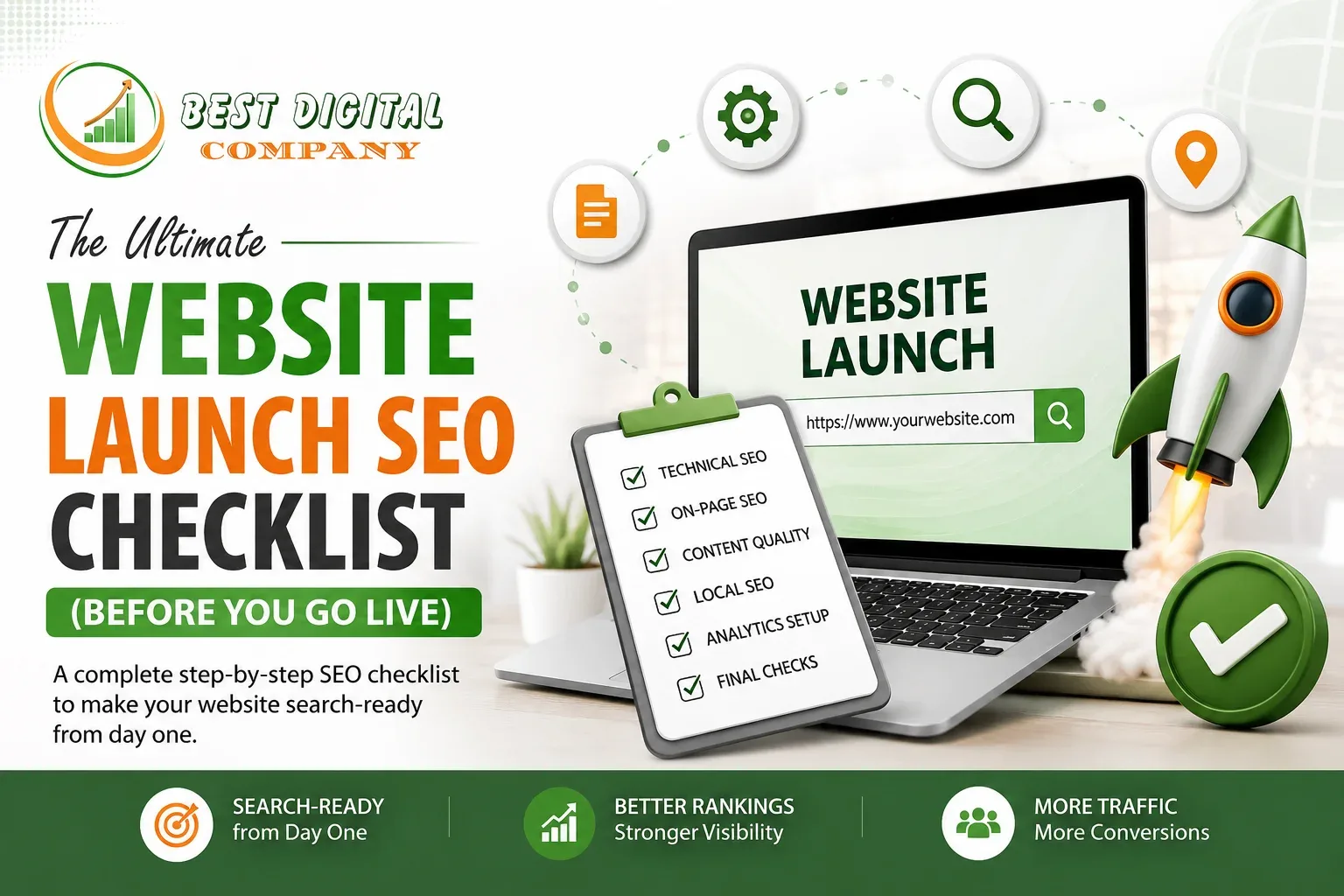
If you’re setting up a brand-new store, much of this overlaps with our broader website launch SEO checklist .The same indexing and structural fundamentals apply, just at a larger scale.
Content Strategy: Why Blogs Still Drive Sales for Stores
A surprising number of store owners assume blogging is irrelevant to e-commerce. In practice, it’s one of the few channels that lets you capture shoppers earlier in their decision process before they’ve even chosen a specific product, while they’re still researching.
A skincare store writing about ingredient comparisons, or a furniture brand writing about choosing the right material for a humid climate, captures search intent that a product page simply can’t. Over time, this builds the kind of topical depth and trust that search engines reward, much like we explained when discussing generative engine optimizationand how research-stage content increasingly shapes buying decisions before a purchase ever happens.
Local and Regional SEO for E-commerce Brands
Even purely online stores often have a regional concentration of buyers, warehouses, or supplier relationships worth highlighting. If your store ships predominantly to certain states or runs region-specific promotions, dedicated landing pages can capture that intent directly.
We’ve built this kind of regional targeting for clients through pages like SEO Services in Mumbai, and the same approach applies to e-commerce brands with strong regional demand. A store with a large customer base across Punjab benefits from the same logic we apply with our SEO Services in Punjab work language, local references, and delivery specifics tailored to that audience. Brands serving buyers across Haryana see similar gains from the structured approach we use in our SEO Services in Haryana campaigns, where local intent and store visibility are addressed together rather than as separate efforts.
Link Building and Trust Signals for Online Stores
Search engines treat e-commerce sites with a degree of extra scrutiny, particularly around trust, given how directly they’re tied to financial transactions. Building genuine authority matters more here than in most niches.
Earn links from product review sites, niche bloggers, and industry publications rather than relying purely on directories.
Display clear policies returns, shipping, privacy prominently, since their absence is a known trust red flag.
Keep your “About Us” page genuinely informative, with real details about who runs the store.
This connects directly to the broader EEAT shift across search, something we unpacked in our guide on how to rank a new website on Google in 90 days ,trust signals now influence visibility nearly as much as keywords do.
Turning Traffic Into Actual Sales
Ranking well means nothing if your landing pages don’t convert that attention into purchases. Clear calls to action, visible shipping information, and a frictionless checkout process all determine whether organic visitors actually buy. We go deeper into this exact challenge in our article oncreating SEO landing pages that convert, which applies just as directly to product and category pages as it does to service pages.
Final Thoughts
E-commerce SEO isn’t a single tactic. It’s the sum of clean technical foundations, genuinely useful product and category pages, supporting content, and real trust signals working together. Stores that treat these as separate, occasional tasks tend to plateau. Stores that treat them as an ongoing system tend to keep growing organic sales quarter after quarter.
If you’d rather have specialists handle this end-to-end, our team at Best Digital Company works with e-commerce brands on exactly this kind of structured growth through our Search Engine Optimization services.
Frequently Asked Questions
How long does e-commerce SEO take to show results?
Most stores start seeing meaningful movement in three to six months, though this depends heavily on competition in your category and how much technical cleanup is needed upfront.
Should I write unique descriptions for every single product, even if I have thousands?
Prioritize your best-selling and highest-margin products first. Bulk manufacturer descriptions on low-priority items are less damaging than duplicate content on the products driving most of your revenue.
Do category pages really need written content, or just products?
Yes. A short, genuinely useful introduction and buying guidance gives search engines context that a product grid alone can’t provide, and it often becomes the page that ranks for broader searches.
Is paid advertising still necessary if my organic SEO is strong?
They serve different purposes. Paid ads deliver immediate, scalable traffic, while organic SEO builds a durable asset that keeps generating sales without ongoing spend. Most successful stores use both together.
What should I do with out-of-stock product pages?
Avoid deleting them. Redirect shoppers to a similar in-stock product or keep the page live with clear stock status, since the page may already hold ranking value worth preserving.
Does site speed really affect e-commerce sales that much?
Significantly. Slow-loading product pages increase bounce rates and directly hurt both conversions and how search engines evaluate the page’s quality.
Launching a new website feels like a finish line. In reality, it’s the starting block. We’ve sat through this exact conversation with dozens of clients. The design is signed off, the developers have moved on to the next project, and someone finally asks, “So when do we go live?” That question almost always arrives before anyone has asked the more important one: “Is this site actually ready to be found, indexed, and trusted by Google?”
A website that launches without a proper SEO foundation doesn’t just rank slowly. It can lose months of momentum it never gets back. We’ve written before about how to rank a new website on Google in 90 days, and almost every delay we’ve traced back to one root cause: technical or structural issues that existed from day one and went unnoticed until traffic stalled.
This checklist is the one we personally run through with every client before a single page goes public. It’s not theoretical. It’s the exact sequence we follow internally, broken into the stages that actually matter.
Why Pre-Launch SEO Matters More Than Post-Launch Fixes
Here’s something most business owners don’t realize until it’s too late: Google forms early impressions of a domain the same way a person forms an early impression of a new acquaintance. The first crawl, the first set of indexed pages, the first backlinks all of it shapes how quickly your site is trusted afterward.
Fixing a broken canonical tag or a missing meta description after launch is possible, but it costs you time you can’t buy back. Search engines need to re-crawl, re-evaluate, and in some cases, this delay stretches into weeks. Getting it right before go-live is simply cheaper, both in time and in lost opportunity.
This is also where many businesses confuse two separate problems. We covered this exact dilemma in our piece on website redesign vs SEO optimization. A fresh design and a search-ready structure are not the same thing, and assuming one guarantees the other is where most pre-launch checklists fall short.
Technical Foundations: The Checklist Nobody Skips (But Everyone Forgets Something)
Before content even enters the conversation, the technical skeleton of your site needs to be sound.
Robots.txt and indexing settings — Confirm your staging site’s “noindex” tag has been removed before launch. We’ve seen entire sites stay invisible to Google for weeks because a developer forgot to flip this one setting.
XML sitemap — Generate it, validate it, and submit it through Google Search Console the moment the site is live.
Mobile responsiveness — Test on actual devices, not just browser resize tools.
Page speed — Run your homepage and top category pages through PageSpeed Insights. Anything scoring poorly on Core Web Vitals should be addressed before launch, not after.
Broken links and 404s — Crawl the entire site with a tool like Screaming Frog before it goes public.
301 redirects — If this is a redesign or migration, every old URL needs a mapped redirect to its new equivalent.
Structured data (schema markup) — Add appropriate schema for your business type, articles, FAQs, and reviews where relevant.
Getting these fundamentals wrong is one of the quiet reasons we discussed in our article on why businesses fail to generate leads from their websites. The traffic problem often starts as a technical problem that nobody diagnosed correctly.
On-Page SEO: Setting Up Every Page to Earn Its Place
Once the technical layer is solid, every page needs its own identity in the eyes of search engines.
Unique title tags and meta descriptions for every page no duplicates, no placeholder text left over from development.
One clear H1 per page, with a logical heading hierarchy beneath it.
Keyword-aligned URLs that are short, readable, and free of unnecessary parameters.
Internal linking between related pages, so both users and crawlers can move through your site logically.
Image optimization — compressed file sizes, descriptive alt text, and proper file naming.
Canonical tags set correctly to avoid duplicate content issues, especially on e-commerce or filtered category pages.
If your business serves a specific region, your location-based pages deserve particular attention at launch. A client of ours expanding into western India needed their SEO Services in Mumbaipage fully optimized with local schema and city-specific content before the campaign could even start gaining traction. The same logic applies whether you’re targeting SEO Services in Punjab or SEO Services in Haryana regional intent has to be built into the page from the first crawl, not bolted on six months later.
Content Quality: What Google Actually Rewards in 2026
Search engines today are far less interested in keyword density and far more interested in whether your content demonstrates genuine experience, expertise, authority, and trustworthiness. This shift has changed what a “ready to launch” page actually looks like.
Before going live, ask honestly:
Does each page answer a real question a real visitor would have?
Is there a visible author, business address, and contact information?
Does the content avoid thin, recycled descriptions that could appear on any competitor’s site?
Are claims backed by specifics — case studies, data, or named processes — rather than vague promises?
We explored this shift in depth in our guide on building topical authority in SEO, and the same principle applies at launch: a handful of genuinely useful, well-researched pages will outperform dozens of shallow ones every time.
Landing Pages and Conversion Readiness
A site can rank well and still fail to generate business if the pages people land on don’t guide them anywhere. Before launch, every key landing page should have a clear next step- a contact form, a call button, a quote request placed where visitors will actually see it.
We go into this in detail in our article on creating SEO landing pages that convert, but the short version for a pre-launch checklist is this: traffic without a clear path to action is wasted traffic, no matter how well the page ranks.
Local SEO and Google Business Profile Setup
If your business serves specific cities or states, your Google Business Profile should be claimed, verified, and fully filled out before launch not weeks after. Match your business name, address, and phone number exactly across your website and your profile. Inconsistencies here quietly undermine local trust signals that take months to rebuild once damaged.
This matters especially for region-specific service pages. A business investing in SEO Services in Haryana or SEO Services in Punjab needs its local citations and Business Profile live and consistent from day one, since local search results often reward established, consistent listings over brand-new ones.
Analytics and Tracking: Don’t Launch Blind
It’s surprisingly common for a site to go live without analytics properly installed and by the time someone notices, weeks of launch-period data are gone for good. Before going public, confirm:
Google Analytics 4 is installed and firing correctly across all key pages.
Google Search Console is verified and connected.
Conversion goals (form submissions, calls, purchases) are configured and tested.
A tag manager setup, if used, is firing events correctly without duplication.
Without this data, you’re flying blind during the most critical early weeks when search engines are deciding how much to trust your new domain.
A Quick Pre-Launch Sanity Check
Right before you flip the switch, run through this final pass:
Search Console and Analytics are connected and verified.
Sitemap is submitted and robots.txt allows crawling.
Every page has a unique title, meta description, and H1.
Mobile experience has been tested on real devices.
All forms and conversion points have been tested end-to-end.
Redirects are in place if migrating from an old site.
Core Web Vitals scores are within acceptable ranges.
Final Thoughts
A strong launch isn’t about rushing live the moment the design looks finished. It’s about making sure search engines and visitors both arrive to a site that’s technically sound, genuinely useful, and built to earn trust from the very first crawl. Skipping steps here doesn’t save time — it borrows it from your future self, usually with interest.
If you’d rather have this entire checklist handled by people who run it daily, our team at Best Digital Company manages pre-launch SEO audits as part of every web project we take on, alongside ongoing Search Engine Optimization support once you’re live.
Frequently Asked Questions
How long before launch should I start working on SEO?
Ideally, SEO planning should begin alongside the design and development phase, not after the site is built. Site structure, URL planning, and content strategy are far easier to set correctly from the start than to retrofit later.
Will my site rank immediately after launch if I follow this checklist?
No checklist guarantees instant rankings. What this process does is remove the avoidable delays technical errors, missing indexing, weak on-page setup that commonly push rankings back by weeks or months.
Do I need a Google Business Profile if I only operate online?
If you serve any specific geographic area, even partially, a verified profile still helps with local trust signals and can appear in relevant local search results.
What’s the single most common mistake businesses make at launch?
Forgetting to remove the “noindex” tag from a staging environment before pushing the site live. It’s a small technical detail with a large, often unnoticed, impact on visibility.
Should I migrate an old site’s content as-is, or rewrite it for the new launch?
If the old content already serves users well and has earned some trust over time, redirect and preserve it. If it’s thin or outdated, a launch is often the right moment to improve it rather than carry old problems forward.
How often should I revisit this checklist after launch?
Treat it as a living document. Revisit core items Search Console performance, Core Web Vitals, broken links on a monthly basis during the first few months after going live.
So you just launched your website. Everything looks clean, the pages load fast, and you are genuinely proud of what you built. But a week passes. Then two. And Google still has no idea you exist.
This is one of the most frustrating things in digital marketing and honestly, one of the most common questions we get asked at Best Digital Company. “We have a great website. Why is nobody finding it?”
Here is the truth: Google does not rank websites out of kindness. It ranks websites it trusts. And trust especially for a brand-new domain takes deliberate, structured effort. The good news is that 90 days is enough time to build meaningful visibility if you are focused and consistent.
This guide walks you through exactly how to do it. Not in theory. In practice.
First, Let’s Be Honest About What “Ranking” Actually Means
Before we talk strategy, let us set realistic expectations.
When someone says “rank on Google in 90 days,” they do not mean page one for “best hotel in Mumbai” from day one. That keyword has years of established competition behind it.
What you can realistically achieve in 90 days is ranking for long-tail, lower-competition keywords .The kind of searches your actual customers type when they are close to making a decision. Phrases like “affordable web design company in Delhi” or “local SEO services for restaurants in Haryana.” These queries may have lower search volume, but they bring in people who are ready to act.
Start small, build authority, and expand. That is the playbook.
Week 1–2: Lay the Technical Foundation
You cannot build rankings on a shaky foundation. Before you write a single blog post or chase a single backlink, your website needs to be technically sound.
Make Sure Google Can Find You
The very first thing to check is whether Google can crawl your website. Go to Google Search Console, verify your property, and submit your sitemap. Many new websites sit for weeks without doing this and Google has simply never crawled them yet.
Check your robots.txt file. If it is accidentally blocking search engines (a common mistake after a site launches from a staging environment), no amount of content work will help until you fix it.
Speed Is Not Optional Anymore
Google’s Core Web Vitals are a direct ranking signal. A site that takes five seconds to load on mobile is already competing at a disadvantage. Use Google’s PageSpeed Insights to check your scores and address the biggest issues first usually unoptimised images, unused JavaScript, or lack of a CDN.
If you are using WordPress, a good caching plugin and compressed images can take your score from 40 to 80+ without touching a single line of code.
HTTPS and Mobile-First Setup
Your site must be on HTTPS. If it is not, browsers flag it as unsafe and Google treats it as lower quality. Beyond that, make sure the mobile experience is genuinely good not just “technically responsive.” Over 70% of searches in India happen on mobile devices. Our detailed guide on why mobile-friendly websites with on-page SEO rank higher covers this in depth.
Week 2–3: Keyword Research That Actually Reflects How People Search
Most new websites make the same mistake: they target keywords they want to rank for instead of keywords their audience is actually searching.
Keyword research for a new website is about finding the right entry points. Queries where you have a realistic shot at visibility within 90 days.
Focus on Long-Tail Over Short-Tail
A short-tail keyword like “SEO services” is dominated by agencies with years of content, thousands of backlinks, and massive domain authority. A long-tail keyword like “how to improve local search rankings for a bakery” may have much less competition and still bring you exactly the right visitor.
Use tools like Google Keyword Planner, Ubersuggest, or Answer The Public to find questions your audience is asking. Sort by difficulty for a new site, target keywords with low-to-medium competition and clear user intent.
Map Keywords to User Intent
Every keyword represents a person trying to accomplish something. There are three main types of intent:
Informational — They want to learn something. Example: “what is on-page SEO?”Navigational — They are looking for a specific brand or page. Transactional — They are ready to act. Example: “hire SEO agency in Noida.”
For a new website trying to build visibility fast, you want a mix of all three but prioritise informational content that leads naturally toward your transactional pages.
Week 3–4: On-Page SEO That Reads Like It Was Written by a Human
Here is where many businesses go wrong. They stuff keywords into headings, repeat the same phrase seven times in a paragraph, and produce content that reads like it was written by a robot for a robot.
Google in 2026 is extraordinarily good at detecting this. With its Helpful Content System now deeply embedded across ranking signals, content that puts user experience first is consistently outperforming keyword-heavy fluff.
Write for the Person, Then Optimise for the Machine
Start with what your reader needs. If someone searches “how to rank a new website on Google,” they want a clear, practical, actionable answer not a 200-word paragraph repeating the phrase “rank a new website on Google” over and over.
Once you have written genuinely useful content, then make sure your target keyword appears naturally in:
The page title (H1)
One or two subheadings (H2s)
The first paragraph
The meta description
The URL slug
Image alt text where relevant
That is it. Natural placement, not forced insertion.
Title Tags and Meta Descriptions Still Matter
Your title tag is the first thing both humans and Google see. Keep it under 60 characters, lead with your keyword, and make it compelling enough that someone actually wants to click.
Meta descriptions do not directly affect rankings, but they affect click-through rates — which do influence how Google evaluates your content’s relevance over time.
Internal Linking Is a Ranking Multiplier
Every new page on your website is an island until you connect it to others. Internal links pass authority, help Google understand your site structure, and keep users engaged longer. Understanding why your SEO might be failing due to poor internal linking is essential reading for any new website owner.
When you publish a new page, ask yourself: which existing pages on my site are related to this topic? Add contextual links between them. Not five or ten forced links just the ones that genuinely help a reader go deeper.
Week 4–6: Content Strategy — Build a Cluster, Not Just Pages
One of the most effective approaches to ranking a new website quickly is the topic cluster model. Instead of publishing random individual posts, you build a network of content around a central theme.
Here is a simple example: if you run a digital marketing agency, your pillar page might be “Complete Guide to SEO for Small Businesses.” Around it, you create supporting cluster content on topics like on-page SEO, link building, local SEO, technical audits, and content strategy all linking back to the pillar page and to each other.
This tells Google that your website has depth on this subject. It builds topical authority. And topical authority is one of the fastest ways a new website can establish trust with search engines. Our detailed breakdown of how to build topical authority in SEO explains this model in full.
How Often Should You Publish?
For a new website, consistency matters more than frequency. Two high-quality, well-researched articles per week is better than seven thin, rushed posts. Google has always favoured depth over volume and since the Helpful Content updates, that preference has become even more pronounced.
Every piece you publish should be the best answer available for that specific query. Ask yourself: if someone finds this through Google, will they get genuine value? Or will they click back and look elsewhere? That second scenario hurts your rankings.
Week 5–7: Off-Page SEO and Building Your First Backlinks
Backlinks are still one of the strongest ranking signals in Google’s algorithm. A link from a respected, relevant website tells Google: “this content is worth recommending.”
For a new website, the goal is not to get hundreds of backlinks overnight. It is to get a handful of quality links from sources that Google already trusts.
Where New Websites Should Start
Business directory listings — Submit your website to Google Business Profile, Justdial, Sulekha, IndiaMART, and other relevant directories for your industry. These create consistent NAP (Name, Address, Phone) signals and provide early crawlable links.
Guest posting — Write genuinely helpful content for industry blogs and include a contextual link back to your website. Focus on relevance, not just domain authority. A link from a smaller but highly relevant website often outperforms a link from a huge unrelated site.
Profile creation on high-authority platforms — LinkedIn, Crunchbase, and similar platforms allow you to list your website. Creating profiles on high DA PA sites is a straightforward way to start building your link profile in the early weeks.
Digital PR — If your business has a story worth telling a launch, a unique service, a local angle reach out to local news sites or industry publications. One genuine editorial mention can do more for your rankings than twenty directory submissions.
What to Avoid
Buying bulk backlinks from link farms. Paying for “1000 backlinks for $10.” Using automated tools that blast your URL across thousands of irrelevant websites. These tactics not only fail to help they can trigger manual penalties that take months to recover from.
Week 6–8: SEO Services in Mumbai – Going Local and Getting Found in Competitive Markets
If your business operates in a city or region, local SEO deserves its own dedicated focus. National rankings are a long game. Local rankings for “[service] near me” or “[service] in [city]” are significantly more achievable in a 90-day window — and they bring customers who are ready to buy.
Mumbai is one of India’s most competitive digital markets. Businesses in every category from architecture firms in Bandra to legal services in Andheri are fighting for the same local search visibility.
What separates the businesses that rank locally from those that don’t?
A fully optimised Google Business Profile. This is not optional. Your GBP listing is often the first thing a local searcher sees, even before organic results. It needs accurate hours, a complete description with relevant keywords, photos updated regularly, and critically genuine reviews from actual customers.
Location-specific landing pages. If you serve multiple areas of Mumbai, a single generic “Contact Us” page will not rank for neighbourhood-level searches. Create individual pages for Bandra, Andheri, Navi Mumbai, and so on each with unique, relevant content describing how you serve that area.
Local citations and consistency. Every mention of your business name, address, and phone number across the web needs to be identical. Inconsistencies confuse Google and suppress your local visibility. A single mismatched address across 30 directories is enough to hurt your local pack rankings.
Week 7–9: SEO Services in Punjab – Building Visibility in Emerging Digital Markets
Punjab’s business landscape is shifting rapidly. Manufacturers in Ludhiana, traders in Amritsar, and service providers across Jalandhar and Patiala are waking up to the reality that digital visibility is no longer a luxury it is survival. Our in-depth coverage of digital marketing for Punjab businessesexplores this transformation in detail.
Here is something counterintuitive: the fact that Punjab’s digital market is still maturing is actually an advantage for businesses that act now. Competition for local keywords in cities like Ludhiana, Jalandhar, and Amritsar is far lower than in Delhi or Mumbai.
A new website targeting “textile export company in Ludhiana” or “chartered accountant in Amritsar” can realistically reach page one within 60–90 days with the right content and minimal backlinking effort simply because fewer businesses are doing the work.
The practical steps for ranking in Punjab:
Start with Google Business Profile same as any local strategy. Get your listing live, verified, and populated with accurate information and photos.
Build location pages for the specific cities you serve. Do not just say “we serve Punjab.” Create a page for Ludhiana, a page for Amritsar, a page for Patiala each with genuinely localised content that a resident of that city would find useful.
Earn mentions from local business associations, trade bodies, and regional news outlets. A mention from Punjab’s business community carries strong local relevance signals that directory links cannot replicate.
Week 8–10: SEO Services in Haryana – Winning in India’s Fastest-Growing Business Corridor
Haryana sits at the intersection of India’s most active commercial zones. From Faridabad’s manufacturing belt to Gurugram’s IT and finance district, and from Panipat’s textile trade to Rohtak’s educational institutions, the diversity of business activity here is remarkable.
Gurugram, in particular, has become one of the most digitally competitive cities in India. Thousands of startups, MNCs, and established SMEs are all competing for visibility. Our complete guide to SEO services in Gurugram goes into detail about what it actually takes to stand out in that market.
For businesses in the rest of Haryana, Faridabad, Rohtak, Panipat, Sonipat, Ambala.The opportunity mirrors what we described for Punjab. The digital competition is lower, the window to rank is narrower, and the businesses that invest in local SEO now will be the ones that dominate for years.
City-specific content is the fastest win. If you are a real estate developer in Faridabad, a page targeting “2BHK flats in Faridabad near metro” will outperform a generic “Properties in Haryana” page in a fraction of the time.
Local backlinks compound over time. Reach out to Haryana-based business directories, local news outlets, and trade associations. Even one or two links from genuinely local, relevant sources can accelerate your rankings significantly.
Week 9–11: Tracking What Is Working (And What Is Not)
At the six-week mark, you should have enough data to start making informed decisions. This is where most businesses either accelerate their progress or keep spinning their wheels.
The Metrics That Actually Matter
Impressions in Google Search Console — This tells you how many times your pages appeared in search results, even if nobody clicked. Rising impressions across your target keywords means Google is starting to understand and surface your content.
Average position — If keywords are appearing at position 18, 22, or 30. You are in striking range. Those rankings respond well to targeted improvement of the page in question.
Click-through rate — A page at position 6 with a mediocre title tag will be outclicked by a compelling one. Improving CTR without changing position still drives more traffic.
Organic traffic from Google Analytics — The ultimate validation. Are real visitors arriving from organic search? Which pages are they landing on? How long are they staying?
Adjust and Iterate
If certain pages are not moving after six weeks, do not just leave them. Review the content is it genuinely the best answer for that query? Review the internal linking are other pages on your site pointing to it? Review the backlink picture does this page have any external authority?
The 90-day ranking process is not a set-and-forget exercise. It is iterative. The businesses that rank are the ones that review, learn, and improve continuously.
Week 10–12: Conversion Optimisation – Because Traffic Means Nothing Without Action
This might seem outside the scope of a ranking guide. It is not. Here is why.
Google increasingly weights user engagement signals bounce rate, time on page, pages per session, and scroll depth as indirect indicators of content quality. A page that ranks in position four but has a 90% bounce rate will eventually lose ground to a lower-ranked page that keeps visitors engaged.
Make sure every page has a clear, low-friction next step. A phone number. A contact form that works on mobile. A WhatsApp button. A compelling reason to reach out. Our breakdown of why visitors leave without contacting youcovers the trust signals that make the difference between a visitor and a customer.
The 90-Day Realistic Milestone Chart
Milestone
What to Expect
Day 1–14
Site indexed by Google, Search Console active, zero organic traffic (normal)
Day 15–30
First impressions appear in Search Console for long-tail queries
Day 30–45
Some pages begin appearing in positions 20–50
Day 45–60
2–5 keywords moving into positions 10–20
Day 60–75
First page appearances for low-competition long-tail keywords
Day 75–90
Consistent organic traffic from 5–15 keywords; 1–3 page-one rankings
These are conservative estimates. Businesses in lower-competition niches, or those investing in consistent content and quality backlinks, often outpace this timeline. Those in highly competitive industries may take longer but the foundation being built in these 90 days continues to compound for years.
Do You Need Professional SEO Services?
Honestly? You can implement much of this yourself, especially in the early stages. The strategies in this guide are not secrets. They are the building blocks of every successful SEO campaign, whether it is done in-house or by an agency.
That said, consistent execution is harder than it looks. Writing two quality articles per week, actively building backlinks, monitoring Search Console, fixing technical issues, and staying current with algorithm changes all while running a business is genuinely demanding.
If you want to move faster and with fewer mistakes, working with a team that has done this across dozens of industries and competitive markets compresses your timeline considerably. Our Search Engine Optimization services are built around exactly this kind of structured, 90-day approach to new website rankings.
We have also put together transparent SEO packages designed for businesses at different stages whether you are a startup needing foundational work or an established company trying to compete in a crowded niche.
If you want to understand what the investment looks like before committing, our guide on how much SEO costs in India in 2026 gives you a realistic picture with no fluff.
Frequently Asked Questions
How long does it really take for a new website to rank on Google?
Most new websites start seeing impressions in Google Search Console within 2–4 weeks of proper setup and indexing. Actual page-one rankings for competitive keywords typically take 6–12 months. However, long-tail keywords with low competition can often be ranked within 60–90 days with consistent content and basic link building. The timeline depends heavily on how competitive your niche is, how consistently you publish quality content, and whether your technical foundations are sound.
Does social media activity help a new website rank on Google?
Social media does not directly influence Google rankings. social shares are not a confirmed ranking signal. However, social activity helps indirectly in meaningful ways: it drives traffic to your website, increases brand searches (which Google does notice), and expands the reach of your content, increasing the likelihood of earning natural backlinks. Social Media Marketing is a valuable parallel channel for new websites, even if the ranking relationship is indirect.
How many backlinks does a new website need to start ranking?
There is no magic number. A single high-quality backlink from a trusted, relevant website can do more than a hundred low-quality directory links. For a new website targeting long-tail keywords in a low-to-medium competition niche, even 5–15 good backlinks can be enough to start seeing rankings within 90 days. Focus on quality and relevance, not volume.
Should I run Google Ads while I am waiting for organic rankings?
Yes and this is often overlooked advice. Pay Per Click advertising and SEO work extremely well together for new websites. While your organic presence is building, paid ads give you immediate visibility for your most important keywords, drive traffic that helps Google understand your site’s engagement quality, and generate leads and revenue so your business is not waiting months to see any return from its digital investment.
What is the biggest mistake new websites make with SEO?
Trying to rank for keywords that are far too competitive, far too soon. The second biggest mistake is publishing thin, generic content because it is faster and then wondering why nothing ranks. Both problems have the same solution: do your research first, write genuinely useful content that serves a specific reader, and be patient enough to see it compound. The businesses that fail at SEO almost always tried to skip steps or take shortcuts that Google’s algorithms are specifically designed to detect and discount.
Does website design affect how quickly a new site ranks?
Absolutely. A well-designed website that is fast, mobile-friendly, and easy to navigate reduces bounce rates and improves user engagement both of which contribute to how Google evaluates your content quality over time. Our Web Development and Designing servicesare specifically built to ensure that new websites launch with both visual quality and technical SEO foundations in place.
Can I rank a new website without hiring an SEO agency?
Yes if you are willing to invest the time to learn and execute consistently. The strategies in this guide are exactly what professional agencies use; the difference is experience, speed of execution, and access to tools. If you are a startup or solo entrepreneur with more time than budget, you can absolutely make meaningful progress in 90 days on your own. If your time is better spent running your business, a professional team will almost always move faster and with fewer costly mistakes.
How is ranking in 2026 different from ranking five years ago?
In several important ways. Google now heavily penalises AI-generated content that lacks genuine insight or human perspective. The 2026 Google algorithm updates reflect a clear priority: content written for people, by people with real experience, consistently outperforms technically-optimised but hollow content. E-E-A-T (Experience, Expertise, Authoritativeness, and Trustworthiness) has moved from a background consideration to a front-and-centre ranking factor. For new websites, this means showing the world who you are through author bios, case studies, real credentials, and transparent business information.
Final Thoughts
Ranking a new website on Google in 90 days is not a myth. It is not magic. It is the result of doing the right things, in the right order, consistently enough that Google starts to trust you.
It starts with a technically sound foundation. It grows through content that genuinely helps real people. It expands through earned backlinks and local signals. And it converts through a website experience that earns the trust of visitors who arrive from search.
The businesses that understand this and execute it are the ones that look back in a year and realise their website is now one of their most valuable business assets.
If you would like to talk through what a structured 90-day ranking plan looks like for your specific industry, city, or goals, we are happy to have that conversation.
Contact Best Digital Company We are based in Delhi and work with businesses across India, from Mumbai and Punjab to Haryana and beyond.
Most businesses get traffic. Very few get customers from that traffic. If you have ever checked your analytics and seen healthy numbers of visitors but a contact form that barely gets touched, the problem usually isn’t your traffic. It’s your landing page.
A landing page that ranks well but doesn’t convert is, frankly, a wasted opportunity. You did the hard part, getting someone to click, and then lost them at the finish line. This guide walks through how to build landing pages that do both jobs at once: rank on Google and turn a visitor into an actual lead or sale.
Why Most Landing Pages Rank But Don’t Convert
Here’s something we see constantly when auditing client websites. A page targets the right keyword, has decent backlinks, and still sits on page one with almost no conversions. Why does this happen?
Usually it comes down to a mismatch between what the visitor expected when they clicked and what they found on the page. Someone searching for a specific service has a specific intent. If your landing page talks generally about your company instead of directly addressing that intent within the first few seconds, the visitor bounces. Google notices that bounce, and your rankings eventually suffer too. Conversion and ranking are not separate goals, they feed each other.
There’s also the trust problem. A landing page with no client proof, no clear contact information, no real explanation of how the service works, and no sense of who is behind the business will struggle to convert no matter how good the design looks. We covered this trust gap in detail in our piece on why visitors leave a website without contacting the business, and the same principles apply directly to landing pages.
Start With One Clear Goal Per Page
A landing page trying to sell three services at once usually sells none of them well. Before writing a single word, decide what one action you want the visitor to take. Request a quote. Book a call. Download a guide. Everything on the page should push toward that single action.
This is different from a homepage, which has to serve many purposes for many types of visitors. A landing page is narrow by design. If you are running SEO Services in Mumbai, your Mumbai landing page should speak only to a Mumbai business owner’s specific concerns, not generic marketing language that could apply to anyone, anywhere.
Match the Headline to Search Intent, Not Just Keywords
A headline stuffed with keywords but written for a search engine, not a person, is one of the fastest ways to lose a visitor in under five seconds. Your headline needs to do two things simultaneously: include the term people are actually searching for, and confirm to a real human that they landed in the right place.
For example, a headline like “Digital Marketing Solutions” tells the visitor almost nothing. A headline like “Get More Local Customers With SEO Services in Haryana” tells them exactly what they get and where it applies. The second version reads naturally, matches intent, and still carries the keyword weight you need.
This is also where local specificity pays off. If you serve multiple regions, build a dedicated page for each rather than one generic page trying to rank everywhere. We have separate pages built this way for SEO Services in Punjab andSEO Services in Haryana, each speaking to the specific market instead of a one-size-fits-all pitch.
Write Content That Answers Real Questions, Not Filler
Google’s systems have gotten noticeably better at telling the difference between a page written to genuinely help someone and a page written to hit a word count. Thin, repetitive paragraphs that restate the same idea five different ways don’t fool anyone anymore, human or algorithm.
The fix is straightforward, even if it takes more effort. Write the page the way you would explain the service to a customer sitting across from you. What problem are they dealing with? What have they probably already tried that didn’t work? What makes your approach different? Address these honestly, with specifics, not vague promises like “best results guaranteed.”
This connects directly to a topic we explored in how to build topical authority in SEO, where depth and genuine expertise on a subject matter far more than surface-level keyword coverage. A landing page benefits from the same depth, scaled down to the specific service and audience it’s targeting.
Build Trust Signals Into the Page Itself
Trust is not a “nice to have” section at the bottom of the page. It needs to be woven throughout. A few elements that consistently move the needle:
Real client names, logos, or case studies rather than vague testimonials
A visible phone number and email, not buried behind a contact form
Clear information about who runs the business and where it’s based
Specific numbers and results instead of generic claims
This is essentially Google’s E-E-A-T idea (experience, expertise, authority, trust) applied at the page level. A landing page that demonstrates real experience with a service, written by people who clearly understand the subject, will outperform a generic template page even if both target the same keyword.
Use a Layout That Guides, Not Overwhelms
Visual structure matters as much as the words on the page. A wall of text with no breathing room loses people fast, no matter how good the writing is. Break the page into clear sections: a strong opening statement, the problem you solve, how your process works, proof of results, and a final call to action.
Keep the call-to-action visible without forcing it on every scroll. One clear button repeated naturally at logical points, top, middle, end, works better than aggressive pop-ups interrupting the reading experience. If a visitor has to hunt for how to contact you, you’ve already lost them.
Optimize for Speed and Mobile Without Sacrificing Substance
A beautifully written landing page that takes eight seconds to load on a phone will lose the majority of its visitors before they read a single line. Speed and mobile usability aren’t separate from content quality at this point, they’re part of the same conversion equation.
Compress images, avoid unnecessary heavy scripts, and test the page on an actual phone, not just a desktop browser. This ties closely into the broader question we addressed in website redesign versus SEO optimization: a slow or clunky page undermines every other effort you’ve made, including the SEO work getting people there in the first place.
Test, Measure, and Refine Continuously
A landing page is never really “finished.” The first version is a starting point, not a final product. Track where visitors drop off, which sections they actually read, and which version of your headline or call-to-action performs better.
Small changes often produce outsized results. Moving a contact form higher on the page, changing one line of headline copy, or adding a single client testimonial near the top can shift conversion rates meaningfully. The businesses that treat their landing pages as a living, improving asset consistently outperform those that build once and walk away.
Local Relevance Still Wins
One pattern shows up again and again across regions: businesses that build landing pages tailored to their actual local market consistently outperform those running one generic national page. A business offering SEO Services in Mumbai needs language, examples, and proof points that feel relevant to Mumbai’s competitive landscape, not borrowed copy that could describe any city.
The same applies whether you’re building out a presence for SEO Services in Punjab or SEO Services in Haryana. Local intent searches carry strong purchase signals, and a landing page that speaks directly to that local context tends to convert noticeably better than a generic equivalent.
Final Thoughts
A landing page that converts isn’t about clever tricks or aggressive sales language. It’s about clarity, honesty, and respecting the visitor’s time. Tell them clearly what you do, prove you can be trusted, make the next step obvious, and keep the experience fast and easy on any device.
Ranking gets someone to your door. Conversion is what happens once they’re standing in it. Get both right, and your landing pages stop being a cost center and start being one of your strongest sources of actual business.
Frequently Asked Questions
What’s the difference between a landing page and a regular website page?
A landing page is built around one specific goal and one specific audience, usually tied to a single service, campaign, or location. A regular website page, like a homepage or services page, serves a broader purpose and audience. Landing pages convert better precisely because they’re narrow and focused.
How long should an SEO landing page be?
There’s no fixed word count that guarantees success. The right length is whatever it takes to clearly explain the offer, address the visitor’s concerns, and build enough trust to act, without padding the page with repetitive filler just to hit a number.
Can one landing page target multiple locations?
It’s possible but rarely effective. A page trying to rank for several cities at once usually ends up too generic to perform well for any of them. Dedicated pages for each location, written with real local context, consistently perform better in both rankings and conversions.
How often should a landing page be updated?
Treat it as ongoing work rather than a one-time project. Review performance data every few months, update outdated statistics or testimonials, and refine the headline or call-to-action based on what visitor behavior is telling you.
Does page design really affect conversions, or is it mostly the content?
Both matter, and they work together. Strong content with a cluttered, slow, or confusing layout still loses visitors. Clean design with weak or vague content fails just as easily. The pages that convert well get both pieces right at the same time.
Why does my landing page rank well but still get few inquiries?
This usually points to a gap between search intent and what the page delivers, or a lack of trust signals once the visitor arrives. Reviewing the page against what a first-time visitor actually needs to see before taking action is the fastest way to find the gap.
Let’s be real for a second. The days of writing one good article and hoping it ranks are long gone. Google’s systems in 2026 are far more sophisticated than they were even two years ago. They don’t just look at a single page anymore. They look at your entire website and ask one fundamental question: Does this site genuinely know what it’s talking about?
That’s topical authority in a nutshell. And if you don’t have it, you’re fighting an uphill battle against websites that do.
We’ve spent years helping businesses across India build lasting digital presence through smart, structured SEO strategies. What we’ve seen, time and again, is that the brands that win in search aren’t the ones with the most backlinks or the flashiest websites. They’re the ones who’ve built deep, trusted expertise on their topic cluster and made sure Google knows it.
This guide walks you through exactly how to do that in 2026.
What Is Topical Authority and Why Does It Matter in 2026?
Topical authority is Google’s way of measuring how comprehensively and reliably a website covers a particular subject area. It’s not just about having one great article. it’s about owning the entire conversation around a topic.
Think of it like this. If someone asked you about heart surgery, you’d trust a cardiologist over a general physician, right? Google thinks the same way. A website that has covered every angle of a subject- beginner guides, advanced strategies, case studies, FAQs, comparisons tells Google: this is the expert on this topic.
In 2026, three forces make topical authority more critical than ever:
AI Overviews in Google are pulling answers directly from sites that demonstrate deep, consistent expertise not just individual pages that match a query.
Google’s Helpful Content System has evolved to reward experience-backed, comprehensive content while penalising thin or repetitive material.
Zero-click searches mean your brand needs to be the recognised authority so users seek you out directly not just stumble upon you. We covered zero-click marketing strategies in detail in a separate post if you haven’t read it yet, it’s worth your time.
The Difference Between Topical Authority and Domain Authority
This is a question we get asked constantly, so let’s settle it clearly.
Domain Authority (DA) is a third-party metric that estimates the overall strength of your website based largely on backlinks. It’s a useful proxy, but it’s not what Google actually uses as a direct ranking signal.
Topical Authority is about content depth and relevance within a specific niche. A brand new website about one narrow topic say, industrial solar panels for factories can outrank a high-DA generalist site if it covers that topic more thoroughly and expertly.
In practical terms: you can have a DA of 70 and still lose rankings to a DA-30 site that has built genuine topical depth. We’ve seen it happen repeatedly with our clients.
Understanding Topic Clusters: The Foundation of Topical Authority
If topical authority is the destination, topic clusters are the road you build to get there.
A topic cluster consists of:
One Pillar Page — a comprehensive, long-form piece that covers a broad topic at a high level. This becomes the authority hub.
Multiple Cluster Pages — individual posts that go deep on specific subtopics related to the pillar.
Internal Links — connecting every cluster page back to the pillar and to each other, passing authority and helping Google understand the structure.
Here’s a simple example. If your pillar page is about SEO Services, your cluster pages might cover:
How on-page SEO works What is technical SEO and why it matters How to build backlinks ethically Local SEO vs national SEO: which does your business need? How to measure SEO success with the right metrics
Each cluster page links back to the pillar.The pillar links out to each cluster. Google crawls this web of content and sees a site that has genuinely mastered this subject area.
Step-by-Step: How to Build Topical Authority in 2026
Step 1 – Choose Your Core Topic With Intent
Before writing a single word, you need to define your territory. What does your business genuinely know better than anyone else?
For a digital marketing agency, the core topic might be SEO Services. For a local business, it might be very specific like plumbing repairs in your city. The narrower and more specific you can go while still having enough to say, the faster you’ll build authority.
Ask yourself: What topics does my business serve day in and day out? What questions do my actual customers ask me that I can answer better than a generic website? What subtopics exist within this space that haven’t been covered well online?
Step 2 – Map Out Every Subtopic Your Audience Needs
Once you’ve chosen your core topic, map every subtopic that exists within it. Use tools like Google’s People Also Ask, your own customer conversations, and competitor analysis.
Organise these into three categories:
Awareness topics for people who are just learning (e.g., “What is SEO?”) Consideration topics for people comparing options (e.g., “SEO vs PPC: which is better?”) Decision topics for people ready to act (e.g., “How to choose the right SEO agency”)
This maps directly to search intent which Google is increasingly using to match content to queries. If you cover all three layers, you’re speaking to your audience at every stage of their journey.
Step 3 – Create Your Pillar Page First
The pillar page is your home base. It should:
Be long-form and comprehensive (typically 3,000–5,000+ words) Cover the topic broadly but with enough depth to be genuinely useful Link out to all your cluster content Be written with clear expertise not just a list of facts, but real perspective
Your pillar page is also the place to showcase Experience, Expertise, Authoritativeness, and Trust (E-E-A-T). Include author credentials, real-world examples, specific data, and original insights. Generic content won’t cut it.
Step 4 – Write Cluster Content That Goes Deep
Each cluster post should fully answer one specific question or subtopic. Don’t try to cover too much in a single post. The magic of the cluster model is that each piece is focused and thorough and together they create a complete picture.
Every cluster post should:
Target one specific, well-researched keyword or question Include practical, actionable information not just theory Draw on real experience or case studies wherever possible Link back to the pillar page and to 2–3 related cluster posts
For example, our post on why your website isn’t generating leads is a cluster post that feeds into a broader understanding of digital marketing strategy. It’s specific enough to be deeply useful and connected enough to build authority.
Step 5 – Use Internal Linking as Your Structural Backbone
Internal links are what tie your topic cluster together. They serve two purposes: they help users navigate deeper into your content, and they help search engines understand the hierarchy and relationship between your pages.
Best practices for internal linking within a topic cluster:
Every cluster post links back to the pillar page The pillar page links to every cluster post Related cluster posts link to each other when genuinely useful Use descriptive, keyword-rich anchor text not just “click here”
Google’s quality evaluators use E-E-A-T – Experience, Expertise, Authoritativeness, and Trustworthiness as the lens through which they assess content quality. In 2026, with AI-generated content flooding the web, Google has doubled down on rewarding content that comes from real human experience.
Here’s how to demonstrate E-E-A-T practically:
Experience: Include first-hand examples, client stories, and what you’ve personally seen work and not work Expertise: Show credentials, qualifications, or professional background especially in the author bio Authoritativeness: Earn mentions and links from recognised publications and industry voices Trustworthiness: Be transparent about who you are, cite credible sources, keep content accurate and updated
Writing that sounds like it was typed by a human who genuinely understands the topic with opinions, nuances, and real context is what separates content that ranks from content that disappears.
SEO Services in Mumbai: Building Topical Authority in a Hyper-Competitive Market
Mumbai is one of India’s most competitive digital markets. Whether you’re in finance, retail, hospitality, or healthcare, the online competition is fierce. Businesses that invest in structured SEO Services in Mumbai and pair them with a genuine topical authority strategy are the ones breaking through the noise.
What works particularly well for Mumbai-based businesses is hyper-local topical clustering. Rather than trying to compete nationally on broad keywords from day one, start by becoming the definitive resource for your industry in Mumbai. Cover every question your local customers ask. Build pages that speak directly to the Mumbai market – local trends, local competition, local customer behaviour.
Once you own your city, expanding to national authority becomes a far smoother journey.
SEO Services in Punjab: How Regional Businesses Can Win With Content Depth
Punjab has seen extraordinary growth in its digital economy over the past three years. Businesses across Ludhiana, Amritsar, Jalandhar, and Chandigarh are increasingly investing in digital presence and the ones seeing the best results are those who’ve committed to content depth over time. Our SEO Services in Punjab are designed specifically for businesses in this market.
The challenge for most Punjab-based businesses is that they try to compete on the same generic keywords as national brands and lose. The smarter approach is to build topical authority around the intersection of your industry and your region.
A logistics company in Ludhiana, for example, could build an entire topic cluster around supply chain and freight management in North India with content covering local routes, regulatory requirements, cold chain logistics specific to Punjab’s agriculture sector, and seasonal demand patterns. That level of specificity is something a national brand simply cannot replicate.
SEO Services in Haryana: Turning Local Expertise Into Search Authority
Haryana’s business landscape is evolving rapidly, with significant industrial growth in Gurugram, Faridabad, Panipat, and Sonipat. Businesses here are waking up to the fact that ranking on Google isn’t about luck. it’s about strategy. Smart investment in SEO Services in Haryana combined with a well-structured topical authority approach can give regional businesses a meaningful edge over national players who aren’t addressing local needs.
The key insight for Haryana businesses: your real-world expertise is your biggest asset. The things you know about operating in this specific market seasonal factors, local regulations, customer preferences, regional competition that’s content that national websites can’t produce authentically. Document it. Publish it. Own it.
Common Mistakes That Undermine Topical Authority
We’ve worked with hundreds of businesses on their SEO strategies, and we see the same mistakes again and again.
Publishing Without a Plan
Random, disconnected blog posts don’t build topical authority. If your content calendar is just “write about whatever’s trending this week”, you’re not building a cluster you’re building a pile. Every piece of content needs a clear home in your topic structure.
Covering Topics Superficially
Thin content 400-word posts that barely scratch the surface actively hurts you in 2026. Google’s Helpful Content System is getting better at identifying content that covers a topic without truly addressing user needs. If your post on “What is backlink building?” can be bettered by a five-minute Wikipedia read, it’s not adding value.
Ignoring Existing Content
Most businesses already have content sitting on their site that could be reorganised into clusters. Before creating new content, audit what you have. A post that’s half-done on a relevant topic can often be expanded into a proper cluster page rather than starting from scratch.
Skipping the Technical Foundation
Topical authority is built on content, but it’s supported by solid technical SEO. If your site is slow to load, broken on mobile, or hard for crawlers to navigate, your cluster strategy will underperform. Our post on why mobile-friendly websites rank higher covers the essentials of what Google looks for technically.
Not Updating Content Over Time
Topical authority isn’t a set-and-forget exercise. Google rewards freshness and accuracy. Set up a schedule to review your pillar and cluster pages at least once a year updating data, expanding sections that have grown in importance, and removing anything that’s become outdated.
How Topical Authority Connects to AI Search and Generative Answers
This is where things get really interesting in 2026. If you’ve noticed that Google is now showing AI-generated summaries at the top of many results pages, you’re seeing the new frontier that topical authority directly feeds into.
AI Overviews pull information from sources that Google trusts as authoritative on a topic. If you’ve built genuine topical depth, you’re far more likely to be cited in these AI summaries which means visibility even when users don’t click through. We wrote about this in detail in our blog on how to rank in ChatGPT, Gemini and AI search results.
Similarly, our post on Generative Engine Optimization covers how to specifically optimise your content to be referenced by AI systems a strategy that works hand-in-hand with building topical authority.
The brands that win in AI-powered search aren’t the ones trying to game the system. They’re the ones who’ve become genuinely trustworthy resources on their topic which is exactly what the topical authority model is designed to create.
Topical Authority Checklist: Where Does Your Site Stand?
Use this as a quick self-assessment:
Do you have a defined primary topic that your site is focused on? Have you mapped the subtopics within your niche that your audience searches for? Do you have pillar pages for your core topics? Do you have cluster content covering each major subtopic? Are your pages interlinked in a logical, structured way? Does your content reflect genuine first-hand experience and expertise? Is your author information and E-E-A-T visible on your pages? Do you update your content regularly? Is your site technically sound mobile-friendly, fast, crawlable? Are you tracking which content is driving traffic and engagement?
If you answered “no” to more than three of these, there’s significant topical authority work to be done and it’s worth starting now rather than later.
How Professional SEO Services Accelerate Topical Authority
Building topical authority takes time but it takes far less time when it’s done with a proper strategy from the start. Most businesses that try to do this on their own spend months creating content that doesn’t connect, doesn’t rank, and doesn’t build the clusters they need.
Working with experienced SEO professionals means you start with a clear map, not a blank page. You know exactly which pillar pages to build, which cluster posts to prioritise, which keywords to target at each stage, and how to structure your internal linking so that Google sees the full picture of your expertise from day one.
Beyond content strategy, there’s the technical side making sure your website development and architecture supports crawling, indexing, and link equity flow properly. And complementary channels like social media marketing can amplify your content’s reach, bringing in the engagement signals that further reinforce your authority.
If you want to understand what professional SEO actually costs and what you should expect for your investment, our post on SEO pricing in India for 2026 gives you a clear, honest breakdown.
Frequently Asked Questions About Topical Authority in SEO
How long does it take to build topical authority?
There’s no fixed timeline, but most businesses start seeing meaningful movement within 4–8 months of consistently publishing well-structured cluster content. Full topical authority in a competitive niche typically takes 12–18 months of sustained effort. The good news: once you’ve built it, it’s very difficult for competitors to displace you quickly.
Do I need a large website to build topical authority?
Not at all. A focused website with 30 tightly structured, high-quality pages on a specific topic will outperform a 300-page site that covers everything loosely. Quality, structure, and coherence matter far more than sheer volume. Start small and go deep, then expand.
Is topical authority the same as being ranked number one?
Topical authority increases your likelihood of ranking highly across many related queries — not just one. The goal isn’t a single number-one ranking; it’s consistent, broad visibility across your entire subject area. When Google trusts you as an authority, a single strong piece of content can lift rankings for dozens of related pages.
Can topical authority be built through off-page SEO as well?
Absolutely. Backlinks from reputable publications in your industry signal to Google that external sources consider you an authority on your topic. Guest posts, expert quotes, PR coverage, and community engagement all contribute to the authority side of the equation. But these work best when your on-site content structure is already solid external signals amplify what’s already there.
What’s the role of keyword research in building topical authority?
Keyword research is the starting point for mapping your topic cluster. You’re not just looking for high-volume keywords. you’re looking for the full universe of questions, concerns, and searches that exist within your topic area. Tools like Google Search Console, Google’s auto-suggest, and People Also Ask sections are gold for this. Long-tail keywords, in particular, are often the entry points that build authority before you can compete on the broader terms.
How does topical authority help with AI-generated search results?
AI systems whether Google’s AI Overviews, ChatGPT search, or Gemini tend to cite and reference sources that have demonstrated consistent, deep coverage of a topic. If you’ve built genuine topical authority, you’re more likely to be included in the sources these systems draw from when answering user questions. This is why topical authority and the emerging field of Generative Engine Optimisation (GEO) are closely related.
Do I need to publish new content every day to maintain topical authority?
No and please don’t publish every day just for the sake of it. Consistency matters more than frequency. Publishing two or three genuinely excellent, well-researched pieces per month is far more effective than churning out daily content that adds little value. Your existing content also benefits from regular updates, which counts as fresh activity in the eyes of search algorithms.
What industries benefit most from topical authority?
Almost every industry benefits, but topical authority is particularly powerful for B2B services, professional services (legal, financial, medical, marketing), e-commerce with complex product categories, and local services where demonstrating expertise can be a genuine trust signal for prospective customers. If your customers need to trust you before they buy, topical authority accelerates that trust.
Final Thoughts: Authority Is Earned, Not Hacked
We say this to every client who comes to us looking for a quick fix: there is no shortcut to genuine authority. The websites that rank consistently and resist algorithm changes are the ones that have put in the work to truly cover their subject area not the ones that found a loophole.
The good news is that building topical authority is a strategy that compounds over time. Every piece of content you publish, every internal link you create, every cluster page you develop makes the entire site stronger. You’re not just optimising individual pages you’re building an asset.
If you’re ready to start building that kind of lasting, sustainable search presence for your business whether you’re in Delhi, Mumbai, Punjab, Haryana, or anywhere else in India .we’d love to talk. Get in touch with Best Digital Companyand let’s build something that actually lasts.
Explore our SEO Packages or learn more about our Search Engine Optimization services.
From textile factories in Ludhiana to steel traders in Bathinda, businesses across Punjab are waking up to a simple truth: if your customers can’t find you online, your competitor will be found instead. This guide is for every business owner in Patiala, Jalandhar, Ludhiana, Bathinda, and beyond who’s asked themselves, “Do I really need a digital marketing agency?”
Let’s be honest Punjab has always had sharp businessmen. The trader who knows how to negotiate, the manufacturer who knows his margin, the retailer who knows his neighbourhood. But the rules of visibility changed, quietly and completely, over the last few years. Word of mouth still matters. But it now travels through Instagram reels, Google Maps reviews, and WhatsApp forwards before it ever reaches a potential buyer. If your digital presence doesn’t back up your reputation, you’re invisible to an entire generation of buyers.
That’s where working with a proper digital marketing agency in Punjab changes the game. Not just someone who makes a page and disappears but a team that understands what your business actually needs, builds a strategy around it, and reports results you can understand and act on.
What Does a Digital Marketing Agency in Patiala Actually Do?
If you’ve heard the term “digital marketing” thrown around but aren’t quite sure what it covers, you’re not alone. It’s one of those phrases that means everything and nothing at the same time. So let’s break it down in plain language.
When a business in Patiala hires a digital marketing agency in Patiala, they’re typically looking for a mix of services working together not a single checkbox to tick. The most common needs we see from local businesses are:
Search Engine Optimisation (SEO) — getting your website to appear when people search for your product or service on Google. If someone in Patiala types “best steel supplier near me” or “wedding caterers in Patiala,” does your business show up?
Social Media Marketing — building a consistent presence on Facebook, Instagram, and YouTube so your brand stays top of mind even when someone isn’t actively searching.
Pay Per Click (PPC) Advertising — running Google Ads or Meta Ads campaigns that put your business in front of people ready to buy, right now.
Website Development — building or improving your website so it converts visitors into enquiries, not just impresses them visually.
The key difference between a good agency and a mediocre one is integration. Any freelancer can run one of these channels in isolation. A proper agency ties them together, so your SEO keywords inform your ad copy, your social content supports your website traffic, and every channel feeds the same funnel.
We’ve written a detailed piece on how most business websites fail to generate leads and a lot of what we see from Punjab businesses comes down to this exact mismatch between individual efforts and coordinated strategy.
The Punjab Market Is Different And Your Digital Strategy Should Reflect That
One thing that frustrates us about generic digital marketing advice is how little it accounts for regional business realities. Ludhiana’s hosiery and bicycle industry has very different buyer behaviour than Bathinda’s agrochemical sector. Jalandhar’s sports goods manufacturers sell both B2B and D2C. Patiala’s service businesses ,clinics, coaching centres, restaurants depend heavily on local trust signals.
A digital marketing company in Bathinda that works well needs to understand the local competitive landscape, the seasonal buying patterns, and the languages people actually search in Punjabi, Hindi, and English together, often in the same query. “Steel fabricators Bathinda” gets searched. So does “ਬਠਿੰਡਾ ਵਿੱਚ ਸਭ ਤੋਂ ਵਧੀਆ ਹੋਟਲ.” A good strategy accounts for all of it.
Similarly, a digital marketing company in Jalandhar needs to recognise that Jalandhar businesses often serve customers from across North India which means local SEO alone isn’t enough. You need content and advertising that works both regionally and nationally depending on your product.
This nuance is exactly why working with a team that has experience across markets from Delhi NCR to smaller cities gives Punjab businesses an edge. We’ve helped clients from across India and understand how buyer intent shifts by geography. If you’re curious how we’ve helped businesses in neighbouring states, our work on SEO Services in Haryana shows a similar playbook adapted to a similar regional audience.
Digital Marketing Services in Ludhiana – The Scale That Demands Serious Strategy
Ludhiana is a different beast. It’s one of Punjab’s largest cities by population and easily its biggest commercial hub. The competition for digital attention is proportionally steeper. If you’re a business in Ludhiana and you haven’t invested seriously in digital marketing services in Ludhiana, you’re likely losing ground to competitors who have.
What we’ve seen consistently with Ludhiana clients is that they’ve often tried “some SEO” or “boosted a few posts” without a clear strategy behind it. The result is spend without return. What makes the difference is starting with an audit understanding where you currently stand in search visibility, what your competitors are doing, and where your biggest untapped opportunities are.
For a typical Ludhiana manufacturer or trader, the most immediate wins often come from three places: Google Business Profile optimisation (showing up properly in local map searches), website speed improvements, and targeted content that answers the questions your buyers are actually asking online. These aren’t glamorous but they’re what moves the needle.
We also find that Ludhiana businesses benefit enormously from Pay Per Click campaigns run with tight geographic targeting, especially for seasonal products. The cost per lead in many Punjab niches is still significantly lower than in metro markets but that window won’t stay open forever as more businesses come online.
SEO Services in Punjab – The Foundation Every Business Needs
If there’s one digital investment that compounds over time, it’s search engine optimisation. Unlike paid ads, which stop the moment your budget runs out, good SEO continues to bring in traffic months and years after the work is done. It’s the digital equivalent of owning prime real estate rather than renting a billboard.
Our SEO Services in Punjab are built around this long-term mindset. We don’t promise overnight results because any agency that does is either misleading you or using tactics that will hurt you later. What we deliver instead is a systematic approach: technical health of your website, targeted content that matches real search intent, and authority-building through quality links and mentions.
For businesses in smaller cities like Patiala or Bathinda, local SEO is often the fastest and most cost-effective starting point. Optimising for “near me” searches, building consistent NAP (name, address, phone) citations across directories, and managing your Google reviews can dramatically change how many people find you within months.
For businesses with national ambitions manufacturers who supply pan-India, or service companies that work remotely a broader keyword strategy is needed. This is where deep content work, technical SEO, and a longer-term roadmap come in. The approach mirrors what we’ve successfully implemented for businesses through our SEO Services in Mumbai, where competitive landscapes demand more depth and precision.
What to Look for When Choosing a Digital Marketing Agency in Punjab
This is the question we get asked most often and we’ll answer it honestly, even if it means you end up choosing someone else. Here’s what actually separates good agencies from the rest:
They ask about your business before pitching their services
A good agency will want to understand your revenue model, your customer profile, your seasonal patterns, and your existing marketing before recommending anything. If someone pitches you an “SEO package” in the first five minutes without asking a single question about your business, walk away.
They give you realistic timelines
SEO takes time. Social media takes consistency. PPC needs testing before it scales. Any agency that promises “page one in 30 days” or “10x ROI in a month” is overpromising. Results take time, and good agencies set expectations honestly from day one. We’ve written about this specifically in our post on whether to prioritise a website redesign or SEO first it depends entirely on where you are and what problem you’re solving.
They report clearly and honestly
You should always know where your money went and what it produced. Monthly reports should show traffic, leads, ranking movement, and spend efficiency not just vanity metrics like “reach” or “impressions.” If you can’t read a report and understand whether your investment is working, ask for a better one.
They have documented results
Ask for case studies or examples from businesses similar to yours. It doesn’t have to be the exact same industry but it should demonstrate that they understand lead generation, not just content creation. Our blog on Generative Engine Optimisation for 2026shows how we stay ahead of the curve for clients because digital marketing is evolving fast and your agency needs to evolve with it.
SEO Services in Haryana and Beyond – Why Regional Expertise Matters
Punjab and Haryana share a lot in common similar industries, overlapping supply chains, and a shared North Indian consumer base. Businesses in both states often compete for the same customers. That’s why we approach our SEO Services in Haryana with the same regional sensitivity as we do for Punjab understanding local intent, local language patterns, and local trust signals.
When a business in Patiala needs to reach customers in Ambala or Chandigarh, or when a Ludhiana exporter needs to rank for queries from buyers in Mumbai, the strategy has to be cross-regional. This is where having an agency that has operated across multiple states not just in one city gives you a measurable advantage.
Our experience spans from Delhi NCR to Punjab, Haryana, Mumbai, and beyond. That breadth of perspective means we’re not guessing what works in your market we’ve built the playbook across enough geographies to know when to follow a standard approach and when to adapt.
The Real Cost of Not Investing in Digital Marketing
We want to address something that comes up often in conversations with Punjab business owners. Many say, “Our business has run fine without digital marketing for 20 years – why do we need it now?”
The honest answer: your buyers changed, even if your business hasn’t. A young buyer in Ludhiana looking for a wholesale fabric supplier will search Google before calling anyone. A family in Jalandhar looking for a wedding venue will check Instagram before walking in. A procurement manager in Bathinda looking for an industrial supplier will check your website and reviews before replying to your email.
The cost of invisibility online isn’t always visible that’s what makes it dangerous. You’re not losing orders dramatically. You’re just not getting the ones you could have had. Over time, that compounds. Businesses that invested in digital marketing five years ago in Punjab are now reaping the benefits of compounded organic traffic and brand recognition. Those starting today have ground to make up but it’s absolutely recoverable with the right strategy.
We’ve detailed how zero-click marketing is changing lead generation in 2026 in our post on generating leads when users never visit your website. It’s worth a read if you want to understand where things are heading.
FAQ
Is there a good digital marketing agency in Patiala that works with small businesses?
Yes and it matters less where the agency’s office is and more whether they understand your market. Best Digital Company works with businesses across Punjab, including in Patiala, offering customised packages that fit small and medium business budgets without compromising on strategy quality. We start with a detailed consultation so we understand your business before recommending any service.
How long does digital marketing take to show results for a Punjab business?
It depends on the channel. PPC campaigns can show results within days of launch, though optimisation takes a few weeks. SEO is a longer game for most businesses in Punjab, meaningful ranking improvements typically take 3–6 months, with compounding results over the following year. Social media builds engagement progressively. We always set clear expectations upfront so you know what to expect at each stage.
What’s the difference between a digital marketing agency and a freelancer?
A freelancer typically handles one or two channels say, social media posting or basic SEO. An agency brings a full team: strategists, SEO specialists, content writers, ad managers, and designers who work in coordination. For businesses that want an integrated approach where every channel supports the others .An agency almost always delivers better returns than multiple individual freelancers working in silos.
Does the digital marketing company in Jalandhar or Bathinda need to be local?
Not at all. In fact, an agency with a broader national perspective often brings more value .They’ve seen what works across industries and geographies, which means they can adapt proven strategies to your local market rather than building from scratch. Best Digital Company serves clients across Punjab and North India, and our results speak for the model.
What digital marketing services are most important for Ludhiana businesses?
It genuinely depends on your business type, but most Ludhiana businesses benefit first from local SEO (ranking in Google Maps and local searches), followed by Google Ads for immediate lead generation, and then content-led SEO for long-term organic growth. For B2B exporters, LinkedIn and national keyword targeting also play an important role. We’d recommend starting with a free audit to identify your biggest gaps.
How much should a Punjab business budget for digital marketing?
There’s no one-size-fits-all number. A starting point for a local business typically runs between ₹15,000–₹40,000 per month for a managed service covering SEO and social, with additional ad spend on top if you’re running PPC. Larger businesses or those with aggressive growth targets invest proportionally more. The most important thing is that your spend maps to a defined goal not just activity.
Can digital marketing work for traditional industries like textile or agro in Punjab?
Absolutely in fact, some of the most impressive ROI we’ve seen comes from traditional industries entering digital marketing later than others. The competition for digital attention in sectors like agro, textile, and manufacturing is still lower than in retail or services, which means earlier movers in Punjab’s industrial sectors have a significant advantage right now. The window to establish online authority is open but it won’t stay open forever.
Does Best Digital Company offer SEO services specifically for Punjab businesses?
Yes. Our SEO Services in Punjab are designed specifically for the regional market accounting for local search patterns, language intent (Punjabi, Hindi, and English), competitor landscape, and the particular buyer journeys common in North Indian markets. We also offer broader national SEO for businesses looking to grow beyond Punjab.
A few months ago, one of our long-term clients called us with a strange complaint. Their website traffic from Google had dropped, but their phone was ringing more than ever. New customers kept saying the same thing: “ChatGPT told me about you” or “Gemini recommended your service.” That conversation is the clearest proof we have seen that the rules of online visibility have changed. Ranking on a results page is no longer the only goal. Being the answer an AI engine gives someone is the new finish line, and that finish line has a name: Generative Engine Optimization, or GEO.
If you run a business and have spent years investing in search engine optimization, this shift can feel unsettling. The good news is that GEO does not replace everything you have built. It builds on top of it. This guide breaks down what GEO actually means, why 2026 is the year it stopped being optional, and how a business whether you run an SEO services in Mumbai operation, an SEO services in Punjab business, or an SEO services in Haryana company can adapt without starting from zero.
What Generative Engine Optimization Actually Means
Generative Engine Optimization is the practice of structuring your website content so that AI systems like ChatGPT, Google’s AI Overviews, Gemini, Perplexity, and Claude can read it, understand it, and choose to use it when answering someone’s question. Traditional search engine optimization was built around one outcome: getting a blue link in front of someone so they click through to your site. GEO focuses on a different goal entirely getting your content selected, synthesized, and cited by AI systems when they generate answers to user questions.
Put simply, classic SEO got you ranked. GEO gets you quoted.
This is not a small distinction. When someone searches “best digital marketing company near me” the old way, they see ten listings and make their own choice. When that same person asks an AI assistant the same question, the assistant picks two or three sources, blends them into one answer, and hands the user a recommendation. If your business is not one of the sources the AI trusts, you are invisible in that conversation, even if your website is technically well optimized for Google.
Why GEO Matters More in 2026 Than It Did a Year Ago
The numbers behind this shift are hard to ignore. ChatGPT now has more than 800 million weekly users, Perplexity handles roughly 780 million monthly queries, and Google’s AI Overviews now appear in a large share of search results. Industry researchers tracking this transition have noted that AI-referred website sessions jumped 527% year-over-year in just the first five months of 2025, which tells you this is not a future trend. It is already happening in real time, inside the same browsers and apps your customers use every day.
What makes this period especially important is the overlap problem. Research from AI visibility firms has found that the overlap between top Google results and the sources AI systems actually choose to cite has dropped from around 70% to below 20%. That means ranking well on Google no longer guarantees that an AI engine will mention you at all. The two systems are starting to reward different things, and a business that only optimizes for one is leaving the other half of its potential audience untouched.
This is exactly the gap we addressed in our earlier post on zero-click marketing in 2026 more people are getting answers without ever clicking through to a website, and businesses need a plan for being part of that answer rather than competing for a click that may never come.
How GEO Is Different From Traditional SEO
It helps to think of traditional SEO and GEO as two related but separate disciplines rather than one replacing the other.
Traditional SEO is built around keywords, backlinks, page speed, and technical structure designed to satisfy a crawler and a ranking algorithm. The end goal is a position on a results page. The fundamental unit of success in classic SEO is the click a user sees a listing, clicks through, and potentially converts.
GEO works differently because the “reader” is no longer just a human scrolling a page. It is a language model trying to extract a clear, trustworthy answer in seconds. Generative engines parse meaning rather than keywords, so content built for GEO needs to be structured around clearly defined entities, claims, and relationships, using elements like structured markup, well-organized headings, explicit definitions, FAQ sections, and comparison tables. The aim shifts from being ranked to being quotable.
This also changes what counts as good content. A page that simply claims to be “a market leader” gives an AI system nothing it can use, while a page built around a specific, sourced, and verifiable claim gives the system exactly the kind of detail it needs to cite confidently. That single idea specificity over vague claims is the difference between content that gets quoted by AI tools and content that gets ignored by them.
If your team is still relying on outdated keyword-stuffing habits, it is worth revisiting our breakdown of common SEO and digital marketing mistakes in 2026, since many of those same habits actively work against GEO.
The Building Blocks of a Working GEO Strategy
A strong GEO approach is not one trick. It is a handful of fundamentals applied consistently across a website.
Structure your content around clear, extractable answers. Every important page should answer its core question directly within the first few lines, then expand with supporting detail. AI systems tend to pull the most direct, well-formed sentence from a page, so burying your answer under three paragraphs of introduction works against you.
Back up claims with specific, original data. General statements about being “trusted” or “experienced” do not give an AI model anything to cite. Numbers, dates, percentages, and named outcomes do. Strategies that work well in 2026 include answering questions directly, including original data, building author authority, earning third-party citations, and publishing consistently.
Use schema markup and clean technical structure. Best practice for 2026 includes implementing schema markup for FAQs and reviews, using clear heading hierarchies with one topic per section, ensuring content is server-side rendered rather than hidden behind JavaScript, and confirming nothing important is locked behind logins or paywalls. It is also worth checking that AI crawlers are not accidentally blocked through your robots file or CDN settings.
Build genuine topical authority. AI systems, much like search engines, tend to trust sites that demonstrate consistent depth on a subject rather than scattered, one-off posts. This is one of the reasons location-specific expertise pages matter so much for local businesses a dedicated page on SEO services in Mumbai signals real, specific authority on that market, rather than a generic national claim stretched across every city.
Maintain editorial consistency across your site. This is where Experience, Expertise, Authoritativeness, and Trust, commonly known as EEAT, becomes central. AI tools weigh whether content reflects first-hand experience and a credible author, not just polished writing. A blog post written by someone with a named author byline, supported by services pages with consistent contact details and a verifiable business address, carries more weight than anonymous, generic content.
Where Local SEO Still Fits Into the GEO Conversation
A common misconception is that GEO replaces local SEO. It does not. If anything, location-specific expertise has become more valuable, because AI systems still rely heavily on local relevance signals when someone asks a location-based question like “who offers the best SEO services in Punjab” or “which agency handles SEO services in Haryana.”
For a business serving multiple regions, this means your location pages cannot be thin, duplicated templates. Each one needs distinct, locally relevant detail: client examples from that market, region-specific challenges, and language that reflects how businesses in that area actually search and ask questions. A well-built SEO services in Mumbai page should read differently from a Punjab or Haryana page, not just swap the city name in an otherwise identical paragraph. AI systems are increasingly good at detecting templated, repeated content, and so is Google, which means duplication hurts you twice over.
Practical Steps to Start Optimizing for Generative Engines Today
You do not need to rebuild your entire website to begin adapting. A focused, staged approach works better than trying to fix everything at once.
Start by auditing your most important pages your homepage, your core service pages, and your highest-traffic blog posts and ask whether a stranger reading only the first two sentences would understand exactly what you offer and why it is credible. If the answer requires scrolling, that page needs restructuring.
Next, add an FAQ section to key pages using direct, conversational questions that match how people actually ask AI assistants for help. This is precisely why a section like the one below matters: it is not filler, it is structured for exactly how generative engines retrieve and cite answers.
Then, review your author and company information. Make sure blog posts carry a real author name, your contact details are consistent across every page, and your business information matches across your website, your Google Business listing, and any directories you appear in. Keyword stuffing is explicitly something to avoid AI systems are built to recognize and discount it, just as modern search algorithms do.
Finally, treat this as an ongoing discipline rather than a one-time project. Citation authority compounds over time in much the same way domain authority did for traditional SEO, and most brands in most industries have not started this work yet, which means the businesses that invest now are the ones AI systems will be citing well into 2027 and 2028.
If you are unsure where your own pages currently stand, our team at Best Digital Company offers a structured way to evaluate this. Our search engine optimization servicesnow fold GEO readiness into every audit we run, alongside the technical and content fundamentals that have always mattered for ranking well.
Bringing SEO and GEO Together Instead of Choosing One
The businesses that will struggle most over the next few years are the ones treating this as an either-or decision. SEO focuses on what a search engine’s crawler sees, while GEO focuses on what an AI model understands, trusts, and chooses to cite and the most effective strategies in 2026 integrate both rather than picking a side. A page with strong technical SEO and weak factual clarity will still struggle to get cited by AI tools. A page with brilliant, quotable content but broken technical fundamentals will struggle to rank at all. You need both working together.
This is also why we encourage clients to think of GEO as an extension of good content practice rather than a separate technical skill to bolt on. The core tactics behind GEO answering questions directly, building real author authority, and publishing consistently overlap heavily with what makes content genuinely useful to a human reader in the first place. Optimizing for AI engines and writing content people actually trust are, increasingly, the same job.
Whether your business operates out of Delhi, supports SEO services in Mumbai, manages SEO services in Punjab, or runs SEO services in Haryana, the underlying principle does not change by geography. Clear, specific, well-structured, and genuinely authoritative content wins in both search results and AI-generated answers. The businesses that adapt their content strategy now, rather than waiting for AI search to become unavoidable, are the ones that will still be visible and getting recommended three years from now.
Frequently Asked Questions
What is Generative Engine Optimization in simple terms?
Generative Engine Optimization is the practice of writing and structuring website content so that AI tools such as ChatGPT, Gemini, and Google’s AI Overviews can understand it clearly enough to use it when answering a user’s question. Instead of aiming for a high position on a results page, the goal is to be the source an AI system trusts and quotes.
Is GEO replacing traditional SEO completely?
No. GEO works alongside SEO rather than replacing it. Search engines still rank pages based on technical health, relevance, and authority, and a large share of website traffic still comes from traditional search. GEO simply adds a second layer of optimization aimed at how AI systems retrieve and cite information, since many user journeys now start with an AI assistant instead of a search bar.
How is GEO different from Answer Engine Optimization (AEO)?
The two terms are closely related and often used together. GEO generally refers to the broader practice of optimizing for generative AI platforms, while AEO is sometimes used to describe optimizing specifically for direct, single-answer responses. In practical terms, the techniques largely overlap: clear structure, direct answers, and verifiable claims benefit both.
Does my business need GEO if most of my customers are local?
Yes. Local searches are increasingly handled by AI assistants too, especially through voice search and conversational queries like “who provides good SEO services in Mumbai” or “best agency for SEO services in Haryana near me.” Local businesses that build clear, specific, region-focused content are well positioned to be cited in these AI-generated local recommendations.
How long does it take to see results from a GEO strategy?
There is no fixed timeline, but most businesses begin noticing early signals, such as appearing in AI-generated summaries or being mentioned by name in chatbot responses, within a few months of consistent work. Because citation authority builds over time, similar to how domain authority builds in traditional SEO, the businesses that start earlier tend to see compounding benefits later.
Can I measure whether AI engines are citing my website?
Yes, to an extent. You can track AI-referred traffic through analytics tools by monitoring referral sources from AI platforms, and you can manually test relevant questions in tools like ChatGPT and Perplexity to see whether your business or content gets mentioned. It is not as precise as traditional rank tracking yet, but the visibility is measurable.
What is the single most important first step for a business starting GEO in 2026?
Start with content clarity. Make sure your most important pages answer their core question directly within the first few lines, back up any claims with specific and verifiable detail, and ensure an FAQ section addresses the real questions your customers ask. Technical fixes matter too, but clear, trustworthy, well-structured content is the foundation everything else builds on.
Need help building a content and technical strategy that works for both search engines and AI platforms? Our team at Best Digital Company has spent the last few years adapting our SEO services for exactly this shift.
Get in touch to see where your website currently stands.