

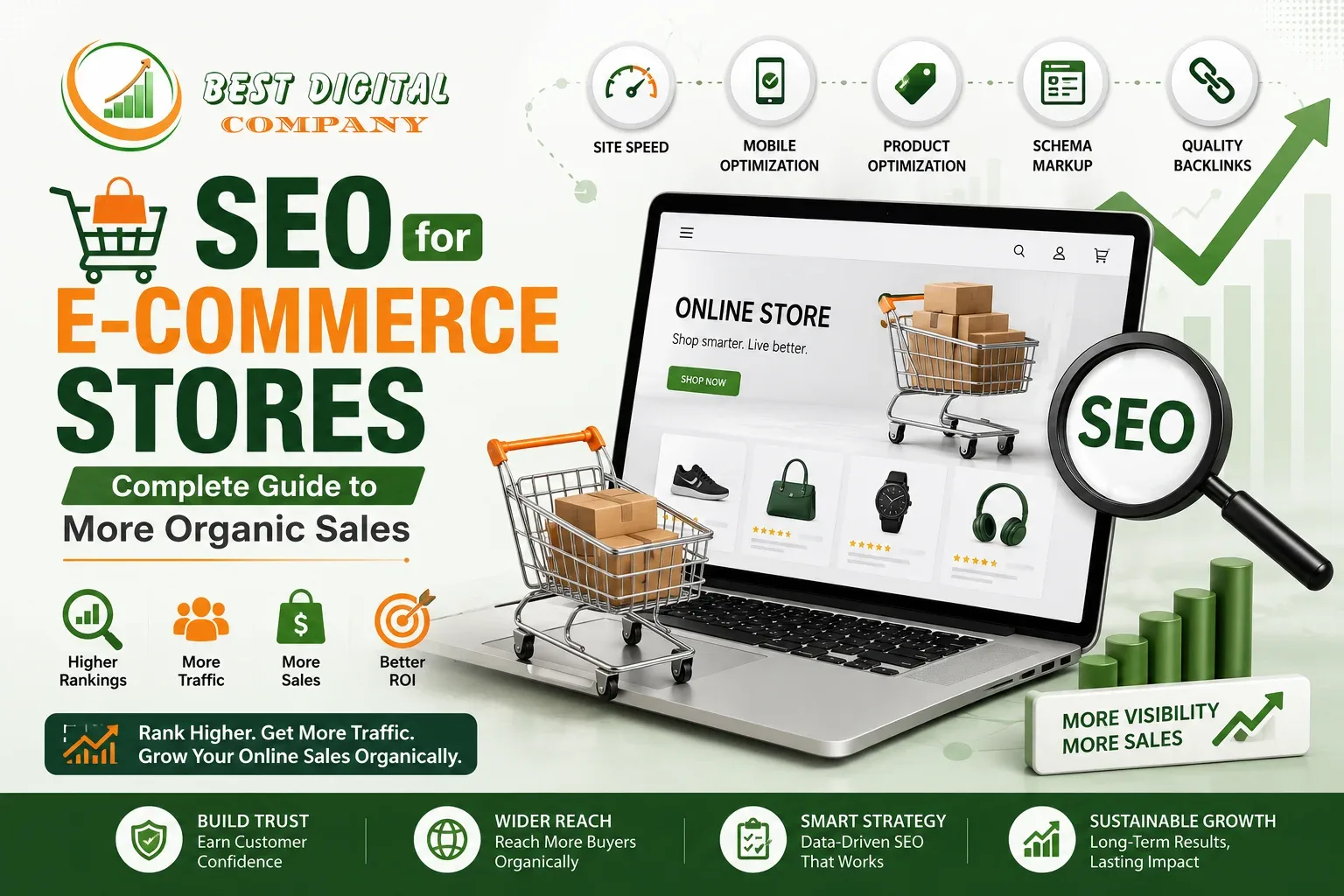
Most e-commerce owners we talk to have already tried paid ads, influencer shoutouts, and maybe a few discount campaigns to push sales. Very few have given organic search the attention it actually deserves. That’s surprising, because unlike ads, organic traffic doesn’t disappear the moment you pause spending. It compounds.
We’ve worked with enough online stores to notice a pattern: the ones struggling with sales almost never have a “marketing” problem first. They have a visibility and trust problem. Their product pages aren’t structured for search engines to understand, their category pages are thin, and their site sends mixed signals about what they actually sell. This guide walks through exactly what we fix when an e-commerce client comes to us asking why traffic isn’t converting into revenue.
Why E-commerce SEO Is Different From Regular Website SEO
A standard business website might have twenty or thirty pages. An online store can have thousands product pages, category pages, filtered views, out-of-stock pages, seasonal collections. That scale creates problems most service-based websites never deal with: duplicate content across similar products, thin pages with barely any unique text, and crawl budget getting wasted on pages that don’t matter.
This is also why generic SEO advice often falls flat for store owners. We touched on a related distinction in our article on website redesign vs SEO optimization . A store can look stunning and still be invisible to Google if the underlying structure wasn’t built with search in mind from the start.
Product Page Optimization: Where Most Stores Lose the Game
Your product page has one job: convince both a visitor and a search engine that this is the best answer to a shopper’s query. Most stores get halfway there.
- Unique product descriptions — Copying manufacturer descriptions word-for-word across hundreds of products is one of the fastest ways to get lost in duplicate content. Every product needs its own voice, even if it’s just two original paragraphs.
- Descriptive, keyword-aware titles — “Men’s Running Shoes – Black, Size 9” tells search engines more than “SKU-4471.”
- High-quality images with proper alt text — Image search drives meaningful e-commerce traffic that many stores ignore entirely.
- Customer reviews on-page — Reviews add fresh, original content automatically and strengthen trust signals.
- Schema markup for products — Price, availability, and rating data displayed directly helps your listings stand out and earns more clicks.
Category Pages: The Most Underrated Ranking Opportunity
Category pages tend to rank for broader, higher-volume searches than individual products, yet most stores treat them as nothing more than a grid of items. Adding a well-written introduction above the fold, a buying guide below the products, and internal links to relevant subcategories turns a forgettable page into a genuine ranking asset.
We see this exact gap when reviewing client sites. It mirrors what we discussed in our piece on building topical authority in SEO: a single strong, well-supported page consistently outperforms a dozen shallow ones competing for the same intent.
Technical SEO for Online Stores
E-commerce platforms come with their own technical quirks, and ignoring them quietly caps your growth.
- Site speed — Heavy product images and third-party scripts slow stores down constantly. Compress images and audit every plugin or app you’ve installed.
- Mobile experience — A majority of e-commerce traffic now happens on mobile. If checkout feels clunky on a phone, you’re losing sales before SEO even matters.
- Faceted navigation control — Filters (size, color, price) can generate thousands of near-duplicate URLs. Use canonical tags or noindex rules to stop them from confusing search engines.
- Out-of-stock page handling — Don’t delete these pages outright. Redirect to a similar product or keep them live with clear messaging, so you don’t lose the ranking equity they’ve already built.
- Sitemap accuracy — Make sure your sitemap updates automatically as products are added or removed.
If you’re setting up a brand-new store, much of this overlaps with our broader website launch SEO checklist .The same indexing and structural fundamentals apply, just at a larger scale.
Content Strategy: Why Blogs Still Drive Sales for Stores
A surprising number of store owners assume blogging is irrelevant to e-commerce. In practice, it’s one of the few channels that lets you capture shoppers earlier in their decision process before they’ve even chosen a specific product, while they’re still researching.
A skincare store writing about ingredient comparisons, or a furniture brand writing about choosing the right material for a humid climate, captures search intent that a product page simply can’t. Over time, this builds the kind of topical depth and trust that search engines reward, much like we explained when discussing generative engine optimization and how research-stage content increasingly shapes buying decisions before a purchase ever happens.
Local and Regional SEO for E-commerce Brands
Even purely online stores often have a regional concentration of buyers, warehouses, or supplier relationships worth highlighting. If your store ships predominantly to certain states or runs region-specific promotions, dedicated landing pages can capture that intent directly.
We’ve built this kind of regional targeting for clients through pages like SEO Services in Mumbai, and the same approach applies to e-commerce brands with strong regional demand. A store with a large customer base across Punjab benefits from the same logic we apply with our SEO Services in Punjab work language, local references, and delivery specifics tailored to that audience. Brands serving buyers across Haryana see similar gains from the structured approach we use in our SEO Services in Haryana campaigns, where local intent and store visibility are addressed together rather than as separate efforts.
Link Building and Trust Signals for Online Stores
Search engines treat e-commerce sites with a degree of extra scrutiny, particularly around trust, given how directly they’re tied to financial transactions. Building genuine authority matters more here than in most niches.
- Earn links from product review sites, niche bloggers, and industry publications rather than relying purely on directories.
- Display clear policies returns, shipping, privacy prominently, since their absence is a known trust red flag.
- Keep your “About Us” page genuinely informative, with real details about who runs the store.
This connects directly to the broader EEAT shift across search, something we unpacked in our guide on how to rank a new website on Google in 90 days ,trust signals now influence visibility nearly as much as keywords do.
Turning Traffic Into Actual Sales
Ranking well means nothing if your landing pages don’t convert that attention into purchases. Clear calls to action, visible shipping information, and a frictionless checkout process all determine whether organic visitors actually buy. We go deeper into this exact challenge in our article oncreating SEO landing pages that convert, which applies just as directly to product and category pages as it does to service pages.
Final Thoughts
E-commerce SEO isn’t a single tactic. It’s the sum of clean technical foundations, genuinely useful product and category pages, supporting content, and real trust signals working together. Stores that treat these as separate, occasional tasks tend to plateau. Stores that treat them as an ongoing system tend to keep growing organic sales quarter after quarter.
If you’d rather have specialists handle this end-to-end, our team at Best Digital Company works with e-commerce brands on exactly this kind of structured growth through our Search Engine Optimization services.
Frequently Asked Questions
How long does e-commerce SEO take to show results?
Most stores start seeing meaningful movement in three to six months, though this depends heavily on competition in your category and how much technical cleanup is needed upfront.
Should I write unique descriptions for every single product, even if I have thousands?
Prioritize your best-selling and highest-margin products first. Bulk manufacturer descriptions on low-priority items are less damaging than duplicate content on the products driving most of your revenue.
Do category pages really need written content, or just products?
Yes. A short, genuinely useful introduction and buying guidance gives search engines context that a product grid alone can’t provide, and it often becomes the page that ranks for broader searches.
Is paid advertising still necessary if my organic SEO is strong?
They serve different purposes. Paid ads deliver immediate, scalable traffic, while organic SEO builds a durable asset that keeps generating sales without ongoing spend. Most successful stores use both together.
What should I do with out-of-stock product pages?
Avoid deleting them. Redirect shoppers to a similar in-stock product or keep the page live with clear stock status, since the page may already hold ranking value worth preserving.
Does site speed really affect e-commerce sales that much?
Significantly. Slow-loading product pages increase bounce rates and directly hurt both conversions and how search engines evaluate the page’s quality.

Add a Comment