

Let’s be real for a second. The days of writing one good article and hoping it ranks are long gone. Google’s systems in 2026 are far more sophisticated than they were even two years ago. They don’t just look at a single page anymore. They look at your entire website and ask one fundamental question: Does this site genuinely know what it’s talking about?
That’s topical authority in a nutshell. And if you don’t have it, you’re fighting an uphill battle against websites that do.
We’ve spent years helping businesses across India build lasting digital presence through smart, structured SEO strategies. What we’ve seen, time and again, is that the brands that win in search aren’t the ones with the most backlinks or the flashiest websites. They’re the ones who’ve built deep, trusted expertise on their topic cluster and made sure Google knows it.
This guide walks you through exactly how to do that in 2026.
What Is Topical Authority and Why Does It Matter in 2026?
Topical authority is Google’s way of measuring how comprehensively and reliably a website covers a particular subject area. It’s not just about having one great article. it’s about owning the entire conversation around a topic.
Think of it like this. If someone asked you about heart surgery, you’d trust a cardiologist over a general physician, right? Google thinks the same way. A website that has covered every angle of a subject- beginner guides, advanced strategies, case studies, FAQs, comparisons tells Google: this is the expert on this topic.
In 2026, three forces make topical authority more critical than ever:
AI Overviews in Google are pulling answers directly from sites that demonstrate deep, consistent expertise not just individual pages that match a query.
Google’s Helpful Content System has evolved to reward experience-backed, comprehensive content while penalising thin or repetitive material.
Zero-click searches mean your brand needs to be the recognised authority so users seek you out directly not just stumble upon you. We covered zero-click marketing strategies in detail in a separate post if you haven’t read it yet, it’s worth your time.
The Difference Between Topical Authority and Domain Authority
This is a question we get asked constantly, so let’s settle it clearly.
Domain Authority (DA) is a third-party metric that estimates the overall strength of your website based largely on backlinks. It’s a useful proxy, but it’s not what Google actually uses as a direct ranking signal.
Topical Authority is about content depth and relevance within a specific niche. A brand new website about one narrow topic say, industrial solar panels for factories can outrank a high-DA generalist site if it covers that topic more thoroughly and expertly.
In practical terms: you can have a DA of 70 and still lose rankings to a DA-30 site that has built genuine topical depth. We’ve seen it happen repeatedly with our clients.
Understanding Topic Clusters: The Foundation of Topical Authority
If topical authority is the destination, topic clusters are the road you build to get there.
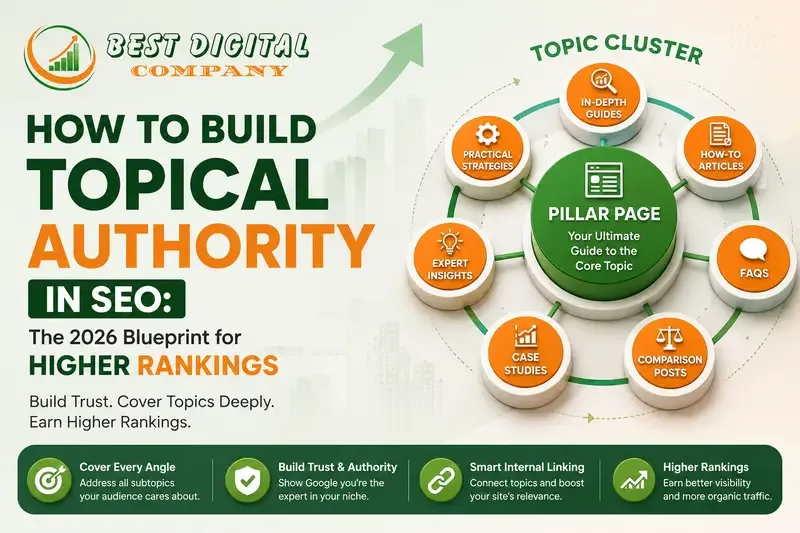
A topic cluster consists of:
One Pillar Page — a comprehensive, long-form piece that covers a broad topic at a high level. This becomes the authority hub.
Multiple Cluster Pages — individual posts that go deep on specific subtopics related to the pillar.
Internal Links — connecting every cluster page back to the pillar and to each other, passing authority and helping Google understand the structure.
Here’s a simple example. If your pillar page is about SEO Services, your cluster pages might cover:
How on-page SEO works What is technical SEO and why it matters How to build backlinks ethically Local SEO vs national SEO: which does your business need? How to measure SEO success with the right metrics
Each cluster page links back to the pillar.The pillar links out to each cluster. Google crawls this web of content and sees a site that has genuinely mastered this subject area.
This is also why internal linking is so powerful. It’s not just a technical SEO trick. It’s how you show Google the shape of your expertise. Read our full guide: Why Your SEO Is Failing: The Power of Internal Linking Explained
Step-by-Step: How to Build Topical Authority in 2026
Step 1 – Choose Your Core Topic With Intent
Before writing a single word, you need to define your territory. What does your business genuinely know better than anyone else?
For a digital marketing agency, the core topic might be SEO Services. For a local business, it might be very specific like plumbing repairs in your city. The narrower and more specific you can go while still having enough to say, the faster you’ll build authority.
Ask yourself: What topics does my business serve day in and day out? What questions do my actual customers ask me that I can answer better than a generic website? What subtopics exist within this space that haven’t been covered well online?
Step 2 – Map Out Every Subtopic Your Audience Needs
Once you’ve chosen your core topic, map every subtopic that exists within it. Use tools like Google’s People Also Ask, your own customer conversations, and competitor analysis.
Organise these into three categories:
Awareness topics for people who are just learning (e.g., “What is SEO?”) Consideration topics for people comparing options (e.g., “SEO vs PPC: which is better?”) Decision topics for people ready to act (e.g., “How to choose the right SEO agency”)
This maps directly to search intent which Google is increasingly using to match content to queries. If you cover all three layers, you’re speaking to your audience at every stage of their journey.
Step 3 – Create Your Pillar Page First
The pillar page is your home base. It should:
Be long-form and comprehensive (typically 3,000–5,000+ words) Cover the topic broadly but with enough depth to be genuinely useful Link out to all your cluster content Be written with clear expertise not just a list of facts, but real perspective
Your pillar page is also the place to showcase Experience, Expertise, Authoritativeness, and Trust (E-E-A-T). Include author credentials, real-world examples, specific data, and original insights. Generic content won’t cut it.
Step 4 – Write Cluster Content That Goes Deep
Each cluster post should fully answer one specific question or subtopic. Don’t try to cover too much in a single post. The magic of the cluster model is that each piece is focused and thorough and together they create a complete picture.
Every cluster post should:
Target one specific, well-researched keyword or question Include practical, actionable information not just theory Draw on real experience or case studies wherever possible Link back to the pillar page and to 2–3 related cluster posts
For example, our post on why your website isn’t generating leads is a cluster post that feeds into a broader understanding of digital marketing strategy. It’s specific enough to be deeply useful and connected enough to build authority.
Step 5 – Use Internal Linking as Your Structural Backbone
Internal links are what tie your topic cluster together. They serve two purposes: they help users navigate deeper into your content, and they help search engines understand the hierarchy and relationship between your pages.
Best practices for internal linking within a topic cluster:
Every cluster post links back to the pillar page The pillar page links to every cluster post Related cluster posts link to each other when genuinely useful Use descriptive, keyword-rich anchor text not just “click here”
If you want to understand the mechanics in detail, our guide on the power of internal linking breaks this down with practical examples.
Step 6 – Optimise for E-E-A-T Across Every Piece
Google’s quality evaluators use E-E-A-T – Experience, Expertise, Authoritativeness, and Trustworthiness as the lens through which they assess content quality. In 2026, with AI-generated content flooding the web, Google has doubled down on rewarding content that comes from real human experience.
Here’s how to demonstrate E-E-A-T practically:
Experience: Include first-hand examples, client stories, and what you’ve personally seen work and not work Expertise: Show credentials, qualifications, or professional background especially in the author bio Authoritativeness: Earn mentions and links from recognised publications and industry voices Trustworthiness: Be transparent about who you are, cite credible sources, keep content accurate and updated
Writing that sounds like it was typed by a human who genuinely understands the topic with opinions, nuances, and real context is what separates content that ranks from content that disappears.
SEO Services in Mumbai: Building Topical Authority in a Hyper-Competitive Market
Mumbai is one of India’s most competitive digital markets. Whether you’re in finance, retail, hospitality, or healthcare, the online competition is fierce. Businesses that invest in structured SEO Services in Mumbai and pair them with a genuine topical authority strategy are the ones breaking through the noise.
What works particularly well for Mumbai-based businesses is hyper-local topical clustering. Rather than trying to compete nationally on broad keywords from day one, start by becoming the definitive resource for your industry in Mumbai. Cover every question your local customers ask. Build pages that speak directly to the Mumbai market – local trends, local competition, local customer behaviour.
Once you own your city, expanding to national authority becomes a far smoother journey.
SEO Services in Punjab: How Regional Businesses Can Win With Content Depth
Punjab has seen extraordinary growth in its digital economy over the past three years. Businesses across Ludhiana, Amritsar, Jalandhar, and Chandigarh are increasingly investing in digital presence and the ones seeing the best results are those who’ve committed to content depth over time. Our SEO Services in Punjab are designed specifically for businesses in this market.
The challenge for most Punjab-based businesses is that they try to compete on the same generic keywords as national brands and lose. The smarter approach is to build topical authority around the intersection of your industry and your region.
A logistics company in Ludhiana, for example, could build an entire topic cluster around supply chain and freight management in North India with content covering local routes, regulatory requirements, cold chain logistics specific to Punjab’s agriculture sector, and seasonal demand patterns. That level of specificity is something a national brand simply cannot replicate.
SEO Services in Haryana: Turning Local Expertise Into Search Authority
Haryana’s business landscape is evolving rapidly, with significant industrial growth in Gurugram, Faridabad, Panipat, and Sonipat. Businesses here are waking up to the fact that ranking on Google isn’t about luck. it’s about strategy. Smart investment in SEO Services in Haryana combined with a well-structured topical authority approach can give regional businesses a meaningful edge over national players who aren’t addressing local needs.
The key insight for Haryana businesses: your real-world expertise is your biggest asset. The things you know about operating in this specific market seasonal factors, local regulations, customer preferences, regional competition that’s content that national websites can’t produce authentically. Document it. Publish it. Own it.
Common Mistakes That Undermine Topical Authority
We’ve worked with hundreds of businesses on their SEO strategies, and we see the same mistakes again and again.
Publishing Without a Plan
Random, disconnected blog posts don’t build topical authority. If your content calendar is just “write about whatever’s trending this week”, you’re not building a cluster you’re building a pile. Every piece of content needs a clear home in your topic structure.
Covering Topics Superficially
Thin content 400-word posts that barely scratch the surface actively hurts you in 2026. Google’s Helpful Content System is getting better at identifying content that covers a topic without truly addressing user needs. If your post on “What is backlink building?” can be bettered by a five-minute Wikipedia read, it’s not adding value.
Ignoring Existing Content
Most businesses already have content sitting on their site that could be reorganised into clusters. Before creating new content, audit what you have. A post that’s half-done on a relevant topic can often be expanded into a proper cluster page rather than starting from scratch.
Skipping the Technical Foundation
Topical authority is built on content, but it’s supported by solid technical SEO. If your site is slow to load, broken on mobile, or hard for crawlers to navigate, your cluster strategy will underperform. Our post on why mobile-friendly websites rank higher covers the essentials of what Google looks for technically.
Not Updating Content Over Time
Topical authority isn’t a set-and-forget exercise. Google rewards freshness and accuracy. Set up a schedule to review your pillar and cluster pages at least once a year updating data, expanding sections that have grown in importance, and removing anything that’s become outdated.
How Topical Authority Connects to AI Search and Generative Answers
This is where things get really interesting in 2026. If you’ve noticed that Google is now showing AI-generated summaries at the top of many results pages, you’re seeing the new frontier that topical authority directly feeds into.
AI Overviews pull information from sources that Google trusts as authoritative on a topic. If you’ve built genuine topical depth, you’re far more likely to be cited in these AI summaries which means visibility even when users don’t click through. We wrote about this in detail in our blog on how to rank in ChatGPT, Gemini and AI search results.
Similarly, our post on Generative Engine Optimization covers how to specifically optimise your content to be referenced by AI systems a strategy that works hand-in-hand with building topical authority.
The brands that win in AI-powered search aren’t the ones trying to game the system. They’re the ones who’ve become genuinely trustworthy resources on their topic which is exactly what the topical authority model is designed to create.
Topical Authority Checklist: Where Does Your Site Stand?
Use this as a quick self-assessment:
Do you have a defined primary topic that your site is focused on? Have you mapped the subtopics within your niche that your audience searches for? Do you have pillar pages for your core topics? Do you have cluster content covering each major subtopic? Are your pages interlinked in a logical, structured way? Does your content reflect genuine first-hand experience and expertise? Is your author information and E-E-A-T visible on your pages? Do you update your content regularly? Is your site technically sound mobile-friendly, fast, crawlable? Are you tracking which content is driving traffic and engagement?
If you answered “no” to more than three of these, there’s significant topical authority work to be done and it’s worth starting now rather than later.
How Professional SEO Services Accelerate Topical Authority
Building topical authority takes time but it takes far less time when it’s done with a proper strategy from the start. Most businesses that try to do this on their own spend months creating content that doesn’t connect, doesn’t rank, and doesn’t build the clusters they need.
Working with experienced SEO professionals means you start with a clear map, not a blank page. You know exactly which pillar pages to build, which cluster posts to prioritise, which keywords to target at each stage, and how to structure your internal linking so that Google sees the full picture of your expertise from day one.
Beyond content strategy, there’s the technical side making sure your website development and architecture supports crawling, indexing, and link equity flow properly. And complementary channels like social media marketing can amplify your content’s reach, bringing in the engagement signals that further reinforce your authority.
If you want to understand what professional SEO actually costs and what you should expect for your investment, our post on SEO pricing in India for 2026 gives you a clear, honest breakdown.
Frequently Asked Questions About Topical Authority in SEO
How long does it take to build topical authority?
There’s no fixed timeline, but most businesses start seeing meaningful movement within 4–8 months of consistently publishing well-structured cluster content. Full topical authority in a competitive niche typically takes 12–18 months of sustained effort. The good news: once you’ve built it, it’s very difficult for competitors to displace you quickly.
Do I need a large website to build topical authority?
Not at all. A focused website with 30 tightly structured, high-quality pages on a specific topic will outperform a 300-page site that covers everything loosely. Quality, structure, and coherence matter far more than sheer volume. Start small and go deep, then expand.
Is topical authority the same as being ranked number one?
Topical authority increases your likelihood of ranking highly across many related queries — not just one. The goal isn’t a single number-one ranking; it’s consistent, broad visibility across your entire subject area. When Google trusts you as an authority, a single strong piece of content can lift rankings for dozens of related pages.
Can topical authority be built through off-page SEO as well?
Absolutely. Backlinks from reputable publications in your industry signal to Google that external sources consider you an authority on your topic. Guest posts, expert quotes, PR coverage, and community engagement all contribute to the authority side of the equation. But these work best when your on-site content structure is already solid external signals amplify what’s already there.
What’s the role of keyword research in building topical authority?
Keyword research is the starting point for mapping your topic cluster. You’re not just looking for high-volume keywords. you’re looking for the full universe of questions, concerns, and searches that exist within your topic area. Tools like Google Search Console, Google’s auto-suggest, and People Also Ask sections are gold for this. Long-tail keywords, in particular, are often the entry points that build authority before you can compete on the broader terms.
How does topical authority help with AI-generated search results?
AI systems whether Google’s AI Overviews, ChatGPT search, or Gemini tend to cite and reference sources that have demonstrated consistent, deep coverage of a topic. If you’ve built genuine topical authority, you’re more likely to be included in the sources these systems draw from when answering user questions. This is why topical authority and the emerging field of Generative Engine Optimisation (GEO) are closely related.
Do I need to publish new content every day to maintain topical authority?
No and please don’t publish every day just for the sake of it. Consistency matters more than frequency. Publishing two or three genuinely excellent, well-researched pieces per month is far more effective than churning out daily content that adds little value. Your existing content also benefits from regular updates, which counts as fresh activity in the eyes of search algorithms.
What industries benefit most from topical authority?
Almost every industry benefits, but topical authority is particularly powerful for B2B services, professional services (legal, financial, medical, marketing), e-commerce with complex product categories, and local services where demonstrating expertise can be a genuine trust signal for prospective customers. If your customers need to trust you before they buy, topical authority accelerates that trust.
Final Thoughts: Authority Is Earned, Not Hacked
We say this to every client who comes to us looking for a quick fix: there is no shortcut to genuine authority. The websites that rank consistently and resist algorithm changes are the ones that have put in the work to truly cover their subject area not the ones that found a loophole.
The good news is that building topical authority is a strategy that compounds over time. Every piece of content you publish, every internal link you create, every cluster page you develop makes the entire site stronger. You’re not just optimising individual pages you’re building an asset.
If you’re ready to start building that kind of lasting, sustainable search presence for your business whether you’re in Delhi, Mumbai, Punjab, Haryana, or anywhere else in India .we’d love to talk. Get in touch with Best Digital Company and let’s build something that actually lasts.
Explore our SEO Packages or learn more about our Search Engine Optimization services.
Related reading: Google Algorithm Updates 2026 —AI Search Optimization in 2026 —Website Redesign vs SEO Optimization .

Add a Comment