

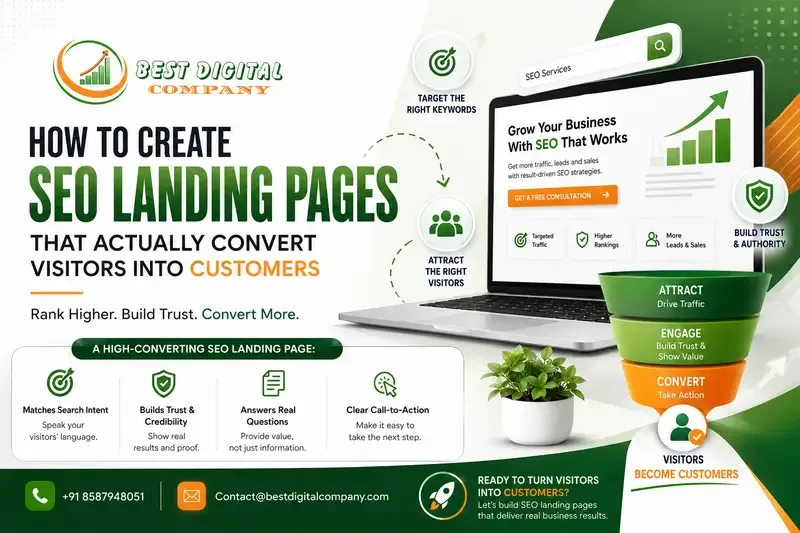
Most businesses get traffic. Very few get customers from that traffic. If you have ever checked your analytics and seen healthy numbers of visitors but a contact form that barely gets touched, the problem usually isn’t your traffic. It’s your landing page.
A landing page that ranks well but doesn’t convert is, frankly, a wasted opportunity. You did the hard part, getting someone to click, and then lost them at the finish line. This guide walks through how to build landing pages that do both jobs at once: rank on Google and turn a visitor into an actual lead or sale.
Why Most Landing Pages Rank But Don’t Convert
Here’s something we see constantly when auditing client websites. A page targets the right keyword, has decent backlinks, and still sits on page one with almost no conversions. Why does this happen?
Usually it comes down to a mismatch between what the visitor expected when they clicked and what they found on the page. Someone searching for a specific service has a specific intent. If your landing page talks generally about your company instead of directly addressing that intent within the first few seconds, the visitor bounces. Google notices that bounce, and your rankings eventually suffer too. Conversion and ranking are not separate goals, they feed each other.
There’s also the trust problem. A landing page with no client proof, no clear contact information, no real explanation of how the service works, and no sense of who is behind the business will struggle to convert no matter how good the design looks. We covered this trust gap in detail in our piece on why visitors leave a website without contacting the business, and the same principles apply directly to landing pages.
Start With One Clear Goal Per Page
A landing page trying to sell three services at once usually sells none of them well. Before writing a single word, decide what one action you want the visitor to take. Request a quote. Book a call. Download a guide. Everything on the page should push toward that single action.
This is different from a homepage, which has to serve many purposes for many types of visitors. A landing page is narrow by design. If you are running SEO Services in Mumbai, your Mumbai landing page should speak only to a Mumbai business owner’s specific concerns, not generic marketing language that could apply to anyone, anywhere.
Match the Headline to Search Intent, Not Just Keywords
A headline stuffed with keywords but written for a search engine, not a person, is one of the fastest ways to lose a visitor in under five seconds. Your headline needs to do two things simultaneously: include the term people are actually searching for, and confirm to a real human that they landed in the right place.
For example, a headline like “Digital Marketing Solutions” tells the visitor almost nothing. A headline like “Get More Local Customers With SEO Services in Haryana” tells them exactly what they get and where it applies. The second version reads naturally, matches intent, and still carries the keyword weight you need.
This is also where local specificity pays off. If you serve multiple regions, build a dedicated page for each rather than one generic page trying to rank everywhere. We have separate pages built this way for SEO Services in Punjab and SEO Services in Haryana, each speaking to the specific market instead of a one-size-fits-all pitch.
Write Content That Answers Real Questions, Not Filler
Google’s systems have gotten noticeably better at telling the difference between a page written to genuinely help someone and a page written to hit a word count. Thin, repetitive paragraphs that restate the same idea five different ways don’t fool anyone anymore, human or algorithm.
The fix is straightforward, even if it takes more effort. Write the page the way you would explain the service to a customer sitting across from you. What problem are they dealing with? What have they probably already tried that didn’t work? What makes your approach different? Address these honestly, with specifics, not vague promises like “best results guaranteed.”
This connects directly to a topic we explored in how to build topical authority in SEO, where depth and genuine expertise on a subject matter far more than surface-level keyword coverage. A landing page benefits from the same depth, scaled down to the specific service and audience it’s targeting.
Build Trust Signals Into the Page Itself
Trust is not a “nice to have” section at the bottom of the page. It needs to be woven throughout. A few elements that consistently move the needle:
- Real client names, logos, or case studies rather than vague testimonials
- A visible phone number and email, not buried behind a contact form
- Clear information about who runs the business and where it’s based
- Specific numbers and results instead of generic claims
This is essentially Google’s E-E-A-T idea (experience, expertise, authority, trust) applied at the page level. A landing page that demonstrates real experience with a service, written by people who clearly understand the subject, will outperform a generic template page even if both target the same keyword.
Use a Layout That Guides, Not Overwhelms
Visual structure matters as much as the words on the page. A wall of text with no breathing room loses people fast, no matter how good the writing is. Break the page into clear sections: a strong opening statement, the problem you solve, how your process works, proof of results, and a final call to action.
Keep the call-to-action visible without forcing it on every scroll. One clear button repeated naturally at logical points, top, middle, end, works better than aggressive pop-ups interrupting the reading experience. If a visitor has to hunt for how to contact you, you’ve already lost them.
Optimize for Speed and Mobile Without Sacrificing Substance
A beautifully written landing page that takes eight seconds to load on a phone will lose the majority of its visitors before they read a single line. Speed and mobile usability aren’t separate from content quality at this point, they’re part of the same conversion equation.
Compress images, avoid unnecessary heavy scripts, and test the page on an actual phone, not just a desktop browser. This ties closely into the broader question we addressed in website redesign versus SEO optimization: a slow or clunky page undermines every other effort you’ve made, including the SEO work getting people there in the first place.
Test, Measure, and Refine Continuously
A landing page is never really “finished.” The first version is a starting point, not a final product. Track where visitors drop off, which sections they actually read, and which version of your headline or call-to-action performs better.
Small changes often produce outsized results. Moving a contact form higher on the page, changing one line of headline copy, or adding a single client testimonial near the top can shift conversion rates meaningfully. The businesses that treat their landing pages as a living, improving asset consistently outperform those that build once and walk away.
Local Relevance Still Wins
One pattern shows up again and again across regions: businesses that build landing pages tailored to their actual local market consistently outperform those running one generic national page. A business offering SEO Services in Mumbai needs language, examples, and proof points that feel relevant to Mumbai’s competitive landscape, not borrowed copy that could describe any city.
The same applies whether you’re building out a presence for SEO Services in Punjab or SEO Services in Haryana. Local intent searches carry strong purchase signals, and a landing page that speaks directly to that local context tends to convert noticeably better than a generic equivalent.
Final Thoughts
A landing page that converts isn’t about clever tricks or aggressive sales language. It’s about clarity, honesty, and respecting the visitor’s time. Tell them clearly what you do, prove you can be trusted, make the next step obvious, and keep the experience fast and easy on any device.
Ranking gets someone to your door. Conversion is what happens once they’re standing in it. Get both right, and your landing pages stop being a cost center and start being one of your strongest sources of actual business.
Frequently Asked Questions
What’s the difference between a landing page and a regular website page?
A landing page is built around one specific goal and one specific audience, usually tied to a single service, campaign, or location. A regular website page, like a homepage or services page, serves a broader purpose and audience. Landing pages convert better precisely because they’re narrow and focused.
How long should an SEO landing page be?
There’s no fixed word count that guarantees success. The right length is whatever it takes to clearly explain the offer, address the visitor’s concerns, and build enough trust to act, without padding the page with repetitive filler just to hit a number.
Can one landing page target multiple locations?
It’s possible but rarely effective. A page trying to rank for several cities at once usually ends up too generic to perform well for any of them. Dedicated pages for each location, written with real local context, consistently perform better in both rankings and conversions.
How often should a landing page be updated?
Treat it as ongoing work rather than a one-time project. Review performance data every few months, update outdated statistics or testimonials, and refine the headline or call-to-action based on what visitor behavior is telling you.
Does page design really affect conversions, or is it mostly the content?
Both matter, and they work together. Strong content with a cluttered, slow, or confusing layout still loses visitors. Clean design with weak or vague content fails just as easily. The pages that convert well get both pieces right at the same time.
Why does my landing page rank well but still get few inquiries?
This usually points to a gap between search intent and what the page delivers, or a lack of trust signals once the visitor arrives. Reviewing the page against what a first-time visitor actually needs to see before taking action is the fastest way to find the gap.

Add a Comment