

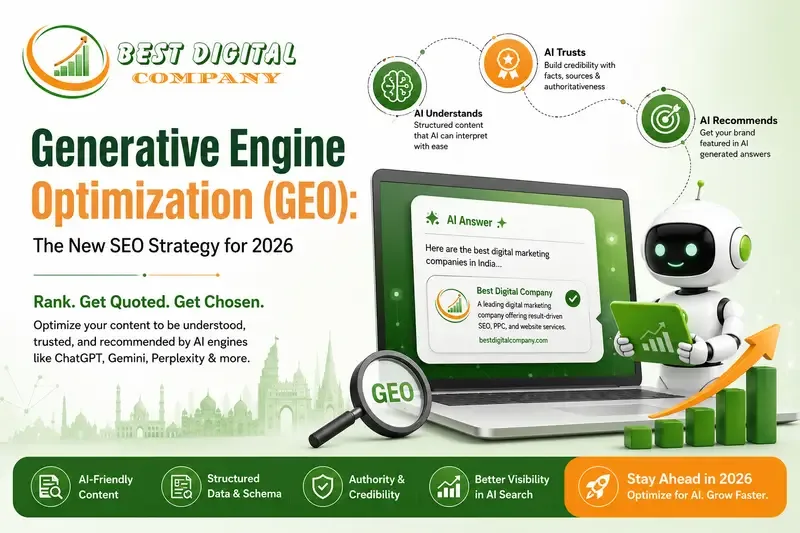
A few months ago, one of our long-term clients called us with a strange complaint. Their website traffic from Google had dropped, but their phone was ringing more than ever. New customers kept saying the same thing: “ChatGPT told me about you” or “Gemini recommended your service.” That conversation is the clearest proof we have seen that the rules of online visibility have changed. Ranking on a results page is no longer the only goal. Being the answer an AI engine gives someone is the new finish line, and that finish line has a name: Generative Engine Optimization, or GEO.
If you run a business and have spent years investing in search engine optimization, this shift can feel unsettling. The good news is that GEO does not replace everything you have built. It builds on top of it. This guide breaks down what GEO actually means, why 2026 is the year it stopped being optional, and how a business whether you run an SEO services in Mumbai operation, an SEO services in Punjab business, or an SEO services in Haryana company can adapt without starting from zero.
What Generative Engine Optimization Actually Means
Generative Engine Optimization is the practice of structuring your website content so that AI systems like ChatGPT, Google’s AI Overviews, Gemini, Perplexity, and Claude can read it, understand it, and choose to use it when answering someone’s question. Traditional search engine optimization was built around one outcome: getting a blue link in front of someone so they click through to your site. GEO focuses on a different goal entirely getting your content selected, synthesized, and cited by AI systems when they generate answers to user questions.
Put simply, classic SEO got you ranked. GEO gets you quoted.
This is not a small distinction. When someone searches “best digital marketing company near me” the old way, they see ten listings and make their own choice. When that same person asks an AI assistant the same question, the assistant picks two or three sources, blends them into one answer, and hands the user a recommendation. If your business is not one of the sources the AI trusts, you are invisible in that conversation, even if your website is technically well optimized for Google.
We have already explored this shift from a few angles on our blog, including how brands can rank in ChatGPT, Gemini, and AI search results, and what AI search optimization in 2026 demands from a technical standpoint. GEO ties both of those ideas together into one coherent strategy.
Why GEO Matters More in 2026 Than It Did a Year Ago
The numbers behind this shift are hard to ignore. ChatGPT now has more than 800 million weekly users, Perplexity handles roughly 780 million monthly queries, and Google’s AI Overviews now appear in a large share of search results. Industry researchers tracking this transition have noted that AI-referred website sessions jumped 527% year-over-year in just the first five months of 2025, which tells you this is not a future trend. It is already happening in real time, inside the same browsers and apps your customers use every day.
What makes this period especially important is the overlap problem. Research from AI visibility firms has found that the overlap between top Google results and the sources AI systems actually choose to cite has dropped from around 70% to below 20%. That means ranking well on Google no longer guarantees that an AI engine will mention you at all. The two systems are starting to reward different things, and a business that only optimizes for one is leaving the other half of its potential audience untouched.
This is exactly the gap we addressed in our earlier post on zero-click marketing in 2026 more people are getting answers without ever clicking through to a website, and businesses need a plan for being part of that answer rather than competing for a click that may never come.
How GEO Is Different From Traditional SEO
It helps to think of traditional SEO and GEO as two related but separate disciplines rather than one replacing the other.
Traditional SEO is built around keywords, backlinks, page speed, and technical structure designed to satisfy a crawler and a ranking algorithm. The end goal is a position on a results page. The fundamental unit of success in classic SEO is the click a user sees a listing, clicks through, and potentially converts.
GEO works differently because the “reader” is no longer just a human scrolling a page. It is a language model trying to extract a clear, trustworthy answer in seconds. Generative engines parse meaning rather than keywords, so content built for GEO needs to be structured around clearly defined entities, claims, and relationships, using elements like structured markup, well-organized headings, explicit definitions, FAQ sections, and comparison tables. The aim shifts from being ranked to being quotable.
This also changes what counts as good content. A page that simply claims to be “a market leader” gives an AI system nothing it can use, while a page built around a specific, sourced, and verifiable claim gives the system exactly the kind of detail it needs to cite confidently. That single idea specificity over vague claims is the difference between content that gets quoted by AI tools and content that gets ignored by them.
If your team is still relying on outdated keyword-stuffing habits, it is worth revisiting our breakdown of common SEO and digital marketing mistakes in 2026, since many of those same habits actively work against GEO.
The Building Blocks of a Working GEO Strategy
A strong GEO approach is not one trick. It is a handful of fundamentals applied consistently across a website.
Structure your content around clear, extractable answers. Every important page should answer its core question directly within the first few lines, then expand with supporting detail. AI systems tend to pull the most direct, well-formed sentence from a page, so burying your answer under three paragraphs of introduction works against you.
Back up claims with specific, original data. General statements about being “trusted” or “experienced” do not give an AI model anything to cite. Numbers, dates, percentages, and named outcomes do. Strategies that work well in 2026 include answering questions directly, including original data, building author authority, earning third-party citations, and publishing consistently.
Use schema markup and clean technical structure. Best practice for 2026 includes implementing schema markup for FAQs and reviews, using clear heading hierarchies with one topic per section, ensuring content is server-side rendered rather than hidden behind JavaScript, and confirming nothing important is locked behind logins or paywalls. It is also worth checking that AI crawlers are not accidentally blocked through your robots file or CDN settings.
Build genuine topical authority. AI systems, much like search engines, tend to trust sites that demonstrate consistent depth on a subject rather than scattered, one-off posts. This is one of the reasons location-specific expertise pages matter so much for local businesses a dedicated page on SEO services in Mumbai signals real, specific authority on that market, rather than a generic national claim stretched across every city.
Maintain editorial consistency across your site. This is where Experience, Expertise, Authoritativeness, and Trust, commonly known as EEAT, becomes central. AI tools weigh whether content reflects first-hand experience and a credible author, not just polished writing. A blog post written by someone with a named author byline, supported by services pages with consistent contact details and a verifiable business address, carries more weight than anonymous, generic content.
Where Local SEO Still Fits Into the GEO Conversation
A common misconception is that GEO replaces local SEO. It does not. If anything, location-specific expertise has become more valuable, because AI systems still rely heavily on local relevance signals when someone asks a location-based question like “who offers the best SEO services in Punjab” or “which agency handles SEO services in Haryana.”
For a business serving multiple regions, this means your location pages cannot be thin, duplicated templates. Each one needs distinct, locally relevant detail: client examples from that market, region-specific challenges, and language that reflects how businesses in that area actually search and ask questions. A well-built SEO services in Mumbai page should read differently from a Punjab or Haryana page, not just swap the city name in an otherwise identical paragraph. AI systems are increasingly good at detecting templated, repeated content, and so is Google, which means duplication hurts you twice over.
This same principle came up in our earlier post on why businesses across Delhi, Mumbai, and Punjab struggle to convert website visitors into leads the issue was rarely a lack of traffic, and almost always a lack of clear, locally specific trust signals on the page itself.
Practical Steps to Start Optimizing for Generative Engines Today
You do not need to rebuild your entire website to begin adapting. A focused, staged approach works better than trying to fix everything at once.
Start by auditing your most important pages your homepage, your core service pages, and your highest-traffic blog posts and ask whether a stranger reading only the first two sentences would understand exactly what you offer and why it is credible. If the answer requires scrolling, that page needs restructuring.
Next, add an FAQ section to key pages using direct, conversational questions that match how people actually ask AI assistants for help. This is precisely why a section like the one below matters: it is not filler, it is structured for exactly how generative engines retrieve and cite answers.
Then, review your author and company information. Make sure blog posts carry a real author name, your contact details are consistent across every page, and your business information matches across your website, your Google Business listing, and any directories you appear in. Keyword stuffing is explicitly something to avoid AI systems are built to recognize and discount it, just as modern search algorithms do.
Finally, treat this as an ongoing discipline rather than a one-time project. Citation authority compounds over time in much the same way domain authority did for traditional SEO, and most brands in most industries have not started this work yet, which means the businesses that invest now are the ones AI systems will be citing well into 2027 and 2028.
If you are unsure where your own pages currently stand, our team at Best Digital Company offers a structured way to evaluate this. Our search engine optimization services now fold GEO readiness into every audit we run, alongside the technical and content fundamentals that have always mattered for ranking well.
Bringing SEO and GEO Together Instead of Choosing One
The businesses that will struggle most over the next few years are the ones treating this as an either-or decision. SEO focuses on what a search engine’s crawler sees, while GEO focuses on what an AI model understands, trusts, and chooses to cite and the most effective strategies in 2026 integrate both rather than picking a side. A page with strong technical SEO and weak factual clarity will still struggle to get cited by AI tools. A page with brilliant, quotable content but broken technical fundamentals will struggle to rank at all. You need both working together.
This is also why we encourage clients to think of GEO as an extension of good content practice rather than a separate technical skill to bolt on. The core tactics behind GEO answering questions directly, building real author authority, and publishing consistently overlap heavily with what makes content genuinely useful to a human reader in the first place. Optimizing for AI engines and writing content people actually trust are, increasingly, the same job.
Whether your business operates out of Delhi, supports SEO services in Mumbai, manages SEO services in Punjab, or runs SEO services in Haryana, the underlying principle does not change by geography. Clear, specific, well-structured, and genuinely authoritative content wins in both search results and AI-generated answers. The businesses that adapt their content strategy now, rather than waiting for AI search to become unavoidable, are the ones that will still be visible and getting recommended three years from now.
Frequently Asked Questions
What is Generative Engine Optimization in simple terms?
Generative Engine Optimization is the practice of writing and structuring website content so that AI tools such as ChatGPT, Gemini, and Google’s AI Overviews can understand it clearly enough to use it when answering a user’s question. Instead of aiming for a high position on a results page, the goal is to be the source an AI system trusts and quotes.
Is GEO replacing traditional SEO completely?
No. GEO works alongside SEO rather than replacing it. Search engines still rank pages based on technical health, relevance, and authority, and a large share of website traffic still comes from traditional search. GEO simply adds a second layer of optimization aimed at how AI systems retrieve and cite information, since many user journeys now start with an AI assistant instead of a search bar.
How is GEO different from Answer Engine Optimization (AEO)?
The two terms are closely related and often used together. GEO generally refers to the broader practice of optimizing for generative AI platforms, while AEO is sometimes used to describe optimizing specifically for direct, single-answer responses. In practical terms, the techniques largely overlap: clear structure, direct answers, and verifiable claims benefit both.
Does my business need GEO if most of my customers are local?
Yes. Local searches are increasingly handled by AI assistants too, especially through voice search and conversational queries like “who provides good SEO services in Mumbai” or “best agency for SEO services in Haryana near me.” Local businesses that build clear, specific, region-focused content are well positioned to be cited in these AI-generated local recommendations.
How long does it take to see results from a GEO strategy?
There is no fixed timeline, but most businesses begin noticing early signals, such as appearing in AI-generated summaries or being mentioned by name in chatbot responses, within a few months of consistent work. Because citation authority builds over time, similar to how domain authority builds in traditional SEO, the businesses that start earlier tend to see compounding benefits later.
Can I measure whether AI engines are citing my website?
Yes, to an extent. You can track AI-referred traffic through analytics tools by monitoring referral sources from AI platforms, and you can manually test relevant questions in tools like ChatGPT and Perplexity to see whether your business or content gets mentioned. It is not as precise as traditional rank tracking yet, but the visibility is measurable.
What is the single most important first step for a business starting GEO in 2026?
Start with content clarity. Make sure your most important pages answer their core question directly within the first few lines, back up any claims with specific and verifiable detail, and ensure an FAQ section addresses the real questions your customers ask. Technical fixes matter too, but clear, trustworthy, well-structured content is the foundation everything else builds on.
Need help building a content and technical strategy that works for both search engines and AI platforms? Our team at Best Digital Company has spent the last few years adapting our SEO services for exactly this shift.
Get in touch to see where your website currently stands.

Add a Comment