

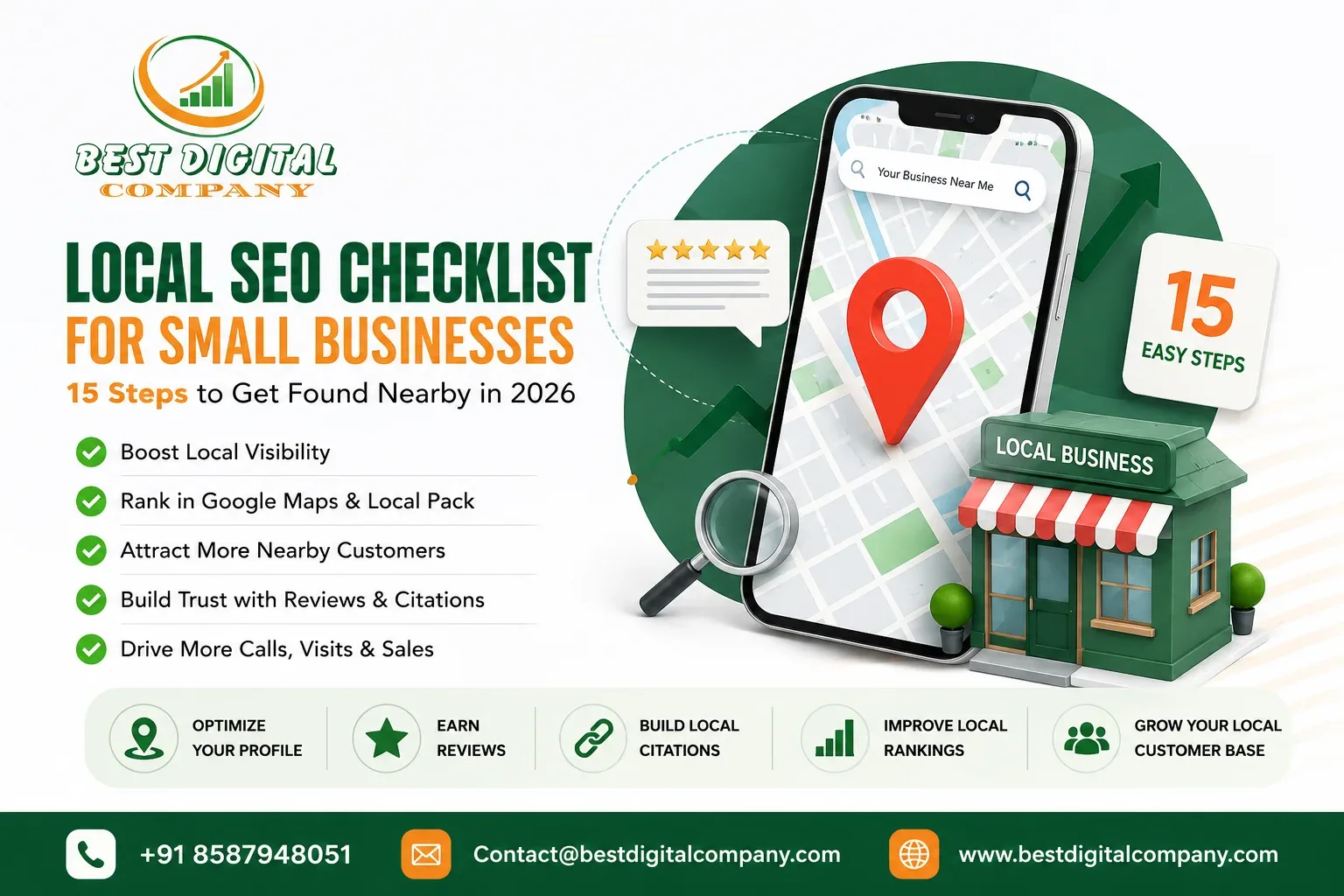
If you run a small business, most of your customers aren’t searching for you by name. They are typing things like “bakery near me,” “plumber in Noida,” or “best salon in Delhi” and picking from whatever Google shows them first. If your business doesn’t show up in that list, it does not matter how good your product or service is you are invisible to the exact people who are ready to buy from you today.
That’s what local SEO solves. It is the process of making sure search engines understand where your business is located, what it does, and why it deserves to be shown to people searching nearby. Done right, it puts your business in front of customers at the exact moment they are looking for what you offer.
This checklist walks through the practical steps small business owners can take to improve their visibility in local search results no jargon, no fluff, just the things that actually move the needle. Whether you are a single-location shop or manage a handful of branches across a city, this guide will help you build a solid local search presence.
Table of Contents
- Claim and Verify Your Google Business Profile
- Get Your NAP Consistency Right
- Choose the Right Business Categories
- Optimize Your Website for Local Search
- Build Location-Specific Landing Pages
- Earn and Manage Customer Reviews
- Build Local Citations and Directory Listings
- Create Locally Relevant Content
- Strengthen Your Internal Linking
- Optimize for Mobile and Page Speed
- Use Local Structured Data (Schema Markup)
- Build Local Backlinks
- Track Your Local Rankings and Traffic
- Common Local SEO Mistakes to Avoid
- Frequently Asked Questions
1. Claim and Verify Your Google Business Profile
Your Google Business Profile (formerly Google My Business) is the single most important asset in local search. It is the listing that shows up on the map, in the local pack, and on Google Maps when someone searches for a business like yours nearby.
To set it up properly:
- Claim your profile and complete the verification process (usually by postcard, phone, or email)
- Fill out every section: business hours, phone number, website, service area, and business description
- Choose accurate categories that match what you actually do
- Upload real photos of your storefront, team, and products not stock images
- Keep your profile updated whenever hours or services change, especially around holidays
A profile that’s only 60% filled out tells Google (and customers) that the business isn’t actively managed. A complete, regularly updated profile signals that you’re a real, active business worth trusting.
2. Get Your NAP Consistency Right
NAP stands for Name, Address, and Phone number. It sounds simple, but inconsistent NAP details across the web are one of the most common reasons small businesses struggle with local visibility.
If your business is listed as “Sharma Electronics” on your website but “Sharma Electronics Pvt Ltd” on Justdial and “Sharma Electronics Store” on Facebook, search engines struggle to confirm these are the same business. That confusion works against you.
Steps to fix this:
- Pick one exact format for your business name, address, and phone number
- Update your website, Google Business Profile, and all directory listings to match exactly
- Avoid abbreviations in one place and full words in another (like “St.” vs “Street”)
- Recheck old listings every few months, especially after an office move or number change
3. Choose the Right Business Categories
Category selection is easy to overlook, but it directly affects which searches your business appears in. If you run a digital marketing agency, for example, listing yourself under a broad category like “Marketing Agency” instead of more specific ones like “Search Engine Optimization” or “Social Media Marketing” limits how often you show up for the exact searches your ideal customers are running.
- Choose one primary category that best matches your core business
- Add secondary categories for the other services you genuinely offer
- Avoid stuffing in unrelated categories just to appear in more searches, it can hurt trust signals rather than help them
4. Optimize Your Website for Local Search
Your Google Business Profile gets people interested, but your website is what convinces them to actually reach out. It needs to clearly communicate where you’re located and what you do, right from the homepage.
- Mention your city and service areas naturally in your page titles, headings, and body content
- Include your address and phone number in the website footer on every page
- Make sure your Services page clearly outlines what you offer, with dedicated pages for each core offering
- Keep your contact page simple, with a working map embed and clickable phone number
5. Build Location-Specific Landing Pages
If you serve multiple cities or neighborhoods, generic pages won’t cut it. A business offering search engine optimization services in both Delhi and Noida, for instance, benefits far more from two well-written, location-specific pages than one page trying to cover both.
- Create a dedicated page for each city or region you actively serve
- Write unique content for each page ,don’t just swap the city name in a copy-paste template
- Include local landmarks, client examples, or case studies specific to that area where possible
- Link these pages clearly from your main navigation or services menu
This approach mirrors what many agencies already do well. Our own post on choosing the right digital marketing company in Delhi and Noida breaks down exactly how location context changes what customers are actually looking for.
6. Earn and Manage Customer Reviews
Reviews are one of the strongest trust signals in local search, and they influence real customers just as much as they influence rankings. A business with 80 genuine, recent reviews will almost always outperform one with five old reviews, even if the second business is technically “better.”
- Ask happy customers directly for a review right after a positive interaction
- Make it easy ,send a direct link to your Google Business Profile review page
- Respond to every review, good or bad, professionally and promptly
- Never buy fake reviews. Google actively detects and penalizes this, and it damages long-term trust
Handling reviews well isn’t a one-time task. It’s an ongoing part of how small businesses manage their online reputation, and it ties directly into the kind of social media marketing efforts that keep a brand’s presence active and trustworthy.
7. Build Local Citations and Directory Listings
A citation is any online mention of your business name, address, and phone number, even without a link. Local directories like Justdial, Sulekha, IndiaMART, and industry-specific listings all count as citations, and they reinforce your business’s legitimacy to search engines.
- List your business on major general directories first
- Add relevant industry-specific directories for your niche
- Keep the details consistent with your NAP guidelines from step 2
- Remove or update any duplicate or outdated listings you find
8. Create Locally Relevant Content
Blogging isn’t just for large companies. For small businesses, it’s one of the most affordable ways to show up for searches that a static website page simply can’t target. Content that speaks to local challenges, questions, and events tends to build trust with both readers and search engines.
Some ideas:
- Answer common questions your local customers actually ask
- Write about industry trends specific to your city or region
- Share results or case studies from real local clients
- Cover seasonal or local events relevant to your business
For example, our post on SMO services in Delhi and Mumbai works well because it speaks directly to business owners in those specific markets rather than offering generic advice.
9. Strengthen Your Internal Linking
Internal linking connects the pages on your own website so that both users and search engines can find related information easily. When done thoughtfully, it also helps distribute authority from your strongest pages to newer or less visible ones.
- Link from blog posts to relevant service pages, like your PPC services or web development pages
- Link between related blog posts so readers can go deeper into a topic
- Use descriptive anchor text instead of generic phrases like “click here”
- Avoid linking to the same page from every single post, spread the links naturally
If you want a deeper look at how this works, our guide on internal linking strategy covers how uneven link distribution quietly caps a website’s ranking potential.
10. Optimize for Mobile and Page Speed
Most local searches happen on a phone, often while someone is out and about looking for a nearby option right now. If your website loads slowly or looks broken on mobile, you will lose that visitor before they even see what you offer.
- Test your website on an actual phone, not just a browser resize
- Compress images so pages load quickly on mobile data
- Make phone numbers and addresses tap-to-call and tap-to-navigate
- Keep forms short and easy to fill out on a small screen
A slow or clunky website undoes the effort put into every other part of this checklist, which is why website development and designing is treated as a core part of local SEO work, not a separate project.
11. Use Local Structured Data (Schema Markup)
Structured data, often called schema markup, is code added to your website that helps search engines understand exactly what your business is, where it’s located, and what it offers. It doesn’t change how your page looks to visitors, but it gives search engines clearer signals.
- Add LocalBusiness schema with your name, address, phone number, and hours
- Include review schema if you display testimonials on your site
- Add FAQ schema on pages that answer common customer questions
- Use a schema testing tool to check for errors after implementation
This is usually a one-time technical setup, but it pays off continuously once it’s in place.
12. Build Local Backlinks
Backlinks from other reputable local websites act as a vote of confidence for your business. A mention from a local news site, a partnership with another nearby business, or a feature in a community blog all carry real weight.
- Partner with complementary local businesses for cross-promotion
- Sponsor local events or organizations that link back to your site
- Reach out to local bloggers or journalists covering your industry
- Join local business associations or chambers of commerce that list members online
13. Track Your Local Rankings and Traffic
None of this matters if you can’t tell whether it’s working. Tracking gives you the feedback loop needed to know what to keep doing and what to fix.
- Monitor your Google Business Profile insights for calls, direction requests, and profile views
- Track keyword rankings for your city and service-specific terms
- Watch your website traffic from local searches over time
- Set a monthly or quarterly check-in to review progress, not just a one-time setup
14. Common Local SEO Mistakes to Avoid
- Ignoring the Google Business Profile after setup: it needs regular updates, not a one-time entry
- Inconsistent NAP details across the web, which confuses both customers and search engines
- Thin or duplicate content across location pages that offers no real value to readers
- Chasing fake reviews, which can lead to penalties and damaged trust
- Neglecting mobile experience, even though most local searches happen on phones
- No internal linking strategy, leaving valuable pages isolated and hard to discover
Frequently Asked Questions
What is local SEO and why does it matter for small businesses?
Local SEO is the practice of optimizing your online presence so your business shows up when nearby customers search for products or services you offer. For small businesses, it matters because most customers choose from whichever nearby options appear first, making visibility directly tied to walk-ins, calls, and sales.
How long does it take to see results from local SEO?
Most small businesses start noticing improvements within two to four months, though this depends on competition in the area, how complete the Google Business Profile is, and how consistently the checklist steps are followed. Local SEO is a gradual process rather than an instant fix.
Do I need a website if I already have a Google Business Profile?
Yes. A Google Business Profile helps you get discovered, but a website is what builds trust, explains your services in detail, and often plays a role in ranking factors that a profile alone can’t cover.
How many Google reviews does a small business need?
There’s no fixed number, but businesses with a steady stream of recent, genuine reviews generally perform better than those with very few or outdated ones. Consistency over time matters more than hitting a specific count.
Can I do local SEO myself, or do I need an agency?
Many of the basics, like completing your Google Business Profile and requesting reviews, can be done in-house. More technical elements, like schema markup, citation management, and content strategy, are often handled faster and more effectively with professional support.
What’s the difference between local SEO and regular SEO?
Regular SEO focuses on ranking for broader, often national or global searches. Local SEO specifically targets searches with local intent, such as “near me” queries or city-specific terms, and relies heavily on tools like Google Business Profile and local citations that general SEO doesn’t use.
Does having multiple locations help or hurt local SEO?
It can help significantly if each location has its own optimized Google Business Profile and dedicated landing page. It can hurt if locations are managed inconsistently, with mismatched NAP details or duplicate content across pages.
How important are online reviews compared to other local SEO factors?
Reviews are one of several important factors, alongside profile completeness, citations, and website relevance. No single factor guarantees rankings on its own, but reviews influence both visibility and a customer’s decision to actually choose your business.
Conclusion
Local SEO isn’t a one-time project you finish and forget. It’s an ongoing set of habits: keeping your profile updated, staying consistent across the web, earning genuine reviews, and creating content that actually helps the people searching for you. Small businesses that treat it this way, rather than as a checkbox exercise, tend to see steady, compounding results over time.
If you’d rather have this handled by people who work on local visibility every day, our team can review your current setup and build a plan around what your business actually needs. Get in touch with Best Digital Company to talk through where your local search presence stands today.

Add a Comment