

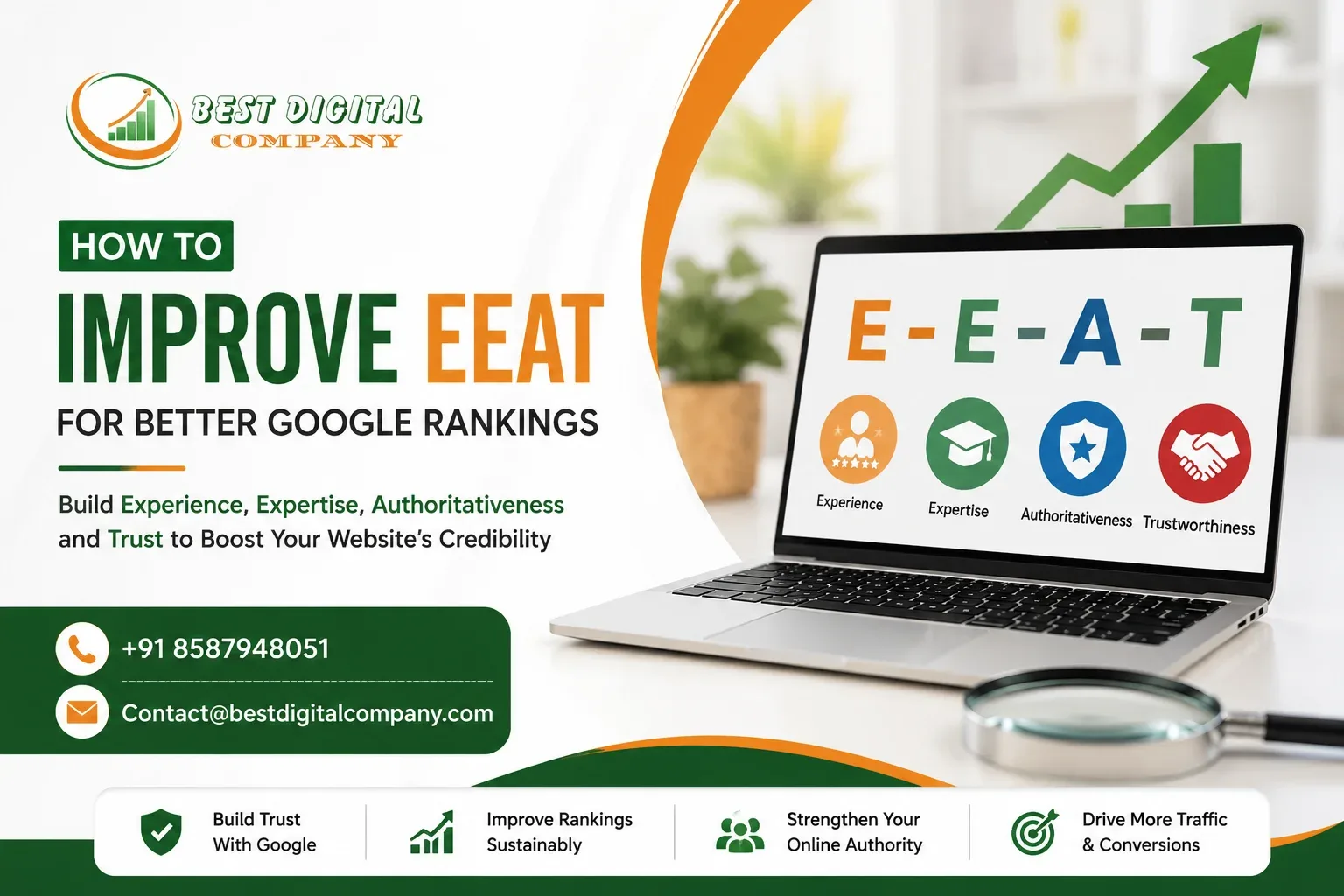
If you have spent any time in an SEO forum, a client meeting, or even a casual chat with your web developer over the last two years, you have probably heard the acronym EEAT thrown around like it explains everything. Experience, Expertise, Authoritativeness, and Trust. It sounds simple on paper. In practice, most businesses we talk to are doing half of it by accident and the other half not at all.
We work with clients across different cities and industries, and the pattern repeats itself almost every time. A business has a decent website, publishes content now and then, has a few backlinks, and still watches a competitor with a thinner site outrank them. Nine times out of ten, when we dig into it, the gap isn’t keywords or backlinks. It’s EEAT. The content doesn’t feel like it was written by someone who actually knows the subject, the site doesn’t build trust the way Google expects it to in 2026, and there is no clear signal of who is actually behind the information.
This guide walks through what EEAT actually means today, why it matters more than it did a few years ago, and the practical steps you can take to strengthen it on your own website, whether you run a local shop, an e-commerce store, or a service-based business.
What EEAT Actually Means (And Why Google Cares)
EEAT stands for Experience, Expertise, Authoritativeness, and Trustworthiness. It comes from Google’s Search Quality Rater Guidelines, a document used by human evaluators to judge whether a page deserves to rank well. It is not a direct ranking factor you can tick off a checklist, but it shapes the algorithms and quality systems that decide who gets visibility.
Here’s the breakdown in plain language:
- Experience asks whether the content creator has actually lived or done what they’re writing about. Did they personally use the product, run the campaign, visit the place, or solve the problem?
- Expertise asks whether the person has the knowledge or qualifications to speak on the topic credibly.
- Authoritativeness looks at whether the website or author is recognized as a go-to source by others in the field, including other reputable sites, publications, or communities.
- Trustworthiness is the umbrella term. It covers accuracy, transparency, security, and honesty. Google treats this as the most important of the four, because even highly experienced and authoritative content is worthless if the reader can’t trust it.
Google added “Experience” to the original EAT framework in December 2022, which tells you something important: search quality raters and Google’s systems were increasingly rewarding content written by people who have actually done the thing, not just people who researched it. That shift matters even more now, with so much AI-generated content flooding the web. Google’s quality systems are specifically designed to identify content that reads as generic, recycled, or disconnected from any real human experience, and rank it lower.
This is exactly why human-written, first-hand, specific content consistently outperforms generic content, no matter how well the keywords are placed.
Why EEAT Matters More in 2026 Than Ever Before
A few years ago, you could publish a reasonably well-optimized 1,000-word article, get a couple of backlinks, and see it rank. That window has narrowed significantly. Google’s core updates over the past two years have repeatedly targeted low-value, mass-produced content, and the businesses that got hit hardest were the ones publishing generic articles with no real depth, no author identity, and no demonstrable experience behind them.
At the same time, the volume of AI-assisted content online has exploded. This is not a problem in itself; the issue is that a lot of it is thin, repetitive, and interchangeable from one website to the next. Google’s systems are increasingly good at recognizing that pattern. What still works, consistently, is content that reflects genuine human judgment, real examples, and a clear point of view, even if AI tools are used somewhere in the process to speed up research or drafting.
If you are planning any kind of content strategy this year, whether that’s blog content, service pages, or landing pages, EEAT should be one of the first things you design around, not something you retrofit later.
Build Real Author Identity Into Your Content
One of the fastest wins for EEAT is also one of the most overlooked: showing who actually wrote the content.
Most business websites either don’t credit an author at all, or they use a generic “Admin” or “Team” byline. Neither builds trust. Google’s raters are explicitly trained to look for information about who created the content and whether that person or organization has relevant experience. If there’s nothing to find, the content gets treated as lower quality by default, regardless of how good the writing actually is.
Practical steps that make a real difference:
- Add a named author to every blog post and article, with a short, specific bio (not just “digital marketing enthusiast”).
- Create a dedicated author page linking to their credentials, LinkedIn profile, and other published work.
- Where relevant, mention direct experience in the piece itself. If someone managed a campaign, say so, with specifics. “We ran this exact strategy for a client in the fashion industry and saw a 40% increase in organic leads over four months” carries far more EEAT weight than “This strategy can increase your leads.”
- Keep author bios and “About Us” pages updated as your team and expertise grow.
This is also where your service pages come in. If you offer something like SEO Services in Mumbai, don’t just describe the service generically. Talk about the specific challenges businesses in that market face, the strategies your team has actually used there, and real outcomes. That level of specificity is exactly what separates expertise from a templated sales pitch.
Demonstrate Expertise Through Depth, Not Just Volume
A lot of businesses equate content quantity with SEO success. Publish more, rank more. That formula worked reasonably well several years ago. It doesn’t hold up as well now, particularly for competitive topics.
What Google’s systems and human raters are actually looking for is depth: does the content genuinely answer the reader’s question in a way that reflects real understanding, or does it just circle around the topic using common phrases picked up from other articles?
A few ways to build genuine depth:
- Answer the follow-up questions a reader would naturally have, not just the primary query. If someone searches “how to improve website rankings,” they will likely also wonder about timelines, costs, and common mistakes. Address those within the same piece or through clear internal links.
- Use original data where you can. Even small sample sizes from your own client work, like average timelines or common issues you’ve fixed, add a layer of credibility that generic advice can’t match.
- Avoid restating the same idea in different words to hit a word count. Every paragraph should add something new. Readers, and increasingly Google’s quality systems, notice when content pads itself out without adding value.
- Cross-link related resources on your site so readers (and search engines) can see the fuller picture of your expertise. For example, someone reading about local SEO strategy would benefit from also seeing your dedicated guide on SEO Services in Punjab, since regional strategy differs meaningfully from one market to another.
Depth isn’t about writing longer for the sake of it. It’s about writing until the reader’s actual question is fully answered, then stopping.
Strengthen Authoritativeness With Consistent Topical Focus
Authoritativeness is largely built over time, and it’s tied closely to how consistently a website covers a subject area. A site that publishes scattered, unrelated content across dozens of unrelated topics has a harder time being seen as an authority on any single one of them, compared to a site that consistently, thoroughly covers a specific niche.
If your business operates in a specific service category, like digital marketing, healthcare, finance, or real estate, your content strategy should reflect that focus clearly. Google’s systems look at the overall pattern of a website’s content to judge whether it has established authority in a given space.
Some ways to build this systematically:
- Group related content into clusters. If you write about search rankings, connect it to related pieces on technical SEO, content strategy, and regional SEO approaches such as your guide on SEO Services in Haryana, so readers and search engines can see the full breadth of your coverage.
- Earn mentions and backlinks from other credible sites in your industry. This doesn’t need to happen overnight, but genuine coverage, guest contributions, or partnerships in your field slowly build the kind of external validation Google’s systems weigh heavily.
- Keep your published work internally consistent. If one article says one thing about a strategy and another contradicts it without explanation, that inconsistency undermines authority. Review older content periodically and update it when your recommendations evolve.
- Show real project outcomes. Case studies, before-and-after data, and specific client results (with permission) go a long way toward demonstrating that your authority is backed by actual work, not just claims.
Build Trust Signals That Actually Matter
Trustworthiness is the anchor of the entire framework, and it’s also the area most businesses underinvest in, mostly because it isn’t as visible or exciting as writing new content or chasing backlinks.
Here’s what genuinely moves the needle:
Accuracy and honesty. Never overstate results or make guarantees you can’t back up. Phrases like “guaranteed #1 ranking” actually damage trust with both readers and search engines, because they’re demonstrably unreliable claims. Be honest about timelines, limitations, and what a strategy can and can’t do.
Transparency about your business. Clear contact information, a real physical address, verifiable phone numbers, and an accessible “About Us” page all contribute to trust. If a visitor can’t easily find out who runs the site or how to reach them, that’s a red flag both for users and for search quality evaluators.
Site security and technical hygiene. Basic technical trust factors still matter: a secure HTTPS connection, no intrusive ads that obscure content, fast load times, and a mobile-friendly layout. These aren’t content factors directly, but they shape how trustworthy the overall experience feels.
Reviews and third-party validation. Genuine client reviews, testimonials with real names (not stock quotes), and third-party mentions all help. Fabricated or overly polished testimonials tend to have the opposite effect once readers notice the pattern.
Clear sourcing. When you reference data, statistics, or claims that aren’t your own first-hand experience, cite where they came from. This applies just as much to blog content as it does to service pages. If you’re discussing digital trends specific to a market, like how businesses might approach SEO Services in Mumbai differently from other regions, ground the claims in something concrete rather than vague generalizations.
Write for Humans First, Search Engines Second
This might be the single most important shift in how content needs to be approached today. For years, a lot of SEO content was written primarily to satisfy an algorithm: hit the keyword density, structure the headings a certain way, stuff in related terms. That approach increasingly backfires now.
Google’s systems are specifically built to recognize and reward content that reads naturally, addresses a real intent, and doesn’t feel mechanically assembled. This doesn’t mean keywords don’t matter, they still help search engines understand what your page is about, but the content around them needs to sound like it was written by a person who understands the topic and genuinely wants to help the reader.
A few practical habits that support this:
- Write the way you’d explain something to a client sitting across the table from you. Direct, specific, and honest, without unnecessary jargon.
- Vary your sentence structure and avoid repeating the same phrases throughout a piece. Repetition, both of ideas and exact wording, is one of the clearest signals of low-effort or automated content.
- Make sure every section of your content has a clear purpose tied to what the reader actually wants to know. If a section doesn’t serve the reader’s intent, cut it.
- Read your content out loud before publishing. If it sounds stiff or robotic when spoken, it will read that way too.
- Update and personalize any AI-assisted drafts significantly before publishing. Add specific examples, your own perspective, and details that couldn’t have been generated generically.
Apply EEAT to Local and Service-Based SEO
EEAT isn’t just a blog content concern; it shapes how service pages, location pages, and business listings perform too, especially for local businesses competing in specific regions.
If you offer location-based services, each location page needs to reflect genuine local relevance, not just a swapped city name in an otherwise identical template. A page built around SEO Services in Haryana should talk about the actual business landscape, competition, and search behavior specific to that region, not read like a copy-pasted version of a page for another state with the name changed.
The same logic applies across every regional page you maintain. Real specificity, real examples, and real local context are what separate a page that ranks from one that quietly sits on page three of the results.
Common EEAT Mistakes That Quietly Hurt Rankings
Even well-intentioned businesses fall into a few recurring traps:
- Publishing content with no clear author or credentials attached. This is one of the easiest fixes and one of the most commonly skipped.
- Using the exact same content structure across every article. Search quality systems and readers both notice repetitive templates that feel formulaic rather than genuinely written for each topic.
- Overloading pages with keyword variations at the expense of readability. If a phrase appears so often it disrupts natural reading, it’s doing more harm than good.
- Ignoring older content. EEAT isn’t a one-time fix. Content published a year or two ago that no longer reflects current best practices, outdated statistics, or old strategies actively works against your credibility if left unchanged.
- Treating reviews and testimonials as decoration rather than trust signals. Genuine, specific, verifiable feedback is worth far more than a handful of generic five-star quotes.
- Skipping internal linking. When your content exists in isolation without connecting to related resources on your site, you miss an opportunity to demonstrate the fuller depth of your expertise and help both readers and search engines understand how your content fits together.
A Practical EEAT Checklist to Work Through
If you want a starting point to audit your own site, work through this list:
- Does every piece of content have a named author with a real, relevant bio?
- Is there a clear, accessible “About Us” page with genuine information about the business?
- Does the content include specific examples, data, or first-hand experience rather than generic advice?
- Are older articles reviewed and updated periodically, rather than left untouched indefinitely?
- Is contact information clear, consistent, and verifiable across the site?
- Are testimonials and reviews genuine, specific, and attributable?
- Does the site link internally between related topics and services in a way that shows depth?
- Is the writing natural and varied, or does it repeat the same phrases and structures throughout?
- Are claims backed by evidence, or are there unsupported guarantees that could damage trust?
- Is the site technically sound, secure, and easy to use on mobile devices?
Working through even a few of these consistently, rather than trying to fix everything at once, tends to produce steady, compounding improvement over a few months.
Final Thoughts
EEAT isn’t a trick or a shortcut. It’s essentially Google’s attempt to reward what has always mattered in good writing and good business: real knowledge, honest communication, and a genuine track record. The businesses that treat it as a checklist to game tend to see limited, short-lived results. The ones that treat it as a reflection of how they actually operate, being transparent, demonstrating real expertise, and writing content that genuinely helps people, tend to see it compound over time.
If your rankings have plateaued despite reasonable effort on keywords and backlinks, EEAT is very often the missing piece. It takes more effort than templated content, but it’s also far harder for competitors to copy, because it’s built on something they can’t easily replicate: your actual experience and expertise.
Frequently Asked Questions
What does EEAT stand for in SEO?
EEAT stands for Experience, Expertise, Authoritativeness, and Trustworthiness. It’s a framework from Google’s Search Quality Rater Guidelines used to evaluate whether content and websites deserve to rank well, particularly for topics that affect a reader’s wellbeing, finances, or important decisions.
Is EEAT a direct Google ranking factor?
Not exactly. EEAT itself isn’t a single measurable signal the way page speed or backlinks are. Instead, it’s a quality framework that shapes the systems and algorithms Google uses to assess content quality, author credibility, and site trustworthiness, all of which influence rankings indirectly but significantly.
How long does it take to see ranking improvements after improving EEAT?
It varies depending on your starting point, competition, and how consistently you apply the changes, but most businesses start noticing measurable movement within two to four months of consistent effort, with stronger gains building over six months to a year.
Does AI-generated content hurt EEAT?
AI-assisted content isn’t automatically penalized, but content that reads as generic, repetitive, or disconnected from genuine human experience tends to underperform. The safest approach is to use AI tools for research or drafting support while ensuring the final content reflects real expertise, specific examples, and a human voice.
Can small or local businesses realistically compete on EEAT with larger competitors?
Yes, and often more easily than expected. Local and small businesses frequently have stronger, more specific first-hand experience than large competitors with generic content. Detailed local knowledge, genuine client relationships, and specific case studies can outweigh sheer content volume.
What’s the single most impactful first step to improve EEAT?
Adding clear author identity and genuine expertise signals to your existing content is usually the fastest, most impactful first step. It requires no new content creation, just updating what you already have with real names, credentials, and specific first-hand detail.

Add a Comment