

Every business owner remembers the exact feeling of watching a brand-new website sit there with zero visitors. You have registered the company, printed the visiting cards, maybe even run a small opening-day offer, and yet the phone is not ringing the way you imagined. This is the point where most small business owners in Delhi, Noida, and honestly every other city ask us the same question: how do we get our first 100 customers without burning through our entire budget on guesswork?
The honest answer is that the first 100 customers rarely come from one lucky break. They come from a handful of channels working together. A website that doesn’t waste the traffic it gets, a bit of visibility on search engines, some paid reach to speed things up, and a social presence that builds trust before the sale happens. In this guide, we’re breaking down exactly how we have helped small businesses go from zero to their first 100 paying customers, step by step, without the vague “just be consistent” advice that doesn’t actually tell you what to do on a Monday morning.
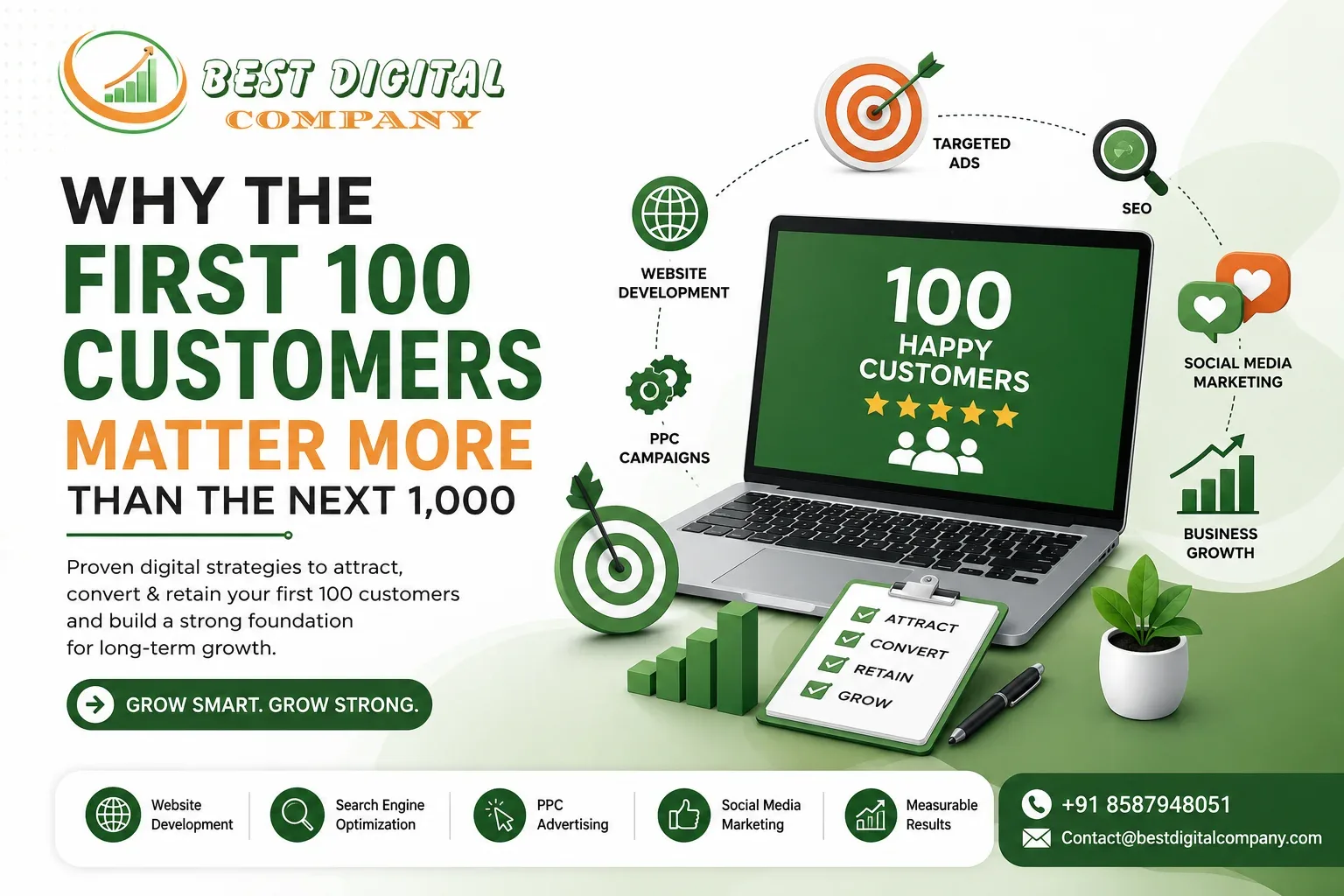
Why the First 100 Customers Matter More Than the Next 1,000
There is a reason we are not talking about customer number 500 first. The first 100 customers are the hardest to get because you have no reviews, no case studies, no word of mouth, and often no real proof that your product or service works at scale. Every sale at this stage is a test of your offer, your pricing, and your messaging.
Once you cross that threshold, something changes. You have testimonials to show, referrals start trickling in on their own, and you finally have real data about who buys from you and why. That data becomes the foundation for everything that follows, from ad targeting to content topics to product decisions. So the goal in this early phase is not just revenue. It is a proof and information you can use to grow faster later.
Build a Website That Turns Visitors Into Customers, Not Just Traffic
Before spending a single rupee on ads or outreach, it is worth asking a blunt question: if 100 people landed on your website today, would any of them actually buy? A surprising number of small business websites are built to look nice but not to convert. No clear offer, a contact form buried three clicks deep, no phone number visible above the fold, and page speeds slow enough that half the visitors leave before it even loads.
This is why website development and designing has to be treated as a growth tool, not just a branding exercise. A good small business website needs a clear headline that says what you do and for whom, one obvious action you want the visitor to take, real proof (photos of your work, testimonials, certifications), and a mobile experience that doesn’t break on a mid-range phone, since most first-time visitors will find you on their phone, not a laptop.
If you already have a website but aren’t seeing enquiries, the issue is often not traffic but conversion. We’ve written in detail about this in how to create SEO landing pages that actually convert visitors into customers, which walks through the exact structure that turns a casual visitor into a lead. And if the site is brand new, running through the ultimate website launch SEO checklist before you go live will save you from fixing avoidable mistakes six months down the line.
Use Search Engine Optimization to Get Found by People Already Searching
Paid ads get you attention while you’re paying for them. Search visibility keeps working long after. For a small business trying to land its first customers without a large budget, ranking for the searches your future customers are already typing is one of the most cost-effective moves you can make.
The mistake most small businesses make with search engine optimization is trying to rank for broad, competitive terms on day one. A local bakery competing for “cakes” nationally will lose to established players every time. What actually works early on is targeting specific, local, and intent-driven searches the kind where someone has already decided they want to buy and is just choosing who from. Think “birthday cake delivery in [your area]” instead of just “cakes,” or “affordable web development for small business” instead of “web development.”
Getting a brand-new website to actually show up takes patience and a proper sequence of work, which is exactly what we cover in how to rank a new website on Google in 90 days. If your business sells products online, the approach shifts slightly, and our guide on SEO for e-commerce stores covers the product-page and category-page specific tactics that bring in organic buyers rather than just browsers.
One point worth clearing up here: plenty of business owners still believe that tweaking a meta description will magically push them up the rankings. It won’t, and Google itself has confirmed this isn’t a direct ranking signal, something we unpacked in detail in our piece on meta descriptions and what actually matters in 2026. The real ranking factors are content quality, site structure, and how well your pages answer what people are actually searching for.
Run Targeted Pay Per Click Campaigns to Get Faster Traction
Search visibility takes time to build, and when you’re chasing your first 100 customers, you often don’t have months to wait. This is where Pay Per Click advertising earns its place in the early growth stage. You’re paying to sit at the top of search results or in front of the right social audience today, not six months from now.
The trap most first-time advertisers fall into is spreading a small budget across too many keywords or audiences, which produces clicks but not customers. A tighter approach works better for a new business: pick two or three high-intent keywords or audience segments, run them with a clear call to action, and measure cost per lead honestly before scaling anything up. Even a modest daily budget can bring in your first genuine leads if the targeting is narrow and the landing page (see the point above) is built to convert.
We go deeper into choosing the right approach, and the right agency partner if you’re outsourcing this, in PPC services in Delhi: how to pick an agency that actually grows your business. It’s worth a read even if you plan to run your own campaigns, since it lays out the questions that separate a campaign that burns budget from one that brings in paying customers.
Build Trust and Reach Through Social Media Marketing
Search and ads get people to your door. Social media is often what makes them trust you enough to knock. For a new or small business, an active, honest social presence does two jobs at once: it puts your brand in front of new people through shares and local discovery, and it gives existing prospects a way to check you are real before they hand over money.
Social media marketing for a business chasing its first 100 customers doesn’t need to mean viral content or a huge posting schedule. It means showing up consistently with things that build credibility: real photos of your work or product, quick answers to common questions in your comments and DMs, short videos of your process, and genuine customer reactions once you have a few. Followers matter less than most business owners think. A page with 800 followers that replies to every enquiry within an hour will out-convert a page with 8,000 followers that nobody manages.
We saw this play out with a clothing brand owner we worked with, whose story we shared in SMO services in Delhi and Mumbai: why brands are finally taking social seriously in 2026. He had a healthy follower count but almost no sales from it, because the account was built for likes, not conversations. Once the strategy shifted toward responsiveness and clear offers, actual customers started coming through.
Turn Every Enquiry Into an Actual Sale
Getting people to your website, your DMs, or your shop is only half the job. Small businesses often lose a good chunk of their first 100 potential customers simply because the follow-up is slow, inconsistent, or missing entirely. Someone fills a contact form on Friday evening and doesn’t hear back until Tuesday. By then, they have usually already bought from a competitor who replied within the hour.
A few habits fix most of this: reply to every enquiry within the same working day, have a simple pricing or process explanation ready to send so people don’t have to wait for a call, and follow up at least twice before assuming someone isn’t interested. Most lost sales at this stage aren’t lost because of price. They’re lost because nobody followed up.
Ask for Referrals and Reviews as Soon as You Can
Once you’ve closed even your first five or ten customers, don’t wait until you have a large customer base to start asking for referrals and reviews. Early customers are usually your most willing advocates, especially if the experience was good, because they remember what it felt like to take a chance on a new or small business.
A simple, direct ask works better than a vague one. Instead of “let us know if you liked our service,” try something specific: “if you were happy with this, a quick Google review would really help us, and here’s the link.” The same goes for referrals; ask directly if they know anyone else who might need what you offer, and consider a small referral incentive if your margins allow it. These early reviews also feed directly back into your search visibility, since reviews and local signals influence how you show up for local searches.
Track What’s Actually Bringing in Customers
By the time you’re a few weeks into working on your website, search visibility, ads, and social presence together, it becomes tempting to just keep doing all of it at the same intensity. The smarter move is to check, honestly, which channel brought in real paying customers versus which one just brought in traffic or likes. For some businesses that’s search, for others it’s a specific ad campaign, and for many local businesses it’s a mix of social proof plus a well-placed ad.
This is also where basic website structure starts to matter again, especially as you add more content, service pages, and blog posts over time. A site with a confusing internal structure makes it harder for both visitors and search engines to find your best pages, something we detail in internal linking strategy in 2026: how to stop quiet link equity loss from capping your Google rankings. Getting this right early means the next 100 customers come in easier than the first.
Bringing It All Together
Getting to your first 100 customers isn’t about finding one secret channel. It’s a website built to convert, search visibility for the searches your customers are already making, a tightly targeted ad campaign or two to speed things up, an honest and responsive social presence, and a follow-up process that doesn’t let warm leads go cold. None of these need a massive budget to start. They need consistency, the right sequence, and honest tracking of what’s actually working.
If you’d rather have this handled by people who do it daily across different industries, that’s exactly the kind of work we do. You can look through our services or read more strategies on our blog, and when you are ready, get in touch with us and we will walk you through what makes sense for your specific business.
Frequently Asked Questions
How long does it usually take a small business to get its first 100 customers?
It varies by industry and location, but most small businesses that combine a converting website, basic search visibility, and a bit of paid advertising see their first 100 customers within two to four months. Businesses relying only on organic search without any paid push often take longer, sometimes five to six months, since search visibility takes time to build.
Do I need a big budget to get my first 100 customers?
No. A tightly targeted ad budget of even a few thousand rupees a month can bring in real leads if the targeting is narrow and the landing page is built well. The bigger cost of getting this wrong isn’t the ad spend, it’s wasting that spend on the wrong keywords, the wrong audience, or a website that doesn’t convert.
Should I focus on search engine optimization or paid ads first?
Ideally both, but if you have to choose, paid ads bring faster results while search visibility is being built in the background. Search engine optimization takes longer to show results but keeps working without an ongoing spend, which makes it more sustainable once you’re past the first 100 customers.
How important are Google reviews for getting new customers?
Very important, especially for local and service-based businesses. Reviews influence both buyer trust and local search visibility. Even five to ten honest reviews from your first customers can noticeably improve how often you show up for local searches and how likely a new visitor is to choose you over a competitor.
What’s the biggest mistake small businesses make while chasing their first customers?
Slow or inconsistent follow-up. Many small businesses put effort into getting traffic and enquiries but lose potential customers simply because nobody replied within a reasonable time. Fixing response time alone often recovers a meaningful chunk of lost sales.
Can social media alone bring in the first 100 customers?
It can for some businesses, especially visual or local ones, but it works far better paired with a website that can actually capture and convert that interest. Social media builds trust and reach; the website and follow-up process are usually what turn that trust into an actual sale.

Add a Comment