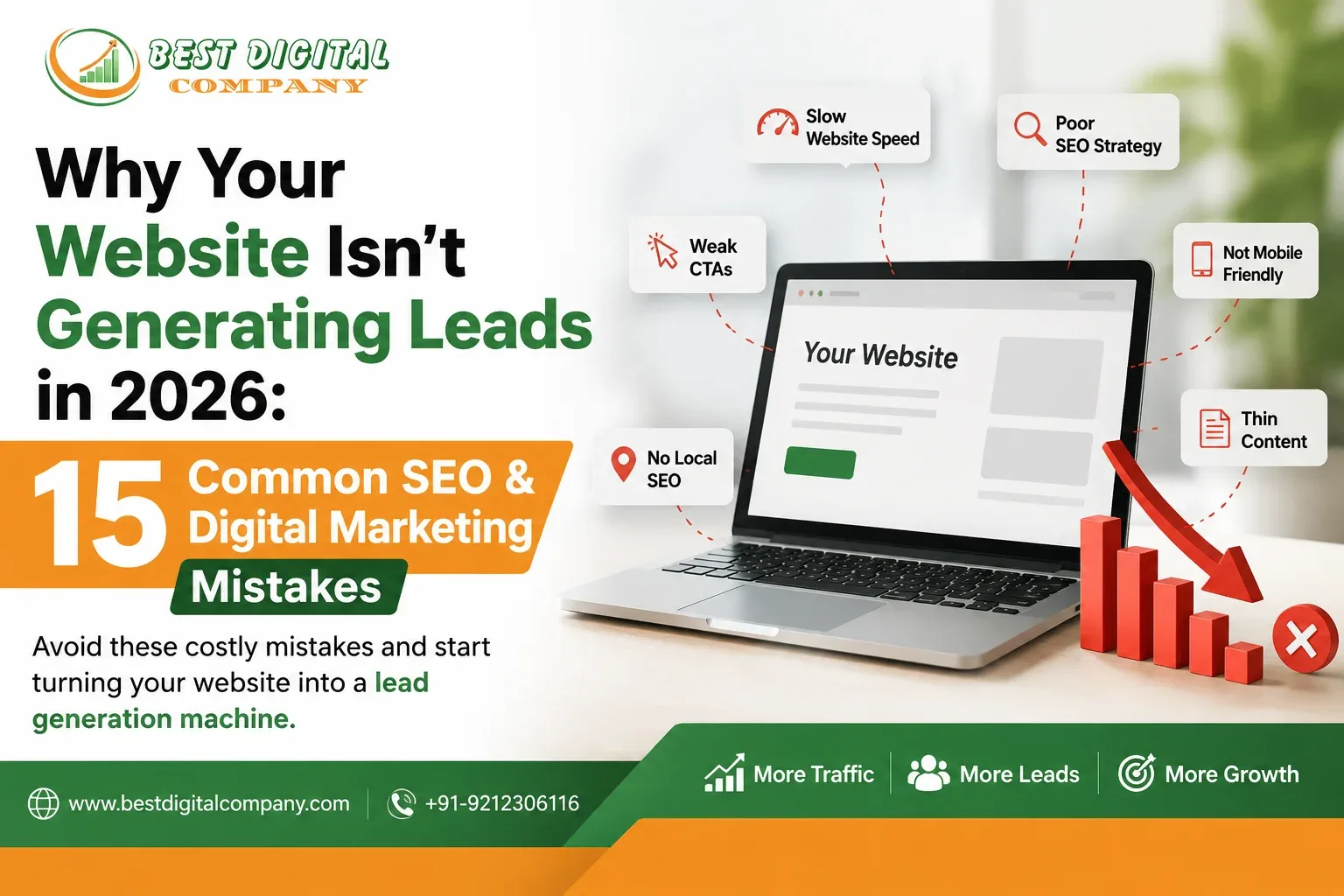
Why Your Website Isn't Generating Leads in 2026: 15 Common SEO & Digital Marketing Mistakes

Why Your Website Isn’t Generating Leads in 2026: 15 Common SEO & Digital Marketing Mistakes

Your Website Is Open – But Is Anyone Walking In?

You invested time, money, and energy building a website. You hit publish. And then… silence. No enquiries. No calls. No leads.

If this sounds familiar, you are not alone. In 2026, millions of businesses are making the same critical errors that quietly strangle their online lead generation and most of them do not even realise it.

At Best Digital Company, India’s trusted digital marketing partner, we audit dozens of websites every month. The pattern is always the same: great-looking sites with invisible problems. Below, we break down the 15 most common SEO and digital marketing mistakes that are costing you leads in 2026 and exactly how to fix each one.


Mistake #1: Ignoring Search Intent in 2026

Google has evolved dramatically. In 2026, its algorithm rewards pages that satisfy search intent not just pages that contain keywords. If someone searches “best dentist in Delhi” and your page is a generic homepage, you will never rank.

Search intent falls into four types: Informational, Navigational, Commercial, and Transactional. Aligning your page type to the right intent is the single biggest ranking factor most small businesses miss.

✅ Fix It: Map each target keyword to a specific intent type before writing a single word of content. Create dedicated landing pages for transactional keywords.


Mistake #2: Slow Website Speed Killing Conversions

Google’s Core Web Vitals are now a confirmed ranking signal. A site that takes more than 3 seconds to load loses over 53% of mobile visitors. In 2026, speed is not a luxury, it is a lead-generation prerequisite.

Common culprits include uncompressed images, excessive plugins, no caching, and poor hosting. Every second of delay costs you potential customers.

✅ Fix It: Use Google PageSpeed Insights to identify bottlenecks. Compress images, enable browser caching, and upgrade to a fast hosting provider.


Mistake #3: No Local SEO Strategy

If your business serves specific cities or regions, local SEO is non-negotiable. Businesses without a Google Business Profile, local citations, and location-based landing pages are invisible to nearby buyers. Whether you need SEO Services in Mumbai, SEO Services in Punjab, or SEO Services in Haryana, a localised strategy is what separates businesses that get calls from those that get ignored.

✅ Fix It: Claim and optimise your Google Business Profile, build NAP-consistent citations, and create geo-specific landing pages with local keywords.


Mistake #4: Weak or Missing Call-to-Actions (CTAs)

Visitors land on your page. They read. They scroll. Then they leave because you never told them what to do next. Vague CTAs like “Learn More” or “Click Here” are conversion killers.

A high-converting CTA is specific, benefit-driven, and visible above the fold. “Get Your Free SEO Audit Today” dramatically outperforms “Submit”.

✅ Fix It: Audit every page for CTAs. Place at least one strong, action-oriented CTA above the fold and one at the end of every page.


Mistake #5: Not Optimising for Mobile Users

Over 70% of all web traffic in India comes from mobile devices. If your website is not fully responsive with touch-friendly buttons, readable fonts, and fast mobile load times you are handing leads to your competitors.

Google uses mobile-first indexing, which means it crawls and ranks your mobile version first. Our Website Development & Designing service ensures your site is flawless across all devices.

✅ Fix It: Test your site on Google’s Mobile-Friendly Test tool. Ensure buttons are at least 44px, fonts are legible, and forms work on touchscreens.


Mistake #6: Thin, Low-Quality Content

Google’s Helpful Content System actively penalises websites with generic, shallow, or AI-spun content that provides no real value. In 2026, 300-word pages are not just unimpressive they actively hurt your rankings.

Pillar content (1,500–3,000+ words), topic clusters, and expert-authored articles are what Google now rewards. Content must demonstrate Experience, Expertise, Authoritativeness, and Trustworthiness (E-E-A-T).

✅ Fix It: Audit your existing content for depth and quality. Expand thin pages, merge duplicates, and build comprehensive topic cluster strategies.


Mistake #7: Missing or Broken Internal Linking Structure

Internal links distribute PageRank across your website, help Google understand your site structure, and guide users deeper into your funnel. A website without strategic internal links is like a building without corridors.

For example, if you are searching for insights on Digital Marketing Service in Delhi or wondering if your business needs a Digital Marketing Agency for Small Business, those resources should be interconnected and easily discoverable.

✅ Fix It: Create a site-wide internal linking map. Link every blog post to at least 2–3 relevant service or pillar pages, and ensure no page is an orphan.


Mistake #8: Ignoring Technical SEO Fundamentals

Broken links, duplicate content, missing canonical tags, no XML sitemap, improper robots.txt, and missing schema markup ,these technical errors prevent Google from properly crawling and indexing your website, no matter how good your content is.

Our Search Engine Optimization team conducts thorough technical audits to uncover and fix every hidden issue dragging your rankings down.

✅ Fix It: Run a Screaming Frog or Semrush site audit monthly. Fix 4xx and 5xx errors, implement canonical tags, and submit an updated sitemap to Google Search Console.


Mistake #9: No Social Proof or Trust Signals

Would you hire a contractor with no reviews? Neither would your customers. In 2026, a website without Google reviews, client testimonials, case studies, or trust badges sees dramatically lower conversion rates even with strong traffic.

Check out how our Digital Marketing Agency for Dentist blog showcases how trust-building content transforms lead generation for service businesses.

✅ Fix It: Add a testimonials section, display star ratings, embed Google reviews, and publish client case studies with measurable results.


Mistake #10: No PPC Strategy to Support Organic Efforts

SEO takes time. If your business needs leads now, waiting 6 months for organic rankings is not an option. Companies that rely solely on organic search and neglect Pay-Per-Click advertising miss out on immediate, targeted traffic.

Our Pay Per Click (PPC) Services deliver instant visibility on Google Ads, Meta Ads, and beyond ensuring your pipeline is never empty while SEO builds long-term authority.

✅ Fix It: Run PPC campaigns for high-commercial-intent keywords while SEO efforts mature. Retargeting ads alone can recover 70% of lost visitors.


Mistake #11: Neglecting Social Media Marketing

Social signals do not directly impact rankings, but they amplify content reach, build brand awareness, and drive referral traffic. Businesses that ignore Instagram, LinkedIn, and Facebook in 2026 lose a critical touchpoint in the buyer’s journey.

Our Social Media Marketing service builds engaged communities that translate followers into warm leads.

✅ Fix It: Post consistently on at least 2 platforms. Share blog content, client results, and behind-the-scenes content. Use platform-native features like Reels and LinkedIn newsletters.


Mistake #12: No Structured Data / Schema Markup

Schema markup helps Google understand your content and display rich results star ratings, FAQs, breadcrumbs, and more directly in search results. Businesses using schema consistently see higher Click-Through Rates (CTR) even without ranking #1.

In 2026, FAQ schema, LocalBusiness schema, and Service schema are powerful tools for appearing in AI Overviews and featured snippets in Google Search.

✅ Fix It: Implement LocalBusiness, Service, FAQ, and Article schema across all key pages using Google’s Structured Data Markup Helper. Validate with the Rich Results Test.


Mistake #13: Poor User Experience (UX) Design

A cluttered layout, confusing navigation, too many pop-ups, and a lack of visual hierarchy destroy user experience and send Dwell Time plummeting. Google interprets high bounce rates and low engagement as a signal that your page is not useful.

Our Website Development & Designing experts build conversion-focused sites where every element guides the user toward taking action.

✅ Fix It: Conduct user testing or use heatmaps (Hotjar, Microsoft Clarity). Simplify navigation to 5–7 items, remove intrusive pop-ups, and use clear visual hierarchy.


Mistake #14: Not Tracking Analytics and Conversion Data

You cannot fix what you cannot measure. Businesses that operate without Google Analytics 4 (GA4), Google Search Console, or conversion tracking are flying blind. They have no idea which pages drive leads or which ones leak traffic.

In 2026, data-driven decisions are the only decisions that matter. Tracking form submissions, call clicks, and chat interactions as conversion events is the baseline not the advanced level.

✅ Fix It: Set up GA4 with goal tracking, connect Search Console, and use UTM parameters on all campaigns. Review data weekly and adjust strategy accordingly.


Mistake #15: Not Investing in Professional SEO Services

Perhaps the most expensive mistake of all: trying to do everything in-house without the expertise, tools, or bandwidth to execute properly. SEO is not a one-time task, it is an ongoing strategy that requires technical knowledge, content creation, link building, and constant adaptation to Google’s algorithm updates.

If your business serves multiple regions, you need hyper-localised campaigns. Our SEO Services in Mumbai, SEO Services in Punjab, and SEO Services in Haryana are tailored for each market’s unique competition and user behaviour.

✅ Fix It: Partner with a professional digital marketing agency that delivers measurable ROI. View our SEO Packages to find the right fit for your business size and budget.


Frequently Asked Questions (FAQs)

Why is my website not generating leads despite having good traffic?

Traffic and leads are two different things. High traffic with low leads usually points to a mismatch between your visitors’ intent and your page content, weak CTAs, poor UX design, or a lack of trust signals. Run a conversion rate audit to identify the bottleneck before investing more in traffic generation.

How long does SEO take to generate leads in 2026?

SEO is a mid-to-long-term strategy. Most businesses see initial improvements in 3–4 months, with meaningful lead generation by month 6. For faster results, combine SEO with a Pay Per Click campaign to capture immediate traffic while organic rankings build.

What is the most important SEO factor in 2026?

In 2026, Search Intent alignment, E-E-A-T (Experience, Expertise, Authoritativeness, Trustworthiness), Core Web Vitals, and AI-friendly content structure are the most critical ranking factors. Technical SEO hygiene and quality backlinks remain essential foundations.

Do I need separate SEO strategies for different cities?

Yes, absolutely. If you serve customers in Mumbai, Punjab, Haryana, or any other specific location, you need geo-targeted landing pages and localised keyword strategies. Our SEO Services in Mumbai, SEO Services in Punjab, and SEO Services in Haryana are specifically designed for this.

How does social media affect lead generation?

Social media builds brand awareness, retargets past visitors, and drives qualified referral traffic to your website. When combined with strong SEO and PPC, Social Media Marketing creates a full-funnel digital presence that consistently generates leads.

What is the impact of poor website speed on lead generation?

A 1-second delay in mobile page load reduces conversions by up to 20%, according to Google research. Slow websites also rank lower in search results, meaning less traffic and fewer opportunities to convert visitors into leads. Speed optimisation is a direct revenue lever.

Can I generate leads without paid ads?

Yes, through a strong SEO strategy, consistent content marketing, social media engagement, and email marketing. However, for businesses in competitive niches or those needing immediate lead flow, combining organic strategies with targeted PPC advertising delivers the best and fastest results.

What is local SEO and why does my business need it?

Local SEO optimises your online presence to attract customers in your specific geographic area. It includes Google Business Profile optimisation, local citations, geo-targeted keywords, and localised content. If your business depends on local customers, local SEO is the highest-ROI digital investment you can make.

How do I know which digital marketing mistakes my website is making?

The fastest way is a professional website and SEO audit.

Contact us at +91 8587948051 or Contact@bestdigitalcompany.com and our team will conduct a comprehensive audit identifying every issue holding your site back.

What services does Best Digital Company offer to fix these mistakes?

We offer end-to-end digital marketing solutions including Search Engine Optimization, Pay Per Click Advertising, Social Media Marketing, and Website Development & Designing all customised to your industry, goals, and budget.


Ready to Turn Your Website into a Lead-Generating Machine?

Every mistake listed above is fixable and our team at Best Digital Company has the expertise, tools, and track record to fix them fast. Whether you are a local business in Delhi, a growing brand in Mumbai, or scaling across Punjab and Haryana, we have a customised digital strategy for you.

Our full suite of services covers every aspect of your digital growth:

  • Search Engine Optimization (SEO)
  • Pay Per Click Advertising (PPC)
  • Social Media Marketing (SMO)
  • Website Development & Designing
  • SEO Services in Mumbai
  • SEO Services in Punjab
  • SEO Services in Haryana

Get in touch today for a FREE website and SEO audit

Also Read
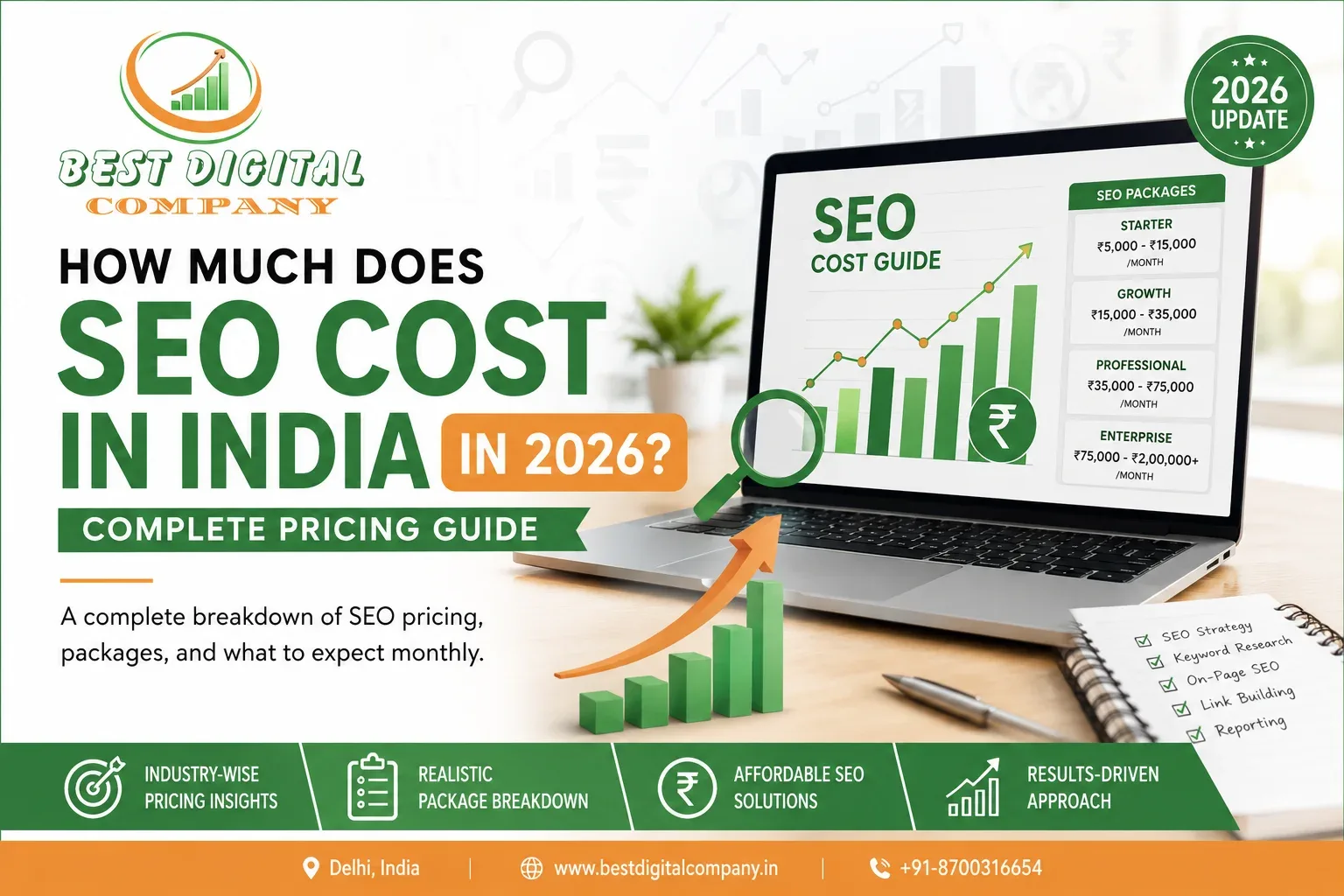
How Much Does SEO Cost in India in 2026? Complete Pricing Guide

How Much Does SEO Cost in India in 2026? Complete Pricing Guide

SEO in India costs anywhere from ₹5,000 to ₹1,00,000+ per month depending on your business size, competition level, and scope of work. Most small and medium businesses pay between ₹10,000–₹35,000/month for a solid, results-driven SEO campaign.

If you’ve been searching “SEO cost India” and getting wildly different answers – ₹3,000 from one agency, ₹80,000 from another you’re not alone. The SEO pricing landscape in India is genuinely confusing, and a lot of agencies don’t make it easy to compare.

We have been in the digital marketing space long enough to give you a straight answer. This guide breaks down real SEO pricing in India for 2026, explains what drives those numbers up or down, and helps you figure out what kind of budget actually makes sense for your business goals.

Why SEO Prices Vary So Much in India

Before jumping into numbers, it helps to understand that the wide range you see in SEO quotes reflects genuinely different levels of service, strategy, and scope not just agency greed. Here’s what actually moves the needle on price:

  • Your industry’s competitiveness. Ranking for “real estate in Mumbai” is a completely different challenge from ranking for “handmade candles in Jaipur.” More competition means more effort and higher cost.
  • The current state of your website. A brand-new site with zero authority needs far more foundational work than a five-year-old site with decent backlinks already in place.
  • Geographic targeting. Local SEO focused on one city costs significantly less than a national or multi-city campaign.
  • Number of pages and keywords. A 10-page service site needs far less optimization than a 500-page e-commerce store.
  • Agency type and quality. A freelancer, a boutique agency, and a full-service digital firm all charge differently and for good reason.

SEO Pricing Models in India – How Agencies Charge

Most SEO agencies in India use one of four pricing structures. Understanding these helps you compare quotes properly:

Monthly Retainer (₹8,000 – ₹1,00,000+/month) The most common model and the most sensible for ongoing SEO. You pay a fixed monthly fee for a defined scope of work. Best for businesses serious about long-term organic growth.

Project-Based (₹15,000 – ₹2,00,000/project) Used for one-time deliverables like a full SEO audit, site migration support, or a penalty recovery plan. Not ideal for ongoing campaigns.

Hourly Consulting (₹800 – ₹5,000/hour) Suited for businesses with in-house teams who need strategic guidance rather than execution. Rarely used by small businesses.

Performance-Based (varies) You pay based on rankings achieved or leads generated. Sounds appealing but is rare in practice because reputable agencies avoid it. Google rankings involve too many variables outside any agency’s control.


SEO Packages in India: What You Get at Each Price Point

Here is a realistic breakdown of what different price tiers actually deliver in 2026:


Starter Plan — ₹5,000 to ₹15,000 per Month

This is the entry level and works well for small local businesses ,a single dental clinic in Noida, a CA firm in Lucknow, or a boutique store in Chandigarh. At this price, a good agency will cover:

  • Keyword research across 10–20 target keywords
  • On-page SEO including meta tags, headings, and image alt text
  • Google Business Profile optimization
  • One to two blog posts per month
  • Basic technical fixes
  • A monthly performance report

What it won’t cover: serious link building, aggressive content output, or competitive national keywords. Manage your expectations accordingly.


Growth Plan — ₹15,000 to ₹35,000 per Month

This is the sweet spot for most Indian small and medium businesses. At this level, you get a comprehensive campaign that actually moves the needle:

  • 30–60 targeted keywords across short, medium, and long-tail terms
  • Full on-page and technical SEO
  • 3–5 SEO-optimized blog posts per month
  • Link building at 5–15 quality backlinks per month
  • Competitor gap analysis
  • Core Web Vitals and page speed optimization
  • Detailed monthly reporting with actionable insights

Professional Plan — ₹35,000 to ₹75,000 per Month

You’re looking at this range if you’re in a competitive vertical finance, real estate, healthcare, or ed-tech or if you’re targeting national audiences. Expect:

  • 80–150 keywords including high-difficulty terms
  • 6–10 high-quality content piecespermonth
  • Aggressive white-hat link building at 20–40 backlinks per month
  • E-E-A-T optimization (Experience, Expertise, Authoritativeness, Trust)
  • Structured data and schema markup implementation
  • A dedicated account manager

Enterprise Plan — ₹75,000 to ₹2,00,000+ per Month

Enterprise SEO is a different discipline entirely. Large e-commerce platforms, SaaS companies, and brands with thousands of indexed pages need dedicated teams, fully custom strategies, and constant technical oversight. This range also covers agencies managing SEO for clients in highly competitive industries like insurance, banking, or real estate portals.


10 Factors That Affect Your SEO Cost in India

You now know the ranges. But what specifically pushes you toward the higher or lower end? Here are the real factors a reputable agency weighs when quoting you:

  1. Keyword difficulty and competition — High-search, high-competition keywords require significantly more effort to rank for than niche long-tail terms.
  2. Website size — More pages means more to audit, optimize, and maintain on an ongoing basis.
  3. Domain age and authority — New domains need more time and link building. Established sites with existing authority are easier to move up the rankings.
  4. Current technical health — A site with crawl errors, broken links, and slow load times needs remediation work before optimization can begin.
  5. Content gaps — If you have little existing content, a significant amount needs to be created from scratch.
  6. Link profile quality — If your site has a history of spammy backlinks, a cleanup campaign adds both time and cost.
  7. Local vs. national vs. international targeting — Each step up in geographic scope multiplies the complexity and the effort required.
  8. Industry type — YMYL niches (Your Money or Your Life) — health, finance, legal — require extra E-E-A-T work to meet Google’s quality standards.
  9. Agency team structure — Are you getting a dedicated team or a shared resource pool? This dramatically affects both results and pricing.
  10. Reporting and communication frequency — Bi-weekly strategy calls, live dashboards, and custom reports cost more than a monthly automated PDF.

Cheap SEO vs. Quality SEO: The Real Cost of Going Too Low

If someone is offering you full SEO services for ₹999 to ₹2,999 per month, they are not doing real SEO. At that price point, the numbers simply do not add up for a legitimate service. What you will likely get are automated directory submissions, private blog network links, or in the worst case nothing at all.

We see this pattern regularly. A business comes to us after spending six months with a cheap provider, having paid ₹3,000–₹5,000 per month, and their site now has a Google manual penalty or has completely stagnated with no ranking movement. The cost of recovering from a Google penalty or simply starting over after wasted months is almost always higher than the cost of hiring a proper agency from day one.

Here is what separates cheap SEO from quality SEO across the key areas:

Keyword Research: Cheap providers give you basic or no research. Quality agencies do intent-based, competitor-mapped analysis that targets terms your customers are actually searching.

Content Creation: Cheap providers deliver spun or low-quality articles. Quality agencies produce original, well-researched content aligned with Google’s E-E-A-T guidelines.

Link Building: Cheap providers use automated tools or PBN links that carry penalty risk. Quality agencies do manual white-hat outreach to earn genuine backlinks.

Technical SEO: Cheap providers rarely touch the technical layer. Quality agencies run full audits and implement fixes that improve crawlability and Core Web Vitals.

Reporting: Cheap providers send vague automated PDFs. Quality agencies deliver custom, insight-driven reports that tell you what’s working and what needs adjustment.


SEO ROI in India: Is It Actually Worth the Investment?

Let’s talk about returns because this is what matters most to any business owner.

Organic search consistently delivers the highest ROI of any digital marketing channel for most Indian businesses. Unlike paid ads, which stop generating traffic the moment you stop paying, SEO builds compounding value over time. A page that earns a top ranking for a high-intent keyword can generate consistent leads for years with minimal ongoing cost.

To put it in concrete terms: a Delhi-based legal firm spending ₹25,000 per month on SEO generated over 40 qualified consultation requests per month from organic search alone within eight months. Their cost per lead from organic was under ₹625. Google Ads targeting the same keywords would have cost ₹3,000–₹8,000 per click in that same vertical.

For businesses with higher ticket sizes real estate, B2B services, healthcare, education, a single converted lead from SEO can recover months of investment. The math almost always works in favour of proper SEO when given enough time.


How Long Does SEO Take to Work in India?

This is one of the most common questions businesses ask, and it deserves an honest answer:

Months 1–2: Technical fixes, keyword mapping, on-page optimization. You won’t see ranking changes yet, but the groundwork is being set properly.

Months 3–4: You’ll start seeing movement for long-tail and low-competition keywords. Traffic may begin ticking upward.

Months 5–6: Noticeable improvements for medium-difficulty keywords. Lead generation from organic search typically begins here.

Months 6–12: Compounding results. High-intent keywords start ranking. Traffic and leads grow in a more meaningful way.

12+ months: You’re building a real competitive advantage. Strong rankings, consistent traffic, and growth that compounds every month.

Any agency promising Page 1 results in 30 days is either being dishonest or planning to use tactics that will hurt your site over time. Google does not move that fast for genuine organic rankings.


How to Choose the Right SEO Agency in India

With hundreds of agencies operating across Delhi, Mumbai, Bangalore, Hyderabad, and beyond, here is what separates the genuinely good from the rest:

  • They show you real case studies with before-and-after ranking and traffic data — not just client logos and award badges.
  • They audit your website before quoting you. A meaningful proposal cannot be written without understanding where your site currently stands.
  • They explain the reasoning behind their work. If they cannot tell you why they’re targeting a specific keyword or building a certain type of link, that is a serious problem.
  • They set realistic timelines and under-promise rather than over-sell.
  • They communicate proactively monthly reports, strategy updates, and a team member who is reachable when you have questions.
  • They are current on Google’s guidelines, including helpful content principles, E-E-A-T signals, Core Web Vitals, and what it takes to appear in AI-generated search overviews in 2026.

FAQ

Q1. How much does SEO cost in India per month?

SEO in India typically costs between ₹5,000 and ₹1,00,000+ per month. Small businesses usually invest ₹5,000–₹15,000/month, mid-size companies spend ₹15,000–₹50,000/month, and large enterprises budget ₹50,000–₹1,00,000+/month depending on competition and scope.

Q2. What is included in an SEO package in India?

A standard SEO package in India includes keyword research, on-page optimization, technical SEO audit, content creation, link building, Google Business Profile management, and monthly performance reporting. Premium packages also include Core Web Vitals fixes, schema markup, and competitor analysis.

Q3. Is cheap SEO worth it in India?

No. SEO services priced below ₹3,000/month almost always involve black-hat or automated tactics that can trigger Google penalties. The cost of recovering from a penalty is far higher than investing in a proper, white-hat SEO campaign from the start.

Q4. How long does SEO take to show results in India?

Most businesses see measurable improvements within 3–6 months. New websites or highly competitive niches may take 9–12 months. SEO compounds over time results at month 12 are significantly stronger than at month 3, which is why consistency matters more than speed.


Q5. What is the difference between local SEO and national SEO cost in India?

Local SEO, which targets one city or region, typically costs ₹5,000–₹20,000/month. National SEO targeting pan-India audiences requires more keywords, content, and link building usually ₹30,000–₹1,00,000+/month depending on the industry.


Q6. Can I do SEO myself instead of hiring an agency in India?

 Yes, but it requires 10–20 hours per week, paid tools like Ahrefs or SEMrush (costing ₹8,000–₹20,000/month alone), and continuous learning. For most business owners, the time cost and learning curve make hiring an agency more cost-effective than doing it in-house.


Ready to Get a Transparent SEO Quote?

At Best Digital Company, we don’t believe in vague proposals or hidden costs. We audit your site, understand your goals, and give you a clear plan with honest pricing.

📞 Call us: +91 8587948051

✉️ Email: Contact@bestdigitalcompany.com

🌐 Website: bestdigitalcompany.com

Whether you’re a local business looking to dominate your city or a growing brand aiming for national visibility, we’ll tell you exactly what’s needed and what it’ll cost.

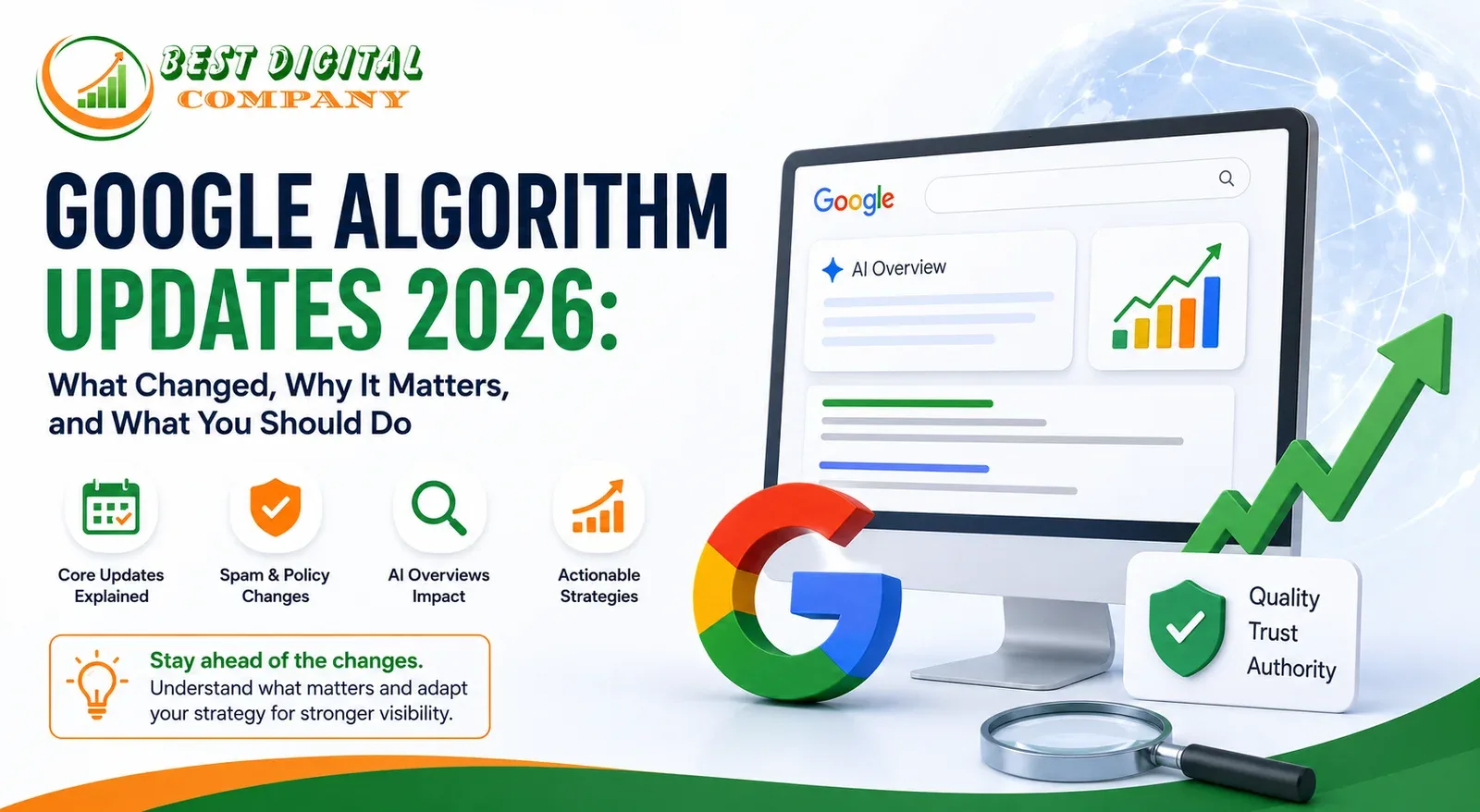
Google Algorithm Updates 2026

Google Algorithm Updates 2026: What Changed, Why It Matters, and What You Should Do

Search is undergoing its most dramatic transformation in a decade. AI Overviews are reshaping the SERP, update cadence is accelerating, and organic visibility now depends on signals far beyond keyword optimisation. This guide breaks down every confirmed update and tells you exactly what to do about each one.

Google still commands roughly 89% of global search traffic, a near-monopoly that makes every algorithm shift consequential for your business. But the rules of the game have shifted. Core updates no longer just reshuffle rankings; they determine whether your content surfaces inside AI-generated answers at all.

The pattern across every 2025–26 update is consistent: Google is building toward an intent-led, quality-first, AI-augmented search experience. Brands still chasing rankings with thin content, link manipulation, or heavy JavaScript are finding themselves penalised faster than ever. Those investing in genuine expertise and people-first content are seeing sustained gains.

Studies from BrightEdge (May 2025) show organic click-through rates can decline by up to 30% on AI-impacted SERPs particularly for informational queries that historically captured featured snippets. Understanding which updates affect your query types is now a strategic priority, not a technical afterthought.


What Did Google Change in the May 2026 Core Update and Is the Volatility Over?

Google officially began rolling out its May 2026 Core Update on 21 May, with full completion expected within two weeks. This update arrives on the heels of significant SERP volatility throughout April and May , many site owners had already been reporting ranking swings before Google even confirmed the update was live.

As with all broad core updates, no specific sites or industries are being targeted. The focus is on improving result relevance and quality overall. Early signals, however, point to continued refinement around content usefulness, search intent alignment, and the growing influence of AI Overviews on informational queries.

Notably, the short turnaround between the March and May updates signals a faster rollout cadence from Google, meaning SERP instability is likely to remain a fixture of the landscape for the foreseeable future.

What to watch:

  • Monitor traffic and ranking data carefully, but wait until the rollout settles before drawing conclusions
  • AI Overviews are becoming a primary SERP feature for informational queries, audit your content against this format
  • Expect further updates in quick succession throughout 2026

How Did the March 2026 Core Update Redefine What Google Considers “Quality”?

On 27 March, Google began its March 2026 Core Algorithm Update, a broad re-evaluation of how content earns rankings across the entire web. The rollout took approximately two weeks to complete, during which time many sites experienced notable fluctuations in visibility.

This wasn’t a penalty update. Google wasn’t targeting bad actors; it was recalibrating what “excellent” looks like. The result is a search engine that better rewards content demonstrating genuine usefulness, real-world expertise, and precise alignment with what users are actually trying to accomplish.

Google’s guidance was clear: avoid assessing performance while the rollout is still in progress. Meaningful analysis should only begin once rankings stabilise premature reactions often lead to unnecessary and counterproductive site changes.

Three pillars of the March 2026 update:

  • Intent alignment: Google’s ability to match queries with truly relevant content has been significantly refined
  • Quality signals: Greater weight given to originality, depth of insight, and credibility markers
  • People-first content: Content created primarily to capture rankings rather than serve readers continues to lose ground

What Tactics Did the March 2026 Spam Update Target and Are You at Risk?

Launched on 24 March, the March 2026 Spam Update moved fast completing its global rollout across all languages in under 24 hours. Unlike a core update, this wasn’t about re-ranking quality content; it was a precision strike on manipulative practices that violate Google’s Search Essentials.

Publishers relying on low-value auto-generated content, artificial link schemes, or other tactics designed to game rankings rather than serve users were the most exposed. Sites following Google’s guidelines and focused on genuine user value were largely unaffected.

Practices targeted by this update:

  • Thin, low-value, or AI-generated content with no meaningful insight for readers
  • Manipulative link schemes including unnatural backlinks acquired purely for ranking signals
  • Deceptive tactics designed to disguise intent or mislead crawlers about page content

If your site was unaffected, this is validation that your approach is sound not cause for complacency. Spam detection capabilities will only improve.


Why Did Google Update Discover Separately and What Does It Mean for Your Content Strategy?

On 5 February, Google rolled out a core update targeting Google Discover not traditional Search. This distinction matters: the Discover feed operates on different signals to the main SERP, surfacing content based on user interests, browsing patterns, and engagement behaviours rather than keyword queries.

The update launched first for English-language users in the US before expanding globally over approximately two weeks. Its purpose was to improve the relevance and quality of Discover content elevating timely, original, people-first publishing while deprioritising click-bait and algorithmically engineered engagement traps.

What this update prioritised:

  • Freshness and topical relevance — content that speaks to current interests and emerging conversations
  • User engagement signals — indicators that real readers are finding and valuing your content
  • Original, authoritative publishing — especially from established sources with demonstrated subject expertise

If Discover is a meaningful traffic source for your site, treat this update as a signal to double down on high-quality editorial content rather than optimising for engagement metrics alone. The two are increasingly in tension.


What Made the December 2025 Core Update One of the Year’s Most Impactful?

The December 2025 Core Algorithm Update launched on 11 December and ran for 18 days, completing on 29 December. Spanning the holiday period, a critical trading window for many e-commerce and travel businesses, its timing amplified the commercial stakes for sites caught on the wrong side of the update.

Sites publishing helpful, authoritative, and people-first content saw visibility gains. Those relying on thin content, outdated material, or heavily optimised pages built more for crawlers than humans experienced meaningful declines.

Google’s consistent message remains: there is no shortcut to recovering from core update losses. The only durable path is building genuinely useful content that serves real user needs over time.

Key emphasis areas:

  • Content quality and depth — original, expert-led content continues to outperform aggregated or recycled material
  • Relevance evaluation — refining how accurately pages match the underlying intent of search queries
  • Devaluation of over-optimised content — pages clearly built for rankings rather than readers

What Did the August 2025 Spam Update Mean for Sites Using Automated Content?

Launched on 26 August and completing on 21 September after a 26-day rollout, the August 2025 Spam Update was one of the more extended spam actions Google has undertaken. Its focus: strengthening detection of manipulative practices and reinforcing the visibility of trustworthy, high-quality sites.

Sites using automation to generate content at scale without genuine editorial value — were among the most exposed. So were those using keyword stuffing or unnatural link patterns as shortcuts to ranking.

Practices in the crosshairs:

  • Keyword stuffing and programmatic content generation without human editorial oversight
  • Unnatural backlink patterns — particularly links acquired through schemes rather than earned editorially
  • Deceptive ranking tactics — any technique designed to manipulate perceived quality signals

What Should Marketers Know About the June 2025 Core Update and Google’s AI Mode?

Announced on 30 June 2025, the second broad core update of the year arrived alongside several significant structural changes to how Google presents search results. The rollout lasted up to three weeks and its timing coincided with Google’s accelerating shift toward AI-augmented search experiences.

Three parallel developments made this period particularly significant for SEO practitioners:

Search Console Insights: Google rolled out a consolidated view of key metrics – impressions, clicks, and trending content performance over time, giving site owners better tools to understand performance shifts in context.

SERP simplification: Google began phasing out certain structured data types to streamline the search results page. Some visual enhancements powered by lesser-used markup types no longer appear, a shift toward a cleaner presentation that also has implications for rich result strategy.

AI Mode maturation: Google’s AI Mode continued expanding, bringing with it a well-documented challenge: organic CTR on AI-impacted SERPs can fall by up to 30% for informational query types. Visibility in AI-generated answers is increasingly a strategic objective alongside traditional ranking.

Strategic implications:

  • Audit your structured data strategy — not all schema types now translate into visible rich results
  • Track AI Overview appearances separately from traditional rank tracking
  • Optimise for answer-engine visibility, not just position — structure content to be surfaced as a cited source

How Did the March 2025 Core Update Change Google’s Approach to Content Authenticity?

On 13 March, Google began rolling out its first confirmed core update of 2025, completing exactly two weeks later on 27 March. The update focused on improving both quality and relevance of search results with a particular emphasis on originality and authenticity in an era of proliferating AI-generated content.

Sites publishing high-quality, authoritative content saw improved rankings. Those with thin, low-value content or those suspected of using AI-generated material without meaningful human enhancement faced visibility declines.

Three key changes introduced:

  • Enhanced content evaluation systems to better assess originality and genuine usefulness beyond surface-level signals
  • Crackdown on “parasite SEO” — the practice of hosting third-party low-quality content on reputable domains to piggyback on their authority
  • Refined spam detection specifically targeting manipulative ranking practices that don’t serve user needs

Did Google’s January 2025 Local Rankings Shift Reveal a Bug or a Deliberate Change?

In early January 2025, local businesses and SEO professionals across the industry reported dramatic, overnight changes to Google local search rankings with some describing their visibility as having “fallen off a cliff” with no warning.

Despite widespread speculation about a possible update, Google never confirmed one had taken place. Tracking tools detected significant volatility, but rankings stabilised relatively quickly — a pattern more consistent with a technical anomaly than a deliberate algorithmic change.

The SEO community consensus converged on the same conclusion: this was most likely an unconfirmed bug rather than an intentional ranking adjustment. If your local rankings shifted significantly during this period and subsequently recovered, this interpretation is probably correct.

The January 2025 local volatility is a useful reminder that not every ranking change signals an algorithmic shift. Wait for stabilisation and context before making reactive site changes.


Why Did the December 2024 Updates Keep Shaking Rankings Well into the New Year?

While January 2025 saw no new confirmed updates, early-year volatility was significant  and it traced directly back to the December 2024 algorithm and spam updates, which caused some of the most widespread ranking disruption in recent years. The aftershocks persisted well into January as Google’s systems continued adjusting.

The December updates targeted multiple dimensions simultaneously: low-quality content, manipulative link-building, thin or AI-generated copy, and the increasingly common practice of producing content purely to capture search traffic rather than serve real user needs. E-commerce, travel, and health sectors were among the most visibly impacted.

Sites adhering to Google’s E-E-A-T guidelines demonstrating Experience, Expertise, Authoritativeness, and Trustworthiness consistently emerged from this period in stronger positions than those relying on shortcuts.

A separate but significant warning from Google in December highlighted the risk of JavaScript-heavy architecture in an AI-search world. With AI crawlers now accounting for approximately 28% of Googlebot traffic, rendering-dependent content creates accessibility problems. Google’s recommendation embedding essential content in initial HTML and adopting server-side rendering has significant implications for technical SEO strategy heading into 2026.

What drove recovery for affected sites:

  • Genuine E-E-A-T signals: demonstrated real-world expertise, credible authorship, and trustworthy sourcing
  • Original, user-focused content free from thin padding or keyword engineering
  • Server-side rendering adoption to ensure content accessibility for both traditional crawlers and AI agents
  • Removal or noindex of low-value pages that diluted overall site quality signals

Still Confused About How Google Updates Work? Here Are the Key Concepts Explained

What Are Google Algorithm Updates, and Why Do They Keep Changing?

Google makes hundreds of changes to its search algorithms every year. Most are minor barely noticeable adjustments to edge cases or spam signals. But several times a year, Google releases what it calls “broad core updates” significant re-evaluations of how content across the entire web should be ranked.

The purpose is not to penalise sites, but to improve the overall quality and relevance of search results. Google’s algorithms are imperfect; core updates represent Google’s attempt to correct for gaps or biases in how content was previously evaluated. The three areas consistently emphasised are:

  • Prioritising high-quality, genuinely helpful content over content engineered for rankings
  • Detecting and demoting spam, manipulation, and low-value tactics
  • Improving understanding of user intent — what people are actually trying to accomplish with a query

What Is a Google Spam Update, and How Is It Different From a Core Update?

A spam update is a targeted, precision action aimed at specific manipulative practices that violate Google’s guidelines. Unlike broad core updates which re-evaluate content quality across the board spam updates are surgical: they focus on detecting and demoting content that actively attempts to deceive or manipulate the search engine.

Common practices addressed in spam updates include:

  • Thin or low-value content with little genuine insight for the reader
  • Programmatically generated content created at scale without meaningful editorial oversight
  • Artificial backlinks and link schemes designed to inflate authority signals
  • Deceptive tactics intended to misrepresent page content or intent

If your site follows Google’s Search Essentials and creates content genuinely serving users, spam updates should not affect you.

What Is a Google Core Update, and How Do You Recover From One?

A core update is a broad change to Google’s core ranking systems, the fundamental mechanisms by which content across the web is evaluated and ordered. These updates happen several times a year and can cause significant visibility shifts for sites across all industries and sectors.

The critical point about core update recoveries: there is no quick fix. Google has repeatedly stated that if a site loses rankings in a core update, the appropriate response is not technical tinkering or short-term SEO manoeuvres,  it is a genuine, sustained effort to improve overall content quality. The four areas consistently at the centre of core update evaluation are:

  • Content quality and depth — rewarding original, well-researched, expert-led material
  • Relevance to search intent — matching pages to what users are actually trying to accomplish
  • Authority and trust signals — giving greater weight to credible, reliable, well-sourced content
  • User-first design — favouring experiences built for human readers over those built for crawlers

Recovery is possible — but it typically requires waiting for the next core update to see the effect of improvements. This reinforces why sustained content investment is a more resilient long-term strategy than reactive optimisation.


Is Your SEO Strategy Built for the AI Search Era?

The updates above share a common thread: Google is moving decisively toward an AI-augmented, quality-first, intent-driven search experience. Organic strategies built on thin content, link manipulation, or technical shortcuts are losing ground and losing it fast.

The brands that will win in 2026 and beyond are those investing in genuine expertise, people-first content, and AI visibility alongside traditional rankings. That means auditing not just where you rank but whether you’re being surfaced inside AI Overviews, Discover feeds, and answer-engine results across the board.

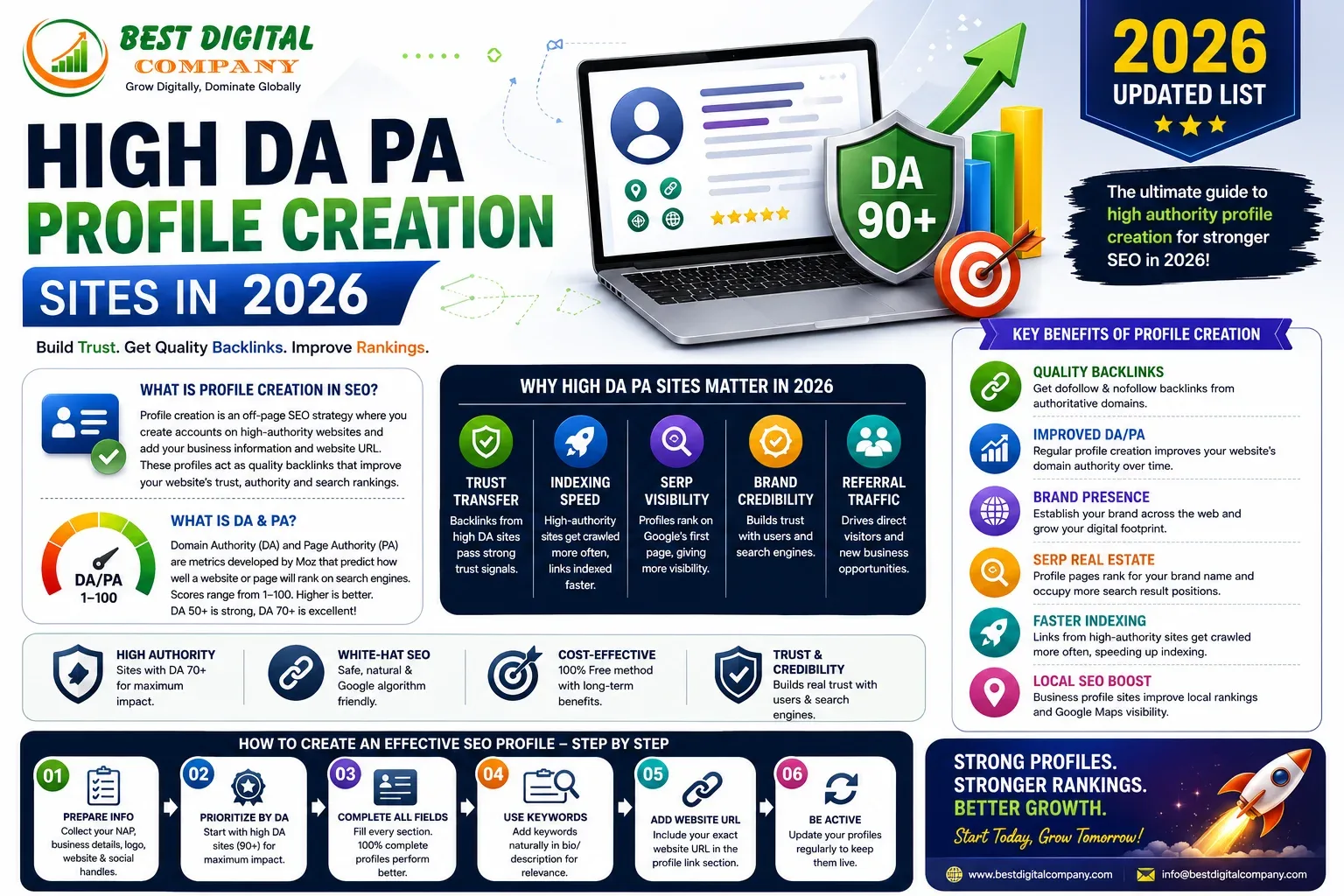
High DA PA Profile Creation Sites in 2026

High DA PA Profile Creation Sites in 2026

What is Profile Creation in SEO?

Profile creation is a powerful off-page SEO strategy where you create accounts on high-authority websites, directories, and platforms and add your business information, website URL, and relevant details. These profile pages act as quality backlinks pointing to your website, signaling trust and relevance to search engines like Google.

In 2026, with Google’s ever-evolving algorithm, the quality and authority of backlinks matter more than ever. Profile creation on high DA (Domain Authority) and high PA (Page Authority) sites remains one of the most cost-effective and white-hat link-building techniques available to SEO professionals and businesses alike.

What is DA & PA?

Domain Authority (DA) and Page Authority (PA) are metrics developed by Moz that predict how well a website or a specific page will rank on search engines. Scores range from 1–100; higher is better. A DA of 50+ is considered strong, and DA 70+ is excellent for backlink purposes.


Why High DA PA Sites Matter in 2026

Not all backlinks are created equal. In 2026, Google’s algorithms including helpful content updates and link spam filters place enormous emphasis on link quality over quantity. Here’s why targeting high DA PA profile creation sites is critical:

  • Trust Transfer: A backlink from a DA 90+ site (like LinkedIn or Crunchbase) passes significant trust signals to your website.
  • Indexing Speed: Search engines crawl high-authority sites more frequently, meaning your backlinks get indexed faster.
  • SERP Visibility: Profiles on high DA sites often rank on the first page for branded searches, giving you additional SERP real estate.
  • Brand Credibility: Being listed on authoritative platforms builds trust with both users and search engines.
  • Referral Traffic: Beyond SEO, these profiles can send direct referral visitors to your website.

Key Benefits of Profile Creation

🔗 Quality Backlinks Create dofollow and nofollow backlinks from authoritative domains that improve your overall link profile naturally.

📈 Improved DA/PA Consistent profile creation gradually improves your own domain authority over time as more high-authority sites link back to you.

🌐 Brand Presence Establish your brand across the web and increase your digital footprint significantly across multiple platforms.

👁️ SERP Real Estate Profile pages can rank for your brand name, occupying more Google search result positions and pushing competitors down.

🚀 Faster Indexing Links from high-authority sites are crawled more often by Google, helping your new pages get indexed more quickly.

💼 Local SEO Boost Business profile sites help improve local search rankings and Google Maps visibility for location-based queries.


Top High DA PA Profile Creation Sites  – 2026 Updated List

Below is our comprehensive, verified, and regularly updated list of the best profile creation sites categorized by Domain Authority. All sites listed are free and accept profile submissions.

 Pro Tip: Start with the highest DA sites and work your way down. Focus on completing 100% of your profile – sites with complete, rich profiles tend to rank higher and pass more link equity to your website.


Websites
https://www.pexels.com/
https://solo.to/
https://giphy.com/
https://dribbble.com/
https://makerworld.com/
https://www.dibiz.com/
https://gettr.com/
https://www.wireanium.com/
https://app.parler.com/
https://hashnode.com/
https://www.ganjingworld.com/
https://dreevoo.com/
https://www.beatstars.com/
https://justpaste.it/
https://www.instructables.com/
https://www.goodreads.com/
https://www.kickstarter.com/
https://www.stylevore.com/
https://www.tm-town.com/
https://nova-driving-school.mn.co/
https://arzookanak110000.mn.co/
https://mitcio.com/
https://www.ameba.jp/
https://pantip.com/
https://www.quora.com/
https://www.4shared.com/
https://www.ted.com/
https://independent.academia.edu/
https://soundcloud.com/
https://www.behance.net/
https://about.me/
https://www.reddit.com/
https://gitlab.com/
https://flipboard.com/
https://wakelet.com/
https://forum.prestashop.com/
https://www.storeboard.com/
https://interestpin.com/
https://stocktwits.com/
https://www.slideshare.net/
https://files.fm/
https://leetcode.com/
https://www.wowonder.xyz/
https://stck.me/
https://paladinscounter.com/
https://www.dailymotion.com/
https://booklog.jp/
https://www.noteflight.com/
https://www.renderosity.com/
https://www.redbubble.com/
https://longbets.org/
https://gravatar.com/
https://myanimelist.net/
https://www.zumvu.com/

How to Create an Effective SEO Profile  – Step by Step

Step 1 – Prepare Your Business Information Before starting, compile your NAP details, business description (150–300 words, keyword-rich), website URL, logo, profile photo, and social media handles. Consistency is key across all platforms.

Step 2 – Prioritize by DA Score Start with DA 90+ sites (LinkedIn, Google Business Profile, Pinterest). High authority profiles tend to get indexed quickly and pass the most link equity to your website.

Step 3 – Complete Every Field Fill in every available field — username, bio, website, location, skills, etc. Profiles with 100% completion score are treated more favorably by both the platform and search engines.

Step 4 – Use Target Keywords Naturally Include your primary and secondary keywords in your bio/description naturally. For example: “Best Digital Company – a leading digital marketing agency in Delhi specializing in SEO, PPC, and web development.”

Step 5 – Add Your Website URL Always add your exact website URL in the designated website/URL field. This is the primary backlink you are creating. Use UTM parameters to track referral traffic in Google Analytics.

Step 6 – Verify Your Account Complete email verification and, where possible, phone or business verification. Verified profiles rank higher and are taken more seriously by search engines and users.

Step 7 – Stay Active & Engage Inactive profiles lose authority over time. Post updates, share content, and engage with the platform’s community. Active profiles retain their SEO value and often gain additional visibility.

 Expert Tip from Best Digital Company: Build a spreadsheet tracking every profile you create  include the site URL, DA, PA, username, password, submission date, and verification status. This saves time during audits and ensures consistency.


Common Mistakes to Avoid in Profile Creation

  • Creating Too Many Profiles at Once: Pace your submissions creating 50+ profiles in a single day can look spammy to Google. Aim for 5–10 per day consistently.
  • Using Duplicate Content: Write a slightly different bio for each platform rather than copy-pasting the exact same description everywhere.
  • Leaving Profiles Incomplete: Incomplete profiles waste the opportunity and send weak signals to search engines.
  • Inconsistent NAP Information: Differences in business name, address, or phone number across profiles can hurt local SEO significantly.
  • Ignoring Profile Photo/Logo: Profiles without images appear unprofessional and are less likely to be trusted by users and platforms.
  • Using Exact-Match Anchor Text Everywhere: Vary your anchor text, use brand name, URL, and generic terms to maintain a natural link profile.
  • Not Tracking Results: Always monitor your backlinks using tools like Ahrefs, SEMrush, or Moz to understand which profiles are passing the most value.

Frequently Asked Questions

How many profile creation sites should I submit to per day?

As a safe practice, submit to 5–10 high-quality profile creation sites per day. Avoid mass submissions in a short period, as this can appear unnatural and trigger Google’s spam filters.

Do nofollow links from profile creation sites help SEO?

Yes. While nofollow links don’t directly pass PageRank, they contribute to a natural, diverse link profile which Google values. They also drive referral traffic and increase brand visibility across the web.

How long does it take to see results from profile creation?

Profile creation is a cumulative strategy. You may start noticing improvements in domain authority and ranking signals within 4–8 weeks, with more significant results visible after 3–6 months of consistent effort.

Is profile creation safe for SEO in 2026?

Yes, profile creation on legitimate, high-authority platforms is a completely white-hat, Google-approved SEO strategy. Focus on quality over quantity and ensure your profiles are genuine, complete, and actively maintained.

Which profile creation sites are best for local SEO in India?

For local SEO in India, the top sites include Google Business Profile, Justdial, Indiamart, Sulekha, Cylex.in, and Asklaila. These platforms specifically help improve visibility in local Indian search results and Google Maps.


Conclusion

Profile creation on high DA PA sites remains one of the most effective, affordable, and Google-safe link-building strategies in 2026. By consistently creating and optimizing profiles on authoritative platforms, you can significantly improve your website’s domain authority, search engine rankings, and overall online visibility.

The key is quality, consistency, and patience. Focus on the top-tier sites first, complete every profile 100%, maintain NAP consistency, and stay active on platforms. Pair this strategy with other off-page SEO activities like guest blogging, social bookmarking, and content marketing for maximum impact.

If you need professional help with your SEO strategy from profile creation to complete link-building campaigns,  Best Digital Company is here to help.

📞 +91 8587948051

✉️ Contact@bestdigitalcompany.com

🌐 bestdigitalcompany.com

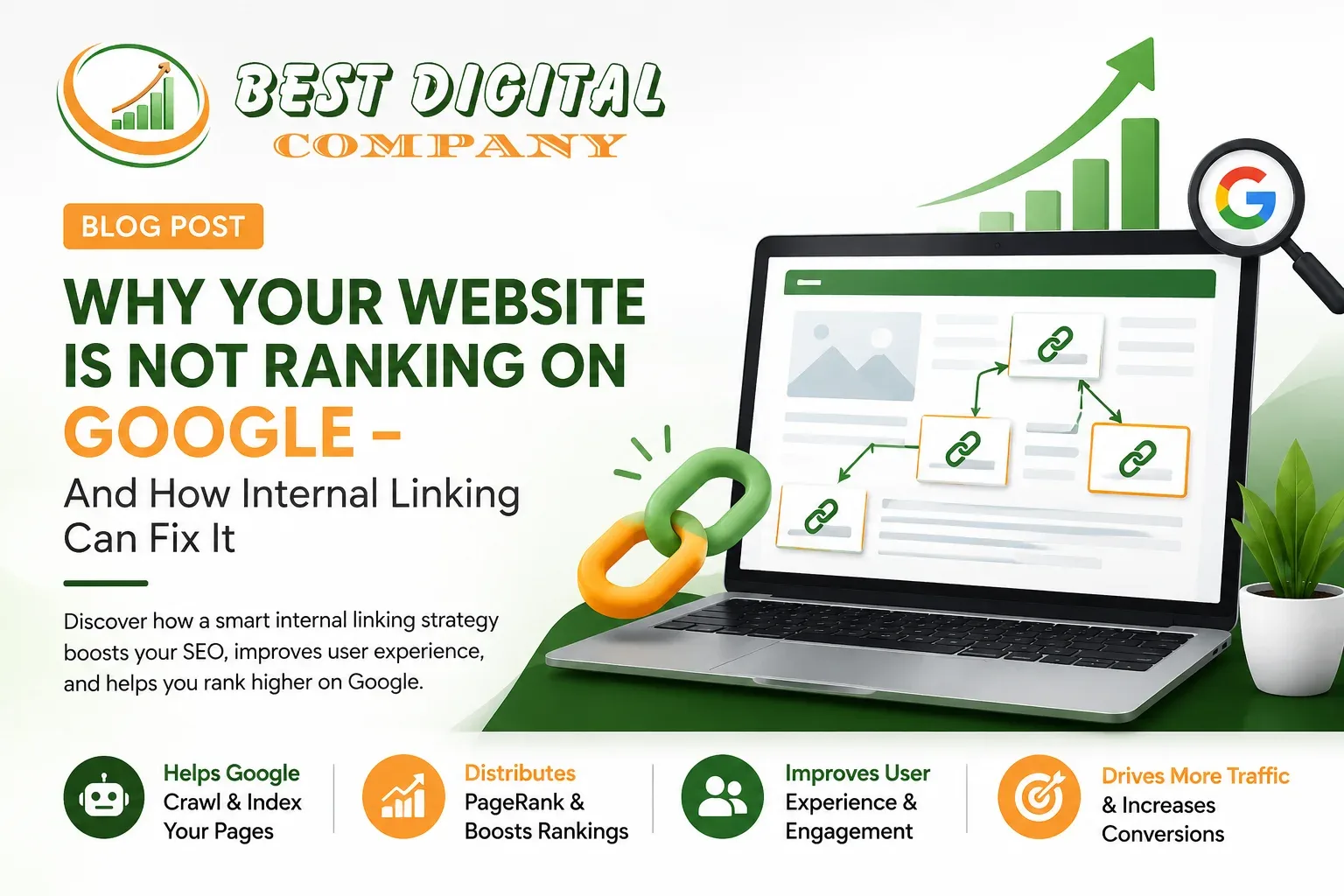
Why Your SEO Is Failing: The Power of Internal Linking Explained

Why Your SEO Is Failing: The Power of Internal Linking Explained

Every week, businesses invest thousands into content, technical audits, and paid backlinks, yet their SEO rankings refuse to budge. Traffic trickles in but never floods. Conversions stay modest. Sound familiar?

Here is something most agencies won’t tell you upfront: internal linking is one of the highest-impact, lowest-cost SEO levers you have and most websites use it wrong, or barely at all.

In this guide, we break down exactly what internal linking is, why it directly affects your Google rankings in 2026, and how to build a winning internal link structure that sends the right signals to search engines and users alike.


What Is Internal Linking And Why Does It Matter?

An internal link is a hyperlink that points from one page on your website to another page on the same domain. Simple enough. But the strategic placement of these links is what separates websites that dominate the first page from those that never crack the top 10.

Internal links serve three critical purposes simultaneously:

They guide Googlebot. Search engine crawlers discover new pages by following links. Without a proper internal link structure, many of your pages will never be crawled ,let alone indexed.

They distribute PageRank (link equity). Every time a page earns a backlink, that authority can be passed inward. Internal links are the pipes through which this equity flows to your most important pages.

They shape user experience. Smart internal linking keeps visitors engaged, reduces bounce rates, and guides users toward conversion pages ,all of which are positive behavioural signals that Google actively measures.

If your SEO strategy doesn’t include a deliberate internal linking plan, you are essentially building a maze with no signposts bad for visitors, worse for Google.

Did you know? Google’s John Mueller has publicly confirmed that internal links are “very important” for helping Google understand your site structure and which pages you consider most valuable. Ignoring them means leaving real ranking power on the table.


The Most Common Internal Linking Mistakes That Kill SEO

Before we dive into the fixes, let’s identify the patterns that are actively harming your rankings right now.

1. Orphan Pages

An orphan page has no internal links pointing to it. Googlebot will rarely find it, and even if it does, the page receives no link equity. These pages are effectively invisible to search engines. Run a crawl audit, you may be shocked at how many orphan pages your site has.

2. Over-Relying on Navigation Links

Your header and footer navigation links count, but they carry far less contextual weight than in-content links. If every page is only linked from the nav menu, Google sees a flat, undifferentiated hierarchy with no prioritisation of your important pages.

3. Generic Anchor Text

Linking with phrases like “click here” or “read more” tells Google absolutely nothing about the destination page’s topic. Keyword-rich, descriptive anchor text helps Google understand relevance and directly boosts the ranking potential of the target page.

4. Broken Internal Links

Linking to pages that return a 404 error wastes your crawl budget and passes no equity. Regular audits are essential especially after site migrations, page deletions, or URL restructuring.

5. Ignoring Deep Pages

The deeper a page sits within your site’s structure more than 3 clicks from the homepage the less authority it typically receives and the less often it gets crawled. Flattening your architecture through strategic internal links solves this entirely.


How Google Reads Your Internal Link Structure in 2026

Google’s crawling and ranking systems have grown dramatically more sophisticated. In 2026, here’s what Googlebot prioritises when evaluating your internal link structure:

  • Topical clusters: Google rewards sites that organise content into tightly linked topic clusters pillar pages surrounded by cluster pages. Internal links signal which pages belong together thematically.
  • Contextual relevance: Links embedded naturally within body content carry significantly more weight than those in sidebars, footers, or boilerplate sections.
  • Anchor text diversity: A natural mix of exact-match, partial-match, and branded anchors looks organic and avoids over-optimisation signals.
  • Link depth and crawl prioritisation: Pages linked from the homepage or high-authority pages get crawled more frequently and receive more distributed equity.
  • E-E-A-T reinforcement: Linking between topically authoritative pages signals genuine expertise and depth an increasingly critical ranking factor under Google’s Helpful Content guidelines.

Pro Tip: Think of your website as a spider’s web. Every page is a node. The strength of the web depends on how many threads connect each node. The more contextually relevant internal links pointing to a page, the stronger its position in Google’s index.


Building a Winning Internal Link Strategy: Step by Step

Here is a practical, actionable framework our team at Best Digital Company uses for clients across India whether they need SEO Services in Mumbai, are growing businesses seeking SEO Services in Punjab, or enterprises scaling with SEO Services in Haryana.

Step 1: Audit Your Current Internal Links

Use a crawl tool -Screaming Frog, Ahrefs Site Audit, or Google Search Console, to map all existing internal links. Identify orphan pages, broken links, redirect chains, and pages with too few inbound internal links. This becomes your baseline for everything that follows.

Step 2: Define Your Site Architecture & Priority Pages

Decide which pages are your most strategically important, typically your commercial service pages and high-converting landing pages. These are your “pillar” pages. Every other relevant page on your site should have a pathway linking toward them. For example, every blog post about SEO should link contextually to your core SEO services page.

Step 3: Build Topical Clusters

Group your content into topic silos. A pillar page covers a broad topic broadly; cluster pages go deep on specific sub-topics, all linking back to the pillar and to each other where relevant. This structure builds topical authority and signals to Google that your site genuinely covers the subject comprehensively.

Step 4: Use Descriptive, Keyword-Rich Anchor Text

When linking to your PPC advertising services, use anchor text like “Google Ads management” or “pay-per-click campaign services” not “learn more.” Be descriptive, be natural, and vary your anchors consistently across multiple linking pages.

Step 5: Link New Content to Existing Pages Immediately

Every time you publish a new blog post or landing page, add contextual internal links from it to 3–5 relevant existing pages, and go back and add links from existing pages to the new one. This two-way linking accelerates indexation and distributes equity from day one.

Step 6: Monitor, Measure & Iterate

Set up tracking in Google Search Console and Google Analytics 4 to monitor which pages gain ranking improvements after internal link updates. Crawl your site quarterly. SEO is an ongoing, evolving system not a one-time fix.


How Best Digital Company Handles Internal Linking for Clients

Our approach to internal linking is never just technical, it is strategic and content-driven at every level. When a client comes to us with stagnant rankings, internal link architecture is always among the first areas we investigate, and frequently one of the fastest wins available.

We integrate deliberate internal linking strategy across all our services:

  • Search Engine Optimization (SEO) — full site architecture mapping, link equity analysis, and cluster-building
  • Social Media Marketing (SMM)driving engaged traffic that lands on well-linked, high-converting pages
  • Pay-Per-Click Advertising (ADS) ensuring ad landing pages are supported by strong internal link authority
  • Web Development building sites from the ground up with SEO-friendly architecture and logical navigation hierarchies

We also offer tailored packages designed for different business sizes and goals. Whether you need a comprehensive SEO Package, a focused SMO Package, or a complete Web Development Package our strategies always include internal linking architecture as a core deliverable, not an afterthought.


Internal Linking Best Practices

Google’s recent algorithm updates particularly around Helpful Content and E-E-A-T have raised the bar significantly. Here is what matters most right now:

  • Quality over quantity. Five highly relevant internal links beat fifty random ones. Every link should serve the reader and reinforce topical relevance.
  • Aim for no more than 100 links per page as a general guideline. Beyond this, each individual link carries less distributed equity.
  • Always use follow links internally. There is almost never a valid reason to nofollow an internal link. You want equity to flow freely within your own domain.
  • Fix all redirect chains. If internal links pass through multiple redirects before reaching the destination, equity is significantly diluted. Always link directly to the final canonical URL.
  • Prioritise contextual placement. Links appearing in the first 100–200 words of a page carry slightly more weight in Google’s evaluation. Lead with your most important contextual links.
  • Mobile-first consideration. Ensure internal links are tap-friendly with adequate spacing on mobile. Poor UX signals high bounce rates, low dwell time directly impact your rankings.

Internal Linking for Local SEO: A Powerful Combination

If your business targets customers in specific cities or regions across India, internal linking becomes even more powerful. By creating dedicated location pages and linking to them from blog posts, service pages, and the homepage, you send strong geo-relevance signals to Google.

For example, a digital agency targeting clients across India might build a cluster of city-specific service pages like our SEO Services in Mumbai, SEO Services in Punjab, and SEO Services in Haryana and then systematically link to each from relevant blog content, the main services hub page, and the homepage footer.

This creates a geographic authority cluster that tells Google precisely where you operate, which local searches you should rank for, and how committed your local presence genuinely is.


Frequently Asked Questions

How many internal links per page is ideal?

There is no single perfect number, but a practical guideline for most sites is 3–10 contextual internal links per standard blog post or landing page. The links should feel natural and genuinely serve the reader’s journey. Avoid stuffing links purely for SEO, Google’s systems are sophisticated enough to detect and discount over-optimised patterns. Quality of placement matters far more than raw volume.


Does anchor text really make a difference for internal links?

Absolutely and it is one of the most underestimated factors in on-page SEO. Descriptive, keyword-relevant anchor text helps Google understand the topic of the destination page and reinforces its relevance for specific search queries. Using “click here” or “read more” misses this opportunity entirely. Use natural, varied, descriptive anchors consistently for measurable improvements in target page rankings.


 Should I update old blog posts to add internal links?

Yes and this is one of the most cost-effective SEO actions you can take right now. Revisiting existing content and adding contextual links to strategically important pages distributes your existing authority and can produce meaningful ranking improvements within weeks, without creating a single new piece of content. Many of our clients see quick wins from this alone.


Can internal linking replace backlinks?

No and you wouldn’t want it to. Backlinks from authoritative external sites remain one of Google’s most powerful ranking signals. However, internal links amplify the value of the backlinks you already have by distributing that authority precisely to the pages that need it most. Think of them as complementary forces working together, not alternatives to each other.


How soon will I see results after fixing internal links?

Results typically begin to appear within 4–12 weeks, depending on how frequently Google crawls your site. After updating your internal link structure, you can request re-crawling of updated pages in Google Search Console to accelerate the process. Sites with stronger existing domain authority tend to see improvements on the faster end of this window.


What tools should I use to audit internal links?

The most commonly used tools are Screaming Frog SEO Spider (excellent for small to mid-size sites), Ahrefs Site Audit, Semrush Site Audit, and Google Search Console’s Coverage and Links reports. For most businesses, starting with Google Search Console (free) and one premium crawl tool gives you everything you need to identify and fix internal linking issues systematically.


Is internal linking part of on-page SEO or technical SEO?

It sits at the intersection of both. The strategy and anchor text selection is on-page SEO; the crawlability, redirect chains, and site architecture aspects are technical SEO. This is precisely why internal linking is so valuable fixing it delivers improvements across both disciplines simultaneously, making it one of the highest-ROI SEO activities available to any website.


Ready to Fix Your SEO From the Inside Out?

Internal linking is not a minor detail ,it is the structural backbone of a high-performing website. If your rankings have plateaued despite producing good content and earning backlinks, there is a strong chance your internal link architecture is the missing piece.

At Best Digital Company, we specialise in building SEO strategies that actually move the needle combining technical excellence, content strategy, and smart internal linking into a single, unified approach.

📞 Call us: +91 8587948051

✉️ Email us: Contact@bestdigitalcompany.com

🌐 Visit: bestdigitalcompany.com

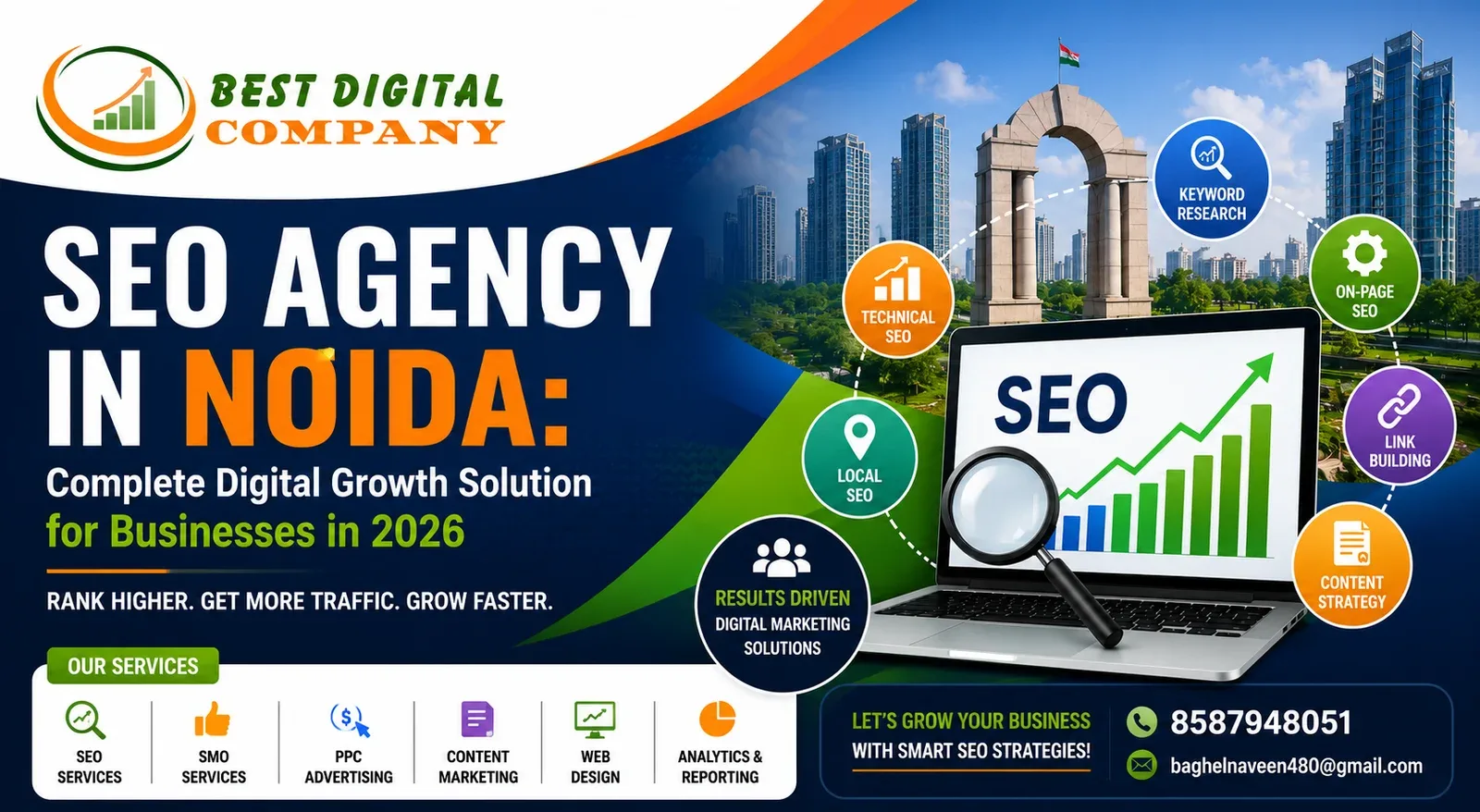
SEO Agency In Noida

SEO Agency In Noida: Complete Digital Growth Solution for Businesses in 2026

In today’s competitive digital landscape, simply having a website is no longer enough. Businesses need visibility, traffic, leads, and conversions to stay ahead of competitors. Whether you own a startup, local business, eCommerce store, healthcare clinic, educational institute, or enterprise company, investing in professional SEO services can significantly improve your online presence.

If you are looking for a trusted SEO Agency In Noida, this comprehensive guide will help you understand why SEO is essential, how it works, and how a professional digital marketing company can accelerate your business growth.

Why SEO Matters in 2026

Search Engine Optimization (SEO) remains one of the most effective digital marketing strategies for generating consistent organic traffic. While paid advertising stops producing results once your budget ends, SEO continues to generate leads and visibility over time.

Modern SEO is no longer limited to ranking on Google. Businesses must optimize their content for:

  • Google Search
  • AI Overviews
  • ChatGPT recommendations
  • Voice Search
  • Bing AI
  • Gemini AI
  • Local Search Results
  • Maps Listings

This is where a professional SEO Agency In Noida can help businesses establish authority across multiple search platforms.

What Does an SEO Agency In Noida Do?

A professional SEO agency helps businesses improve their search engine visibility through strategic optimization techniques.

Key SEO services include:

1. Website SEO Audit

A complete analysis of your website identifies issues affecting rankings such as:

  • Slow page speed
  • Broken links
  • Duplicate content
  • Poor user experience
  • Technical SEO errors

2. Keyword Research

Finding the right keywords is essential for attracting targeted visitors.

Examples:

  • SEO Agency In Noida
  • Best Digital Marketing Company In Noida
  • SEO Services Near Me
  • Local SEO Company
  • eCommerce SEO Services

3. On-Page SEO

Optimizing:

  • Meta Titles
  • Meta Descriptions
  • Header Tags
  • Internal Linking
  • Content Structure
  • Image Optimization

4. Technical SEO

Technical improvements include:

  • XML Sitemap Creation
  • Schema Markup
  • Core Web Vitals Optimization
  • Mobile Responsiveness
  • HTTPS Security
  • Crawlability Improvements

5. Content Marketing

High-quality content builds authority and attracts organic traffic.

Examples:

  • Blogs
  • Case Studies
  • Industry Guides
  • FAQs
  • Service Pages

6. Link Building

Acquiring quality backlinks improves domain authority and rankings.

7. Local SEO

Businesses targeting local customers need optimization for:

  • Google Business Profile
  • Local Citations
  • Maps Rankings
  • Location-Based Keywords

Why Choose the Best Digital Marketing Company In Noida?

Many businesses struggle because they hire agencies that focus only on rankings rather than business growth.

The Best Digital Marketing Company In Noida focuses on:

  • Lead Generation
  • Revenue Growth
  • Brand Authority
  • Customer Acquisition
  • Long-Term SEO Strategy

A results-driven approach ensures measurable business outcomes rather than vanity metrics.

Benefits of Hiring an SEO Agency In Noida

Increased Organic Traffic

SEO attracts users actively searching for your products or services.

Higher Quality Leads

SEO traffic converts better because users already have purchase intent.

Better Brand Trust

Users trust websites appearing on the first page of search results.

Cost-Effective Marketing

Compared to traditional advertising, SEO offers better long-term ROI.

Improved User Experience

SEO improvements enhance website usability and engagement.

SEO Trends Businesses Must Follow in 2026

AI Search Optimization

Google AI Overviews and AI-powered search engines are changing how users find information.

Businesses must create:

  • Expert-level content
  • Comprehensive guides
  • FAQ sections
  • Entity-based optimization

GEO (Generative Engine Optimization)

Generative AI engines like ChatGPT and Gemini often recommend authoritative websites.

To improve visibility:

  • Publish original content
  • Demonstrate expertise
  • Use structured data
  • Build brand mentions

Voice Search Optimization

More users are searching through voice assistants.

Examples:

  • “Which is the best SEO Agency In Noida?”
  • “Top digital marketing company near me.”

Local SEO Growth

Local searches continue to dominate mobile traffic.

Importance of SMO Services in Delhi NCR

Social media plays a critical role in modern marketing strategies.

Professional SMO Services in Delhi NCR help businesses:

  • Build brand awareness
  • Increase engagement
  • Generate leads
  • Improve customer trust
  • Support SEO efforts

Popular platforms include:

  • Facebook
  • Instagram
  • LinkedIn
  • YouTube
  • X (Twitter)
  • Pinterest

A strong social presence can significantly enhance online authority.

Why Businesses Need the Best PPC Agency in Delhi

While SEO delivers long-term growth, PPC generates immediate traffic and leads.

The Best PPC Agency in Delhihelps businesses:

  • Generate instant leads
  • Increase sales
  • Target specific audiences
  • Improve conversion rates
  • Maximize advertising ROI

Popular PPC platforms include:

  • Google Ads
  • YouTube Ads
  • Facebook Ads
  • Instagram Ads
  • LinkedIn Ads

Combining SEO and PPC often produces the best results.

How SEO, SMO, and PPC Work Together

Successful businesses use an integrated strategy.

SEO

Builds long-term organic traffic.

SMO

Increases brand awareness and engagement.

PPC

Generates immediate leads and sales.

Together they create a complete digital growth ecosystem.

Industries That Benefit from SEO Services

A professional SEO Agency In Noida can help:

Healthcare

  • Dentists
  • Clinics
  • Hospitals

Real Estate

  • Builders
  • Property Consultants

Education

  • Schools
  • Colleges
  • Coaching Institutes

eCommerce

  • Online Stores
  • D2C Brands

Technology

  • SaaS Companies
  • IT Firms

Local Businesses

  • Restaurants
  • Salons
  • Service Providers

How to Choose the Right SEO Agency In Noida

Before hiring an agency, consider:

Experience

Review previous projects and industry expertise.

Transparency

Ensure regular reporting and communication.

Proven Results

Ask for case studies and success stories.

Ethical SEO Practices

Avoid agencies promising instant rankings.

Customized Strategy

Every business requires a unique approach.

Why Businesses Trust Professional Digital Marketing Agencies

Professional agencies provide:

  • Dedicated SEO Experts
  • Content Writers
  • Technical Specialists
  • PPC Managers
  • Social Media Experts

This integrated expertise helps businesses achieve sustainable growth.

Future of SEO Beyond Google

The future of digital marketing extends beyond traditional search engines.

Businesses must optimize for:

  • AI Search Engines
  • Voice Search
  • Conversational AI
  • ChatGPT Recommendations
  • Gemini AI
  • AI Overviews

Companies investing early in GEO and AEO strategies will gain a significant competitive advantage.

Contact Us for Professional SEO Services

Looking for a reliable SEO Agency In Noida to grow your business online?

Our team specializes in:

  • SEO Services
  • Local SEO
  • Technical SEO
  • Content Marketing
  • SMO Services in Delhi NCR
  • PPC Advertising
  • Website Optimization

📞 Phone: 8587948051

📧 Email: baghelnaveen480@gmail.com

Contact us today to discuss your business goals and receive a customized digital marketing strategy.

Conclusion

Choosing the right SEO Agency In Noida can transform your business by increasing visibility, generating qualified leads, and building long-term brand authority. In 2026, businesses need a combination of SEO, GEO, AEO, social media marketing, and paid advertising to remain competitive.

Whether you need SMO Services in Delhi NCR, support from the Best PPC Agency in Delhi, or a complete digital growth strategy from the Best Digital Marketing Company In Noida, investing in professional digital marketing services can help your business achieve sustainable success.

Frequently Asked Questions (FAQs)

1. Why should I hire an SEO Agency In Noida?

An SEO agency helps improve rankings, increase website traffic, generate leads, and grow your online presence.

2. How long does SEO take to show results?

Most businesses start seeing noticeable improvements within 3 to 6 months depending on competition and website condition.

3. What is the difference between SEO and PPC?

SEO generates organic traffic over time, while PPC provides immediate visibility through paid advertisements.

4. Are SMO Services in Delhi NCR important for SEO?

Yes, social media improves brand visibility, engagement, and supports overall digital marketing efforts.

5. What industries benefit most from SEO?

Healthcare, real estate, education, eCommerce, technology, and local businesses benefit significantly from SEO.

6. What is GEO in digital marketing?

GEO (Generative Engine Optimization) helps businesses appear in AI-powered search engines and conversational AI platforms.

7. What is AEO?

Answer Engine Optimization focuses on providing direct answers that can appear in featured snippets, voice search, and AI-generated results.

8. How much should a business invest in SEO?

The budget depends on competition, business goals, and target market. A customized strategy typically delivers the best ROI.

9. Why combine SEO, SMO, and PPC?

Combining these channels creates a balanced marketing strategy that generates both short-term and long-term growth.

10. How can I get started with SEO services?

You can contact our team at 8587948051 or email baghelnaveen480@gmail.com for a personalized consultation.

How Does a Digital Marketing Company Work for Clients

How Does a Digital Marketing Company Work for Clients?

In today’s hyper-competitive online world, businesses of every size are turning to a professional digital marketing company to grow their brand, attract quality leads, and convert visitors into loyal customers. But if you’ve ever wondered how exactly a digital marketing company works for its clients, you’re not alone.

At Best Digital Company, we believe in full transparency. In this blog, we walk you through our entire process from the first strategy call to measurable results, so you know exactly what you’re getting when you partner with us.


What Does a Digital Marketing Company Actually Do for Its Clients?

A digital marketing company acts as your online growth partner. We handle every aspect of your digital presence search engine rankings, social media engagement, paid advertising, and website performance so you can focus on running your business.

Unlike traditional agencies, a results-driven digital marketing company uses data, creativity, and technology together. The goal isn’t just online visibility; it’s measurable growth in traffic, leads, and revenue.

At Best Digital Company, our core services include:


How Does the Client Onboarding Process Begin?

Every successful digital campaign starts with a deep understanding of your business. Here’s how we kick things off:

1. Discovery Call & Business Analysis We schedule an initial consultation to understand your goals, target audience, competitors, and current digital footprint.

2. Website & SEO Audit Our team runs a comprehensive audit of your website, identifying technical issues, keyword gaps, backlink profile, and content opportunities.

3. Competitor Research We analyse what your top competitors are doing right (and wrong) to give you a competitive edge from day one.

4. Custom Strategy Proposal Based on our findings, we build a tailored digital marketing roadmap covering SEO, social media, paid ads, and web development as required.

This thorough onboarding is what separates a professional digital marketing company from generic “one-size-fits-all” agencies.


How Does a Digital Marketing Company Improve Search Engine Rankings?

SEO (Search Engine Optimization) is the backbone of long-term digital growth. Here’s how we approach it:

  • On-Page SEO: Optimising title tags, meta descriptions, heading structure, internal linking, and keyword placement across all pages.
  • Technical SEO: Fixing site speed, mobile responsiveness, crawlability, structured data, and Core Web Vitals.
  • Content Strategy: Creating high-quality, keyword-rich blog posts, landing pages, and service content that answers your customers’ questions.
  • Off-Page SEO & Link Building: Earning quality backlinks from authoritative websites to build your domain’s trust and authority.
  • Local SEO: If you serve specific regions, we optimise for local searches. For instance, businesses looking for SEO Services in Mumbai, SEO Services in Punjab, or SEO Services in Haryanabenefit from our hyper-local optimisation approach.

Explore our affordableSEO Packages designed for businesses of all sizes.


How Does Social Media Marketing Help Grow a Client’s Business?

Social media is where your audience lives and Social Media Marketing (SMM) ensures your brand shows up there with the right message at the right time.

Our SMM process includes:

  • Profile Optimisation: Setting up and optimising business profiles across Facebook, Instagram, LinkedIn, and more.
  • Content Creation & Scheduling: Designing engaging posts, reels, carousels, and stories tailored to your brand voice.
  • Community Management: Responding to comments and messages to build authentic customer relationships.
  • Audience Growth Strategies: Running organic campaigns to grow your follower base with real, targeted users.
  • Performance Reporting: Monthly analytics reports covering reach, engagement, and follower growth.

Interested in a structured approach? Check out our SMO Packages built to deliver consistent social media results.


How Do Paid Advertising Campaigns Generate Fast Results for Clients?

While SEO builds long-term authority, Pay-Per-Click (PPC) advertising delivers immediate, targeted traffic. Here’s how we manage paid campaigns:

  • Google Ads Campaigns: Search ads, Display ads, Shopping ads, and YouTube ads — all strategically targeted to your ideal customer.
  • Keyword Research & Bid Strategy: Identifying high-intent keywords and setting smart bids to maximise your return on ad spend (ROAS).
  • Ad Copywriting & Creative: Writing compelling ad copies and designing visual creatives that drive clicks and conversions.
  • Landing Page Optimisation: Ensuring the page users land on is optimised to convert fast load times, clear CTAs, and persuasive content.
  • A/B Testing: Continuously testing ad variations to find what performs best.
  • Regular Reporting: Transparent reports showing impressions, clicks, CTR, conversions, and cost-per-acquisition.

PPC is ideal when you need leads now while your SEO strategy gains traction over time.


How Does a Digital Marketing Company Handle Website Development?

Your website is your most powerful digital asset. A poorly designed or slow website can undo all your SEO and marketing efforts. That’s why Website Development is a core part of what we do.

Our web development process includes:

  • Discovery & Wireframing: Understanding your business goals and mapping out the website structure.
  • UI/UX Design: Designing visually appealing, user-friendly interfaces that reflect your brand identity.
  • Responsive Development: Building mobile-first websites that perform flawlessly across all devices.
  • SEO-Friendly Architecture: Structuring URLs, sitemaps, schema markup, and page speed from the ground up.
  • CMS Integration: Setting up WordPress and other CMS platforms so you can manage content easily.
  • Testing & Launch: Rigorous testing across browsers and devices before going live.
  • Post-Launch Support: Ongoing maintenance, updates, and performance monitoring.

Check out our Web Development Packages to find the right fit for your project.


How Does a Digital Marketing Company Measure and Report Results?

One of the most important things clients want to know is: are my marketing efforts actually working?

At Best Digital Company, we believe in complete transparency. Every client receives:

  • Monthly Performance Reports — covering organic traffic, keyword rankings, social media metrics, PPC performance, and website analytics.
  • Goal Tracking — we set clear KPIs (Key Performance Indicators) at the start and measure progress against them monthly.
  • Real-Time Dashboard Access — clients can check campaign performance anytime.
  • Regular Strategy Reviews — monthly or quarterly calls to review what’s working, what needs adjustment, and what opportunities lie ahead.

We don’t just show you vanity metrics ,we show you the numbers that matter to your bottom line: leads generated, cost per lead, conversion rates, and revenue growth.


Why Should You Choose Best Digital Company as Your Digital Marketing Partner?

Choosing the right digital marketing company can make or break your online growth. Here’s what makes Best Digital Company different:

  • Customised Strategies — no cookie-cutter plans; every campaign is built around your specific business goals.
  • Experienced Team — specialists across SEO, social media, paid ads, and web development.
  • Transparent Reporting — you always know where your budget is going and what results it’s producing.
  • Pan-India Presence — serving clients across Delhi, Mumbai, Punjab, Haryana, and beyond.
  • Affordable Packages — from startups to enterprises, we have plans that fit every budget.
  • Proven Results — we’ve helped businesses across industries increase their traffic, leads, and revenue.

Whether you need expert SEO Services in Mumbai, targeted SEO Services in Punjab, or growth-focused SEO Services in Haryana, our team is ready to deliver.


Frequently Asked Questions (FAQs)

How much does it cost to hire a digital marketing company in India?

The cost of hiring a digital marketing company in India varies depending on the services you need, the size of your business, and the scope of the campaign. At Best Digital Company, we offer flexible and affordable packages for SEO, social media, PPC, and web development suitable for startups, small businesses, and large enterprises alike. Browse our SEO Packages, SMO Packages, and Web Development Packages to find the right plan for your budget.


How long does it take to see results from digital marketing?

Results depend on the channel. Pay-Per-Click (PPC) advertising can generate leads within days of launching a campaign. SEO, on the other hand, is a long-term strategy ,most businesses start seeing meaningful organic ranking improvements within 3 to 6 months. Social Media Marketing typically shows engagement growth within the first 4–8 weeks. A good digital marketing company uses both short-term and long-term strategies simultaneously to keep your pipeline full at all times.


What is the difference between SEO and PPC?

SEO (Search Engine Optimization) is the process of organically improving your website’s ranking on Google and other search engines through content, technical improvements, and backlinks. It’s a long-term investment that compounds over time. PPC (Pay-Per-Click) is paid advertising where you bid on keywords and pay only when someone clicks your ad  delivering instant traffic. The best digital marketing strategies use both: PPC for immediate results and SEO for sustainable, long-term growth.


Does Best Digital Company provide SEO services across India?

Yes! While we are headquartered in Delhi, we serve clients across the country. We offer specialised SEO Services in Mumbai, SEO Services in Punjab, and SEO Services in Haryana, along with pan-India digital marketing solutions tailored to local markets and audiences.


Can a digital marketing company help a small business or startup?

Absolutely. In fact, digital marketing levels the playing field for small businesses and startups. With the right SEO strategy, a well-targeted social media presence, and a professionally built website, even a small business can compete with larger brands online. At Best Digital Company, we have dedicated packages specifically designed for businesses that are just getting started.


How does a digital marketing company handle multiple services together?

A full-service digital marketing company like Best Digital Company integrates all channels into one cohesive strategy. Your website development is built with SEO in mind from day one. Your SEO content is repurposed for social media. Your PPC landing pages are aligned with your brand messaging. This integrated approach eliminates silos, reduces wasted budget, and amplifies results across every channel.


Will I get a dedicated account manager at Best Digital Company?

Yes. Every client at Best Digital Company is assigned a dedicated account manager who acts as your single point of contact. They oversee your entire campaign, coordinate between our SEO, social media, ads, and development teams, and provide you with regular updates and performance reports. You’ll never feel left in the dark about your campaign’s progress.


How do I get started with Best Digital Company?

Getting started is simple. Reach out to us via phone or email, and we’ll schedule a free discovery call to understand your business goals. From there, our team will conduct an audit and present a customised digital marketing strategy with recommended packages.


Conclusion: Ready to Grow Your Business with a Trusted Digital Marketing Company?

Now that you understand how a digital marketing company works for clients, the next step is simple partner with one that delivers real, measurable results.

At Best Digital Company, we combine the power of SEO, Social Media Marketing, PPC Advertising, and Website Development into a unified strategy tailored to your business.

📞 Call Us: +91 8587948051

📧 Email Us: Contact@bestdigitalcompany.com

🌐 Visit: www.bestdigitalcompany.com

Why Every Business Needs a Website in 2026?

Why Every Business Needs a Website in 2026?

Let me ask you something honest: if someone hears about your business today from a friend, a social media post, or even just a passing ad , what’s the first thing they’re going to do? They’re going to Google you. And if they land on nothing, or worse, a half-abandoned Facebook page from three years ago, that’s a lead you’ve already lost.

This isn’t a scare tactic. It’s just the reality of doing business in 2026. A website isn’t a luxury or a “nice to have” anymore. It is the foundation of every serious business, regardless of size or industry. Let’s break down exactly why and why now matters more than ever.


Why Is Your Website the First Impression Your Business Makes?

Think about the last time you looked up a restaurant, a dentist, or a local service. If their website looked outdated or didn’t load properly on your phone, did you stay? Probably not.

In 2026, consumers have higher expectations than ever. They expect a clean, fast, mobile-friendly experience within the first few seconds. A professionally designed website signals that your business is real, trustworthy, and worth their time. Without it, you’re asking potential customers to take a leap of faith and most won’t.

“Your website works for you 24 hours a day, 7 days a week, 365 days a year without taking a lunch break or a day off.”


What Happens If Your Business Is Not Searchable Online?

Here’s the brutal truth: your competitors who have websites are showing up on Google. You’re not. Every day without a website is another day you’re handing over potential customers to businesses that made the investment you haven’t yet.

Search engine optimisation (SEO) is what helps your website climb those rankings and get found by people actively searching for what you offer. A well-built website paired with smart SEO can completely transform how many people discover your business organically without spending a single rupee on ads.

If you’re a business in Maharashtra, our SEO Services in Mumbai are designed to put you in front of customers who are already searching for what you do.


Is Social Media Alone Really Enough for Your Business?

Many small business owners think, “I have Instagram and Facebook that’s enough.” And while social media is absolutely a powerful marketing tool, it should never be your only digital home.

Here’s the problem with relying solely on social platforms:

  • Algorithm changes can cut your reach overnight, without any warning.
  • You don’t own your audience the platform does.
  • Accounts can be suspended, hacked, or deleted at any time.
  • You can’t fully control the design, messaging, or user experience.
  • Many professional buyers and B2B clients won’t take you seriously without a website.

Your website, on the other hand, is yours. It’s the one digital property you own completely. It’s where you set the rules, tell your full story, and convert visitors into paying customers on your own terms.


Can Your Website Generate Leads Even While You Sleep?

This is one of the most underappreciated benefits of having a proper business website. With the right structure, a clear call to action, a contact form, a lead magnet, or even a WhatsApp button your website can be generating enquiries around the clock.

Imagine waking up to three new leads in your inbox that came in overnight. That’s what an optimised website does. It’s not just a digital brochure; it’s a sales machine that works even when you’ve clocked out for the day.

Pro Tip: Adding a simple contact form, a click-to-call button, and a clear “What We Do” section to your homepage can increase enquiries significantly. Make it easy for people to reach you.


How Can Local Businesses Compete with Big Brands Online?

Here’s something that surprises a lot of business owners: with the right website and local SEO strategy, a small business in Punjab or Haryana can outrank a national chain for searches in their own area. That’s the real power of local digital visibility.

When someone in Ludhiana searches “best interior designer near me” or someone in Gurugram types “affordable CA firm in Haryana,” Google is going to show results based on local relevance and website authority not just company size or marketing budget.

That’s why location-specific SEO is so important. Our SEO Services in Punjab help local businesses rank for the exact terms their customers are searching and our SEO Services in Haryana do the same for businesses across cities like Gurugram, Faridabad, Ambala, and beyond.


How Does a Website Help You Understand Your Customers Better?

One massive advantage of a website is access to real data. Tools like Google Analytics tell you exactly who is visiting your site ,where they’re from, what pages they spend the most time on, what they searched before finding you, and where they drop off.

This information is gold. It helps you understand what your audience actually wants, refine your marketing strategy, and make smarter business decisions every month. Social media gives you some of this, but nothing as detailed or actionable as your own website analytics.


Is Building a Business Website More Affordable Than You Think?

A common reason businesses delay getting a website is cost. But in 2026, getting a clean, professional website built and optimised for search doesn’t require a massive budget. And when you consider what a single new customer is worth to your business, the return on investment becomes very obvious, very quickly.

Think of it this way: if your website brings in even two or three new clients a month that you wouldn’t have had otherwise, it has already paid for itself several times over. And unlike a newspaper ad or a billboard, your website keeps working for you month after month, year after year.


How Does a Website Build Long-Term Brand Trust?

People do business with people they trust. And trust, in the digital age, is largely built online. A well-maintained website with genuine testimonials, case studies, a clear “About Us” section, and useful blog content tells a visitor that you’re the real deal, experienced, professional, and worth working with.

Over time, your website becomes an asset that grows in authority and credibility. The longer it’s live and the more consistently it’s updated, the stronger your position becomes both in the eyes of search engines and in the minds of your potential customers.

“In 2026, not having a website isn’t being ‘traditional.’ It’s being invisible and invisibility is the fastest way to fall behind.”


What Is the Bottom Line for Businesses in 2026?

Whether you run a small shop in Delhi, a service business in Punjab, a startup in Haryana, or a growing enterprise in Mumbai, a website is not optional in 2026. It is the single most important investment you can make in your digital future.

The businesses growing fastest right now aren’t necessarily the biggest or the oldest. They’re the ones that showed up online, built a credible presence, and made it easy for customers to find and trust them. That can be you and it starts with a website.

At Best Digital Company, we help businesses across India build that foundation from website design and development to full-scale SEO and digital marketing. If you’re ready to stop being invisible online, we’d love to talk.

📞 +91 8587948051 ✉️ Contact@bestdigitalcompany.com 🌐 www.bestdigitalcompany.com


Frequently Asked Questions

Why does every business need a website in 2026?

In 2026, consumers search online before making almost any purchase decision. A website gives your business credibility, 24/7 visibility, and a direct channel to reach customers without depending on any third-party platform that can change its rules at any time.


Can a small business survive without a website in 2026?
It’s extremely difficult. Without a website, you’re invisible to the majority of potential customers who search online. Even a simple, well-optimised website can dramatically increase your enquiries and sales within just a few months of going live.


How does SEO help a business website in 2026?
SEO helps your website rank higher on Google, making it easier for customers to find you organically without paying for ads every single day. It drives consistent, long-term traffic and builds your authority over time. Whether you’re in Mumbai, Punjab, or Haryana, localised SEO makes all the difference in getting found by nearby customers.


Is social media enough instead of a website?

No. Social media platforms can change their algorithms or suspend accounts without warning. Your website is the only digital property you truly own and control. It’s also far more powerful for long-term lead generation, brand authority, and showing up on Google searches.


How much does a business website cost in India in 2026?

The cost varies depending on your requirements, but a professional, functional website is far more affordable than most business owners expect and the return on investment is real and measurable.

Reach out to us at Contact@bestdigitalcompany.com for a free consultation and quote tailored to your business.


How long does it take to see results from a business website?

A well-built website with paid advertising can start generating traffic within days. Organic SEO typically shows strong, consistent results within 3 to 6 months. The key is having the right strategy from the very beginning which is where an experienced digital marketing partner like Best Digital Company makes a genuine difference.


What makes a good business website in 2026?

A good business website in 2026 needs to be mobile-friendly, fast-loading, easy to navigate, and optimised for search engines. It should clearly communicate what you do, who you serve, and how people can contact you. Adding a blog, testimonials, and a strong call to action takes it even further.


Does my business need a website if I already rank on Google Maps?

Google Maps visibility is great, but it’s not a replacement for a website. A website allows you to rank for a much wider range of keywords, share detailed information, showcase your work, collect leads, and build long-term authority ,all things a Maps listing simply cannot do on its own.

Why Mobile-Friendly Websites with On-Page SEO Rank Higher

Why Mobile-Friendly Websites with On-Page SEO Rank Higher

If you have been wondering why your competitor’s website consistently outranks yours despite having seemingly similar content, the answer likely lies in two powerful, interconnected pillars of modern search engine optimization: mobile-friendliness and on-page SEO.

In 2024, over 63% of all Google searches happen on mobile devices. Google responded to this shift by rolling out mobile-first indexing meaning Google now uses the mobile version of your website as the primary basis for ranking and indexing. If your site isn’t optimized for mobile, you are, quite simply, invisible to the majority of your potential customers.

At Best Digital Company, we’ve helped hundreds of businesses across India transform their online presence through strategic mobile optimization and on-page SEO. This guide breaks down exactly why these two forces work best together and what you can do about it.


What Is Mobile-First Indexing and Why It Matters

Google officially completed its switch to mobile-first indexing for all websites in 2023. This means Googlebot now crawls and evaluates your mobile site first your desktop version is secondary. The implications are profound:

  • If your mobile site has less content than your desktop version, Google only sees that reduced content for ranking purposes.
  • If your mobile pages load slowly, Core Web Vitals scores drop, directly hurting rankings.
  • If navigation, text, or buttons aren’t optimized for touchscreens, user engagement metrics suffer and Google takes note.

The truth is, mobile-friendliness is no longer an enhancement, it is the baseline requirement for ranking on the first page of Google. Businesses that treat it as optional are leaving enormous revenue on the table, regardless of how strong their off-page authority might be.


On-Page SEO: The Foundation Google Builds Rankings On

On-page SEO refers to all the optimizations you make directly within your web pages to improve their relevance and usability for both users and search engines. Unlike off-page SEO (which involves backlinks and external signals), on-page SEO is entirely within your control.

Title Tags and Meta Descriptions

Your title tag is arguably the single most important on-page SEO element. It signals to Google and to users, what your page is about. An optimized title tag includes your primary keyword near the beginning, stays under 60 characters, and compels clicks. Similarly, your meta description (ideally 150–160 characters) should act as a mini-advertisement for your page, incorporating secondary keywords naturally.

Header Structure (H1–H6)

Proper use of header tags creates a logical hierarchy that helps Google understand your content structure. Your H1 should contain your primary keyword and appear exactly once. Subsequent H2 and H3 headings break content into scannable sections — which is especially critical for mobile readers who scroll through content quickly on small screens.

Keyword Placement and Semantic SEO

Modern on-page SEO goes beyond simply inserting keywords into text. Google’s natural language processing (NLP) now evaluates semantic relevance whether your content genuinely covers a topic comprehensively. This means incorporating related terms, answering user questions directly, and structuring content around search intent.

Image Optimization

Images are often the largest culprits behind slow mobile load times. Properly optimized images compressed to WebP format, with descriptive alt text containing relevant keywords improve both page speed scores and accessibility, both of which factor into rankings.


Why Mobile-Friendliness + On-Page SEO = Ranking Power

Neither mobile optimization nor on-page SEO works as effectively in isolation. Here’s why the combination is multiplicative, not additive:

Core Web Vitals Connect Both

Google’s Core Web Vitals measuring Largest Contentful Paint (LCP), Interaction to Next Paint (INP), and Cumulative Layout Shift (CLS) sit at the intersection of mobile performance and on-page optimization. A technically well-coded, mobile-responsive page that also has lean, properly structured on-page content will consistently outperform competitors on these metrics.

User Engagement Signals Amplify Rankings

When a user lands on a mobile-friendly page with clear on-page structure, readable font sizes, properly sized CTAs, and fast-loading images, they stay longer. Lower bounce rates, higher time-on-page, and more pages-per-session are behavioural signals that Google incorporates into its ranking algorithm. On-page SEO drives initial relevance; mobile UX drives sustained engagement.

The Mobile-First On-Page SEO Checklist:

  • Responsive design that adapts fluidly to all screen sizes
  • Page load time under 3 seconds on mobile (use PageSpeed Insights to check)
  • Touch-friendly buttons with minimum 48×48px tap targets
  • Font size no smaller than 16px on mobile viewports
  • Primary keyword in H1, URL slug, title tag, and first 100 words
  • Compressed WebP images with descriptive alt text
  • Structured data markup (Schema.org) for rich results
  • Internal links to relevant service pages with anchor-text variety
  • No intrusive interstitials or pop-ups that block mobile content
  • XML sitemap submitted to Google Search Console

Local SEO: Where Mobile and On-Page SEO Intersect Most Powerfully

One of the most striking examples of the mobile-SEO nexus is local search. When someone types “SEO services near me” or “digital marketing agency in Mumbai” on their phone, Google prioritizes businesses that are:

  1. Geographically relevant — with location-specific on-page content
  2. Mobile-optimized — because local searches are overwhelmingly performed on phones
  3. Fast to load — since mobile users on the go have zero patience for slow pages

For businesses looking to dominate local search across India’s major markets, our region-specific SEO services combine mobile-first technical optimization with hyper-local on-page content strategies:

  • SEO Services in Mumbai → Dominate India’s commercial capital with targeted Mumbai SEO strategies built for mobile-first indexing.
  • SEO Services in Punjab → Grow your business across Amritsar, Ludhiana, and Chandigarh with our Punjab-focused SEO solutions.
  • SEO Services in Haryana → Rank higher across Gurugram, Faridabad, and Hisar with on-page and mobile SEO expertise in Haryana.

Technical On-Page Factors That Boost Mobile Rankings

Schema Markup for Mobile Rich Results

Structured data (Schema.org markup) helps Google understand your content in order to generate rich results star ratings, FAQs, breadcrumbs, and more directly in search results pages. On mobile, these rich results occupy significantly more screen real estate, dramatically increasing click-through rates even when you’re not in position one.

Accelerated Mobile Pages (AMP) vs. Core Web Vitals

While Google retired AMP as a ranking factor, the underlying principle holds: fast, clean mobile pages win. The modern equivalent is optimizing for Core Web Vitals through techniques like lazy loading images, eliminating render-blocking resources, and leveraging browser caching. These are all on-page technical decisions with direct ranking consequences.

 Internal Linking Architecture

A strong internal linking structure distributes “link equity” across your site and helps Google discover and prioritize your most important pages. On mobile, clear internal navigation also keeps users exploring your site rather than bouncing back to search results. Every service page and blog post should strategically link to other relevant pages using varied, keyword-rich anchor text.

For example, a business seeking comprehensive SEO services in Mumbai benefits not only from local keyword targeting but from a mobile-optimized site structure that makes navigating between service pages seamless on any device. The same principle applies whether you’re looking for SEO services in Punjab or SEO services in Haryana, the combination of local on-page relevance and flawless mobile experience is what separates page-one businesses from the rest.


Content Strategy for Mobile-First On-Page SEO

Writing content for mobile readers isn’t about dumbing it down, it’s about structuring it differently. Mobile users scroll quickly and read in fragments. Here’s how top-ranking pages structure their content for mobile-first consumption:

  • Inverted pyramid structure: Lead with your most important information. Mobile users decide within seconds whether to keep reading.
  • Short paragraphs: No more than 3–4 lines on mobile. Long walls of text look especially overwhelming on a 6-inch screen.
  • Scannable subheadings: Every H2 and H3 should be able to stand alone as a meaningful takeaway.
  • Bulleted lists: Ideal for mobile reading – easy to skim, easy to process.
  • Strategic keyword placement: Primary keywords in the first 100 words, in at least one H2, and in the conclusion but always naturally integrated.

The #1 Mistake Businesses Make with Mobile SEO: They separate mobile optimization and on-page SEO into different workstreams, treating them as distinct disciplines. The most successful sites integrate these strategies from the beginning: every content decision is made with mobile rendering in mind, and every mobile UX decision is made with ranking impact in mind.


How to Measure Mobile SEO Success

Google Search Console

GSC’s Mobile Usability report identifies specific pages with mobile errors. The Core Web Vitals report shows URL-level performance data for mobile vs. desktop separately. Monitor your mobile click-through rate (CTR) for target keywords, an increase indicates improving title tags and meta descriptions.

Google Analytics 4

Segment all traffic by device type. Compare bounce rates, session duration, and conversion rates between mobile and desktop users. A properly optimized mobile experience should show mobile bounce rates approaching (if not matching) desktop performance.

PageSpeed Insights

Run your core service and landing pages through PageSpeed Insights monthly. Aim for a mobile score above 80. Pay close attention to LCP (should be under 2.5s), INP (under 200ms), and CLS (under 0.1).


Frequently Asked Questions

How long does mobile-first on-page SEO take to show results?

Most businesses begin to see measurable improvements in mobile rankings within 3–6 months of implementing comprehensive mobile-first on-page SEO changes. Technical improvements (speed, mobile usability) often produce faster results than content-based changes. Consistency and regular updates are key to sustained ranking improvements.

Does my website need a separate mobile version?

No ,Google actually recommends against separate mobile URLs (m.website.com). The preferred approach is a single responsive website that adapts automatically to any screen size using CSS media queries. Responsive design is Google’s recommended configuration and avoids the complications of managing duplicate content across multiple URLs.

Is on-page SEO enough to rank without backlinks?

For highly competitive keywords, off-page signals (backlinks) remain important. However, for local and long-tail keywords, excellent on-page SEO combined with mobile optimization can absolutely achieve first-page rankings with minimal backlinks. We often see this with our clients seeking SEO services in Mumbai ,Punjab and Haryana or any other location in India or across India, local intent significantly reduces the backlink threshold for ranking.

What’s the most important on-page SEO element for mobile rankings?

Page speed is the single most impactful factor unique to mobile. However, it works in conjunction with title tags, header structure, and content quality. Think of it as a chain: page speed gets you through the door, on-page content quality keeps you in the room, and user engagement signals determine how high you rise.

How can Best Digital Company help with mobile SEO?

We offer end-to-end SEO services covering technical mobile audits, on-page optimization, content strategy, and local SEO, all integrated into a single cohesive strategy. Whether you need SEO in Mumbai, Punjab or Haryana, or any other location, our team delivers measurable ranking improvements.

Reach us at +91 8587948051 or Contact@bestdigitalcompany.com.


Conclusion: The Mobile-SEO Advantage Is Available to You

The evidence is overwhelming and the direction is clear: businesses that invest in mobile-friendly design and rigorous on-page SEO consistently outperform those that neglect either element. In India’s rapidly mobile-first digital landscape, this combination is especially powerful.

Whether you’re a local business in Punjab looking to capture regional search traffic, a growing brand in Haryana trying to dominate district-level SERPs, or an enterprise in Mumbai competing for high-value commercial keywords, the playbook is the same: optimize for mobile, perfect your on-page SEO, and measure relentlessly.

Ready to take your search rankings to the next level? Our team at Best Digital Company specializes in exactly this intersection.

SEO Strategies for Packers, Movers & Home Services

SEO Strategies for Packers, Movers & Home Services

If you run a packers and movers company or any home service business plumbing, cleaning, electricians, pest control , you already know how competitive the market is. Every customer in your city is searching Google before they pick up the phone.

The question is: are they finding you, or your competitors?

This guide is not about vague digital marketing advice. It is a straight-to-the-point SEO roadmap built specifically for packers, movers, and home service businesses operating in India and beyond. Let’s get into it.


Why SEO Is Non-Negotiable for Movers & Home Services

Unlike e-commerce, home service businesses live and die by local intent. Nobody searches “best packers and movers” in general they search “packers and movers in Dehradun” or “home shifting services near me.” That local intent is pure gold because it signals the person is ready to book.

Traditional marketing like pamphlets, referrals, and word-of-mouth still works but it has limits. SEO compounds over time. An article you publish today can bring you leads for years. A Google Business Profile optimized today keeps generating calls every single day. That is why the most successful moving companies in every Indian city have made SEO the backbone of their lead generation.

Paid ads stop working the moment you stop paying. SEO, when done right, builds an asset that keeps generating leads on its own and it gets stronger with time, not weaker.


1. Master Local SEO First – It’s Your Biggest Opportunity

For packers and movers, local SEO is the single highest-ROI activity. Here is what it actually involves not the buzzword version, but the real tactical breakdown.

Google Business Profile (GBP) Optimization

Your Google Business Profile is often the first thing a potential customer sees before they ever visit your website. If it looks incomplete or untrustworthy, they move to the next result instantly.

  • Claim and verify your GBP listing for every city you operate in
  • Add all relevant service categories (Packers and Movers, Moving Company, Storage Facility, Home Services)
  • Write a keyword-rich description – include your city and services naturally
  • Upload 20+ real, high-quality photos of your trucks, team, and packing process
  • Add all your services with descriptions and pricing where possible
  • Post weekly updates offers, tips, completed moves, customer highlights
  • Respond to every review within 24 hours – positive and negative
  • Enable messaging and keep your Q&A section updated

Local Citations & Directory Listings

Citations are mentions of your business name, address, and phone number (NAP) across the web. Consistency is critical, if your phone number on Justdial is different from your website, Google loses trust in your listing.

Prioritize getting listed on: Justdial, Sulekha, IndiaMART, Urban Company, Housejoy, NoBroker, MagicBricks, 99acres, Google Maps, Bing Places, and any city-specific local directories.

Many businesses have inconsistent NAP data across listings  different spellings of the company name, old phone numbers, or wrong addresses. Audit all your citations every 6 months.


2. Keyword Research That Actually Converts

Generic keywords like “packers and movers” have enormous competition. Smart keyword research for home services focuses on city-specific, intent-driven, and long-tail keywords that your actual customers type when they are ready to hire someone.

Keyword Types to Target:

  • Core local: “Packers and movers in Dehradun” – High volume, Transactional, High Priority
  • Service-specific: “Home shifting services Dehradun” – Medium volume, Transactional, High Priority
  • Office relocation: “Office movers in Delhi NCR” – Medium volume, Transactional, High Priority
  • Near me: “House shifting services near me” – High volume, Transactional, High Priority
  • Comparison: “Best packers movers [city] reviews” – Medium volume, Navigational, Medium Priority
  • Price-based: “Cheap movers in [city], affordable shifting” – Medium volume, Transactional, Medium Priority
  • Informational: “How to pack fragile items for moving” – Medium volume, Informational, Medium Priority
  • Long-tail: “Two-bedroom flat shifting cost Dehradun” – Low volume, Transactional, High Priority

Use free tools like Google Keyword Planner, Google Search Console, and the “People Also Ask” box on search results to find more keyword ideas. For Indian markets, also check what keywords appear in Justdial and Sulekha autocomplete suggestions.


3. On-Page SEO: Optimize Every Page Like a Pro

Having a website is not enough. Every page needs to be structured so Google understands exactly what it is about and so users who land on it immediately trust you and take action.

Service Pages

Create a dedicated page for every service you offer. Do not lump everything on one page. Separate pages for Home Shifting, Office Relocation, Car Transport, Bike Transport, Storage Services, and Packing Services each should be its own page with 800+ words of original content.

Step 1 — Title Tag: Include your primary keyword plus the city. Format: “Packers and Movers in Dehradun | Best Digital Company” keep it under 60 characters.

Step 2 — Meta Description: Write a compelling 150–155 character description with your main keyword and a clear value proposition. Include a call-to-action like “Get a free quote today.”

Step 3 — H1 Heading: One H1 per page only. It should naturally include your target keyword. Example: “Trusted Packers and Movers in Dehradun  Reliable, Affordable & On-Time.”

Step 4 — Content Quality: Answer the customer’s questions ,  What do you offer? What does it cost? How long does it take? What areas do you serve? Include real customer testimonials on each page.

Step 5 — Schema Markup: Add LocalBusiness schema to your homepage, Service schema to each service page, and FAQ schema to any page with questions. This can unlock rich snippets in Google.

Step 6 — Internal Linking: Link from your blog posts to relevant service pages and from service pages to related services. This helps Google crawl your site and distributes authority.

Location Landing Pages

If you serve multiple cities, create a unique, detailed page for each city , not a copy-paste job with just the city name changed. Google penalizes thin, duplicate content. Each location page should include area-specific content: local landmarks, neighborhoods served, distance-specific pricing hints, and local testimonials.

Example: a page for /packers-movers-haridwar should mention local neighborhoods like the Rishikesh bypass, popular housing colonies, common moving challenges in that area, and actual customer stories from that city.


4. Content Marketing That Builds Trust & Rankings

A blog is not just for filling up your website. When done right, it positions you as the most knowledgeable, trustworthy business in your space and it brings in consistent organic traffic from people in the research phase of their move.

Blog Topics That Actually Work for Home Services:

  • “Complete Moving Checklist: 30 Days Before Your Move” – captures early-stage researchers
  • “How to Choose the Right Packers and Movers in [City]” – pre-purchase decision content
  • “Average Cost of Moving a 2BHK in Dehradun in 2026” – high-intent, converts well
  • “How to Pack Fragile Items Like Glassware and Mirrors” – builds expertise
  • “Red Flags to Watch for When Hiring Packers and Movers” – trust-building
  • “Home Cleaning Checklist After You Move In” – serves home service customers too
  • “Things to Do Immediately After Moving to a New City” – lifestyle content, wide reach

Publish at least 2 quality blog posts per month. Aim for 1,200–2,000 words per article, properly structured with H2 and H3 headers, internal links to your service pages, and a clear call-to-action at the end of each post.


5. Reviews & Reputation Management

In the home services industry, your reputation is everything. A competitor with fewer features but more 5-star reviews will consistently win more business than you. Here is how to build and protect yours.

Businesses with 50+ reviews rank significantly higher in Google Maps than those with fewer. Aim to collect reviews consistently not just in one burst, but steadily over time.

Make review collection a standard part of your process. After every successful move or service, send the customer a WhatsApp message with a direct link to your Google review page. Make it one tap no extra steps. Most satisfied customers will leave a review if you ask at the right moment, within 24 hours of service completion, when the experience is fresh.

When you get a negative review and every business does eventually respond professionally. Never get defensive. Acknowledge the concern, apologize for the inconvenience, and offer to make it right. This shows potential customers that you are accountable and customer-focused.


6. Technical SEO Essentials

Technical SEO is the foundation everything else is built on. If your website loads slowly or is not mobile-friendly, your rankings will suffer regardless of how good your content is.

  • Page Speed: Aim for under 3 seconds load time. Compress images, use a CDN, and choose a fast hosting provider.
  • Mobile Optimization: Over 75% of local searches happen on mobile. Your site must look and work perfectly on phones.
  • HTTPS Security: Ensure your website uses SSL (https://). Google treats non-secure sites as a ranking negative.
  • XML Sitemap: Submit your sitemap to Google Search Console so Google can discover and index all your pages.
  • Core Web Vitals: Check your LCP, FID, and CLS scores in Google Search Console. Fix any pages marked “Poor” or “Needs Improvement.”
  • Click-to-Call: Make your phone number tappable on every page. This alone can significantly increase mobile conversions.

7. Link Building for Home Service Businesses

Backlinks links from other websites to yours remain one of Google’s strongest ranking signals. For local home service businesses, the goal is quality over quantity. One link from a respected local news site or a popular real estate blog is worth more than 50 links from random directories.

Practical Link Building Tactics:

  1. Local citations: Every listing on Justdial, Sulekha, etc. is a backlink and also helps your local rankings.
  2. Partner with complementary businesses: Real estate agents, interior designers, property portals, and property management companies can refer and link to you.
  3. Guest blog posts: Write expert articles on real estate, home improvement, or relocation blogs. Include a natural link back to your site.
  4. Local press coverage: Sponsor a community event, do something newsworthy, or pitch your story to local news outlets. A single local news feature can bring powerful links.
  5. Customer testimonial exchanges: If you use a supplier packing materials, truck rental offer them a testimonial for their website in exchange for a mention on theirs.

8. Track Your SEO Progress – Know What’s Working

You cannot improve what you do not measure. Set up these free tools from day one:

  • Google Search Console –  track which keywords bring traffic, identify crawl errors, and monitor your indexing status
  • Google Analytics 4 – understand where your visitors come from and what they do on your site
  • Google Business Profile Insights – see how many calls, direction requests, and profile views you get each month
  • Call tracking – use a unique phone number for your website vs. your GBP to measure which channel drives more calls

Review your performance monthly. Look at keyword rankings, organic traffic, and most importantly, how many leads and calls are coming from search. SEO success is ultimately measured in business outcomes, not just traffic.


Frequently Asked Questions

What is the most important SEO strategy for packers and movers?

Local SEO is the most critical strategy. Optimizing your Google Business Profile, getting listed in local directories, collecting genuine reviews, and targeting city-specific keywords gives the highest ROI for moving companies. These activities directly influence your visibility when a local customer searches for services in your area.

How long does SEO take to show results for a home service business?

Typically 3–6 months for noticeable improvements in rankings and traffic, and 6–12 months for strong, consistent results. Local SEO especially Google Maps optimization can show faster results, sometimes within 4–8 weeks, particularly in less competitive cities or niches.

Do I need a separate landing page for each city I serve?

Yes, absolutely. Creating dedicated, unique location pages for each city or service area dramatically improves your chances of ranking locally. Generic pages that only change the city name rarely rank well. Each location page should have original content local context, testimonials from that area, and specific service details relevant to that city.

Are online reviews really important for SEO in the moving industry?

Absolutely. Google reviews directly influence your local search rankings and your Google Maps placement. Businesses with 50+ reviews and a 4.5+ star rating consistently outrank competitors with fewer reviews. Beyond SEO, reviews heavily influence conversion a person choosing between two movers will almost always pick the one with more and better reviews.

What keywords should packers and movers target for SEO?

Focus on high-intent local keywords like “packers and movers in [city]”, “house shifting services [city]”, “office relocation [city]”, and long-tail phrases like “affordable packers and movers near me” or “1BHK shifting cost [city]”. Also target informational keywords for your blog “how to pack before moving”, “moving house checklist India” , these attract users in the research phase.

Is blogging actually helpful for a packers and movers website?

Yes, when done consistently. A blog builds topical authority, targets informational search queries, and attracts potential customers who are in the planning phase of their move. Topics like moving checklists, packing tips, cost guides, and city-specific moving guides drive consistent organic traffic that converts into leads over time.

How do I get backlinks for my home service business?

Start with local citations – Justdial, Sulekha, IndiaMART each is a backlink. Then build partnerships with real estate agents, interior designers, and property portals who can link and refer to you. Guest posting on relocation, home improvement, and real estate blogs is highly effective. You can also pitch your moving expertise to local news outlets and offer them quotes or articles on moving tips.

Should I hire an SEO agency or do it myself?

You can handle basics like Google Business Profile optimization and review collection yourself. But for technical SEO, content strategy, backlink building, and sustained ranking improvement, working with an experienced digital marketing agency typically delivers much faster and more reliable results. The key is finding an agency with a proven track record in the home services or moving industry specifically.

What is schema markup and do I need it?

Schema markup is structured data code added to your website that helps Google understand your content and potentially display rich results like star ratings, FAQs, or service info directly in search results. For packers and movers, you should use LocalBusiness schema, Service schema, Review schema, and FAQ schema. It does not directly boost rankings but improves click-through rates by making your listing more visually informative in search.


Final Thoughts: SEO Is a Long Game Worth Playing

Let’s be honest SEO is not a switch you flip and see instant results. It requires consistency, patience, and doing the right things repeatedly over months. But for packers, movers, and home service businesses, the payoff is unmatched. Once you rank well locally, you get a steady stream of inbound calls and quote requests without spending a rupee on ads.

Start with the fundamentals: optimize your Google Business Profile, target local keywords on dedicated service pages, collect reviews aggressively, and publish helpful blog content regularly. From there, build your technical foundation and authority over time.

If you want expert help implementing these strategies with a team that understands both SEO and the Indian home services market we are here to make it happen.

📞 +91 8587948051

Contact@bestdigitalcompany.com

🌐 bestdigitalcompany.com