SEO Strategies for Packers, Movers & Home Services

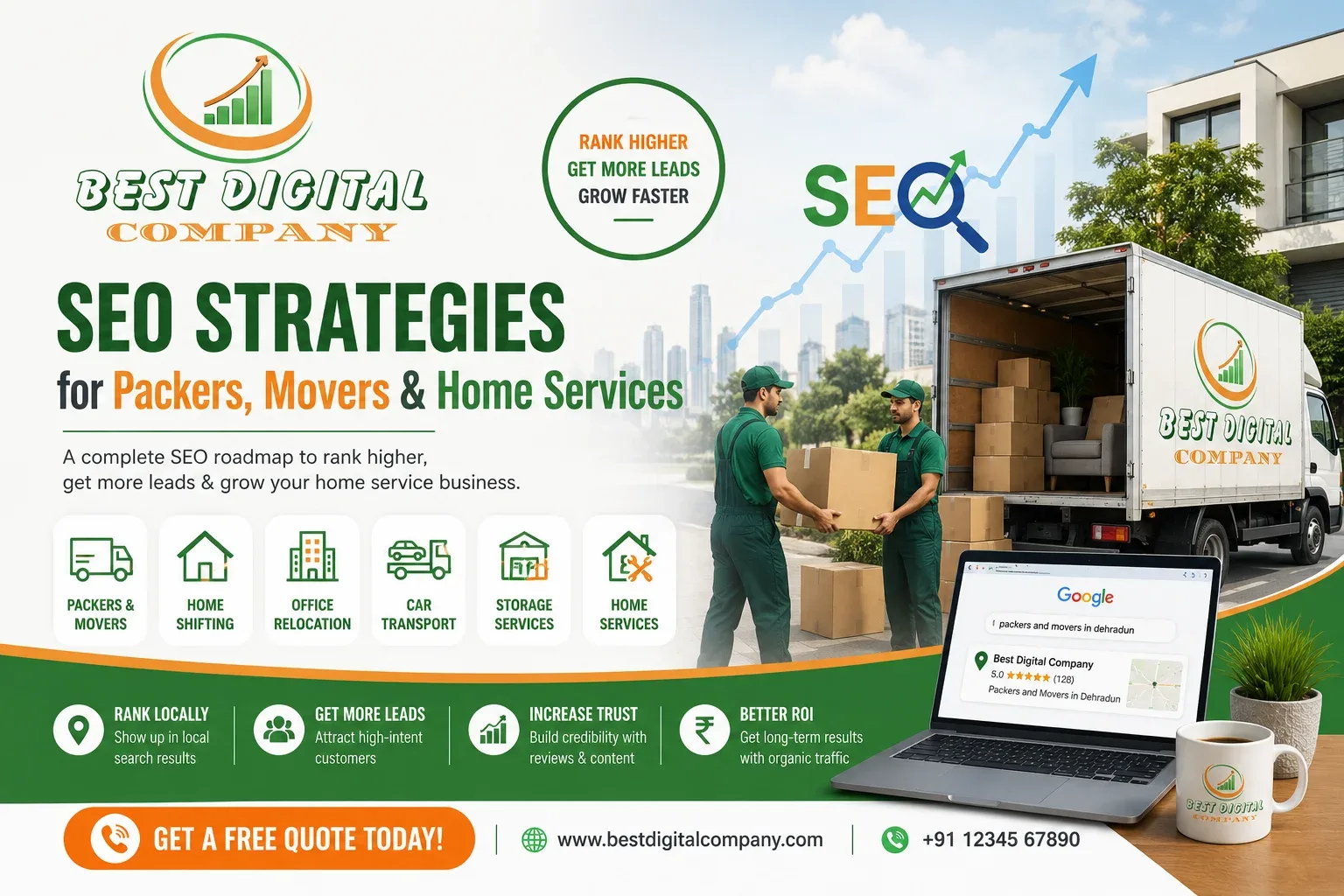
SEO Strategies for Packers, Movers & Home Services

If you run a packers and movers company or any home service business plumbing, cleaning, electricians, pest control , you already know how competitive the market is. Every customer in your city is searching Google before they pick up the phone.

The question is: are they finding you, or your competitors?

This guide is not about vague digital marketing advice. It is a straight-to-the-point SEO roadmap built specifically for packers, movers, and home service businesses operating in India and beyond. Let’s get into it.


Why SEO Is Non-Negotiable for Movers & Home Services

Unlike e-commerce, home service businesses live and die by local intent. Nobody searches “best packers and movers” in general they search “packers and movers in Dehradun” or “home shifting services near me.” That local intent is pure gold because it signals the person is ready to book.

Traditional marketing like pamphlets, referrals, and word-of-mouth still works but it has limits. SEO compounds over time. An article you publish today can bring you leads for years. A Google Business Profile optimized today keeps generating calls every single day. That is why the most successful moving companies in every Indian city have made SEO the backbone of their lead generation.

Paid ads stop working the moment you stop paying. SEO, when done right, builds an asset that keeps generating leads on its own and it gets stronger with time, not weaker.


1. Master Local SEO First – It’s Your Biggest Opportunity

For packers and movers, local SEO is the single highest-ROI activity. Here is what it actually involves not the buzzword version, but the real tactical breakdown.

Google Business Profile (GBP) Optimization

Your Google Business Profile is often the first thing a potential customer sees before they ever visit your website. If it looks incomplete or untrustworthy, they move to the next result instantly.

  • Claim and verify your GBP listing for every city you operate in
  • Add all relevant service categories (Packers and Movers, Moving Company, Storage Facility, Home Services)
  • Write a keyword-rich description – include your city and services naturally
  • Upload 20+ real, high-quality photos of your trucks, team, and packing process
  • Add all your services with descriptions and pricing where possible
  • Post weekly updates offers, tips, completed moves, customer highlights
  • Respond to every review within 24 hours – positive and negative
  • Enable messaging and keep your Q&A section updated

Local Citations & Directory Listings

Citations are mentions of your business name, address, and phone number (NAP) across the web. Consistency is critical, if your phone number on Justdial is different from your website, Google loses trust in your listing.

Prioritize getting listed on: Justdial, Sulekha, IndiaMART, Urban Company, Housejoy, NoBroker, MagicBricks, 99acres, Google Maps, Bing Places, and any city-specific local directories.

Many businesses have inconsistent NAP data across listings  different spellings of the company name, old phone numbers, or wrong addresses. Audit all your citations every 6 months.


2. Keyword Research That Actually Converts

Generic keywords like “packers and movers” have enormous competition. Smart keyword research for home services focuses on city-specific, intent-driven, and long-tail keywords that your actual customers type when they are ready to hire someone.

Keyword Types to Target:

  • Core local: “Packers and movers in Dehradun” – High volume, Transactional, High Priority
  • Service-specific: “Home shifting services Dehradun” – Medium volume, Transactional, High Priority
  • Office relocation: “Office movers in Delhi NCR” – Medium volume, Transactional, High Priority
  • Near me: “House shifting services near me” – High volume, Transactional, High Priority
  • Comparison: “Best packers movers [city] reviews” – Medium volume, Navigational, Medium Priority
  • Price-based: “Cheap movers in [city], affordable shifting” – Medium volume, Transactional, Medium Priority
  • Informational: “How to pack fragile items for moving” – Medium volume, Informational, Medium Priority
  • Long-tail: “Two-bedroom flat shifting cost Dehradun” – Low volume, Transactional, High Priority

Use free tools like Google Keyword Planner, Google Search Console, and the “People Also Ask” box on search results to find more keyword ideas. For Indian markets, also check what keywords appear in Justdial and Sulekha autocomplete suggestions.


3. On-Page SEO: Optimize Every Page Like a Pro

Having a website is not enough. Every page needs to be structured so Google understands exactly what it is about and so users who land on it immediately trust you and take action.

Service Pages

Create a dedicated page for every service you offer. Do not lump everything on one page. Separate pages for Home Shifting, Office Relocation, Car Transport, Bike Transport, Storage Services, and Packing Services each should be its own page with 800+ words of original content.

Step 1 — Title Tag: Include your primary keyword plus the city. Format: “Packers and Movers in Dehradun | Best Digital Company” keep it under 60 characters.

Step 2 — Meta Description: Write a compelling 150–155 character description with your main keyword and a clear value proposition. Include a call-to-action like “Get a free quote today.”

Step 3 — H1 Heading: One H1 per page only. It should naturally include your target keyword. Example: “Trusted Packers and Movers in Dehradun  Reliable, Affordable & On-Time.”

Step 4 — Content Quality: Answer the customer’s questions ,  What do you offer? What does it cost? How long does it take? What areas do you serve? Include real customer testimonials on each page.

Step 5 — Schema Markup: Add LocalBusiness schema to your homepage, Service schema to each service page, and FAQ schema to any page with questions. This can unlock rich snippets in Google.

Step 6 — Internal Linking: Link from your blog posts to relevant service pages and from service pages to related services. This helps Google crawl your site and distributes authority.

Location Landing Pages

If you serve multiple cities, create a unique, detailed page for each city , not a copy-paste job with just the city name changed. Google penalizes thin, duplicate content. Each location page should include area-specific content: local landmarks, neighborhoods served, distance-specific pricing hints, and local testimonials.

Example: a page for /packers-movers-haridwar should mention local neighborhoods like the Rishikesh bypass, popular housing colonies, common moving challenges in that area, and actual customer stories from that city.


4. Content Marketing That Builds Trust & Rankings

A blog is not just for filling up your website. When done right, it positions you as the most knowledgeable, trustworthy business in your space and it brings in consistent organic traffic from people in the research phase of their move.

Blog Topics That Actually Work for Home Services:

  • “Complete Moving Checklist: 30 Days Before Your Move” – captures early-stage researchers
  • “How to Choose the Right Packers and Movers in [City]” – pre-purchase decision content
  • “Average Cost of Moving a 2BHK in Dehradun in 2026” – high-intent, converts well
  • “How to Pack Fragile Items Like Glassware and Mirrors” – builds expertise
  • “Red Flags to Watch for When Hiring Packers and Movers” – trust-building
  • “Home Cleaning Checklist After You Move In” – serves home service customers too
  • “Things to Do Immediately After Moving to a New City” – lifestyle content, wide reach

Publish at least 2 quality blog posts per month. Aim for 1,200–2,000 words per article, properly structured with H2 and H3 headers, internal links to your service pages, and a clear call-to-action at the end of each post.


5. Reviews & Reputation Management

In the home services industry, your reputation is everything. A competitor with fewer features but more 5-star reviews will consistently win more business than you. Here is how to build and protect yours.

Businesses with 50+ reviews rank significantly higher in Google Maps than those with fewer. Aim to collect reviews consistently not just in one burst, but steadily over time.

Make review collection a standard part of your process. After every successful move or service, send the customer a WhatsApp message with a direct link to your Google review page. Make it one tap no extra steps. Most satisfied customers will leave a review if you ask at the right moment, within 24 hours of service completion, when the experience is fresh.

When you get a negative review and every business does eventually respond professionally. Never get defensive. Acknowledge the concern, apologize for the inconvenience, and offer to make it right. This shows potential customers that you are accountable and customer-focused.


6. Technical SEO Essentials

Technical SEO is the foundation everything else is built on. If your website loads slowly or is not mobile-friendly, your rankings will suffer regardless of how good your content is.

  • Page Speed: Aim for under 3 seconds load time. Compress images, use a CDN, and choose a fast hosting provider.
  • Mobile Optimization: Over 75% of local searches happen on mobile. Your site must look and work perfectly on phones.
  • HTTPS Security: Ensure your website uses SSL (https://). Google treats non-secure sites as a ranking negative.
  • XML Sitemap: Submit your sitemap to Google Search Console so Google can discover and index all your pages.
  • Core Web Vitals: Check your LCP, FID, and CLS scores in Google Search Console. Fix any pages marked “Poor” or “Needs Improvement.”
  • Click-to-Call: Make your phone number tappable on every page. This alone can significantly increase mobile conversions.

7. Link Building for Home Service Businesses

Backlinks links from other websites to yours remain one of Google’s strongest ranking signals. For local home service businesses, the goal is quality over quantity. One link from a respected local news site or a popular real estate blog is worth more than 50 links from random directories.

Practical Link Building Tactics:

  1. Local citations: Every listing on Justdial, Sulekha, etc. is a backlink and also helps your local rankings.
  2. Partner with complementary businesses: Real estate agents, interior designers, property portals, and property management companies can refer and link to you.
  3. Guest blog posts: Write expert articles on real estate, home improvement, or relocation blogs. Include a natural link back to your site.
  4. Local press coverage: Sponsor a community event, do something newsworthy, or pitch your story to local news outlets. A single local news feature can bring powerful links.
  5. Customer testimonial exchanges: If you use a supplier packing materials, truck rental offer them a testimonial for their website in exchange for a mention on theirs.

8. Track Your SEO Progress – Know What’s Working

You cannot improve what you do not measure. Set up these free tools from day one:

  • Google Search Console –  track which keywords bring traffic, identify crawl errors, and monitor your indexing status
  • Google Analytics 4 – understand where your visitors come from and what they do on your site
  • Google Business Profile Insights – see how many calls, direction requests, and profile views you get each month
  • Call tracking – use a unique phone number for your website vs. your GBP to measure which channel drives more calls

Review your performance monthly. Look at keyword rankings, organic traffic, and most importantly, how many leads and calls are coming from search. SEO success is ultimately measured in business outcomes, not just traffic.


Frequently Asked Questions

What is the most important SEO strategy for packers and movers?

Local SEO is the most critical strategy. Optimizing your Google Business Profile, getting listed in local directories, collecting genuine reviews, and targeting city-specific keywords gives the highest ROI for moving companies. These activities directly influence your visibility when a local customer searches for services in your area.

How long does SEO take to show results for a home service business?

Typically 3–6 months for noticeable improvements in rankings and traffic, and 6–12 months for strong, consistent results. Local SEO especially Google Maps optimization can show faster results, sometimes within 4–8 weeks, particularly in less competitive cities or niches.

Do I need a separate landing page for each city I serve?

Yes, absolutely. Creating dedicated, unique location pages for each city or service area dramatically improves your chances of ranking locally. Generic pages that only change the city name rarely rank well. Each location page should have original content local context, testimonials from that area, and specific service details relevant to that city.

Are online reviews really important for SEO in the moving industry?

Absolutely. Google reviews directly influence your local search rankings and your Google Maps placement. Businesses with 50+ reviews and a 4.5+ star rating consistently outrank competitors with fewer reviews. Beyond SEO, reviews heavily influence conversion a person choosing between two movers will almost always pick the one with more and better reviews.

What keywords should packers and movers target for SEO?

Focus on high-intent local keywords like “packers and movers in [city]”, “house shifting services [city]”, “office relocation [city]”, and long-tail phrases like “affordable packers and movers near me” or “1BHK shifting cost [city]”. Also target informational keywords for your blog “how to pack before moving”, “moving house checklist India” , these attract users in the research phase.

Is blogging actually helpful for a packers and movers website?

Yes, when done consistently. A blog builds topical authority, targets informational search queries, and attracts potential customers who are in the planning phase of their move. Topics like moving checklists, packing tips, cost guides, and city-specific moving guides drive consistent organic traffic that converts into leads over time.

How do I get backlinks for my home service business?

Start with local citations – Justdial, Sulekha, IndiaMART each is a backlink. Then build partnerships with real estate agents, interior designers, and property portals who can link and refer to you. Guest posting on relocation, home improvement, and real estate blogs is highly effective. You can also pitch your moving expertise to local news outlets and offer them quotes or articles on moving tips.

Should I hire an SEO agency or do it myself?

You can handle basics like Google Business Profile optimization and review collection yourself. But for technical SEO, content strategy, backlink building, and sustained ranking improvement, working with an experienced digital marketing agency typically delivers much faster and more reliable results. The key is finding an agency with a proven track record in the home services or moving industry specifically.

What is schema markup and do I need it?

Schema markup is structured data code added to your website that helps Google understand your content and potentially display rich results like star ratings, FAQs, or service info directly in search results. For packers and movers, you should use LocalBusiness schema, Service schema, Review schema, and FAQ schema. It does not directly boost rankings but improves click-through rates by making your listing more visually informative in search.


Final Thoughts: SEO Is a Long Game Worth Playing

Let’s be honest SEO is not a switch you flip and see instant results. It requires consistency, patience, and doing the right things repeatedly over months. But for packers, movers, and home service businesses, the payoff is unmatched. Once you rank well locally, you get a steady stream of inbound calls and quote requests without spending a rupee on ads.

Start with the fundamentals: optimize your Google Business Profile, target local keywords on dedicated service pages, collect reviews aggressively, and publish helpful blog content regularly. From there, build your technical foundation and authority over time.

If you want expert help implementing these strategies with a team that understands both SEO and the Indian home services market we are here to make it happen.

📞 +91 8587948051

Contact@bestdigitalcompany.com

🌐 bestdigitalcompany.com
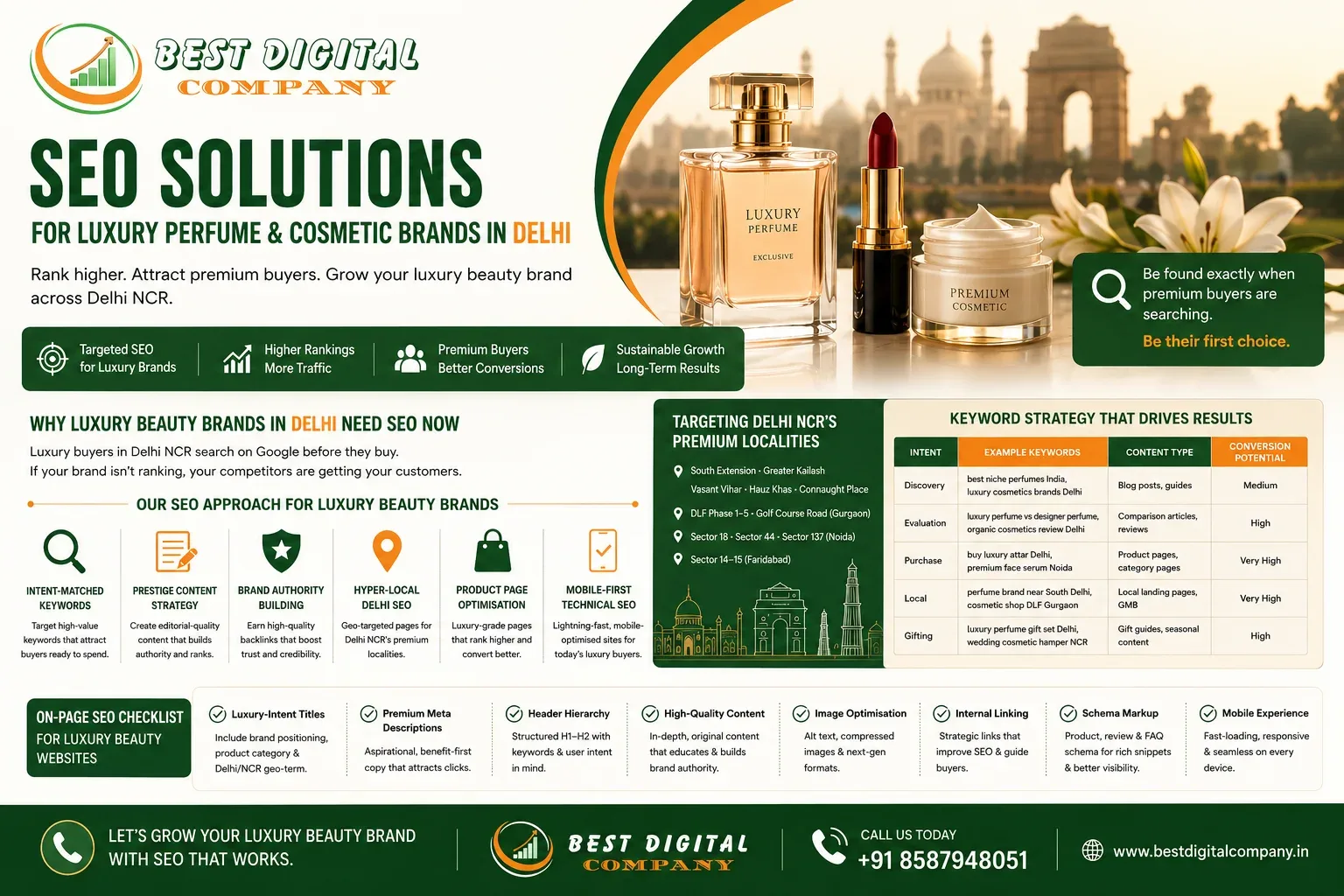
SEO Solutions for Luxury Perfume & Cosmetic Brands in Delhi

SEO Solutions for Luxury Perfume & Cosmetic Brands in Delhi

Delhi’s luxury beauty market is booming and the brands dominating it aren’t always the biggest names. They’re the ones that show up on Google exactly when a premium buyer is searching. If your perfume or cosmetic brand isn’t ranking, your competitors are capturing your customers.


Why Luxury Perfume & Cosmetic Brands in Delhi Need SEO Now

India’s premium beauty segment is growing at over 14% annually, with Delhi NCR accounting for a disproportionate share of luxury spending. Wealthy consumers in South Delhi, Gurgaon’s DLF enclaves, Noida’s premium sectors, and Greater Noida’s gated townships are increasingly discovering brands through organic Google searches not just through malls or word-of-mouth.

Yet most luxury beauty brands in Delhi are either ignoring SEO entirely or running it like a commodity fashion brand. That’s a costly mistake. In the luxury segment, SEO is not just about traffic , it’s about brand perception, trust signals, and capturing buyers at the exact moment of intent.

“The customer who searches ‘niche perfume brand Delhi’ is not browsing. They are ready to buy — and they will purchase from whoever earns the top spot.”

When a buyer types “luxury attar perfume gift Delhi” or “best organic cosmetics South Delhi” into Google, they are showing clear purchase intent. A brand that ranks for these queries doesn’t just get a click, it gets a qualified lead that is far more likely to convert than any paid ad click.


What Makes SEO for Luxury Beauty Brands Different

Standard SEO focuses on volume. Luxury SEO focuses on value. The two require very different strategies, and applying the wrong approach can actually harm your brand’s prestige positioning.

Intent-Matched Keywords Targeting high-value, low-volume keywords that attract buyers ready to spend not bargain hunters browsing for deals.

Prestige Content Strategy Editorial-quality blogs, ingredient deep-dives, and fragrance guides that reflect your brand’s luxury positioning while ranking for information searches.

Brand Authority Building High-quality backlinks from Delhi lifestyle publications, beauty editors, and premium directories that signal trust to Google.

Hyper-Local Delhi SEO Targeting wealthy micro-localities in Delhi NCR with geo-specific landing pages, Google Business optimisation, and local schema markup.

Product Page Optimisation Luxury-grade product pages with structured data, rich snippets, and aspirational copy that ranks and converts simultaneously.

Mobile-First Technical SEO Lightning-fast, mobile-optimised pages because over 70% of luxury buyers in Delhi browse on their smartphones before purchasing.


The Delhi NCR Luxury Beauty Landscape: Where Your Buyers Are

Understanding the geography of luxury spending in Delhi NCR is essential for effective local SEO. Your buyers aren’t uniformly spread they cluster in specific high-income zones, and your SEO strategy must reflect that.

Here are the key luxury buyer localities your SEO should be targeting:

Delhi: South Extension · Greater Kailash I & II · Lajpat Nagar · Vasant Vihar · Hauz Khas · Connaught Place · Defence Colony Gurgaon: DLF Phase 1–5 · Sohna Road · Golf Course Road Noida: Sector 18 · Sector 44 · Sector 137 Faridabad: Sector 14–15

For each of these zones, we build dedicated geo-optimised content and landing pages targeting searches like “luxury perfume shop in Greater Kailash” or “best organic skincare brand Gurgaon” , capturing buyers at the moment they’re searching in your sales area.


Keyword Strategy: What Luxury Beauty Buyers Search for in Delhi

Keyword research for luxury beauty brands in Delhi must balance three distinct search intents: discovery, evaluation, and purchase. Here is how we structure a winning keyword matrix:

IntentExample KeywordsContent TypeConversion Potential
Discoverybest niche perfumes India, luxury cosmetics brands DelhiBlog posts, guidesMedium — builds brand awareness
Evaluationluxury perfume vs designer perfume, organic cosmetics review DelhiComparison articles, reviewsHigh — buyer is shortlisting
Purchasebuy luxury attar Delhi, premium face serum delivery NoidaProduct pages, category pagesVery High — ready to buy
Localperfume brand near South Delhi, cosmetic shop DLF GurgaonLocal landing pages, GMBVery High — immediate intent
Giftingluxury perfume gift set Delhi, wedding cosmetic hamper NCRGift guides, seasonal contentHigh — high AOV purchases

On-Page SEO Checklist for Luxury Cosmetic & Perfume Brands

Every page on your luxury beauty website from your homepage to your individual product pages must be optimised to communicate both prestige and relevance to Google. Here is the essential on-page checklist we apply for every luxury beauty brand client:

  • Luxury-intent title tags: Include brand positioning, key product category, and Delhi/NCR geo-term in every page title.
  • Premium meta descriptions: Write aspirational, benefit-first meta descriptions that attract clicks from discerning buyers.
  • H1 clarity: One clear, keyword-rich H1 per page ,no generic titles like “Products” or “About Us”.
  • Structured data (Schema markup): Product, Review, LocalBusiness, and BreadcrumbList schema on all relevant pages.
  • Image optimisation: High-quality product photography with compressed file sizes, descriptive alt text, and WebP format.
  • Internal linking: Strategic links between ingredient pages, collection pages, blog content, and product pages.
  • Page speed: Core Web Vitals scores above 90 on mobile, critical for both rankings and luxury buyer experience.
  • SSL + HTTPS: Non-negotiable for trust in the luxury segment ,security is a brand signal.
  • Canonical tags: Prevent duplicate content issues across product variants and filter pages.
  • FAQ schema on key pages: Capture featured snippet positions for high-value informational queries.

Local SEO for Luxury Perfume Brands in Delhi NCR

Local SEO is the fastest route to visibility for luxury beauty brands targeting Delhi, Gurgaon, and Noida. When a high-income buyer searches “luxury perfume store near me” while sitting in Sector 18 Noida or Khan Market Delhi, Google’s local pack results appear above everything else including paid ads.

Google Business Profile Optimisation

Your Google Business Profile (GBP) is your brand’s local identity on Google. For luxury perfume and cosmetic brands in Delhi NCR, we ensure your GBP includes: accurate NAP (Name, Address, Phone) information, premium photographs of your products and store, the right primary and secondary business categories, regular Google Posts showcasing new launches and seasonal collections, keyword-rich business descriptions, and a consistent review acquisition strategy.

Local Citation Building

We build consistent brand mentions across India-specific local directories including JustDial, Sulekha, IndiaMART, and luxury lifestyle platforms to strengthen your local search authority in Delhi NCR.

Geo-Targeted Landing Pages

We create dedicated, uniquely-written landing pages for each high-value locality you serve for example, a page specifically targeting “luxury perfume brand Greater Kailash Delhi”  so that your brand captures hyperlocal searches where buyer intent is highest.


Content Strategy for Luxury Beauty Brands: What Works in Delhi’s Market

Content is the foundation of luxury SEO. But the content that works for a budget beauty brand will actively damage a luxury brand’s perception. Here is the content architecture we build for luxury perfume and cosmetic brands in Delhi:

  1. The Fragrance Education Hub: Long-form guides on fragrance families, oud vs attar vs eau de parfum, and how to choose a signature scent targeting informational searches from educated Delhi buyers.
  2. Ingredient Transparency Content: Deep-dives into your brand’s key ingredients their sourcing, benefits, and luxury credentials. This builds trust and ranks for ingredient-specific queries.
  3. Delhi NCR Gift Guides: Seasonal gift guide content targeting high-AOV gifting searches Diwali, weddings, corporate gifting specific to Delhi’s calendar and culture.
  4. Celebrity & Influencer-Adjacent Content: Aspirational content that associates your brand with the lifestyle Delhi’s affluent buyers aspire to, without licensing issues.
  5. Behind-the-Brand Storytelling: Your brand’s founding story, values, and artisan processes ,the content that converts comparison shoppers into loyal customers.

Technical SEO: The Foundation Your Luxury Brand Cannot Ignore

A beautiful website that loads slowly, has broken product pages, or is not mobile-optimised will be penalised by Google and quietly abandoned by the luxury buyers who expect perfection. Technical SEO is the non-negotiable foundation that makes everything else work.

For luxury perfume and cosmetic brand websites in Delhi, our technical SEO audit covers: Core Web Vitals improvement, crawl budget optimisation for large product catalogues, structured data implementation, fixing broken links and redirect chains, XML sitemap accuracy, robots.txt configuration, mobile usability across all devices, and ensuring product variant pages do not create duplicate content penalties.

“A luxury brand’s website should load in under 2 seconds. Every extra second costs you both rankings and the trust of a buyer who expects premium in every experience.”


Link Building for Luxury Beauty Brands: Quality Over Quantity

In luxury SEO, one backlink from a respected Delhi lifestyle magazine or a high-authority beauty publication is worth more than 50 links from generic directories. Our link-building strategy for luxury beauty brands in Delhi focuses on:

  • Editorial features in Delhi NCR lifestyle and luxury publications
  • Guest contributions to Indian beauty and wellness editorial platforms
  • PR-driven coverage of product launches, limited editions, and brand milestones
  • Collaborations with premium Delhi-based bloggers and content creators with high-income audiences
  • Brand mentions in wedding planning platforms targeting the NCR luxury bridal market
  • Ingredient supplier and certification-linked authority links

How Best Digital Company Delivers SEO for Luxury Beauty Brands in Delhi

At Best Digital Company, we are a Delhi-based digital marketing agency with deep expertise in SEO, social media, PPC, and web development. We understand both the technical demands of modern SEO and the brand sensitivities of the luxury segment, a combination that most agencies in Delhi do not offer.

Our luxury beauty SEO process begins with a comprehensive brand and competitor audit, followed by a keyword strategy built around your specific product range and target buyer profile in Delhi NCR. We then execute on-page optimisation, technical SEO fixes, content creation, and local SEO simultaneously delivering measurable ranking improvements typically within 90 to 120 days for targeted keywords.

Our SEO Deliverables for Luxury Beauty Brands:

  • Full technical SEO audit and fix implementation
  • Local keyword research specific to Delhi NCR luxury beauty searches
  • On-page optimisation for all key product, collection, and brand pages
  • Monthly editorial content (blogs, guides, product stories)
  • Google Business Profile management and local citation building
  • Authority link building from relevant luxury and beauty publications
  • Monthly keyword ranking and organic traffic performance reports
  • Competitor monitoring and adaptive strategy updates

FREQUENTLY ASKED QUESTIONS


Why do luxury perfume and cosmetic brands in Delhi need SEO?

Delhi’s luxury beauty market is intensely competitive. The majority of premium buyers now search Google before making a purchase decision whether they’re looking for a niche perfume in South Delhi or an organic skincare brand in Gurgaon. Without a strong SEO presence, your brand is invisible to these high-intent buyers even if your products are superior. SEO ensures your luxury brand appears prominently for purchase-ready searches like “buy luxury perfume Delhi” or “best cosmetic brand in South Delhi”, driving qualified traffic that converts into premium sales.


How is SEO for luxury beauty brands different from regular brand SEO?

Luxury beauty SEO is fundamentally about prestige, precision, and perception not just search volume. Instead of targeting the broadest possible keywords, luxury brand SEO focuses on high-value, intent-specific keywords that attract buyers willing to pay a premium. The content must maintain editorial quality to protect brand perception. Link building must prioritise prestigious publications over volume. And the entire website experience speed, design, and copy  must communicate luxury at every touchpoint, because Google’s user experience signals directly influence rankings.


How long does it take to see SEO results for a cosmetic brand in Delhi?

Most luxury cosmetic and perfume brands in Delhi start seeing measurable improvements in organic traffic within 3 to 6 months of consistent, quality SEO execution. Highly competitive keywords like “luxury perfume brand Delhi” can take 6 to 9 months to reach page one, while longer-tail geo-specific keywords often rank faster. Local SEO improvements such as appearing in the Google Maps pack for nearby luxury beauty searches typically show results within 4 to 8 weeks of Google Business Profile optimisation.


What SEO strategies work best for cosmetic brands in Delhi and NCR?

The most impactful strategies for luxury beauty brands in Delhi NCR are: hyper-local SEO targeting specific high-income neighbourhoods (Connaught Place, Lajpat Nagar, Greater Kailash, South Extension, Noida Sector 18, Gurgaon DLF); product page SEO with rich structured data; editorial content targeting branded and informational beauty searches; Google Business Profile optimisation for local pack visibility; high-authority backlinks from beauty and lifestyle media; and comprehensive technical SEO to ensure fast, mobile-first pages that meet Google’s Core Web Vitals standards.


Can SEO help a local perfume brand compete with international luxury brands in Delhi?

Absolutely — and this is one of SEO’s greatest opportunities for Delhi-based luxury beauty brands. International brands often neglect hyper-local Indian search intent, leaving significant gaps in local, cultural, and occasion-specific searches. By targeting queries like “best attar perfume brand Delhi”, “luxury homegrown cosmetics NCR”, or “wedding fragrance gift Noida”, a well-executed SEO strategy allows local and indie luxury brands to outrank even global names for the searches that matter most to Delhi buyers.


Does Best Digital Company offer SEO specifically for beauty and cosmetic brands?

Yes. Best Digital Company is a leading Delhi-based digital marketing agency offering specialised SEO, PPC, social media marketing, and web development services for brands across industries — including luxury beauty, cosmetics, and perfumes. We craft custom SEO strategies tailored to your brand’s positioning, product range, and target buyer profile across Delhi, Noida, Gurgaon, Faridabad, and the broader NCR region.

Contact us at +91 8587948051 or Contact@bestdigitalcompany.com to discuss your brand’s SEO requirements.


What is the cost of SEO for a luxury cosmetic brand in Delhi?

SEO pricing for luxury cosmetic brands in Delhi varies based on the competitiveness of target keywords, the size of your product catalogue, current website health, and your growth objectives. Professional SEO services for a beauty brand targeting the Delhi NCR luxury market typically range from ₹15,000 to ₹75,000 per month, depending on scope. Best Digital Company offers transparent, results-oriented SEO packages with no hidden fees. Visit bestdigitalcompany.com/seo-packages or call us to discuss a package suited to your brand.


Should luxury perfume brands invest in local SEO for Delhi?

Unquestionably. Local SEO is among the highest-ROI investments for luxury perfume brands with retail presence, delivery services, or appointment-based consultations in Delhi NCR. When a high-income buyer in Hauz Khas or Golf Course Road Gurgaon searches “luxury perfume near me”, the Google local pack results appear above paid ads and organic listings. Optimising your Google Business Profile and building local authority ensures your brand captures these highly motivated, near-purchase buyers before they find a competitor.


Ready to Make Your Luxury Beauty Brand Rank & Sell in Delhi?

Get a free, no-obligation SEO audit from Best Digital Company. We’ll show you exactly where your brand stands and how to reach the top.

📞 +91 8587948051

Contact@bestdigitalcompany.com

🌐 bestdigitalcompany.com
📍 C-1/295 Gali No-15, Harsh Vihar, Delhi – 110093

Get Your Free SEO AuditView SEO Packages

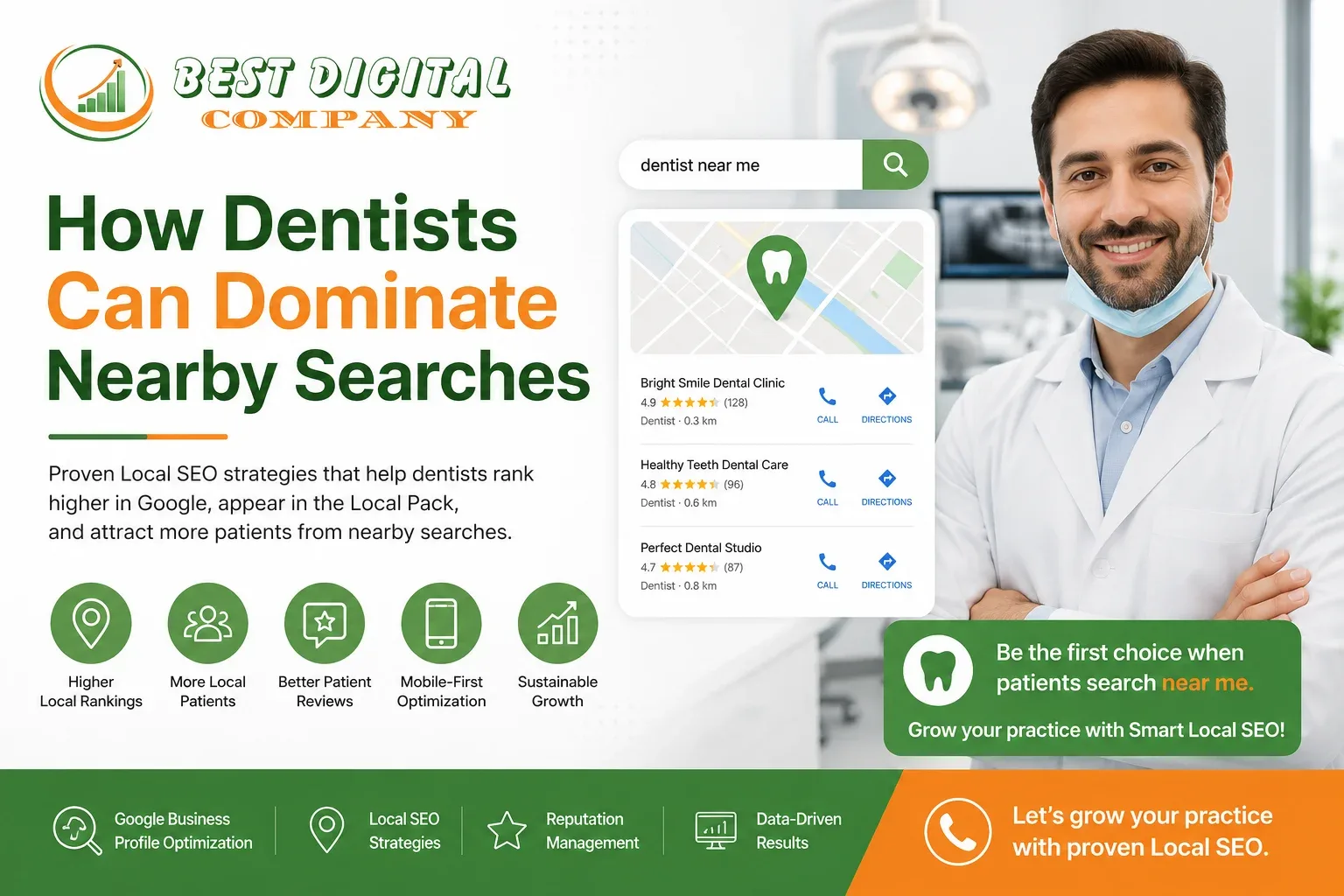
How Dentists Can Dominate Nearby Searches

How Dentists Can Dominate Nearby Searches

When someone wakes up with a toothache or finally decides it’s time for that long-overdue dental check-up, the first thing they do is grab their phone and type “dentist near me.” If your practice isn’t showing up in those first few results , you’re invisible to the very patients who are actively looking for you, right now, in your neighbourhood.

That’s the reality of local search today. And the good news? It’s entirely possible to change it. Whether you run a solo practice in a small town or a multi-chair clinic in a bustling city, local SEO can put your name in front of the right people at exactly the right moment.

In this guide, we’re going to walk you through exactly how dentists can dominate nearby searches ,no jargon, no fluff. Just clear, proven strategies that actually move the needle.


TABLE OF CONTENTS

  1. Why Local SEO Is a Game-Changer for Dental Practices
  2. Optimizing Your Google Business Profile the Right Way
  3. NAP Consistency: The Foundation Nobody Talks About
  4. Using the Right Local Keywords on Your Website
  5. How Patient Reviews Directly Impact Your Rankings
  6. Building Local Citations That Google Trusts
  7. Mobile-First & Site Speed: Non-Negotiables for Local Rank
  8. Content That Attracts Local Patients
  9. Combining Local SEO with Google Ads for Maximum Reach
  10. Frequently Asked Questions

Why Local SEO Is a Game-Changer for Dental Practices

Let’s start with a truth every dentist should know: the majority of people searching for dental care never scroll past the first page of Google and most clicks go to the top three results in the Local Pack. That’s the map section with three business listings that appears right at the top of the search results, above everything else.

If your competitor’s practice is showing up there and yours isn’t, they are getting your patients. Every single day.

Local SEO is the process of making your dental practice visible to people in your geographic area when they search for relevant services. It’s not just about ranking on Google, it’s about appearing on Google Maps, in voice searches, on Apple Maps, and across dozens of local directories that patients use to compare clinics.

Think about it this way: a patient searching “teeth whitening near me” is ready to book an appointment. They’re not browsing casually ,they have intent. Local SEO puts your practice directly in their path at that decision-making moment.

And unlike paid advertising where you stop appearing the moment your budget runs out, good local SEO delivers compounding returns. A well-optimized profile and website can bring in new patients month after month, year after year without spending a single rupee on ads.


Optimizing Your Google Business Profile the Right Way

Your Google Business Profile (GBP) is the single most important local SEO asset you have. It’s what powers your listing on Google Maps and in the Local Pack. If you haven’t claimed yours yet, that’s step one. If you have, there’s almost certainly room to improve it.

Here’s what a fully optimized dental GBP looks like:

  • Business name matches exactly what’s on your signage and website
  • Primary category set to “Dentist” with relevant secondary categories (e.g., Cosmetic Dentist, Dental Implants Periodontist)
  • Complete address with the correct pin location on the map
  • Local phone number not a call centre or national number
  • Website URL linked (ideally to a location-specific page)
  • Accurate business hours, including holiday hours
  • At least 15–20 high-quality photos of your clinic, team, equipment, and waiting area
  • Services listed with detailed descriptions
  • Q&A section populated with common patient questions
  • Weekly Google Posts sharing promotions, tips, or updates

The photos deserve a special mention. Profiles with photos get significantly more direction requests and website clicks than those without. Invest in a few good-quality images ,patients want to know what your clinic looks and feels like before they walk in.

Pro Tip: Post on your GBP at least once a week. Google prioritizes active, regularly updated profiles. Even a short post about a dental health tip or a seasonal promotion keeps your profile fresh in Google’s eyes.


NAP Consistency: The Foundation Nobody Talks About

NAP stands for Name, Address, and Phone number. It sounds simple and it is but it’s also one of the most commonly neglected local SEO factors for dental practices.

Google is essentially a fact-checker. It looks at your business information across hundreds of websites your website, Google Business Profile, Justdial, Practo, Sulekha, Facebook, and local directories and compares them. If your address appears as “C-12, Lajpat Nagar” on one site and “C 12 Lajpat Nagar” on another, those inconsistencies create confusion and reduce Google’s confidence in your listing.

Less confidence from Google means lower local rankings.

Go through all the places your clinic is listed online and make sure your name, address, and phone number appear exactly the same way everywhere. Pick one format and stick to it across every platform.

Pro Tip: Use your full, official business name everywhere not a shortened version. If your practice is registered as “Sharma Dental Clinic and Orthodontics,” don’t list it as “Sharma Dental” on some platforms and the full name on others.


Using the Right Local Keywords on Your Website

Your website is your most powerful long-term local SEO asset but only if it’s optimized correctly. Most dental clinic websites make one critical mistake: they talk about their services without mentioning where they are.

Think like your patient. They’re not searching “dental implants.” They’re searching “dental implants in Connaught Place” or “affordable dental implants Delhi.” Your content needs to reflect that.

Where to Use Local Keywords

  • Page titles: “Best Dentist in [City/Area] | [Clinic Name]”
  • Meta descriptions: Mention your location and key service
  • H1 heading: Include your primary service and city name
  • Body content: Naturally mention your area, nearby landmarks, and neighbourhood
  • Image alt text: Use descriptive names like “dental-clinic-south-delhi.jpg”
  • Footer: Display your full address with area and city name
  • URL slugs: Use /dentist-in-lajpat-nagar/ instead of a generic /services/

If you serve multiple areas, create a separate page for each location. For example, if you have a clinic in Dwarka and another in Rohini, don’t cram both into one page — each location deserves its own dedicated, optimized page.

Don’t stuff keywords unnaturally. Google’s algorithms are smart enough to detect that, and it will hurt more than it helps. Write for humans first, and weave in location terms where they flow naturally. Good content that genuinely helps patients is always rewarded.


How Patient Reviews Directly Impact Your Rankings

Online reviews are one of the most powerful local ranking signals Google uses and they’re also the thing most dental clinics completely ignore until they have a problem.

Here’s the truth: a dental practice with 80 reviews and a 4.6-star rating will almost always outrank a practice with 10 reviews and a 5-star rating even if the second clinic is technically “perfect.” Volume, recency, and your responses to reviews all matter.

How to Get More Patient Reviews Without Being Pushy

  • Send an SMS or WhatsApp message after each appointment with a direct Google review link
  • Train your receptionist to say: “We’d really appreciate it if you left us a quick Google review”
  • Put a QR code to your review page in the waiting area and on printed receipts
  • Add a review link to your email signature and website footer
  • Respond to every review – good and bad – promptly and professionally

Pro Tip: Responding to negative reviews publicly actually builds trust. It shows potential patients that you take feedback seriously and care about the experience. A thoughtful, empathetic response to a bad review can be more impressive than the review itself.

Never buy fake reviews. Google’s systems are increasingly sophisticated at detecting inauthentic behaviour, and the penalty removal of your entire listing is not worth any short-term boost.


Building Local Citations That Google Trusts

A citation is any online mention of your dental practice’s name, address, and phone number whether or not it includes a link to your website. Each citation tells Google your business is real and where it says it is.

For dental practices in India, the key directories to be listed on include:

  • Practo – essential for healthcare providers in India
  • Justdial – a massive local traffic source
  • Sulekha – strong regional presence
  • Bing Places for Business – don’t ignore Bing; it’s significant for the senior patient demographic
  • Apple Maps – critical for iPhone users using Siri to find a dentist
  • Facebook Business Page – also functions as a local directory
  • Local state medical association directories

The goal isn’t to be listed on 500 directories. It’s to be consistently and accurately listed on the 20–30 most authoritative ones relevant to your location and industry. Quality beats quantity here every time.


Mobile-First & Site Speed: Non-Negotiables for Local Rank

When was the last time you pulled up your dental clinic’s website on your own phone? If you’ve never done it, do it right now because that’s what your patients see.

Google ranks websites based on their mobile experience, not desktop. This means if your website loads slowly on mobile, has text that’s too small to read, or has buttons that are hard to tap, Google penalizes your rankings. And more importantly, patients leave without booking.

Key Technical Checks for Your Dental Website

1. Page Load Speed Your website should load in under 3 seconds. Use Google’s PageSpeed Insights to test it. Compress images, enable browser caching, and consider a faster hosting provider if needed.

2. Mobile Responsiveness Every element text, images, buttons, forms should adjust beautifully to any screen size. Test it across iPhone, Android, and tablets.

3. Click-to-Call Button Your phone number should be tappable on mobile so patients can call you in one touch. Don’t make them copy-paste a number.

4. HTTPS Security Your website must have an SSL certificate (the padlock icon in the browser bar). Google actively flags non-HTTPS sites and patients won’t trust a clinic whose website shows “Not Secure.”

5. Easy-to-Find Contact & Booking Your phone number and appointment booking option should be visible without scrolling ideally in the header on every single page.


Content That Attracts Local Patients

Content is what separates dental practices that dominate local search from those that barely show up. But we’re not talking about generic posts like “5 Reasons to Brush Twice a Day.” We’re talking about content that’s genuinely useful, locally relevant, and built around what your patients are actually searching for.

Content Ideas That Drive Local Traffic for Dental Clinics

  • “Best foods to eat after a tooth extraction advice from our [City] dental team”
  • “What to expect from dental implant surgery in [City]”
  • “Teeth whitening vs veneers: which is right for you? A [City] dentist explains”
  • “Why [Neighbourhood] residents are choosing Invisalign over traditional braces”
  • “Emergency dentist in [City]: what to do when you have a dental crisis”
  • Patient success stories and before/after case studies (with permission)
  • FAQs specific to your area and patient demographic

Every piece of content should answer a real question, be written in plain language your patients understand, and naturally include your location. Aim to publish at least two to four blog posts per month. Over time, this builds a library of content that ranks for dozens of long-tail keywords bringing in a steady stream of organic visitors who are actively looking for dental care in your area.

Pro Tip: Add a “Service Area” section to your website footer that lists the specific neighbourhoods and areas you serve. This simple addition helps Google understand your geographic reach and can improve rankings for surrounding area searches.


Combining Local SEO with Google Ads for Maximum Reach

While SEO builds your long-term organic presence, Google Ads especially Local Services Ads can generate new patient inquiries almost immediately. The smartest dental practices use both together.

Here’s how the two complement each other:

  • Local Services Ads appear right at the top of Google, above even regular paid ads. They’re pay-per-lead and come with the “Google Guaranteed” badge — which patients trust enormously
  • Google Search Ads let you target high-intent keywords like “emergency dentist [city]” or “invisible braces near me” and drive immediate, relevant traffic
  • Organic SEO ensures you keep showing up even when you’re not running ads — and those clicks cost you nothing
  • Being visible in both paid and organic results on the same page dramatically increases your click-through rate and builds brand authority

If your ad budget is limited, focus it on your highest-value services, dental implants, full mouth rehabilitation, or Invisalign where a single patient can justify the cost of several months of advertising. Let organic SEO handle the volume of routine check-up and cleaning searches.

The most successful dental practices don’t treat SEO and Google Ads as either/or. They use SEO to build a sustainable foundation and paid ads to accelerate growth especially when launching a new service or entering a new neighbourhood.


Putting It All Together: Your 90-Day Local SEO Action Plan

Local SEO can feel overwhelming when you look at everything at once. Here’s a simple roadmap to get started:

Days 1–15: Claim & Optimize Claim and fully optimize your Google Business Profile. Fix your NAP consistency across all major directories. Ensure your website is mobile-responsive and loads quickly.

Days 16–30: Keywords & On-Page SEO Identify 10–15 local keywords for your practice. Optimize your homepage, service pages, and title tags. Create or improve your location-specific pages.

Days 31–60: Reviews & Citations Launch a review generation system with your front desk team. List your practice on the top 20 local directories. Respond to all existing reviews.

Days 61–90: Content & Ads Publish your first four locally optimized blog posts. Set up a small Google Local Services Ads campaign for your top service. Track your GBP insights weekly.

Consistency is everything in local SEO. The practices that dominate nearby searches aren’t always the ones with the biggest budgets — they’re the ones who show up consistently, serve their patients well, and invest in their online presence month after month.


Frequently Asked Questions

Why is local SEO important for dentists?

Most patients search for dental services on Google using phrases like “dentist near me” or “best dentist in [city].” Local SEO helps your practice appear in the Google Local Pack and Maps results which are the first things patients see. It gives you more visibility, more phone calls, and more bookings without relying entirely on paid ads. Unlike traditional marketing, local SEO targets people who are already actively looking for dental care in your area, making every visitor highly relevant.

How do I get my dental practice to appear in the Google Local Pack?

To appear in the Local Pack, you need a fully optimized Google Business Profile with accurate NAP (Name, Address, Phone), the right business categories, quality photos, and regular posts. Consistent citations across directories, a strong stream of patient reviews, and a locally optimized website all contribute significantly. Google rewards businesses that are active, accurate, and trusted by their community.

How many reviews does a dentist need to rank locally on Google?

There’s no fixed magic number, but in most competitive markets, practices with 50 or more genuine reviews and a rating above 4.5 stars tend to rank well. More important than the total count is the recency and consistency of reviews. Getting five new reviews every month is often more effective than having 100 reviews from two years ago. Google interprets recent reviews as a signal that your practice is active and patients are engaged.

What is NAP consistency and why does it matter for dentists?

NAP stands for Name, Address, and Phone number. Google cross-references your business information across websites, directories, and your own site. If your details vary even something minor like “St.” versus “Street” or a different phone number, it creates inconsistency that Google interprets as unreliable information. This directly reduces your local ranking potential. Keeping your NAP identical across every platform is one of the simplest and most impactful things you can do for local SEO.

Should a dental clinic run Google Ads alongside local SEO?

Yes ,combining Google Ads, especially Local Services Ads, with organic local SEO gives your dental practice maximum visibility on the search results page. SEO builds sustainable long-term rankings, while Google Ads generate immediate leads. Local Services Ads are particularly effective for dentists because they come with the “Google Guaranteed” badge, which gives patients added confidence to call.

How long does it take for dental local SEO to show results?

Most dental practices begin seeing noticeable improvements in local rankings within 3 to 6 months of consistent SEO effort. In highly competitive cities, it may take 6 to 12 months to reach the top positions. The timeline depends on your current website authority, how strong your competition is, and how aggressively you pursue the strategy. Some quick wins like optimizing your Google Business Profile and fixing NAP inconsistencies can show visible improvements within just a few weeks.

Can a digital marketing agency help my dental clinic with local SEO?

Absolutely. A specialized digital marketing agency like Best Digital Company can handle the entire process optimizing your Google Business Profile, building local citations, creating location-based content, managing your review strategy, and running targeted Google Ads campaigns. This frees you up to focus on what you do best: treating patients. We work with healthcare providers and understand the unique challenges of marketing a dental practice in a competitive local market.


Ready to get more patients from Google? Best Digital Company helps dental clinics and healthcare providers rank higher locally, get more calls, and grow their practice with proven digital marketing strategies.

📞 +91 8587948051

📧 Contact@bestdigitalcompany.com

🌐 www.bestdigitalcompany.com

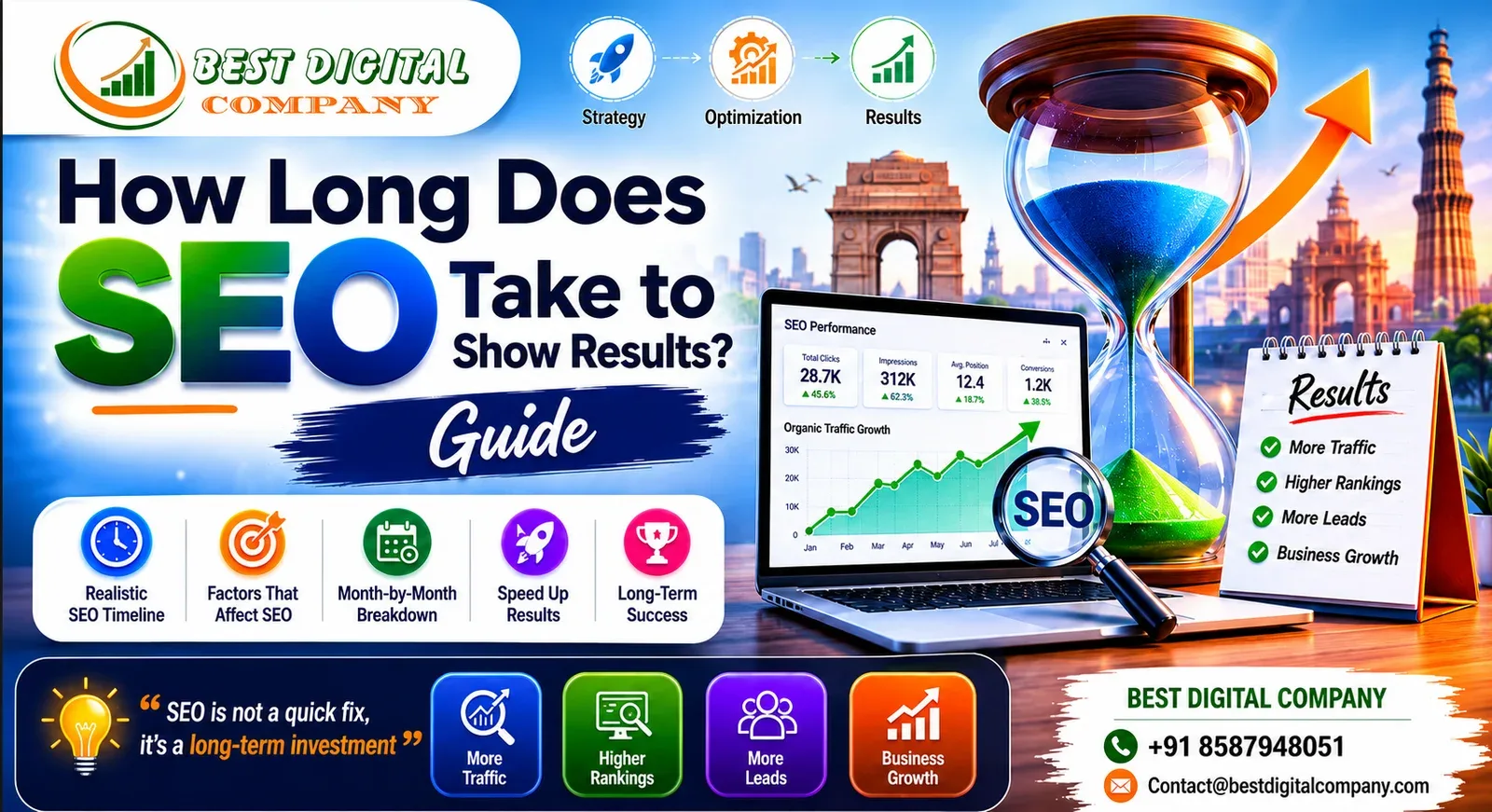
How Long Does SEO Take to Show Results

How Long Does SEO Take to Show Results?

SEO typically takes 3–6 months to show noticeable results for most businesses. Competitive industries require 6–12 months. Brand-new websites may need 12+ months to achieve first-page rankings.


Table of Contents

  1. The Realistic SEO Timeline
  2. Key Factors That Affect SEO Speed
  3. Month-by-Month Breakdown
  4. How to Speed Up Your SEO Results
  5. New Website vs. Established Website
  6. Frequently Asked Questions

If you’ve ever Googled “how long does SEO take,” you’ve probably seen answers ranging from “3 months” to “it depends.” The truth is both frustratingly nuanced and genuinely important because understanding the SEO timeline is the difference between setting realistic expectations and wasting your budget.

At Best Digital Company, we’ve helped businesses across India rank on Google’s first page. Here’s what we’ve learned about SEO timelines, backed by real data and hands-on experience.


1. The Realistic SEO Timeline

Let’s be direct: SEO is not a quick fix. It is a compounding long-term investment. Unlike Google Ads, which delivers traffic the moment you pay, SEO builds authority gradually but the payoff is far more sustainable and cost-effective over time.

Based on industry data from Ahrefs, Moz, and our own campaign results, here is what to realistically expect:

Months 1–2 – Foundation & Crawling Phase Google crawls and re-indexes your site. Technical fixes go live. Minimal visible ranking change, but essential groundwork is laid.

Months 3–4 – Early Signals Long-tail keywords start moving. Google Search Console impressions rise. Some pages may enter the top 20–30 results. Organic traffic begins showing a slight upward trend.

Months 5–6 – Momentum Builds Noticeable ranking improvements for target keywords. Organic traffic increases 20–50% for well-optimised sites. Conversions may start appearing from organic channels.

Months 6–12 – Compounding Growth Consistent traffic increases. First-page rankings for primary keywords. Strong ROI becomes clearly visible. Content authority starts attracting backlinks organically.


2. Key Factors That Affect SEO Speed

There is no universal SEO clock, your timeline depends heavily on several interconnected variables.

Domain Age & Authority Older domains with existing authority rank faster. New sites must prove trustworthiness to Google first.

Industry Competition Low-competition niches show results in 3 months. Highly competitive sectors- finance, legal, e-commerce can take 12+ months.

Content Quality & Volume Consistent, high-quality, EEAT-aligned content accelerates rankings. Thin or duplicate content slows everything down.

Backlink Profile Quality backlinks from authoritative sites significantly speed up ranking growth. Toxic links can actively harm your timeline.

Technical SEO Health Crawl errors, slow page speed, poor mobile experience, and broken links all delay Google from ranking your pages.

SEO Investment Level More resources, time, content, link building, and expert guidance — directly correlate with faster and stronger results.


3. Month-by-Month Breakdown: What to Expect

Month 1: Audit, Strategy & Technical Fixes The first month is about building the right foundation. A thorough SEO audit identifies crawl issues, broken links, duplicate content, and keyword gaps. This month is critical but produces no visible ranking changes, Google needs time to process updates.

Months 2–3: Content Creation & On-Page Optimisation Keyword-optimised content is created and published. Meta titles, descriptions, header tags, internal linking, and schema markup are implemented. Some long-tail keyword pages may start appearing in Google’s top 50 results.

Months 4–5: Link Building & Outreach Quality backlinks are built through guest posting, digital PR, and directory listings. Google begins assigning more trust to your domain. You should see measurable Search Console impression increases.

Month 6+: Rankings, Traffic & Conversions This is where your investment starts paying visible dividends. Pages rank for primary keywords. Organic traffic climbs month-over-month. With consistent effort, many of our clients at Best Digital Company achieve first-page rankings and solid lead generation from organic search within this window.


4. How to Speed Up Your SEO Results

While there are no shortcuts, these strategies consistently accelerate the timeline:

Fix technical SEO issues first – crawl errors, page speed, Core Web Vitals, and mobile-friendliness are non-negotiable baseline requirements.

Target long-tail, low-competition keywords – early quick wins build momentum and domain authority before you tackle harder terms.

Publish content consistently – Google rewards fresh, helpful, well-structured content. Aim for at least 2–4 quality posts per month.

Build quality backlinks proactively – one link from a DA 60+ website is worth more than 50 low-quality directory submissions.

Optimise for user intent – content that truly answers search queries earns longer dwell times, reducing bounce rates and signalling quality to Google.

Leverage Google Business Profile – for local SEO, an optimised GMB profile can deliver results in weeks, not months.

Monitor and iterate monthly – SEO is not set-and-forget. Regular analysis of GSC data, rank tracking, and competitor gaps keeps you ahead.

Pro Tip: If your site is brand new, running Google Ads in parallel during the first 3–6 months is a smart strategy, it drives traffic while your organic SEO builds momentum in the background.


5. New Website vs. Established Website

One of the most common questions we receive is: “I just launched my website ,how long will it take?”

New websites face what’s informally called the “Google Sandbox” effect, a trust-building period where Google holds back rankings until sufficient authority signals are established.

New websites typically take 6–12 months to see meaningful organic traffic, even with excellent SEO.

Established websites (2+ years, existing backlinks) can see improvements in 2–4 months after a targeted SEO campaign begins.

Penalty-affected sites may take 3–6 months just to recover to their previous position before growth resumes.


Frequently Asked Questions (FAQ)

How long does SEO take to show results?

SEO typically takes 3 to 6 months to show noticeable results for most businesses. However, competitive industries may require 6 to 12 months or more to see significant organic traffic growth and keyword ranking improvements. The exact timeline depends on your domain age, competition level, content quality, and backlink profile.

Can SEO show results in 1 month?

It’s possible to see minor improvements within the first month ,especially for technical fixes, indexing updates, or low-competition long-tail keywords. However, substantial organic ranking improvements usually take at least 3–6 months. Anyone promising first-page rankings in 30 days is overpromising.

What factors affect how fast SEO works?

Key factors include website age and domain authority, content quality and publishing frequency, backlink profile strength, technical SEO health, industry competition level, keyword difficulty, and Google algorithm updates. The more of these you optimise, the faster your results will come.

Is SEO a long-term investment?

Absolutely. SEO is a compounding long-term digital marketing strategy. Unlike paid ads that stop the moment your budget runs out, SEO builds lasting organic authority over time. Once you rank on page one, the traffic is essentially free and continues delivering ROI for months and years afterward.

How can I speed up my SEO results?

You can accelerate results by fixing technical SEO issues immediately, consistently publishing high-quality content, earning quality backlinks from authoritative sites, targeting low-competition keywords first, improving Core Web Vitals and page speed, and ensuring complete mobile-friendliness across all pages.

Does a new website take longer to rank on Google?

Yes. New websites typically take 6 to 12 months to rank because Google needs time to crawl, index, and assess your domain’s authority and trustworthiness. Established websites with prior authority tend to see faster ranking improvements, sometimes in as little as 2–4 months.

Should I do SEO or Google Ads while waiting for organic results?

Both serve different purposes. Google Ads delivers immediate traffic and leads while your SEO builds in the background. Running them in parallel is the smartest approach for new websites ,ads generate revenue now, while SEO builds long-term, free traffic. As your organic rankings grow, you can gradually reduce ad spend.


Ready to Start Ranking on Google?

Let Best Digital Company build an SEO strategy tailored to your business goals, industry, and timeline.

📞 +91 85879 48051

✉️ Contact@bestdigitalcompany.com

🌐 bestdigitalcompany.com
Get your free SEO audit today.

SEO for Schools & Educational Institutes

SEO for Schools & Educational Institutes

When a parent types “best CBSE school in Delhi” or a student searches “MBA colleges with placement near me”, the institutions that appear on page one win. Those that don’t exist on Google simply don’t exist in the minds of prospective students.

Unlike paid advertising, SEO builds compounding returns. A well-optimised blog post or admission page can drive enquiries for years without ongoing ad spend. For schools operating with tight marketing budgets, this makes SEO the highest-ROI digital marketing channel available.

Quick Summary:

Educational institutes face unique SEO challenges seasonal search spikes, hyper-local intent, and a parent-student dual audience. This guide covers keyword strategy, on-page optimisation, local SEO, content marketing, and technical SEO tailored specifically for schools, colleges, coaching centres, and universities.


Why SEO Matters for Educational Institutes

Over 93% of parents research schools online before visiting in person. Yet most educational institutes still rely on word-of-mouth and print advertising alone. The institutions investing in SEO today are quietly capturing every prospective admission that their competitors are missing.

Here is why SEO is the most powerful long-term marketing investment for any school or educational institute:

Targeted Visibility:

SEO puts your institution in front of parents and students who are actively searching for exactly what you offer high intent, zero wastage, and no cost per click.

Credibility and Trust:

 Parents associate top Google rankings with institutional quality. A school that ranks on page one is subconsciously perceived as more credible, established, and trustworthy than one buried on page three.

Long-Term Admissions Growth:

 Unlike paid ads that stop delivering the moment you stop paying, organic traffic compounds over time. A page optimised today can drive admission enquiries for the next three to five years.

Multi-Location Reach:

Institutes with multiple campuses can target each location independently with dedicated landing pages and localised SEO strategies, multiplying their organic footprint.

Cost Efficiency:

The cost per lead from organic SEO is consistently three times lower than paid advertising over a 12-month period making it the smartest allocation of a school’s limited marketing budget.


Keyword Research for Educational Institutes

Effective keyword research for schools requires understanding three types of search intent. Informational intent covers queries like “how to apply for school admissions.” Navigational intent covers branded searches like your school’s name. Transactional intent covers high-value queries like “CBSE school admissions open near me” where the parent is ready to act.

High-Value Keyword Categories

Local Brand Keywords – Example: “best school in Delhi” or “top institute in Noida” — These are transactional, high-competition, and highest priority. These are the keywords that directly drive admission enquiries.

Course and Board Specific Keywords – Example: “CBSE school Delhi admissions 2025” or “IB curriculum school South Delhi” , High intent, moderate competition, and excellent for dedicated landing pages.

Proximity Keywords – Example: “school near me” or “coaching centre nearby” — These are local searches with immediate intent. Winning these requires strong Google Business Profile optimisation.

Informational Keywords – Example: “how to choose a good school for my child” or “difference between CBSE and ICSE” , Lower competition, builds brand authority, and attracts parents early in their research phase.

Comparison Keywords – Example: “CBSE vs ICSE which is better for engineering”. These high-volume informational queries are perfect for long-form blog content that builds topical authority.

Long-Tail Niche Keywords – Example: “IB schools with hostel facilities in South Delhi” — Very low competition, very high conversion. Parents using these searches know exactly what they want.

Pro Tip -Target Admission Season Keywords Early:

Search volumes for “school admissions 2025–26” spike sharply between October and January in India. Begin your SEO campaign three to four months before admission season to build ranking momentum before the peak traffic window opens.


On-Page SEO for School Websites

On-page SEO transforms your website pages from static digital brochures into admission-generating assets. Every page from the homepage to individual department and programme pages must be systematically optimised.

1. Optimise Title Tags and Meta Descriptions

Each page on your website needs a unique, keyword-rich title tag between 50 and 60 characters and a meta description between 150 and 160 characters. The meta description should include a clear value proposition and a call-to-action like “Explore admissions 2026–27” or “Book a school tour today.”

2. Use Proper Heading Hierarchy

Use one H1 per page containing the primary keyword. Use H2 headings for major content sections and H3 headings for subsections. A clear heading structure helps Google understand your page content and improves accessibility for screen readers.

3. Create Dedicated Admission Landing Pages

A single generic admissions page severely limits your SEO potential. Create separate landing pages for each programme, board, grade group, or academic year. A page titled “Class 1 to 5 Admissions 2026–27 — XYZ School Delhi” will outperform a generic admissions page for nearly every relevant long-tail search.

4. Optimise All Images with Descriptive Alt Text

Every campus photograph, classroom image, event photo, and infographic needs descriptive alt text. A good example: “Annual sports day celebration at XYZ School Rohini Delhi 2026.” This helps Google index your images and improves accessibility compliance.

5. Build a Strong Internal Linking Structure

Link from blog posts to relevant admission pages. Link from your homepage to department pages and course-specific pages. Internal linking passes SEO authority between pages and guides visitors naturally toward conversion points like the enquiry form or contact page.

6. Implement Structured Data Markup

Add EducationalOrganization, Course, FAQPage, and Event schema markup to your key pages. Rich results generated by schema markup can boost click-through rates from search results by up to 30% , a significant competitive advantage during admission season.


Local SEO: The Most Powerful Tool for Schools

The vast majority of school-related searches carry local intent. Parents want a good school near them. Winning the Google Local Pack, the map-based results that appear above organic listings can dramatically increase calls, campus visits, and admission form submissions.

Google Business Profile Optimisation Checklist

Claim and verify your Google Business Profile with the correct and consistent Name, Address, and Phone number (NAP).

Select an accurate primary business category such as “School,” “Private school,” “University,” or “Coaching centre.”

Add all services your institution offers: Nursery, Primary, Secondary, Senior Secondary, Extracurricular activities, Hostel, and Transport.

Upload a minimum of 20 high-quality photographs: classrooms, science labs, sports facilities, library, canteen, and event coverage.

Publish regular GBP posts covering admission updates, exam results, upcoming events, and institutional achievements. Google rewards active profiles with higher local rankings.

Respond to every review positive and negative within 24 to 48 hours. Your responses are publicly visible and shape the perception of prospective parents.

Pre-populate the Q&A section with answers to the most common admission questions so parents get instant information.

Ensure your NAP is completely consistent across all online directories including JustDial, Sulekha, IndiaEducation, SchoolMyKids, and CollegeDekho.

Reviews Are Ranking Signals: Google’s local search algorithm weights review quantity, recency, and sentiment heavily. Proactively encourage satisfied parents to leave Google Reviews after positive touchpoints  graduation ceremonies, parent-teacher meetings, result announcements, or sports events.


Content Marketing Strategy for Educational Institutes

Content marketing serves a dual purpose: it educates and assists your target audience while simultaneously signalling topical expertise to Google’s ranking algorithms. Schools that publish consistently useful content outrank competitors by a wide margin and they do so without paying for every click.

Blog and Content Ideas That Drive Organic Traffic

Admission Guides: “How to Apply for Class 1 Admission in Delhi 2025–26” is a high-intent query that parents search every admission season. A detailed, accurate guide positions your school as the authority and the destination.

Board Comparison Articles: “CBSE vs ICSE vs IB: Which Board is Best for Your Child?” This type of evergreen comparative content attracts enormous search volume from parents in the research phase of their school selection journey.

Achievement and Success Stories: Toppers, national sports champions, alumni career achievements, and scholarship winners , this content builds social proof, earns natural backlinks from local news websites, and keeps your site fresh with new content.

Event Recaps and School News: Annual day coverage, science fair results, inter-school competition wins, and cultural events. Regular event content signals to Google that your institution is active, growing, and community-engaged.

Career Guidance Articles: “Best Career Options After Class 12 Science” or “How to Prepare for JEE 2026”, these high-traffic informational articles attract students and parents researching academic decisions and position your institution as a trusted advisor.

Parent Resource Guides: “10 Questions to Ask During a School Admission Interview” or “How to Evaluate a School’s Infrastructure Before Enrolling”, practical guides that help parents make decisions earn enormous trust and social shares.

Aim for a consistent publishing schedule of four to six blog posts per month, targeting a mix of informational and transactional keywords. Over twelve months, this compounds into a significant and durable organic traffic advantage over competitors who publish rarely or not at all.


Technical SEO Fundamentals

Technical SEO ensures that search engine crawlers can efficiently find, crawl, index, and rank every important page on your website. Many school websites suffer from preventable technical issues that cap their organic search potential entirely.

Page Speed: Target a Core Web Vitals score above 90 on both mobile and desktop. Compress and convert all images to WebP format, enable browser caching, use a Content Delivery Network, and minify CSS and JavaScript. Parents abandon slow-loading websites within three seconds and Google penalises them in rankings.

Mobile-First Design: Over 75% of education-related searches in India happen on mobile devices. Google’s indexing is mobile-first by default, meaning it evaluates the mobile version of your website for ranking purposes. A non-responsive website is a critical SEO liability.

HTTPS Security: An SSL certificate is non-negotiable. Browsers display “Not Secure” warnings on HTTP websites,  an immediate trust-killer for parents considering your institution.

XML Sitemap: Submit a complete, current XML sitemap to Google Search Console so all important pages are discovered and indexed promptly. Update the sitemap whenever new admission pages or blog posts are published.

Canonical Tags: Implement canonical tags to prevent duplicate content issues between www and non-www versions of your site, and across filtered category or pagination pages.

Structured Data: Implement EducationalOrganization and FAQPage schema on relevant pages to qualify for Google rich results, which significantly improve click-through rates from search results.

Broken Link Audits: Run monthly checks to identify and fix 404 errors. This is especially critical for admission pages that change URLs or are retired at the end of each academic year broken admission pages cost real enquiries.


Link Building for Schools

Backlinks remain one of Google’s top three ranking factors. For educational institutes, earning high-quality inbound links is more achievable than in most industries, thanks to natural community credibility and consistent news-generating activity.

Local News Coverage: Press releases about student achievements, sports victories, academic results, and community events get picked up by local news websites and portals — earning high-authority, geographically relevant backlinks at no cost.

Education Directories: List your institution on SchoolMyKids, CollegeDekho, JustDial Education, Sulekha, IndiaEducation.net, and similar authoritative education directories. These are trusted sources that pass genuine link equity and drive direct referral traffic.

Guest Articles and Thought Leadership: Principals, academic directors, and department heads writing for parenting blogs, education portals, and local newspapers builds personal and institutional authority and earns natural editorial backlinks in the process.

Alumni Networks: Encourage active alumni to feature their alma mater on LinkedIn profiles, personal websites, and professional portfolios. Over time, alumni-generated mentions and links create a consistent stream of trust signals for your domain.

Community Partnerships: Sponsor local events, partner with NGOs for educational initiatives, or collaborate with government literacy programmes. These partnerships consistently generate backlinks from government and non-profit domains, which carry exceptional authority.


Frequently Asked Questions

Why is SEO important for schools?

SEO helps schools appear at the top of search results when parents and students search for educational institutes nearby. It drives organic admissions enquiries, builds institutional credibility, and reduces dependence on paid advertising delivering consistently better ROI over 12 months and beyond.

How long does SEO take to show results for educational institutes?

Typically 3 to 6 months for meaningful ranking improvements on competitive keywords. Local SEO results, Google Maps visibility and the local pack can appear within 4 to 8 weeks with consistent Google Business Profile optimisation and citation building.

What keywords should schools target for SEO?

Focus on local intent keywords: “best school in [city]”, “CBSE school near me”, “top coaching institute in [area]”, and course-specific terms like “MBA college admissions Delhi 2025”. Long-tail keywords like “IB schools with hostel in South Delhi” have lower competition and significantly higher conversion rates.

Is local SEO different from regular SEO for educational institutes?

Yes. Local SEO targets geographically specific searches and focuses on Google Business Profile optimisation, local citations, online reviews, and location-based keywords. It is essential for schools that serve a defined geographic catchment area and want to appear prominently in “near me” and map-based searches.

Do schools need a blog for SEO?

Absolutely. A consistently updated blog signals topical authority to Google, attracts long-tail search traffic, and helps answer the questions parents and students ask during the admission research phase. Schools that blog regularly generate up to three times more organic traffic than those with static websites.

How can Best Digital Company help my school with SEO?

Best Digital Company offers end-to-end SEO services for educational institutes including keyword strategy, on-page optimisation, technical SEO audits, Google Business Profile management, content creation, link building, and monthly performance reporting. Contact us for a free SEO audit of your school’s website.

Best Free SEO Tools for Small Businesses in 2026

Best Free SEO Tools for Small Businesses in 2026

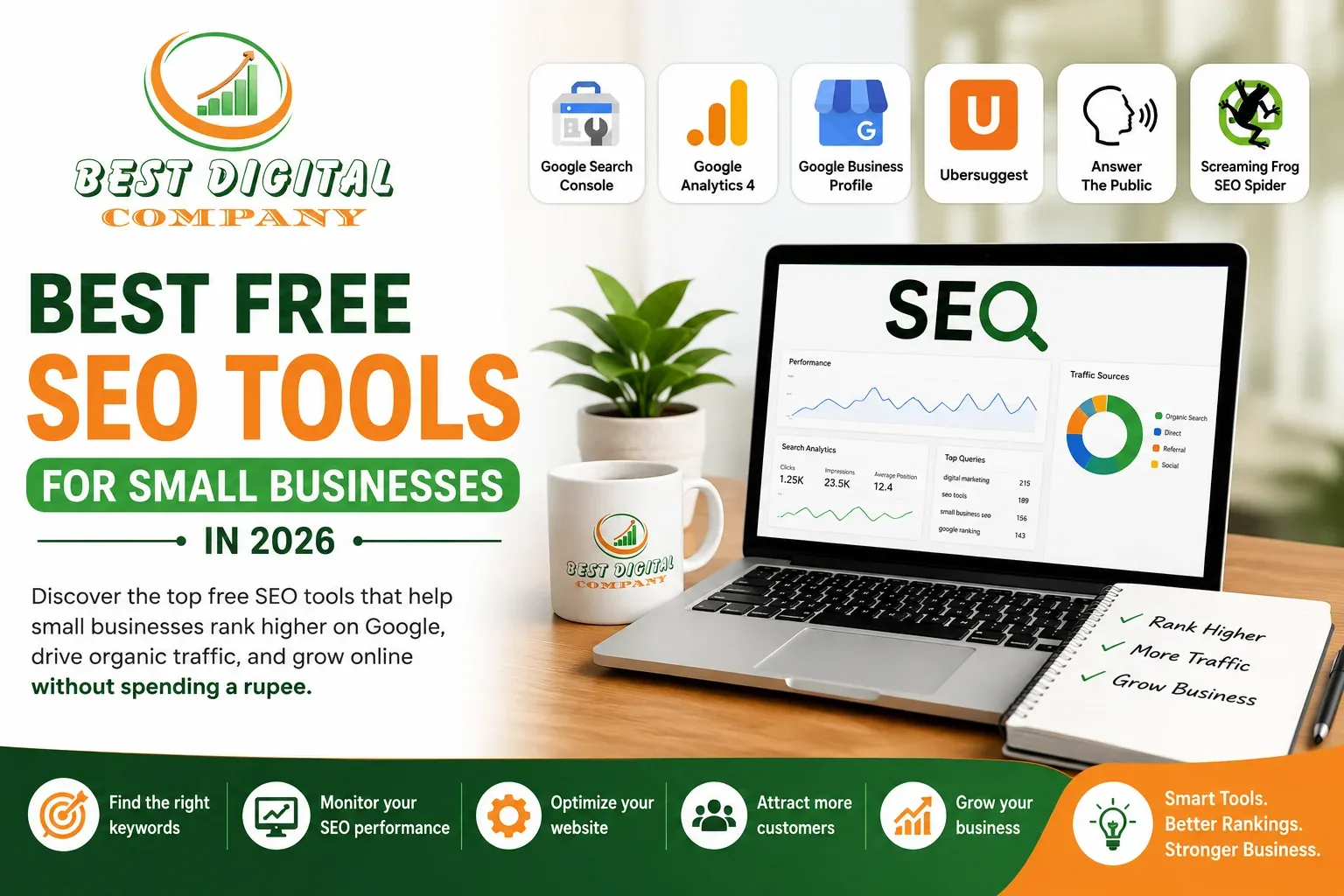
Discover the top free SEO tools that help small businesses rank higher on Google, drive organic traffic, and grow online without spending a rupee.

Running a small business is already a full-time job. Between managing customers, handling operations, and keeping your finances in check, it can feel impossible to also think about showing up on Google. But here’s the truth, if people can’t find you online, you’re leaving serious money on the table.

The good news? You don’t need a massive marketing budget to compete. There are powerful, free SEO tools available today that can give your small business the same visibility advantages that big brands enjoy. You just need to know which ones are actually worth your time.

At Best Digital Company, we’ve helped dozens of small and medium-sized businesses in Delhi and across India build strong organic search presences often starting with these exact free tools. In this guide, we’re breaking down the best free SEO tools for small businesses, what they do, and exactly how to use them.


Why SEO Matters for Small Businesses

Before we dive into the tools, let’s address the elephant in the room, why does SEO even matter for a small, local business?

Think about your own behaviour. When you need a plumber, a bakery, or a digital marketing agency, where do you go first? Google. Your potential customers do the same. Studies consistently show that over 90% of online experiences begin with a search engine, and the first page of Google captures nearly 95% of all clicks.

If you’re not showing up on page one, you’re practically invisible. SEO fixes that and free tools make it accessible to businesses at every level.

Let’s get into the tools.


1. Google Search Console – Your SEO Command Centre

What It Is

Google Search Console (GSC) is a free tool directly from Google that shows you exactly how your website performs in Google Search. If you only set up one tool from this entire list, make it this one.

What It Does for Small Businesses

  • Shows which search queries are driving traffic to your site
  • Identifies which pages are getting impressions but low clicks (a huge opportunity)
  • Flags technical errors like broken pages, crawl issues, and mobile usability problems
  • Lets you submit your sitemap so Google indexes your pages faster
  • Tracks your average ranking position for different keywords

Pro Tip

In the Performance tab, look for keywords where your site appears in positions 8–20. These are your low-hanging fruit. With a little content optimisation, you can push those to page one and dramatically increase your traffic  without creating brand-new content.


2. Google Analytics 4 – Understand Your Visitors

SEO isn’t just about getting visitors ,it’s about getting the right visitors. Google Analytics 4 (GA4) tells you what those visitors do once they land on your site.

What You’ll Learn

  • Which pages visitors spend the most time on (these are your best-performing pages)
  • Where your traffic comes from organic search, social media, direct, referrals
  • Which pages have high bounce rates (visitors leave immediately something needs fixing)
  • User demographics and interests, helping you create better-targeted content
  • Conversion tracking ,are visitors actually taking action (calling, buying, enquiring)?

When used together, Google Search Console and GA4 give you a nearly complete picture of your SEO health all for free.


3. Google Business Profile – The Local SEO Game-Changer

If your business serves a local area -0 a shop, a clinic, a restaurant, a service provider — Google Business Profile (GBP) is arguably the most important free SEO asset you have. This is what makes your business show up in the Google Maps section and the local “3-pack” that appears at the top of local searches.

How to Maximise It

  • Fill out every single field, business name, address, phone, hours, website, categories
  • Upload high-quality photos of your premises, team, and products/services
  • Actively collect and respond to Google reviews (this directly impacts your local ranking)
  • Post regular updates, offers, and events using the Posts feature
  • Use the Q&A section to answer common customer questions before they even ask

For small businesses in Delhi and other Indian cities, an optimised Google Business Profile can be the difference between a phone that rings and one that doesn’t.


4. Ubersuggest – Keyword Research Without the Price Tag

Keyword research is the foundation of all SEO. If you’re creating content without knowing what your potential customers are actually searching for, you’re writing into the void. Ubersuggest, created by digital marketing expert Neil Patel, offers a solid free tier for keyword research.

Key Features (Free Tier)

  • Keyword suggestions with monthly search volume and competition scores
  • Content ideas based on what’s already ranking for your target keyword
  • Backlink data showing who links to your competitors
  • Site audit tool to spot on-page SEO issues
  • Competitor analysis see what’s working for businesses like yours

Start by typing in your main business keyword (e.g., “digital marketing Delhi” or “bakery Lajpat Nagar”) and explore the related keywords it suggests. Look for keywords with decent search volume but low SEO difficulty those are the ones you can realistically rank for.


5. AnswerThePublic – Discover What Your Customers Are Asking

One of the most underrated free SEO tools for small businesses is AnswerThePublic. Enter a keyword and it generates a visual map of all the questions, prepositions, and comparisons people type into search engines related to that topic.

This is gold for content creation. Instead of guessing what to write about, you’re answering questions your customers are already asking Google. Each question becomes a potential blog post, FAQ section, or service page.

For example, if you’re a digital marketing agency, you might discover questions like:

  • “How much does SEO cost for a small business?”
  • “Is social media marketing worth it for local businesses?”
  • “What is the difference between SEO and PPC?”

Each one of those is a blog post waiting to be written content that captures real search intent and drives qualified leads to your site.


6. Yoast SEO – On-Page Optimisation Made Simple (WordPress Users)

If your website runs on WordPress (and many small business sites do), Yoast SEO is an essential free plugin. It removes the guesswork from on-page optimisation by giving you real-time feedback as you write.

What Yoast Does

  • Guides you to write an optimised SEO title and meta description for every page
  • Analyses your content’s readability and keyword usage
  • Automatically generates XML sitemaps to help Google crawl your site
  • Adds structured data (schema markup) to help your site appear in rich snippets
  • Alerts you to thin content, missing alt text, and other on-page issues

Think of Yoast as a junior SEO assistant that sits in your WordPress dashboard and tells you what to fix before you hit publish.


7. Screaming Frog SEO Spider (Free Version) – Technical SEO Audit

Technical SEO is the backbone of your website’s performance in search. Even the best content won’t rank if your site has broken links, missing meta tags, duplicate pages, or slow load times. Screaming Frog’s free version crawls up to 500 URLs and identifies exactly these kinds of issues.

What to Look For

  • Pages returning 404 errors (broken pages hurt both users and rankings)
  • Missing or duplicate title tags and meta descriptions
  • Images without alt text (accessibility and SEO issue)
  • Pages that redirect incorrectly (redirect chains)
  • Thin content pages with very little text

Run a crawl once a month to catch issues before they tank your rankings. For sites under 500 pages, the free version is all you’ll need.


8. Google PageSpeed Insights – Speed Up Your Site

Page speed is a confirmed Google ranking factor, and it also directly affects your conversion rate. Research shows that if a page takes longer than 3 seconds to load, more than half of visitors will leave. Google PageSpeed Insights is a free tool that analyses your website’s loading speed and tells you exactly what to fix.

It breaks down issues into categories like image compression, unused JavaScript, and render-blocking resources and for most issues, it tells you specifically how to fix them. This is especially important in India, where many users browse on mobile data connections.

Aim for a score above 70 on mobile. Anything under 50 is a red flag that’s likely hurting your rankings and your user experience.


9. MozBar – Quick On-Page Analysis in Your Browser

MozBar is a free Chrome extension that adds an SEO toolbar to every page you visit. As you browse your own site or your competitors’ sites, it shows you critical SEO data at a glance.

  • Domain Authority (DA) – a score indicating how strong a website’s backlink profile is
  • Page Authority – the strength of a specific page
  • On-page elements like title tags, meta descriptions, and header structure
  • Link metrics – see how many links a page has and where they go
  • Keyword highlighting on any search results page

MozBar is great for competitive research before you create content or target a keyword, check the Domain Authority of the pages currently ranking to understand how competitive the space is.


10. Ahrefs Webmaster Tools – Free Backlink & Keyword Data for Your Site

Ahrefs is one of the most powerful SEO tools in the world and while the full version is expensive, their free Webmaster Tools product gives small business owners something incredibly valuable: complete backlink and keyword data for their own website.

What You Get for Free (Verified Site Only)

  • Full backlink profile – see every site linking to you
  • Organic keywords – every keyword your site ranks for in Google
  • Site health score with prioritised technical issues to fix
  • Broken backlinks – find and reclaim links pointing to deleted pages
  • Top pages by organic traffic and ranking position

You simply verify your website (the same process as Google Search Console), and Ahrefs gives you a level of insight that used to cost hundreds of dollars a month. For any small business serious about SEO, this is a must-use.


How to Use These Tools Together: A Simple Monthly SEO Routine

You don’t need to use all ten tools every day. Here’s a simple monthly routine that covers all the bases:

  • Week 1 – Content: Use AnswerThePublic and Ubersuggest to find keywords and content ideas. Write one optimised blog post or update an existing page.
  • Week 2 – Technical: Run a Screaming Frog crawl. Fix any broken links or missing meta tags. Check Google PageSpeed Insights and action the top recommendations.
  • Week 3 – Performance: Log into Google Search Console. Review which pages got impressions without clicks. Update those pages to better match search intent.
  • Week 4 – Local & Links: Update your Google Business Profile with a new post or photos. Check Ahrefs Webmaster Tools for any new backlinks and respond to Google reviews.

That’s roughly 2-3 hours a month. Consistent effort with free tools will outperform inconsistent use of expensive tools every single time.


Frequently Asked Questions

Can free SEO tools really help my small business rank on Google?

Yes ,absolutely. Google Search Console, Google Business Profile, and Ahrefs Webmaster Tools are all free and are used by professional SEO agencies (including ours) every single day. The paid tools mainly offer more data on competitor sites; for your own site, free tools cover the essentials extremely well.

How long does it take to see results from SEO?

SEO is a long-term investment. Most businesses start seeing meaningful improvements within 3 -6 months of consistent effort. Local SEO (through Google Business Profile) can show results faster, sometimes within weeks of optimisation.

Do I need all 10 of these tools?

Not all at once. Start with Google Search Console, Google Analytics 4, and Google Business Profile, these three alone will give you a solid foundation. Add the others progressively as you get comfortable.

What is the most important free SEO tool for a local business?

Google Business Profile, without question. If your business serves a local area, an optimised GBP listing is the fastest way to appear in relevant local searches and on Google Maps.


Final Thoughts – Start Today, Grow Tomorrow

SEO doesn’t have to be expensive or complicated. With the ten free tools covered in this guide, you have everything you need to build a solid organic search presence, understand your audience, and outrank your competitors even on a tight budget.

The key is consistency. Pick two or three tools, get comfortable with them, and build from there. Small, regular improvements compound over time into significant results.

And if you’d like expert help implementing these strategies or if you want to accelerate your growth with a tailored SEO campaign our team at Best Digital Company is here to help. We’ve been helping businesses across Delhi and India grow their online presence through smart, ethical SEO strategies that deliver real, measurable results.


Ready to Grow Your Business Online? Get a free SEO audit from Best Digital Company — Delhi’s trusted digital marketing experts.

🌐 Website: https://bestdigitalcompany.com 📞 Phone: +91 8587948051 📧 Email: Contact@bestdigitalcompany.com

How to Optimize Google Business Profile in 2026

How to Optimize Google Business Profile in 2026

In 2026, local search has become the battlefield where businesses win or lose customers before a competitor’s website even loads. If you run a business in India — whether you are seeking SEO services in Punjab, scaling up with SEO services in Mumbai, growing visibility through SEO services in Delhi, or tapping into local demand with SEO services in Haryana — your Google Business Profile (GBP) is the single most powerful free tool at your disposal.

Google Business Profile is no longer just a digital visiting card. It is a dynamic, AI-enhanced listing that influences map pack rankings, voice search results, and local buying decisions every single day. Yet most businesses in India still treat it as a one-time setup task — fill in the address, add a phone number, and forget it.

That approach will not survive 2026.

This guide walks you through every step of optimizing your Google Business Profile this year, with actionable strategies that work whether you are a startup in Ludhiana, a retailer in Connaught Place, a firm in Chandigarh, or an agency in Andheri.

1. Claim and Verify Your Profile — The Right Way

Before optimization begins, ownership must be confirmed. Visit business.google.com, search for your business, and claim it. Google verification in 2026 includes video verification, postcard, phone, and email options. Video verification has become the most common method — you will be asked to record a short clip showing your shopfront, interior, and proof of ownership.

If you are working with an agency offering SEO services in Punjab or any other state, make sure ownership of the GBP remains with your business account, not the agency’s.

Pro Tip: Once verified, add trusted managers rather than sharing your primary login credentials.

2. Choose the Right Business Category (Primary + Secondary)

Your primary category is the single most important ranking signal in your GBP. Google uses it to decide which searches your listing is eligible to appear for.

  • Be specific. “Digital Marketing Agency” outperforms “Marketing Company.”
  • Add up to 10 secondary categories to capture adjacent searches.
  • Revisit categories quarterly — Google frequently adds new options.

Businesses offering SEO services in Delhi have found that adding categories like “Internet Marketing Service” and “Advertising Agency” alongside their primary category significantly improves impressions in the local map pack.

3. Write a Keyword-Rich Business Description

Your business description (up to 750 characters) is not directly a ranking factor, but it influences click-through rates and builds trust. Include:

  • What you do and who you serve
  • Your primary locations or service areas
  • A natural mention of key services

Example: “We provide result-driven digital marketing and SEO services in Punjab, helping local businesses rank higher on Google and attract more customers. Serving clients across Chandigarh, Amritsar, Ludhiana, and beyond, our team specializes in local SEO, content strategy, and Google Business Profile optimization.”

Avoid keyword stuffing. Write for humans first, search engines second.

4. Keep NAP Consistency Across the Web

NAP stands for Name, Address, and Phone Number. Inconsistency in your NAP across Google, Justdial, Sulekha, IndiaMART, and your website confuses search engines and hurts rankings.

Audit your listings regularly. Businesses scaling with SEO services in Mumbai often discover dozens of duplicate or outdated listings on third-party directories that silently damage their local authority.

Use tools like Moz Local or BrightLocal to run a citation audit and clean up inconsistencies.

5. Upload High-Quality Photos and Videos Consistently

Profiles with photos receive significantly more direction requests and website clicks than those without. In 2026, Google’s AI actively evaluates photo quality and recency as engagement signals.

What to upload:

  • Exterior photos (taken from multiple angles and in daylight)
  • Interior shots showing your workspace or store
  • Team photos (builds trust)
  • Product or service images
  • Short videos (30–90 seconds) showcasing your process or customer experience

Aim to add at least 2–3 new photos every week. Businesses utilizing SEO services in Haryana who commit to a consistent photo-upload schedule consistently outperform competitors in the local pack.

6. Leverage Google Posts Every Week

Google Posts appear directly on your listing and act like mini social media updates. In 2026, Posts are more visible than ever — they appear in mobile search results prominently.

Use Posts for:

  • Promotions and offers
  • New service announcements
  • Events and webinars
  • Blog content snippets with a CTA

Each post expires after 7 days (offers can last longer), so consistency is critical. Treat your GBP like a social channel, not a static directory.

7. Collect and Respond to Reviews — Strategically

Reviews are the lifeblood of local SEO. The quantity, quality, recency, and your responses all factor into ranking.

To build reviews:

  • Ask satisfied customers directly (in person, via WhatsApp, or email)
  • Add a QR code to your invoice or visiting card that links to your review page
  • Automate review requests using CRM integrations

Responding to reviews:

  • Respond to every review — positive and negative — within 48 hours
  • For positive reviews, thank the customer and mention your service or location naturally
  • For negative reviews, stay professional, acknowledge the concern, and offer resolution offline

Agencies offering SEO services in Delhi report that clients who respond to reviews consistently see a measurable improvement in local pack rankings within 60–90 days.

8. Use the Q&A Section Proactively

The Questions & Answers section is often ignored — but it is a goldmine. Anyone can ask a question on your profile, and anyone (including your competitors) can answer it.

Take control:

  • Seed the Q&A section yourself with common customer questions
  • Answer every question thoroughly
  • Include relevant keywords naturally in your answers

This section also surfaces in voice search results, making it especially valuable as smart speaker usage grows in India.

9. Enable and Optimize Messaging

Google’s built-in messaging feature lets potential customers contact you directly from your listing. In 2026, response time is tracked and displayed publicly.

Enable messaging, set up automated welcome messages, and aim to respond within one hour. Fast response times improve your listing’s engagement signals and reflect positively on your brand.

10. Track Insights and Iterate

Google Business Profile Insights provides data on:

  • How customers find your listing (direct vs. discovery search)
  • Search queries that triggered your listing
  • Actions taken (calls, website visits, direction requests)
  • Photo views vs. competitor averages

Use this data monthly. If direction requests are low, improve your exterior photos and area descriptions. If calls are dropping, revisit your business hours and phone number accuracy.

Businesses investing in SEO services in Mumbai or SEO services in Punjab that pair GBP optimization with regular Insights reviews consistently outperform those who set and forget.

Conclusion: Your GBP Is a Living Asset

Optimizing your Google Business Profile in 2026 is not a one-time task — it is an ongoing commitment. The businesses that dominate local search are those that treat their GBP with the same attention they give their website or social media. Whether you are a small retailer in Patiala, a law firm in Gurugram, a clinic in Bandra, or a manufacturer in Faridabad, these strategies apply to you.

If you need professional support, partnering with experts who specialize in SEO services in Punjab, SEO services in Haryana, SEO services in Delhi, or SEO services in Mumbai can accelerate your results and keep your strategy aligned with Google’s ever-evolving algorithm.

The local search race in 2026 rewards consistency, relevance, and engagement. Start optimizing today.

Frequently Asked Questions (FAQs)

Q1. What is Google Business Profile and why is it important for local SEO?

Google Business Profile (formerly Google My Business) is a free tool that lets businesses manage how they appear in Google Search and Maps. It is crucial for local SEO because it directly influences your visibility in the local map pack, which appears above organic results for location-based searches.

Q2. How long does it take to see results after optimizing my Google Business Profile?

Most businesses begin to see measurable improvements in impressions and clicks within 30–60 days of consistent optimization. Full results — including map pack rankings — typically take 3–6 months depending on competition and the completeness of your profile.

Q3. Can I optimize my Google Business Profile without hiring an SEO agency?

Yes, you can follow the steps in this guide independently. However, if you operate in competitive markets, partnering with professionals offering SEO services in Punjab, Delhi, Mumbai, or Haryana can accelerate results and handle technical aspects more efficiently.

Q4. How many photos should I have on my Google Business Profile?

There is no strict limit, but profiles with 10+ high-quality photos generally perform better. More importantly, upload new photos consistently — at least 2–3 per week — to signal to Google that your business is active.

Q5. Do Google reviews directly affect my local search ranking?

Yes. The quantity, quality, recency, and diversity of reviews are confirmed local ranking factors. Responding to reviews also sends positive engagement signals to Google’s algorithm.

Q6. What is the best business category to choose on Google Business Profile?

Always choose the most specific primary category that accurately describes your core business. Add secondary categories to capture related searches. Revisit your categories every quarter as Google regularly adds new options.

Q7. How does Google Business Profile optimization support my overall SEO strategy?

 GBP optimization works in tandem with your website SEO. A well-optimized profile drives traffic to your site, builds local citations, earns reviews, and increases brand trust — all of which strengthen your broader SEO performance.

Q8. Is it possible to manage multiple locations on one Google Business Profile account?

Yes. Google allows businesses with multiple locations to manage them all under one account using the Business Profile Manager dashboard. Each location should have its own optimized profile with unique photos, descriptions, and content.

Q9. Why are my Google Business Profile posts not getting views?

Low post views can result from an unverified profile, a low overall listing score, poor photo quality, or infrequent posting. Ensure your profile is fully complete, post weekly, and use compelling images and clear calls to action.

Q10. How do SEO services in Punjab or other cities help with Google Business Profile?

 Local SEO agencies understand the regional search landscape, competitive keywords, and consumer behaviour specific to their geography. Whether you need SEO services in Punjab, Mumbai, Delhi, or Haryana, a local specialist can audit your GBP, build citations, manage reviews, and align your profile with Google’s latest algorithm requirements for faster, more sustainable results.

How Digital Marketing Service in Delhi for Real Estate in 2026

How Digital Marketing Service in Delhi is Transforming Real Estate Sales in 2026

The Indian real estate market generated over ₹3.5 lakh crore in residential sales in 2024 — and a staggering 92% of buyers began their property search online. If your real estate brand is not showing up at the top of Google when someone types “3BHK in Dwarka” or “commercial plot in Gurugram,” you are handing your leads directly to your competitors. The right digital marketing service in Delhi for real estate is no longer a luxury — it is the single highest-ROI investment a developer or agent can make today.

Why Real Estate Brands in Delhi Cannot Ignore Digital Marketing in 2026

Delhi NCR — encompassing Noida, Greater Noida, Faridabad, Gurugram, and Ghaziabad — is one of Asia’s most competitive real estate corridors. With over 4,000 active real estate projects listed across platforms like MagicBricks, 99acres, and Housing.com, organic differentiation has become nearly impossible without a dedicated digital marketing strategy.

Traditional marketing — newspaper inserts, hoardings, site banners — averages a cost-per-lead of ₹8,000–₹20,000. A well-executed digital marketing service in Delhi for real estate brings that number down to ₹800–₹2,500 per qualified lead, while simultaneously building your brand’s long-term equity online.

92%
Indian buyers start property search online
67%
Real estate searches happen on mobile
More leads via local SEO vs. print ads
₹1,200
Average CPL with digital marketing

The Core Pillars of a Winning Real Estate Digital Marketing Strategy

A result-driven Digital Marketing Service in Delhi for real estate is not a single tactic — it is an integrated ecosystem of channels working in concert. Here are the non-negotiable pillars:

🏗️ The 6-Pillar Real Estate Digital Framework

  • Local SEO & Google Business Profile Optimisation — Own the “near me” searches and Google Maps pack for every micro-market you operate in.
  • Search Engine Optimisation (SEO) — Rank organically for high-intent keywords like “ready-to-move flats in Noida” or “luxury villas in Delhi” with zero recurring ad spend.
  • Google & Meta Pay-Per-Click (PPC) Campaigns — Capture buyers at the exact moment they express intent, with conversion-optimised landing pages built for real estate.
  • Video & Virtual Tour Marketing — YouTube walkthroughs and 360° tours increase inquiry rates by 40% for residential projects.
  • WhatsApp & Email Drip Nurturing — Convert cold inquiries into site visits with automated, personalised follow-up sequences.
  • Content Marketing & Property Blogs — Build topical authority that reduces your dependency on paid traffic over time.

SEO Services in Delhi: The Long-Game That Pays Forever

Search Engine Optimisation is the cornerstone of sustainable real estate lead generation. Unlike PPC, where leads stop the moment you pause spending, SEO services in Delhi compound in value — rankings you earn today continue delivering traffic for years. For real estate businesses specifically, SEO targets buyers at three critical stages of their journey: awareness (researching localities), consideration (comparing projects), and decision (ready to book a site visit).

An expert real estate SEO strategy for Delhi includes hyperlocal keyword research (targeting specific sectors, sectors, and sub-localities), technical SEO audits for your property website, schema markup for listings, high-authority backlink acquisition from real estate publications, and Google Business Profile management across all your project offices.

What Real Results Look Like

A mid-sized developer in South Delhi engaged professional SEO services and within 9 months saw their website traffic grow from 1,200 to 18,400 monthly visitors — with 340 organic inquiry form submissions per month at zero additional ad spend. This is the compounding power of investing in SEO services in Delhi for real estate.

Expanding Your Reach: SEO Services Across India’s Key Real Estate Markets

The real estate digital opportunity extends far beyond the capital. Developers with projects in Punjab, Mumbai, and Haryana are discovering that localised SEO gives them an enormous first-mover advantage in markets where online competition is still relatively nascent.

🏙️

SEO Services in Delhi

Dominate searches in Dwarka, Rohini, Vasant Kunj, Saket, and the broader NCR corridor with neighbourhood-specific content and Google Maps optimisation.

🌾

SEO Services in Punjab

Capture buyers in Mohali, Ludhiana, Amritsar, and Chandigarh — markets seeing rapid residential development thanks to infrastructure investment.

🌊

SEO Services in Mumbai

Outrank competitors for premium searches in Bandra, Powai, Thane, and Navi Mumbai, and attract high-net-worth and NRI investors actively searching online.

🏢

SEO Services in Haryana

Tap into the Gurugram, Faridabad, and Panchkula boom — placing your luxury and mid-segment projects in front of corporate professionals searching daily.

Social Media Marketing for Real Estate: Where Emotion Meets Conversion

Real estate is an emotionally charged purchase. Social media — particularly Instagram and Facebook — allows your brand to speak to the lifestyle aspiration behind every property purchase, not just the square footage. A strong social media presence for your real estate brand builds trust, drives remarketing audiences, and reduces the time-to-decision for prospective buyers.

Top-performing real estate social content includes drone footage of project locations, builder Q&A reels, resident testimonials, “Day in the life” neighbourhood explainer videos, and countdown posts for new launches. Paired with precision Facebook Lead Ads targeting Delhi NCR pincode-level audiences, social media marketing becomes one of the most powerful tools in the real estate digital arsenal.

Google Ads & PPC: Capturing Ready-to-Buy Leads Instantly

When a buyer is ready to shortlist properties, they go to Google. A well-structured Google Ads campaign — built specifically for the digital marketing service in Delhi for real estate landscape — can put your project at the very top of those search results within 24 hours of launch.

The key to real estate PPC success lies in campaign architecture: separate ad groups for each project, dedicated conversion-optimised landing pages (not your homepage), aggressive negative keyword management to filter out tenants and researchers, and call tracking integration so every lead is attributed accurately. With monthly budgets starting at ₹30,000, small and mid-sized developers can compete effectively against even the largest national brands.

Content Marketing: Build Authority That Sells Without Selling

The most trusted real estate brands online are not the ones that shout the loudest — they are the ones that educate buyers the most. A consistent content marketing programme — monthly blogs, area guides, investment analysis, RERA explainers, home loan calculators — positions your brand as the go-to authority in your market.

For example, a well-written guide titled “Is Buying a Flat in Noida Extension Worth It in 2025?” published on your website and promoted via social media can attract 5,000–15,000 readers over 12 months, a significant portion of whom will be active buyers in exactly that micro-market. Content marketing integrated with SEO services in Delhi creates an inbound lead machine that works 24/7.

How to Choose the Right Digital Marketing Partner for Your Real Estate Business

With hundreds of agencies offering digital marketing services in Delhi, choosing the right partner is critical. The wrong choice wastes budget; the right one transforms your pipeline. Here is what to look for:

✅ Your Agency Selection Checklist

  • Proven real estate case studies with verifiable lead volume and CPL data
  • Deep expertise in local SEO across Delhi, Punjab, Mumbai, and Haryana
  • In-house creative team for property photography, video, and ad creatives
  • Transparent monthly reporting with actual lead quality tracking (not just clicks)
  • Integration capabilities with your CRM (e.g., Salesforce, Zoho, LeadSquared)
  • Dedicated account manager who understands the property sales cycle
  • No long-term lock-in contracts — results should speak for themselves

The ideal digital marketing service in Delhi for real estate will not just drive traffic — it will drive qualified buyers who are ready to visit your site, not just browse your website. Measure your agency by site visit conversion rates, not just lead volume.

Conclusion: The Future of Real Estate Belongs to Digital-First Brands

The Indian real estate market is undergoing a digital revolution. Developers and agents who invest in digital marketing service in Delhi for real estate — backed by expert SEO services in Delhi, Punjab, Mumbai, and Haryana — will own the next decade of property sales. The buyers are online. The question is: will they find you, or your competition?

Start with a comprehensive digital audit of your current online presence. Identify the gaps — local SEO, content, paid ads, or social media — and build a phased roadmap with measurable milestones. The compounding returns of a well-executed digital strategy will outperform every hoarding you have ever booked.

Frequently Asked Questions

It is a suite of online strategies — SEO, PPC, social media, content marketing, and lead generation — tailored specifically for property developers and agents operating in Delhi NCR. The goal is to attract qualified buyers and investors online and convert them into site visits and bookings.
SEO services in Delhi improve your property listings’ visibility on Google, drive organic traffic from high-intent buyers and investors, and reduce your cost per lead over time. Unlike paid ads, SEO rankings compound in value — delivering leads long after the initial investment.
Absolutely. SEO services in Punjab help developers in Mohali, Ludhiana, Chandigarh, and Amritsar capture regional buyers searching for residential and commercial properties online. Punjab’s real estate market is growing rapidly, and early SEO investment creates a powerful first-mover advantage.
Mumbai’s property market is fiercely competitive. SEO services in Mumbai ensure your listings outrank competitors across Bandra, Thane, Navi Mumbai, and Powai, attract NRI investors searching from abroad, and build long-term domain authority that no competitor can buy overnight.
With Gurugram and Faridabad experiencing unprecedented commercial and residential development, SEO services in Haryana place your properties in front of corporate buyers and IT professionals actively searching for homes in these high-growth corridors every single day.
Most real estate clients begin seeing measurable improvements in rankings and organic traffic within 3–6 months, with significant lead volume increases by month 9–12. The timeline depends on your website’s current authority, the competitiveness of your target keywords, and the consistency of content production.
Google Search Ads, local SEO, YouTube virtual property tours, Facebook and Instagram Lead Ads, WhatsApp broadcast marketing, and content-rich property blogs consistently deliver the strongest ROI for Indian real estate brands across all price segments.
Packages typically range from ₹15,000 to ₹1,50,000 per month depending on the scope — covering SEO, paid search, social media management, creative production, and CRM integration. Most mid-sized developers find a ₹40,000–₹80,000/month retainer delivers a strong positive ROI within the first quarter.
Yes — even a modest digital marketing budget of ₹10,000–₹20,000/month can help independent brokers dominate hyperlocal searches like “2BHK flats in Dwarka Sector 12” or “resale apartments in Noida Extension” and compete effectively with large developers who are spending far more on generic campaigns.
Look for an agency with proven real estate case studies showing actual lead volumes and CPL data, expertise in local SEO across Delhi, Punjab, Mumbai, and Haryana, transparent monthly reporting, and dedicated account managers who genuinely understand the property sales cycle — not generalist marketers learning on your budget.

Ready to Transform Your Real Estate Leads?

Get a free digital audit and custom growth roadmap — crafted specifically for your real estate brand across Delhi, Punjab, Mumbai & Haryana.

Get Your Free Digital Audit →
Why Small Businesses Need Local SEO to Survive & Thrive

Why Small Businesses Need Local SEO to Survive & Thrive

If you run a local shop, clinic, restaurant, or service-based business, Local SEO isn’t optional , it’s survival. In this guide, we break down exactly why Local SEO drives real customers through your door, how it works, and the steps you need to take today.

Key Stats

  • 97% of consumers search online to find a local business
  • 78% of mobile local searches result in an offline purchase
  • 46% of all Google searches have local intent

What Is Local SEO?

Local SEO (Search Engine Optimization) is the practice of optimizing your online presence so your business appears prominently in geographically relevant searches. When someone in your city searches “best digital marketing agency near me” or “plumber in Delhi,” Local SEO determines whether your business shows up or your competitor’s does.

Unlike traditional SEO, which targets broad national audiences, Local SEO zeroes in on hyper-specific, intent-driven searches from people who are ready to buy, call, or visit. It involves your Google Business Profile, local citations, online reviews, and location-optimized content.

Did You Know? Google’s “Local Pack”, the map block showing 3 businesses at the top of search results captures over 44% of all clicks for local queries. If your business isn’t there, you’re invisible to nearly half your potential customers.


Why Local SEO Matters More for Small Businesses

Large brands have massive marketing budgets. They dominate generic keyword searches. But Local SEO levels the playing field, here’s why small businesses actually have an advantage with it:

🎯 Hyper-Targeted Customers Local searches come from people in your area who are actively looking for what you offer. These are high-intent customers, not casual browsers.

💸 Cost-Effective Growth Unlike paid ads that stop the moment you stop spending, organic local rankings keep generating traffic and leads 24/7 with no per-click cost.

🏆 Outrank Big Brands Google prioritizes proximity and relevance in local results. A well-optimized local business can outrank national chains for neighborhood searches.

⭐ Build Trust & Authority High local rankings combined with positive reviews build immediate credibility. Customers trust businesses that appear at the top of Google Maps.

📱 Capture Mobile Traffic “Near me” searches on mobile have grown over 200% in recent years. Local SEO ensures you capture this enormous wave of ready-to-buy mobile users.

📊 Measurable Results Track calls, direction requests, website clicks, and more directly from your Google Business Profile dashboard. Every result is quantifiable.


How Google Ranks Local Businesses

Google uses three core factors to determine local search rankings. Understanding these helps you build a strategy that actually works:

1. Relevance How well does your business match what the searcher is looking for? Complete, keyword-rich Google Business Profile descriptions, service listings, and website content all signal relevance to Google.

2. Distance How close is your business to the searcher? While you can’t move your location, you can optimize service areas, local landing pages, and geo-targeted content to expand your reach.

3. Prominence How well-known and reputable is your business? Google factors in reviews, backlinks from local sites, social signals, and how often your business is mentioned across the web.

“Local SEO isn’t just about ranking on Google, it’s about being the obvious choice in your community at the exact moment customers need you.”


Essential Local SEO Strategies for Small Businesses

Implementing Local SEO doesn’t require a massive budget but it does require consistency and strategy. Here are the most impactful steps you can take:

1. Optimize Your Google Business Profile (GBP) Your Google Business Profile is the single most powerful Local SEO asset you have. Ensure your Name, Address, and Phone (NAP) information is accurate, choose the correct business categories, upload high-quality photos, add your services/products with descriptions, and post regular updates to show Google your listing is active.

2. Build Local Citations & Directory Listings Get your business listed consistently on platforms like Justdial, IndiaMart, Sulekha, Yelp, and industry-specific directories. NAP consistency across all listings is critical; any discrepancy confuses both Google and potential customers.

3. Generate & Manage Customer Reviews Proactively ask satisfied customers to leave Google reviews. Respond professionally to all reviews  both positive and negative. Reviews are a major ranking signal AND a conversion driver; 88% of consumers trust online reviews as much as personal recommendations.

4. Create Location-Specific Content Write blog posts, service pages, and landing pages that target local keywords. For example: “Best Digital Marketing Services in Ghaziabad,” “SEO Agency in Delhi NCR,” or “How to Grow Your Business Online in Noida.” This geographic targeting signals local relevance to Google.

5. Optimize for Mobile & Voice Search Over 60% of local searches happen on mobile devices. Ensure your website loads in under 3 seconds, is fully mobile-responsive, and uses natural conversational language to capture voice search queries like “Who is the best digital marketing agency near me?”

6. Build Local Backlinks Earn links from local news sites, city blogs, chambers of commerce, and community organizations. Local backlinks from trusted regional sources are powerful signals that boost your local authority and rankings.


Local SEO Checklist for Small Businesses

  • Claim and fully optimize your Google Business Profile
  • Ensure NAP (Name, Address, Phone) consistency everywhere online
  • Get listed on top local directories (Justdial, Sulekha, etc.)
  • Actively collect and respond to Google reviews
  • Create dedicated location pages on your website
  • Use local keywords naturally in page titles, headings & meta descriptions
  • Add local schema markup to your website
  • Ensure your website is fast, mobile-friendly & secure (HTTPS)
  • Build relationships for local backlinks
  • Track performance via Google Search Console & GBP Insights

The ROI of Local SEO: Real Business Impact

Small businesses that invest in Local SEO consistently report dramatic improvements in foot traffic, phone inquiries, and revenue. Here’s what the data shows:

Businesses that appear in Google’s Local Pack receive 44% of all clicks for a given local search. Customers who find a business through local search are 5x more likely to convert than those who come through other channels. And the best part unlike paid advertising, the results compound over time as your authority grows.

Local SEO delivers an average ROI of 500%+ for small businesses when executed consistently over 6–12 months making it the single highest-return marketing investment available to most SMBs.


Frequently Asked Questions

What is Local SEO and why is it important for small businesses?

Local SEO is the process of optimizing your online presence to attract customers from relevant local searches on Google and other search engines. It is crucial for small businesses because most consumers search for nearby products and services before making purchasing decisions and Local SEO ensures your business appears at the top of those results, directly in front of ready-to-buy customers.

How does Local SEO differ from regular SEO?

Regular SEO targets broad, national or global audiences, while Local SEO focuses on geo-specific searches like “best bakery near me” or “plumber in Delhi.” Local SEO uniquely involves Google Business Profile optimization, local citations, customer reviews, and location-based keywords strategies specifically designed to drive nearby customers to your business.

How long does it take to see results from Local SEO?

Most small businesses begin to see measurable improvements in local rankings and traffic within 3 to 6 months of implementing a consistent Local SEO strategy. The exact timeline depends on your competition, niche, and the quality of your optimization. Google My Business improvements can sometimes show results within 4–6 weeks.

Is Local SEO expensive for small businesses?

Local SEO is one of the most cost-effective digital marketing strategies available. Unlike paid ads, organic local rankings generate ongoing traffic without per-click costs. Many foundational steps like claiming your Google Business Profile and getting listed in directories are completely free. Professional Local SEO services provide exceptional ROI compared to traditional advertising.

What is Google My Business and do I need it?

Google My Business (now called Google Business Profile) is a free tool that lets businesses manage how they appear on Google Search and Maps. It is absolutely essential for Local SEO businesses with optimized profiles are significantly more likely to appear in Google’s Local Pack (the top 3 map results), which captures the majority of clicks for local queries.

Can Local SEO help me compete with bigger brands?

Absolutely. Local SEO is one of the few digital strategies where small businesses can legitimately outrank large national brands. Google prioritizes proximity and relevance in local searches, giving small businesses with strong local signals reviews, accurate listings, local content, a genuine competitive edge over big-box retailers who lack a local presence.

How do online reviews affect Local SEO?

Online reviews are a major local ranking factor. A higher volume of positive reviews signals trust and authority to Google, which directly boosts your ranking in local search results. Reviews also influence customer buying decisions ,88% of consumers trust online reviews as much as personal recommendations, making review management an indispensable part of any Local SEO strategy.


Ready to Dominate Local Search?

Best Digital Company specializes in results-driven Local SEO strategies for small businesses across Delhi NCR and beyond. Let us put your business on the map.

📞 +91 8587948051Contact@bestdigitalcompany.com 🌐 bestdigitalcompany.com
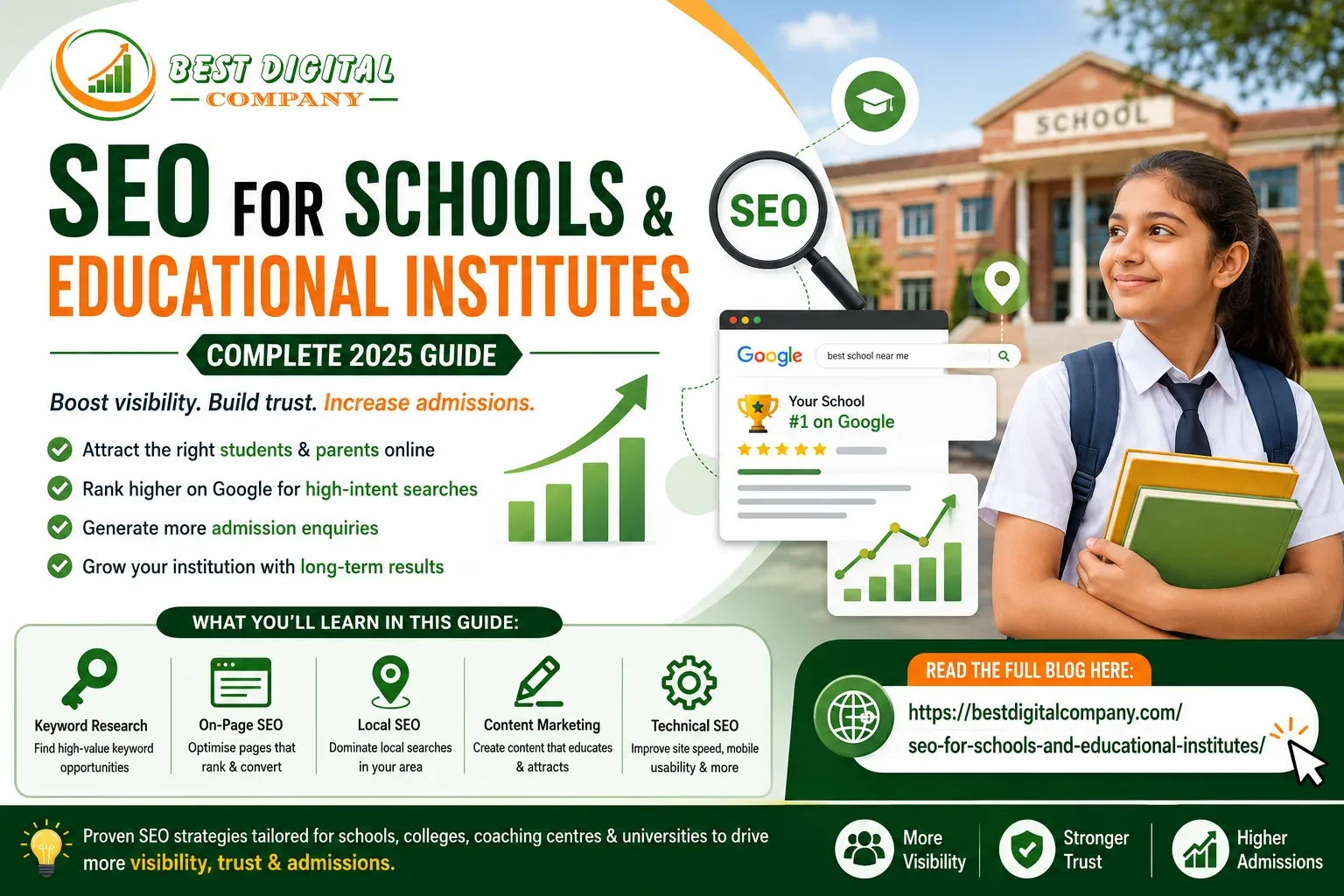
Local SEO for Yoga Studios

Local SEO for Yoga Studios: How to Attract More Local Clients

If someone in your city searches “yoga studio near me” right now, does your studio appear? If not, you are leaving dozens, possibly hundreds, of potential clients on the table every single month.

Local SEO is the most cost-effective way for yoga studios to attract a steady stream of local clients without relying on costly paid ads alone. When your studio ranks at the top of local search results, you are visible to people who are already looking for exactly what you offer, at the exact moment they are ready to take action.

This guide walks you through every Local SEO strategy your yoga studio needs — from optimising your Google Business Profile to building local citations, earning reviews, and creating content that ranks. We have also included a detailed FAQ section addressing the most common questions yoga studio owners ask us.


Why Local SEO Matters for Yoga Studios: The Numbers

Before diving into strategy, consider what is at stake:

  • 76% of people who search for a local business on their smartphone visit within 24 hours
  • 46% of all Google searches have local intent
  • 88% of local mobile searchers call or visit a business within one day
  • Businesses that fully optimise their Google Business Profile receive 3x more calls than those that do not

For yoga studios, which depend on a local client base, these numbers are not abstract, they represent real people in your neighbourhood who are actively looking for a studio like yours.


1. What Is Local SEO and How Does It Work for Yoga Studios?

Local SEO (Search Engine Optimisation) is the practice of optimising your online presence so your business appears prominently when people in your geographic area search for services you offer. For yoga studios, this means ranking in Google’s Local Pack, the map box with three business listings that appears at the very top of local search results and in the organic results below it.

Unlike traditional SEO that targets a national or global audience, Local SEO focuses on hyper-targeted searches such as:

  • “yoga studio near me”
  • “yoga classes in Delhi”
  • “beginner yoga Lajpat Nagar”
  • “Hatha yoga studio South Delhi”
  • “prenatal yoga classes near me”

These are high-intent searches — the people typing them are ready to visit and book. Local SEO puts your studio directly in front of them.

Our Search Engine Optimisation service is designed for exactly this ,helping local service businesses like yoga studios dominate their geographic market online.


2. Optimising Your Google Business Profile (GBP)

Your Google Business Profile (formerly Google My Business) is the single most powerful tool in your Local SEO arsenal. A fully optimised GBP can place your studio in the coveted Local 3-Pack, which captures the majority of clicks for local searches.

How to Optimise Your GBP Step by Step

Step 1: Claim and Verify Your Listing

Go to business.google.com, claim your listing, and complete verification via phone or postcard. Unverified listings rank poorly and cannot be fully managed.

Step 2: Choose the Right Primary Category

Select “Yoga Studio” as your primary category. Add secondary categories for the specific styles you offer- Hatha, Vinyasa, Ashtanga, Kundalini and related categories like “Fitness Centre” or “Meditation Centre.”

Step 3: Write a Keyword-Rich Business Description

Include your city, neighbourhood, key yoga styles, and target client phrases naturally. Example: “Award-winning yoga studio in Lajpat Nagar, Delhi offering Hatha, Vinyasa, and prenatal yoga classes for all levels from complete beginners to advanced practitioners.”

Step 4: List Every Service Individually

Add each class type, workshop, and private session as a separate service with its own description. Each service can independently rank for its own keyword in local search.

Step 5: Upload High-Quality Photos Consistently

Studios with 100+ photos receive 520% more calls than those with fewer. Upload studio interiors, classes in action, instructor photos, and exterior signage regularly at least 2–3 new photos per week.

Step 6: Use GBP Posts Weekly

GBP Posts function like social media updates directly on your Google listing. Share new class schedules, seasonal offers, events, and instructor features. Regular posting signals an active business to Google.

Step 7: Enable Messaging and Booking

Activate the messaging feature and connect a booking link so potential clients can enquire or reserve directly from your Google listing before they even visit your website.

Critical: NAP Consistency

Ensure your Name, Address, and Phone number (NAP) on your GBP exactly match what appears on your website and every other online directory. Even minor inconsistencies,  “St.” vs “Street” , confuse Google and hurt your local rankings.


3. Local Keyword Research for Yoga Studios

Effective Local SEO begins with understanding what your potential clients are searching for. Here are the key keyword categories to target:

Primary Local Keywords (Highest Priority)

These drive the most valuable, ready-to-book traffic:

  • “yoga studio near me”
  • “yoga classes [your city]”
  • “yoga studio [your neighbourhood]”
  • “best yoga studio [city]”

Style-Specific Local Keywords (High Priority)

Target these to attract clients interested in a particular style:

  • “Hatha yoga classes Delhi”
  • “Vinyasa yoga studio Gurugram”
  • “Iyengar yoga Noida”
  • “hot yoga studio near me”

Audience-Specific Keywords (High Priority)

These capture niche demand with very high conversion rates:

  • “prenatal yoga classes Delhi”
  • “yoga for seniors near me”
  • “yoga for beginners [city]”
  • “corporate yoga classes Delhi”

Long-Tail Informational Keywords (Medium Priority)

Use these in blog posts and FAQs to attract clients earlier in their decision journey:

  • “how to start yoga for the first time”
  • “what to expect at your first yoga class”
  • “Hatha vs Vinyasa yoga – which is right for me”
  • “benefits of yoga for stress relief”

Use Google’s “People Also Ask” and “Related Searches” sections to continuously discover new keyword opportunities. Our SEO Packages include comprehensive keyword research tailored to your location and target audience.


4. On-Page SEO: Location Pages and Website Optimisation

Your website must be optimised for both search engines and human visitors. Here are the most important on-page SEO elements for yoga studio websites:

Create Dedicated Location and Service Pages

If your studio serves multiple areas or offers multiple yoga styles, create a dedicated page for each one:

  • /yoga-classes-south-delhi/
  • /hatha-yoga-classes-delhi/
  • /prenatal-yoga-delhi/
  • /beginner-yoga-lajpat-nagar/

Each page should contain unique content targeting that specific location or class type — not thin duplicate content.

On-Page SEO Checklist

  • Title tag includes primary keyword + city name (under 60 characters)
  • Meta description is compelling, includes a call to action, under 155 characters
  • H1 tag contains the main target keyword naturally
  • H2 and H3 subheadings contain supporting keywords and location variants
  • First paragraph mentions your city or neighbourhood naturally
  • NAP (Name, Address, Phone) visible on every page — in the footer at minimum
  • Google Maps embed of your studio location on the Contact page
  • LocalBusiness Schema markup implemented on your homepage and location pages
  • Internal links connecting service pages, class pages, and blog content
  • Image alt tags are descriptive and include location keywords where natural
  • Page load speed under 3 seconds on mobile devices
  • SSL certificate active (HTTPS)

For technically precise on-page implementation, our Search Engine Optimisation service covers everything from Schema markup to page structure optimisation, so you can focus on teaching yoga rather than coding.


5. Building Local Citations and NAP Consistency

A local citation is any online mention of your yoga studio’s Name, Address, and Phone number (NAP). Citations on authoritative local and niche directories signal to Google that your business is legitimate and locally relevant directly influencing your Local Pack rankings.

Priority Directories for Yoga Studios in India

Start with these for the highest impact:

  1. Google Business Profile – non-negotiable, highest priority
  2. JustDial – India’s most widely used local business directory
  3. Sulekha – strong domain authority for fitness and wellness
  4. Practo – excellent for health and wellness-adjacent businesses
  5. IndiaMart – adds local business signals
  6. Facebook Business Page – functions as a citation as well as social proof
  7. Apple Maps – growing rapidly with iPhone usage in India
  8. Bing Places – often overlooked; still drives meaningful traffic
  9. Yoga Alliance – niche directory with strong authority in the yoga space
  10. MindBody / ClassPass – industry-specific, high-conversion platforms

Conduct a Citation Audit First

Before building new citations, audit your existing ones. Tools like BrightLocal or Moz Local can scan for inconsistent NAP data across the web. Fixing incorrect existing citations often delivers faster ranking improvements than creating new ones.


6. Review Management: Your Secret Local Ranking Weapon

Google’s local ranking algorithm treats review quantity, quality, and recency as major ranking signals. Yoga studios with more positive, keyword-rich reviews consistently outrank competitors even long-established ones in local search results.

Beyond rankings, reviews directly influence whether a prospective client chooses your studio. Research shows 93% of consumers say online reviews impact their purchase decisions.

Strategies to Generate More Google Reviews

Post-Class Email or SMS Automation Set up an automated message sent 2 hours after each class. Thank the student for attending and include a direct link to your Google review page. Timing is critical ask while the experience is still fresh.

QR Code at the Studio Place a branded QR code at the reception desk and in changing rooms. Label it clearly: “Enjoyed your class today? Leave us a review!” This captures reviews from clients who may not check email.

Announce Milestone Goals Tell your community: “Help us reach 100 reviews and we will celebrate with a free community class!” This creates social momentum. Never offer individual rewards per review, this violates Google’s guidelines.

Respond to Every Single Review Always respond to positive and negative reviews promptly. Responses demonstrate that you value client feedback, and your replies naturally allow you to include local keywords a small but genuine ranking signal.

Train Your Instructors Brief your teaching team to mention reviews naturally at the end of class: “If you enjoyed today’s session, it would mean the world if you left us a quick Google review.”


7. Local Content Marketing Strategy

Content marketing is the long-term engine of Local SEO growth. For yoga studios, locally relevant content builds topical authority, earns backlinks from local websites, and attracts potential clients at every stage of their decision journey.

High-Value Content Ideas for Yoga Studios

Neighbourhood and City Guides “5 Reasons to Start Yoga in South Delhi This Season” , attracts local backlinks, shares well on social media, and positions your studio as a community authority.

Local Event Coverage “Our Studio at the Delhi Wellness Festival 2026” , fresh, date-stamped content that Google rewards for recency.

Instructor Spotlights “Meet Priya: Our Certified Ashtanga Yoga Teacher from Hauz Khas” builds E-E-A-T (Experience, Expertise, Authority, Trustworthiness) signals that Google uses to evaluate content quality.

FAQ-Style Blog Posts “What Should I Bring to My First Yoga Class in Delhi?”  directly targets informational searches and brings in prospective clients earlier in their research phase.

Seasonal and Timely Content “Best Yoga Routines for Delhi Summers” or “How to Stay Consistent With Your Practice During Festival Season”  seasonal relevance boosts your content’s visibility at the right time of year.

Client Success Stories Authentic testimonials that mention the studio, location, specific classes, and personal transformation , these build trust while naturally incorporating local keywords.

Comparison Guides “Hatha vs Vinyasa Yoga: Which Style Is Right for You?”  captures high-traffic comparison searches from people researching their options.

For more digital marketing insights, visit our Blog and News section.


8. Social Media and Local SEO Synergy

While social media signals are not a direct Google ranking factor, a strong social presence plays an important supporting role in your Local SEO strategy. It drives branded searches (a powerful indirect ranking signal), generates backlinks from local websites, and keeps your studio prominent in the local community’s mind.

Instagram and Facebook Best Practices for Local Yoga Studios

  • Include your city and neighbourhood in your Instagram and Facebook bio
  • Tag your studio location in every post and story
  • Use targeted local hashtags: #DelhiYoga, #YogaStudioDelhi, #YogaNearMe, #[Neighbourhood]Wellness
  • Share user-generated content from students with permission , authentic content performs significantly better than polished marketing posts
  • Run locally targeted Instagram and Facebook ads to reach people within a specific radius of your studio
  • Post consistently , a minimum of 4–5 times per week to maintain algorithmic visibility
  • Use Instagram Reels showing snippets of classes , these receive 3x more reach than static posts on average

Our Social Media Marketing service and SMO Packages are specifically designed to build a loyal local following that converts into paying clients for your yoga studio.


9. Technical SEO Essentials

Technical SEO ensures search engines can efficiently crawl, index, and rank your website. Even the most beautifully written content will underperform if your website has underlying technical issues.

Technical SEO Priorities for Yoga Studio Websites

Mobile-First Design Over 70% of local searches happen on mobile devices. Your website must load correctly and be easy to use on a smartphone , this is a direct Google ranking factor.

Core Web Vitals Google measures page experience through Core Web Vitals: Largest Contentful Paint (LCP) under 2.5 seconds, First Input Delay (FID) under 100ms, and Cumulative Layout Shift (CLS) under 0.1.

LocalBusiness Schema Markup Implement Schema.org structured data on your homepage and location pages to help Google understand your business type, location, hours, and contact information. This can also unlock rich snippets in search results.

Clean URL Structure Use descriptive, readable URLs: /yoga-classes-delhi/ not /page?id=123. Clear URLs help both Google and users understand what a page is about before clicking.

XML Sitemap and Google Search Console Submit your sitemap to Google Search Console and monitor it regularly for crawl errors, indexing issues, and search performance data.

Image Optimisation Compress all images and serve them in next-gen formats like WebP. Large, unoptimised images are one of the most common reasons yoga studio websites fail Core Web Vitals tests.

If you need a professionally built, technically optimised yoga studio website, our Web Development service and Web Development Packages deliver fast, SEO-ready websites that rank and convert.


10. Combining Local SEO with PPC for Maximum Visibility

Local SEO builds compounding, long-term visibility. Pay-Per-Click (PPC) advertising delivers immediate placement at the top of search results, often within hours. The most successful yoga studios use both together.

When your studio appears in both paid ads and organic/local results simultaneously, it dominates the search results page and dramatically increases click-through rates and brand trust among prospective clients.

Smart PPC Strategies for Yoga Studios

  • Use geographic radius targeting to show ads only to searchers within 5–10 km of your studio
  • Run campaigns during high-intent periods: January (New Year resolutions), monsoon season when outdoor activities decline, and pre-festival periods
  • Use ad copy insights to refine your on-page SEO messaging ,what converts in ads often converts on landing pages too
  • Set up retargeting campaigns for people who visited your website but did not book a class
  • Use Google Local Service Ads to appear above standard PPC ads for relevant local searches

Explore our PPC Management service and PPC Packages for yoga studios and local service businesses.


Frequently Asked Questions (FAQ)

What is Local SEO and why does my yoga studio need it?

Local SEO is the process of optimising your online presence to attract more clients from local searches. When someone types “yoga studio near me” or “yoga classes in Delhi,” Local SEO determines whether your studio appears in those results. Without it, potential clients in your own neighbourhood may never find you , no matter how good your studio is. It works 24/7, bringing in clients who are actively searching and ready to book.

How long does Local SEO take to show results for a yoga studio?

Most yoga studios start seeing measurable improvement in local rankings within 3 to 6 months of consistent Local SEO effort. Quick wins like Google Business Profile optimisation and citation building can show results in as little as 4–8 weeks. The more competitive your local market, the longer full results may take , but unlike paid ads, the results are durable and compound over time.

What is the most important Local SEO factor for yoga studios?

Your Google Business Profile (GBP) is the single most important factor. A fully optimised, regularly updated GBP with positive reviews, accurate NAP details, photos, and detailed service listings dramatically increases your chances of appearing in the Google Local Pack , the top 3 map results that capture the majority of local search clicks. If you do only one thing today, optimise your GBP.

Do I need a website if I already have a Google Business Profile?

Yes, absolutely. While a GBP alone can generate some visibility, a well-designed website is essential for serious Local SEO results. A website allows you to target a much wider range of local keywords through service pages and blog content, build credibility with prospective clients, showcase class schedules and pricing, and convert visitors into booked members. Our Web Development team builds SEO-ready yoga studio websites that rank and convert.

How do online reviews impact local search rankings?

Reviews are one of the top three local ranking factors in Google’s algorithm. The quantity, quality, recency, and diversity of your reviews all play a role. Studios with 50+ positive Google reviews consistently outrank competitors with fewer reviews. Beyond rankings, reviews directly influence whether a prospective client chooses your studio ,93% of consumers say online reviews impact their purchase decisions.

What are local citations and how do they help my yoga studio?

Local citations are online mentions of your business Name, Address, and Phone number (NAP) on directories like JustDial, Sulekha, Apple Maps, and niche platforms like Yoga Alliance. Consistent citations signal to Google that your business is legitimate and locally relevant, which improves your local rankings. The key is consistency conflicting NAP information across directories can harm your rankings.

Should I use PPC alongside Local SEO for my yoga studio?

Yes, combining Local SEO with PPC delivers significantly better results than either channel alone. SEO builds long-term organic visibility that compounds over time. PPC gives you immediate placement at the very top of search results, even before you have established organic rankings. Together, they allow your studio to dominate the search results page. See our PPC Packages designed for local businesses.

How much does Local SEO cost for a yoga studio?

Cost varies depending on the competition in your area, number of locations, and scope of services needed. At Best Digital Company, we offer flexible SEO Packages designed for small and growing yoga studios at every budget, with transparent pricing and no hidden fees.

Call us on +91 8587948051 or email Contact@bestdigitalcompany.com for a free consultation.

Can Best Digital Company manage my entire Local SEO campaign?

Absolutely. We offer fully managed Local SEO campaigns covering GBP optimisation, citation building, review strategy, on-page SEO, local content creation, technical SEO, and monthly performance reporting. You focus on running your classes , we focus on filling them.

Contact us for a free audit and personalised recommendation.


Conclusion

Local SEO is not a one-time task , it is an ongoing strategy that builds momentum over time. The yoga studios that invest in it consistently are the ones that appear at the top of search results, attract a steady flow of new local clients, and reduce their dependence on expensive paid advertising.

Whether you start with optimising your Google Business Profile, cleaning up your citations, or launching a content strategy, every step you take builds compounding value for your studio’s online visibility.

Best Digital Company is here to help at every stage. From local keyword research and on-page optimisation to citation management, review strategy, social media, and fully managed SEO campaigns, we have the expertise and track record to grow your yoga studio’s local presence.

📞 Call us: +91 8587948051

✉️ Email: Contact@bestdigitalcompany.com

🔗 Get started: Free SEO Audit | View SEO Packages