AI Overviews Optimization: Make Your Business Visible

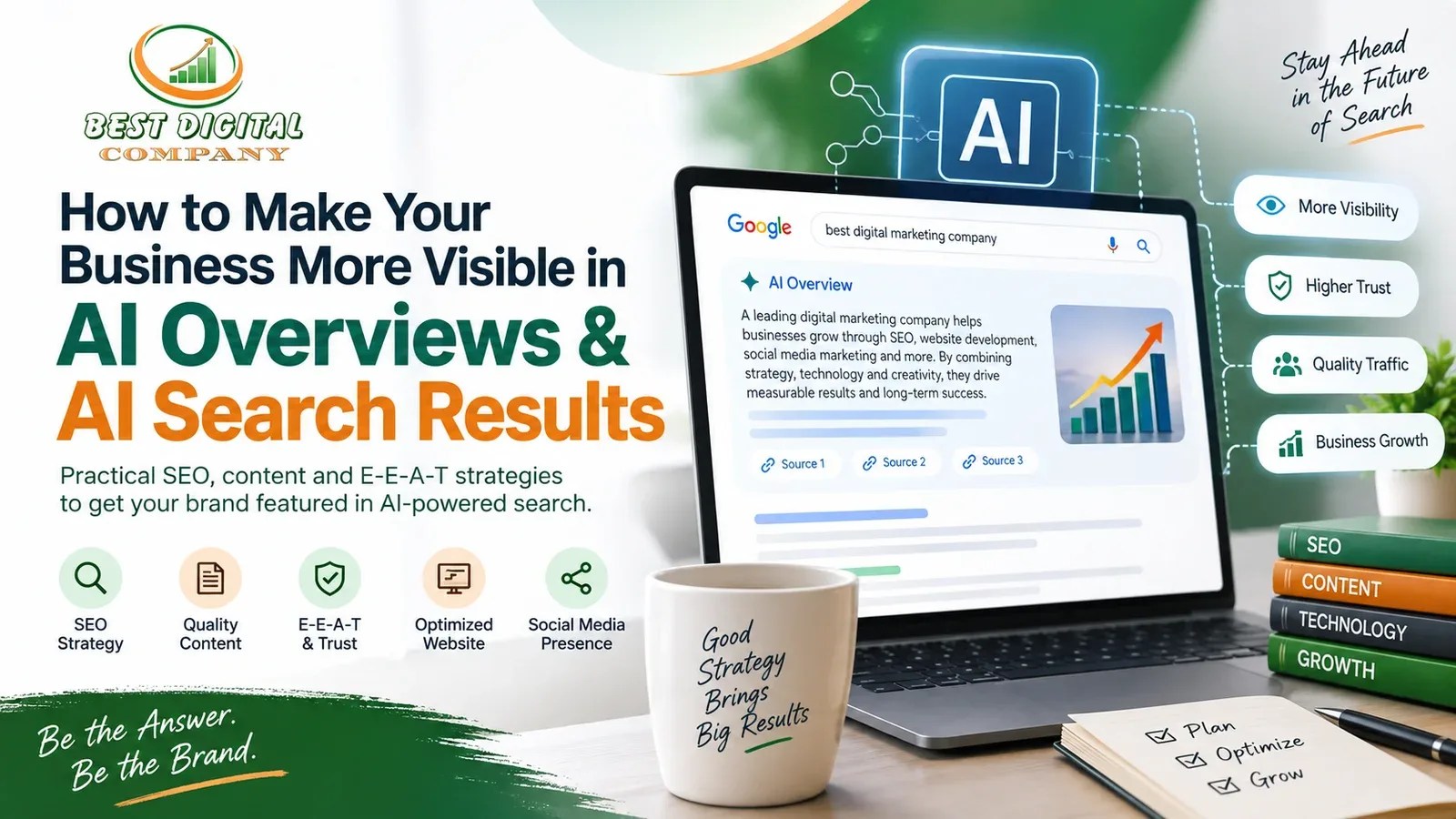
How to Make Your Business More Visible in AI Overviews & AI Search Results

Search behavior has changed more in the last two years than it did in the previous decade. People no longer type a query and scroll through ten blue links. Instead, they read a short AI-generated summary at the top of the page, get their answer, and move on. If your business isn’t part of that summary, you’re invisible to a growing share of potential customers — even if you still rank well the old-fashioned way.

This shift is exactly why AI Overviews optimization has become one of the most important priorities for any business that wants to stay discoverable in 2026 and beyond. Whether you run a local service business, an e-commerce store, or a B2B company, the way you structure and present your content now directly affects whether Google’s AI, ChatGPT, Perplexity, or Copilot mentions your brand when someone asks a relevant question.

In this guide, we’ll break down what AI Overviews actually are, why they matter, and the practical steps you can take — from content structure to technical setup — to improve your chances of being featured. We’ll also look at how core digital marketing disciplines like SEO, website development, and social media marketing all play a role in this new search landscape.

What Are AI Overviews and Why They Matter for Your Business

AI Overviews are the AI-generated summaries that now appear at the top of many search results. Instead of listing links for the user to click through, the search engine reads across multiple trusted sources, synthesizes the information, and presents a direct answer — often with a few source links attached.

This matters for three reasons:

  1. Reduced click-through rates. When a searcher gets their answer directly in the overview, they may never click through to a website at all. If your competitor is cited and you aren’t, they get the visibility and the trust, even if your content is just as good.
  2. New ranking signals. Being included in an AI Overview depends less on traditional keyword density and more on how clearly your content answers a specific question, how trustworthy your site appears, and how well your information is structured for machines to read.
  3. A shrinking window of opportunity. Early adopters who optimize now will have an advantage, since AI systems tend to favor sources they’ve already learned to trust over time.

In short, if your business isn’t showing up in AI-generated answers, you’re losing visibility at the exact moment a customer is deciding who to trust.

How AI Search Is Different from Traditional Search Results

Traditional search rewarded pages that matched a keyword closely and had strong backlink profiles. AI search still cares about relevance and authority, but it adds a layer of interpretation on top. The AI has to understand the intent behind a question, not just the words used, and then decide which sources are reliable enough to summarize.

A few practical differences worth understanding:

  • Answers are extracted, not just linked. The AI pulls a sentence or paragraph out of your page and rewrites it in its own words. This means your content needs to contain clear, self-contained answers, not just vague marketing language.
  • Multiple sources are blended. An AI Overview often draws from three, five, or even ten different pages to build one answer. Your goal isn’t to “win” the top spot outright — it’s to be one of the sources the AI trusts enough to include.
  • Freshness and consistency matter more. AI models weigh how consistently a fact appears across multiple credible sources. If your business information is inconsistent across your website, directories, and social profiles, it becomes harder for AI systems to confidently cite you.

Understanding this shift is the foundation of any real AI Overviews optimization strategy — it’s not a trick or a shortcut, it’s a change in how you present expertise.

AI Overviews Optimization: The Core Principles You Need to Follow

Once you understand how AI-driven search works, the actual optimization process becomes much clearer. Here are the principles that consistently make a difference:

1. Answer the question directly, early, and clearly.

Every page should open with a clear, concise answer to the core question it targets, ideally within the first two or three sentences. Save the elaboration, examples, and context for after the direct answer.

2. Structure content for extraction.

Use descriptive subheadings, short paragraphs, numbered steps, and bullet points. AI systems parse structured content far more easily than long, unbroken blocks of text.

3. Cover the topic completely, not just the keyword.

AI Overviews tend to favor pages that thoroughly address a topic — including related questions, common objections, and practical next steps — over pages that only skim the surface to target a single phrase.

4. Keep facts accurate and consistent everywhere.

Your business name, services, pricing information, and claims should match across your website, Google Business Profile, social channels, and any directories you’re listed in.

5. Update content regularly.

Stale pages lose trust over time. Revisiting older posts, refreshing statistics, and adding new insights signals to AI systems (and human readers) that your information is current.

None of this replaces solid fundamentals — it builds on them. A technically sound, well-structured, genuinely useful website is still the backbone of visibility in AI-driven search results.

Building E-E-A-T to Earn a Place in AI Answers

Google has been public about the importance of Experience, Expertise, Authoritativeness, and Trustworthiness (E-E-A-T) for years, and this framework matters even more in an AI-driven search environment. AI systems are cautious about which sources they cite, because citing an unreliable source damages the credibility of the answer itself. That means your business needs to actively demonstrate why it should be trusted.

Practical ways to strengthen E-E-A-T on your site:

  • Show real experience. Share case studies, client results, and behind-the-scenes insights that only someone who has actually done the work could write. Generic, recycled advice is easy for AI systems to deprioritize because it adds nothing new.
  • Highlight expertise with author bios. Attach a real name, credentials, and a short bio to your blog content. Anonymous, unattributed content is far less likely to be treated as authoritative.
  • Build authority through consistent publishing. A single great article won’t move the needle much. A steady stream of useful, well-researched content across your blog builds topical authority over time.
  • Earn trust signals. Secure hosting (HTTPS), clear contact information, transparent pricing where possible, genuine customer reviews, and an easy-to-find About Us page all contribute to how trustworthy your site appears — both to human visitors and to AI crawlers evaluating your content.

E-E-A-T isn’t a checkbox exercise. It’s the difference between a website that reads like it was written to please an algorithm and one that reads like it was written by people who genuinely know what they’re talking about — which, not coincidentally, is exactly what both human readers and AI systems are looking for.

Content Structure Tips That Help AI Systems Understand Your Business

Beyond E-E-A-T, there are specific formatting choices that make your content easier for AI systems to read, summarize, and cite accurately.

  • Use question-based subheadings. Phrasing an H2 or H3 as a question (e.g., “How much does website development cost?”) makes it far easier for an AI system to match your section to a user’s actual query.
  • Front-load the answer, then explain. Don’t bury the useful information under three paragraphs of introduction. Say what the reader needs to know, then support it with detail.
  • Use lists and tables where they genuinely help. Steps, comparisons, and pricing breakdowns are exactly the kind of content AI Overviews like to pull from.
  • Add structured data (schema markup). FAQ schema, article schema, and organization schema give search engines explicit, machine-readable signals about what your content covers and who published it.
  • Keep paragraphs short. Dense blocks of text are harder to parse and less likely to be extracted cleanly.

This kind of structural work is technical, but it’s also very much a content and writing discipline — which is why AI Overviews optimization sits at the intersection of SEO, content strategy, and web development.

The Role of SEO Services in AI Visibility

Traditional SEO services haven’t become irrelevant in the age of AI search — they’ve become the foundation it’s built on. AI Overviews still rely heavily on a site’s existing search performance, indexation, and topical relevance to decide which sources are worth summarizing.

A few SEO fundamentals that directly support AI visibility:

  • Keyword and intent research to understand exactly what questions your audience is asking, not just what terms they type.
  • On-page optimization, including title tags, meta descriptions, header structure, and internal linking, so both traditional and AI crawlers can understand your content hierarchy.
  • Technical SEO health, such as fast page speed, mobile-friendliness, and clean indexing, since AI systems are far less likely to cite a site that’s difficult to crawl.
  • Backlink building, because external validation from other trusted sites still signals authority to AI-driven ranking systems.

If your business hasn’t invested in solid SEO practices yet, AI Overviews optimization will be much harder to achieve, because you’d essentially be trying to build a second floor without a first one.

Why Website Development and Design Impact AI Overviews Optimization

It’s easy to think of AI visibility as purely a content problem, but the technical foundation of your website plays a huge role. A poorly built site — slow load times, broken navigation, missing metadata, non-responsive design — makes it harder for both search engines and AI crawlers to access and understand your content in the first place.

Good website development and design supports AI Overviews optimization by:

  • Ensuring pages load quickly on mobile and desktop, since speed affects crawl efficiency and user experience alike.
  • Providing clean, semantic HTML so headings, lists, and key information are properly tagged rather than styled with generic text.
  • Making navigation and internal linking logical, so crawlers can find and connect related content easily.
  • Supporting the structured data (schema) that helps AI systems understand what type of content each page contains.

A visually appealing site that’s technically weak underneath won’t perform well in AI search. The two need to work together.

Using Social Media Marketing to Support AI Search Visibility

While AI Overviews primarily draw from indexed web content, social signals still play a supporting role in building the kind of brand presence and consistency that AI systems (and human searchers) trust.

Social media marketing contributes to AI Overviews optimization in a few indirect but meaningful ways:

  • Brand consistency. When your business name, services, and messaging are consistent across social platforms and your website, it reinforces the same facts AI systems are trying to verify.
  • Content distribution. Sharing blog content on social channels increases the chances of engagement, mentions, and links — all of which feed back into your site’s authority signals.
  • Real-time relevance. Active social profiles show that a business is operational, current, and engaged with its audience, which supports the “trustworthiness” side of E-E-A-T.

Social media won’t replace strong website content, but it amplifies it — and amplification matters when AI systems are weighing which sources deserve to be cited.

How Paid Campaigns Complement Your AI Visibility Strategy

Paid advertising and AI Overviews optimization serve different purposes, but they work well together. While organic AI visibility takes time to build, paid campaigns can drive immediate traffic and conversions while your long-term content and authority-building efforts take hold.

A well-run paid strategy can also indirectly support AI visibility by:

  • Driving more visitors to your best-performing content, increasing engagement signals like time on page.
  • Testing which headlines, offers, and messaging resonate most, insights you can then apply to the organic content you’re optimizing for AI Overviews.
  • Keeping your brand visible and consistent across the search results page while your organic AI presence is still developing.

If you’re exploring how paid and organic strategies fit together for your business, our digital marketing packages are built to combine both.

Local Business Visibility in AI Search Results

For local businesses, AI Overviews optimization has an added layer: local intent. When someone searches for a service “near me” or in a specific city, AI-generated answers often pull from Google Business Profiles, local citations, and reviews, alongside website content.

To improve local AI visibility:

  • Keep your Google Business Profile complete, accurate, and regularly updated with posts, photos, and correct hours.
  • Maintain consistent name, address, and phone number (NAP) details across every directory and citation source.
  • Encourage genuine customer reviews and respond to them — review content is frequently referenced in local AI-generated answers.
  • Publish location-specific content that answers real questions your local customers are asking, rather than generic, copy-paste service pages.

Local businesses that get these basics right often see AI visibility improvements faster than larger, more generic competitors, simply because the local data ecosystem is smaller and easier to dominate with consistent, accurate information.

Measuring Success: Tracking Your AI Overviews Optimization Progress

Because AI Overviews are still a relatively new feature, measurement tools are evolving quickly. Here’s how to track progress in a practical way:

  • Monitor impressions and click data in Google Search Console for queries where an AI Overview appears, watching for shifts in visibility even when clicks decline.
  • Track brand mentions by periodically asking AI tools like ChatGPT, Gemini, or Perplexity questions relevant to your industry, and noting whether your business is mentioned.
  • Watch engagement metrics, such as time on page and scroll depth, since these often correlate with the kind of content AI systems prefer to cite.
  • Audit content consistency across your website, directories, and social profiles on a regular schedule, rather than only when something breaks.

Treat this as an ongoing process rather than a one-time project. AI search behavior will keep evolving, and your optimization approach needs to evolve with it.

Common Mistakes Businesses Make with AI Search Optimization

A few patterns show up repeatedly among businesses that struggle to gain AI visibility:

  • Writing for algorithms instead of people. Keyword-stuffed, repetitive content might have worked years ago, but it actively hurts your chances now. AI systems are specifically designed to favor genuinely helpful, human-sounding writing.
  • Ignoring technical fundamentals. No amount of great writing matters if your site is slow, poorly structured, or difficult to crawl.
  • Inconsistent business information. Conflicting details across platforms make it harder for AI systems to confidently cite your business.
  • Treating this as a one-time fix. AI Overviews optimization isn’t a project you complete once. It requires ongoing content updates, technical maintenance, and monitoring.
  • Neglecting the basics of trust. Missing author information, no clear contact details, and thin “About” pages all quietly undermine your credibility in the eyes of both readers and AI systems.

Avoiding these mistakes is often just as valuable as actively optimizing, since a single trust or technical issue can undo months of good content work.

How Best Digital Company Can Help

Improving visibility in AI-driven search results touches nearly every part of digital marketing — content strategy, technical SEO, website performance, social presence, and paid campaigns all need to work together. That’s a lot to manage on your own, especially while running a business.

Our team works with businesses to build this kind of integrated visibility strategy, combining SEO services, website development, content creation, and social media marketing into one coordinated approach. If you’d like a clearer picture of where your business currently stands in AI search results and what it would take to improve it, get in touch with us and we’ll walk you through it.

Frequently Asked Questions

What is AI Overviews optimization?

AI Overviews optimization is the practice of structuring and writing website content so it’s more likely to be selected, summarized, and cited by AI-generated search answers, such as Google’s AI Overviews or other AI search assistants.

Is AI Overviews optimization different from regular SEO?

Not entirely. It builds on solid SEO fundamentals — technical health, relevant keywords, quality backlinks — but adds an emphasis on clear, extractable answers, strong E-E-A-T signals, and information consistency across the web.

Can small or local businesses realistically compete in AI search results?

Yes. AI systems favor accurate, well-structured, trustworthy content over sheer brand size. A local business with consistent, complete information and genuinely useful content can outperform larger competitors with weaker or inconsistent online presence.

How long does it take to see results from AI Overviews optimization?

It varies by industry and competition, but most businesses start noticing shifts in visibility within a few months of consistent content improvements, technical fixes, and authority-building work. Ongoing effort tends to compound over time.

Do I need to abandon traditional SEO to focus on AI search?

No. Traditional SEO and AI Overviews optimization aren’t competing strategies — they reinforce each other. A technically strong, well-optimized site is the foundation that makes AI visibility possible in the first place.

Does social media affect AI Overviews visibility?

Indirectly, yes. Social media supports brand consistency, distribution, and engagement, all of which contribute to the trust signals that AI systems weigh when deciding which sources to cite.

What’s the biggest mistake businesses make when trying to appear in AI Overviews?

Writing content that’s optimized for keywords rather than for genuinely answering a reader’s question. AI systems are built to prioritize clear, helpful, human-sounding content, so anything that reads as manipulative or thin tends to be filtered out.
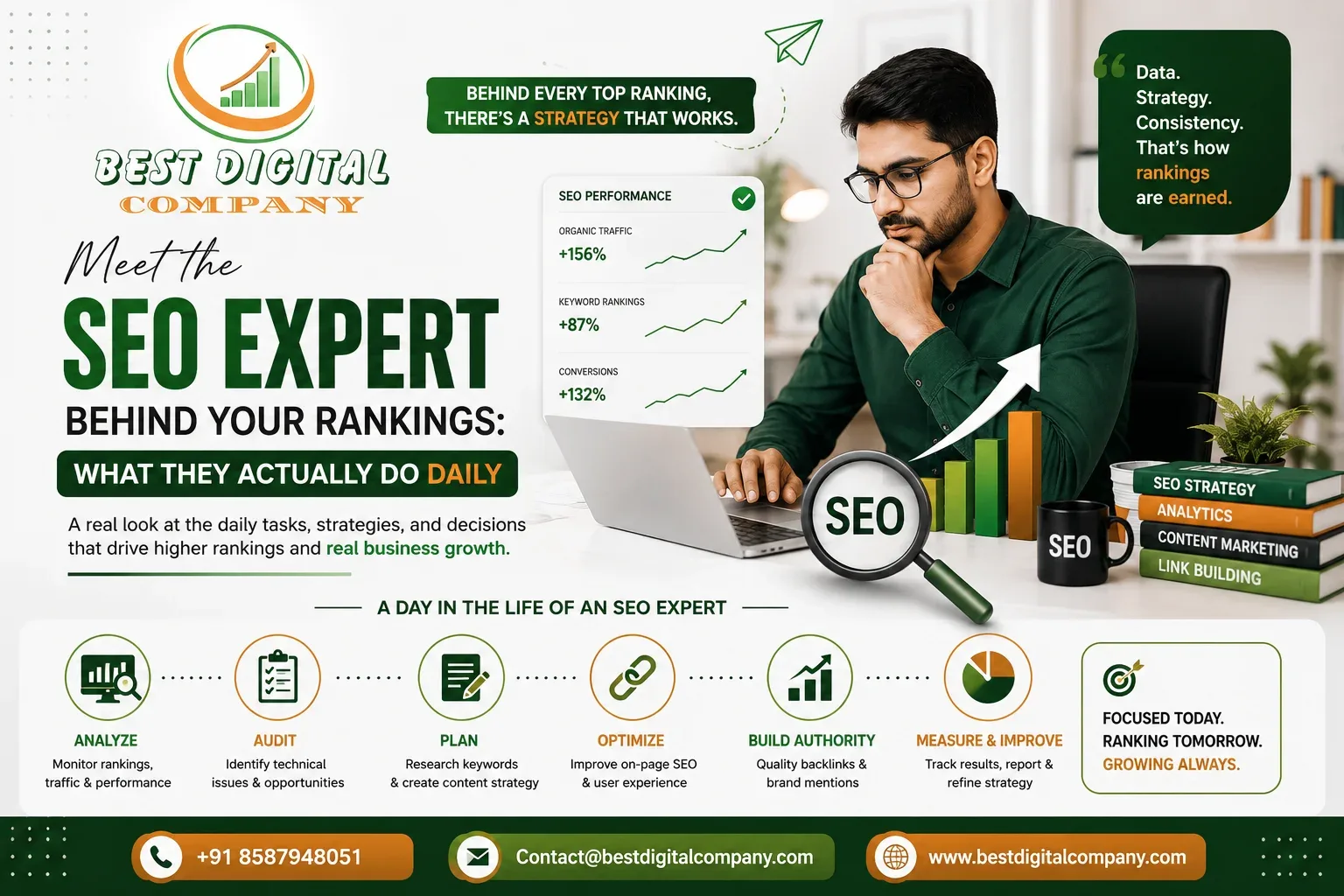
Meet the SEO Expert Behind Your Rankings

Meet the SEO Expert Behind Your Rankings: What They Actually Do Daily

Most business owners picture an SEO expert as someone who mutters a magic keyword into a laptop and rankings appear overnight. The reality is a lot less glamorous and a lot more disciplined. Behind every website that climbs to page one, there is a person quietly running audits, fixing broken code, writing content briefs, checking analytics, and having awkward conversations with clients who want results by Friday.

If you have ever hired an agency and wondered what actually happens between the invoice and the ranking report, this post pulls back the curtain. We’ll walk through a realistic day in the life of a working SEOexpert, explain why the role has changed so much in the last two years, and show you what separates an average freelancer from the best SEO expert you could hire for your business.

Who Is an SEO Expert, Really?

An SEO expert is not a single job title so much as a blend of five smaller ones: technical auditor, content strategist, data analyst, link builder, and translator. That last part matters more than people think. A big chunk of the job is translating what Google’s algorithm rewards into instructions a developer, a writer, and a business owner can all understand and act on.

The title gets thrown around loosely. Plenty of people who call themselves an SEO expert are really just running the same generic checklist on every client, regardless of industry, without ever opening Google Search Console or looking at real user behavior. A genuine expert treats every website as a different puzzle. A local plumber’s site and a national SaaS company do not need the same strategy, the same keywords, or the same content calendar, even if both technically fall under “SEO.”

What actually separates a professional from a hobbyist is repetition and feedback. Someone who has optimized fifty websites across different industries has already seen what breaks rankings and what fixes them. That pattern recognition, built over years, is the actual product you’re paying for not a spreadsheet of keywords.

A Realistic Morning: Audits, Alerts, and Analytics

Most days start before the actual “strategy” work even begins. The first hour is spent checking dashboards, not brainstorming ideas.

Checking rank tracking and traffic reports. The first task is usually opening a rank tracker to see which pages moved up, which dropped, and whether anything unusual happened overnight  a sudden spike, a random drop, a page that got deindexed. This is paired with a quick look at organic traffic in Google Analytics to see whether movement in position is actually translating into clicks.

Reviewing Google Search Console. This tool tells the real story that rank trackers can’t. Impressions, click-through rate, indexing errors, and mobile usability issues all live here. If a page has thousands of impressions but almost no clicks, that’s a signal the title tag or meta description needs work, not the content itself. We have written a full walkthrough of this exact process in our Google Search Console guide for beginners, which explains how to read these reports without getting lost in jargon.

Scanning for technical issues. Broken links, slow-loading pages, crawl errors, duplicate content, and indexing problems get flagged here. A technically broken website can undo months of good content work, so this check happens daily, not monthly.

Reviewing algorithm and industry news. Search engines update constantly, and a real expert tracks these changes closely because a single update can shift rankings across an entire portfolio of client sites overnight.

None of this is glamorous. It is closer to being a mechanic doing a daily inspection than a creative dreaming up campaigns. But this groundwork is exactly why some professionals consistently protect and grow rankings while others get blindsided by every update.

Midday: Content Strategy and On-Page Optimization

Once the health checks are done, the actual growth work begins. This is where the job starts to look like what people expect from SEO expert work but even here, it’s far more structured than most people imagine.

Keyword and search intent research. Before a single word gets written, there’s research into what people are actually typing into search engines, and more importantly, what they mean when they type it. Someone searching “seo expert near me” wants to hire someone quickly. Someone searching “what does an SEO expert do” wants education, not a sales pitch. Confusing these two intents is one of the most common reasons content fails to rank even when it’s well-written.

Content briefs and outlines. Rather than handing a writer a keyword and hoping for the best, a proper brief includes the target intent, the questions competitors are already answering, gaps in their coverage, and the structure the page should follow. This is also where topics like how to improve EEAT for better Google rankings get baked in from the start experience, expertise, authority, and trust aren’t things you sprinkle on afterward; they need to shape the content from the outline stage.

On-page optimization. This includes structuring headings logically, writing meta titles and descriptions that actually get clicked, compressing images, adding internal links to relevant pages, and making sure the content answers the query completely without padding it with fluff. On-page work is unglamorous but it’s often the difference between a page that ranks on the second page and one that sits comfortably in the top five.

Content pruning and cleanup. Not every task is about adding new content. Sometimes the smartest move is removing or consolidating old, thin, or duplicate pages that are quietly dragging a site’s overall quality down. We cover this in more depth in our post on content pruning and why deleting pages can improve SEO  a strategy that surprises a lot of clients who assume more pages always means more traffic.

Afternoon: Technical Fixes, Link Building, and Client Communication

The second half of the day usually splits between technical execution and people work.

Technical SEO fixes. This might mean working with a developer to fix page speed issues, correcting schema markup, cleaning up a broken sitemap, or resolving mobile usability problems. Search engines increasingly reward sites that load fast and work well on phones, so this work never really stops. It is ongoing maintenance, not a one-time project.

Link building and outreach. Earning backlinks from relevant, trustworthy websites is still one of the strongest ranking signals available. This part of the job involves outreach emails, relationship building with other site owners, and, honestly, a fair amount of rejection. It’s slow, unglamorous work that compounds over months rather than delivering instant results.

Adapting to how search itself is changing. A growing part of the afternoon now involves thinking beyond traditional blue links. More users are getting answers directly inside search results or from AI tools before they ever click through to a website. We break this shift down in our guide on zero-click searches and how to get traffic anyway, along with a deeper look at what Generative Engine Optimization actually means for 2026. A modern expert has to optimize for both traditional rankings and these newer AI-driven answer formats, which is a meaningfully different skill set than what the job required even two years ago.

Client reporting and communication. Numbers mean nothing to a client if they can’t understand them. A large chunk of the afternoon often goes into translating technical progress into plain language explaining why rankings dipped during a site migration, or why a content refresh takes six weeks to show results instead of six days. Our post on creating an SEO report clients actually understand covers exactly how this translation should work, because a report full of jargon and no context usually does more harm than good to the client relationship.

Why the Role Has Changed So Much

Five years ago, a lot of ranking work came down to keyword density and backlink volume. That world is mostly gone. Search engines now weigh user experience, page speed, mobile usability, content depth, and genuine expertise far more heavily than simple keyword repetition.

This shift is exactly why generic, templated content struggles to perform anymore. Search engines are actively trying to reward pages written by people with real experience and demote content that reads like it was mass-produced to hit a word count. That means the daily job of an SEO expert now includes far more editorial judgment than it used to deciding what is actually worth publishing, not just what technically checks a keyword box.

It also means the tools have expanded. Search Console, analytics platforms, site speed testers, and AI-assisted research tools are all part of the daily toolkit now, but none of them replace judgment. A tool can tell you a page is slow. It can’t tell you whether the content actually solves the visitor’s problem.

What Separates an Average Freelancer From the Best SEO Expert

If you’re evaluating who to hire, here’s what actually separates a mediocre hire from the best SEO expert for your situation:

They explain the “why,” not just the “what.” Anyone can tell you to add more keywords. A genuine expert can explain why a specific page isn’t converting impressions into clicks, and what that tells them about search intent.

They set realistic timelines. SEO is not a light switch. Anyone promising first-page rankings in two weeks is either inexperienced or being dishonest with you. Real, sustainable growth typically shows meaningful movement over three to six months, not days.

They work across disciplines, not in isolation. Good SEO overlaps heavily with good web development and design, thoughtful pay-per-click strategy for immediate visibility while organic growth builds, and consistent social media marketing to support brand signals. An expert who only thinks about keywords and ignores everything else is only doing part of the job.

They customize the plan to the business. A dentist in a single city needs a very different plan than an e-commerce brand selling nationwide. Location-specific strategy matters whether that’s a general approach to search engine optimization or something more targeted like local SEO for a Delhi-based business or SEO services built specifically for the Delhi market. One-size-fits-all strategies are usually a sign of a template, not a plan.

They document and communicate consistently. The best professionals send clear, honest updates on what was done, what results it produced, and what’s coming next not just a monthly report full of numbers with no context.

A Day That Never Really Repeats

Ask any working SEO expert what a “typical” day looks like and most will tell you there isn’t one, not exactly. Some days are entirely spent untangling a technical bug that’s silently blocking search engines from indexing a client’s most important page. Other days disappear into content strategy meetings, or reviewing a competitor’s site that suddenly jumped several positions to figure out what changed. What stays consistent is the underlying discipline: check the data first, understand the intent behind the numbers, make a change, and measure what actually happened.

This is also why so much of the work happens behind the scenes, away from anything a client would notice directly. Rankings feel like they “just happen,” but they’re the visible result of dozens of small, unglamorous decisions made correctly, day after day, over months.

Final Thoughts

Understanding what an SEO expert actually does daily should change how you evaluate one. It is not about finding someone who knows a few tricks. It is about finding someone who treats your website like an ongoing system that needs daily attention, not a one-time project to check off a list. The businesses that see real, lasting growth are usually the ones that partnered with someone who does the unglamorous groundwork consistently, not just the flashy parts.

If you’re looking for a team that handles this work daily across SEO packages built for different business sizes and goals, it’s worth having a conversation about where your website currently stands and what a realistic growth plan looks like for your industry.


Frequently Asked Questions

What does an SEO expert actually do every day?

An SEO expert typically starts the day reviewing rankings and traffic data, checking for technical issues, researching keywords and search intent, writing or reviewing content briefs, optimizing existing pages, working on link building, and communicating progress to clients. The exact mix changes daily depending on what a website needs most at that moment.

How long does it take to see results from an SEO expert’s work?

Most meaningful movement takes three to six months, depending on competition, the current state of the website, and the industry. Anyone promising instant first-page rankings is not being realistic. Sustainable growth in organic visibility is a gradual process built on consistent, correct work over time.

What makes someone the best SEO expert for a small business versus a large company?

Small businesses usually need a strong focus on local search, clear on-page fixes, and content that answers specific customer questions quickly. Larger companies often need more technical depth, content at scale, and coordination across multiple departments. The best SEO expert for either situation is one who adjusts their approach to the size and goals of the business rather than applying the same plan to everyone.

Do SEO experts only work on content, or do they handle technical issues too?

Both. Content is only one part of the job. A meaningful portion of daily work involves technical fixes like page speed, mobile usability, indexing errors, and site structure all of which directly affect how well content can rank in the first place.

Is hiring an SEO expert better than trying to do SEO myself?

It depends on your time and how competitive your industry is. Basic on-page fixes can often be done in-house with some learning. However, industries with heavy competition usually benefit from an experienced professional who has already seen what works and what doesn’t across many similar websites, saving months of trial and error.

How do I know if an SEO expert is actually good at their job?

Look for someone who explains their reasoning clearly, gives realistic timelines instead of guarantees, shows past results with context, and asks detailed questions about your business before proposing a strategy. Vague promises and pressure to sign quickly are usually warning signs.

How to Choose the Best Website Development Agency and the Best SEO Company in 2026

How to Choose the Best Website Development Agency and the Best SEO Company in 2026

Every week, someone reaches out to us with the same underlying question, just phrased differently. Sometimes it’s “who’s the best website development agency near me,” and sometimes it’s “we need the best SEO company because our traffic has flatlined.” What’s interesting is that these two questions almost always end up connected. A site that’s built well but never gets found is a wasted investment. A site that ranks well but confuses or loses visitors the moment they land on it is just as wasteful.

We’ve worked on both sides of this problem for years, building sites from scratch and rescuing rankings on sites someone else built badly. This piece is meant to help you evaluate both types of partners honestly, without the usual sales pitch language that makes every agency sound identical on paper.

What a Website Development Agency Should Actually Deliver

A lot of businesses assume website development is just about how a site looks. It isn’t. Design is the visible 20%. The other 80% is structure, speed, mobile behavior, and how easily search engines can read the site once it’s live.

When we talk to clients about web development, we are not just talking about layouts and color palettes. We’re talking about clean code, fast load times, proper heading structure, and a site architecture that doesn’t fight against SEO later. This matters more than people expect. We’ve reviewed dozens of sites where the design team and the SEO team never once spoke to each other, and it shows in how long the site takes to rank once it’s finally live. If this sounds familiar, our guide on the website launch checklist before going live walks through exactly what typically gets missed.

A genuinely capable development team will ask you questions before they touch a single line of code .Questions about your customers, your competitors, and your growth goals for the next two years, not just the next two months. If an agency jumps straight to showing you templates, that’s usually a sign they’re building a website, not a business asset.

Signs You’re Looking at a Genuine SEO Company (Not Just a Reseller)

There are a lot of businesses calling themselves an SEO company right now, and the range in quality is enormous. Some run legitimate strategy built on content, technical fixes, and consistent link building. Others buy cheap backlink packages in bulk and hope nobody checks the results six months later.

A few things separate the two. A real SEO partner will actually audit your site before promising anything. They’ll look at your existing content, your technical setup, and your competitors before quoting you a number or a timeline. If you’re curious what a proper audit uncovers, our breakdown on how to rank a new website on Google in 90 days shows the kind of groundwork that has to happen before rankings move at all.

Another sign worth watching for is whether they talk about topical depth or just keywords. Search engines in 2026 reward sites that demonstrate real subject-matter coverage, not single pages stuffed with a phrase repeated a dozen times. We wrote in detail about this shift in our piece on building topical authority, and it’s one of the biggest reasons thin, one-off content strategies are losing ground.

If you run an online store specifically, the priorities shift slightly again product pages, category structure, and reviews all carry more weight than they do for a typical service business. Our SEO guide for e-commerce stores covers that in more depth if that’s closer to your situation.

Why the “Best” Agency Isn’t Always the One with the Biggest Portfolio

Here’s something we’ve noticed after years of client conversations: business owners often equate “best” with “biggest name” or “most case studies on the homepage.” In reality, fit matters more than size. A large agency juggling hundreds of accounts may not give a mid-sized business the attention it needs. A smaller, specialized team focused on both development and search often ends up being more responsive and more invested in the outcome.

This is also why the decision between fixing your website first or investing in SEO first comes up so often. We addressed that exact dilemma in website redesign versus SEO optimization: which should you do first, because the honest answer depends on your specific starting point, not a one-size-fits-all rule.

The Cost of Treating Development and SEO as Separate Projects

We’ve seen this pattern too many times to ignore it: a business hires one team to build the site and, months later, hires a completely different team to fix the rankings. The second team then spends the first few weeks undoing decisions the first team never should have made broken URL structures, missing metadata, slow-loading images, duplicate content across pages.

When development and search strategy are planned together from day one, you skip that entire rebuilding phase. Your pay-per-clickcampaigns land on pages that are actually built to convert, your social media marketing traffic doesn’t bounce off a slow homepage, and your organic content has a technical foundation that supports it instead of working against it. Businesses that get their traffic without users ever clicking through in the traditional sense also need to think about this early. Our piece on zero-click marketing explains how visibility now extends well beyond your website itself.

What This Looks Like in Practice

If your website currently generates visitors but very few actual inquiries, the problem is rarely traffic. It’s usually the experience once someone arrives. We’ve covered this at length in why business websites fail to generate leads, and the fixes are often smaller than business owners expect a clearer call to action, faster load speed, or a landing page actually designed around one specific goal rather than trying to say everything at once. Our guide on building SEO landing pages that convert goes into the specific structure that tends to work.

And if you’re running a regional business, location matters more in this evaluation than most owners realize. What works for a business competing nationally looks different from what works for a business trying to dominate a specific city or state something we saw play out clearly while working with businesses across Punjab building their first real digital presence.

Frequently Asked Questions

How do I know if an agency is genuinely good at both website development and SEO, or just good at one?

Ask to see examples of sites they’ve built that are also ranking well organically, not just sites that look good in a portfolio. A team that’s strong in only one area will usually have plenty of design work to show but very little proof of sustained rankings, or the reverse strong rankings on outdated, clunky websites.

Is it better to hire one agency for both development and SEO, or two separate specialists?

 In most cases, one team handling both works out better because it removes the handoff gap where technical decisions made during development end up hurting SEO later. If you do go with separate teams, make sure they’re willing to actually communicate with each other during the build.

How long does it typically take to see results from SEO after a new website launch?

Most businesses start seeing measurable movement somewhere between two and four months, with stronger results building over six to twelve months. Anyone promising rankings within days is either overselling or using tactics that won’t hold up long term.

What’s a reasonable budget range for combined website development and SEO services?

 This varies widely based on the size of the site, the competitiveness of your industry, and your city or region. A basic informational site with light SEO will cost far less than an e-commerce platform competing in a crowded market. It’s worth getting a scoped quote based on your actual goals rather than comparing generic package prices across agencies.

Do I need a new website if my current one already ranks reasonably well?

Not necessarily. If your site ranks decently but converts poorly, a redesign focused on user experience and conversion paths might matter more than a full rebuild. If the site has deep technical issues holding back rankings, a rebuild alongside an SEO strategy usually makes more sense than patching an outdated foundation.

How do I evaluate an SEO company’s past results without just trusting their word for it?

 Ask for specific, verifiable examples a website URL, the approximate timeline, and what changed. Legitimate agencies are usually comfortable sharing this level of detail. Vague claims about “massive growth” without any specifics are worth treating with caution.


Choosing between agencies is rarely about finding the flashiest portfolio. It’s about finding a team that treats your website and your search visibility as one connected system, not two separate line items on an invoice. If you’d like a second opinion on where your current site and search strategy stand, get in touch with our team and we’ll walk you through what we’d actually prioritize first.

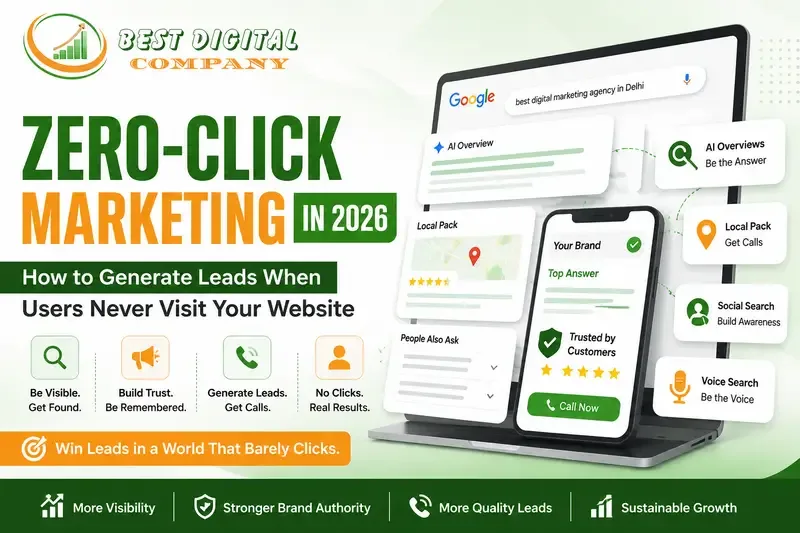
Zero-Click Marketing in 2026: How to Generate Leads When Users Never Visit Your Website

Zero-Click Marketing in 2026: How to Generate Leads When Users Never Visit Your Website

Here’s something that would have sounded absurd five years ago: your best lead today may have found you, decided to trust you, and is ready to call you without ever landing on your website. Welcome to the reality of zero-click marketing in 2026.

Roughly 65% of all Google searches now end without a single click. People get business hours from Knowledge Panels, find answers in AI Overviews, read product comparisons in featured snippets, and discover brands through short-form videos, all without touching your domain. If your strategy still defines success purely by traffic analytics, you’re measuring the wrong thing.

This blog breaks down what zero-click marketing actually means for businesses today, which channels and tactics genuinely work, and how our services from Search Engine Optimisation to Pay Per Click advertising can be repositioned to win leads in a world that barely clicks through.


1. What Is Zero-Click Marketing And Why It Matters Right Now

Zero-click marketing is the practice of generating brand awareness, authority, and inbound leads through digital touchpoints where the user never actually visits your website. The interaction happens entirely on Google’s SERP, on a social platform, inside a voice assistant, or through a brand impression that stays in memory until the person is ready to buy.

This isn’t a loophole or a workaround. It is simply where consumer attention has moved. Google’s AI Overviews, Position Zero featured snippets, Local Packs, People Also Ask boxes, and social search are now the first and sometimes only stop before a purchase decision.

For a digital marketing agency like ours, based in Delhi and working with businesses across India, the shift means our clients need to think about presence, not just placement. Ranking number one is still important. But being the brand that shows up authoritatively in answer boxes, maps, knowledge graphs, and social feeds that is the new lead funnel.


2. The Channels Driving Zero-Click Lead Generation in 2026

2.1 Google Featured Snippets and AI Overviews

When someone types ‘best digital marketing agency in Delhi’ or ‘how much does SEO cost in India,’ Google frequently pulls a direct answer from a webpage and displays it at the top sometimes without the user needing to scroll further. Your goal is to be that source.

Structured, well-formatted content that directly answers specific questions tends to earn these positions. Writing in clear Q&A formats, using concise definitions followed by detail, and organising content with semantic HTML all contribute. It’s disciplined writing not keyword stuffing that gets you there.

2.2 Google Business Profile and Local Pack

For service-based businesses, especially those targeting local markets, the three-pack of local results above organic listings often drives more enquiry calls than a full website visit would. Someone searching ‘PPC agency near me’ on mobile sees your rating, phone number, hours, and reviews and calls directly. That lead is zero-click from a website perspective, but it is a very real conversion.

Maintaining an accurate, review-rich Google Business Profile has become as important as having a well-built website. If you haven’t already, explore our Digital Marketing Services in Delhi to understand how local visibility fits into a broader strategy.

2.3 Social Search – Instagram, YouTube, and LinkedIn

Younger demographics increasingly use Instagram and YouTube as search engines. A business that shows up in a relevant Reel, a YouTube short explaining a service, or a LinkedIn thought-leadership post is generating brand awareness and leads without the user ever needing to visit a domain. The discovery happens on-platform.

This is precisely why our Social Media Marketing service now centres on searchable content, not just engagement content. Every post, caption, and hashtag is treated as an SEO asset.

2.4 Voice Search and Conversational AI

Smart speakers and AI assistants read out a single answer when someone asks a voice question. There is no second result. Optimising for conversational long-tail queries, local intent, and FAQ-structured content increases the probability that your business is the one answer Alexa, Google Assistant, or an AI chatbot returns.

2.5 Knowledge Panels and Brand SERPs

When users search your brand name directly, what does Google show them? A Knowledge Panel with accurate details and positive reviews builds enormous trust even if they never click. Managing your brand’s SERP through consistent NAP (Name, Address, Phone) data, authoritative backlinks, and structured data is a form of zero-click reputation management.


3. How to Build a Zero-Click Lead Generation Strategy

Step 1 — Audit Your Current SERP Presence

Before optimising for zero-click, understand where you currently appear. Search for your core service keywords and note: do you appear in featured snippets? Does your GBP show up in the local pack? Is your brand Knowledge Panel accurate? This baseline tells you where the gaps are.

Step 2 — Structure Content to Answer Questions Directly

Google’s crawlers are looking for content that answers a user’s question in the first 40–60 words of a section. This means leading with your answer, then providing supporting context. Use H2 and H3 headings that mirror real search queries. Include FAQ sections (like the one at the end of this article) because People Also Ask boxes heavily pull from structured FAQ schema.

Step 3 — Invest in Local SEO and GBP Optimisation

For businesses in Delhi and across India, local intent searches convert at the highest rate. A fully optimised Google Business Profile with updated services, photos, Q&A responses, and a steady stream of genuine reviews will generate enquiries without a single website visit. Pair this with our SEO Packages designed for local dominance.

Step 4 — Make Social Media Content Searchable

Think of every social post as a micro-webpage. Use descriptive captions, relevant hashtags treated as keywords, and on-screen text in videos. YouTube descriptions should be treated like blog introductions. When your social content is optimised for search intent, it appears in both social search and sometimes in Google’s own video carousel doubling your zero-click surface area.

Step 5 — Use Paid Ads to Own the SERP Real Estate

PPC campaigns through Google Ads can claim top-of-SERP real estate for branded and competitor keywords, ensuring that even zero-click searchers see your name, your messaging, and your credibility. Callout extensions, site links, and structured snippet extensions deliver information directly on the SERP the user learns who you are before clicking. Our PPC Services are designed to maximise this brand impression value, not just cost-per-click.

Step 6 — Implement Schema Markup Across Your Site

Schema markup tells Google exactly what your content means whether it’s a business address, a product price, a FAQ answer, or a review rating. Rich results generated by schema (stars, prices, event dates) appear directly on the SERP and increase your brand’s perceived credibility even in a zero-click environment. Your website may not get the visit, but it earns the trust.


4. Measuring Success When Clicks Aren’t the Metric

The hardest part of zero-click marketing is convincing stakeholders that the strategy is working when organic traffic numbers don’t move dramatically. Here are the metrics that actually matter:

  • Direct traffic and branded search volume — rising numbers here indicate growing off-SERP awareness
  • Google Business Profile insights — calls, direction requests, and message enquiries
  • SERP feature appearances — track featured snippet wins, local pack placements, and Knowledge Panel accuracy using tools like SEMrush or Ahrefs
  • Social media reach and saves — content saved or shared indicates informational value even without a click
  • Lead quality and source attribution — more leads identifying your brand by name, from referrals or word-of-mouth, often trace back to zero-click impressions
  • Phone call volume — particularly relevant for local businesses; this is often the most direct zero-click conversion signal

The mindset shift is this: you’re not trying to bring people to your website in Step 1 of the funnel. You’re building enough trust through zero-click touchpoints that by Step 3 or 4, they already know who you are and come directly.


5. What This Means for Small and Mid-Sized Businesses

We work with businesses across Delhi and beyond from dental clinics to e-commerce startups to professional service firms. As we noted in our blog on Digital Marketing for Small Businesses, the biggest challenge for smaller brands isn’t budget  it’s attention. Zero-click marketing levels that playing field to a surprising degree.

A well-optimised Google Business Profile costs nothing beyond time. Earning a featured snippet is achievable with strong content, not a big ad spend. Appearing in local voice search results is primarily a function of accurate data and consistent reviews. These are accessible advantages for businesses that invest in smart strategy over brute-force spending.

Even niche industries benefit. We’ve seen this firsthand with healthcare. Our Digital Marketing approach for dental clinics shows how local knowledge panels and GBP reviews drive a significant portion of new patient enquiries before a prospective patient ever reaches the clinic’s website.


6. The Role of Website Development in a Zero-Click World

You might wonder: if users aren’t visiting the site, does web development still matter? Absolutely and here’s why.

Your website is the engine that powers your SERP presence. Fast load speeds, clean technical architecture, proper structured data, and mobile optimisation all signal authority to Google which determines whether you appear in zero-click features at all. A slow, poorly structured site won’t earn featured snippets no matter how good the content is. Our Website Development & Design service builds sites designed to both convert visitors and perform well in zero-click environments.

Additionally, when a zero-click lead does decide to visit perhaps after seeing you in a featured snippet three times over two weeks.They’ll land on a site that confirms the authority they’ve already begun to associate with your brand. The website is still the conversion asset. It just no longer needs to be the first touchpoint.


Frequently Asked Questions (FAQ)

What is zero-click search and how is it different from zero-click marketing?

Zero-click search refers to a Google search that ends on the results page the user gets their answer from a snippet, knowledge panel, or local pack without clicking any link. Zero-click marketing is the strategic practice of designing your content, local presence, and social media to capitalise on these moments, generating brand awareness and leads through those on-SERP interactions rather than through website traffic.

Can zero-click marketing actually generate real leads?

Yes and for many local and service businesses, it already does. Phone calls from the Google local pack, messages through Google Business Profile, direct brand searches after seeing a featured snippet, and social DMs after a searchable video are all lead-generation events that trace back to zero-click touchpoints. They’re harder to track in a traditional GA4 dashboard, which is why attribution strategy matters alongside the zero-click tactics themselves.

Does investing in SEO still make sense if fewer people are clicking through?

More than ever. SEO today is about earning authority across the entire SERP featured snippets, local packs, image carousels, video results, and People Also Ask boxes are all SEO-driven surfaces. Ranking well still drives clicks for higher-intent, research-heavy queries. And the technical and content foundation required for good SEO is the same foundation that earns you zero-click features. See our Search Engine Optimisation service for how we approach this holistically.

How long does it take to see results from a zero-click strategy?

For local GBP optimisation and review building, you can see improved call volume within 4–8 weeks. For featured snippets and AI Overview placements, the content typically needs 3–6 months to gain enough authority and indexing signals. PPC-driven SERP impressions can begin immediately. A blended approach combining quick wins from local SEO and paid ads with longer-term content and technical SEO investments gives you results across both timeframes.

What types of content earn featured snippets most reliably?

Content that directly and concisely answers a specific question at the start of a clearly labelled section. Paragraph snippets (definitions and explanations), list snippets (step-by-step guides and ranked items), and table snippets (comparisons and data) are the three main formats Google pulls. FAQ sections using FAQ schema markup like this one significantly increase the probability of appearing in People Also Ask boxes on relevant queries.

Do PPC ads help with zero-click marketing?

Yes. PPC ads at the top of Google’s results page dominate visual real estate. Even users who scroll past without clicking absorb your brand name, your headline, and your value proposition. Over repeated exposures, this builds the brand familiarity that makes a future direct search or referral more likely. Extensions like callouts, structured snippets, and location extensions deliver information directly on the SERP which is itself a form of zero-click lead engagement. Explore our PPC Packages for options suited to different budgets.

Is zero-click marketing suitable for e-commerce businesses?

It depends on the intent stage. For top-of-funnel awareness and research-phase queries, yes zero-click strategies build the brand trust that influences purchase decisions later. For bottom-of-funnel transactional queries (‘buy running shoes online’), users typically do click through to browse and purchase, so traditional SEO and PPC with strong landing page conversion optimisation remains essential. A well-rounded strategy combines both.

How can Best Digital Company help with zero-click marketing?

We offer a fully integrated approach from technical SEO and schema implementation to content strategy, Google Business Profile management, social media marketing, and paid search. All of these services now incorporate zero-click considerations by default, because ignoring this shift isn’t a strategic option anymore. Contact us to discuss how we can build a presence strategy for your business that generates leads wherever your customers actually are not just on your website.


Final Thoughts

Zero-click marketing isn’t about giving up on your website. It’s about understanding that your website is one node in a much larger presence ecosystem and optimising all the other nodes too.

The businesses that will win in the next two to three years are those that show up authoritatively in featured snippets, maintain a well-reviewed local profile, create searchable social content, and use paid ads to own the SERP impression even when the click never comes. These aren’t separate strategies. They are a single, coherent approach to being visible where your audience’s attention actually lives.

If you’re ready to rethink your digital strategy for a zero-click world, we’d love to have that conversation. Explore our full range of Digital Marketing Services or get in touch with our team today.