
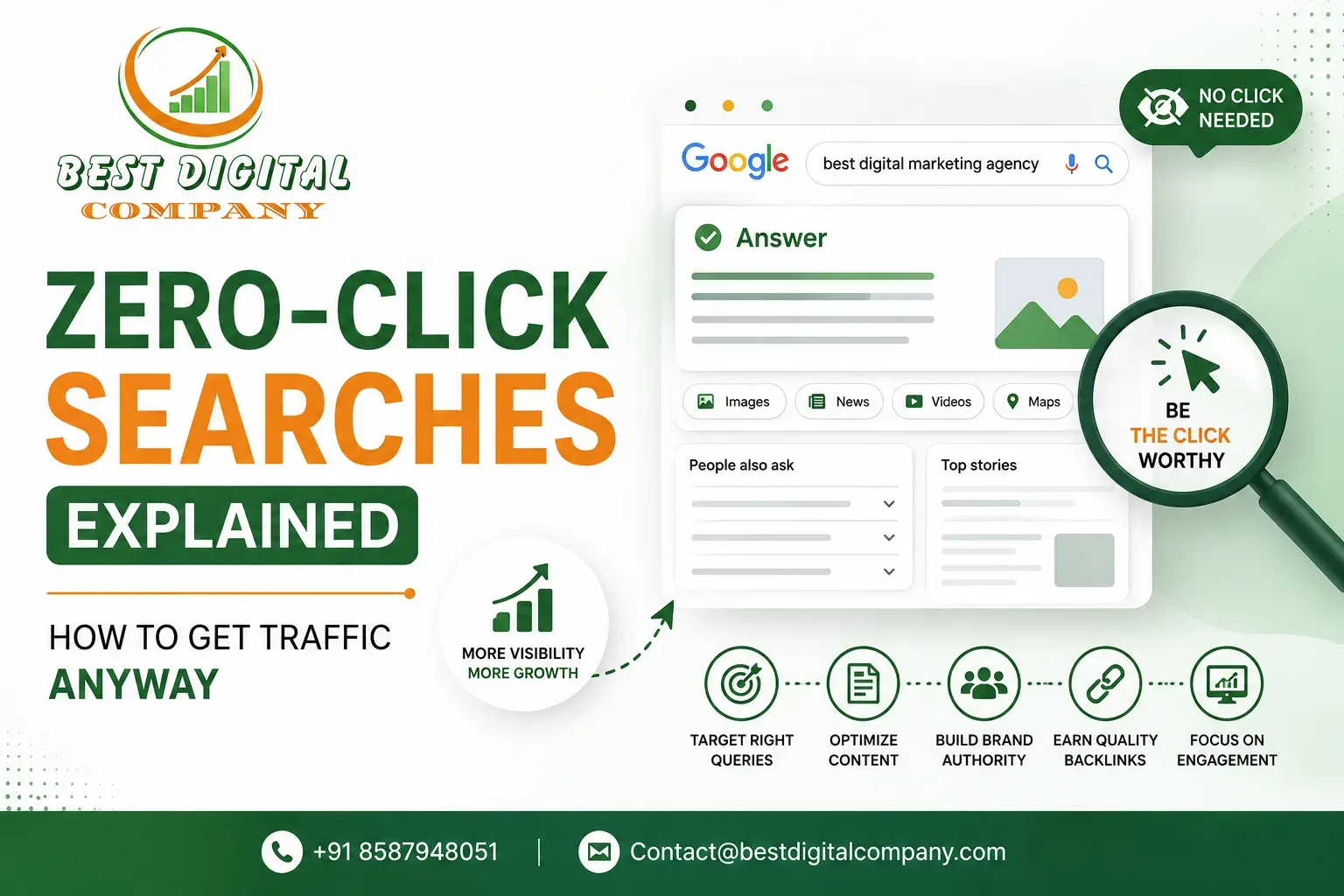
If you have checked Google Search Console lately and noticed impressions climbing while clicks barely move, you are not imagining things. You are watching a zero-click search in action, and it is one of the biggest shifts in how people find information online since Google first started showing featured snippets.
A few years ago, ranking on the first page almost guaranteed a visitor. Today, a growing share of searches end without the user ever leaving the results screen. They get their answer, close the tab, and move on with their day. For business owners who built their entire growth plan around organic clicks, this can feel unsettling. It raises a fair question: if people are not clicking through, is search still worth the effort?
The short answer is yes, but the strategy has to change. In this guide, we will break down what zero-click searches actually are, why Google keeps pushing in this direction, and most importantly, how brands can still generate real traffic, leads, and recognition even when the click never happens.
What Is a Zero-Click Search (And Why Is It Suddenly Everywhere)
A zero-click search happens when a person types a question into Google and gets a complete answer directly on the results screen, without needing to visit any website. This could be a quick definition pulled into a highlighted answer box, a local business showing up in the map pack with hours and directions already listed, a “People Also Ask” accordion that expands with the exact answer, or even a knowledge panel pulling facts from multiple sources into one tidy summary.
Search behavior data over the past few years has shown that a large percentage of all searches now end this way. Simple factual questions, unit conversions, weather, definitions, and quick how-to steps are the most common victims. If someone searches “what time zone is Delhi in” or “how many days for Google to index a new page,” they rarely need to click anywhere. Google already answers it for them.
This is not a glitch or a temporary trend. It is a deliberate design choice. Google wants users to stay satisfied within its own ecosystem, and answer boxes, AI overviews, and map packs keep people engaged without forcing them to leave.
Why Google Is Rewarding Instant, Human-Written Answers
Here’s the part most articles gloss over: the rise of instant answers is directly tied to a parallel shift in what kind of content earns visibility at all. Google’s own guidance has repeatedly emphasized that content created primarily to manipulate rankings, rather than to genuinely help a reader, is being pushed down or filtered out entirely. Thin, templated, obviously AI-generated pages that recycle the same five paragraphs everyone else has already published simply do not get pulled into answer boxes, and increasingly, they do not rank well at all.
What does get pulled forward is content that reads like it was written by someone who actually understands the topic. Specific numbers instead of vague claims. Real examples instead of generic advice. A point of view instead of fence-sitting. This lines up with what is often called Experience, Expertise, Authoritativeness, and Trustworthiness. Google is not just checking whether your page contains the right keywords anymore; it is trying to judge whether a real, qualified source is behind the words, because that is the kind of content it wants to feature in an instant answer and the kind of content it wants to send a click to when a fuller answer is required.
This is genuinely good news for small and mid-sized businesses. You do not need to out-spend a national brand. You need to publish content that reflects real, first-hand knowledge of your industry, written in your own voice, without copying the structure of the ten articles already ranking above you.
How Zero-Click Results Actually Affect Your Website Traffic
It is worth being honest about the trade-off instead of pretending nothing has changed. If your target keyword is a simple, factual question, you may see your impressions rise while your click-through rate drops, because Google is answering the question itself using your content or a competitor’s. This is frustrating when it happens on a page you built specifically to drive visits.
But there is a flip side that gets less attention. Appearing inside an answer box, a map pack, or a “People Also Ask” panel is still visibility. Your brand name, your business, or your domain is still shown to the user, even if they do not click. Over repeated exposures, this builds recognition. Someone who sees your name answering their questions three or four times is far more likely to click through, or search for you directly by name, the fifth time.
The businesses getting hurt worst by this shift are the ones chasing only simple, top-of-funnel questions with generic content. The businesses that are gaining are the ones creating content around questions that require nuance, comparison, local knowledge, or a decision, the kind of queries where a short answer box genuinely cannot satisfy the searcher and a click becomes necessary.
How to Get Traffic Anyway: Practical Strategies That Work
Target Questions That Cannot Be Answered in Two Lines
The easiest way to stop losing traffic to instant answers is to stop competing for queries that instant answers are built to solve. Instead of writing about “what is SEO,” write about how a specific industry should approach SEO differently than another, or what mistakes are costing a particular type of business its rankings. Comparison content, decision-making guides, and “how to choose between X and Y” formats are far harder to compress into a three-line answer box, which means the searcher still has a reason to click.
Optimize for the Answer Box, Then Optimize Past It
Rather than avoiding instant answers altogether, a smarter approach is to win the answer box and then give the reader a reason to keep reading. Structure your page so the direct answer appears clearly near the top, using a short paragraph or a simple list, which increases your odds of being the source Google pulls from. Immediately after that, add the context, examples, and next steps that the short answer could never include. You capture the visibility of the instant answer while still earning the click from readers who want the full picture.
Build Topic Depth Instead of Isolated Pages
Single pages competing against instant answers rarely win alone. What tends to perform well is a cluster of related content, where one detailed guide links out to supporting articles that each go deeper on a sub-topic. This is exactly why internal linking strategy has become such a critical part of technical SEO work in 2026. When your pages are connected logically, search engines understand the full scope of your expertise on a subject, and readers stay on your site longer because there is always a relevant next page to explore.
Strengthen Local Signals So Map Results Work in Your Favor
For businesses with a physical location or a defined service area, the map pack is arguably more valuable than the traditional listing below it. People searching “digital marketing agency near me” are often ready to call or visit, not just browse. Getting this right requires consistent business information, genuine reviews, and location-specific content that matches how real customers search. This is a core part of what we handle through SEO services in Mumbai, where local intent queries behave very differently from broad national searches and need a tailored approach to show up in both the map pack and the standard listings.
Diversify Where Your Traffic Comes From
Relying on organic search alone leaves you exposed every time Google changes how it displays answers. A more resilient approach spreads visibility across multiple channels: paid search for high-intent commercial terms, social platforms for brand discovery, and email for retaining the traffic you already earned. Businesses that combine social media marketing with search efforts tend to weather these algorithm shifts far more comfortably, because a drop in one channel does not sink the entire pipeline.
Use Paid Search to Fill the Gap on High-Value Terms
For keywords where instant answers dominate the free listings, paid placements can still put your business directly in front of a ready-to-buy audience. A well-run Pay Per Click campaign lets you bypass the competition for organic visibility entirely on the terms that matter most for revenue, while your content strategy works in the background to build long-term organic presence.
Make Sure Your Website Can Actually Convert the Traffic You Do Get
None of this matters if visitors land on a slow, cluttered, or confusing website. A fast, clean, well-structured site, built through proper website development and designing, keeps the visitors you do earn instead of losing them to a bad first impression. This becomes even more important when every click is harder-won than it used to be.
Why Regional Strategy Matters More Than Ever
Search behavior is not uniform across the country, and treating every region the same way is one of the most common reasons a content strategy underperforms. A query that triggers an instant answer in one city might still send steady clicks in another, simply because local competition and search habits differ.
We have seen this play out clearly through SEO services in Punjab, where smaller cities and tier-two markets often have far less competition for local commercial terms compared to metro areas. A business that ranks for a specific service in a specific Punjab city can capture a large share of local search demand, even when the broader national keyword is dominated by instant answers and large aggregator sites. The opportunity here is not to fight for generic terms; it is to own the specific, local, high-intent searches that big brands rarely bother optimizing for.
The same principle applies across SEO services in Haryana, where industrial and business hubs generate a steady volume of specific, service-related searches. Businesses here often get overlooked in generic national campaigns, but a locally tuned strategy, one built around the actual language customers use and the actual services they are searching for, consistently outperforms a copy-paste national approach. Regional depth like this is exactly where zero-click competition tends to be weakest, which makes it one of the smarter places to invest effort right now.
Content Formats That Still Earn Clicks
Not all content is equally vulnerable to being absorbed into an instant answer. A few formats consistently continue to pull real visits:
Original data and case studies. If your content includes numbers or results that only your business has access to, there is nothing for an answer box to summarize. The reader has to visit your page to see the actual case study, chart, or before-and-after result.
Opinion and analysis pieces. A factual question can be answered in one line. A “here’s why this common advice is actually wrong” argument cannot, because the value is in the reasoning, not just the conclusion.
Tools and interactive resources. Calculators, checklists, and templates require interaction, so they are naturally immune to being summarized away.
Long-form guides that solve a multi-step problem. Our own website launch SEO checklist and our guide onhow to rank a new website on Google in 90 days are good examples of this. Both cover a process with several dependent steps, which is genuinely difficult to compress into a three-line answer box, so readers still need to visit and follow along.
Location and comparison pages. Content that compares options or focuses on a specific city or region, rather than a generic global topic, tends to face far less competition from instant answers, since the query itself is already narrow and specific.
Measuring Success When Clicks Aren’t the Only Metric
If you are still judging every piece of content purely by click volume, you are measuring an incomplete picture. A more honest scorecard for the current search environment includes a few additional data points.
Impressions and average position in Search Console tell you whether you are showing up at all, even without a click. A rising impression count on branded searches often signals that instant-answer exposure is building recognition, even if the raw click number looks flat. Direct traffic and branded search volume, tracked over months rather than days, tell you whether people are starting to seek your business out by name after seeing it repeatedly in answer boxes. Conversion rate on the traffic you do receive matters more than ever, because if fewer people are clicking, each visitor needs to count for more. And finally, tracking which specific pages continue to earn clicks despite instant answers helps you understand which formats and topics are worth investing further in.
None of this means clicks stop mattering. It means the businesses that adapt their expectations and their measurement approach are the ones who will make sound decisions instead of panicking over a single metric that no longer tells the whole story.
Final Thoughts
Zero-click behavior is not going away, and pretending otherwise will not help any business plan for what is coming next. Google is going to keep answering simple questions directly, and no amount of on-page optimization will change that for genuinely simple queries. What is entirely within your control is the kind of content you choose to compete on, how well you build depth and authority around your specific market, and whether the traffic you do earn actually converts once it lands.
The businesses that will keep growing through this shift are not the ones fighting the hardest for generic answer-box terms. They are the ones building genuine expertise around specific, local, and complex questions, connecting that content thoughtfully, and giving readers a real reason to click through instead of settling for the summary. That is a strategy worth building around, regardless of how the results screen keeps changing.
FAQ
What exactly counts as a zero-click search?
It is any search where the user finds their answer directly within the results screen, whether through a highlighted answer box, a knowledge panel, a map listing, or an expanded “People Also Ask” section, and never needs to click through to a website.
Are zero-click searches bad for my business?
Not entirely. They reduce clicks for simple factual queries, but they also increase brand exposure and recognition. The real risk is only for businesses that rely solely on simple, generic queries for all their traffic.
Can I stop Google from showing my content in an answer box?
You can, using structured data settings or meta directives to opt out of certain snippet types, but this is rarely a smart move. Appearing in an answer box still builds visibility and trust, even without an immediate click.
Which keywords are safest from becoming zero-click results?
Comparison queries, local and city-specific searches, opinion-based questions, and multi-step processes are generally safer because they cannot be reduced to a short summary the way simple factual questions can.
How long does it take to see results from this kind of strategy shift?
Most businesses start noticing meaningful movement in three to six months, since it involves rebuilding content around deeper topics and strengthening local and regional signals, rather than a quick technical fix.
Does local SEO still work if instant answers are taking over?
Yes, and in many ways it works better now. Map pack results and location-specific searches remain some of the strongest opportunities left for real, high-intent traffic, especially in regional markets that are not yet saturated with competition.
Should I focus more on paid search now that organic clicks are harder to get?
It depends on your goals. Paid search is a smart way to fill gaps on competitive, high-value terms in the short term, but a sustainable strategy still needs organic content and local visibility working alongside it for long-term stability.

Add a Comment