

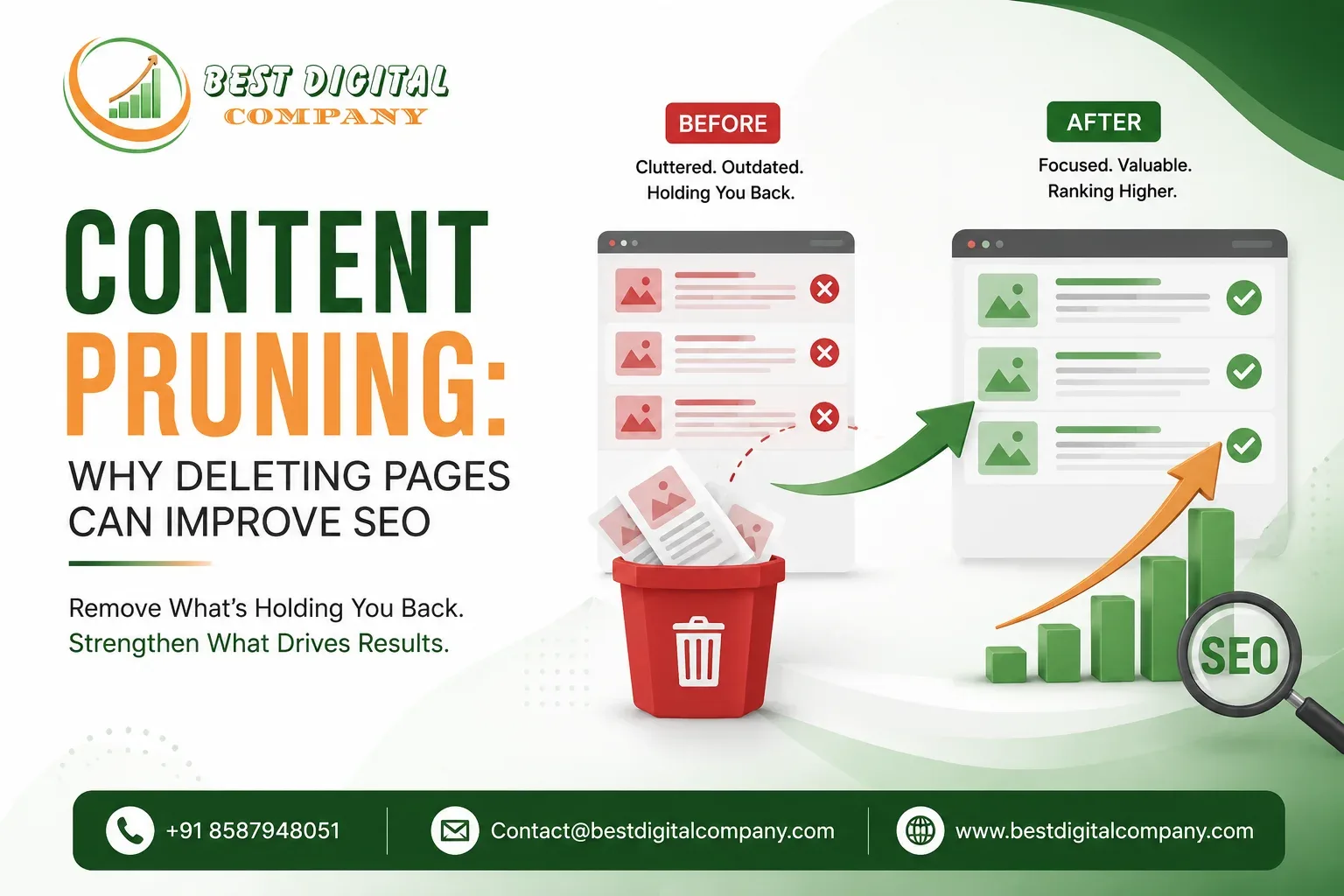
If you have been managing a website for more than a couple of years, chances are it has quietly turned into a storage room. Old blog posts nobody reads, service pages you no longer offer, thin “just to have something” articles, duplicate landing pages from an old campaign, they are all still sitting there, indexed, and doing absolutely nothing for you. Some of them might even be working against you.
This is where content pruning comes in. It sounds counterintuitive at first. How can removing pages help a website grow? But once you understand how Google actually evaluates a site, it makes complete sense. A website is not judged purely by how many pages it has. It is judged by how useful, relevant, and trustworthy the overall collection of pages is. When a large chunk of that collection is outdated or low-value, it drags the average down.
In this guide, we will walk through what content pruning really means, why it works, how to identify pages worth removing, and how to do it safely without losing the traffic and rankings you have already earned. This is not about panic-deleting your blog. It is a deliberate, data-backed process, and by the end of this article you will know exactly how to approach it for your own website.
What Is Content Pruning in SEO?
Content pruning is the process of reviewing your website’s existing pages and deciding what to keep, what to update, what to merge, and what to remove entirely. Think of it the way a gardener thinks about pruning a plant. You are not destroying the plant, you are removing the dead branches so the healthy ones get more light, more water, and more energy to grow.
On a website, that “energy” is often referred to as crawl budget and link equity. Search engines allocate a limited amount of attention to crawling and evaluating your site. If a large share of that attention is spent on pages that provide no value expired offers, duplicate category pages, old news updates with zero long-term relevance your genuinely useful pages get less attention than they deserve.
Content pruning typically falls into three actions:
- Delete and redirect — for pages with no value and no traffic potential, permanently removed with a proper redirect where relevant.
- Consolidate — for multiple thin pages covering similar ground, merged into one comprehensive resource.
- Update and improve — for pages with decent potential but outdated or shallow information, refreshed rather than removed.
Not every underperforming page needs to be deleted. Pruning is about making an honest decision for each page, based on data, not guesswork.
Why Deleting Pages Can Improve Search Engine Optimization
It feels backwards to say that having fewer pages can lead to better visibility, but there are several concrete reasons this happens.
Crawl Budget Gets Used More Efficiently
Every website is crawled a finite number of times within a given period, especially larger sites. If your site has thousands of thin, outdated, or duplicate pages, crawlers spend time revisiting those instead of prioritizing your newer, more valuable content. Removing dead weight means your important pages like your core service pages get crawled and re-evaluated more often.
It Removes Signals of Low Overall Quality
Search engines do not evaluate pages in complete isolation. They also form an impression of the site as a whole. A website where 40% of the content is thin, duplicated, or years out of date sends a weaker overall quality signal than a site where every page earns its place. This is closely tied to how search engines assess Experience, Expertise, Authoritativeness, and Trustworthiness, often shortened to EEAT. A cluttered archive of low-effort pages undermines the expertise and trust part of that equation, even if your best pages are genuinely strong.
It Reduces Internal Competition Between Pages
When you have five different blog posts loosely covering the same topic, they often end up competing with each other instead of one clear winner ranking well. This is sometimes called keyword cannibalization. Consolidating those overlapping posts into one authoritative piece, and removing or redirecting the weaker duplicates, gives search engines a single clear page to rank for that topic which usually performs better than five competing ones ever did individually.
It Improves User Experience Metrics
If visitors keep landing on outdated pages with broken information, expired pricing, or dead internal links, they leave quickly. That behavior is a signal that the page is not meeting the visitor’s intent. Removing or refreshing those pages improves the experience for anyone who does land there, which in turn supports engagement metrics that indirectly support your rankings.
It Strengthens Your Site’s Topical Focus
A leaner, more focused website makes it easier for search engines and for actual visitors to understand what you specialize in. If a digital marketing agency’s blog is 30% genuinely useful Search Engine Optimization content and 70% filler, its authority in that subject looks diluted. Trim the filler, and the specialization becomes obvious.
How to Identify Pages That Need Pruning
Before you delete anything, you need data. Removing pages based on gut feeling is risky; removing them based on evidence is smart. Here is the process we generally follow when auditing a client’s site.
Step 1: Export Every URL on the Site
Start with a full crawl of your website using a tool like Screaming Frog, Sitebulb, or a search engine’s own coverage report. You want a complete list of indexed URLs, not just the ones in your navigation menu. Old sites often have orphaned pages that are still live and indexed but no longer linked from anywhere.
Step 2: Layer in Performance Data
For each URL, pull in:
- Organic traffic over the last 12–24 months
- Number of backlinks pointing to the page
- Average position and impressions
- Conversions or engagement, if tracked
- Last updated date
This is the same kind of data you would review when putting together an SEO report clients actually understand , the goal is to translate raw numbers into a clear decision, not to drown in spreadsheets.
Step 3: Categorize Every Page
A simple framework that works well:
- Keep as is — solid traffic, healthy engagement, still accurate.
- Update — some traffic or backlinks, but outdated facts, thin content, or missed opportunity to expand.
- Merge — overlaps heavily with another page on the same topic.
- Redirect — no meaningful traffic, but has backlinks worth preserving, or matches a topic still relevant to a related page.
- Delete — no traffic, no backlinks, no relevance, and no realistic way to make it useful.
Step 4: Check Search Intent Alignment
Sometimes a page isn’t outdated in the factual sense, but it no longer matches what people are actually searching for. Search behavior evolves. A page written five years ago as a simple product description might no longer match how people search today for example, many searches now expect a direct answer up front rather than a long-winded introduction. If a page consistently fails to satisfy what searchers are looking for, it is a candidate for a significant rewrite or removal, regardless of its age.
Common Types of Pages Worth Pruning
Not every website has the same clutter, but a few categories show up again and again during audits.
Thin blog posts under 300–400 words that never had enough substance to rank for anything competitive, and never earned backlinks or shares.
Duplicate or near-duplicate content, often created when a business publishes slightly different versions of the same guide across time, such as multiple posts explaining basic checklist-style topics that were later covered more thoroughly, similar to how a well-structured local SEO checklist for small businesses can make several older, thinner local-search posts redundant.
Outdated seasonal or news-style content that was relevant for a specific window of time, an old promotional announcement, a past event recap, or a “trends this year” post from three years back that no longer reflects current information.
Old landing pages from discontinued campaigns, such as a page built for a past ad push that is still live, still indexed, but tied to an offer that no longer exists.
Auto-generated or low-effort tag and category archive pages that WordPress and other content management systems often create by default, many of which have almost no unique content and simply repeat excerpts from other pages.
Pages that duplicate a core service description, for instance several old posts loosely explaining what Pay Per Click advertising is, without adding new insight beyond what the dedicated service page already covers.
How to Prune Content Safely, Step by Step
This is where a lot of site owners get nervous, and rightly so done carelessly, pruning can hurt rather than help. Here is the safer, methodical approach.
1. Back Up Everything First
Before touching a single page, take a full backup of your site and export your complete list of URLs with their current metrics. If something goes wrong, you need a way to reverse the decision.
2. Decide Redirect Targets Carefully
If a page has any backlinks or historical traffic, do not simply delete it and let it return a 404 error. Set up a 301 redirect to the closest relevant, still-live page. If you are consolidating five old posts about website performance into one updated guide, redirect all five old URLs to that new comprehensive post so the link value transfers instead of disappearing.
3. Remove in Batches, Not All at Once
Especially on larger sites, avoid deleting hundreds of pages in a single day. Search engines can interpret a sudden mass removal as a signal of instability. Prune in reasonable batches — for example 20 to 50 pages at a time and monitor how the site responds before continuing.
4. Update Your XML Sitemap and Internal Links
Once pages are removed or redirected, make sure your sitemap reflects the current, accurate list of live URLs. Just as importantly, go through your site and update any internal links that pointed to removed pages, redirecting the reader (and the crawler) toward the correct, current destination instead. This step is often skipped, and it quietly undermines the whole effort similar mistakes are exactly what we cover when planning a proper website redesign checklist to avoid breaking rankings during bigger structural changes.
5. Request Re-indexing
For the pages you deleted or merged, use your search engine’s indexing tools to request removal of the old URLs and indexing of the updated or redirected ones. This speeds up how quickly the change is reflected.
6. Monitor for Four to Eight Weeks
Track organic traffic, indexed page count, and rankings for your key pages after the pruning is complete. It is normal to see minor fluctuation in the first couple of weeks. What you are watching for is an overall upward or stable trend once search engines re-crawl and re-evaluate the site.
Content Pruning and EEAT: Why Quality Beats Quantity
A big part of why content pruning has become more relevant is the growing emphasis on genuine expertise and trustworthiness across an entire website, not just isolated pages. A site stacked with hundreds of shallow, repetitive, or AI-generated-sounding posts does not read as authoritative, even to a human visitor scrolling through the archive. It reads as noise.
Trust is built cumulatively. When someone lands on one of your pages and then clicks through to your blog, every additional page they see either reinforces or chips away at their impression of your expertise. A tightly curated set of genuinely useful, well-researched, human-written articles builds more credibility than a bloated archive where three-quarters of the posts feel like filler.
This is also why pruning pairs so well with a broader content strategy centered on real experience and original insight the kind of first-hand knowledge you’d expect from a business genuinely offering Website Development & Designing or Social Media Marketing services, rather than generic advice repeated from a hundred other sites. Search engines increasingly reward that distinctiveness, and pruning is one of the fastest ways to make it visible by clearing away everything that dilutes it.
Content Pruning vs. Content Refresh: Knowing the Difference
It is worth being clear that pruning and refreshing are not the same strategy, and confusing the two leads to bad decisions.
Content refresh is the right move when a page has proven potential it ranks reasonably well, or it targets a topic your audience clearly searches for but the information is outdated, thin, or poorly structured. You keep the URL, update the facts, expand the depth, improve formatting, and often see a fairly quick recovery in rankings.
Content pruning is the right move when a page has no realistic path to being valuable, regardless of how much you rewrite it. A page about a service you discontinued, or a duplicate that will always lose to a stronger page on the same topic, is not a refresh candidate. Trying to “fix” a page that fundamentally should not exist just wastes time that could go toward strengthening the pages that do have potential.
A good rule of thumb: if the page’s core topic still matters to your business and your audience, refresh it. If the topic itself is no longer relevant, or is already better covered elsewhere on your site, prune it.
How Often Should You Audit Your Content?
There is no universal number, but a reasonable rhythm for most businesses is a full content audit once or twice a year, with lighter monthly reviews of your most recent posts to catch thin content before it accumulates. Businesses that publish frequently several posts a week benefit from auditing more often, simply because low-value content piles up faster.
If your site has never been audited and you are working with years of accumulated pages, expect the first pruning pass to be the biggest. After that, the process becomes routine maintenance rather than a major project.
Bringing It Together
Content pruning is not about shrinking your website for the sake of a smaller number. It is about making sure every page that stays online is pulling its weight answering a real question, matching real search intent, and reflecting genuine expertise. Removing what doesn’t serve that goal is not a loss. It is how you make room for the content that actually moves your business forward.
If you are unsure where to start, begin small: pull your traffic data, identify your lowest-performing 10% of pages, and make an honest decision about each one. That single exercise often reveals patterns thin categories, outdated guides, forgotten campaign pages that make the rest of the audit far easier to plan.
Frequently Asked Questions
Does deleting old blog posts hurt my website’s rankings?
Not if it’s done correctly. Deleting a page with no traffic, no backlinks, and no relevance rarely causes harm, and often frees up authority for your stronger pages. The risk only comes from deleting pages carelessly without redirects, without checking backlinks, or by removing content that still had value.
How do I know if a page is worth keeping?
Look at traffic, backlinks, and whether the topic still matters to your business. A page with steady organic visits or inbound links, even if modest, is usually worth updating rather than removing. A page with none of those signals and an outdated topic is a strong candidate for removal.
Should I redirect every page I delete?
Redirect any page that has backlinks, historical traffic, or a close topical match to a live page. For pages with genuinely zero value and zero external links, it’s acceptable to let them return a proper “not found” status rather than forcing an irrelevant redirect.
How long does it take to see results after pruning content?
Most sites see initial shifts within four to eight weeks, once search engines re-crawl and re-evaluate the site. Larger sites or bigger pruning efforts can take longer to fully settle, so it’s best to monitor over a couple of months rather than judging results after just a few days.
Can content pruning replace the need for new content?
No. Pruning cleans up what already exists; it doesn’t substitute for creating new, valuable content. The two work best together remove what no longer serves your audience, and keep publishing well-researched material that does.
Is content pruning only for large websites?
No. Even small business websites with 20–30 pages can accumulate outdated service descriptions, old announcements, or thin posts over a few years. The principles of auditing and cleaning up scale down just as effectively as they scale up.
Not sure where to start with your own content audit? Get in touch with our team, or explore our SEO services to see how a structured content strategy can improve your site’s overall performance.

Add a Comment