
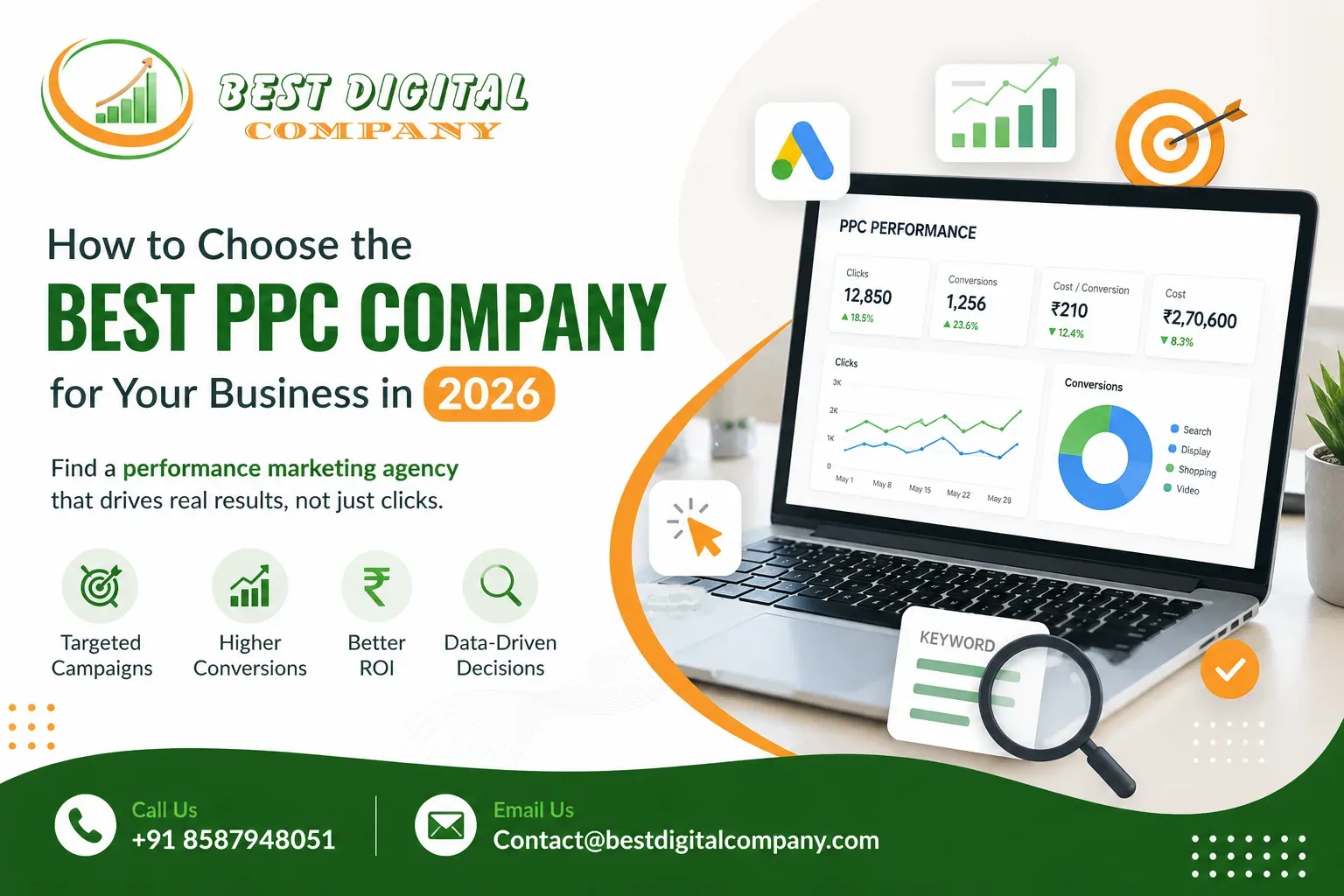
If you have ever typed “PPC company near me” into Google at midnight while staring at a Google Ads dashboard that is burning money without bringing in a single lead, you already know how frustrating paid advertising can be without the right partner. Running ads is easy. Running ads that actually make money is a completely different skill, and it is the reason so many business owners eventually go looking for a performance marketing agency instead of trying to figure it out alone.
This guide walks through what a genuine performance marketing company does differently, how to separate a best PPC company from one that is simply good at selling itself, and what to check before you hand over your ad budget to any PPC advertising agency. We will also answer the questions we hear most often from business owners in our first strategy call, so by the end you will know exactly what to look for.
Why Businesses Are Turning to a Performance Marketing Agency in 2026
A few years ago, most companies split their marketing into separate buckets: one team for the website, another for social posts, and someone else handling ads whenever there was budget left over. That approach does not hold up anymore. Ad platforms have become smarter, more automated, and far more competitive, which means campaigns that “sort of work” quietly waste thousands of rupees every month without anyone noticing.
A performance marketing agency exists to close that gap. Instead of billing you for hours spent “managing” a campaign, a genuine performance-driven team ties its work to outcomes you can actually measure: cost per lead, cost per acquisition, return on ad spend, and revenue. This is a different mindset from traditional advertising, where the goal was often just visibility. With performance marketing, every rupee spent has to justify itself, and every campaign is judged by the results it produces, not the creativity of the ad copy alone.
This shift matters even more if your website already has strong organic traffic. Businesses that have invested in search engine optimization often see PPC as the fastest way to fill the gap while their organic rankings climb, since paid campaigns can start driving qualified visitors within a day or two, unlike SEO, which typically takes months to show its full impact.
What Does a PPC Company Actually Do?
At its core, a PPC company manages paid advertising campaigns on your behalf, from research and setup to daily optimization and reporting. But “managing ads” undersells the actual work involved. A capable team is doing several jobs at once:
- Keyword and audience research to understand exactly who is searching for what you sell, and how much competitors are willing to pay for that same click.
- Ad copywriting and creative testing so your ads stand out instead of blending into a feed of near-identical competitors.
- Bid strategy management to make sure your budget is spent on the clicks most likely to convert, not just the ones that are cheapest.
- Landing page alignment because even the best ad in the world will not convert if it sends traffic to a page that does not match what the person was searching for.
- Continuous testing and reporting so decisions are based on real data rather than guesswork.
If a provider is only doing the first two items on that list, they are not really running a performance campaign. They are just placing ads and hoping.
Performance Marketing Company vs a Traditional Ad Vendor: What’s the Difference
This is one of the most common points of confusion we run into. Plenty of freelancers and small agencies will happily “run your Google Ads,” but there is a real difference between someone who sets up a campaign and someone who manages it like a growth channel.
A traditional vendor typically sets a campaign live, checks in once a month, and reports on surface-level numbers like impressions and clicks. A true performance marketing company treats every campaign as a living system. Budgets shift toward what is working. Underperforming keywords get paused. Ad copy is rewritten based on what the data shows, not what looks good on paper. And most importantly, reporting focuses on business outcomes leads, sales, bookings not vanity metrics that look impressive but do not pay the bills.
If you are also investing in content or organic visibility, it helps to work with a team that understands how paid and organic channels support each other. For example, we have written before about how to improve EEAT for better Google rankings, and the same principles of trust and credibility that Google rewards organically also influence how well your landing pages convert paid traffic.
Signs You are Working With the Best PPC Company
There is no single certificate that proves an agency is the right fit for your business, but there are patterns you can watch for. Here is what tends to separate the best PPC company for your industry from one that just sounds confident in a sales call.
They ask about your business before talking about budgets. A team that jumps straight to “how much can you spend” without understanding your margins, sales cycle, or customer lifetime value is optimizing for their own convenience, not your results.
They are honest about timelines. PPC can generate traffic almost immediately, but real optimization the kind that actually lowers your cost per lead usually takes a few weeks of data collection. Anyone who promises overnight miracles is either inexperienced or not being straight with you.
They show you the account, not just a slide deck. Transparent reporting means access to the actual Google Ads or Meta Ads dashboard, not a polished PDF summary once a month. If an agency is reluctant to give you visibility into your own account, that is worth questioning.
They connect ad performance to your website experience. Paid traffic that lands on a slow, confusing, or outdated page will always underperform, no matter how well the ad itself is written. A serious agency will flag this and, if needed, bring in support from a web development team to fix conversion bottlenecks rather than just blaming the ad.
They think beyond a single platform. Google is usually the starting point, but the right channel mix depends on your audience. B2B companies often need LinkedIn. E-commerce brands often need a strong presence on Instagram and Facebook alongside Google Shopping.
Core PPC Services Every PPC Agency Should Offer
Not every business needs every channel, but a well-rounded PPC agency should be able to support you across the platforms that matter for your industry. At a minimum, look for a provider that offers:
Google Ads management, covering Search, Display, and Shopping campaigns, since this is still where most high-intent buyers begin their search.
Social advertising across Facebook and Instagram, useful for building awareness and retargeting visitors who did not convert the first time.
YouTube advertising, which has become increasingly important as more buying research happens through video rather than text.
LinkedIn advertising for B2B companies that need to reach decision-makers directly rather than a broad consumer audience.
Remarketing campaigns that bring back visitors who browsed your site but left without taking action often some of the most cost-effective ads you will ever run, because you are advertising to people who already showed interest.
You can see the full breakdown of platforms and the step-by-step process we follow on our PPC services page, along with the packages available for different budget levels on our PPC packages page.
Why You Need a Certified Google Ads Expert on Your Team
Google Ads changes constantly. Bidding strategies, automation rules, ad formats, and Quality Score factors get updated far more often than most business owners realize, and campaigns that were optimized six months ago can quietly become inefficient without anyone touching them.
This is exactly why working with a genuine Google Ads expert matters more than it did a few years ago. Automation has made the platform more powerful, but it has also made it easier to waste money if you do not understand how the machine learning behind Smart Bidding actually behaves. A skilled account manager knows when to let automation run and when to step in manually, how to structure campaigns so Google’s algorithm gets clean signals to learn from, and how to spot early warning signs like a rising cost per click with no matching increase in conversions before they turn into a wasted month of ad spend.
If your website already ranks organically for some of your target keywords, a Google Ads expert can also help you avoid cannibalizing your own traffic, bidding smartly on terms where you are already visible in organic results while reserving more aggressive bidding for competitive terms where you have no organic presence yet.
How a Pay Per Click Company Builds Campaigns That Convert
Good campaigns rarely happen by accident. Here is roughly how a competent pay per click company approaches a new account, from the first conversation to ongoing scaling.
Step 1: Discovery. Understanding your product, your typical customer, your sales cycle, and what a “good lead” actually looks like for your business. Without this, an agency is just guessing at targeting.
Step 2: Research. Studying competitor ads, estimating realistic cost-per-click ranges, and identifying keywords with genuine buying intent rather than just high search volume.
Step 3: Build. Structuring campaigns and ad groups logically, writing ad copy that speaks directly to what the searcher needs, and making sure landing pages match the promise made in the ad.
Step 4: Launch and monitor. Watching early data closely in the first one to two weeks, since this period tells you a lot about how the algorithm is interpreting your targeting.
Step 5: Optimize. Pausing what does not work, increasing budget on what does, and testing new ad variations on a regular schedule rather than leaving campaigns untouched.
Step 6: Report and scale. Sharing clear, honest reporting and using that data to decide where additional budget will produce the best return.
This is the same structured process we follow for every client, and it is worth asking any agency you are evaluating to walk you through their own version of it. If they cannot explain their process clearly, that usually means there is not much of a process to begin with.
Choosing Between a PPC Advertising Agency and an In-House Team
Some businesses, especially larger ones, wonder whether they should hire an in-house specialist instead of outsourcing to a PPC advertising agency. Both paths can work, but they come with very different trade-offs.
An in-house hire gives you someone fully dedicated to your brand, but you are relying on one person’s skill set and their ability to keep up with a platform that changes constantly. If they are experienced only with Google Ads, you may struggle to expand into LinkedIn or YouTube without hiring again.
A PPC advertising company typically gives you access to a broader team someone focused on strategy, someone focused on creative, someone focused on data for a fraction of what it would cost to build that same team internally. You also benefit from patterns the agency has already learned across other accounts in similar industries, which an in-house hire starting from scratch simply would not have.
For small and mid-sized businesses especially, working with an established PPC advertising agency is usually the more practical starting point, with the option to build an internal team later once ad spend justifies it.
Red Flags to Avoid When Hiring a PPC Advertising Company
Before you sign a contract with any PPC advertising company, watch for a few common warning signs:
- Vague reporting. If you cannot get a straight answer about what specific numbers you will receive and how often, assume you will be kept in the dark later too.
- Locked-in contracts with no exit. A confident agency does not need to trap you in a twelve-month commitment to prove its value.
- No questions about your business. As mentioned earlier, an agency that skips straight to budget talk is not planning to build a real strategy.
- Guaranteed rankings or guaranteed leads. No one can guarantee exact outcomes on an auction-based ad platform. Anyone who promises this is either misinformed or not being honest with you.
- One-size-fits-all packages. Your industry, competition, and audience are specific to you. A generic package rarely accounts for that.
If you have run into any of these red flags with a previous provider, you are far from alone — plenty of business owners go through one bad experience before finding a partner who actually communicates clearly and delivers measurable results.
How Best Digital Company Delivers Performance Marketing Results
At Best Digital Company, we built our PPC process around one simple idea: your ad budget should work as hard as the rest of your business does. As a full-service performance marketing agency, our team manages everything from Google Ads and social advertising to remarketing and landing page alignment, so campaigns are never running in isolation.
We also believe paid and organic growth should support each other rather than compete for attention. That is why our PPC strategy is often paired with insights from our SEO work including lessons from guides like our local SEO checklist for small businesses and our breakdown of Google Search Console for beginners so you get a complete picture of where your traffic is coming from and what to do with it.
If your business relies on local customers, whether you run a clinic, a service business, or a retail store, it is worth reading our piece on how doctors and local businesses rank on Google alongside your PPC strategy, since local intent searches often respond very differently to ads than broader, competitive keywords. And if you are just getting started and trying to build your very first customer base, our guide on how small businesses can get their first 100 customers covers how PPC fits into that early growth stage.
Whether you need a dedicated PPC company to manage an existing account that is underperforming, or you are launching paid ads for the first time, our team is happy to review your current setup and show you exactly where the gaps are, with no pressure to commit before you see the numbers for yourself.
Frequently Asked Questions
What is the difference between a performance marketing agency and a regular PPC agency?
Both manage paid ad campaigns, but a performance marketing agency ties everything back to measurable business outcomes leads, sales, and return on ad spend rather than just clicks and impressions. A regular agency may focus mainly on campaign setup without the same level of ongoing optimization.
How do I know if a PPC company is actually good, not just good at sales calls?
Ask for account-level access, not just reports. Ask how they structure campaigns, how often they optimize, and how they handle underperforming keywords. A confident, experienced team will walk you through their process without hesitation.
Is PPC better than SEO, or should I do both?
They serve different purposes. PPC delivers traffic almost immediately but stops the moment you stop paying, while SEO builds long-term, sustainable visibility that takes longer to establish. Most businesses see the best results using both together, with PPC filling the gap while organic rankings grow.
How much should I budget for PPC advertising services?
This depends heavily on your industry and competition. Many businesses start with a monthly budget in the range of ₹15,000 to ₹1,00,000, then scale based on the return they see. A good agency will help you set a realistic starting budget rather than pushing you toward the biggest number possible.
How long does it take to see results from a PPC advertising agency?
Traffic can start within a day or two of launch, but meaningful optimization the kind that lowers your cost per lead over time usually takes three to six weeks of data collection. Treat the first month as a learning period rather than a final verdict on performance.
Can a small business afford a professional PPC advertising company?
Yes. Most PPC agencies offer tiered packages designed for different budget levels, so you do not need an enterprise-sized ad spend to get professional campaign management. The key is finding a provider willing to work with your current budget rather than pushing you into a package that does not fit.
What platforms should my ads run on besides Google?
It depends on where your customers spend time. B2B businesses often benefit from LinkedIn, e-commerce brands do well on Instagram and Facebook, and service businesses with visual appeal can benefit from YouTube. A capable PPC company will recommend a platform mix based on your specific audience rather than running the same setup for every client.
Looking for a PPC company that treats your ad budget like an investment, not an expense? Get in touch with Best Digital Company for a free review of your current campaigns.

Add a Comment