
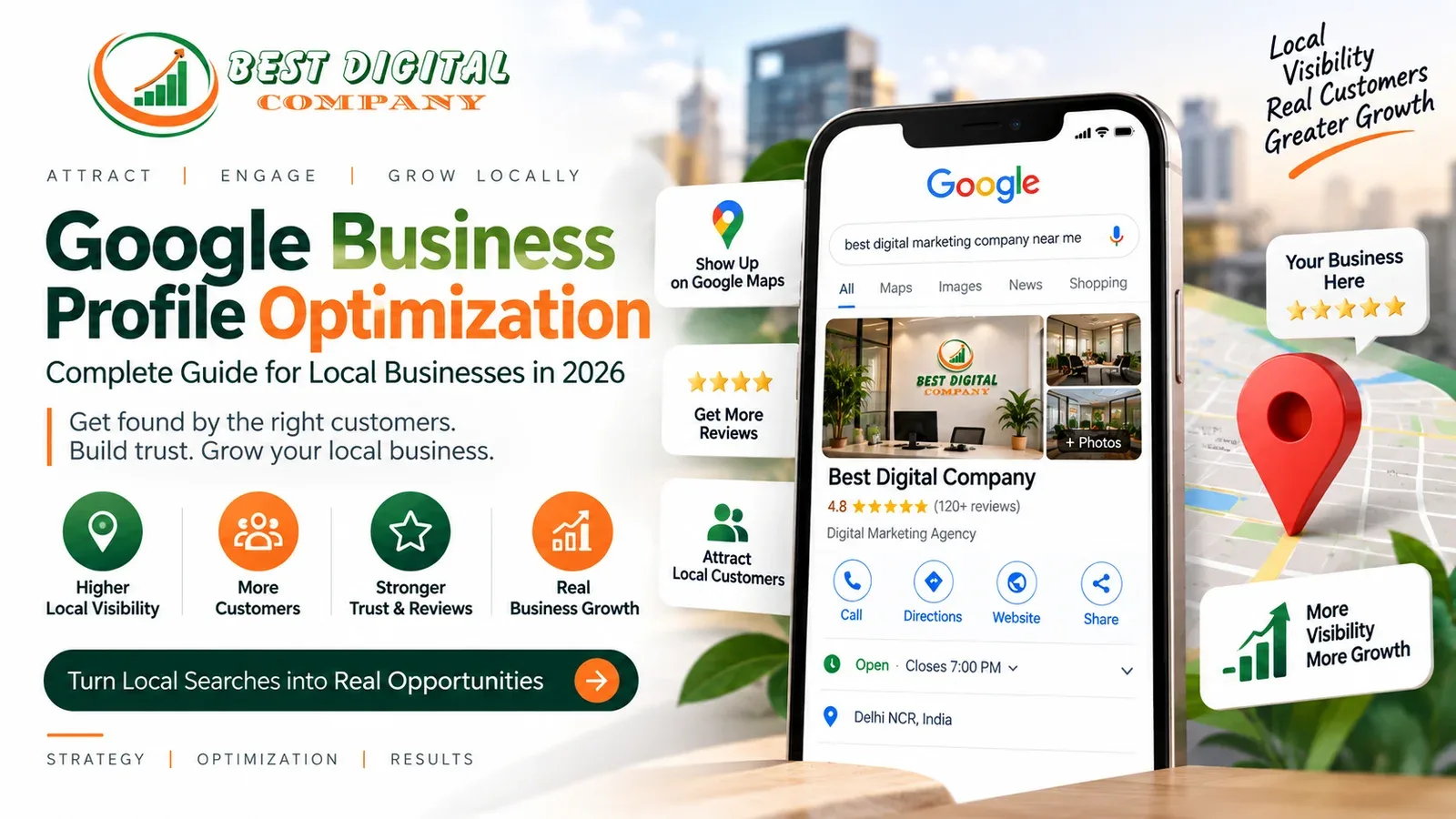
If you run a local business — a clinic, a restaurant, a salon, a service company, or an agency — the way people find you has quietly shifted. Fewer customers are typing your business name into Google. More of them are searching “near me,” scrolling a map with pins on it, and picking whoever looks the most credible in those first few seconds. That map result, with your name, star rating, photos, and hours, is your Google Business Profile, and in 2026 it often decides whether a customer calls you or calls your competitor instead.
Google Business Profile optimization is no longer a “nice to have” checkbox item. It is one of the fastest, cheapest ways for a local business to get in front of people who are ready to buy, book, or visit right now. This guide walks through what actually moves the needle in 2026, based on how local search and AI-driven results are behaving today, and how to build a profile that earns trust with both Google and the people reading it.
What Is Google Business Profile Optimization and Why It Matters in 2026
Google Business Profile (formerly Google My Business) is the free listing that appears when someone searches for a business by name or by category and location — think “dentist in Karol Bagh” or “best digital marketing company near me.” Optimization simply means filling out, structuring, and maintaining that listing so it ranks higher in local results and gives searchers enough reason to choose you over the next name on the list.
What has changed heading into 2026 is how much weight Google places on completeness, activity, and genuine customer signals. A profile that was set up once in 2019 and never touched again is easy to spot — thin descriptions, outdated photos, no recent posts, and reviews that trail off. Google’s local algorithm rewards profiles that look actively managed by a real business, because that is exactly the kind of listing that keeps searchers on the platform and satisfied with what they find.
There is also a bigger shift happening in how people search at all. AI-generated summaries and assistant-style answers are pulling from business data — including Business Profile information — to answer questions like “which clinic near me has good reviews for back pain treatment.” If your profile is thin or inconsistent, it simply will not get pulled into those answers. We cover this shift in more depth in our guide on how to make your business more visible in AI Overviews and AI search results, and the overlap with Business Profile optimization is significant — both reward structured, accurate, and frequently updated information.
How Google Business Profile Optimization Fits Into Your Local SEO Strategy
It helps to think of your Business Profile as one piece of a bigger picture rather than a standalone task. Google cross-checks the information on your profile against what it finds on your website, in online directories, and in customer reviews across the web. When your business name, address, and phone number match everywhere, Google gains confidence that you are a legitimate, established business — and confidence translates into rankings.
This is really where Google Business Profile optimization and local SEO become the same conversation. A profile without a properly optimized website behind it is like a shop window with nothing to show inside; people click through and leave. If your website is not built to support local search — with location pages, schema markup, and fast load times — your profile’s hard work goes to waste the moment someone clicks your website link. Our local SEO services in Delhi are built specifically to align your website, citations, and Business Profile so they reinforce each other instead of working in isolation, and the same logic applies to businesses in any city.
A quick self-check: search your own business name right now. Does the address on your profile match your website’s contact page exactly, down to the pin code? Does your phone number match across your site, your profile, and directories like Justdial or IndiaMart? Small mismatches like “Ltd.” versus “Limited,” or a missing suite number, are common reasons profiles underperform even when everything else looks fine.
Step-by-Step Google Business Profile Optimization Checklist for 2026
Here is the practical part — the actual steps, in the order most local businesses should tackle them.
1. Claim and Verify Your Profile Properly
This sounds basic, but a surprising number of businesses are operating on unclaimed or unverified listings, or worse, duplicate listings created by data aggregators years ago. Search for your business first. If a listing already exists, claim it rather than creating a new one — duplicates confuse both Google and customers, and they can actively hurt your ranking. Verification today usually happens by phone, email, video, or postcard, depending on your business category and location.
2. Get Your Business Name, Category, and Address Exactly Right
Your business name field should match your real-world signage and legal name — stuffing keywords into this field (“Best Digital Marketing Company Delhi SEO PPC”) is against Google’s guidelines and is one of the fastest ways to get a profile suspended. Choose a primary category that describes your core business as precisely as possible, then add secondary categories for everything else you genuinely offer. A dentist who also does cosmetic procedures should have “Dentist” as primary and “Cosmetic Dentist” as a secondary category, not the other way around.
3. Write a Complete, Human-Sounding Business Description
You get 750 characters to explain who you are, what you do, and who you serve. Avoid generic filler like “we are the best in the industry” — write the way you would explain your business to a new customer standing in front of you. Mention your service area, your specialties, and what makes your approach different. This is also a natural place to work in your core service terms without forcing them; if you offer several services, describe them the way a customer would search for them.
4. Add and Update Photos and Videos Regularly
Profiles with photos receive significantly more clicks and direction requests than those without. Upload real photos: your storefront, your team, your workspace, finished projects, before-and-afters where relevant. Stock photos are easy to spot and do less for trust than a slightly imperfect real photo. Add new images every few weeks rather than uploading twenty at once and forgetting the profile for a year — consistent activity is part of what signals a genuinely operating business.
5. Use Google Posts to Stay Active
Posts function almost like a mini social feed inside your profile — offers, events, new services, or general updates. They expire after seven days for most post types, which naturally pushes you toward regular activity. Businesses that post weekly tend to show more engagement signals than those that set up a profile and never return to it.
6. List Services and Products With Real Detail
Rather than one vague description, list out individual services with their own short descriptions and, where appropriate, pricing. A clinic should list each treatment; a marketing agency should list each service line separately. This also gives Google more specific text to match against specific searches — someone searching “PPC management” is more likely to be matched to a profile that explicitly lists PPC as a service than one that only mentions “digital marketing” in general terms.
7. Fill Out Every Attribute Available
Attributes are the small details — wheelchair accessible, free Wi-Fi, women-led, outdoor seating, online appointments — that Google surfaces to searchers making quick decisions. They seem minor individually, but a profile with fifteen relevant attributes filled in looks more complete and trustworthy than one with three.
8. Manage Reviews Actively — Don’t Just Collect Them
Reviews are arguably the single biggest local trust signal you control. Ask happy customers to leave one, make it easy with a direct link, and respond to every review, good or bad. A thoughtful reply to a negative review often does more for your credibility with future customers than the negative review itself does damage. Never buy fake reviews or incentivize them with discounts tied to a five-star rating — Google actively detects and penalizes this, and it undermines the exact trust the review section is meant to build.
9. Answer Questions in the Q&A Section Before Customers Have To
Anyone can post a question on your profile, and anyone can answer it — including strangers who may give wrong information. Seed the section yourself with the questions you get most often (parking, appointment booking, service area, payment methods) and answer them accurately. Monitor it regularly so incorrect answers don’t sit there unaddressed.
10. Keep Hours Accurate, Including Holidays
Nothing frustrates a searcher more than driving to a business that Google says is open, only to find it closed. Update special hours ahead of holidays and local events, and correct your regular hours immediately if they change.
Google Business Profile Optimization and the Rise of AI-Driven Search
Search in 2026 does not stop at a results page. A growing share of queries are answered directly, whether through Google’s AI-generated summaries or through assistants like ChatGPT and Gemini that pull live business information to answer questions conversationally. This is often called answer engine optimization, and it is closely tied to how well-structured and accurate your business data is across the web.
We have written in detail about this shift in our guides on what AEO means and how to get featured in AI search resultsand on the difference between GEO and traditional SEO. The short version for Business Profile purposes: AI systems favor businesses with clean, consistent, and detailed data. A profile with accurate categories, complete service listings, and a strong review history gives these systems something reliable to pull from. A sparse or inconsistent profile simply gets skipped in favor of a competitor’s.
This is also whyhow AI search is changing SEO matters even for businesses that only care about local customers. The technical foundation that helps AI systems understand your business — structured data, consistent citations, an optimized profile — is the same foundation that improves your traditional local rankings. You are not choosing between optimizing for AI search and optimizing for Google; increasingly, they are the same work.
Common Google Business Profile Optimization Mistakes Local Businesses Make
A few patterns show up again and again when businesses come to us for help after their profile stalls out:
Leaving the profile untouched for months. Google can tell the difference between a business that logs in occasionally and one that has abandoned its listing. Inactivity is a quiet way to lose ground to competitors who are posting, responding to reviews, and updating photos every week.
Inconsistent information across the web. A phone number that’s correct on the profile but outdated on an old directory listing, or an address that’s slightly different on your website footer, creates the kind of confusion that erodes trust scores over time.
Ignoring negative reviews. Silence on a bad review reads as indifference to the next hundred people who see it. A calm, specific, non-defensive response usually repairs more trust than the review took away.
Category mismatches. Choosing an overly broad category to try to rank for more searches often backfires, because it dilutes relevance for the specific searches that actually convert.
Treating the profile as a one-time setup task. This is probably the biggest one. Google Business Profile optimization is ongoing maintenance, not a project with an end date.
How Website Development Supports Your Google Business Profile
Your Business Profile is often the first impression, but your website is where the decision usually gets made. If someone clicks through from your profile and lands on a slow, outdated, or hard-to-navigate site, the trust you built in the profile can evaporate in seconds. Page speed, mobile responsiveness, clear contact information, and a design that reflects your business properly all matter here.
This is where professional website development and design becomes part of the same local visibility strategy rather than a separate project. A well-built site with proper local schema markup, embedded maps, and location-specific pages gives Google additional confirmation of the same details on your profile, which reinforces rather than contradicts your local search signals.
Using Social Media Marketing to Strengthen Your Profile
Google Business Profile optimization does not happen in isolation from the rest of your online presence. Active, consistent social media profiles — especially ones that link back to your website and mention your location — add another layer of signals that support your local credibility. Customer engagement on platforms like Instagram and Facebook also often drives people straight to your Google listing to check reviews before they commit, which means a healthy social presence indirectly feeds profile traffic.
Our social media marketing servicesare frequently paired with Business Profile optimization for exactly this reason — a customer’s journey today rarely happens on a single platform, and each one should reinforce the same consistent, trustworthy picture of your business.
Google Business Profile Optimization and Paid Ads: Where PPC Fits In
Organic Google Business Profile optimization takes time to build momentum, which is exactly where paid advertising can help in the interim. Local service ads and Google Ads campaigns that are geographically targeted can put your business in front of nearby searchers immediately, while your organic local signals are still strengthening in the background.
A well-run pay-per-click campaign can also feed data back into your local strategy — which search terms are actually converting, which locations are generating the most calls, and where your ad spend and organic optimization should focus next. Businesses that treat PPC and Business Profile optimization as connected efforts, rather than separate budgets, tend to see faster, more measurable results. Our detailed breakdown on how Google Ads generates faster leads for local businessesgoes deeper into how the two can work together.
How to Measure the Success of Your Google Business Profile Optimization
Optimization without measurement is guesswork. Google provides performance data directly inside your Business Profile dashboard, and it’s worth checking monthly at minimum. Pay attention to:
- Search views versus map views, which show whether people are finding you by name or by browsing the map for a category.
- Customer actions, including calls, website clicks, and direction requests — these are the metrics that actually reflect business impact, not just visibility.
- Review volume and average rating over time, tracked monthly rather than as a single snapshot.
- Photo views, compared against similar businesses in your category, to see whether your visual content is competitive.
- Query strings, which show the actual searches people used to find your listing — a goldmine for understanding how customers describe what you do, often in different words than you’d expect.
If calls and direction requests are climbing month over month while your ranking for competitive local terms improves, your optimization is working. If views are up but actions are flat, the issue is usually with the profile’s content or reviews, not its visibility.
Why Businesses Choose Professional Google Business Profile Optimization Services
Some businesses manage their profile well on their own, especially with a bit of consistent effort. Others find that between running daily operations and keeping up with an increasingly technical local search environment, the profile ends up neglected within a few months. That’s usually the point where working with a specialist starts to pay for itself — not because the work is complicated in theory, but because it requires steady, ongoing attention that’s easy to deprioritize.
At Best Digital Company, Google Business Profile optimization is handled as part of a connected local search strategy rather than a one-off task, tied directly into our broader search engine optimization services. If you’re comparing agencies or exploring what full-service local support looks like, our guides on digital marketing strategy across Delhi NCR and local SEO, PPC, and social media for businesses in Noidawalk through how these pieces typically come together for businesses in the region.
Frequently Asked Questions
What is Google Business Profile optimization?
It’s the ongoing process of completing, refining, and maintaining your free Google Business Profile listing — including your description, categories, photos, posts, and reviews — so it ranks higher in local search and gives customers a clear, trustworthy reason to choose your business.
How long does it take to see results from Google Business Profile optimization?
Most businesses start noticing changes in visibility and customer actions within four to eight weeks of consistent optimization, though competitive categories and cities can take longer. Reviews and citation consistency tend to compound in value over several months rather than producing overnight jumps.
Is Google Business Profile optimization free?
Creating, verifying, and managing your profile costs nothing directly to Google. What takes investment is the time required to do it properly and consistently — writing detailed descriptions, sourcing good photos, responding to reviews, and posting regularly — which is why many businesses choose to outsource it.
How often should I update my Google Business Profile?
Aim to post at least weekly, add new photos every few weeks, and review your hours, services, and attributes at least once a month. Profiles that show regular activity tend to outperform ones that were set up once and left alone.
Do reviews really affect my local ranking?
Yes. Review count, average rating, recency, and how you respond to reviews all factor into how Google evaluates your profile’s trustworthiness, alongside how customers themselves judge whether to contact you.
Can I change my business category later?
Yes, categories can be updated at any time from your profile dashboard. It’s worth revisiting your categories periodically as your services evolve, since an outdated category can quietly cost you visibility for searches you’re now equipped to serve.
What’s the difference between Google Business Profile optimization and local SEO?
Google Business Profile optimization is one component of local SEO. Local SEO also includes your website’s structure, citations across directories, backlinks from local sources, and on-page content — all of which work together with your profile rather than replacing it.
Final Thoughts
Google Business Profile optimization in 2026 rewards businesses that treat their listing the way they’d treat a physical storefront — kept clean, kept current, and genuinely representative of what customers will actually experience. It rewards patience and consistency far more than shortcuts, and it increasingly determines whether AI-driven search tools surface your business at all, not just where you land in a traditional list of results.
If your profile has been sitting untouched, or you’re not sure whether your local signals are actually working together, our team can review it and show you exactly where the gaps are. Get in touch with Best Digital Company to talk through a local search strategy built for how people are actually searching today.

Add a Comment