

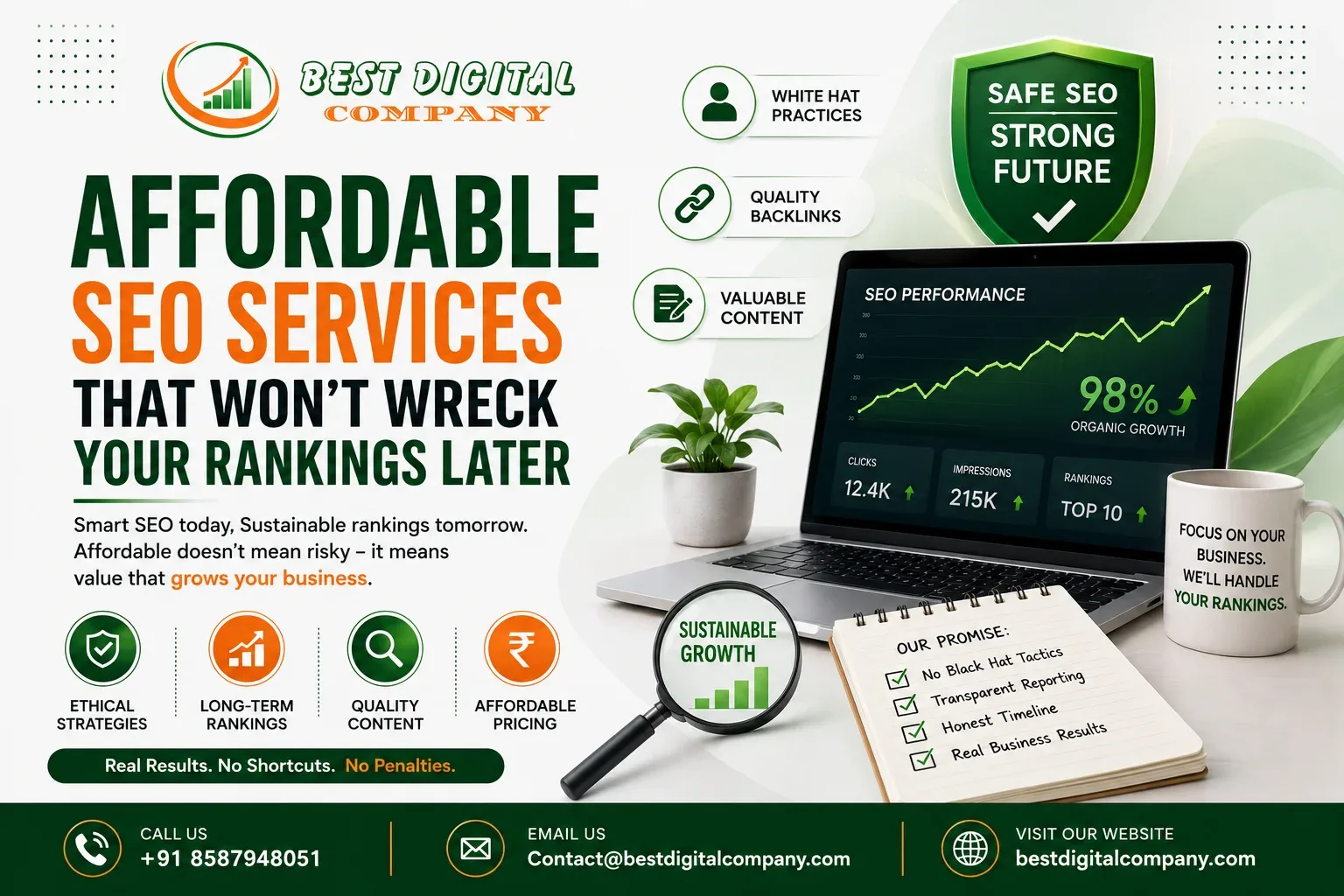
If you have ever searched for “cheap SEO packages” late at night, hoping to find something that fits your budget without turning into a disaster six months down the line, you are asking the right question at the right time. Most business owners don’t get burned by SEO because they spent too little. They get burned because they hired someone who promised the moon, cut every corner to hit that low price, and left them with a penalized domain, unnatural backlinks, and a ranking graph that looks like a cliff.
Affordable seo services are not the problem. Reckless, corner-cutting SEO sold under the label of “affordable” is the problem. There is a real difference between the two, and this article is going to walk you through exactly how to tell them apart before you sign a contract, not after your traffic disappears.
We work with small and mid-sized businesses every day who come to us after a bad experience with a bargain-bin agency. So this isn’t theory. It’s a practical guide built from what actually happens when SEO is done cheaply versus done affordably but correctly.
What “Affordable SEO Services” Actually Means in 2026
Affordable does not mean the lowest number on a price list. It means getting SEO work that is priced fairly for the effort involved, delivered by people who understand current search behavior, and structured so your rankings hold up over the long run instead of collapsing the moment an algorithm update rolls out.
Genuinely affordable seo services usually share a few traits:
- Clear, itemized scope ,you know exactly what is being done for your money, not a vague “we’ll optimize your site” line.
- A pricing structure that matches the size and competitiveness of your market, not a flat rate copied across every client regardless of industry.
- Reporting that shows real movement traffic, rankings, and leads rather than vanity metrics like “keywords tracked” or “backlinks built” with no context.
- A team that explains its process instead of guarding it as a mystery.
If an agency can not explain, in plain language, what they will do to your website and why, the price does not matter. You are buying a black box, and black boxes are where rankings go to disappear.
Why “Cheap” SEO Usually Costs More Later
This is the part most people learn the hard way. A cheap SEO package often looks fine for the first two or three months. Rankings might even inch up slightly, because low-effort tactics like directory submissions or spun content sometimes produce a short-term bump. Then Google’s systems catch up, and everything that was propping up those rankings gets discounted or penalized.
The most common damage we see when we audit a site coming from a low-cost provider includes:
- Thousands of low-quality backlinks from unrelated, spammy websites
- Duplicate or AI-spun content stuffed with the same keyword repeated unnaturally
- Hidden text, keyword stuffing in metadata, or cloaked pages
- No technical foundation — broken schema, missing sitemaps, slow load times, duplicate title tags across dozens of pages
Undoing that damage is almost always more expensive than doing the work correctly the first time. A disavow process for a toxic backlink profile alone can take weeks of manual review. Rewriting hundreds of thin, duplicate pages takes real content hours. So the “cheap” package ends up costing double once you add the cleanup bill.
This is exactly why we wrote a full breakdown on why deleting old, thin, or duplicate pages can actually improve your rankings. It is one of the most common recovery steps businesses need after a low-quality SEO run.
How to Spot Affordable SEO Services That Are Actually Safe
Before you commit to any agency claiming to offer budget-friendly SEO, run through this checklist. It takes fifteen minutes and can save you a year of recovery work.
1. Ask what “link building” actually means to them
There’s a massive difference between earning links through outreach, guest content, and digital PR versus buying links in bulk from a private network. If the answer to “where do these backlinks come from” is vague or evasive, that’s your signal to walk away.
2. Ask to see a sample of their content
Read it. Does it sound like a person wrote it for another person, or does it read like keywords were stitched together to hit a word count? Google’s systems are now very good at recognizing content built to manipulate rankings rather than help a reader, and so is any human reading it carefully.
3. Ask how they measure success
If the only metric offered is “we’ll rank you for X keywords,” push further. Ask about organic traffic growth, conversion tracking, and how they’ll report on actual business impact. If your agency isn’t referencing your Search Console data, that’s a red flag. If you want to understand this tool yourself so no one can hide behind jargon, our beginner’s guide to Google Search Console is a good starting point.
4. Ask about timeline expectations
Honest SEO providers will tell you that meaningful ranking movement typically takes three to six months, sometimes longer in competitive niches. Anyone promising page-one results in two weeks for a low monthly fee is either lying or planning to use tactics that will hurt you later.
The Real Components of a Fair, Affordable SEO Package
When pricing is done right, an affordable seo services package still covers the fundamentals. It’s just scoped sensibly for your business size instead of padded with services you don’t need yet.
Technical health — making sure your site can actually be crawled and indexed properly, page speed is reasonable, and there are no structural errors blocking growth.
On-page optimization — title tags, headers, internal linking, and content structure that reflects what real people are searching for, not just keyword density.
Content that answers real questions — built around your actual services and the actual questions your customers ask, written by people who understand the subject, not generated in bulk and lightly edited.
Local visibility, where relevant — if you serve a specific city or region, this matters enormously. A general SEO plan without a local layer often wastes budget on generic tactics that don’t match how nearby customers search. This is precisely why our local SEO services in Delhi are scoped separately from general SEO — local intent needs its own strategy, not a copy-paste national plan.
Honest, readable reporting — a report you can actually understand without a glossary. We have written before about how to build an SEO report that clients genuinely understand, because transparency is what separates a partner from a vendor hiding behind jargon.
Why Human-Written Content Still Wins
There’s a lot of noise right now about AI-generated content flooding the internet, and plenty of cheap SEO packages lean on it heavily because it’s fast and nearly free to produce. The problem is that search systems, and readers, are getting sharper at spotting content with no real experience or point of view behind it.
Google’s own quality guidance has consistently centered on rewarding content that demonstrates real experience, expertise, authority, and trust often shortened to E-E-A-T. Content written by someone who has actually done the work, made mistakes, and learned from client results reads differently than content assembled to hit a keyword quota. It has specifics. It has judgment calls. It admits trade-offs instead of pretending every tactic works for every business.
If you want a deeper look at how this concept applies to your own site, we broke it down step by step inour guide on improving E-E-A-T for better rankings. It’s one of the most practical levers available for businesses that want durable growth instead of a short-lived spike.
This also connects to a bigger shift happening in how people find information at all. Search behavior is changing more answers are being pulled directly into results pages, and AI tools like ChatGPT and Gemini are becoming a genuine discovery channel alongside traditional search. We covered this shift in detail in our piece on zero-click searches and how to still capture traffic and visibility, and in our guide to Generative Engine Optimization, which explains how to structure content so it gets referenced by AI answer engines, not just ranked in a list of blue links. An affordable SEO plan in 2026 has to account for both channels, not just the old one.
Matching Your SEO Budget to Your Actual Goals
Not every business needs the same scope of work, and a fair agency will tell you that instead of upselling everything at once. A local service business competing in one city has very different needs than an e-commerce brand trying to rank nationally.
If your goals include broader visibility, it’s worth understanding how SEO fits alongside other channels rather than replacing them. Businesses often pair SEO with social media marketing to build brand recognition while organic rankings mature, or with pay-per-click advertising to generate leads during the months it takes for organic traffic to compound. We talked through this exact trade-off in our post on choosing the right PPC partner versus a broader performance marketing approach, and it’s a useful read if you’re deciding where your first budget rupee should go.
If your website itself is holding you back slow load times, outdated design, poor mobile experience no amount of SEO spend will fix that. Our website development and design services exist specifically because SEO and site quality are inseparable; you can’t optimize your way around a broken foundation.
And if you are a newer business still building your first wave of visibility and customers, our piece on how small businesses can land their first 100 customers covers the groundwork that should happen alongside, not instead of, SEO.
What This Looks Like in Practice
Picture two businesses, both spending roughly the same monthly amount on SEO.
Business A hires a provider promising 500 backlinks a month and top-10 rankings within four weeks. For ten weeks, rankings climb. Then a core algorithm update hits, their backlink profile gets flagged, and their homepage drops off the first three pages entirely. Recovery takes eight months and a separate cleanup budget larger than a year of the original contract.
Business B hires a provider that spends the first month on a technical audit, fixes indexing issues, and builds a content plan around the actual questions their customers ask. Growth is slower noticeable improvement by month three, solid gains by month six but it holds. A year later, rankings are still climbing, because nothing about the strategy depended on tactics that stop working once search engines catch up.
Same budget range. Completely different outcome. The difference wasn’t the price tag. It was whether the “affordable” label was attached to sound strategy or to shortcuts.
Questions to Ask Before You Sign Any SEO Contract
Before committing, it helps to have a short list ready:
- Can you show me examples of content you’ve written for other clients in my industry?
- Where exactly do your backlinks come from?
- What happens to my rankings if I stop paying. Do they collapse immediately?
- How often will I get a report, and will it include actual traffic and conversion data, not just rankings?
- What’s your process if a page isn’t performing after three months?
A confident, experienced provider will answer all five without hesitation. A provider relying on cheap shortcuts will get vague, defensive, or start talking about guarantees that sound too good to match reality.
Final Thoughts
Affordable seo services and safe, sustainable rankings are not opposites. The real dividing line is between agencies that scope their pricing honestly around real strategy, and agencies that use “affordable” as a cover for shortcuts they know won’t survive the next algorithm update. Ask the right questions, look at the actual work behind the price, and prioritize content and technical foundations that are built to last rather than built to spike.
If you’d like a second opinion on a proposal you’ve received, or want a straightforward technical audit before committing to any package, our team is happy to walk through it with you no upsell script, just an honest look at what your site actually needs.
Frequently Asked Questions
Is affordable SEO actually safe, or does it always mean risky shortcuts?
Affordable and safe are not opposites. What matters is whether the pricing reflects honest, scoped work technical fixes, real content, and legitimate link building rather than bulk tactics designed to fake quick results. Price alone doesn’t tell you which one you’re getting; the process behind it does.
How long does it take to see results from an affordable SEO plan?
Most businesses start seeing measurable movement in rankings and traffic between month three and month six, with stronger compounding gains after that. Anyone promising major results within a few weeks for a low monthly fee is likely relying on tactics that won’t hold up long-term.
What’s the biggest risk with cheap SEO packages specifically?
The biggest risk is a toxic backlink profile or thin, duplicate content that triggers a ranking drop months after you’ve paid for it. Recovery from this kind of penalty typically costs more in time and money than the original low-price package ever saved.
Should a small local business choose general SEO or local SEO?
If most of your customers come from a specific city or region, local SEO should be a core part of the plan, not an afterthought. General SEO tactics alone often miss the map-pack visibility and local search intent that actually drive foot traffic and calls for regional businesses.
Can I switch from a cheap SEO provider without losing my rankings?
In most cases, yes, especially if the switch includes a proper audit first. A new provider should review your existing backlink profile and content before making changes, clean up anything harmful, and rebuild from a stable technical foundation rather than starting completely from scratch.
Do I need SEO and PPC together, or is one enough?
It depends on your timeline. SEO builds compounding, long-term organic visibility but takes months to mature, while PPC can generate leads immediately. Many businesses run both together early on, then lean more on organic traffic as rankings strengthen and reduce dependence on paid spend.

Add a Comment