

Type “web designing company” into Google and you will get thousands of results in under a second. Add the word “best” in front of it, and the list barely changes everyone claims the title. So what actually separates an ordinary web designing company from one that genuinely deserves to be called the best? That is the question this article answers, without the marketing fluff.
If you have ever compared three agency quotes side by side and found the pricing, the promises, and even the portfolio slides looking suspiciously similar, you already know the problem. Most businesses do not fail at hiring a web designer because good options do not exist. They fail because they never learned what “best” is supposed to measure in the first place.
What Is a Web Designing Company, Really?
Before comparing “good” to “best,” it helps to define the baseline. A web designing company is a business that plans, builds, and maintains websites for clients everything from the visual layout and navigation structure to the coding, hosting setup, and ongoing updates. Some agencies focus purely on visual design (colors, fonts, layout), while others handle the full stack: design, development, content, SEO readiness, and post-launch support.
At its core, a web designing company is supposed to solve one problem turning a business idea into a functional, professional online presence. That’s the baseline every agency should clear. The trouble is, “functional” is a low bar. A five-page site with a contact form technically clears it. So does a bloated, slow-loading template stuffed with stock photos. Both would be built by “a web designing company.” Neither would necessarily grow your business.
This is exactly where the confusion starts. Since the term itself doesn’t guarantee quality, outcomes, or strategy, two agencies can both call themselves web designers while delivering completely different value. One treats the website as a checkbox. The other treats it as a growth asset. That gap is the entire reason the word “best” exists and why it needs a real definition instead of being used as a slogan.
Why Everyone Claims to Be the “Best Web Designing Company”
Search for a best web designing company and nearly every agency on page one uses that exact phrase somewhere on their homepage. It’s become such a standard claim that it has almost stopped meaning anything similar to how “world-class service” or “industry-leading” gets slapped onto every brochure regardless of whether it is backed by anything real.
Here is the uncomfortable truth: “best” is not a fixed title. No governing body hands it out. There is no universal certificate that separates a merely competent web designing company from the best one. Instead, “best” is a combination of measurable factors that shift depending on what a business actually needs. A restaurant owner who wants a simple menu-and-booking site has different “best” criteria than a SaaS company that needs a conversion-optimized landing page connected to a CRM.
That said, this doesn’t mean the word is meaningless. It just means it needs qualification. When an agency backs up the claim with real evidence case studies, transparent process, technical depth, and measurable client outcomes “best” stops being a marketing adjective and starts being a reasonable description. This is the same principle search engines apply when ranking websites: claims without evidence carry little weight, while claims supported by demonstrated expertise, real experience, and verifiable results hold up. If you want a deeper look at how that evaluation works in practice, our guide on how to improve EEAT for better Google rankings breaks down exactly what search engines and increasingly, savvy customers look for as proof of credibility.
The Real Difference: Ordinary vs. Best
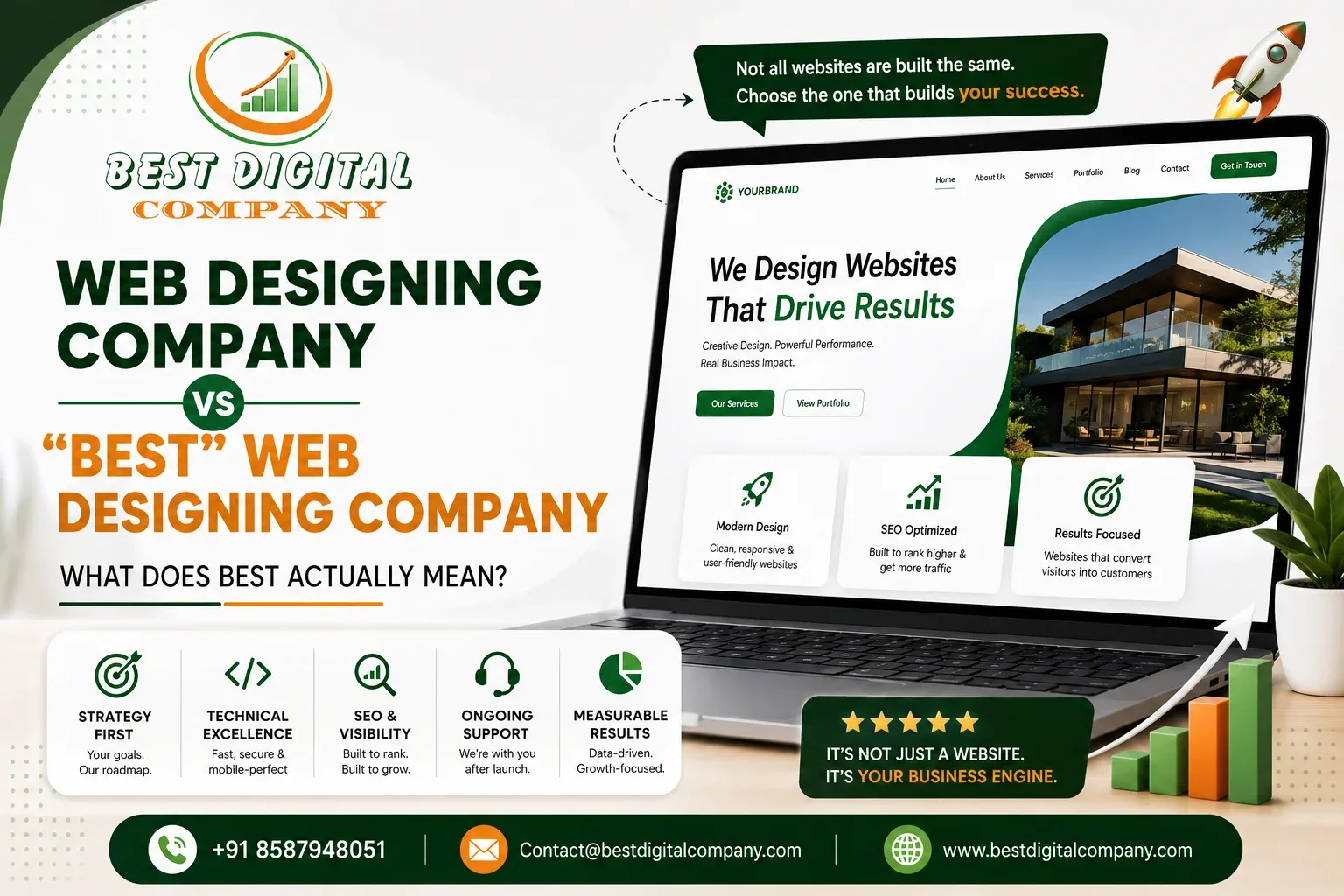
So what specifically separates a run-of-the-mill web designing company from one worth calling the best? It usually comes down to five areas.
1. Strategy Before Design
An ordinary agency asks, “What colors do you like?” A stronger one asks, “Who is your customer, what action do you want them to take, and how will this website support that goal?” Design without strategy produces a site that looks fine in a portfolio screenshot but doesn’t convert visitors into leads or customers. The best web designing company treats the website as a business tool first and a visual product second.
2. Technical Foundation, Not Just Visual Polish
A visually appealing homepage means nothing if the site takes eight seconds to load on mobile, isn’t secure, or breaks on a mid-range Android phone. Page speed, clean code, mobile responsiveness, and accessibility are unglamorous, but they’re what actually keep visitors on the page long enough to convert. This technical groundwork also feeds directly into search visibility a site’s design decisions and its search engine optimization performance are far more connected than most business owners realize. A beautifully designed site with poor technical SEO is still an invisible site.
3. Ongoing Support Instead of a One-Time Handoff
A lot of web designing companies disappear the moment the invoice clears. The best ones stick around offering maintenance, security updates, content changes, and troubleshooting long after launch. Websites aren’t static assets; they need adjustments as your business, offers, and audience evolve. If an agency’s contract ends the second the site goes live, that’s a signal worth noticing before you sign anything.
4. Transparent Process and Communication
Ask any business owner who has worked with multiple agencies, and they will tell you the biggest complaint is rarely about design quality. It is about communication. Missed deadlines, vague timelines, and radio silence during development are common enough that “we actually respond to emails” has become an unofficial differentiator. A genuinely strong website development and designing partner sets clear milestones, shares progress regularly, and explains decisions in plain language instead of jargon.
5. Measurable Results, Not Just Portfolio Screenshots
Anyone can show a polished mockup. Fewer agencies can show what happened after launch traffic growth, lower bounce rates, more form submissions, better conversion rates. The best web designing company treats the launch as the starting line, not the finish line, and tracks what the site actually does for the business afterward.
How to Evaluate a Web Designing Company Before You Hire One
Rather than relying on the word “best” printed on a homepage, here is a practical framework for judging any web designing company on its actual merits.
Look at their own website first. It sounds obvious, but it’s astonishing how many agencies pitch beautiful websites for clients while their own site is slow, outdated, or barely functional. If they can’t apply their own standards to themselves, that’s a warning sign.
Ask about the process, not just the price. A vague “we will build you a website in two weeks” answer tells you very little. A strong agency can walk you through discovery, wireframing, design review, development, testing, and launch with rough timeframes for each stage.
Request real client examples, and check them. Don’t just look at screenshots. Visit the live sites. Are they still online? Do they load quickly? Do they look current, or does the portfolio show work from three years ago that no longer represents their standards?
Ask what happens after launch. Who fixes a broken page? Who updates the site if you add a new product line? Is hosting and maintenance included, or is that a separate ongoing cost? Get this in writing before signing anything.
Understand how design connects to marketing. A website rarely exists in isolation. It needs to work alongside social media marketing campaigns driving traffic to it, and often pay-per-click advertising sending paid visitors directly to landing pages. An agency that only thinks about design in isolation, without considering how traffic actually arrives at the site, is missing half the picture.
Common Myths About “Best” Web Designing Companies
A few misconceptions keep businesses from making good decisions, so it is worth clearing them up directly.
Myth: The most expensive agency is automatically the best. Price often reflects overhead, brand recognition, or agency size more than it reflects the outcome you’ll get. A mid-sized team with a focused process can easily outperform a large agency where your project gets handed to a junior designer.
Myth: More design awards mean better business results. Award-winning design is often built for visual creativity contests, not necessarily for conversion rates or usability. A site can look stunning and still confuse visitors about what to click next.
Myth: A cheap website is a bad investment no matter what. This isn’t universally true either. A small business testing an idea might genuinely need a lean, affordable site rather than a five-figure custom build. “Best” is relative to the goal, not a fixed price tier.
Myth: If they rank first on Google for “web designing company,” they must be the best. Search rankings reflect a mix of SEO factors, competition, and content strategy not a direct measure of design quality or client satisfaction. It’s a useful signal, but not proof on its own.
Why “Best” Should Be Judged by Outcomes, Not Adjectives
Here’s a simple mental shift that makes this whole comparison easier: stop looking for the best web designing company as a label, and start looking for the company whose track record best matches what your business actually needs.
A local bakery doesn’t need the same website partner as a fintech startup raising a Series A round. A nonprofit needs different priorities than an e-commerce store selling physical products across states. “Best” isn’t a universal ranking. It is a fit between what an agency consistently delivers and what a specific business is trying to achieve.
This is also why credibility markers matter more than slogans. A company that publishes detailed, useful content about its own field the kind that helps readers make informed decisions rather than just pitching services tends to understand its craft more deeply than one that only posts generic “we build amazing websites” copy. It’s the same reasoning search engines use to evaluate trustworthiness, and it applies just as well to how a business owner should evaluate a potential partner. If you’re curious how that kind of trust-building plays out in practice, this piece on how small businesses can get their first 100 customers shows how design, content, and marketing work together rather than existing as separate line items.
Bringing It All Together
So, what does “best” actually mean when it comes to a web designing company? It isn’t a badge, a slogan, or a claim printed at the top of a homepage. It’s a combination of strategic thinking, technical competence, transparent communication, ongoing support, and most importantly measurable results after launch.
Any agency can call itself a web designing company. Far fewer can prove, with real examples and real outcomes, that they consistently deliver what that label promises. The next time you’re comparing quotes, skip the word “best” in the pitch deck and ask for the evidence instead. That’s the real difference between an agency that says it, and one that actually lives up to it.
Frequently Asked Questions
What does “best web designing company” actually mean?
There is no official ranking system behind the phrase. In practice, “best” refers to an agency that combines strategic planning, strong technical execution, clear communication, and proven results matched to what a specific business actually needs, rather than a generic, one-size-fits-all claim.
How is a web designing company different from a web development company?
Web designing usually focuses on layout, visuals, user experience, and branding, while web development covers the coding, backend functionality, and technical build. Many agencies, including full-service ones, handle both under a single roof so the design and the technical execution stay aligned.
How much should I expect to pay a web designing company?
Costs vary widely based on the complexity of the site, the number of pages, custom functionality, and ongoing maintenance needs. A simple informational site costs far less than a custom e-commerce platform or a web app with user accounts and payment integration. It’s best to request a detailed quote based on your specific requirements rather than comparing flat “starting prices” across agencies.
Can a cheap web designing company still be a good choice?
Yes, depending on the goal. A small business testing a new idea or launching a simple local presence may not need an expensive custom build. The right question isn’t “cheap vs. expensive” it’s whether the agency’s process and output match what the project actually requires.
How long does it typically take to build a website?
Timelines depend on scope, but a straightforward business website usually takes a few weeks from discovery to launch, while more complex projects involving custom features, integrations, or e-commerce functionality can take longer. Any agency worth hiring should be able to give you a realistic, stage-by-stage timeline upfront.
Does a good website design actually improve SEO rankings?
Yes, indirectly and directly. Site speed, mobile responsiveness, clean navigation, and structured content all influence how search engines evaluate a page, while a confusing or slow site tends to increase bounce rates and hurt rankings over time. Design and search visibility are far more connected than most people assume.
What questions should I ask before hiring a web designing company?
Ask about their process from discovery to launch, request live examples of past client work (not just screenshots), clarify what post-launch support is included, and ask how they measure success after the site goes live. Their answers will tell you more than any “best” claim on their homepage ever could.

Add a Comment