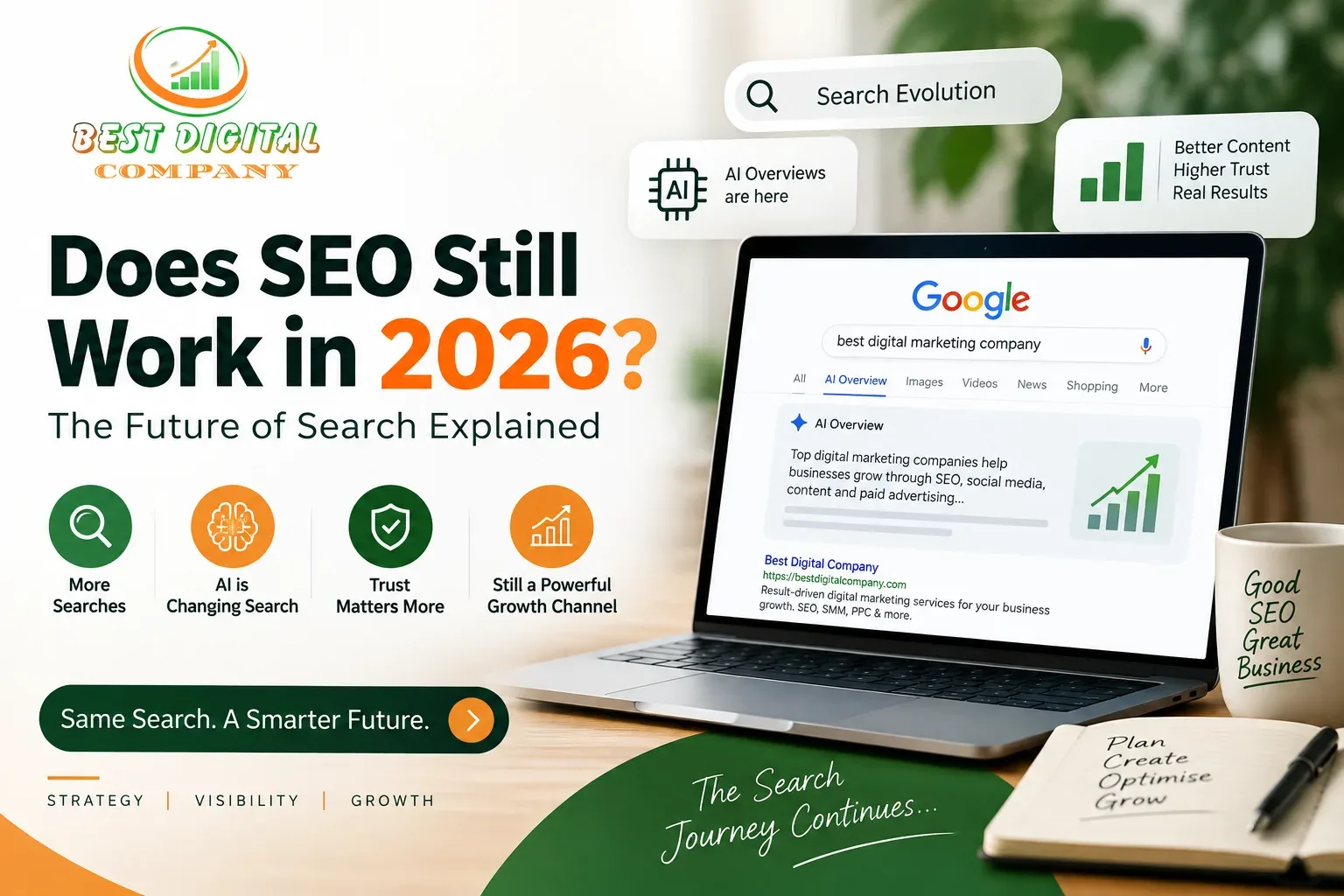
Does SEO Still Work in 2026? The Future of Search

Does SEO Still Work in 2026? The Future of Search Explained

Every few years, someone declares SEO dead. It happened when social media exploded, again when voice assistants arrived, and now it’s happening because of AI chatbots and AI-generated answers sitting right at the top of the search results page. So it’s a fair question to ask in the middle of 2026: does SEO still work, or has the game actually moved on without it?

The short answer is that SEO in 2026 is not dead, but it has changed shape. Search behaviour has shifted, Google’s algorithms have gotten far better at understanding intent, and the businesses winning visibility today aren’t the ones stuffing keywords into blog posts. They’re the ones building genuinely useful, well-structured, trustworthy websites. If you run a business and you’re wondering whether it’s still worth investing in search visibility, this guide walks through exactly what has changed, what still matters, and how to build an approach to SEO in 2026 that actually holds up.

Why People Keep Asking If SEO Is Dead

The doubt isn’t coming from nowhere. Over the last two years, Google has rolled out AI-powered summaries that answer many queries directly on the results page, reducing the number of clicks that go to individual websites. Chatbots like ChatGPT and Gemini have become a starting point for research that used to begin with a Google search. Naturally, business owners started asking whether ranking on page one even matters anymore.

Here’s the part that gets missed in that panic: people are still typing (and speaking) billions of queries into Google every single day, and most commercial searches — the ones where someone wants to buy something, book a service, or find a local business — still lead to a list of websites, maps results, and organic listings. AI overviews have changed how informational queries get answered, but they haven’t replaced the need for a business to be found, evaluated, and chosen online. If anything, the businesses with strong SEO foundations are the ones AI tools pull their answers from in the first place.

Is SEO in 2026 Still Worth the Investment?

This is really the question underneath everything else, so let’s answer it directly: yes, SEO in 2026 is still one of the highest-return, most durable marketing channels available to a business — but only when it’s done the way search engines now expect.

The old playbook of publishing thin, keyword-stuffed pages and building a pile of low-quality backlinks stopped working years ago, and it’s even less effective now. What still works is a website that clearly demonstrates expertise, gets structured correctly for both traditional search and AI-driven answers, earns links because people genuinely want to reference it, and keeps loading fast and working properly on mobile. That’s a longer list of requirements than it used to be, which is exactly why SEO in 2026 rewards businesses that treat it as an ongoing discipline rather than a one-time project.

We’ve seen this play out first-hand while managing campaigns for clients across different cities — our recent work on digital marketing strategy for businesses in Delhi NCR is a good example of how SEO, social, and paid channels now have to work together rather than sit in separate silos.

How Google’s AI Overviews Changed the Search Results Page

The single biggest shift affecting SEO in 2026 is the way Google now answers questions directly within the search results page, using AI-generated summaries pulled from multiple sources. For simple, factual queries — “what time zone is Tokyo in,” “how many ounces in a cup” — this means fewer people click through to a website at all.

But there’s a nuance that gets lost in most of the doom-and-gloom takes: these AI summaries are built by pulling information from pages that already rank well and are structured clearly. A business with no organic visibility doesn’t suddenly get pulled into an AI summary — it has to already be recognised as a credible, relevant source. In practice, this means the fundamentals of SEO (clear content, proper headings, fast pages, credible signals) matter just as much as before. What’s changed is that ranking on page one is now a prerequisite for being cited by AI tools, not a separate goal.

For queries with commercial intent — anything close to “near me,” a service name, or a product comparison — actual website listings, reviews, and map results still dominate the page, which is exactly the kind of search where local and service-based businesses need to show up.

E-E-A-T: Why Trust Matters More Than Experience Ever Did

Google’s quality guidelines revolve around a framework it calls E-E-A-T: Experience, Expertise, Authoritativeness, and Trustworthiness. It’s not a ranking factor you can tick off with a plugin — it’s a lens Google’s systems and human quality raters use to judge whether content deserves to be shown to real people.

In 2026, this framework has become more important, not less, precisely because AI-generated content has made it easier than ever to produce large volumes of generic, low-effort articles. Google’s systems have gotten noticeably better at spotting content that reads like it was written to target a keyword rather than to genuinely help someone. The sites that keep ranking are the ones that show real experience — actual case studies, specific numbers, named authors, and details that couldn’t have been written by someone who’s never worked in the field.

Practically, this means:

  • Experience: Writing from direct, hands-on knowledge rather than summarising what other articles already say.
  • Expertise: Demonstrating a genuine understanding of the subject, not just surface-level familiarity.
  • Authoritativeness: Being recognised by other credible sites and sources as a go-to reference in your field.
  • Trustworthiness: Accurate information, transparent business details, secure browsing, and honest claims.

For a local business, this is where working with an established SEO service in Delhi or a similar specialist actually pays off — it’s far easier to build authority and trust signals with someone who understands how Google evaluates a business website than to guess at it alone.

Human-Written Content Is Winning Back the Search Results Page

There’s a reason Google keeps pushing content quality updates: the internet got flooded with AI-generated filler content almost overnight, and a lot of it was designed purely to rank rather than to inform anyone. Google’s response has been to reward content that reads like it was written by a person who actually knows the topic — content with opinions, specific examples, a clear point of view, and information that isn’t just a rehash of the ten articles already ranking above it.

This doesn’t mean AI tools have no place in content creation. Plenty of good writers use them for research or first drafts. What it means is that publishing content without a human editing, fact-checking, and adding real insight to it is a losing strategy for SEO in 2026. Search engines are specifically trying to identify and de-rank content that adds nothing new, repeats the same points in different words, or answers a question without actually answering it.

If you’re building out a content plan, the goal should be to answer the question a real person is asking, in a way only your business (with your specific experience) could write it — not to hit a word count or a keyword density target.

Local and Voice Search Are Reshaping SEO in 2026

Two search behaviours have grown fast enough to change how local businesses need to think about visibility this year: local search and voice/conversational search.

Local search — someone typing “digital marketing agency near me” or asking their phone the same thing out loud — depends heavily on a well-optimised Google Business Profile, consistent business information across the web, and genuine customer reviews. This is a different discipline from traditional SEO, and it’s why we treat it as its own workstream in our local SEO services in Delhi, separate from broader national campaigns.

Voice and conversational search — driven by smart speakers and AI assistants — tends to favour content written in a natural, question-and-answer style, because that’s closer to how people actually speak their queries. This is part of why FAQ sections, clear headings phrased as questions, and conversational writing have become genuinely useful SEO tactics rather than just a nice-to-have.

We’ve seen these patterns play out consistently across markets — the strategies we outlined for SEO services in Gurugram and for businesses comparing an SEO company in Gurugram versus an SEO agency in Gurgaon both come back to the same fundamentals: accurate local listings, review generation, and content that matches how people actually search in that city.

Technical SEO and Website Experience Still Decide Who Ranks

No amount of good content saves a website that loads slowly, breaks on mobile, or confuses search engines with a messy structure. Technical SEO has actually grown in importance in 2026, because Google now evaluates page experience — loading speed, visual stability, mobile usability, and secure connections — as a direct part of how it ranks pages.

This is also where structured data (schema markup) has become far more valuable than it used to be. Marking up your content correctly helps search engines and AI systems understand exactly what a page is about, who wrote it, what a product costs, or what a service includes — which increases the odds of being pulled into rich results or AI-generated answers.

A slow, outdated, or poorly structured website undermines every other SEO effort you make, which is why we always pair search strategy with proper website development and design rather than treating the two as separate projects. You can publish the best content in your industry, but if the site takes six seconds to load on a phone, most of that work goes to waste.

SEO in 2026 Doesn’t Work Alone Anymore

One thing that genuinely has changed is how isolated SEO can afford to be. A few years ago, a business could run SEO as a standalone channel and see steady results. In 2026, the businesses getting the best outcomes are combining organic search with paid advertising and social visibility, because each channel now reinforces the others.

Paid search fills the gap while organic rankings are still building, and it gives you fast data on which keywords actually convert. Our breakdown of how PPC and Google Ads can generate faster leads covers this in more detail — the short version is that PPC services and SEO complement each other rather than compete for budget.

Social signals also feed into how discoverable and trustworthy a brand appears, both to users and, indirectly, to search engines evaluating a brand’s overall footprint. We’ve written about this in our guide to how SMO supports business growth, and it’s a big part of why social media marketing now sits inside most integrated SEO strategies rather than off to the side.

Building a Future-Proof SEO Strategy in 2026

If you’re planning search visibility for the year ahead, here’s what an approach built for SEO in 2026 actually looks like in practice:

1. Start with real search intent, not just keywords. Before writing anything, understand what the person searching actually wants — information, a comparison, or a business to hire. Content that matches intent gets rewarded; content that just repeats a keyword phrase doesn’t.

2. Invest in original, experience-backed content. Case studies, original data, and specific examples from your own work carry far more weight than generic advice that could apply to any business anywhere.

3. Fix the technical foundation first. Page speed, mobile usability, and clean site structure aren’t optional extras — they’re the baseline Google expects before it even evaluates your content quality.

4. Build genuine authority signals. Earn links and mentions from credible sources in your industry rather than chasing volume through low-quality directories.

5. Treat local presence as its own project. If you serve a specific city or region, your Google Business Profile, reviews, and local content need dedicated attention — this is exactly the kind of work covered instructured SEO packages built around measurable local outcomes.

6. Track what actually moves the needle. Rankings alone don’t pay the bills — traffic, leads, and conversions do. A strategy built for 2026 needs to track the full path from a search to an actual customer.

Common Mistakes Businesses Still Make With SEO in 2026

Even with all this shift toward quality and trust, a lot of businesses keep repeating the same mistakes:

  • Treating SEO as a one-time task. A website optimised once and left untouched for a year will lose ground to competitors who keep publishing and refining.
  • Publishing content no one asked for. Articles written to hit a keyword rather than answer a real question tend to underperform, no matter how well they’re optimised technically.
  • Ignoring page experience. A beautifully written page on a slow, cluttered website still struggles to rank or convert.
  • Skipping local optimisation. Businesses that serve a specific city but never invest in local search lose a huge share of nearby, ready-to-buy customers to competitors who do.
  • Expecting overnight results. SEO in 2026 still takes months to show its full impact — it rewards patience and consistency over quick fixes.

We’ve walked through a lot of these patterns while comparing options for business owners, including in our look at choosing between an SEO expert and a freelancer in Bangalore and our guide on what to ask before hiring an SEO agency in Lucknow the mistakes are strikingly consistent across cities and industries.

So, Does SEO Still Work in 2026?

Yes — but it works differently than it did even three years ago. Search engines have gotten better at rewarding genuine expertise and penalising shortcuts, AI-generated answers have raised the bar for what “ranking” actually means, and local, technical, and content strategies now have to work together instead of separately. Businesses that adapt to these shifts, rather than trying to relive 2019-era SEO tactics, are still seeing strong, sustainable growth from organic search.

The businesses struggling with SEO in 2026 usually aren’t struggling because the channel stopped working — they’re struggling because they haven’t adjusted their approach to match how search actually functions today. Whether you’re just getting started or trying to recover lost visibility, teams that understand search engine optimisation at this level of detail can usually get things back on track faster than trying to guess at it in-house.


Frequently Asked Questions About SEO in 2026

Is SEO still relevant in 2026, or has AI search replaced it?

SEO is still very relevant in 2026. AI-generated answers on the search results page have changed how some queries get answered, but they pull their information from well-ranked, trustworthy websites — so strong SEO is now a requirement for being included in AI answers, not a separate, outdated channel.

How long does it take to see results from SEO in 2026?

Most businesses start seeing meaningful movement in three to six months, with stronger, compounding results after nine to twelve months of consistent work. Highly competitive industries or cities can take longer, which is one reason pairing SEO with paid search often makes sense in the early stages.

What matters most for SEO in 2026: content, backlinks, or technical setup?

All three matter, but they’re no longer separate checkboxes. Content needs to demonstrate real experience and answer intent clearly, backlinks need to come from genuinely credible sources, and the technical foundation (speed, mobile experience, structured data) has to be solid enough for search engines to trust and understand the site in the first place.

Does AI-generated content hurt SEO rankings?

Content that is purely AI-generated, unedited, and adds nothing new tends to underperform, because search engines are specifically trying to identify and reduce visibility for generic, low-effort content. AI tools used for research or drafting are fine, but the published result needs human review, fact-checking, and genuine expertise added on top.

Is local SEO different from regular SEO in 2026?

Yes. Local SEO focuses on your Google Business Profile, reviews, local citations, and location-specific content, while broader SEO focuses on the wider website. Businesses that serve a specific city or region typically need both working together for full visibility.

Should a small business still invest in SEO in 2026, or focus on paid ads instead?

Both channels serve different purposes, and most businesses benefit from combining them. Paid ads deliver faster, immediate visibility, while SEO builds a lasting asset that keeps generating traffic without an ongoing cost per click. A small business with a limited budget often gets the best return by using paid search to generate quick leads while SEO builds up in the background.
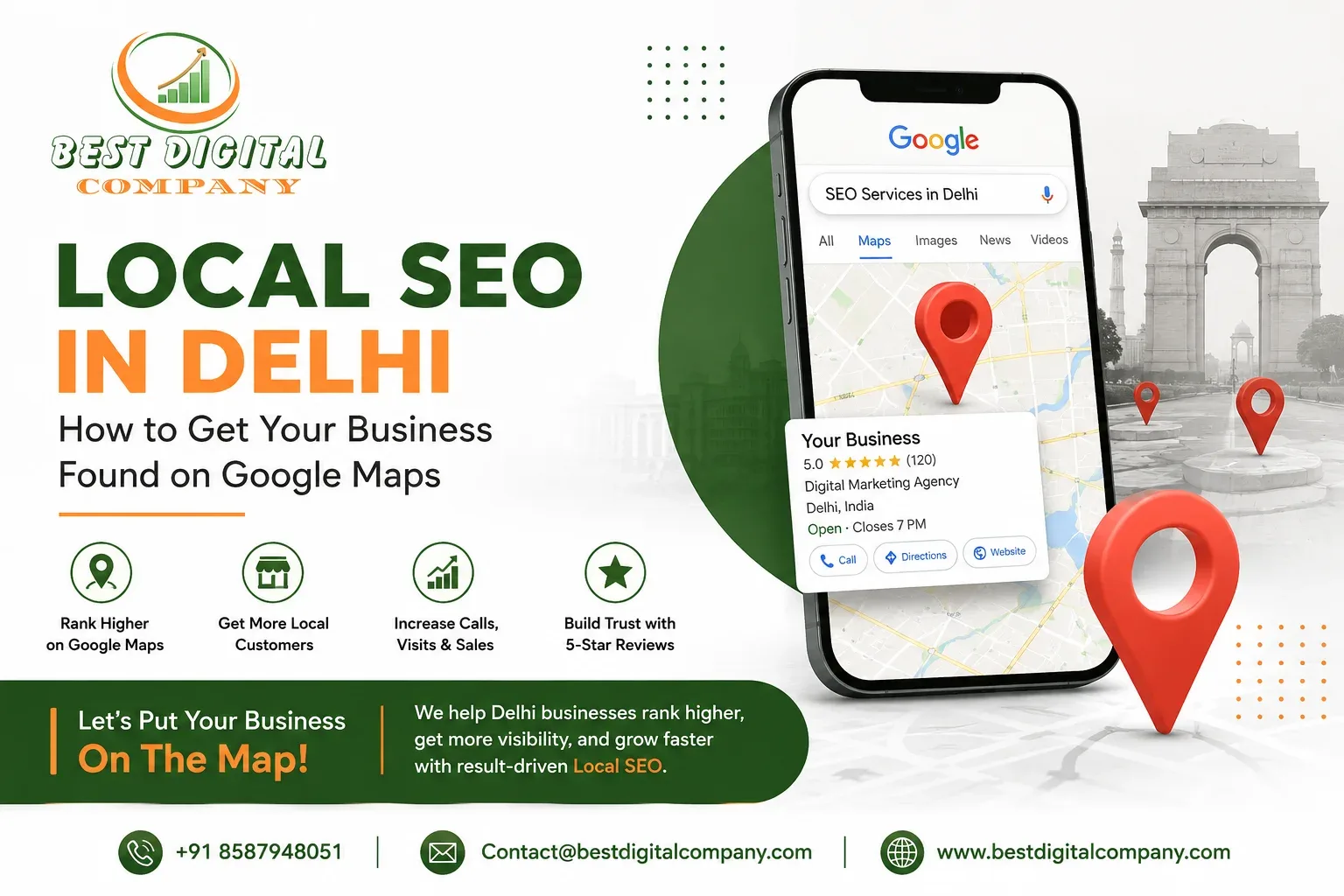

Local SEO in Delhi

Local SEO in Delhi: How to Get Your Business Found on Google Maps

If you run a shop, clinic, restaurant, or service business anywhere from Connaught Place to Dwarka, there’s a good chance most of your new customers are finding you the same way: they open Google, type something like “near me,” and pick from whatever shows up on the map. That map pack, sitting right above the regular results, is where local buying decisions are made in seconds. If your business is not there, you are not losing a little visibility, you are losing the customer who was already ready to walk in or call.

This is exactly why have shifted so heavily toward local optimization over the past few years. A national ranking strategy doesn’t help a dentist in Rohini or a boutique in Karol Bagh. What helps is showing up when someone nearby is actively looking. In this guide, we will walk through what local SEO actually involves, how Google Maps visibility works, and the practical steps that move a business from invisible to found without the jargon and without the guesswork.

What Is Local SEO and How Is It Different From Regular SEO Services in Delhi

Traditional SEO focuses on ranking a website for broad, often national, search terms. Local SEO does something narrower and, for most small and mid-sized businesses, more valuable: it makes sure your business shows up when someone in your city or neighbourhood searches for what you offer.

The difference matters because Google treats these two types of searches differently. A search for “best CRM software” pulls up websites based on content depth, authority, and backlinks. A search for “SEO company in Delhi” or “AC repair near me” pulls up a mix of map listings and websites, weighted heavily by proximity, relevance, and how well a business has verified its presence on Google.

That’s why a lot of Delhi businesses that invest in a general Search Engine Optimization plan without a local layer end up disappointed. Their website might rank fine for informational searches, but they’re still invisible on the map when a customer three kilometres away is searching with buying intent. Local SEO closes that gap. It’s not a replacement for regular SEO — it’s a companion strategy that works alongside it, and if you want a broader look at how the two connect, our dedicated page onSEO Service in Delhi breaks that relationship down further.

Google Business Profile: The Foundation of Google Maps SEO

If there’s one thing that determines whether your business appears on the map, it’s your Google Business Profile (formerly Google My Business). This single, free listing carries more weight for local visibility than almost anything else you can do.

A few things matter here more than people expect:

Accurate categories. Pick the primary category that most precisely matches what you do, not the broadest one. A “family dentist” ranks differently than a general “dentist” category for certain searches, and choosing the wrong one quietly limits how often you appear.

Complete, honest information. Business hours, service areas, phone number, and a real address all need to match what’s on your website. Gaps or inconsistencies here don’t just confuse customers — they signal to Google that the listing might not be reliable.

Photos that are actually yours. Stock images or borrowed photos hurt more than they help. Real photos of your storefront, team, and work build trust with both customers and Google’s systems, which increasingly reward listings that show genuine activity.

Regular updates. Profiles that post updates, respond to questions, and add fresh photos tend to outperform ones that were set up once and forgotten. Google Maps SEO rewards businesses that treat their profile as a living page, not a static directory entry.

Getting this foundation right is usually the single highest-impact step in any local SEO Delhi campaign, and it’s often the first thing we audit when a client comes to us frustrated about not showing up in the map pack.

On-Page Signals Support Local SEO Delhi Efforts

Your Google Business Profile does not work in isolation — Google cross-checks it against your website. This is where on-page local SEO comes in, and it’s a step a lot of businesses skip entirely.

At minimum, your website should include:

  • A clear mention of your city and neighbourhood in page titles, headings, and body content, written naturally rather than stuffed in
  • A dedicated location or service-area page if you serve multiple parts of Delhi NCR
  • Your business name, address, and phone number displayed consistently, ideally in the footer of every page
  • Schema markup (structured data) that tells search engines exactly what kind of business you are and where you’re located
  • Fast loading times and mobile-friendly design, since most local searches happen on a phone while someone is already out and about

We built our own Local Seo in Delhi service page around exactly this structure, and it’s the same framework we apply for clients across different industries, from clinics to retail chains. The goal isn’t to cram keywords into every paragraph. It’s to make the geographic and service intent unmistakable to both the reader and the algorithm.

Building Citations and Local Links That Strengthen Google Maps SEO

Citations are simply mentions of your business name, address, and phone number on other websites — directories, local news sites, industry associations, and review platforms. They might sound old-fashioned in an age of AI-driven search, but they still carry real weight for one simple reason: consistency across the web tells Google your business is legitimate and stable.

The mistake most businesses make is listing their address slightly differently on every platform — “Rd” on one site, “Road” on another, a missing suite number somewhere else. Individually these look trivial, but collectively they create doubt in Google’s local ranking systems about which version is accurate.

A cleaner approach is to:

  1. Audit your existing listings on major directories and fix mismatches
  2. Prioritise Delhi-specific and India-wide directories relevant to your industry over generic global ones
  3. Earn a handful of genuine local backlinks from a trade association, a local blog, a chamber of commerce rather than chasing volume
  4. Keep your NAP (name, address, phone) identical everywhere, including on your website footer and social profiles

This kind of cleanup rarely feels exciting, but it’s often the quiet difference between a business that ranks steadily and one that fluctuates in and out of the map pack for no obvious reason.

Reviews and Reputation: Why They Influence Google Maps SEO

Ask any business owner in Delhi who’s watched their map ranking improve, and reviews usually come up early in the conversation. Google factors in both the quantity and the recency of reviews, along with how you respond to them.

A profile with 40 reviews and a 4.6 rating, where the owner replies to almost everyone, typically outperforms a profile with 100 reviews that has not been touched in a year. Responsiveness signals an active, trustworthy business which is precisely what Google Maps SEO is designed to surface.

A few practical habits help here:

  • Ask happy customers for a review right after a positive interaction, rather than in a generic follow-up email weeks later
  • Reply to every review, including the critical ones, calmly and specifically
  • Never buy reviews or use review-gating tools that filter out negative feedback before it’s posted — Google’s guidelines prohibit this, and getting caught can suppress a listing entirely
  • Mention specific services or neighbourhoods naturally when replying, since this reinforces relevance without looking manufactured

Reputation management isn’t a side task anymore. For most Delhi businesses competing in a crowded map pack, it’s become as important as the technical groundwork.

Choosing the Right SEO Company in Delhi for Local Growth

Delhi has no shortage of agencies claiming to guarantee the number-one spot on Google Maps within weeks. That promise alone is usually a red flag — no reputable SEO Company In Delhi can guarantee rankings, because Google’s algorithm accounts for hundreds of signals that no agency fully controls.

What you should look for instead:

A clear, documented process. Ask what they’ll actually do in the first 30, 60, and 90 days. Vague answers about “optimising everything” usually mean there isn’t a real plan.

Local case studies, not just generic ones. A company that’s ranked businesses specifically within Delhi NCR understands the competitive landscape here far better than one working from a template built for a different city.

Transparent reporting. You should be able to see your Google Business Profile insights, keyword movement, and website traffic on a regular basis, not just a monthly PDF with vague summaries.

Ethical practices. Fake reviews, keyword stuffing, and spammy directory submissions might produce short-term bumps, but they routinely lead to penalties that take months to undo.

If you’re comparing agencies right now, it’s worth reading our earlier piece on Best SEO Company vs Best SEO Agency: Which Title Actually Matters? it goes into how these titles are often just marketing labels, and what actually determines whether a provider will do good work. We’ve also written about a closely related question in SEO Company Near Me vs Remote SEO Agency: Does Location Still Matter in 2026?, which is directly useful if you’re weighing whether a Delhi-based team gives you an edge over a remote one for local work.

Common Local SEO Mistakes Delhi Businesses Make

A few patterns show up again and again when we audit a new client’s presence:

Multiple listings for the same location. Old, duplicate, or unclaimed Google Business Profiles from a previous owner or an earlier attempt at setup often confuse Google about which listing is current, splitting reviews and ranking signals across two or more pages.

Ignoring service-area accuracy. Businesses that serve all of Delhi NCR but only list their exact address sometimes miss out on visibility in areas they genuinely cover. Setting service areas correctly in the profile settings fixes this.

Treating the website and the map listing as separate projects. They need to reinforce each other. A gorgeous website with no local schema, and a Google Business Profile with no matching content on the site, sends mixed signals.

No mobile optimisation. Since the overwhelming majority of “near me” searches happen on phones, a slow or clunky mobile experience can undo a lot of the ranking progress made elsewhere. If your site needs a rebuild, our Website Development & Designing team can help make sure the technical foundation actually supports your local SEO Delhi strategy instead of working against it. We also compared different approaches to this in Best Web Designer or Best Web Development Company: Who Do You Actually Need?, which is worth a read if you are unsure what kind of help your site needs first.

Neglecting reviews after the initial push. A flurry of reviews when a business first launches its profile, followed by silence for a year, tends to stall momentum right when competitors are still actively collecting theirs.

How Best Digital Company Approaches SEO Services in Delhi

We’ve worked with businesses across Delhi NCR — retail, healthcare, home services, and B2B — and the pattern is consistent: local visibility rarely improves through one single fix. It comes from a combination of a properly optimised Google Business Profile, a website built to reinforce local relevance, consistent citations, and a steady stream of genuine reviews, maintained over months rather than treated as a one-time project.

Our approach usually starts with an audit of where a business currently stands — profile completeness, citation consistency, competitor comparison, and website technical health — followed by a prioritised action plan rather than a generic checklist. If paid visibility is also part of the conversation, we pair local SEO with Pay Per Click campaigns targeted specifically at Delhi NCR searches, since the two channels tend to reinforce each other when a business is trying to grow quickly. For businesses also active on social platforms, our Social Media Marketing team can align local content with what’s happening in the Maps listing, which keeps the brand consistent across every touchpoint a customer sees.

If you’d like a structured, ongoing plan rather than a one-off audit, our SEO Packages outline what’s included at different levels of support, from foundational profile and citation work up to full local content strategy.

We are based at C-1/295, Gali No-15, Harsh Vihar, Delhi -110093, near Lal Mandir, and most of our team has spent years working specifically within the Delhi NCR market — which means we are not applying a national template to a local problem. If you’d rather talk through your specific situation than read another checklist, you can reach us directly through our Contact Us page.

FAQ

How long does local SEO take to show results in Delhi?

Most businesses start seeing early movement in Google Business Profile visibility within 4 to 8 weeks, particularly if the profile was previously incomplete. Meaningful, stable ranking improvement in the map pack usually takes 3 to 6 months, since it depends on consistent review growth, citation cleanup, and ongoing content updates rather than a single fix.

Is local SEO different from paid Google Ads for local visibility?

Yes. Local SEO improves your organic position on Google Maps and in local search results over time, without paying per click. Local Google Ads campaigns can put you at the top of results immediately, but that visibility disappears the moment the budget stops. Many Delhi businesses use both together — ads for immediate visibility while organic local SEO builds a lasting foundation.

Do I need a physical office in Delhi to rank for local searches?

Not necessarily, but it helps significantly. If you serve customers without a walk-in location — say, a service-area business like a plumber or an electrician — you can still set up and optimise a Google Business Profile using a service-area setting instead of a public address. What matters most is that your listed information is accurate and verifiable.

How many Google reviews does a business need to rank well on Maps?

There is no fixed number. What matters more is consistency and recency — a steady trickle of new reviews over months tends to outperform a large batch collected once and then abandoned. Response rate and review quality also factor into how Google evaluates the listing.

Can I do local SEO myself, or do I need to hire an SEO company in Delhi?

Basic steps — claiming your Google Business Profile, keeping information accurate, and asking customers for reviews — are manageable on your own. Where most businesses benefit from professional help is in citation building, schema markup, competitor analysis, and ongoing optimisation, since these require both technical knowledge and consistent time investment that’s hard to sustain alongside running the actual business.

What is the biggest local SEO mistake Delhi businesses make?

Treating it as a one-time setup rather than an ongoing effort. A Google Business Profile that’s optimised once and then left untouched for a year almost always loses ground to competitors who are actively posting updates, collecting reviews, and refining their listing on a regular basis.

SEO Expert in Delhi

SEO Expert in Delhi: What Does an SEO Expert Actually Do for Your Business?

Most business owners hire an SEO expert in Delhi without ever asking what the job actually involves. They see a proposal, a monthly fee, and a promise of “page one rankings,” and they sign. Three months later, half of them are still asking the same question they should have asked on day one: what am I actually paying for?

That confusion is not your fault. SEO has been sold as a black box for so long that even experienced founders struggle to separate real work from vague reporting. This blog breaks down exactly what a genuine SEO expert does, how that work differs from what an SEO consultant, an SEO agency, or a freelancer offers, and how you can judge whether the person handling your website’s growth is doing real work or just billing you for a checklist.

If you run a business in Delhi NCR and you’re trying to figure out whether you need an in-house hire, a consultant, or a full agency team, this guide should make that decision a lot easier.

Who Is an SEO Expert in Delhi and What Do They Actually Own?

An SEO expert in Delhi is someone responsible for how your website performs across organic search not just rankings, but visibility, click-through rate, and the quality of traffic that eventually converts into leads or sales. That’s a broader job than most people assume.

A capable SEO expert typically owns four things at once:

  • Technical health of the website — how fast it loads, whether search engine crawlers can read it properly, and whether it’s structured in a way that doesn’t confuse either users or algorithms.
  • Content strategy — deciding what topics your website should cover, in what depth, and in what order, based on what your actual customers are searching for.
  • Authority building — earning links, mentions, and citations from other credible websites so search engines trust your domain more over time.
  • Measurement — tracking whether any of this is translating into real business outcomes, not just vanity metrics like impressions.

Notice that “keyword stuffing” and “submitting to 500 directories” aren’t on that list. That’s old-school SEO from a decade ago, and it doesn’t work anymore. Delhi’s market is dense and competitive — retail, real estate, healthcare, education, manufacturing — and generic tactics get buried instantly. What separates a real expert from someone reselling a template is whether they understand your specific industry, your specific customer’s search behavior, and your specific competitors’ weaknesses.

If you want a deeper look at how core optimization work is structured, our Search Engine Optimization service page breaks down the full process we follow with clients.

What an SEO Consultant in Delhi Actually Does Day to Day

There is a real difference between hiring an SEO consultant in Delhi and hiring an in-house employee or a large agency, and it comes down to scope and independence.

A consultant is usually brought in for one of three reasons:

  1. Your business already has a marketing team, but nobody has deep search expertise.
  2. You want an outside audit of what your current agency or in-house SEO person is doing.
  3. You need a strategy built, but you have the internal resources to execute it.

A good consultant’s actual day-to-day work includes auditing your website’s technical setup, researching how your target customers phrase their searches, mapping content gaps against competitors, and building a prioritized action plan. They’re not writing every blog post or fixing every broken link themselves. They are telling your team, or your agency, exactly what needs to happen and why.

This is where a lot of businesses get burned. Some people call themselves consultants but are really just freelancers doing execution work under a fancier title, without the strategic thinking that justifies a consulting fee. A real consultant should be able to explain, in plain language, why a particular page isn’t ranking, what’s actually happening at a technical level, and what the fix will realistically cost in time and effort. If someone can’t do that, they’re guessing, not consulting.

For businesses weighing whether to go the consultant route or hire a full-service partner, this comparison from our blog is worth a read: Best SEO Company vs Best SEO Agency: Which Title Actually Matters? It covers a similar dilemma from a different angle.

Inside an SEO Agency in Delhi: How the Work Actually Gets Divided

When you hire an SEO agency in Delhi, you are not hiring one person- you are hiring a team, even if you only ever speak to one account manager. Understanding how that team splits the work helps you judge whether you’re getting real value or just a single overworked freelancer wearing an agency’s name.

A properly staffed agency generally divides SEO work across a few functions:

  • Technical SEO specialists who handle site speed, indexing issues, structured data, and mobile usability.
  • Content strategists and writers who research topics, map search intent, and produce pages that actually answer what people are looking for.
  • Link building and outreach specialists who build relationships with other websites to earn credible backlinks.
  • Analysts who track rankings, traffic, and conversions, and adjust strategy based on what’s actually working.

This division matters because SEO is not a single skill. Someone who’s excellent at technical audits might not know how to write content that ranks. Someone who writes well might have no idea how to fix a crawl error. A one-person operation claiming to handle all of this at expert level for a low monthly fee is usually stretched too thin to do any of it properly.

We have written more about how location and structure affect this decision here: SEO Company Near Me vs Remote SEO Agency: Does Location Still Matter? a useful read if you are deciding between a local Delhi team and a remote one.

The Core SEO Services in Delhi Businesses Actually Need

Ask ten different providers what falls under SEO services in Delhi and you will get ten different answers. But strip away the jargon, and most legitimate SEO work falls into these categories:

On-page optimization — This covers your title tags, meta descriptions, header structure, internal linking, and how well each page targets a clear search intent. It’s foundational, and it’s the part most agencies get right because it’s mechanical and easy to audit.

Local SEO — For most Delhi-based businesses, especially those serving a specific area or neighborhood, local visibility often matters more than national rankings. This includes your Google Business Profile, local citations, and location-specific content. If you’re a service business trying to capture nearby customers, this is often where the highest return lives. Our Local SEO in Delhi service focuses specifically on this.

Content development — Publishing pages and blog posts that answer real questions your customers are asking, structured around genuine search intent rather than keyword density. Thin, repetitive content doesn’t move rankings anymore depth and clarity do.

Technical SEO — Site speed, mobile responsiveness, crawlability, secure connections, and clean site architecture. If search engines can’t crawl and understand your site efficiently, none of the other work matters much.

Off-page SEO and authority building — Earning backlinks and mentions from other relevant, trustworthy sites. This is slower and harder to fake, which is exactly why it’s one of the strongest trust signals a website can build over time.

Reporting and strategy adjustment — Ongoing tracking of what’s working, what isn’t, and why, with monthly or quarterly strategy shifts based on real data rather than guesswork.

If your current provider is only doing one or two of these usually on-page tweaks and a monthly report. You are getting a fraction of what real SEO services in Delhi should include. You can see how we structure pricing and scope for these services on our SEO Packages page.

How to Tell a Genuine SEO Expert in Delhi from a Pretender

Delhi’s digital marketing scene has grown fast, and with that growth has come a flood of self-declared experts who learned SEO from a two-week course and started taking clients the next month. Here’s how to filter them out before you sign a contract.

Ask for specifics, not generalities. A real expert can tell you, within the first conversation, roughly what’s wrong with your current website and why. Someone who only speaks in vague promises — “we’ll get you to page one” — without ever looking closely at your site is not analyzing anything; they’re reciting a sales script.

Check how they talk about timelines. SEO is not instant. Anyone guaranteeing rankings within two or three weeks is either lying or planning to use tactics that will get your site penalized later. A genuine expert will tell you that meaningful movement typically takes a few months, and sustainable results take longer, because that’s simply how search engines evaluate trust over time.

Look at their own website and content. If someone is selling you SEO but their own site isn’t optimized, doesn’t rank for anything relevant, or reads like it was written in five minutes, that’s a signal worth taking seriously.

Ask how they measure success. Rankings alone do not pay your bills — traffic that converts does. A capable SEO expert in Delhi will talk about qualified traffic, conversion rate, and business impact, not just position numbers for a handful of keywords.

Understand what “guaranteed rankings” really means. No one — not us, not any legitimate agency — controls how search engines rank pages. Anyone guaranteeing a specific rank on a specific date is either inexperienced or dishonest. What a real expert can promise is a clear process, consistent execution, and transparent reporting.

Why Experience, Expertise, and Trust Actually Matter Here

Search engines today are far better at recognizing genuine expertise than they were even two or three years ago. That shift has real consequences for how SEO work needs to be done.

This means the SEO expert working on your account should actually understand your industry, not just generic optimization tactics. A person handling SEO for a hospital website needs a different depth of knowledge than someone optimizing for a furniture showroom. Content needs to be accurate, written by people who understand the subject, and backed by real business information — your actual address, real client work, genuine team credentials — not stock templates copied across a dozen client sites.

This is also why content quality has become non-negotiable. Search engines are increasingly good at distinguishing between content written by someone who understands a topic and content generated purely to hit a word count or a keyword target. Thin, repetitive, or obviously templated writing tends to underperform, no matter how many keywords are packed into it. The businesses seeing consistent growth are the ones publishing content that genuinely helps their readers, written in a natural, human voice, covering a topic with real depth instead of circling the same three points in different words.

If your SEO expert can’t explain why a piece of content matters to your actual customers not just to a search algorithm — that’s usually a sign the strategy is outdated.

What Results Should You Realistically Expect, and When?

This is the question every business owner should ask before signing on, and honestly, few providers answer it straight.

In most cases, technical fixes and on-page improvements start showing early signals — small ranking movements, slightly better crawl behavior — within four to eight weeks. Meaningful organic traffic growth, the kind that actually shows up in your leads or sales, usually takes three to six months, depending on how competitive your industry is and how much authority your website already has.

Local SEO tends to move faster than broader organic rankings, particularly for service businesses targeting specific Delhi neighborhoods, because the competition pool is smaller and more localized. National or highly competitive keywords — the kind big brands fight over — can take six months to a year of consistent work before you see real movement.

None of this means SEO is slow for the sake of being slow. It reflects how search engines evaluate trust: gradually, based on consistent signals over time, not sudden spikes that often indicate manipulation. A provider who understands this will set expectations honestly upfront rather than promising instant results to close the deal.

If your business also runs paid campaigns alongside organic SEO, it’s worth understanding how that budget split typically works — we cover that comparison in PPC Company vs PPC Agency: Which Model Fits Your Ad Budget?, and you can explore our own approach on the Pay Per Click service page.

FAQs About Hiring an SEO Expert in Delhi

How do I know if my website actually needs an SEO expert?

If your website isn’t showing up for searches directly related to your products or services, if your traffic has stayed flat for months, or if you’re relying entirely on paid ads to get visitors, that’s usually a sign organic search is being left on the table. A quick audit from a genuine expert can tell you fairly fast whether there’s real opportunity worth pursuing.

What is the real difference between an SEO consultant and an SEO agency?

A consultant typically focuses on strategy and diagnosis telling you what is wrong and what needs to happen. An agency usually handles both strategy and execution, with a full team covering technical work, content, and outreach. Which one you need depends on whether you already have people who can execute a plan internally.

Can content ranking well today stop ranking later if it’s not written properly?

Yes. Search engines regularly reassess content quality, and pages that were thin, repetitive, or clearly written just to target keywords can lose their positions over time, especially as competitors publish more thorough, genuinely useful material. This is one reason ongoing content review matters, not just a one-time publish.

Is local SEO different from regular SEO for a Delhi-based business?

Yes, meaningfully so. Local SEO focuses on visibility for people searching within a specific area — your neighborhood, your city zone and relies heavily on your Google Business Profile, local citations, and location-specific content. Regular organic SEO targets broader, often national, search intent. Most Delhi businesses benefit from doing both, but the priority depends on whether your customers are local or spread across regions.

How much should SEO services in Delhi realistically cost?

Pricing varies widely based on scope, competition level, and whether you need ongoing content production or just technical maintenance. What matters more than the number itself is what is included a cheap package that only covers surface-level on-page tweaks will cost you more in lost time than a properly scoped one. It’s worth comparing scope, not just price, across a few providers before deciding. Our SEO Packages page breaks down what’s typically included at different levels.

How long before I should expect to see a return from SEO?

Most businesses start seeing measurable movement within two to three months, with stronger, more reliable results building over six months to a year. Businesses in highly competitive categories should expect a longer runway before organic search becomes a major traffic source.

Final Thoughts

Hiring an SEO expert in Delhi is not about finding someone who can promise the fastest results — it is about finding someone who actually understands your business, your customers, and how search engines evaluate trust and relevance today. Whether you go with an independent SEO consultant in Delhi, bring on a full SEO agency in Delhi, or piece together a mix of SEO services in Delhi that fit your current stage of growth, the fundamentals stay the same: transparent process, honest timelines, and content built around real expertise rather than shortcuts.

If you are evaluating your options and want a straight assessment of where your website currently stands, our team at Best Digital Company is happy to walk through it with you — no inflated promises, just a clear look at what is working, what is not, and what it would realistically take to fix it. You can reach out through our Contact Us page, or explore our full Search Engine Optimization services to see how we approach this work for businesses across Delhi NCR.

SEO Services in Delhi NCR

SEO Services in Delhi NCR: What Businesses Should Expect From a Professional Agency

If you have spent any time searching for help with your website’s rankings, you already know the region is crowded. Gurugram has agencies working out of co-working spaces. Noida has entire buildings full of digital marketing teams. Delhi itself has everything from one-person freelancers to large firms with dozens of employees. Somewhere in that noise, business owners are trying to answer one simple question: what should I actually be getting for my money?

That question is harder to answer than it sounds. Two agencies can quote nearly identical prices for SEO services in Delhi NCR and deliver completely different experiences one sends you a monthly spreadsheet of vague “optimizations,” while the other builds a strategy tied to leads, calls, and revenue. The difference usually isn’t obvious in the sales pitch. It shows up three or four months later, when one client is seeing more inquiries and the other is still waiting for “the algorithm to catch up.”

This guide breaks down what a genuinely professional agency does, what deliverables you should expect month to month, and how to separate real SEO work from busywork dressed up as strategy.

Why Businesses Across Delhi NCR Are Prioritizing SEO Right Now

Delhi NCR isn’t one market — it’s several markets stitched together. A dental clinic in Rohini competes locally with three other clinics on the same road. A B2B manufacturing unit in Faridabad competes nationally with suppliers it has never met. A fashion boutique in Cyber Hub competes with both nearby stores and online marketplaces. That variety is exactly why generic, one-size-fits-all SEO packages tend to underperform here.

What’s changed in the last couple of years is buyer behavior. People research before they call. They compare three or four businesses on their phone before deciding who to contact. If your business isn’t visible during that research phase, you’re not losing the sale at the last step — you are losing it before the conversation even starts. That’s the practical reason so many businesses in this region are now treating SEO as a core part of their growth budget instead of an afterthought.

It also helps to understand what SEO actually involves before you hire anyone. Our own overview of search engine optimization breaks down the moving parts content, technical structure, and authority building that together decide whether a website earns visibility or stays buried.

What a Genuine SEO Agency in Delhi NCR Actually Does Differently

There is a pattern we have noticed after years of taking over accounts from other providers: the agencies that get real results treat SEO as a discipline with cause and effect, not a checklist. A capable SEO agency in Delhi NCR will usually start with questions before it starts with promises. What do you sell? Who buys it? Which of your competitors are already ranking, and why? What’s realistic in three months versus twelve?

Compare that to agencies that open with a fixed package and a fixed price before they’ve even looked at your website. That’s usually a sign the “strategy” is the same template applied to every client, regardless of industry or competition level.

A serious provider will also be upfront about timelines. SEO is not instant, and any agency promising rankings within two or three weeks is either exaggerating or planning to use tactics that put your site at risk later. Real progress in a competitive metro region typically starts showing in months two and three, with meaningful movement by month four to six, depending on how competitive your keywords are.

We have written before about how to tell a genuinely established provider apart from one that’s just using bigger words — our comparison of a best SEO company versus a best SEO agency covers a few distinctions worth knowing before you sign anything.

The Core Deliverables You Should See From Any SEO Services in Delhi Provider

Regardless of your industry, a professional provider of SEO services in Delhi should be delivering a consistent set of activities every month, not just a report. Here’s what that typically looks like in practice.

A Technical Audit That Goes Beyond a Speed Score

Every serious engagement should start with a technical review of your website — page speed, mobile usability, broken links, duplicate pages, indexing issues, and site structure. This isn’t a one-time task either; technical health should be monitored continuously, because a single bad plugin update or a poorly coded page can undo months of progress.

Keyword Research Tied to Buying Intent

Ranking for random high-volume terms means nothing if those searchers were never going to become customers. A capable agency researches what your actual buyers type into Google — including local phrases like “near me” searches, service-specific terms, and comparison queries — and builds content around those instead of vanity keywords.

On-Page and Content Optimization

This includes optimizing existing pages (titles, headings, internal linking, content depth) and creating new content that answers real questions your audience is asking. Good content doesn’t just repeat a keyword — it explains something clearly enough that a reader trusts the business behind it.

Link Building With Real Sources

Backlinks still matter, but the quality bar has gone up. A trustworthy agency builds links through genuine outreach, guest contributions, directory listings, and partnerships not through link farms or spammy networks that can trigger penalties later.

Transparent, Understandable Reporting

You should not need a marketing degree to understand your monthly report. Traffic trends, ranking movement, and most importantly leads or conversions should be presented in plain language, alongside what’s planned for the next cycle.

If you want a sense of how these deliverables are typically packaged and priced, our page on SEO packages lays out what’s usually included at different budget levels.

Local SEO Delhi NCR: Why the Map Pack Deserves Its Own Strategy

Local search behaves differently from national or broad-market search, and treating them the same is one of the most common mistakes we see when auditing accounts that come to us from other agencies. If your business serves customers within a specific city, sector, or neighborhood — a clinic, a salon, a real estate consultant, a repair service then local SEO Delhi NCR work needs its own dedicated plan, separate from your general website optimization.

A few elements matter more here than almost anywhere else in the SEO process:

  • Google Business Profile management — accurate categories, complete service descriptions, regular updates, and photos that actually represent the business.
  • Review generation and response — a steady flow of genuine reviews, and responses that show the business is active and attentive.
  • Local citations and directory consistency — your business name, address, and phone number need to match exactly across every directory, or you risk confusing both users and search engines.
  • Location-specific landing pages — if you serve multiple areas across Delhi, Gurugram, Noida, or Faridabad, dedicated pages for each location (done properly, not duplicated) can meaningfully expand your local visibility.

We manage this specifically through our local SEO in Delhi service, and it’s worth asking any agency you are evaluating whether local optimization is a separate line item in their plan or just an afterthought bundled into a generic package. If it’s the latter, that’s usually where results stall first.

It’s also worth remembering that “near me” searches do not automatically favor a business just because it’s physically close. Relevance, completeness of your profile, and review activity all weigh in — something we discussed in more depth in our piece on SEO company near me versus remote SEO agency options, and it applies just as much to how customers find your business as to how you find your agency.

Red Flags: What a Weak SEO Agency in Delhi NCR Hides From You

Because the barrier to calling yourself an “SEO expert” is basically zero, this region has more than its share of providers who oversell and underdeliver. Watch for these patterns:

Guaranteed rankings. No one not us, not anyone can guarantee a specific ranking position on Google. Algorithms change too often, and competition shifts constantly. Guarantees are a sales tactic, not a technical reality.

Vague monthly reports. If your report only shows generic metrics without explaining what was actually done, or without tying activity back to your business goals, you’re paying for effort you can’t verify.

No communication between milestones. SEO takes patience, but that doesn’t mean radio silence. A provider should be reachable when you have questions, not just present at renewal time.

Keyword stuffing and thin content. If blog posts or service pages read like they were written for a robot rather than a human being  repetitive phrases, awkward keyword placement, no real information that content is more likely to hurt trust with readers than help rankings.

One-size-fits-all packages sold without an audit. As mentioned earlier, this is one of the clearest signs the “strategy” isn’t actually built around your business.

Interestingly, the confusion between titles like “SEO company” and “SEO agency” often maps onto exactly this problem smaller operations sometimes use bigger-sounding titles to appear more established than they are. Our breakdown on best SEO company versus best SEO agency is a useful reference if you are trying to read between the lines of a pitch.

How SEO Fits Into a Bigger Growth Plan

SEO rarely works in isolation, and a good agency will tell you that upfront instead of pretending it’s the only lever you need to pull. For businesses that need visibility faster than organic rankings can deliver, running PPC services alongside SEO can fill the gap while long-term rankings build. The data from paid campaigns — which keywords convert, which landing pages perform can even inform your SEO content plan.

Similarly, social media marketing plays a supporting role by building brand recognition and driving traffic that search engines notice, even if social signals are not a direct ranking factor. And none of this matters much if the website itself is slow, outdated, or hard to navigate which is why website development and design often needs to happen before or alongside SEO, not after.

If you are deciding how to structure a budget across all of this, our comparison of performance marketing versus a traditional ad agency model, and our breakdown of PPC company versus PPC agency structures, are both useful starting points for understanding where SEO should sit relative to paid channels.

What to Ask Before You Sign With an SEO Agency in Delhi NCR

A short conversation before signing can save months of frustration later. A few questions worth asking directly:

  1. Can you show me results from a business similar to mine? Not every agency will have a case study in your exact industry, but they should be able to explain a comparable situation.
  2. What does your reporting actually include, and how often? Ask to see a sample report before you commit.
  3. How do you handle content — who writes it, and how do you keep it accurate and original? This matters more now than ever, since search engines increasingly favor content that reads as genuinely written by someone with real knowledge of the subject, not recycled or auto-generated text.
  4. What happens if rankings dip after an algorithm update? A confident agency will have a process for diagnosing and responding to this, not a script for blaming the algorithm.
  5. Is local optimization a distinct part of the plan, or bundled in vaguely? Especially relevant if you serve customers within a specific part of Delhi NCR.

If an agency answers these clearly and specifically, that’s usually a good sign. If the answers stay vague or shift the conversation back to price, treat that as useful information too.

You can see how we structure these conversations on our SEO services in Delhi page, or reach out directly through our contact page if you’d rather just ask us these questions yourself.

Frequently Asked Questions

How long does it take to see results from SEO services in Delhi NCR?

Most businesses start noticing early movement more impressions, slightly better positions for easier keywords within eight to twelve weeks. Meaningful, revenue-affecting change usually takes four to six months, longer in highly competitive categories like real estate, legal services, or healthcare. Anyone promising faster, guaranteed movement is likely cutting corners that could hurt you later.

What is the difference between local SEO and regular SEO?

Regular SEO focuses on improving visibility broadly, often for national or non-location-specific searches. Local SEO Delhi NCR work specifically targets people searching within a city, neighborhood, or service area — it relies heavily on your Google Business Profile, reviews, and location-based content, which don’t play nearly as large a role in broader SEO strategy.

Do I need a separate SEO agency in Delhi NCR if I already run Google Ads?

Not necessarily separate, but the two should ideally work together. Paid ads deliver traffic immediately while your organic rankings build over time. Many businesses run both in parallel and use insights from one to sharpen the other.

How much should SEO services in Delhi cost?

Pricing varies widely based on competition, industry, and scope a local service business in one area of Delhi will typically cost less to optimize than a national e-commerce brand. Rather than comparing raw prices, compare what’s included in each package and whether the plan matches your specific goals.

Is it a red flag if an agency won’t guarantee first-page rankings?

No it’s actually the opposite. No legitimate agency controls Google’s ranking algorithm, so guarantees of specific positions are a warning sign, not a confidence booster. What you should expect instead is a clear plan, honest timelines, and regular reporting on progress.

Can I switch agencies without losing my current rankings?

Generally yes, if the transition is handled carefully. A new agency should start with a full audit of your existing setup content, backlinks, technical health before making changes, rather than starting from scratch or undoing work that was already performing well.

Final Thoughts

Choosing between the many providers offering SEO services in Delhi NCR ultimately comes down to how much transparency and evidence you are given before you sign anything. A professional agency will explain its process, set honest expectations, and treat your business as different from the one they worked with last month not identical to it.

If you are currently weighing your options and want a clear, honest look at what a strategy for your specific business could look like, our team is happy to walk you through it. You can explore our full range ofSEO services or get in touch through our contact page to start with a straightforward conversation, not a sales pitch.

SEO Services in Delhi Guide

SEO Services in Delhi: Complete Guide to Growing Your Business Online in 2026

Delhi’s market moves fast. New shops open every week in Lajpat Nagar, new startups launch out of Gurugram and Noida, and every single one of them is fighting for the same real estate — the first page of Google. If you have been putting off SEO because your business “runs on referrals” or “word of mouth has always worked,” 2026 is the year that stops being enough. Customers now research before they trust, and that research starts with a search bar, not a phone call.

This guide breaks down what SEO Services in Delhi actually involve today, how to evaluate an SEO Company in Delhi, what separates a real SEO Agency in Delhi from a template-pushing vendor, and how to think about hiring an SEO Expert in Delhi or an SEO Consultant in Delhi depending on the size and stage of your business. No jargon walls, no recycled checklists – just a practical look at what’s working right now.

Why SEO Services in Delhi Matter More Than Ever in 2026

Delhi-NCR is one of the most competitive digital markets in the country. Whether you run a clinic in Rohini, a manufacturing unit in Okhla, or a D2C brand shipping pan-India from a Delhi warehouse, your potential customers are typing search queries before they ever pick up the phone. If your website isn’t visible when they do, a competitor’s website is.

What’s changed in the last couple of years is the type of visibility that matters. It’s no longer just about ranking for a handful of keywords — it’s about how AI-driven search summaries pull information, how quickly your site loads on a mid-range phone in Karol Bagh, and whether your content actually answers the question someone typed. This is exactly why professional Search Engine Optimization has stopped being an optional add-on and has become core infrastructure for any Delhi business that wants to grow online in 2026.

What Does an SEO Company in Delhi Actually Do?

A lot of business owners still picture SEO as “adding keywords to a webpage.” That description was outdated a decade ago, and it’s almost meaningless today. A capable SEO Company in Delhi typically works across four connected areas:

  • Technical foundation — making sure your website loads fast, is mobile-friendly, has clean site architecture, and doesn’t have broken links or crawl errors blocking search engines from indexing your pages properly.
  • On-page optimization — structuring titles, headings, internal links, and content around what your actual customers are searching for, not just what sounds good internally.
  • Content strategy — publishing pages and articles that genuinely answer questions your audience has, built around search intent rather than keyword stuffing.
  • Off-page authority building — earning credible backlinks and citations that tell search engines your business is a trustworthy source in your industry.

None of these pieces work well in isolation. A beautifully written blog post on a site that takes eight seconds to load won’t rank. A technically flawless website with no useful content won’t convert visitors into customers. This is why an experienced SEO service in Delhi treats these as one connected system rather than four separate checkboxes.

SEO Agency in Delhi vs Freelancer: Which One Actually Fits Your Business?

This is one of the most common forks in the road for business owners starting their SEO journey. A freelancer might quote you a lower monthly rate, and an SEO Agency in Delhi will usually cost more but the deciding factor shouldn’t be price alone.

A freelancer works well for very small, single-location businesses with limited scope. But the moment your goals expand multiple service pages, local SEO across several areas of Delhi, content production, technical audits, and link building running simultaneously — a solo freelancer’s bandwidth becomes the bottleneck. An agency brings a team: someone focused on technical SEO, someone on content, someone on outreach, and someone managing strategy and reporting.

We’ve actually broken this comparison down in detail, including cost differences, deliverables, and the risks of each model, in our earlier piece on SEO Agency vs SEO Company, which is worth a read if you’re still weighing your options.

How to Choose the Right SEO Expert in Delhi

Not every SEO Expert in Delhi is cut from the same cloth, and the wrong hire can genuinely set your website back — sometimes with penalties that take months to recover from. Here’s what actually separates a credible expert from someone reselling a template plan:

  1. They ask about your business before your keywords. A real expert wants to understand your margins, your sales cycle, and your customer profile before recommending a strategy.
  2. They can explain their process in plain language. If every answer sounds like a sales pitch full of buzzwords, that’s a red flag, not a strength.
  3. They show past results with context, not just screenshots of ranking graphs with no explanation of what changed and why.
  4. They’re realistic about timelines. SEO in a competitive market like Delhi typically takes three to six months to show meaningful movement — anyone promising “page one in two weeks” is either inexperienced or cutting corners that will hurt you later.

If you are curious what an SEO expert’s actual day-to-day work looks like — beyond the sales pitch. We have documented it in Meet the SEO Expert Behind Your Rankings, which walks through the daily discipline involved in ranking a website properly.

The Role of an SEO Consultant in Delhi in Your Growth Strategy

An SEO Consultant in Delhi plays a slightly different role than a full-service agency. Consultants are often brought in for strategic guidance — auditing your current setup, identifying gaps, and advising your internal team or existing agency on direction — rather than executing every task themselves.

This model works well for businesses that already have some in-house marketing capacity but need an outside, experienced perspective to catch what internal teams might miss. A good consultant will look at your website structure, your competitors’ strategies, your existing content, and your conversion funnel, then hand you a roadmap with clear priorities instead of a vague list of “best practices.”

For businesses without any internal marketing bandwidth, though, a full-service SEO Company in Delhi that handles both strategy and execution is usually the more practical route, simply because a plan without hands to implement it does not move the needle.

Local SEO in Delhi: Why It’s a Game-Changer for Neighborhood Businesses

If your customers are searching “near me” or typing a locality name alongside your service — think “dentist in Dwarka” or “packers and movers in Preet Vihar” — local SEO deserves its own focused strategy, separate from your general SEO plan.

Local SEO includes optimizing your Google Business Profile, building consistent local citations, gathering genuine customer reviews, and creating location-specific content that speaks directly to a Delhi audience rather than a generic national one. For businesses with a physical location or a defined service area within the city, Local SEO in Delhi often delivers faster, more measurable results than broad national SEO because the competition, while still real, is narrower and more winnable.

SEO Services in Delhi: The Strategies That Actually Work in 2026

Search engines have gotten noticeably better at understanding intent, and that has changed which tactics still work and which ones have quietly stopped mattering. Here’s what’s actually moving rankings in 2026:

Search intent mapping. Instead of chasing a keyword list, effective SEO Services in Delhi start by categorizing what searchers actually want — informational, navigational, or transactional — and building pages that match that intent precisely.

E-E-A-T signals. Google continues to weigh Experience, Expertise, Authoritativeness, and Trustworthiness heavily, especially for topics that affect health, money, or safety. This means author credentials, genuine case studies, and transparent business information on your site matter more than they did a few years ago.

Core Web Vitals and page experience. Site speed, visual stability, and mobile usability aren’t nice-to-haves anymore — they directly influence whether your pages get a fair shot at ranking.

Structured, answer-first content. Pages that clearly answer the question in the first few lines, then go deeper, tend to perform better than content that buries the answer under filler paragraphs.

Consistent publishing and internal linking. A website that adds fresh, well-linked content regularly signals to search engines that it’s an active, maintained resource worth revisiting and indexing frequently.

None of these strategies work as isolated tricks — they compound over months of consistent execution, which is precisely why businesses that treat SEO as a one-time project rarely see lasting results.

Combining SEO With PPC, Social Media, and Web Development

SEO rarely performs at its best in a vacuum. The businesses seeing the strongest growth in 2026 are the ones treating their digital presence as one connected engine rather than separate departments working in silos.

Running Pay Per Click campaigns alongside SEO gives you immediate visibility while your organic rankings build over months — and the keyword data from your ad campaigns can directly inform your SEO content strategy. If you are already running paid ads and unsure whether your current setup is being managed well, our piece on Pay Per Click Company Red Flags is worth checking before you renew any contract.

Meanwhile, Social Media Marketing builds brand recognition and drives the kind of engagement signals that increasingly influence how your brand shows up across search and discovery platforms. And none of it matters if the website itself is slow, outdated, or hard to navigate — which is where solid Website Development & Designing becomes the foundation everything else is built on.

Affordable SEO Packages in Delhi: What to Actually Expect

“Affordable” and “cheap” get used interchangeably, but in SEO, they’re very different things. Cheap SEO usually means shortcuts — thin content, spammy backlinks, and unrealistic promises — that can actively damage your website’s standing and take longer to fix than to have never done at all.

Genuinely affordable SEO Packages in Delhi are built around a realistic scope for your budget: maybe fewer target keywords initially, or a slower content cadence, but every task is still done properly and sustainably. We have written more specifically about spotting this difference in Affordable SEO Services That Won’t Wreck Your Rankings, and you can review our own tiered SEO Packages to see how scope and investment typically scale with business size.

How Much Do SEO Services in Delhi Cost?

Pricing varies widely depending on your industry’s competitiveness, how many locations or service pages you need optimized, and whether you’re starting from scratch or recovering from past penalties. As a rough guide for the Delhi market in 2026:

  • Small local businesses typically see monthly SEO investment starting in the lower range, focused mainly on local search and a handful of core pages.
  • Growing businesses with multiple services or locations usually need a broader monthly scope covering content production, technical work, and link building.
  • Larger or highly competitive industries — legal, healthcare, finance, real estate — often require the most comprehensive investment because the competition for visibility is simply steeper.

Any agency that gives you an exact number without first understanding your industry, current website condition, and competition should be approached carefully. A fair quote follows an audit, not the other way around.

Signs Your Business Needs to Hire an SEO Company in Delhi Now

If any of these sound familiar, it’s probably time to stop delaying:

  • Your website traffic has been flat or declining for several months with no clear explanation.
  • Competitors consistently outrank you for searches that directly relate to your business.
  • Your site gets visitors but very few of them turn into leads or sales.
  • You’ve never had a technical audit done, or it’s been over a year since the last one.
  • You’re relying entirely on paid ads and your cost per lead keeps climbing.

Each of these is fixable, but the fix takes longer the more it’s postponed. Search engines reward consistency, and starting today puts you months ahead of starting next quarter.

Why Choose Best Digital Company as Your SEO Agency in Delhi

We are based in Delhi and work with businesses across the city and NCR — from local service providers to growing D2C brands — building SEO strategies around actual business goals rather than vanity ranking reports. Our team handles technical audits, content strategy, local optimization, and link building under one roof, and we pair that with Pay Per Click, Social Media Marketing, and Website Development when a client’s growth plan calls for it. If you’d like an honest look at where your website currently stands, you can reach out through our Contact Us page and we’ll walk you through it.

Frequently Asked Questions

How long does SEO take to show results in Delhi’s competitive market?

Most businesses start seeing measurable movement in rankings and traffic within three to four months, with more substantial results building between six and twelve months. Highly competitive industries can take longer, simply because more established competitors are already occupying the top positions.

What’s the difference between an SEO Company in Delhi and an SEO Agency in Delhi?

In practice, the terms are often used interchangeably, though “agency” sometimes implies a broader range of services beyond SEO alone, such as social media and paid advertising. What matters more than the label is the team’s actual process, transparency, and track record.

Do I need local SEO if I sell products online across India, not just in Delhi?

If your business has no physical location or Delhi-specific service area, national SEO strategy matters more than local optimization. Local SEO becomes essential specifically when customers are searching with location intent, like “near me” or a neighborhood name.

Can I do SEO myself instead of hiring an SEO Consultant in Delhi?

Basic on-page changes and content publishing are doable in-house with some learning. However, technical SEO, competitive analysis, and sustainable link building typically require specialized tools and experience that make professional guidance worth the investment for most growing businesses.

How do I know if an SEO Expert in Delhi is using safe, sustainable practices?

Ask specifically what techniques they use for link building and content creation. Vague answers, guaranteed rankings, or reluctance to explain their process in detail are warning signs. A trustworthy expert will walk you through their approach openly, including realistic timelines and risks.

Is SEO still worth it in 2026 with AI-powered search results becoming more common?

Yes arguably more than before. AI-driven search still pulls its answers from indexed, well-structured, trustworthy web content. Sites with strong technical foundations, clear expertise signals, and genuinely useful content are the ones most likely to be surfaced, which makes solid SEO fundamentals more relevant, not less.

Final Thoughts

SEO in Delhi is not about chasing a single ranking number anymore — it’s about building a website that search engines trust and customers actually find useful. Whether you are comparing your first SEO Company in Delhi, evaluating a specific SEO Agency in Delhi, or trying to decide between hiring an in-house SEO Expert in Delhi versus bringing in an outside SEO Consultant in Delhi, the businesses that win in 2026 will be the ones that start now, stay consistent, and build their online presence like the long-term asset it actually is.

Internal Linking Strategy in 2026: Improve Rankings & SEO

Internal Linking Strategy in 2026: How to Stop Quiet Link Equity Loss From Capping Your Google Rankings

Not every page deserves equal water pressure. Your homepage, primary service pages, and best-converting content should sit at the top of that flow. The problem is that most sites do the opposite by default: new blog posts link to the newest blog posts, while the commercial pages that actually drive revenue get steadily cut off from new internal signals. Over time, search engines start treating the freshest content as the most important content simply because it’s the only thing still receiving internal support.

Internal Link Decay: A Three-Year Snapshot

This is the slow-moving problem most audits uncover, and it rarely trips any alarm in standard SEO tools.

Year one –

Ten blog posts go live, each linking to the core service page. The structure is clean and easy to follow.

Year two –

Fifty more posts publish. Writers link to whatever was published most recently, since that’s top of mind. Nobody circles back to update the original ten. The service page’s share of internal links starts shrinking relative to the rest of the site.

Year three –

Another hundred posts arrive. The earliest content is now several pages deep in the blog archive. Authority that should be concentrating on commercial pages is instead scattered across dozens of low-priority articles.

Nothing breaks. No crawl error appears. The site simply becomes structurally weaker, one publishing cycle at a time.

Nine Reasons Internal Link Value Erodes

Publishing without revisiting older content.

Most editorial calendars are built entirely around new output, with no recurring step for strengthening what’s already live.

Site redesigns.

Navigation, footers, and category pages often get rebuilt for aesthetics or usability, and the SEO impact on internal link flow is an afterthought rather than a planning input.

Unclustered content.

Without topic clusters, related articles compete against each other for the same keywords instead of reinforcing one clear cornerstone page.

Internal links that still point at redirected URLs.

Redirects technically work, but every hop adds friction. Pointing links directly at the final URL is cleaner for both crawlers and users.

Orphan pages.

A page with zero internal links pointing to it is nearly invisible to both visitors and crawlers, regardless of how good the content is.

Pagination soaking up authority.

On large blogs or ecommerce catalogs, deep paginated archives can absorb more internal link equity than the priority pages they’re meant to support.

Generic anchor text.

“Click here” and “learn more” tell search engines almost nothing about the destination page; descriptive, specific anchor text does real work.

An overgrown footprint of low-value URLs.

Tag archives, author pages, and duplicate filtered URLs quietly consume crawl budget and link equity without returning much ranking value.

Treating publication as the finish line.

Content that’s never revisited gradually falls out of the internal link graph, even if the information in it is still accurate.

How This Shows Up in Your Rankings

Weak internal linking rarely produces a dramatic ranking drop that’s part of why it goes unnoticed. Instead, you tend to see a plateau: important pages stop gaining ground, new content takes longer to index, organic traffic becomes inconsistent without an obvious cause, and conversion pages see fewer visits even as overall traffic looks stable.

The instinct in this situation is usually to buy more backlinks. In our experience, restructuring internal links first is the faster, cheaper fix you’re reallocating authority you already have rather than trying to acquire more from scratch.

Signs Worth Checking on Your Own Site

A few patterns we look for during audits: older posts that haven’t been touched in over a year, service or product pages with very few internal links pointing to them, redirect chains scattered through the site, valuable pages buried more than three clicks from the homepage, and new articles that never reference your cornerstone content. Any one of these is common; several together usually points to a structural problem worth fixing.

Frequently Asked Questions

What is an internal linking strategy?

It’s the deliberate process of connecting related pages on your site with relevant hyperlinks, so both visitors and search engines can navigate your content efficiently and understand which pages matter most.

Why do internal links matter for SEO?

They help search engines discover new pages, understand how topics relate, and decide which pages deserve the most visibility while also improving on-site navigation and engagement for real visitors.

What exactly is internal link decay?

It’s the gradual loss of internal link support to important pages as a site grows and publishes new content without maintaining older pages, which weakens authority distribution over time.

How often should internal links be audited?

Every three to six months is a reasonable cadence for most sites frequent enough to catch orphan pages and redirect chains before they accumulate.

How many internal links should one blog post include?

There’s no fixed quota. Aim for links that genuinely help the reader, which in practice tends to land somewhere between five and fifteen for a thorough article.

Do internal links directly improve rankings?

Not on their own but they materially improve how search engines crawl, understand, and prioritize your content, which supports rankings when paired with solid content and technical SEO.

What’s an orphan page, and does it need fixing?

It’s a page with no internal links pointing to it, making it hard for crawlers and users to find regardless of content quality. Linking it from relevant pages is usually a quick, high-value fix.

How does Best Digital Company approach this?

We run structural audits to map orphan pages, redirect chains, and weak linking patterns, then build a prioritized plan to redirect internal authority toward the pages that actually drive business results as part of our broader SEO Services in Delhi and beyond.


This article reflects audit methodology used at Best Digital Company as of 2026. For a site-specific internal linking audit, reach out to our team.

By Naveen Kumar,

Senior SEO Strategist at Best Digital Company

8+ years auditing enterprise and small-business websites across India, the UK, and the US.