

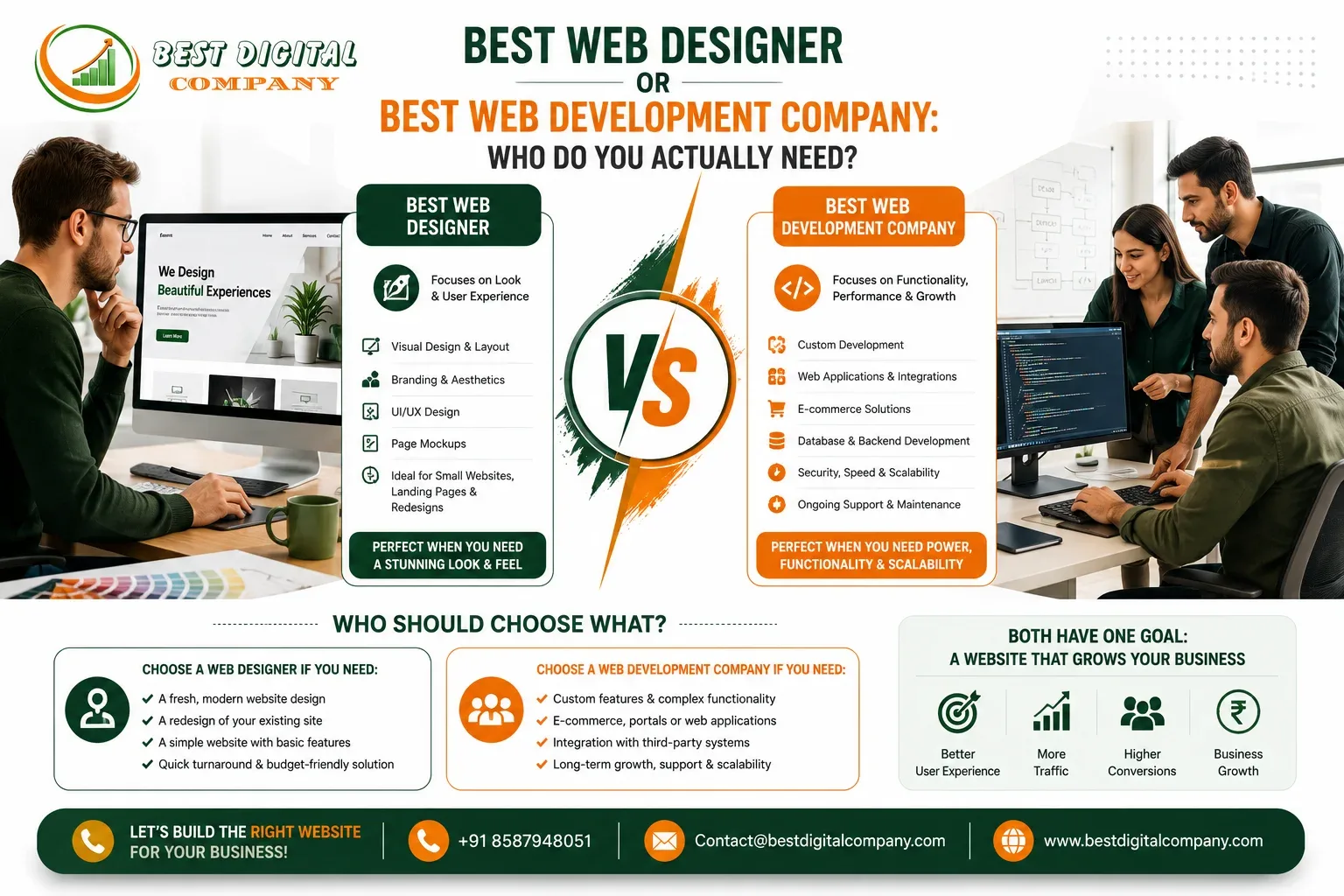
If you have ever typed “I need someone to build my website” into a search bar and then stared at a mix of freelancer portfolios, design studios, and full-scale agencies, you already know how confusing this decision can get. Some results promise stunning visuals. Others promise complete business systems bookings, payments, dashboards, the works. And somewhere in between, you are left wondering whether you actually need a best web designer or a best web development company.
This is not a trick question, and it is not something you should have to guess at. The two roles overlap, but they are not the same job wearing two different name tags. One is focused on how your site looks and feels. The other is focused on how your site works, scales, and survives contact with real customers, real traffic, and real business goals.
In this guide, we will break down exactly what each option is built for, where the line between them actually sits, what each one costs in time and money, and how to figure out without the sales pitch which one your project genuinely needs right now.
What Does a Web Designer Actually Do?
A web designer is, at their core, someone who shapes the visual and experiential layer of your website. Think of layout, color palettes, typography, spacing, imagery, and the overall “feel” a visitor gets in the first three seconds of landing on your homepage. A skilled designer thinks about hierarchy what a visitor sees first, second, and third and about how easy it is to find a phone number, a menu, or a “Buy Now” button without hunting for it.
A good web designer usually works with tools like Figma or Adobe XD to mock up pages before anything is built, and many can also implement their designs directly on platforms like WordPress, Shopify, or Wix using themes, page builders, or basic front-end code. Where they typically stop is at the boundary of custom functionality things like building a proprietary booking engine, integrating multiple payment gateways, creating a custom API, or architecting a database that needs to handle thousands of transactions a day.
This is not a limitation so much as a specialization. A designer’s job is to make your site look credible, feel intuitive, and reflect your brand accurately. If your website’s biggest challenge right now is that it looks outdated, feels cluttered, or does not represent your business well visually, a designer is often exactly the right fit.
What Does a Web Development Company Bring to the Table?
A web development company operates on a different scale entirely. Instead of one person handling design, content, and build, you typically get a team designers, front-end developers, back-end developers, a project manager, and sometimes a dedicated QA tester all working on your project in parallel.
This matters because real websites are rarely just “pretty pages.” They are systems. An e-commerce store needs inventory syncing, secure checkout, and shipping calculations. A service business might need appointment scheduling tied to a CRM. A growing company might need a custom dashboard, multi-language support, or an architecture built to handle a spike in traffic without crashing. This is the kind of work that sits squarely in the territory of a full web development team rather than a solo designer.
A capable web development company also thinks beyond launch day. They plan for security patches, server performance, SEO-friendly code structure, and future scalability the parts of a website that are invisible to visitors but decide whether your site still works smoothly a year from now, after three product launches and a traffic spike from a viral post.
Best Web Designer vs Best Web Development Company: Key Differences
It helps to lay this out plainly, because the marketing language from both sides can blur the distinction on purpose.
Scope of work: A designer focuses on layout, visuals, and user experience. A development company handles design plus the engineering databases, integrations, custom functionality, and infrastructure.
Team size: Designers are often solo freelancers or small two-person studios. A development company brings a coordinated team, which means work can happen on multiple fronts at once instead of one task at a time.
Ongoing support: Freelance designers may or may not offer maintenance after launch. Established companies typically build in hosting support, security updates, and technical troubleshooting as part of the relationship, not an afterthought.
Complexity ceiling: A designer can usually handle a template-based business site beautifully. Once you need custom logic — a marketplace, a booking system, a membership portal you are in development company territory, because that requires back-end engineering a design-only professional is not trained to build.
Accountability: If a freelancer becomes unavailable mid-project, you can be left stuck. A company structure means the work is not tied to one individual’s schedule or availability, which matters more than most business owners realize until it becomes a problem.
None of this makes one option “better” in absolute terms. It makes them suited to different jobs, the same way you would not hire an interior decorator to redo your plumbing, even though both work on the same house.
When You Actually Need a Best Web Designer
There are situations where a talented designer is genuinely the smarter, faster, and more cost-effective choice.
You are likely in designer territory if your website is a straightforward brochure-style site a handful of pages describing your business, services, and contact details, without custom logins, payment processing, or complex integrations. A local bakery, a boutique consulting practice, or a personal portfolio site usually falls here.
You also lean toward a designer if your existing site’s structure works fine but it simply looks dated, feels visually inconsistent with your brand, or is difficult to navigate. Sometimes a business does not need a rebuild from scratch it needs a redesign of the same pages, done properly, with better hierarchy and cleaner visuals.
Budget and timeline matter here too. A single designer, particularly one working from proven templates, can usually turn around a small site in a matter of weeks and at a lower cost than a full development build. If your needs are modest, paying for a full engineering team is often unnecessary overhead.
When You Need a Best Web Development Company
The calculation flips once your website has to do more than look good once it has to actually run parts of your business.
You need a development company if your site involves custom functionality: a booking calendar tied to real-time availability, a payment gateway processing multiple currencies, a user login system with different account permissions, or an API connection to a third-party tool like a CRM or inventory system.
E-commerce is one of the clearest examples. A store selling a handful of products off a simple template might get away with a designer. A store managing hundreds of SKUs, variable shipping rules, tax calculations across regions, and inventory syncing needs engineering, not just a nice layout.
Scale is another signal. If you are expecting rapid growth, heavy traffic, or plan to add features over time a blog, then a members’ area, then a mobile app a development company can architect the site so it grows with you instead of needing to be rebuilt every time you add something new. Our own team has walked several clients through exactly this kind of phased build, starting with a lean version 1 and expanding it as the business scaled, which is far cheaper than starting over.
Security and compliance also push businesses toward a company structure. If you are handling sensitive customer data, payment details, or operate in a regulated industry, you want a team that understands secure architecture, not just visual polish.
What Does Each Option Actually Cost?
Cost is where a lot of confusion creeps in, mostly because “web design” and “web development” get quoted so differently depending on who you ask.
A freelance designer working on a template-based small business site might charge anywhere from a modest flat fee to a few thousand rupees for a handful of pages, depending on experience and customization level. It is a lighter investment, and for a simple site, that is entirely reasonable.
A full development company project costs more upfront because you are paying for a team’s time, not one person’s design, coding, testing, and project management across the timeline. But that higher cost typically buys you fewer surprises later: fewer bugs, better performance under real traffic, and a structure that does not need a costly overhaul the moment you want to add a new feature.
We have written in detail about how these numbers actually break down in practice, including where agencies and freelancers differ in what they include versus what they quietly leave out. It is worth a full read if you want the real math before requesting quotes: Website Developer Company or Freelancer? An Honest Cost & Risk Comparison. We have also mapped out exactly what tends to be included in a standard build versus what typically comes as an add-on cost in our piece on Website Development Services: What’s Included and What Costs Extra.
Signs You Have Outgrown a Freelance Designer
Even businesses that started with a designer often reach a point where the relationship stops fitting the need. A few signals worth paying attention to:
You keep asking for “one more feature” and the answers keep involving third-party plugins stacked on top of each other, slowing the site down. You are getting more traffic than the site was built to handle, and pages are loading slower than they used to. You need integrations — a CRM, a payment processor, an inventory system and your designer is recommending workarounds rather than clean solutions. Or your single point of contact has become a bottleneck: they are busy with other clients, slow to respond, or unavailable for weeks at a time while your business needs updates now.
None of this means your original designer did bad work. It usually means your business has grown past what a template-and-plugin approach was ever meant to support, and it is time to bring in engineering depth.
How to Choose the Best Web Development Company in 2026
If you have concluded that your project needs a full team rather than a solo designer, the next challenge is picking the right one. A few things genuinely separate a solid partner from a risky bet.
Ask to see real, live projects not just mockups. Anyone can show a polished design file. What matters is whether their past sites still run well months or years later. Check load speed, mobile responsiveness, and whether the site still looks maintained.
Ask who handles what after launch. Some companies disappear the moment the invoice clears. Others include ongoing support, security patching, and troubleshooting. Get this in writing before you sign anything.
Ask about their process for custom functionality. A company that immediately jumps to “we’ll just install a plugin for that” for every complex request may not have genuine development depth. You want a team that can explain, in plain language, how they would actually build the feature you need.
Ask how they think about SEO and structure from day one. A beautifully designed site that search engines cannot read properly is a wasted investment. Development and search engine optimization should not be treated as separate conversations — clean code, fast load times, and proper site structure are foundational to both.
We have gone deeper into this exact selection process, including the specific questions to ask before signing a contract, in Website Development Services: How to Pick the Best Web Designing Company in 2026.
Why Businesses Are Increasingly Choosing Full-Service Partners
There is a broader shift happening among small and mid-sized businesses: rather than hiring a designer for the site, a separate freelancer for SEO, another for ads, and yet another for social media, more businesses are consolidating with a single partner who understands how all these pieces connect.
The logic is straightforward. A site built without SEO in mind often needs expensive rework later to rank well. A beautiful site with zero traffic strategy behind it does not generate leads on its own — that usually requires pay per click campaigns or organic search visibility working alongside it. And a site that is not connected to a consistent social media marketing presence often struggles to build the kind of brand recognition that turns first-time visitors into repeat customers.
This does not mean every business needs to bundle everything at once. It means it is worth thinking about your website as one piece of a larger growth system rather than an isolated project, and choosing a partner who can either handle that system directly or coordinate cleanly with whoever else you are working with. If you are also cleaning up or restructuring an older website as part of this process, it is worth reading our take on Content Pruning: Why Deleting Pages Can Improve SEO before your redesign goes live, since a rebuild is the ideal moment to trim what is not working.
Making the Final Call
If you strip away the sales language, the decision usually comes down to one honest question: does your website need to look right, or does it need to run something?
If the answer is “look right” a clean, credible, well-organized presence for a straightforward business a talented web designer can deliver exactly that, often faster and at a lower cost than a full build. If the answer involves custom functionality, integrations, scalability, or handling sensitive data, you are better served by a full web development team that can engineer the back end properly and support it long after launch.
Whichever path fits your business, the goal is the same: a site that represents you accurately, works reliably, and grows with you instead of becoming another thing you have to rebuild in eighteen months. If you want a second opinion on where your specific project falls, our team is happy to walk through your requirements and give you a straight answer, not just a quote. You can see our full range of build options on our web development packages page.
Frequently Asked Questions
Is a web designer cheaper than a web development company?
Generally, yes, for straightforward projects. A designer working with templates and existing platforms typically charges less because the work involves fewer moving parts no custom back-end coding, no database architecture, no complex integrations. The moment your project needs custom functionality, though, the cost gap narrows quickly, because a designer will often need to bring in a developer anyway, sometimes at a higher combined cost than hiring a development company directly.
Can a web designer build an e-commerce store?
A designer can build a simple store using an existing platform like Shopify with standard features. However, once you need custom checkout logic, multi-currency support, advanced inventory management, or integrations with external systems, that work moves into development territory and typically requires a team with back-end engineering experience.
How long does it take to build a website with a development company versus a freelance designer?
A simple designer-led site can often be completed in a few weeks. A full development build, depending on complexity, can take anywhere from six weeks to several months, since it involves design, coding, testing, and revisions across multiple stages rather than a single linear process.
Do I need a web development company if I am just starting my business?
Not necessarily. Many businesses launch successfully with a designer-built site and scale up to a full development partner once their needs become more complex — additional features, higher traffic, or new integrations. Starting lean and upgrading later is often a smarter financial decision than over-building on day one.
What should I look for before hiring either option?
Ask to see live examples of past work, not just design mockups. Confirm what happens after launch who fixes bugs, who handles hosting issues, and whether ongoing support is included. And make sure whoever you hire understands how design, functionality, and search visibility work together, rather than treating your website as a one-time visual project.
Can I switch from a freelance designer to a development company later?
Yes, and it is a common path. Many businesses start with a designer for their first website and move to a development company once they need custom features, higher performance, or a scalable structure. A good development team can usually assess an existing site and rebuild or extend it rather than starting completely from zero, though the amount of reusable work depends on how the original site was built.

Add a Comment