

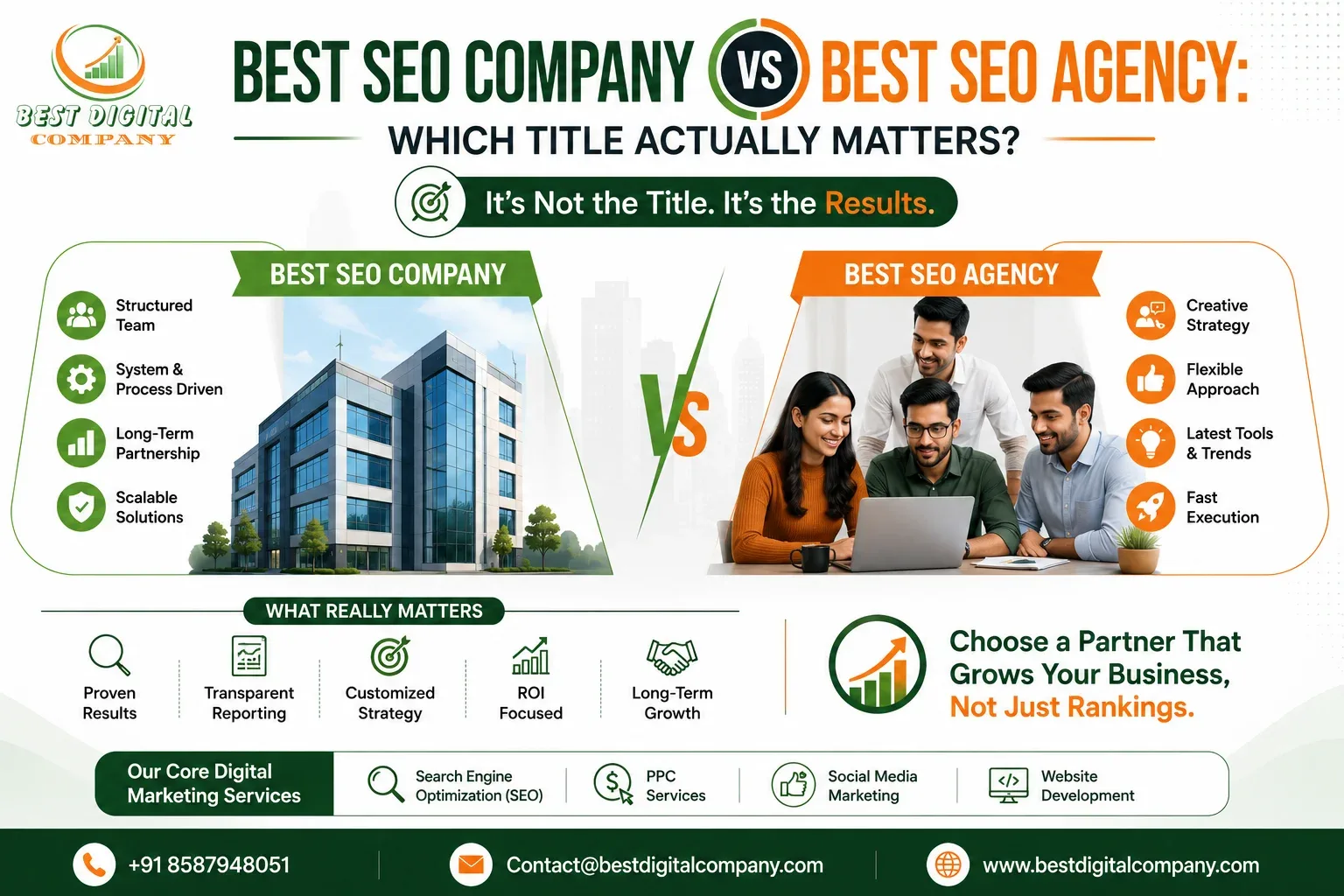
A client called us last month with a strange question. She had shortlisted three vendors for her website’s rankings project. One called itself the best SEO company in its city. Another described itself as the best SEO agency for growing brands. The third just said “SEO experts” and left it at that. Her question was simple: does the label on the homepage actually tell you anything about the work you’ll get?
It is a fair question, and one we get asked more often than you’d think. Business owners spend hours comparing pricing sheets, reading testimonials, and scrolling through portfolios, but very few stop to ask whether the words “company” and “agency” carry any real weight. So let’s settle it properly, without the jargon, using what we’ve actually seen work (and fail) across dozens of client projects.
What Do “Best SEO Company” and “Best SEO Agency” Really Mean?
Strip away the marketing gloss, and both phrases describe the same basic thing: a team of people who get paid to improve how a website performs in search results. There’s no legal registry that decides who qualifies as a “company” versus an “agency.” A one-person freelance setup can legally call itself a company. A twenty-person team with account managers, strategists, and writers can call itself an agency, or vice versa. The words are self-assigned, not government-issued.
What actually separates one provider from another isn’t the noun in their name. It is the structure behind the work: how the team is organized, what processes they follow, how they report progress, and whether they treat your business as a long-term relationship or a one-time transaction. We’ve written more on this exact distinction in our post on SEO agency vs SEO company: is there really a difference, which digs into the operational side. This piece takes a different angle. We are looking specifically at why the title itself keeps showing up in search queries, and whether chasing that title is a smart way to shortlist a partner.
Why Business Owners Search for a Best SEO Company Before Signing a Contract
People type “best SEO company” into Google for a reason that has very little to do with grammar. They are trying to reduce risk. Hiring someone to handle your website’s visibility feels like handing over the keys to your storefront if it goes wrong, you lose customers, not just money. So the word “best” becomes a shortcut for “safe,” “proven,” or “won’t disappear after the first invoice.”
The problem is that this search habit rewards marketing copy, not necessarily capability. A provider that has invested in a polished website and consistent content will rank higher for that phrase than one that’s simply better at the actual work. This is exactly why we always tell prospective clients to look past the headline and into the substance: case studies with real numbers, a documented process for search engine optimization, and clarity on what’s included at each pricing tier through something like a published SEO packages page. If a provider is transparent enough to show you exactly what you’re paying for before you even ask, that’s a stronger signal than any self-awarded title.
What Makes an SEO Agency Earn the Word “Best” Instead of Just Claiming It
If the title is self-assigned, how does anyone actually earn the description “best SEO agency”? In our experience working with clients across different industries, three things tend to separate the agencies that deserve the label from the ones that just print it on a banner.
First, they can explain their reasoning, not just their results. Anyone can show you a graph where traffic went up. Fewer providers can walk you through why it went up which pages were optimized, which keywords were targeted, and which technical issues were fixed first. When a team can explain their decisions in plain language, it usually means they understand the work rather than following a template.
Second, they adapt the strategy to the business, not the other way around. A restaurant in one neighborhood and a B2B software company have almost nothing in common in terms of what “good SEO” looks like. A provider chasing the “best agency” label with a one-size-fits-all package is optimizing for their own delivery speed, not your outcome.
Third, they treat local relevance as part of the strategy, not an afterthought. If your customers are searching from a specific city or region, generic national tactics rarely move the needle. This is where services like local SEO in Delhi or region-specific work such as SEO services in Punjab and SEO services in Haryana matter a genuinely capable agency builds location intent into the plan instead of bolting it on later.
Company vs Agency: Does the Title Change the Service You Get?
Short answer: not by itself. Longer answer: the title can hint at internal structure, but it’s not a reliable predictor.
Providers who lean on the word “company” sometimes emphasize process, documentation, and predictable deliverables think monthly reports, fixed scopes, and clear timelines. Providers who lean on “agency” sometimes emphasize creative strategy, campaign thinking, and closer collaboration with your marketing team. But these are tendencies, not rules. We’ve seen tightly-run “agencies” with better reporting discipline than some self-described “companies,” and we’ve seen the reverse just as often.
We covered this operational comparison in detail in SEO agency vs SEO company: is there really a difference worth a read if you want the nuts-and-bolts version. The short version for this article: judge the contract, the team you’ll actually work with, and the reporting cadence. Don’t judge the noun on the homepage.
Signs You are Looking at a Genuinely Strong SEO Partner, Not Just a Cheap Vendor
Price is usually the first filter people apply, and it is understandable budgets are real. But price alone tells you almost nothing about quality. Here are signals we’d actually trust, based on what tends to separate strong partners from ones that underdeliver:
- They ask about your business before quoting a number. A provider that sends a price within minutes of your first message, without asking what you sell, who your customers are, or what “success” looks like for you, is pricing a generic package, not your situation.
- They are upfront about timelines. Genuine search engine optimization work takes months to show compounding results. Anyone promising page-one rankings in two weeks is either exaggerating or planning to use tactics that risk a penalty later.
- They can show you work for a business similar to yours. Not identical similar in scale and market. A provider that’s only ever worked with e-commerce brands might not have the right playbook for a local service business, and vice versa.
- They explain content decisions, not just technical ones. Search visibility today depends heavily on whether your content actually answers what people are searching for. If a provider only talks about backlinks and meta tags and never mentions the quality or usefulness of your content, that’s a gap worth asking about.
- Their own site practices what it preaches. If a provider’s website has SEO service in Delhi or similar pages that are genuinely well-structured, load fast, and read like they were written for humans first, that’s a small but honest signal about how they’ll treat your project.
How Experience and Real Expertise Separate a Strong Partner From the Rest
This is where the conversation moves past labels entirely. What actually protects your investment isn’t whether a provider calls itself a company or an agency. It is whether the people doing the work have genuine, demonstrable experience.
Ask direct questions: How long has this team been running search campaigns? What industries have they worked across? Who specifically will be handling your account a senior strategist or a junior executive learning on your budget? A provider that answers these questions clearly, and is willing to introduce you to the actual person managing your account, is operating with a level of transparency that self-titled “bests” rarely bother with.
We’ve built our own approach around this idea. You can read more about our background and how our team is structured on our About Us page. We’d rather a prospective client judge us on that than on any adjective in our name.
Trustworthiness also shows up in smaller, easy-to-check details: does the provider have a real, physical presence rather than just a domain name? Do they answer questions honestly, including telling you when something won’t work for your business? Do their past clients confirm what the case studies claim? None of this requires you to decode the difference between “company” and “agency” it just requires you to ask a few direct questions and pay attention to how honestly they’re answered.
Beyond Search Visibility: Why the Best Digital Partner Rarely Does Just One Thing
Here’s something that gets missed in the company-versus-agency debate: search visibility rarely operates in isolation anymore. A business that only improves its rankings but ignores everything else in its digital presence often plateaus quickly.
Paid visibility, for instance, works alongside organic growth rather than competing with it. If you’re comparing providers, it’s worth checking whether they also offer Pay Per Click management, and whether they can explain how the two strategies support each other instead of running as separate, disconnected efforts. We broke down what a paid campaign actually involves month to month in PPC services explained: what a performance marketing agency really does every month, and how to evaluate providers for that specific service in how to choose the best PPC company for your business.
The same logic applies to your social presence. Search rankings and social engagement influence each other more than most business owners realize brand searches, referral traffic, and content sharing all play a role. If audience engagement matters to your growth, it’s worth reading likes don’t pay the bills: how to pick a social media marketing agency that actually grows sales alongside your evaluation of anysocial media marketing provider.
And none of this matters if the website itself is slow, poorly structured, or hard to navigate. Rankings can only send visitors to a page that’s actually built to convert them. That is why website development is often the quiet foundation underneath every SEO conversation. We’ve written about this exact trade-off in website developer company or freelancer: an honest cost and risk comparison and in website development services: how to pick the best web designing company, both worth reading if your site needs work alongside your search strategy.
Red Flags: Titles That Sound Impressive but Mean Nothing
A few warning signs worth flagging, because they show up constantly in this industry:
- Guaranteed rankings. No provider controls how search engines rank pages. Anyone promising a specific position by a specific date is either overpromising or planning shortcuts that could hurt your site later.
- Vague reporting. If monthly updates are just screenshots of a dashboard with no explanation, you’re not getting a partner you are getting a subscription.
- No mention of content quality. A provider fixated only on technical fixes and backlinks, with no plan for the actual words on your pages, is missing the part of the strategy that increasingly determines whether a page performs well at all.
- Recycled proposals. If the strategy document they send you could apply to literally any business in any industry, it probably was written for exactly that purpose.
- A portfolio with no verifiable clients. Case studies with blurred names, unnamed “confidential clients” across the board, or stock-photo testimonials deserve extra scrutiny.
None of these red flags have anything to do with whether the provider calls itself a company or an agency. They are about substance, and substance is genuinely checkable if you ask the right questions.
How to Actually Evaluate a Provider, Regardless of What They Call Themselves
If you are currently comparing options, here’s a practical sequence that tends to work better than searching for a title:
- List what you actually need. Is it purely organic visibility, or do you also need paid campaigns, social management, or a website rebuild? Clarity here prevents you from being upsold on services you don’t need.
- Ask for a strategy specific to your business, not a generic package. If they can’t produce one without weeks of “discovery calls” and payment upfront, be cautious.
- Request references, not just testimonials. A quick call with an existing client tells you more than any homepage badge.
- Clarify who does the actual work. Some providers sell you on senior expertise, then hand your account to someone with far less experience.
- Check their reporting sample. Ask to see an anonymized version of a monthly report before signing anything.
- Compare pricing structures honestly, using something like our breakdown in SEO services vs SEO packages: what should you actually pay for as a reference point for what reasonable inclusions look like.
This process takes an extra hour or two, but it protects a budget that will otherwise run for months before you find out whether it was working.
Our Take: Does the Title Actually Matter?
Honestly, no not in the way most people assume. The word on the homepage tells you how a provider wants to be perceived, not how they’ll actually perform. What matters is the evidence behind the claim: real client history, a documented process, honest communication about timelines, and a team willing to explain their thinking instead of hiding behind jargon.
If there’s one thing worth taking from this article, it’s this: stop searching for the “best” title and start searching for proof. Ask for it directly. Any provider confident in their own work will hand it over without hesitation.
Frequently Asked Questions
Is there an official difference between an SEO company and an SEO agency?
No. Neither term is regulated or legally defined. Businesses choose whichever word fits their branding, so the label alone doesn’t indicate size, quality, or specialization.
How can I tell if a provider genuinely deserves to be called the best in their field?
Look at documented case studies with real numbers, ask for client references you can actually contact, and request a strategy tailored to your business rather than a generic package. Providers confident in their work rarely hesitate to share this information.
Should I choose based on price or experience?
Experience should weigh more heavily. A cheaper option that lacks a clear process often costs more in the long run through wasted months, missed opportunities, or corrective work needed after ineffective tactics.
Does hiring one provider for search visibility, paid ads, and social media together make sense?
Often, yes. These channels influence each other, and a team that coordinates all three tends to produce more consistent results than juggling separate vendors who don’t communicate with each other.
How long does it typically take to see results from an SEO campaign?
Meaningful, sustainable improvement usually takes a few months, depending on the competitiveness of your industry and the starting condition of your website. Anyone promising results within days should be questioned carefully.
What is the single biggest mistake businesses make when hiring an SEO partner?
Choosing based on the lowest price or the most polished-sounding title, without asking to see how the provider actually works, reports progress, and adapts strategy to different types of businesses.
Looking for a team that’s more focused on results than on titles?
Get in touch with us and we will walk you through exactly how we’d approach your website no generic packages, no guarantees we can’t back up.

Add a Comment