

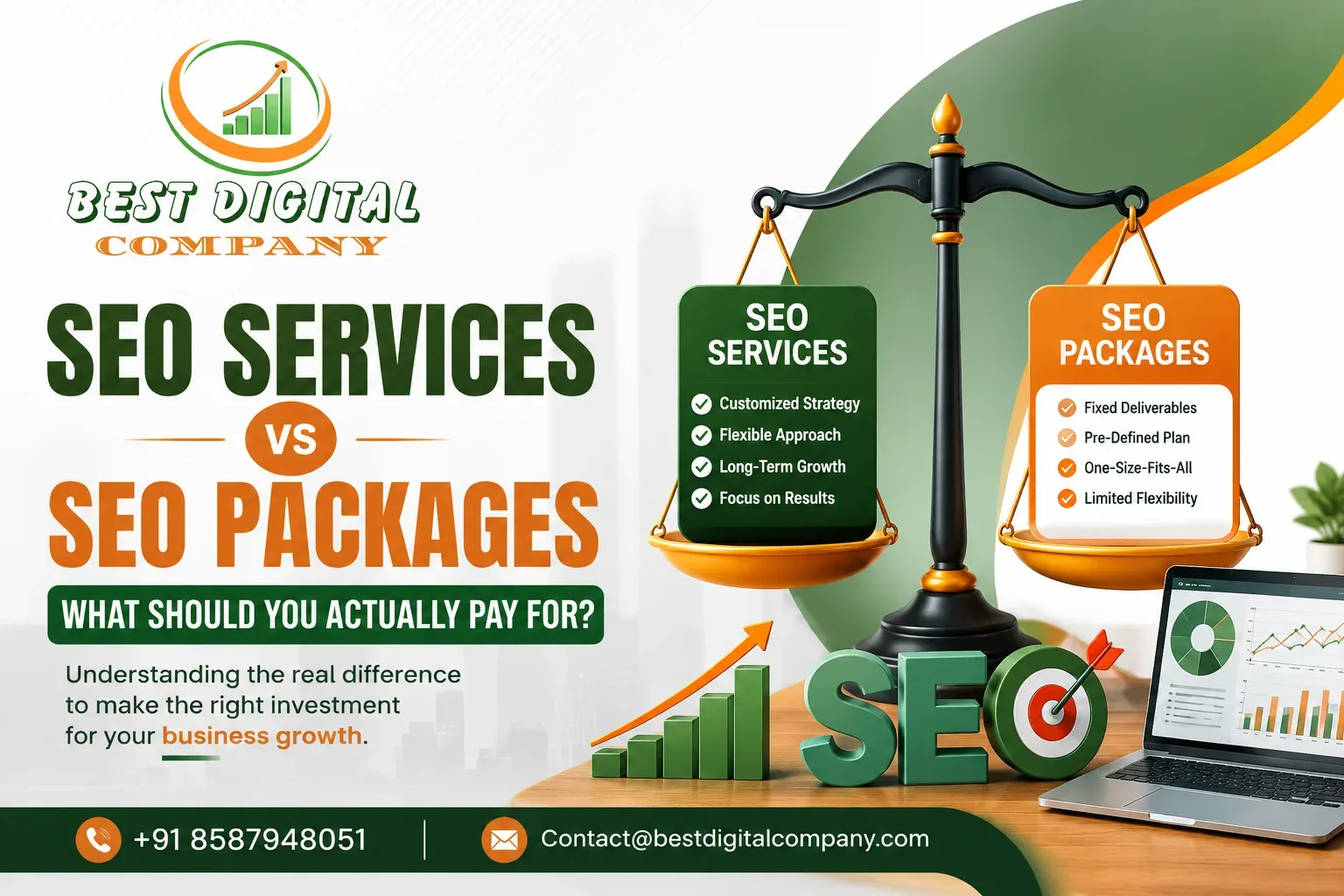
If you have spent any time getting quotes from digital marketing agencies, you have probably run into two very different sales pitches. One agency wants to sit down, understand your business, and build a plan around it. Another hands you a laminated sheet with “Silver, Gold, and Platinum” tiers and asks which one fits your budget. Both call what they sell SEO. Both promise rankings, traffic, and leads. But underneath the surface, they are not the same thing at all.
This confusion costs business owners real money. Some end up locked into a rigid package that never adjusts to what their website actually needs. Others pay premium rates for “custom” work that turns out to be a copy-paste template with their business name swapped in. Before you sign anything, it helps to understand what you are really being sold, what a fair price looks like, and how to tell a genuine growth partner from a template factory.
What Are SEO Services, Really?
At its core, search engine optimization is the practice of improving a website so that search engines can understand it, trust it, and show it to the right people. When an agency talks about SEO services, they usually mean an ongoing, needs-based engagement built around your specific website, industry, and competitors.
A proper SEO service typically starts with a technical and content audit of your site, followed by a strategy that covers keyword research, on-page optimization, content creation, link building, and regular performance reporting. No two audits look the same because no two websites have the same problems. A ten-page local business site and a five-hundred-page e-commerce store need completely different roadmaps, even if both fall under the umbrella of search engine optimization.
The advantage of a service-based model is flexibility. If your website has a duplicate content problem this month and a backlink gap next month, the strategy shifts to match. There is no fixed checklist being applied regardless of what your site actually needs. This is also where the depth of an agency’s process shows. If you want to see how a serious audit process should work before committing to anyone, our guide on how to choose the best SEO company walks through the exact questions to ask during that first consultation.
What Are SEO Packages, and Why Do Agencies Sell Them?
An SEO package is a pre-built bundle of deliverables sold at a fixed price, usually organized into tiers like Basic, Standard, and Premium. A typical package might promise a set number of keywords, a set number of blog posts per month, a certain number of backlinks, and a monthly report, all for a flat fee.
Packages exist because they make pricing predictable and sales conversations easier. A prospect can compare three price points side by side and pick one without a lengthy discovery call. For agencies managing dozens of clients, standardized packages also make internal workflows simpler to run at scale.
The problem is that search engines do not care about your package tier. A brand-new website with almost no online presence and a ten-year-old website with thin, outdated content are not comparable, yet a rigid package often treats them identically because the deliverable list stays the same regardless of the starting point. If you want to see this in practice, our page on SEO packages breaks down what is typically included at each tier and where the line between “helpful bundle” and “one-size-fits-none template” usually sits.
The Core Difference: Customization vs Convenience
The real distinction between the two comes down to whether the strategy is built around your website or around the agency’s internal production line.
Service-based SEO is diagnostic first. The agency looks at your analytics, your search console data, your competitors, and your current rankings before recommending anything. Package-based SEO is prescriptive first. The scope is decided before anyone has looked at your site, because the package was designed to be sold to hundreds of different businesses without modification.
Neither approach is automatically bad. A well-designed package can work fine for a small, straightforward local business that just needs the basics done consistently. A poorly run custom service can waste months on strategy meetings with little actual execution. What matters is matching the model to your situation, and being honest with yourself about how much oversight and customization your website genuinely requires.
When Affordable SEO Services Make Sense
Cost is usually the first question business owners ask, and it is a fair one. Affordable SEO services are not automatically a red flag, but the word “affordable” needs context. A reasonable, lower-cost engagement for a small local business with a handful of pages and modest competition looks nothing like a reasonable price for a national e-commerce brand competing against established players.
Affordable SEO services tend to work best when the scope is honestly matched to the price. If an agency is charging a modest monthly fee for a small local business, focused on core on-page fixes, a handful of high-intent local keywords, and one or two pieces of content a month, that can be a genuinely good deal. Problems start when “affordable” is used to disguise a stripped-down, automated process dressed up as a full strategy, or when a suspiciously low price comes with vague reporting and no clear explanation of what work was actually done.
Before choosing based on price alone, ask what specifically is included at that price point, how results are measured, and how often you will get a report you can actually understand rather than a spreadsheet full of jargon. If you have ever received a report you couldn’t make sense of, our post on creating an SEO report clients actually understand shows what transparent, plain-language reporting should look like, regardless of what you are paying.
When a Fixed SEO Package Makes Sense
A structured package can be the right call in a few specific situations. If you are a small business owner with a limited budget who wants predictable monthly costs without surprise invoices, a package gives you that certainty. If your website is relatively new and needs the fundamentals covered, on-page optimization, basic technical fixes, a handful of relevant blog posts, a package can cover the essentials without you having to negotiate scope every month.
Packages also work well when your goals are narrow and local. A neighborhood clinic, a single-location restaurant, or a regional service provider often does not need an elaborate, constantly shifting national strategy. They need consistent, focused work around a defined set of local search terms. In that case, a package built around local optimization can be more efficient than an open-ended custom engagement. This is exactly the kind of scenario where a focused offering like local SEO in Delhi makes more sense than a sprawling enterprise strategy, because the goal is narrow and the deliverables can reasonably stay fixed month to month.
The trade-off to keep in mind is flexibility. If your business grows quickly, expands into new markets, or launches new product lines, a rigid package may not scale with you without upgrading tiers, and upgrading often means renegotiating the whole contract.
Hidden Costs to Watch For in Both Models
Whether you go with a service or a package, certain hidden costs show up again and again, and business owners rarely ask about them upfront.
Content production is one of the biggest. Many packages advertise “X blog posts per month” without specifying word count, research depth, or whether the content is written by a person familiar with your industry or generated with minimal editing. Thin, generic content rarely moves rankings and can actually work against you.
Link building is another area worth scrutinizing. Some cheaper packages count low-quality directory submissions or spammy guest posts as “backlinks,” which can do more harm than good over time. Ask specifically what kind of links are being built and from what type of sites.
Technical work is often underpriced or skipped entirely in low-cost packages. Site speed issues, broken internal links, missing structured data, and crawl errors need to be found and fixed, and this kind of work is easy for an agency to quietly ignore because it does not show up in a simple checklist. If your website has accumulated years of outdated or thin content, it is also worth asking whether the agency will recommend pruning some of it. Our article on content pruning and why deleting pages can improve SEO explains why more content is not always better, and why a good strategy sometimes means removing pages rather than adding them.
Finally, ask about contract length and cancellation terms for both models. Long lock-in periods with no clear exit clause are worth questioning regardless of whether you are buying a service or a package.
How to Decide What Fits Your Business
A useful way to make this decision is to be honest about three things: your budget, the complexity of your website, and how hands-on you want to be in the process.
If your budget is tight, your website is simple, and you mainly want steady, predictable local visibility, a well-scoped package is a reasonable starting point. If your website is complex, your competition is aggressive, or your business changes shape frequently with new locations, products, or campaigns, a flexible, service-based engagement will likely serve you better even if it costs more upfront.
It also helps to ask any agency you are evaluating how they measure success beyond rankings alone. Rankings for the wrong keywords do not pay bills; qualified traffic and leads do. A capable partner should be able to explain, in plain terms, how they track visibility using tools like Google Search Console and connect that data back to actual business outcomes. If that phrase sounds unfamiliar, our beginner’s guide to Google Search Console is a good starting point before your next conversation with an agency, so you can ask informed questions instead of taking their word for it.
Why Working With an Experienced SEO Company Matters
Whether you end up choosing custom services or a structured package, the deciding factor is rarely the label on the pricing page. It is the experience, transparency, and consistency of the team doing the work. Search engines increasingly reward websites that demonstrate genuine expertise and trustworthiness, and that same standard should apply to the agency you choose to work with.
A trustworthy agency will be upfront about timelines and will not promise page-one rankings in two weeks. They will show you real examples of past work, explain their process in plain language, and adjust their approach as your website and competitors change. This is also closely tied to how Google evaluates content quality on your own site. If you want to understand the standard your website is actually being measured against, our guide on improving EEAT for better Google rankings explains why experience and trustworthiness now matter as much as keyword placement.
It is also worth remembering that search engine optimization does not operate in isolation. A site that ranks well but converts poorly still needs work on user experience and page performance, which is why SEO is often paired with website development and design improvements, and businesses that want faster, more immediate visibility alongside organic growth sometimes combine SEO with pay per click advertising to cover both the short and long term. If your growth plan also includes building an audience on social platforms, it is worth reading about how a social media marketing agency can complement organic search rather than compete with it for budget.
Search behavior itself is also shifting. More answers now show up directly without a click, and AI-driven search tools are changing how people discover businesses altogether. Our posts on zero-click searches and generative engine optimization explain how these changes affect visibility, and why an agency that only optimizes for traditional rankings may already be behind. Whatever model you choose, the agency you work with should be actively adapting to these shifts, not selling you the same package they were selling three years ago.
Making the Final Call
There is no universally correct answer to whether you should buy a service or a package. What matters is transparency. Before signing with anyone, ask exactly what is included, how progress will be measured, how content and links will be created, and what happens if your business needs change halfway through the contract. A good agency, whether they call their offering a service or a package, will answer these questions clearly and without hesitation.
If you are still building your first customer base and searching for a starting point, our guide on how small businesses can get their first 100 customers is a useful companion piece, since organic search is rarely the only channel that matters in the early stages of growth.
If you would like a straightforward assessment of what your website actually needs before choosing between a service or a package, our team is happy to walk through it with you. You can explore our full range of search engine optimization offerings or reach out directly for a no-pressure conversation about what would genuinely work for your business.
Frequently Asked Questions
Is it better to buy SEO services or an SEO package?
It depends on your website’s complexity and how often your business changes. Custom services suit businesses with larger, evolving websites or aggressive competition, while a package works well for smaller, local businesses that need consistent, predictable work each month.
How much do affordable SEO services usually cost?
Pricing varies widely by market, industry, and competition level, so there is no single fair number. What matters more than the price itself is whether the scope of work, reporting, and communication match what you are being charged. Always ask for a breakdown of exactly what is included before comparing prices across agencies.
Can affordable SEO services still deliver real results?
Yes, as long as the scope is honestly matched to the price and the strategy is built around your actual website rather than a generic template. Affordable does not have to mean low quality; it simply means the deliverables should be scaled sensibly to fit the budget.
How long does it take to see results from SEO?
Most legitimate campaigns start showing measurable movement in three to six months, with more significant results building over six to twelve months. Anyone promising guaranteed rankings within a few weeks is not being realistic with you.
What should I look for in an SEO package before signing up?
Ask about content quality and word counts, the type of backlinks being built, how technical issues are identified and fixed, reporting frequency, and contract length. A package with vague deliverables and no clear reporting process is a warning sign regardless of price.
Can I switch from a package to custom SEO services later?
Yes, and many businesses do exactly this as they grow. Starting with a package to cover the basics and moving to a more customized service once your website and goals become more complex is a common and sensible path.

Add a Comment