

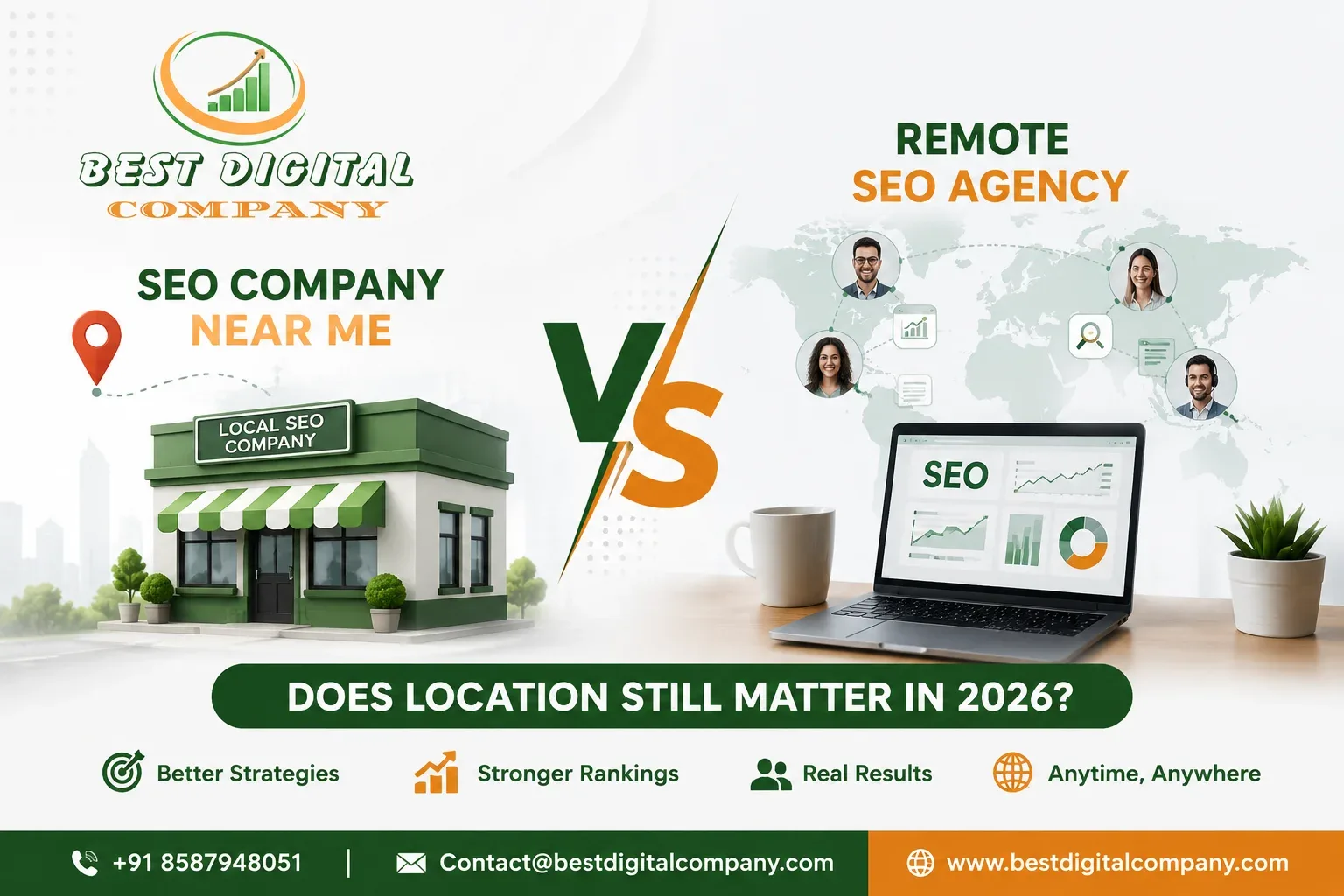
Type “SEO company near me” into Google and watch the map pack load before the text results even settle. That little moment says a lot about how most business owners still think about hiring help for their rankings find someone close, shake a hand, trust the accent. Then scroll a little further and you will see agencies from three states away, sometimes three countries away, pitching the exact same promises for half the price.
So which one actually works in 2026? Is proximity still a real advantage, or is it a habit left over from a time before video calls and shared dashboards? This article breaks down what changed, what did not, and how to choose between a local SEO company and a remote SEO agency without guessing.
Why “Near Me” Searches Still Exist for SEO Services
Before deciding whether location matters, it helps to understand why the search behavior persists in the first place. Business owners search for nearby options for a handful of very human reasons, not because remote work is unreliable.
Trust builds faster in person. Meeting someone across a table, seeing their office, shaking hands after a pitch — these still shortcut the trust-building process for a lot of buyers, especially those who were burned once by a vendor they never actually saw.
Local market knowledge feels reassuring. A shop owner in Delhi assumes a nearby agency automatically understands Delhi’s competitive landscape, local search behavior, and even which festivals or seasons move foot traffic.
Accountability feels closer. If a project goes sideways, some owners simply feel safer knowing they could walk into an office and ask what happened.
None of these reasons are wrong. They are just increasingly separate from whether an agency can actually deliver results. Skill, process, and communication now matter more than a shared postal code, and that shift is exactly what this article unpacks.
What a Local SEO Company Actually Offers
A local SEO company brings a few genuine, practical advantages not myths, just advantages with limits.
Familiarity With Regional Search Behavior
An agency working daily with businesses in your city develops an intuitive feel for how people in that region search. They notice patterns: which neighborhoods get typed into queries, which local directories carry weight, and how competitors in the same market are positioning themselves. This is one of the few areas where being local genuinely helps, particularly for businesses that depend heavily on foot traffic or hyperlocal visibility, which is why local SEO services remain a distinct offering rather than something folded into general optimization work.
Easier In-Person Collaboration
For businesses that prefer whiteboard sessions over shared screens, a local team removes friction. Photoshoots, on-site audits of a physical store, or a quick walk-through of a warehouse for a logistics client are simpler when the agency can just show up.
Community and Industry Connections
Long-standing local agencies often have relationships with regional press, business associations, and directories that can support digital PR and link-building efforts specific to that geography.
The Limits of “Local”
Here’s the part most local pitches leave out: none of the above has anything to do with whether the team actually understands technical optimization, content strategy, or how a modern algorithm evaluates a website. A company can be five minutes from your office and still run outdated tactics, and a company on the other side of the country can be deeply embedded in your local market data without ever setting foot there. Proximity is a convenience, not a qualification.
What a Remote SEO Agency Brings to the Table
Remote agencies have gone from a fallback option to, in many cases, the default choice for growing businesses. A few reasons explain why.
Access to Specialized Talent
A local market might only have a handful of agencies to choose from, and not all of them will have deep technical expertise. Going remote opens the door to teams that specialize narrowly — technical audits, content strategy, e-commerce optimization — instead of settling for generalists simply because they are nearby.
Better Pricing Without Cutting Corners
Agencies operating outside expensive metro overheads can often price more competitively while still running the same processes as their big-city counterparts. This isn’t about hunting for the cheapest possible option; it’s about not paying a premium purely for a downtown office address.
Proven Systems Over Personal Relationships
Established remote teams tend to rely on structured reporting, shared dashboards, defined communication schedules, and documented processes because they have to there’s no hallway conversation to fill the gaps. That structure often results in clearer accountability than a handshake-based local relationship.
Round-the-Clock Workflows
Some remote agencies operate across time zones, meaning technical work, content production, and monitoring can continue outside standard business hours, which can compress project timelines.
Does Google Care Where Your SEO Company Is Based?
This is the question that actually matters, and the honest answer is: no, not even a little. Search engines evaluate a website based on its content quality, technical health, backlink profile, user experience, and relevance to a query not the mailing address of the marketing team that worked on it. A ranking algorithm has no mechanism for checking where the agency’s office sits.
What does matter, heavily, is whether the business itself has accurate location signals if it depends on local customers a correct business listing, consistent name-address-phone details, and location-relevant content. But that is about the client’s own presence, not the vendor’s headquarters. An agency in another city can build and manage those local signals just as effectively as one next door, provided they know what they’re doing. The confusion between “my agency should be local” and “my business needs to look local” is where most of this myth comes from.
SEO Company vs SEO Services: What You are Really Comparing
Part of the location debate gets murky because people conflate two different decisions: choosing a company to hire, and understanding the services they need. It helps to separate them.
SEO company refers to who does the work their team, their processes, their communication style, their track record. SEO services refers to what gets delivered technical audits, on-page optimization, content development, link building, local listings management, and ongoing reporting. Location might occasionally influence the first (accessibility, familiarity, in-person meetings). It has almost no bearing on the second. A well-run SEO services package should look structurally similar whether the team sits across the street or across an ocean: audits, keyword strategy, content, technical fixes, and transparent reporting on progress. If a vendor cannot clearly explain what specific services are included in your package regardless of where they’re based, that’s a bigger red flag than their office location. This distinction is also explored in more detail in SEO agency vs SEO company, which digs into how these two terms often get used interchangeably even though they describe different things.
Communication: The Real Deciding Factor in 2026
If location itself is mostly irrelevant, what actually predicts whether a client-agency relationship works? Communication quality, consistently, across both local and remote setups.
A local agency with poor reporting habits and vague monthly updates will frustrate a client just as much as a remote one that goes quiet for weeks. Conversely, a remote agency running structured weekly check-ins, clear dashboards, and documented milestones can feel more present than a nearby office that only sends a generic PDF once a month.
Before signing with anyone local or remote it’s worth asking a few direct questions:
- How often will we receive updates, and in what format?
- Who is our specific point of contact, and can we reach them directly?
- What tools will we have access to for tracking progress ourselves?
- How are strategy changes communicated and explained?
The answers reveal far more about the working relationship than a physical address ever could.
Red Flags That Have Nothing to Do With Location
Some warning signs get wrongly attributed to remote agencies when they are really just signs of a badly run business, local or not.
- Vague deliverables. If nobody can explain exactly what work happens each month, that’s a process problem, not a distance problem.
- No clear reporting cadence. Agencies that go silent between invoices are a risk whether they’re downtown or overseas.
- Overpromising rankings. Guaranteed “page one in 30 days” claims are a red flag from anyone, anywhere, and worth checking against real project outcomes like the kind highlighted in affordable SEO services that won’t wreck your rankings, which walks through what realistic, sustainable pricing and timelines actually look like.
- No named specialists on the account. If you can’t get a straight answer about who is actually doing the technical work, that matters more than their zip code a point covered well in meet the SEO expert behind your rankings, which breaks down what a competent specialist’s day-to-day actually involves.
When Location Genuinely Should Influence Your Decision
To be fair to the “near me” instinct, there are specific situations where proximity carries real weight:
- Heavy reliance on local foot traffic, such as restaurants, clinics, or retail stores, where hyperlocal content and community connections add tangible value.
- Multi-location businesses needing coordinated on-site visits across several physical branches.
- Owners who simply work better with in-person relationships and know that comfort translates into a stronger, longer working partnership.
- Regulatory or industry-specific nuances that a local team might already understand from working with similar businesses in the same area.
Outside of these situations, the decision comes down to expertise, communication, and results not geography.
A Practical Framework for Choosing Between Local and Remote
Rather than defaulting to “nearby feels safer,” it helps to run any candidate agency local or remote through the same checklist:
- Portfolio and case studies: Ask for real examples relevant to your industry, not just generic before-and-after screenshots.
- Transparency on process: Can they explain, in plain language, what will actually be done each month?
- Reporting structure: Will you get dashboards, calls, written summaries, or a mix?
- Contract flexibility: Are you locked into a long, rigid term, or can you exit if the work underdelivers?
- Team specialization: Are technical, content, and outreach tasks handled by people who actually specialize in those areas?
Run this checklist against both a nearby option and a remote one, and the location question tends to answer itself.
So, Does Location Still Matter in 2026?
A little, for a narrow set of businesses — mostly those depending on physical foot traffic or strong in-person collaboration preferences. For most businesses, though, the meaningful differentiators have shifted entirely to expertise, communication, transparency, and proven process. A skilled, well-organized team working remotely will consistently outperform a nearby agency running outdated tactics, and vice versa. The real question isn’t “how close is this agency to my office” — it’s “can this team clearly show me what they will do, how they will report on it, and why it will work for my business.”
If you are weighing a nearby option against a remote one, it’s worth having a direct conversation about process and results before making a decision based on comfort alone. A quick consultation, wherever the team happens to be sitting, usually clears up more than a dozen “near me” searches ever will.
Frequently Asked Questions
Is a local SEO company always better for local businesses?
Not automatically. A local business benefits from strong local optimization work accurate listings, region-relevant content, community links but that work can be executed by a skilled remote team just as effectively as a nearby one. What matters is whether the agency understands local search behavior, not where their office sits.
Can a remote SEO agency really understand my city’s market?
Yes, provided they do the research. Competent agencies study a client’s regional competitors, local search patterns, and community context regardless of their own location, using data and tools rather than proximity to build that understanding.
Will hiring a remote agency hurt my rankings compared to a local one?
No. Ranking factors are based on the website’s content, technical health, and authority signals, not on the physical location of the agency managing it. There is no mechanism that rewards or penalizes a site based on where the marketing team is based.
How do I know if an SEO company, local or remote, is actually good?
Look at their process transparency, past results in similar industries, reporting structure, and how clearly they explain their strategy. A trustworthy company can answer specific questions about their approach without vague promises or guaranteed timelines.
Should I ever choose location as the deciding factor?
It can be a reasonable tiebreaker if two agencies are otherwise equally strong, or if your business genuinely needs frequent in-person collaboration. But it should not outweigh expertise, communication quality, and a track record of real results.
Looking for an SEO team that puts process and results ahead of guesswork? Get in touch to talk through what your business actually needs no matter where you’re searching from.

Add a Comment