Think about the last time you searched for “pharmacy near me” or “AC repair near me.” You probably didn’t scroll far. You looked at the first few results, checked the ratings, maybe tapped call or directions, and moved on within a minute.
That minute is where local businesses win or lose customers. People who search this way usually aren’t browsing. They have a problem and want it solved close to home, often today.
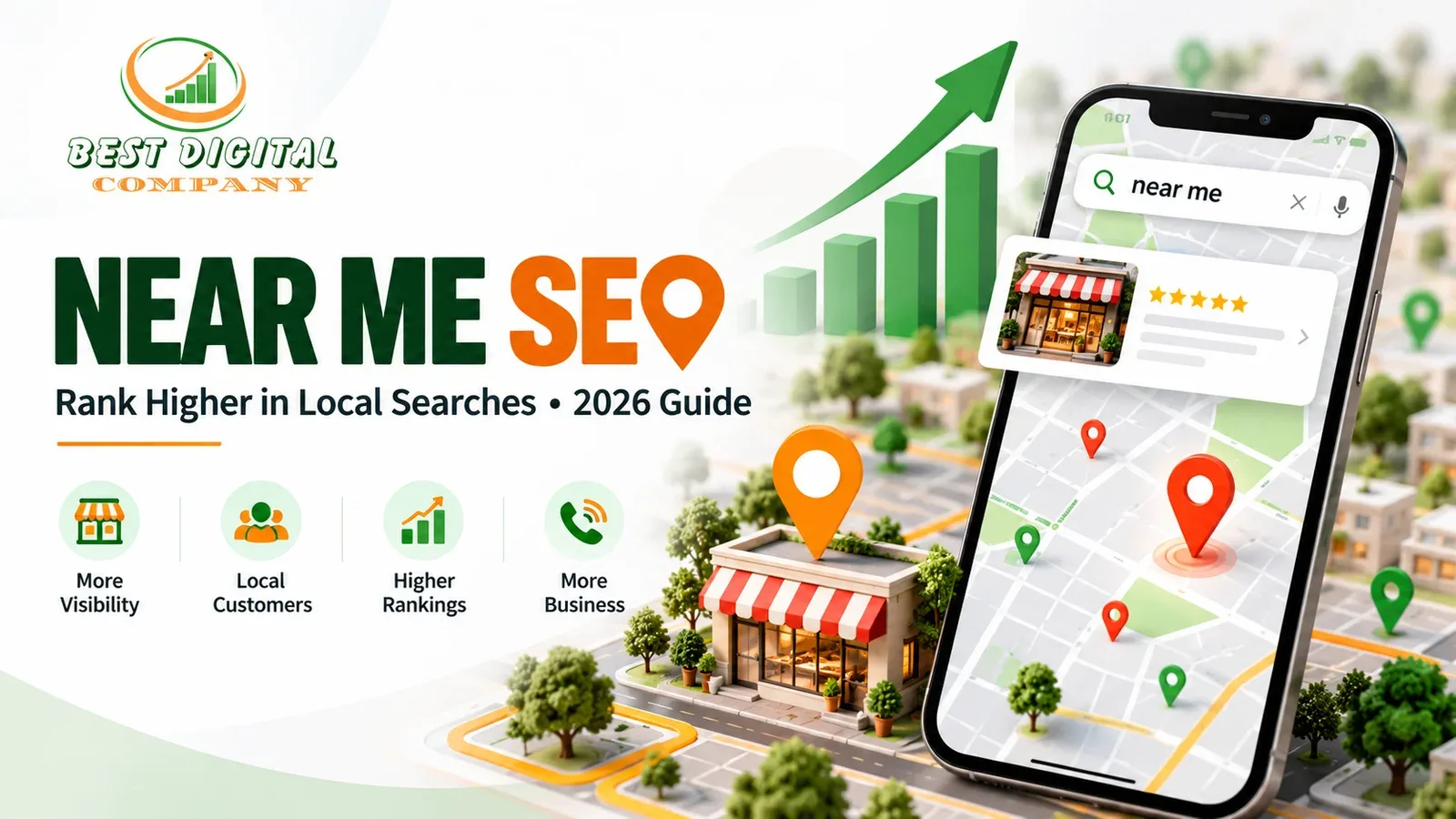
Near me SEO is the work of making sure your business is one of the few options Google shows at that moment. This guide explains how it works in 2026, what actually affects your visibility, and what to do about it, based on what we see while working with local businesses in Delhi and across India.
What Is Near Me SEO, and Why Does It Matter in 2026?
Near me SEO means optimizing your business so it appears when someone searches with a nearby intent. That includes phrases like “dentist near me,” but also searches that never contain those words, such as “best salon in Laxmi Nagar” or “plumber open now.” Google treats all of these as the same kind of question: who can help me, close to where I am, right now?
Three things make this more important than it was a few years ago.
Most of these searches happen on phones. People are standing in a market, sitting in a car, or walking down a street. They want a phone number, opening hours, and directions, not a long article.
The intent is strong. Someone searching “car service near me” is much closer to buying than someone searching “how often should I service my car.” Local searches tend to end in a call, a visit, or a booking.
Google shows fewer choices than it used to. A map section with three businesses, plus an occasional AI-generated summary, takes up most of the first screen. If you’re not in that group, you’re easy to miss.
If you’ve been wondering whether traditional optimization still holds up with all these changes, our piece on whether SEO still works in 2026 covers that in detail. The short version for local businesses is yes, but the details have shifted.
How Google Decides Who Appears for Near Me Searches
Google has been fairly open about this. Local results are based on three things: relevance, distance, and prominence.
Relevance is how well your business matches what the person asked for. A profile that clearly says you’re a pediatric dental clinic will beat a vague “healthcare services” listing for the search “child dentist near me.”
Distance is how far you are from the searcher, or from the area they named in the search. You can’t change where your shop is, and this is the part that frustrates people most. But understanding it helps you set realistic goals. If you’re in Preet Vihar, you probably won’t show up for someone standing in Dwarka, and that’s fine. You want to win your own neighborhood first.
Prominence is how well-known and trusted your business appears. Reviews, mentions across the web, the strength of your website, and how consistently your business details appear online all feed into this.
You control relevance and prominence almost entirely. Most of the rest of this guide is about those two.
Start With Google Business Profile Optimization
If you only have time to fix one thing, fix your Google Business Profile. It’s the foundation of everything else, and it’s where most near me visibility is won.
Here’s what we check first when a new client comes to us.
Business name. It should be exactly what appears on your signboard. Adding keywords like “Best Dentist in Delhi” to the name violates Google’s guidelines, and it’s one of the quickest ways to get a profile suspended.
Categories. Your primary category matters more than almost any other field. Pick the one that most precisely describes your main service, then add secondary categories for anything else you genuinely offer. A restaurant that lists itself as “Restaurant” when it’s really a “North Indian restaurant” is leaving relevance on the table.
Services and products. Fill these in properly, with short plain-language descriptions. Don’t skip them because they feel optional.
Hours. Keep them accurate, including holiday hours. Nothing loses trust faster than a customer arriving at a closed shop that Google said was open.
Photos. Real photos of your shop front, interior, team, and work. Customers do check them, and a profile with recent, genuine images feels alive. Stock photos don’t help.
Posts and updates. Share offers, new services, or events now and then. They’re not a magic ranking lever, but they show the profile is actively managed.
We’ve written a full walkthrough in our Google Business Profile optimization guide for 2026, which goes field by field if you want to work through your own listing.
Google Maps Ranking: Why Some Businesses Win the Top Three
Most near me searches end at the map results. So it’s worth understanding what separates the businesses at the top from everyone else.
In our experience, the businesses that hold those top spots usually have a few things in common. Their profiles are complete and accurate. They have a steady flow of recent reviews. Their name, address, and phone number match everywhere online. And their websites back up what the profile claims.
What they usually don’t have is a trick. Over the years we’ve seen business owners try fake reviews, extra listings at made-up addresses, and keyword-stuffed names. Those shortcuts sometimes bring a short burst of visibility, and then a suspension. Recovering a suspended profile takes far longer than building a clean one would have.
If you want a deeper breakdown of the signals involved, we put together a guide on how to rank higher on Google Maps in 2026 that goes through the practical steps.
Why Your Business Is Not Showing on Google Maps
Before you try to rank higher, make sure you’re actually eligible to appear. A surprising number of businesses we speak to are invisible for basic reasons, not competitive ones.
The common causes are:
- The profile isn’t verified. Unverified profiles rarely show in map results.
- The profile was suspended or flagged because of a guideline issue, often something small like a name mismatch.
- The category is wrong or too generic, so Google can’t connect the business to the search.
- The address is unclear. In Indian cities, landmark-based addresses and inconsistent formatting cause real confusion. “Near Lal Mandir” means something to locals and very little to an algorithm.
- Duplicate listings split your signals and sometimes trigger filters.
- The listing is a service-area business but has been set up as a storefront, or the other way around.
If you’ve searched your own business name and come up empty, start there. Our post on why your business is not showing on Google Maps and how to fix it walks through each of these problems and how to check for them.
Google Reviews: The Trust Signal Nearby Customers Check First
When someone is choosing between three nearby options, reviews are often the deciding factor. They’re also a major part of how Google judges prominence.
What matters isn’t just the star rating. Google and customers both look at:
- How many reviews you have
- How recent they are
- Whether they mention specific services and locations naturally
- Whether you respond to them
A business with 40 reviews from the past six months often looks more credible than one with 200 reviews that all date back to 2022.
The best way to get reviews is the simplest one: ask. Ask in person after a good experience. Send a short message with your review link. Put a QR code at the counter. Don’t offer discounts or gifts in exchange for reviews, and don’t write them yourself or ask friends to. Google’s policies are clear on this, and fake reviews get removed, sometimes along with your ranking.
Respond to every review, including the negative ones. A calm, specific reply to a complaint tells future customers more about your business than ten five-star ratings. We cover the full approach in our guide onhow to get more Google reviews without breaking Google’s rules.
Google Business Profile vs Website: You Need Both
Some owners believe a good profile makes a website unnecessary. Others spend everything on the website and ignore the profile. Both are mistakes.
The profile gets you into the map results. The website gives Google the depth it needs to understand what you do, where you do it, and why you can be trusted. When the two disagree or the website is thin, rankings tend to stall.
We once worked with a clinic in East Delhi that had hundreds of reviews and a strong profile, but a website that was a single page with a phone number. Their map visibility was decent, yet they lost people at the next step. Visitors who clicked through found almost nothing to reassure them. Fixing the website, not the profile, is what changed the picture.
If you’re deciding where to put your time and budget first, our comparison of Google Business Profile vs website for local SEO lays out which one matters more in different situations.
Local SEO in Delhi: Building Location Pages That Match Real Intent
A single “Contact Us” page can’t carry your whole local presence. If you serve more than one area, or offer more than one service, you’ll usually need dedicated pages.
Good local landing pages have a few things in common:
- They’re written for one service in one area. “Dental implants in Janakpuri” is more useful than a page that lists every service and every neighborhood.
- They contain information only you could write. Mention the areas you actually serve, how to reach you, which landmarks are nearby, real examples of your work, and questions customers in that area genuinely ask.
- They include clear contact details, an embedded map, and a visible phone number.
- They don’t copy each other. Swapping the area name on an otherwise identical page is thin content, and Google is good at spotting it.
Only create pages for areas you genuinely serve. If you have no presence in a neighborhood, a page about it helps no one.
This is also the kind of work that benefits from local experience. When we handle local SEO in Delhi for clients, a big part of the job is understanding how people in specific parts of the city actually describe their needs, which words they use, and which landmarks they navigate by. That detail is hard to fake.
On-Page Basics That Support Near Me SEO
Your website still needs to be easy for Google to read and for customers to use. These are the fundamentals worth getting right.
Title tags and headings. Include your main service and your location in a natural way. “Pediatric Dentist in Rohini | Clinic Name” reads better than a stack of keywords.
Business details in text. Your address and phone number should appear as real text, ideally in the header or footer, not only inside an image.
Local schema markup. Structured data for your business type, address, hours, and reviews helps search engines confirm the details they’ve found elsewhere.
Original content. Write about the problems your customers actually bring to you. A clinic can explain what to expect at a first visit. A repair shop can explain what a typical fault costs to fix. This kind of helpful, specific writing builds trust and covers the questions nearby customers type.
Clear next steps. A phone button, a booking form, a visible WhatsApp link. Make the action easy.
These are all part of what we’d call goodsearch engine optimization generally, and near me work simply points them toward a local audience.
Web Development Decisions That Affect Local Rankings
Many near me searches happen on a mid-range phone with a patchy connection. If your site is slow or awkward on mobile, people leave before they’ve seen anything.
A few web development basics make a real difference:
- Fast loading on mobile, including compressed images and clean code
- A mobile layout where buttons are easy to tap and text is readable without zooming
- Secure browsing (HTTPS) on every page
- Simple navigation, so a visitor can find your address, hours, and services within seconds
- Click-to-call on every key page
We see sites that look impressive on a desktop but are painful on a phone. Since most local searches start on a phone, that’s the version Google and your customers are judging. If your site needs rebuilding or a serious cleanup, our web development team focuses on exactly this kind of speed and usability.
Citations and Consistent Business Information
Your business name, address, and phone number (often called NAP) should look the same everywhere they appear: your website, your Google profile, directories, social pages, and industry listings.
Small differences cause bigger problems than people expect. “Shop No. 4” in one place and “Shop 4” in another isn’t usually fatal. But a different phone number on an old directory, or an outdated address after a move, sends mixed signals.
A sensible approach:
- Pick one exact format for your name, address, and phone number.
- List it on the major platforms and the directories that are relevant to your industry and city.
- Search for old or duplicate listings and correct or remove them.
- Update everything immediately if anything changes.
Quality matters more than quantity here. Twenty accurate, relevant listings are worth more than two hundred random ones.
Near Me SEO and AI Overviews
Search results now often include an AI-generated summary, and many local searches trigger some version of it, especially for questions like “which clinic near me is best for back pain.”
You can’t control whether an AI summary appears, but you can make your business easier to understand and trust. The same things that help traditional local rankings help here: accurate profile data, strong reviews, clear and specific website content, and consistent information across the web.
Where AI summaries differ is in how they favor direct, well-organized answers. Pages that clearly explain who you serve, what you offer, what it costs (even roughly), and how to reach you tend to be easier for these systems to draw from. Our guide on how to make your business visible in AI Overviews goes deeper on this, and if the terminology is confusing, our explainer on SEO vs AEO vs GEO breaks down how the three overlap.
How Pay Per Click and Social Media Marketing Support Local Visibility
Organic ranking takes time. While you build it, two other channels can keep nearby customers finding you.
Pay per click. Local ads appear above or alongside the map results and can bring calls quickly. They’re useful for new businesses, for competitive categories, or for promoting a specific service in a specific area. Good pay per click management is about tight location targeting, sensible budgets, and tracking calls rather than just clicks.
Social media. Customers often check your Instagram or Facebook page before visiting. A page with recent photos, genuine customer posts, and responses to comments gives them confidence. Done consistently, social media marketing also helps people in your area remember your name, which leads to more direct and branded searches over time.
Neither replaces local SEO, but they cover gaps while it builds momentum.
Common Near Me SEO Mistakes We See Again and Again
After working with many local businesses, the same errors keep appearing.
Stuffing “near me” into everything. Writing “best dentist near me near me” on a page reads badly and doesn’t help. Google already knows where the searcher is. Write for people and mention real locations.
Ignoring reviews after the first few. Reviews are a habit, not a one-time project.
Using a virtual office or fake address. Google verifies these more strictly than before, and it often ends in suspension.
Creating many near-identical location pages. More pages don’t mean more rankings.
Leaving the profile unattended. Wrong hours, outdated services, or unanswered questions quietly hurt trust.
Expecting results in a week. For most local businesses, meaningful movement takes a few months of steady work. Anyone promising top three rankings in days is either exaggerating or planning something risky.
How to Measure Whether Near Me SEO Is Working
You don’t need a complicated dashboard. Track a handful of things every month:
- Calls, direction requests, and website clicks from your Google Business Profile
- Search queries that show your profile, which your profile insights reveal
- Local rankings for your key services across a few nearby areas, ideally checked in a private browser or with a grid-style tracking tool
- Review count and average rating
- Website traffic from local searches, and how many of those visitors contact you
The most useful number is the simplest one: how many new customers say they found you on Google. Ask people when they call or walk in. It’s low-tech, and it tells you more than most reports.
Choosing the Right SEO Services in Delhi for Near Me Growth
Some businesses can do much of this themselves, especially if they have time and a small number of locations. Others find it easier to hand it over.
If you decide to hire help, ask a few direct questions:
- Can they show results for businesses similar to yours, in similar areas?
- Do they explain what they’re doing, or hide behind jargon?
- Do they avoid guaranteeing rankings?
- Will you own your Google Business Profile and website, or will the agency control them?
- Do they follow Google’s guidelines on reviews and listings?
Good SEO services in Delhi should feel like a working partnership, with clear reporting and honest timelines. If you’d like to see what’s typically included at different budgets, our SEO packages page lays it out, and you can always talk to our team if you’d like an honest opinion on where your business stands.
A Simple Near Me SEO Checklist to Start With
If you want a clear starting point, work through these in order:
- Claim and verify your Google Business Profile.
- Choose accurate primary and secondary categories.
- Fill in services, hours, and photos.
- Fix any inconsistent or duplicate listings.
- Start a simple, rule-following review routine.
- Make sure your website loads fast and works well on phones.
- Build location or service pages with genuinely useful, original content.
- Add local schema markup.
- Track calls, directions, and reviews monthly.
- Keep everything current as your business changes.
None of these steps is glamorous. That’s the point. Near me SEO rewards businesses that are accurate, active, and genuinely useful to the people nearby, and that’s something you can build with steady effort.
Frequently Asked Questions About Near Me SEO
What is near me SEO?
Near me SEO is the process of optimizing your business so it appears when people search for products or services close to their location. It covers your Google Business Profile, your website, reviews, and online listings, all of which help Google decide whether to show you to a nearby searcher.
How long does near me SEO take to show results?
It depends on competition and your starting point. A business with a neglected profile can sometimes see improvement within a few weeks of fixing basic issues. Competitive categories in busy areas usually take three to six months or longer of consistent work. Anyone promising instant top rankings should be treated with caution.
Do I need a website to rank for near me searches?
You can appear in map results with only a Google Business Profile, but a good website makes ranking easier and helps turn visitors into customers. A strong profile and a helpful website work better together than either does alone.
Should I add “near me” to my website content?
Not as a keyword to repeat. Google already uses the searcher’s location, so it’s better to mention your actual city, neighborhood, and landmarks naturally. Write for the people you want to serve, and let the location details do the work.
How many reviews do I need to rank in the top three?
There’s no fixed number. What matters is having more recent, genuine reviews than the competitors around you, along with a good rating and replies from you. Look at the businesses currently ranking in your area and aim to match or beat their review activity.
Can I rank for near me searches without a physical shop?
Yes, if you’re a service-area business, such as a plumber or a home tutor, and you set up your profile that way. You’ll need to define the areas you serve honestly. You shouldn’t list a false address or a virtual office to appear in places you don’t actually operate.
Is near me SEO different from local SEO?
They overlap heavily. Local SEO is the broader practice of improving visibility for location-based searches. Near me SEO focuses on the “close to me, right now” type of search, which depends strongly on proximity, your profile, and reviews.