Social Media Marketing Services Bundle

Social Media Marketing Services Bundle: What Should Be Included Every Month

If you have ever paid an agency a fixed monthly fee for social media and then wondered, three months later, what you actually got for the money, you are asking a fair question. A lot of businesses sign up for “social media management” without ever seeing a clear breakdown of deliverables. They get a few posts, maybe a story here and there, and a vague promise of “growth.” Then the invoice arrives again.

The problem usually is not the platform or the budget. It is that most people never see what a properly built monthly package should contain. Once you know what belongs in a real bundle, it becomes much easier to compare vendors, spot corners being cut, and hold your marketing partner accountable for results instead of activity.

This guide breaks down exactly what a complete package of social media marketing services should include every single month, why each piece matters, and how to tell when you are being sold busywork instead of a strategy.

What a Complete Social Media Marketing Services Package Actually Covers

Before comparing quotes or packages, it helps to separate the work into categories. A monthly retainer for social media is rarely just “posting.” It is a combination of planning, creation, distribution, paid promotion, community management, and reporting. When any one of these pieces is missing, the whole strategy tends to feel disconnected posts go out, but nobody is watching how people respond to them, or ads run without any organic content backing them up.

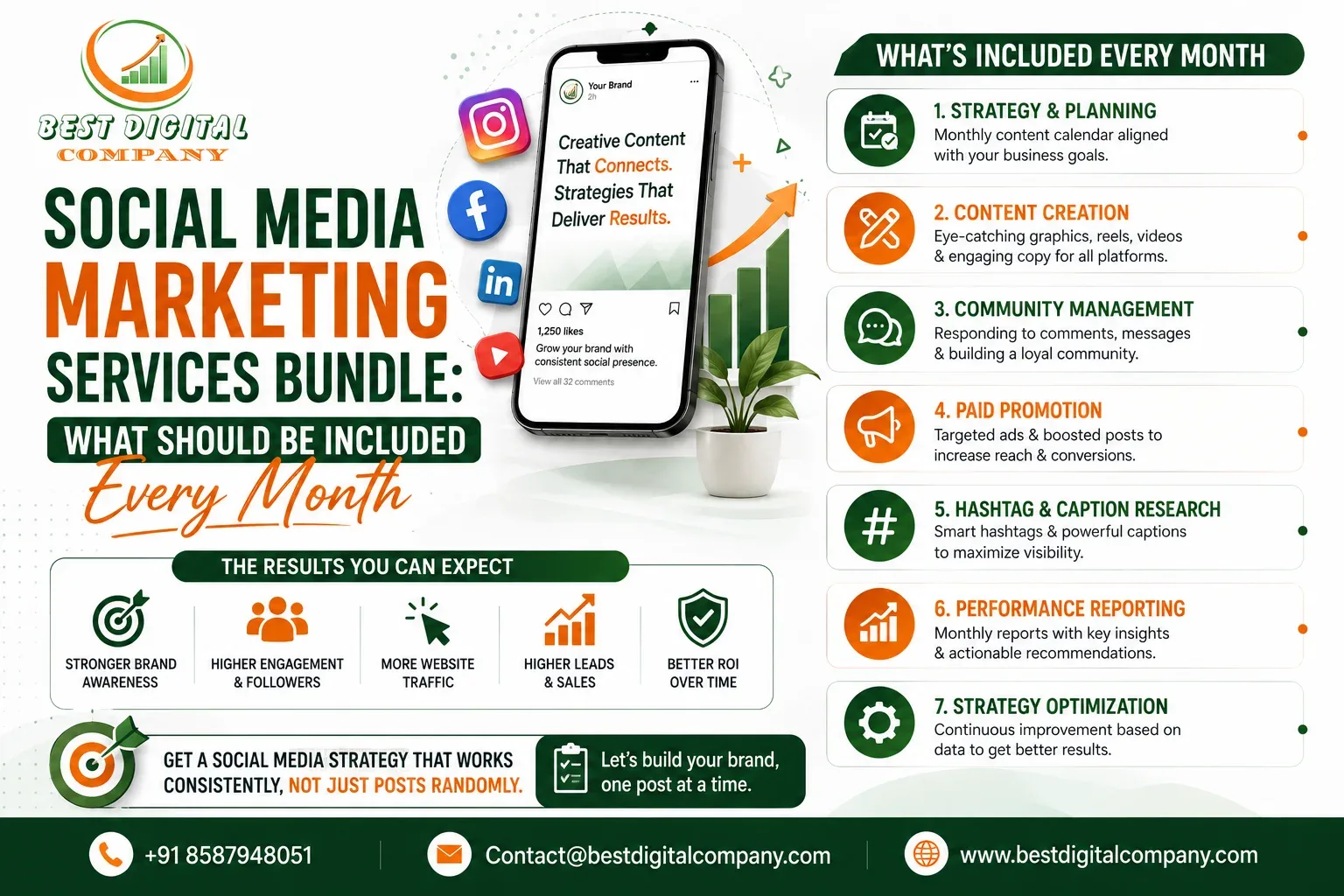
A well-structured bundle of social media marketing services typically includes:

  • A monthly content calendar built around business goals, not random trending topics
  • Original graphics, short videos, and copywriting for each platform
  • Community management, meaning replies to comments and messages
  • Paid promotion or boosted posts where the budget allows
  • Hashtag and caption research specific to the industry
  • Monthly performance reporting with clear next steps
  • Ongoing strategy adjustments based on what the data shows

Each of these deserves a closer look, because the details are where the real difference between a strong package and a weak one shows up.

Content Planning: The Foundation Before Anything Gets Posted

Content planning is the part clients rarely see, which is exactly why it gets skipped by agencies trying to cut corners. A proper plan starts with a monthly theme or set of goals maybe it is pushing a new product line, building local awareness, or supporting a seasonal sale and then maps content around that goal rather than posting whatever is easiest to produce.

This planning stage should answer a few practical questions before a single graphic is designed:

  • What is this month’s business priority, and how does social media support it?
  • Which platforms actually reach this audience, and which ones are a waste of effort?
  • What mix of formats (reels, carousels, static posts, stories) makes sense for the goal?
  • How does this month’s content connect to what was posted last month, so the page tells a consistent story instead of a scattered one?

Without this step, a monthly bundle turns into a content mill: posts that look fine individually but do not build toward anything. If a monthly proposal jumps straight from “how many posts do you want” to a content calendar with no discussion of goals, that is usually a sign the planning stage was skipped entirely.

Content Creation and Copywriting Inside Social Media Marketing Services

Once the plan is set, the creative work begins and this is usually the largest visible chunk of any monthly package. It should cover:

Design and video production. Static graphics, carousel posts, short-form reels, and story templates that match brand colors and tone. A business that sells industrial equipment should not have the same visual style as a boutique clothing brand, yet a surprising number of agencies use the same templates across every client.

Captions and copy. Every post needs writing that fits the platform. A LinkedIn caption aimed at other businesses reads very differently from an Instagram caption aimed at everyday shoppers. If every platform is getting the exact same copy pasted across it, that is not a real multi-platform strategy — it is one post published in five places.

Hashtag and keyword research. This should be revisited monthly, not set once and reused forever. Trends shift, and hashtags that worked six months ago can lose relevance or even attract the wrong audience.

Platform-specific formatting. A vertical reel is not the same asset as a square feed post, and a package that simply resizes one image for every platform is cutting a corner that shows up in lower reach.

This is also where a package should overlap with broader brand and web presence work. If your social pages are promoting a website that has not been touched in years, the mismatch is obvious to visitors. Businesses that are still deciding between a professional build and a template-based approach may find it worth reading what small businesses should know when comparing a website making company to DIY builders before assuming the content strategy alone will carry the brand.

Community Management: The Part That Gets Skipped Most Often

Posting content is only half the job. The other half is what happens after a post goes live — replying to comments, answering direct messages, and handling reviews or complaints that show up publicly. This is called community management, and it is the piece most frequently missing from budget packages because it takes ongoing attention rather than a one-time deliverable.

A monthly bundle should specify:

  • Response time expectations for comments and messages (same day, within 24 hours, etc.)
  • Who handles sensitive or negative comments, and what tone they use
  • Whether the team is monitoring mentions and tags, not just the main page
  • How user-generated content, like a customer photo or tag, gets acknowledged or reshared

Ignoring this part of the work is one of the fastest ways to damage trust. A page with polished posts but unanswered questions from three weeks ago tells visitors that nobody is actually managing the account, no matter how good the graphics look.

Paid Promotion Should Be Planned, Not an Afterthought

Organic reach on most platforms has shrunk over the years, which means a portion of almost every serious monthly package now needs to include paid boosting or targeted ad spend. This does not have to mean a massive advertising budget even a modest amount, spent correctly, can extend the reach of a strong post far beyond followers alone.

A monthly plan should be specific about:

  • Which posts are being boosted and why (a product launch usually deserves paid support; a routine update usually does not)
  • What audience targeting is being used, and whether it is being refined over time
  • Whether the ad budget is separate from the management fee, and how much of it goes to the platform versus the agency

Social advertising and search advertising often get confused, but they solve different problems and are usually managed differently. If you are also running or considering pay-per-click advertising alongside your social presence, it is worth understanding how the two connect, and it helps to know the warning signs that a pay-per-click provider is wasting your ad spend, since some of the same red flags vague reporting, no clear targeting logic, budget spent without a plan show up in poorly managed social ad accounts too.

Reporting: Numbers That Actually Mean Something

A monthly report should do more than list how many posts went out. Post counts measure effort, not results. A useful report connects activity to outcomes and should include:

  • Follower growth, but framed against engagement quality rather than a raw number alone
  • Reach and impressions by platform, so you can see where the audience is actually responding
  • Engagement rate (likes, comments, shares, saves) rather than just total likes
  • Click-throughs to the website or landing pages, when applicable
  • A short written summary explaining what worked, what didn’t, and what changes are planned for next month

This last part is where many packages fall short. A spreadsheet full of numbers with no interpretation puts the burden of understanding the data back on the client. A proper report should read almost like a short letter: here is what happened, here is why, and here is what we are adjusting.

How Social Media Marketing Services Should Connect With the Rest of Your Marketing

Social media rarely works well in isolation. The strongest monthly bundles are built with an awareness of what else is happening in a business’s marketing its website, its search visibility, and any paid campaigns running elsewhere.

For example, if a business is also investing in search engine optimization, the social team should know what keywords and pages are being pushed so that social content can point traffic toward the right landing pages rather than just the homepage. Similarly, a business investing in website development should make sure the site can actually handle the traffic social campaigns are meant to drive there is little point in a beautifully produced reel if it links to a page that loads slowly or looks outdated.

This kind of coordination is often the difference between an agency and a freelancer working in isolation. If you are deciding who should manage these moving pieces together, it can help to read aboutthe real difference (or lack of one) between an agency and a company, since similar distinctions apply when comparing social media providers as well.

The Jargon Problem: SMO, SMM, and What They Actually Mean for Your Package

Anyone shopping for a monthly package will run into a mix of acronyms SMM, SMO, engagement funnels, organic reach often used interchangeably by salespeople in ways that make the pitch sound more sophisticated than the actual deliverable. Before signing anything, it is worth understanding what these terms mean in practice rather than nodding along on a sales call.

Two resources worth reading side by side are a breakdown of what a social media optimization company actually does day to day, and a comparison of how an SMO company differs from an SMO agency. Both cut through the jargon and make it easier to match the terms in your contract to the actual work being promised.

Platform-Specific Deliverables to Look For

Not every platform deserves the same treatment, and a monthly package should reflect that. A few examples of what to expect, broken down by platform:

Instagram — a mix of feed posts, reels, and stories, plus highlight cover design and regular use of interactive story features like polls or questions.

Facebook — event promotion, review monitoring, and community group engagement where relevant, alongside standard feed content.

LinkedIn — a more professional tone, employee or founder spotlights, and industry commentary rather than promotional posts alone.

Pinterest — for visually driven businesses, pin creation linked back to product pages or blog content, since Pinterest traffic tends to behave more like search traffic than typical social traffic.

A package that treats every platform identically, with the same three posts a week copied across all of them, is not really tailored — it is templated. Ask any vendor to walk through exactly what differs between platforms in their plan.

Red Flags in a Monthly Social Media Marketing Services Bundle

A few warning signs tend to repeat across weak packages:

  • No mention of community management or response times
  • Reports that only show follower counts, with no engagement or conversion data
  • The same content copied word-for-word across every platform
  • No clear owner for paid ad spend, or ad budget quietly folded into the management fee without disclosure
  • A content calendar that changes every month with no connection to a longer-term goal
  • Vague answers when asked “what exactly do we get for this price”

If two or more of these show up in a proposal, it is worth asking pointed follow-up questions before signing a contract.

Questions to Ask Before Signing a Monthly Package

Before committing to any provider, it helps to get specific, written answers to a short list of questions:

  1. How many original posts, reels, and stories are included per platform, per month?
  2. Who writes the captions, and are they tailored per platform?
  3. Is community management included, and what is the expected response time?
  4. Is paid ad spend separate from the management fee, and how is it reported?
  5. What does the monthly report look like, and can we see a sample?
  6. How often is strategy reviewed and adjusted based on performance?
  7. Is there a minimum contract length, and what happens if results are not meeting expectations?

A provider that can answer these clearly, ideally in writing, is far more likely to deliver a coherent monthly package than one that gives general reassurances without specifics.

Bringing It All Together

A strong monthly bundle of social media marketing services is not measured by how many posts go live. It is measured by whether planning, creative work, community management, paid promotion, and reporting all connect to a clear goal and whether that goal ties back into the rest of a business’s marketing, from its website to its search visibility to any paid campaigns running elsewhere.

If your current package only checks one or two of these boxes, it may be worth a conversation about what is missing before renewing another month at the same price. And if you are comparing providers from scratch, ask to see a sample content calendar and a sample monthly report before you sign anything that single request tends to reveal more than any sales pitch.

If you want a package built around your specific goals rather than a generic template, you can see how a structured approach comes together on our social media marketing services page, or compare tiers directly through our monthly social media packages.


Frequently Asked Questions

What is usually included in a monthly social media marketing services package?

A complete package typically includes content planning, graphic and video creation, platform-specific copywriting, community management, paid promotion where budget allows, and a monthly performance report with recommendations for the following month.

How many posts should be included per month?

This varies by platform and industry, but most active accounts need a mix of three to six feed posts per week per platform, along with regular stories and at least a few short-form videos. What matters more than the raw number is whether the content is planned around a goal rather than posted at random.

Is paid advertising part of social media marketing services, or is it separate?

It depends on the provider. Some packages include a management fee for handling ads, with the actual ad spend billed separately to the platform. Others fold a small ad budget into the overall fee. Either approach can work, but it should always be disclosed clearly in writing.

Do I need a different strategy for each platform?

Generally yes. Audiences behave differently on Instagram, Facebook, LinkedIn, and Pinterest, and content that performs well on one often falls flat on another. A package that reuses identical content everywhere is usually cutting corners rather than saving effort.

How do I know if my current package is underdelivering?

Compare what you are receiving against the categories covered in this article planning, creation, community management, paid promotion, and reporting. If your reports only show follower counts with no engagement data, or if comments and messages go unanswered for days, those are strong signs the package is incomplete.

Should social media work be coordinated with SEO and paid search?

It helps a great deal. When social content, search engine optimization, and pay-per-click campaigns are planned together, they reinforce each other social posts can drive traffic to pages built to rank, and paid campaigns can retarget people who already engaged with social content. Managing these in silos often wastes budget on both sides.
Social Media Agency Pricing

Social Media Agency Pricing in 2026: What’s a Fair Monthly Retainer?

If you have ever asked three different social media agencies for a quote and gotten three completely different numbers, you already know how confusing this decision can be. One agency quotes ₹15,000 a month. Another wants ₹75,000. A third won’t even give you a number until you have sat through a 45-minute discovery call. So which one is actually fair, and which one is just testing how much you’re willing to pay without asking?

This is one of the most common questions we hear at Best Digital Company when business owners first reach out about working with a social media agency. There isn’t a single “correct” retainer figure that applies to every business, but there is a fair range, and there are clear signals that tell you whether a quote reflects real value or just guesswork. This guide breaks down what actually goes into social media pricing in 2026, why the range is so wide, and how to know if the number in front of you is reasonable for what you’re getting.

Why Social Media Agency Pricing Varies So Much

Before getting into numbers, it helps to understand why the range is so wide in the first place. Two businesses in the same city, same industry, even the same street, can get retainer quotes that differ by four or five times, and both quotes can be legitimate.

Pricing depends on a handful of variables that most business owners don’t think to ask about upfront:

Number of platforms managed. Running Instagram alone costs less than running Instagram, Facebook, LinkedIn, and Pinterest together, because each platform needs its own content style, posting cadence, and community management approach.

Content production load. A retainer built around four static posts a month looks nothing like one that includes weekly reels, motion graphics, and photography shoots. Video content in particular takes significantly more time to script, shoot, and edit than a carousel graphic.

Strategy versus execution. Some agencies just post what you send them. Others build a content calendar around your business goals, research your audience, track competitor activity, and adjust the plan monthly based on performance. That strategic layer is where a large part of the cost difference comes from.

Paid promotion management. If the retainer includes managing an ad budget on top of organic posting, expect the fee to rise, since running paid campaigns properly requires ongoing testing, audience research, and reporting that organic-only management doesn’t.

Reporting and account management. Agencies that provide detailed monthly reports, a dedicated account manager, and regular strategy calls typically charge more than those offering a bare-bones “we’ll post for you” service.

Location and agency size. A boutique freelancer working from home will price differently than an established agency with a full creative team, and both can produce good work depending on your needs.

Once you understand these variables, the wide range in quotes starts to make a lot more sense. The question isn’t “what’s the average price,” it’s “what am I actually paying for at this price.”

What a Typical Monthly Retainer Looks Like in 2026

With those variables in mind, here is a realistic breakdown of what businesses in India are commonly paying for ongoing social media management this year. These figures assume organic management (ad spend is separate and billed on top).

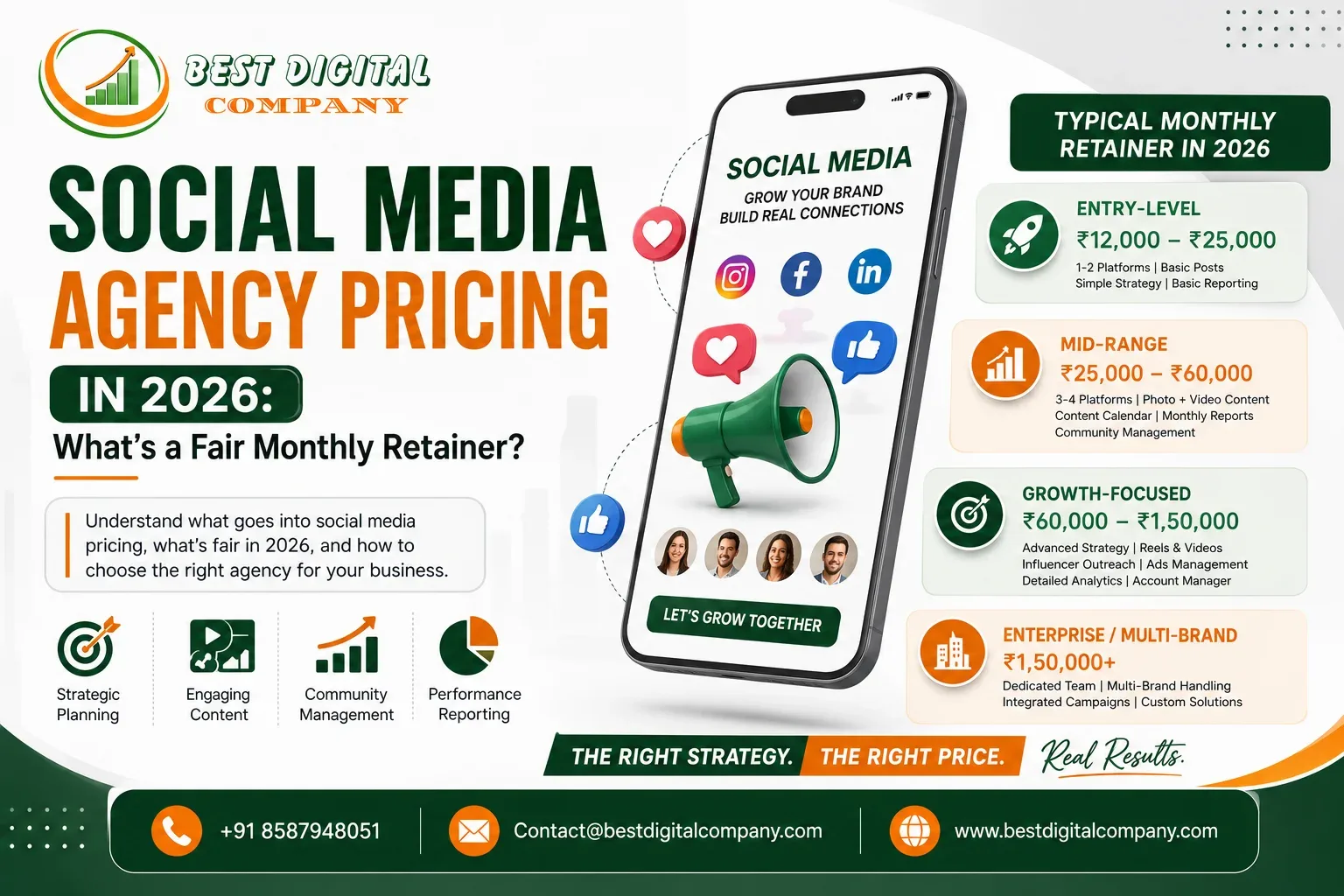
Entry-level management (₹12,000–₹25,000/month): This tier usually covers one or two platforms, a handful of static posts and stories each week, basic captions, and minimal strategy work. It suits very small businesses or solo founders who mainly need consistency rather than a full growth plan. Reporting at this level is often just a simple monthly summary.

Mid-range management (₹25,000–₹60,000/month): This is where most small and mid-sized businesses land. It typically includes three to four platforms, a mix of static and video content, a documented content calendar, community management (responding to comments and messages), and monthly performance reporting with some strategic input.

Growth-focused management (₹60,000–₹1,50,000/month): At this level, agencies usually provide dedicated account managers, in-house content creation (photography, videography, editing), influencer outreach, competitor analysis, and closer alignment with sales or lead-generation goals. This tier makes sense for businesses that treat social media as a real revenue channel, not just a brand presence.

Enterprise or multi-brand management (₹1,50,000+/month): Larger companies managing multiple brands, locations, or markets often need a bigger team behind the account, more frequent reporting cycles, and integration with broader marketing campaigns. Pricing here is usually customized rather than packaged.

These numbers reflect the general market in 2026, but the exact figure for your business should come down to the scope of work, not a flat industry number someone quoted you once. That’s why we structure our own SMO packages around scope tiers rather than a single fixed price, so a business only pays for the platforms, content volume, and strategy depth it actually needs.

What Should Be Included in a Fair Retainer

A retainer that looks cheap on paper can turn out expensive if half the work you assumed was included actually costs extra. Before agreeing to a monthly fee, it’s worth confirming exactly what’s covered.

Content Planning and Calendar

A fair retainer should include an actual content calendar, not just a promise to “post regularly.” You should know roughly what will go up, when, and why, tied to some kind of theme or business goal for the month.

Content Creation

Clarify whether the agency is designing original graphics and shooting original video, or repurposing templates and stock content. Original content generally justifies a higher price point because it takes more time and reflects your brand more accurately.

Community Management

Responding to comments, direct messages, and reviews is often left out of cheaper packages, yet it’s one of the most important parts of building trust with an audience. If this isn’t included, ask what it would cost as an add-on.

Performance Reporting

You should receive a monthly report that goes beyond vanity metrics like follower count. Reach, engagement rate, click-throughs, and (where relevant) leads or conversions attributed to social media give a clearer picture of whether the spend is working.

Strategy Reviews

A good social media agency doesn’t run the same plan every month regardless of results. Ask how often the strategy gets reviewed and adjusted, and whether that’s included in the retainer or billed separately.

If a proposal is vague on any of these five points, that’s usually a sign the price is lower because the scope is thinner, not because you’re getting a discount.

Red Flags: When a Quote Is Too Low or Too High

Signs a Quote Is Unrealistically Low

If a retainer promises daily posting across five platforms, professional video editing, paid ad management, and detailed reporting for under ₹10,000 a month, be cautious. At that price, something has to give, usually quality, consistency, or the amount of actual human time going into your account. Some agencies subcontract this work overseas at very low rates or use heavily templated content that isn’t tailored to your brand.

Signs a Quote Is Overpriced

On the other end, a high price doesn’t automatically mean better service. If an agency can’t clearly explain what’s included in a ₹2,00,000/month retainer, or the answer is vague industry jargon rather than specific deliverables, ask for a breakdown. Paying more only makes sense if you can see where the extra money goes, whether that’s a larger creative team, better reporting, or more platforms covered.

The fairest way to evaluate any quote is to ask the agency to walk you through exactly what a typical month looks like: how many posts, how many hours of video editing, how many strategy touchpoints, and what reporting looks like. A transparent answer is a good sign regardless of the number attached to it.

Agency Retainer vs In-House Team: A Cost Comparison Worth Making

Before committing to any retainer, it is worth comparing it against the cost of hiring in-house. A full-time social media manager in India typically costs anywhere from ₹25,000 to ₹60,000 a month in salary alone, before accounting for design tools, video editing software, stock photography subscriptions, or a second hire for content creation if the manager isn’t also a designer.

An agency retainer often works out cheaper once you factor in these hidden costs, because you’re getting access to a whole team, strategist, designer, video editor, copywriter, without paying full-time salaries for each role. That said, an in-house hire offers more day-to-day control and faster turnaround for time-sensitive requests. We have laid out this comparison in more depth in our earlier post on social media marketing company vs in-house team, which is worth a read if you’re weighing both options seriously.

How to Tell If You are Actually Getting Value, Not Just a Low Price

Price alone does not tell you whether a retainer is fair. Value comes from the outcome relative to the spend. Here are a few practical ways to judge that:

Ask for past client results, not just a portfolio of pretty posts. Growth in followers means little if it doesn’t translate into inquiries, bookings, or sales. A results-oriented agency should be able to show engagement or conversion trends from real client accounts (even anonymized).

Check how they define success. If an agency’s only metric is “more followers,” that’s a warning sign. Followers are one data point among many, and honestly, one of the least useful ones for judging business impact. We wrote more about why chasing likes alone doesn’t move the needle in our post on picking a social media agency that actually grows sales, which digs into this exact problem.

Compare the retainer to your monthly marketing budget as a whole. A retainer that eats 60% of your total marketing spend probably needs to justify itself with strong, trackable results, not just consistent posting.

Ask what happens if results plateau. A fair agency partnership includes a process for adjusting strategy when something isn’t working, rather than continuing to bill the same amount for the same underperforming plan month after month.

Why Working With a Full-Service Digital Partner Often Makes More Sense

Social media rarely works in isolation. A well-run account can drive traffic to your website, but if that website is slow or poorly designed, the visitors bounce before converting. Similarly, social proof and paid promotion often perform best when they’re coordinated rather than managed by separate, disconnected vendors.

This is where working with an agency that also handles search engine optimization, pay per click, and website development alongside social media can be genuinely more cost-effective than juggling separate vendors for each channel. When one team understands your whole marketing picture, from the ad campaign driving traffic to the landing page it lands on, the strategy tends to be more coherent, and reporting is easier to make sense of because it is not scattered across five different dashboards.

If you are also currently comparing paid advertising vendors, our breakdown of what a performance marketing agency actually does each month covers a lot of the same “what am I actually paying for” questions from the paid media side, and it’s a useful companion read to this one.

A Simple Framework for Deciding What to Pay

If you’re still unsure where your business fits, here’s a straightforward way to think it through:

  1. Start with your goal. Are you building brand awareness, generating leads, or driving direct sales through social channels? The goal shapes how much strategy and paid promotion support you actually need.
  2. List your must-have platforms. Don’t pay for five platforms if your audience really only lives on two of them.
  3. Decide how much original content you need. If your brand depends heavily on visuals (say, a restaurant, a fashion label, or a design studio), budget more for photography and video.
  4. Ask three agencies for a detailed scope-based quote, not just a number. Compare what’s actually included, not just the total.
  5. Reassess after 90 days. A fair retainer should show measurable movement in the first quarter, even if full results take longer. If there’s nothing to point to after three months, that’s worth a conversation with your agency.

Following this kind of process protects you from both overpaying for a bloated retainer you don’t need and underpaying for a service that’s too thin to move the needle.

Final Thoughts

There’s no single “correct” number for social media agency pricing in 2026, because the fair price depends entirely on what your business actually needs and what the agency is genuinely delivering for that fee. A retainer between ₹25,000 and ₹60,000 a month covers most small and mid-sized businesses looking for consistent, strategic management, while smaller operations can start lower and larger, growth-focused brands will reasonably pay more.

The real test of fairness isn’t the number on the invoice, it is whether you can clearly see what that number buys you: how many posts, how much original content, what kind of reporting, and how the strategy adapts over time. If an agency can answer those questions clearly and back them up with real client outcomes, the price, whatever it is, is easier to trust.

If you’d like a scope-based quote for your own business rather than a generic industry number, our team at Best Digital Company is happy to walk you through exactly what a monthly retainer would include for your goals. You can explore our social media marketing services or get in touch directly to talk through your specific requirements.


Frequently Asked Questions

What is a fair monthly retainer for a social media agency in 2026?

For most small and mid-sized businesses, a fair retainer typically falls between ₹25,000 and ₹60,000 per month for organic management across three to four platforms, including content creation, community management, and monthly reporting. Businesses with heavier content needs or paid promotion built into the scope should expect to pay more.

Why do social media agency quotes vary so much between providers?

Pricing depends on the number of platforms managed, how much original content is produced, whether paid advertising is included, the depth of strategy and reporting provided, and the size and experience level of the team behind the account. Two quotes that look very different can both be fair once you compare the actual scope of work.

Does a higher retainer always mean better results?

Not necessarily. A higher price should come with a clear explanation of what it covers, more original content, a larger team, deeper reporting, or additional strategic support. If an agency can’t explain where the extra cost goes, price alone isn’t a reliable indicator of quality.

Is it cheaper to hire an in-house social media manager instead of an agency?

It depends on your needs. A full-time in-house hire in India often costs ₹25,000 to ₹60,000 a month in salary alone, without covering design tools or additional roles like video editing. An agency retainer frequently works out more cost-effective because it includes access to a full team rather than one individual.

What should be included in a social media retainer besides posting content?

A fair retainer should include a documented content calendar, original content creation, community management (replying to comments and messages), monthly performance reporting, and periodic strategy reviews. If a quote only covers posting with no reporting or strategy input, it’s likely priced lower because the scope is limited.

How long does it take to see results from a social media agency?

Most businesses start seeing measurable movement in engagement and reach within the first 60 to 90 days, though lead generation and sales impact can take longer depending on the industry and how competitive the space is. A fair agency partnership should be able to show some data-backed progress by the end of the first quarter.

SMO Services Explained: What a Social Media Optimization Company Does

SMO Services Explained: Everything a Social Media Optimization Company Does

If you have ever asked a vendor “what exactly am I paying for?” after signing up for social media help, you are not alone. Most business owners know they need a presence on Instagram, Facebook, and LinkedIn, but very few actually understand what happens behind the scenes once they hire someone to manage it. The term gets thrown around loosely, invoices arrive every month, and yet the connection between the work being done and the leads coming in often stays fuzzy.

This guide breaks down exactly what an smo service includes, what a social media optimization company actually does day to day, and how to tell if the one you are paying is doing real work or just scheduling a few posts and calling it strategy.

What Is an SMO Service, Really?

SMO stands for Social Media Optimization. It is the process of improving your social profiles, content, and engagement so that your brand shows up more often, looks more credible, and converts more followers into actual customers. Unlike a one-off ad campaign, an smo service is an ongoing discipline. It touches your profile setup, content calendar, hashtag research, community replies, analytics, and the way your brand’s voice comes across across platforms.

People sometimes confuse this with paid social advertising, but the two are different. Optimization is about the organic health of your presence how discoverable, trustworthy, and engaging your profiles are on their own while advertising is about paying to push content in front of new audiences. A serious social media marketing plan usually blends both, but optimization is the foundation that makes the paid spend work harder.

Why Businesses Are Hiring a Social Media Optimization Company in 2026

A few years ago, most small businesses treated social media as a side task something the office intern handled between other jobs. That has changed. Buyers now research brands on Instagram and LinkedIn before they ever visit a website, and a profile that looks abandoned or inconsistent quietly costs trust before a single conversation happens.

This shift is why more owners are choosing to work with a dedicated social media optimization company instead of managing it internally. A few reasons keep coming up in client conversations:

  • Consistency is hard to maintain in-house. Posting drops off the moment someone gets busy, and gaps in activity are visible to anyone who checks your profile.
  • Platforms change constantly. Instagram’s algorithm, LinkedIn’s reach rules, and Facebook’s ad policies shift often enough that keeping up requires dedicated attention, not a spare hour on a Friday.
  • Buyers expect proof, not promises. Reviews, comments, and shared posts act as informal trust signals, and a team that manages this daily can shape those signals intentionally.
  • Competitors are already investing here. Once one player in an industry starts showing up consistently with useful content, the rest usually have to catch up.

None of this means social media replaces other channels. It works best alongside a strong Search Engine Optimization foundation and, where budget allows, targeted Pay Per Click campaigns that bring in traffic while your organic presence builds over time.

Core Tasks Every SMO Service Handles

Here is where the vague marketing language usually falls apart. A genuine smo service is not just “posting content.” It is a set of specific, repeatable tasks. Here’s what should actually be happening behind your account each month.

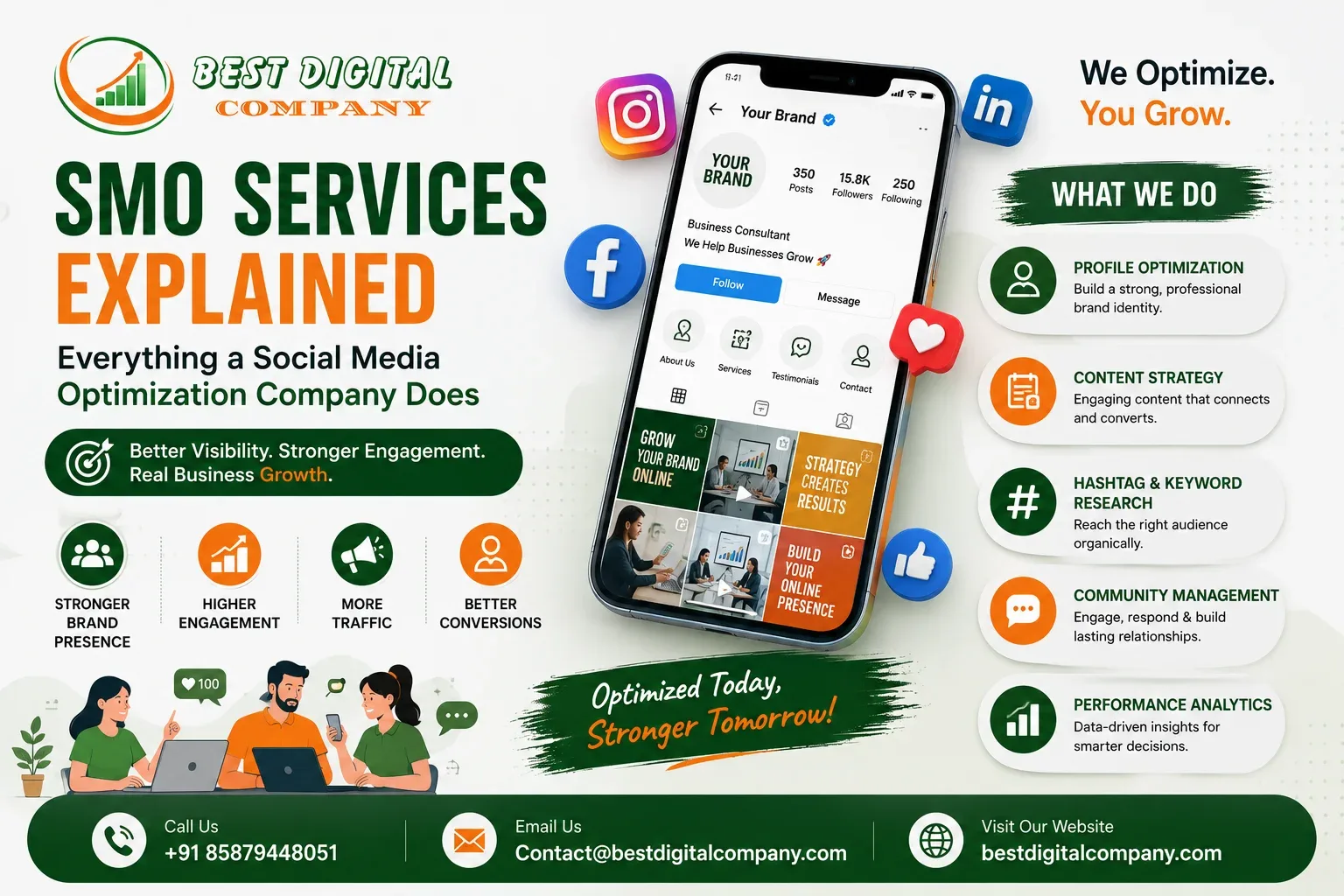
1. Profile and Bio Optimization

Every platform has fields most businesses fill in half-heartedly bio text, category tags, contact buttons, link-in-bio tools, keywords in the “about” section. A social media optimization company audits these first because an incomplete or poorly worded profile quietly loses potential customers before content even matters.

2. Content Planning and Calendar Management

Random posting rarely works. A proper content calendar maps out themes, formats (reels, carousels, static posts, stories), and posting times based on when your specific audience is actually active not generic “best time to post” advice copied from a blog.

3. Hashtag and Keyword Research

Just like websites rank on relevant search terms, social posts get discovered through the right mix of hashtags and on-platform keywords. This research changes by platform and by season, which is why it needs regular attention rather than a one-time list.

4. Community Management

Replying to comments, DMs, and mentions within a reasonable window is part of the job, not an afterthought. A brand that responds quickly and personally builds more trust than one with perfect graphics and silent comment sections.

5. Visual Consistency and Branding

Fonts, colors, templates, and tone need to feel recognizable across every post. This is where design work overlaps with your broader brand identity, and where a team familiar with your Website Development & Designing can keep your social presence and website visually aligned.

6. Analytics and Reporting

Follower counts alone tell you very little. A serious provider tracks reach, engagement rate, saves, shares, click-throughs to your website, and  most importantly which posts are actually driving inquiries or sales. Reports should connect activity to business outcomes, not just vanity numbers.

7. Competitor and Trend Monitoring

Watching what similar brands and industry trends are doing helps spot content gaps and format opportunities before they become oversaturated.

8. Platform-Specific Formatting

What works on LinkedIn rarely works the same way on Instagram, and a caption written for Facebook often needs trimming before it fits a Twitter/X post. Rather than copy-pasting one piece of content everywhere, a proper smo service reformats messaging, image dimensions, and even tone for each platform’s audience expectations. A carousel that performs well on Instagram might need to become a single strong graphic on LinkedIn, and a casual, funny caption that works on Instagram may need a more professional rewrite before it goes on LinkedIn.

9. Influencer and Collaboration Outreach

For many brands, a small, well-chosen set of collaborations a local micro-influencer, a complementary business, or a satisfied customer willing to share their experience does more for credibility than paid ads alone. Identifying the right partners, negotiating simple terms, and tracking whether a collaboration actually drove engagement or inquiries is often part of a broader social media optimization company’s scope, even if it isn’t advertised upfront.

How an SMO Service Fits Into a Bigger Marketing Picture

Social media rarely works well in isolation. The businesses that see the strongest results usually treat their smo service as one piece of a connected system rather than a standalone task.

For example, a well-optimized Instagram or LinkedIn profile can drive traffic to blog content, which supports your on-site Search Engine Optimization efforts by generating backlinks, shares, and signals of relevance. At the same time, retargeting audiences built through organic engagement often perform better in Pay Per Click campaigns, since the audience already has some familiarity with the brand.

This is also part of why Experience, Expertise, Authoritativeness, and Trustworthiness matters beyond just your website active, credible social profiles are one of the signals that reinforce a brand’s authority across the internet, not just on a single search engine.

What’s Included in Our SMO Packages

Every business has a different starting point, some need to build a presence from zero, others already have a following but no consistent strategy behind it. That’s why our SMO Packages are structured in tiers rather than offered as one-size-fits-all bundles.

Generally, a well-structured package includes:

  • A full audit of your existing profiles and competitor benchmarking
  • A monthly content calendar tailored to your industry and audience
  • Design and copywriting for each post, reel, or carousel
  • Hashtag and caption optimization for discoverability
  • Community management within agreed response times
  • Monthly performance reporting with clear, plain-language takeaways
  • Strategy adjustments based on what the data shows, not guesswork

If you are also investing in paid search or organic rankings, it’s worth reviewing our SEO Packages alongside your social strategy, since the two often share keyword research and audience insights that make both perform better together.

Signs You Need a Social Media Optimization Company

Not every business needs to outsource this work immediately, but certain signs usually point to the fact that doing it in-house isn’t scaling anymore:

  • Posting has become inconsistent — weeks go by with no activity, then a rush of five posts in a day
  • Engagement (comments, shares, saves) has been flat or declining for months
  • Nobody on the team has time to reply to DMs or comments promptly
  • Competitors are visibly more active and are getting more visible engagement
  • You have no clear reporting on what social media is actually contributing to leads or sales
  • Content still looks like a personal account rather than a brand

If two or more of these sound familiar, it is usually a sign that the current approach has hit its ceiling.

How to Choose the Right SMO Service Provider

Not every provider offering “social media management” is actually running a real optimization process. A few questions help separate genuine expertise from surface-level services:

Do they ask about your business goals before your content style? A provider who leads with “what colors do you like” instead of “who is your customer and what do you want them to do” is likely starting from the wrong end.

Can they show reporting, not just posts? Ask to see a sample report. If it only shows follower growth without any mention of engagement quality or website traffic, that’s a red flag.

Do they understand your industry’s platform mix? A B2B service business usually needs a different platform priority (often LinkedIn-first) than a retail brand that leans heavily on Instagram and Facebook.

Are they transparent about response times and processes? Community management only works if replies happen within hours, not days.

Do they connect social media to your broader digital presence? The strongest results usually come from providers who also understand search engine optimization and can see how social activity supports the rest of your online visibility, rather than treating it as a completely separate silo.

Common Mistakes Businesses Make With SMO

Even well-intentioned businesses fall into a few recurring traps:

Posting without a strategy. Content calendars built around “what should we post today” instead of clear themes tend to feel disjointed and rarely build momentum.

Ignoring comments and messages. A beautiful feed with unanswered questions in the comments sends the opposite of the intended signal.

Chasing follower counts instead of engagement. Ten thousand followers who never interact are worth far less than a thousand who comment, share, and buy.

Copying competitors instead of adapting to your own audience. What works for one brand’s tone and audience won’t automatically translate to another, even in the same industry.

Treating social media as separate from the rest of digital marketing. Businesses that keep their social team, their SEO efforts, and their PPC campaigns working in silos often see slower, less connected results than those who let the channels inform each other. For businesses trying to build early traction, it also helps to look at broader growth fundamentals. Our guide on getting a business’s first 100 customers covers a few of those overlapping strategies in more detail.

Measuring Whether Your SMO Service Is Actually Working

It’s worth setting expectations early: social media optimization is not usually a channel that produces overnight spikes. It compounds. The metrics worth watching monthly include:

  • Follower growth rate (steady, not explosive, is usually a healthier sign)
  • Engagement rate per post relative to follower count
  • Click-throughs from bio links or story links to your website
  • Direct messages or inquiries that mention social media as the source
  • Share of voice compared to two or three direct competitors

If a provider can’t explain these numbers in plain language during a monthly call, it’s a sign the reporting process needs to change a well-run SEO report philosophy of translating data into plain business language applies just as much to social media reporting.

What Does an SMO Service Typically Cost?

Pricing varies widely depending on scope the number of platforms managed, how many posts are produced weekly, whether paid boosting is included, and how much design or video work is involved. As a general guide:

  • Starter tier: Usually covers one or two platforms, a handful of posts per week, and basic monthly reporting. Suited to small local businesses just building a presence.
  • Growth tier: Adds more platforms, higher posting frequency, reels or short video content, and more detailed engagement tracking. This is where most established small-to-mid-sized businesses land.
  • Full-scale tier: Includes multi-platform management, influencer coordination, advanced analytics, and close integration with paid campaigns and website goals.

Rather than comparing providers purely on price per month, it’s worth comparing what’s actually delivered for that price number of deliverables, response time commitments, and reporting depth all matter more than the headline number. Our SMO Packages page breaks down what’s included at each tier so there are no surprises once the contract starts.

The Human Side of Social Media Optimization

It’s easy to reduce all of this to a checklist, but the businesses that get the most out of an smo service usually treat it as a relationship, not a vendor transaction. That means sharing real updates from the business a new product, a team milestone, a customer story rather than leaving the provider to invent content from nothing. It also means giving honest feedback when a post’s tone feels off, rather than assuming the team will guess what “feels right” for the brand.

The strongest results tend to come from a back-and-forth: the provider brings platform expertise and consistency, and the business brings the real, specific details that make content feel authentic rather than generic. Neither side can do it well alone.

Final Thoughts

An smo service isn’t about picking pretty templates or posting for the sake of staying active. Done properly, it’s a structured, ongoing process profile optimization, content strategy, community management, and reporting that ties back to real business results. A capable social media optimization company treats your social presence as part of a larger digital ecosystem, working alongside your website, your search visibility, and your paid campaigns rather than in isolation.

If your current social media efforts feel scattered, or if you’ve never actually seen a report that connects activity to leads, it might be time to have that conversation with a provider who can show their process clearly rather than just their post count.


Frequently Asked Questions

What does an SMO service actually include?

It typically includes profile optimization, a structured content calendar, graphic and caption creation, hashtag research, community management, and monthly performance reporting tied to business outcomes rather than just follower counts.

Is SMO the same as social media marketing?

Not exactly. SMO focuses on optimizing your organic presence profiles, content quality, and engagement while social media marketing can also include paid promotion and advertising campaigns built on top of that foundation.

How long does it take to see results from SMO?

Most businesses start noticing steadier engagement and follower quality within two to three months, though meaningful lead generation usually builds over four to six months of consistent work.

Do I need SMO if I already run paid social ads?

Yes. Paid ads bring in visibility, but an optimized profile and consistent content give visitors a reason to trust and follow your brand once the ad has done its job of getting them there.

Which platforms should a social media optimization company focus on?

It depends on your industry and audience. B2B businesses often prioritize LinkedIn, while retail and consumer brands typically lean on Instagram and Facebook. A good provider will base this on your actual customer behavior, not a default template.

How do I know if my current SMO provider is doing a good job?

Ask for a monthly report that connects activity (posts, engagement) to outcomes (traffic, inquiries, sales). If the reporting only shows follower growth with no deeper insight, it’s worth reassessing the relationship.