
If you have ever asked a vendor “what exactly am I paying for?” after signing up for social media help, you are not alone. Most business owners know they need a presence on Instagram, Facebook, and LinkedIn, but very few actually understand what happens behind the scenes once they hire someone to manage it. The term gets thrown around loosely, invoices arrive every month, and yet the connection between the work being done and the leads coming in often stays fuzzy.
This guide breaks down exactly what an smo service includes, what a social media optimization company actually does day to day, and how to tell if the one you are paying is doing real work or just scheduling a few posts and calling it strategy.
What Is an SMO Service, Really?
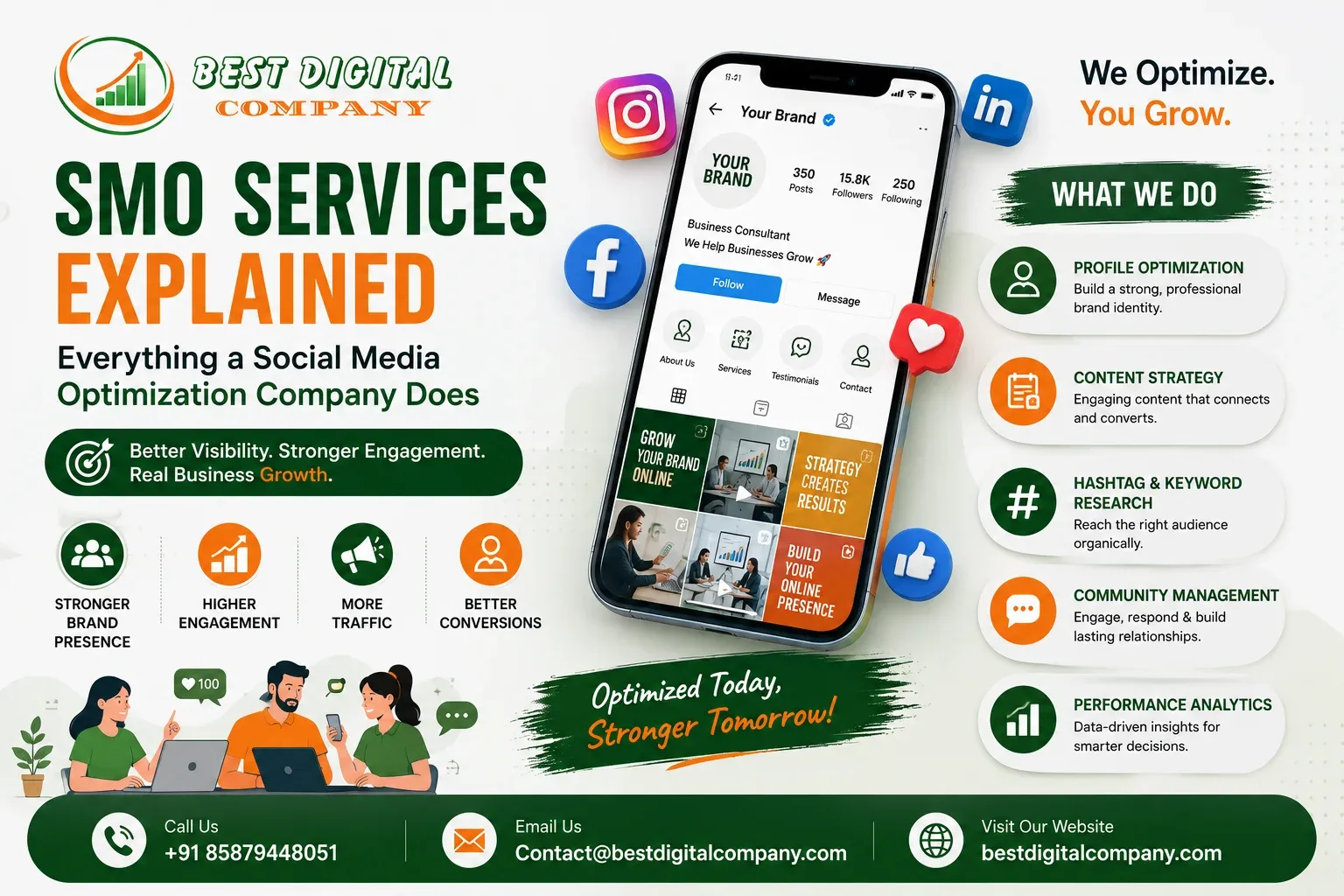
SMO stands for Social Media Optimization. It is the process of improving your social profiles, content, and engagement so that your brand shows up more often, looks more credible, and converts more followers into actual customers. Unlike a one-off ad campaign, an smo service is an ongoing discipline. It touches your profile setup, content calendar, hashtag research, community replies, analytics, and the way your brand’s voice comes across across platforms.
People sometimes confuse this with paid social advertising, but the two are different. Optimization is about the organic health of your presence how discoverable, trustworthy, and engaging your profiles are on their own while advertising is about paying to push content in front of new audiences. A serious social media marketing plan usually blends both, but optimization is the foundation that makes the paid spend work harder.
Why Businesses Are Hiring a Social Media Optimization Company in 2026
A few years ago, most small businesses treated social media as a side task something the office intern handled between other jobs. That has changed. Buyers now research brands on Instagram and LinkedIn before they ever visit a website, and a profile that looks abandoned or inconsistent quietly costs trust before a single conversation happens.
This shift is why more owners are choosing to work with a dedicated social media optimization company instead of managing it internally. A few reasons keep coming up in client conversations:
- Consistency is hard to maintain in-house. Posting drops off the moment someone gets busy, and gaps in activity are visible to anyone who checks your profile.
- Platforms change constantly. Instagram’s algorithm, LinkedIn’s reach rules, and Facebook’s ad policies shift often enough that keeping up requires dedicated attention, not a spare hour on a Friday.
- Buyers expect proof, not promises. Reviews, comments, and shared posts act as informal trust signals, and a team that manages this daily can shape those signals intentionally.
- Competitors are already investing here. Once one player in an industry starts showing up consistently with useful content, the rest usually have to catch up.
None of this means social media replaces other channels. It works best alongside a strong Search Engine Optimization foundation and, where budget allows, targeted Pay Per Click campaigns that bring in traffic while your organic presence builds over time.
Core Tasks Every SMO Service Handles
Here is where the vague marketing language usually falls apart. A genuine smo service is not just “posting content.” It is a set of specific, repeatable tasks. Here’s what should actually be happening behind your account each month.
1. Profile and Bio Optimization
Every platform has fields most businesses fill in half-heartedly bio text, category tags, contact buttons, link-in-bio tools, keywords in the “about” section. A social media optimization company audits these first because an incomplete or poorly worded profile quietly loses potential customers before content even matters.
2. Content Planning and Calendar Management
Random posting rarely works. A proper content calendar maps out themes, formats (reels, carousels, static posts, stories), and posting times based on when your specific audience is actually active not generic “best time to post” advice copied from a blog.
3. Hashtag and Keyword Research
Just like websites rank on relevant search terms, social posts get discovered through the right mix of hashtags and on-platform keywords. This research changes by platform and by season, which is why it needs regular attention rather than a one-time list.
4. Community Management
Replying to comments, DMs, and mentions within a reasonable window is part of the job, not an afterthought. A brand that responds quickly and personally builds more trust than one with perfect graphics and silent comment sections.
5. Visual Consistency and Branding
Fonts, colors, templates, and tone need to feel recognizable across every post. This is where design work overlaps with your broader brand identity, and where a team familiar with your Website Development & Designing can keep your social presence and website visually aligned.
6. Analytics and Reporting
Follower counts alone tell you very little. A serious provider tracks reach, engagement rate, saves, shares, click-throughs to your website, and most importantly which posts are actually driving inquiries or sales. Reports should connect activity to business outcomes, not just vanity numbers.
7. Competitor and Trend Monitoring
Watching what similar brands and industry trends are doing helps spot content gaps and format opportunities before they become oversaturated.
8. Platform-Specific Formatting
What works on LinkedIn rarely works the same way on Instagram, and a caption written for Facebook often needs trimming before it fits a Twitter/X post. Rather than copy-pasting one piece of content everywhere, a proper smo service reformats messaging, image dimensions, and even tone for each platform’s audience expectations. A carousel that performs well on Instagram might need to become a single strong graphic on LinkedIn, and a casual, funny caption that works on Instagram may need a more professional rewrite before it goes on LinkedIn.
9. Influencer and Collaboration Outreach
For many brands, a small, well-chosen set of collaborations a local micro-influencer, a complementary business, or a satisfied customer willing to share their experience does more for credibility than paid ads alone. Identifying the right partners, negotiating simple terms, and tracking whether a collaboration actually drove engagement or inquiries is often part of a broader social media optimization company’s scope, even if it isn’t advertised upfront.
How an SMO Service Fits Into a Bigger Marketing Picture
Social media rarely works well in isolation. The businesses that see the strongest results usually treat their smo service as one piece of a connected system rather than a standalone task.
For example, a well-optimized Instagram or LinkedIn profile can drive traffic to blog content, which supports your on-site Search Engine Optimization efforts by generating backlinks, shares, and signals of relevance. At the same time, retargeting audiences built through organic engagement often perform better in Pay Per Click campaigns, since the audience already has some familiarity with the brand.
This is also part of why Experience, Expertise, Authoritativeness, and Trustworthiness matters beyond just your website active, credible social profiles are one of the signals that reinforce a brand’s authority across the internet, not just on a single search engine.
What’s Included in Our SMO Packages
Every business has a different starting point, some need to build a presence from zero, others already have a following but no consistent strategy behind it. That’s why our SMO Packages are structured in tiers rather than offered as one-size-fits-all bundles.
Generally, a well-structured package includes:
- A full audit of your existing profiles and competitor benchmarking
- A monthly content calendar tailored to your industry and audience
- Design and copywriting for each post, reel, or carousel
- Hashtag and caption optimization for discoverability
- Community management within agreed response times
- Monthly performance reporting with clear, plain-language takeaways
- Strategy adjustments based on what the data shows, not guesswork
If you are also investing in paid search or organic rankings, it’s worth reviewing our SEO Packages alongside your social strategy, since the two often share keyword research and audience insights that make both perform better together.
Signs You Need a Social Media Optimization Company
Not every business needs to outsource this work immediately, but certain signs usually point to the fact that doing it in-house isn’t scaling anymore:
- Posting has become inconsistent — weeks go by with no activity, then a rush of five posts in a day
- Engagement (comments, shares, saves) has been flat or declining for months
- Nobody on the team has time to reply to DMs or comments promptly
- Competitors are visibly more active and are getting more visible engagement
- You have no clear reporting on what social media is actually contributing to leads or sales
- Content still looks like a personal account rather than a brand
If two or more of these sound familiar, it is usually a sign that the current approach has hit its ceiling.
How to Choose the Right SMO Service Provider
Not every provider offering “social media management” is actually running a real optimization process. A few questions help separate genuine expertise from surface-level services:
Do they ask about your business goals before your content style? A provider who leads with “what colors do you like” instead of “who is your customer and what do you want them to do” is likely starting from the wrong end.
Can they show reporting, not just posts? Ask to see a sample report. If it only shows follower growth without any mention of engagement quality or website traffic, that’s a red flag.
Do they understand your industry’s platform mix? A B2B service business usually needs a different platform priority (often LinkedIn-first) than a retail brand that leans heavily on Instagram and Facebook.
Are they transparent about response times and processes? Community management only works if replies happen within hours, not days.
Do they connect social media to your broader digital presence? The strongest results usually come from providers who also understand search engine optimization and can see how social activity supports the rest of your online visibility, rather than treating it as a completely separate silo.
Common Mistakes Businesses Make With SMO
Even well-intentioned businesses fall into a few recurring traps:
Posting without a strategy. Content calendars built around “what should we post today” instead of clear themes tend to feel disjointed and rarely build momentum.
Ignoring comments and messages. A beautiful feed with unanswered questions in the comments sends the opposite of the intended signal.
Chasing follower counts instead of engagement. Ten thousand followers who never interact are worth far less than a thousand who comment, share, and buy.
Copying competitors instead of adapting to your own audience. What works for one brand’s tone and audience won’t automatically translate to another, even in the same industry.
Treating social media as separate from the rest of digital marketing. Businesses that keep their social team, their SEO efforts, and their PPC campaigns working in silos often see slower, less connected results than those who let the channels inform each other. For businesses trying to build early traction, it also helps to look at broader growth fundamentals. Our guide on getting a business’s first 100 customers covers a few of those overlapping strategies in more detail.
Measuring Whether Your SMO Service Is Actually Working
It’s worth setting expectations early: social media optimization is not usually a channel that produces overnight spikes. It compounds. The metrics worth watching monthly include:
- Follower growth rate (steady, not explosive, is usually a healthier sign)
- Engagement rate per post relative to follower count
- Click-throughs from bio links or story links to your website
- Direct messages or inquiries that mention social media as the source
- Share of voice compared to two or three direct competitors
If a provider can’t explain these numbers in plain language during a monthly call, it’s a sign the reporting process needs to change a well-run SEO report philosophy of translating data into plain business language applies just as much to social media reporting.
What Does an SMO Service Typically Cost?
Pricing varies widely depending on scope the number of platforms managed, how many posts are produced weekly, whether paid boosting is included, and how much design or video work is involved. As a general guide:
- Starter tier: Usually covers one or two platforms, a handful of posts per week, and basic monthly reporting. Suited to small local businesses just building a presence.
- Growth tier: Adds more platforms, higher posting frequency, reels or short video content, and more detailed engagement tracking. This is where most established small-to-mid-sized businesses land.
- Full-scale tier: Includes multi-platform management, influencer coordination, advanced analytics, and close integration with paid campaigns and website goals.
Rather than comparing providers purely on price per month, it’s worth comparing what’s actually delivered for that price number of deliverables, response time commitments, and reporting depth all matter more than the headline number. Our SMO Packages page breaks down what’s included at each tier so there are no surprises once the contract starts.
The Human Side of Social Media Optimization
It’s easy to reduce all of this to a checklist, but the businesses that get the most out of an smo service usually treat it as a relationship, not a vendor transaction. That means sharing real updates from the business a new product, a team milestone, a customer story rather than leaving the provider to invent content from nothing. It also means giving honest feedback when a post’s tone feels off, rather than assuming the team will guess what “feels right” for the brand.
The strongest results tend to come from a back-and-forth: the provider brings platform expertise and consistency, and the business brings the real, specific details that make content feel authentic rather than generic. Neither side can do it well alone.
Final Thoughts
An smo service isn’t about picking pretty templates or posting for the sake of staying active. Done properly, it’s a structured, ongoing process profile optimization, content strategy, community management, and reporting that ties back to real business results. A capable social media optimization company treats your social presence as part of a larger digital ecosystem, working alongside your website, your search visibility, and your paid campaigns rather than in isolation.
If your current social media efforts feel scattered, or if you’ve never actually seen a report that connects activity to leads, it might be time to have that conversation with a provider who can show their process clearly rather than just their post count.
Frequently Asked Questions
What does an SMO service actually include?
It typically includes profile optimization, a structured content calendar, graphic and caption creation, hashtag research, community management, and monthly performance reporting tied to business outcomes rather than just follower counts.
Is SMO the same as social media marketing?
Not exactly. SMO focuses on optimizing your organic presence profiles, content quality, and engagement while social media marketing can also include paid promotion and advertising campaigns built on top of that foundation.
How long does it take to see results from SMO?
Most businesses start noticing steadier engagement and follower quality within two to three months, though meaningful lead generation usually builds over four to six months of consistent work.
Do I need SMO if I already run paid social ads?
Yes. Paid ads bring in visibility, but an optimized profile and consistent content give visitors a reason to trust and follow your brand once the ad has done its job of getting them there.
Which platforms should a social media optimization company focus on?
It depends on your industry and audience. B2B businesses often prioritize LinkedIn, while retail and consumer brands typically lean on Instagram and Facebook. A good provider will base this on your actual customer behavior, not a default template.
How do I know if my current SMO provider is doing a good job?
Ask for a monthly report that connects activity (posts, engagement) to outcomes (traffic, inquiries, sales). If the reporting only shows follower growth with no deeper insight, it’s worth reassessing the relationship.

Add a Comment