AI Search SEO 2026: How It's Changing SEO for Business

How AI Search Is Changing SEO in 2026: What Businesses Need to Know

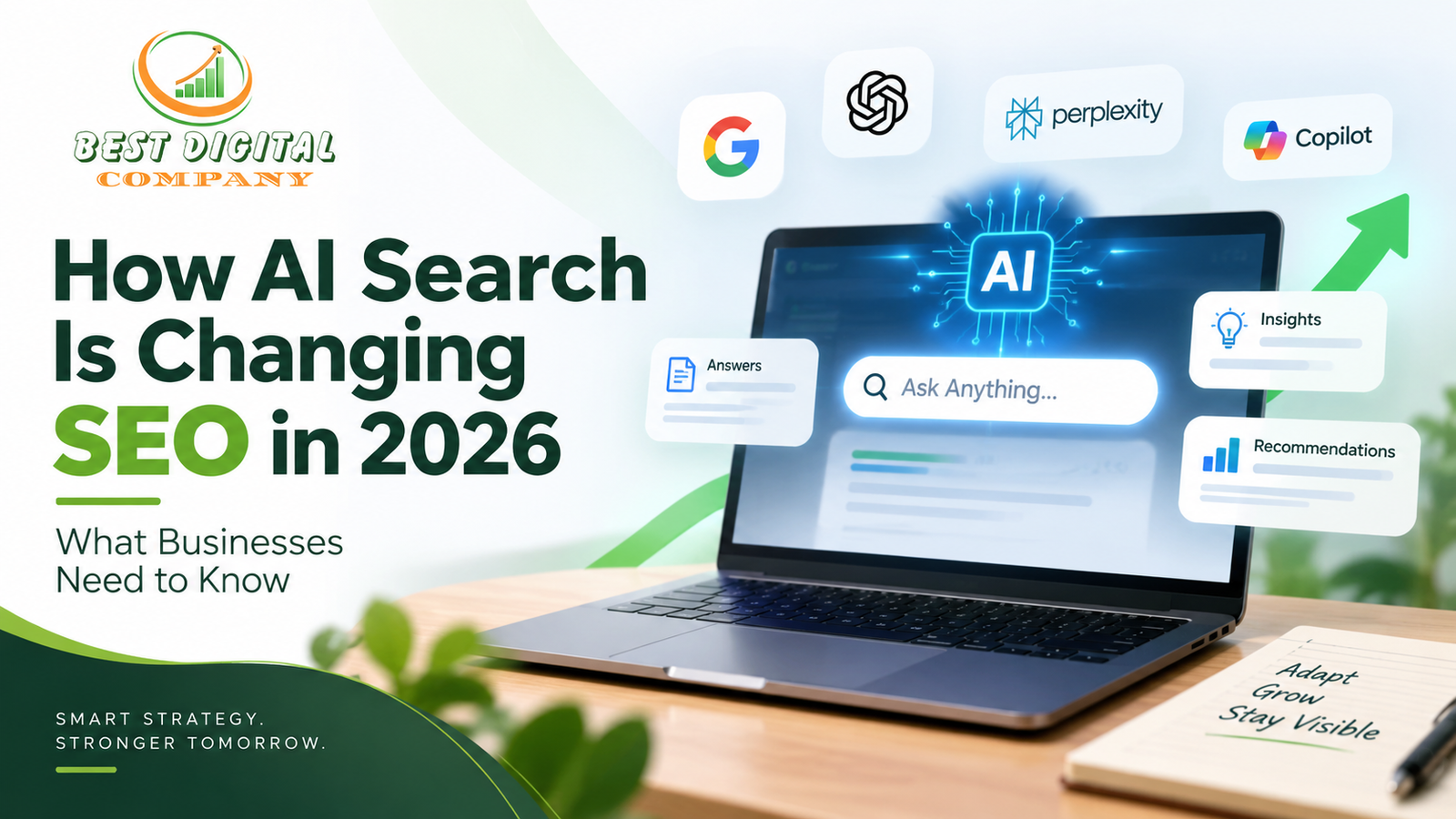
Type a question into Google today and there is a good chance you will not click a single blue link before you get an answer. An AI-generated summary sits right at the top, pulling information from several sources at once, and a growing number of people stop reading right there. Add to that the rise of ChatGPT, Perplexity, and Copilot as everyday research tools, and it becomes clear that the way people “search” has quietly changed shape.

For business owners who spent years learning how to rank a page on Google, this shift can feel unsettling. The rules that worked in 2020 or even 2023 do not fully apply anymore. But this is not the end of search visibility — it is a new phase of it. Understanding AI search SEO now is what will separate businesses that keep showing up in front of customers from those that quietly disappear from view over the next couple of years.

This guide breaks down what has actually changed, why it matters, and what a business whether it runs a single local shop or manages a national brand should be doing differently in 2026.

What Is AI Search SEO and Why 2026 Is a Turning Point

AI search SEO refers to the practice of optimizing content, structure, and authority signals so that a brand gets picked up not just in traditional organic listings, but also inside AI-generated answers, chat-based assistants, and summary boxes that appear before or instead of a standard list of website links.

The difference sounds small until you look at the numbers. Search engines are no longer just indexing pages and ranking them by relevance and links. They are reading, summarizing, and synthesizing information from multiple pages to construct a single answer. That answer often satisfies the user’s question completely, which means there is no guarantee of a click at all.

2026 is being treated as a turning point for a few reasons:

  • AI-generated summaries now appear on a large share of everyday queries, not just complex research questions.
  • Conversational assistants have become a genuine alternative entry point for shopping, comparing services, and getting recommendations.
  • Search engines are placing far more weight on demonstrated expertise and trustworthiness, not just keyword matching.
  • Voice search and multi-step conversational queries are pushing content to answer follow-up questions, not just the first one.

None of this means classic SEO principles are dead. It means the target has expanded. You are no longer optimizing for one results page — you are optimizing for how machines understand, trust, and repeat what you say about your own business.

How AI Search Engines Actually Decide What to Show

It helps to understand the mechanics before changing a content strategy. AI-powered search tools generally work in two overlapping ways.

Retrieval-based answers. Tools like Google’s AI Overviews and Bing’s Copilot pull from indexed web pages in real time (or near real time), select the passages that best answer the query, and stitch them into a readable summary with citations. This means your page still needs strong traditional optimization clear headings, fast load times, structured data because the AI has to find and understand your content before it can use it.

Trained knowledge plus retrieval. Tools like ChatGPT and Perplexity blend what they learned during training with live web lookups. For a business, this means your reputation across the internet reviews, mentions in industry publications, consistent business information, social proof  matters just as much as your own website content. The AI is not only asking “what does this page say,” it is effectively asking “how many trustworthy places already say the same thing about this business.”

This is why AI search SEO is less about chasing a single trick and more about building a consistent, well-documented, genuinely useful presence across your website and the wider internet.

Why Old-School SEO Tactics Alone No Longer Work

A lot of businesses are still running the same playbook they used five years ago: stuff a keyword into a title tag, publish a few hundred words, build some backlinks, wait. That approach used to be enough to get a page ranking on a results page. It is no longer enough to get a business mentioned inside an AI-generated answer.

Here is what has changed on the ground:

  • Thin content gets skipped. AI systems are trained to summarize genuinely useful information. A page that repeats the keyword five times but says very little tends to get ignored in favor of a competitor’s more detailed, well-organized page.
  • Generic, templated writing is easy to detect. Search engines have gotten noticeably better at identifying content that reads like it was mass-produced without a real person’s input, and they now actively favor pages that show original thinking, direct experience, and a clear point of view.
  • Keyword density matters far less than clarity of intent. AI models are built to understand meaning, not just match words. A page that clearly answers “how much does SEO cost in Delhi” in plain language will often outperform a page dense with keyword repetition but light on a direct answer.
  • Backlinks alone don’t build trust the way they used to. Links still matter, but AI search tools also weigh things like consistent business details across the web, credible mentions, and demonstrated expertise in the subject.

The businesses adapting well right now are the ones treating their website like a genuine resource for their audience not a container for keywords.

What AI Search SEO Means for Content Strategy in 2026

If AI tools are summarizing your content instead of just linking to it, your content has to be built differently.

Answer the actual question, early and clearly. Structure content so the core answer appears near the top, with supporting detail underneath. AI summarization tools tend to favor content that states its point plainly rather than building up to it over several paragraphs.

Write like a person who has actually done the work. Specific numbers, real examples, and small details that only come from direct experience are what make content genuinely useful — and they are also what current search systems are actively trying to reward, as part of a broader push toward human-written, experience-based content rather than generic filler.

Structure for scanning and citation. Use clear headings, short paragraphs, and organized lists where they genuinely help the reader. AI systems tend to pull cleanly formatted sections into their summaries far more easily than dense blocks of text.

Cover the full topic, not just the headline keyword. If someone is researching AI search SEO, they are also likely wondering about related questions cost, timeline, tools, risks. Covering these naturally within one well-organized piece, rather than spreading thin content across a dozen shallow pages, tends to perform better.

Update content regularly. AI systems favor pages that reflect current information. A page written in 2022 that still references outdated statistics or old platform names signals staleness, both to readers and to the systems evaluating trustworthiness.

The Growing Role of Professional SEO Services in an AI-First World

A common misconception is that AI search reduces the need for SEO expertise. In practice, it has raised the bar. Getting a business surfaced inside an AI-generated answer requires technical groundwork (structured data, crawlability, page speed), consistent content strategy, and ongoing authority-building all at once.

This is exactly why working with an experienced Search Engine Optimization partner matters more now than it did a few years ago. A capable SEO team is not just chasing rankings on a results page anymore; it is managing how a brand is represented across the entire information ecosystem that AI models draw from your website, your Google Business Profile, third-party reviews, and industry mentions.

For businesses that operate across multiple cities, this also means location-specific strategy still has a place. Companies exploring SEO services in Haryana or comparing options like an SEO company in Gurugram versus an SEO agency in Gurgaon are often trying to solve the same underlying problem: how do we stay visible when the way people search keeps shifting under our feet. The city-level detail changes, but the fundamentals of AI search SEO — clarity, trust signals, and consistent information apply everywhere.

Why Local SEO Still Matters in the Age of AI Search

It’s tempting to assume that AI search is a global, generic phenomenon that erases the value of local optimization. The opposite is closer to the truth. When someone asks an AI assistant “who’s a reliable digital marketing agency near me” or “best SEO company in my city,” the assistant still relies heavily on localized signals Google Business Profile accuracy, local reviews, and location-specific content to shape its answer.

This is why local SEO in Delhi remains a distinct discipline rather than something AI search has made irrelevant. If your business information is inconsistent across directories, or your Google Business Profile hasn’t been updated in a year, AI-driven answers are less likely to trust or recommend you regardless of how good your website content is.

Businesses researching options like SEO services in Punjab, or comparing an SEO expert in Bangalore against a freelancer, are usually trying to answer the same question from a different city: who can actually keep our business visible as search itself keeps changing. The honest answer is that local groundwork accurate listings, genuine local reviews, location-relevant content is now a foundation for AI search SEO, not a separate, optional add-on.

How Social Media Signals Influence AI Search Visibility

Search and social media used to be treated as separate channels with separate strategies. That line has blurred considerably. AI search tools increasingly factor in social proof mentions, engagement patterns, and brand consistency across platforms when deciding how much to trust a business.

This doesn’t mean a viral post will get you cited in an AI answer. It means that an active, consistent, and credible social presence contributes to the overall trust picture that AI systems are trying to build about your brand. A well-run Social Media Marketing strategy that keeps your business name, offerings, and customer interactions consistent across Instagram, Facebook, and LinkedIn adds another layer of verifiable information that supports your visibility in AI-driven search.

Businesses that have historically treated their SMO strategy as separate from their SEO efforts are increasingly finding value in aligning the two same messaging, same service descriptions, same location details because that consistency is now part of what determines whether AI models treat a brand as a credible source.

Pay Per Click and AI Search: Do Ads Still Matter?

With AI-generated answers taking up more space at the top of results pages, many business owners are asking whether paid advertising is still worth the investment. The short answer is yes, but its role is shifting.

As organic visibility becomes harder to guarantee inside AI summaries especially in competitive industries Pay Per Click advertising offers something AI search SEO cannot: a controlled, immediate placement in front of ready-to-buy customers. Businesses that have used Google Ads to generate faster leads are finding that a combined strategy solid organic content built for AI search alongside targeted PPC campaigns provides more consistent visibility than relying on either channel alone.

Think of it this way: AI search SEO builds long-term trust and visibility that compounds over time. PPC fills the gap while that trust is being built, and continues to deliver targeted traffic even after your organic presence matures.

Website Development, Technical SEO, and AI Crawlability

Content quality matters, but AI-driven search tools also need to physically access and understand your website before any of that content can help you. This is where technical foundations come back into focus.

A slow, poorly structured, or outdated website creates real friction for both traditional search crawlers and the newer AI systems trying to retrieve information. Clean HTML structure, fast load times, mobile responsiveness, and properly implemented structured data (schema markup) all make it easier for AI tools to correctly interpret what your business does and who it serves.

This is precisely why Website Development and Designing has become inseparable from a modern SEO strategy rather than a one-time setup task. A business with excellent content sitting on a slow, cluttered, or badly coded website is fighting an uphill battle that no amount of writing can fully offset.

Building E-E-A-T for AI Search SEO Success

Google’s long-standing quality framework experience, expertise, authoritativeness, and trustworthiness has become even more central in an AI-driven search environment. These four elements are essentially what AI systems are trying to measure, in different forms, when they decide which sources to trust and cite.

A few practical ways businesses can strengthen this:

  • Show real experience. Case studies, project results, and specific outcomes (not vague claims) demonstrate that you’ve actually done the work you’re writing about.
  • Credit real authors. Content attributed to a named person with relevant background carries more weight than anonymous or generic “admin” posts.
  • Keep information accurate and current. Outdated statistics, dead links, or old service details undermine trust quickly.
  • Earn mentions from credible third parties. Reviews, press mentions, and citations from other reputable sites all feed into how trustworthy your business appears to both human readers and AI systems.
  • Be transparent about who you are. Clear “About Us” information, verifiable contact details, and a consistent business address across the web all contribute to trust signals that AI-driven evaluation increasingly relies on.

None of this is new advice, exactly but it has moved from “good practice” to genuinely essential as AI systems take on a larger role in deciding which businesses get recommended.

Practical Steps Businesses Should Take Right Now

Rather than trying to overhaul everything at once, most businesses see the best results by working through a few priorities in order:

  1. Audit existing content for genuine usefulness. Identify thin, outdated, or purely keyword-stuffed pages and either rewrite them with real depth or remove them.
  2. Fix technical gaps. Confirm your site loads quickly, works well on mobile, and has proper schema markup so AI crawlers can understand it easily.
  3. Strengthen local listings. Make sure your business name, address, phone number, and service details are identical across your website, Google Business Profile, and directories.
  4. Build a consistent cross-channel presence. Align your website content with your social media messaging so AI systems see one consistent story about your business.
  5. Invest in original, experience-based content. Prioritize depth and real examples over volume. A handful of thorough, well-researched pages will outperform dozens of shallow ones.
  6. Monitor how your brand appears in AI answers. Periodically ask AI tools questions related to your industry and location to see whether and how your business shows up.

Businesses that treat this as an ongoing process, rather than a one-time fix, are the ones building durable visibility as AI search continues to evolve through 2026 and beyond.

Frequently Asked Questions

What exactly is AI search SEO?

AI search SEO is the practice of optimizing a website’s content, structure, and off-site reputation so that it gets picked up not only by traditional search rankings but also by AI-generated answers, summaries, and conversational search tools like AI Overviews, ChatGPT, and Perplexity.

Is traditional SEO no longer relevant in 2026?

Traditional SEO fundamentals quality content, technical performance, and backlinks are still relevant. What has changed is that they are no longer sufficient on their own. Businesses now also need to focus on clarity, demonstrated expertise, and consistent trust signals across the web to be picked up by AI-driven search.

Will AI search reduce website traffic?

For some types of informational queries, yes — users may get their answer directly from an AI summary without clicking through. However, businesses that build genuinely useful, well-structured content often still get cited and clicked, particularly for queries where the user wants more detail, pricing, or a specific local recommendation.

How long does it take to see results from AI search optimization?

Similar to traditional SEO, meaningful results typically take a few months of consistent effort, since AI systems rely partly on accumulated trust signals reviews, mentions, and content depth  that build up gradually rather than overnight.

Does local SEO still matter if AI handles most searches now?

Yes. AI assistants rely heavily on accurate, localized information business listings, reviews, and location-specific content to answer location-based queries. Local SEO remains a core part of getting recommended by AI tools for “near me” type searches.

Should small businesses worry about AI search changes?

Small and local businesses are actually well positioned to benefit, since AI search tools tend to favor genuine, specific, experience-based content over generic corporate copy something smaller businesses can often produce more naturally than larger competitors.

Final Thoughts

AI search is not replacing the need for good SEO — it is raising the standard for what “good” actually means. The businesses that will do well through the rest of 2026 are the ones building genuinely useful content, keeping their technical foundation solid, staying consistent across every channel where customers might encounter them, and treating trust as something to be earned deliberately rather than assumed.

If you are unsure where your business currently stands in this shifting landscape, a practical first step is a clear-eyed audit of your website, content, and online presence followed by a strategy built around how people (and the AI tools they now use) actually search today.
Performance Marketing Company vs Traditional Ad Agency

Performance Marketing Company vs Traditional Ad Agency: What is the Real Difference?

If you have sat through a pitch meeting recently, you have probably heard both phrases thrown around like they mean the same thing. “We are a full-service agency.” “We are performance-driven.” “We focus on ROI.” Somewhere in that word salad, most business owners quietly nod along and hope the invoice at the end of the month will explain what they actually bought.

It won’t.

The confusion is understandable. Traditional ad agencies and a performance marketing company both promise to grow your brand, both build campaigns, and both send you decks full of charts. But the way they get paid, the way they measure success, and the way they treat your budget are fundamentally different. One is built around a philosophy of “creative first, measure later.” The other is built around a philosophy of “measure everything, then create around what works.” Confusing the two can cost you months of budget and a marketing plan that looks good in a boardroom but does nothing for your bank account.

This article breaks down exactly how these two models differ, where each one genuinely shines, and how to figure out which approach actually fits the stage your business is at right now.

What a Performance Marketing Company Actually Does

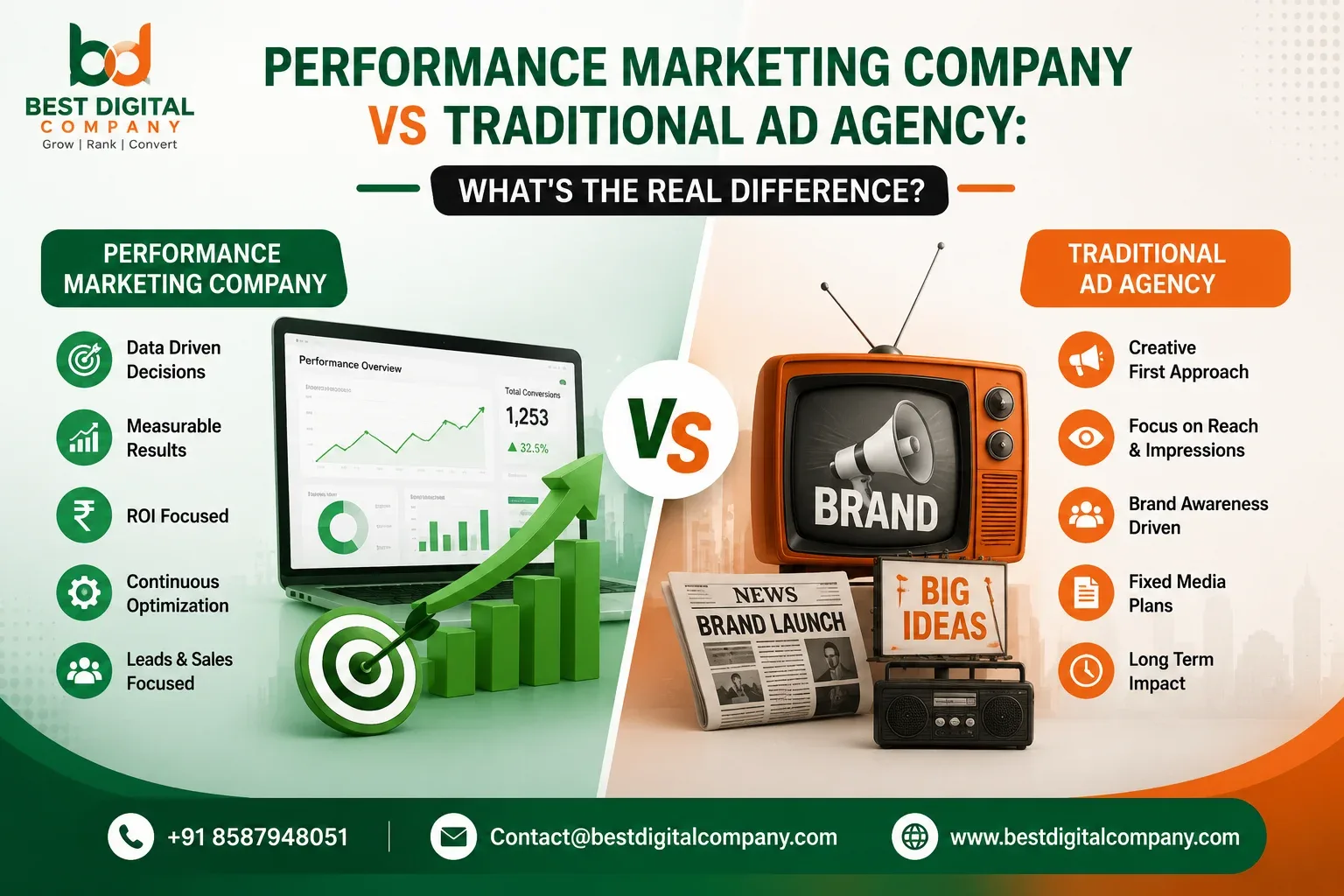
A performance marketing company builds every campaign around a measurable action: a lead form filled, a product purchased, a call placed, an app installed. Nothing gets a green light unless it can be tracked back to a number. If a social post, a landing page, or an ad creative isn’t contributing to that number, it gets changed or dropped, usually within days rather than months.

This is a very different mindset from “brand awareness” campaigns, where success is judged by impressions, reach, or how many people saw the ad. A performance-focused team treats visibility as a means to an end, not the end itself. The question is never “did people see this?” It’s “did people act on this, and can we afford to keep doing it at scale?”

In practice, this usually means combining a few disciplines under one roof:

  • Paid advertising across Google, Meta, and other platforms, managed with tight budget controls and daily optimization
  • Landing page testing to see which version actually converts visitors into leads or customers
  • Search visibility work so that organic traffic supports paid spend instead of competing against it
  • Analytics and attribution to trace every rupee spent back to a result

If any of that sounds familiar, it is because it overlaps heavily with services like pay per click management and search engine optimization except the performance model ties them together under one shared scoreboard: revenue, not vanity metrics.

What a Traditional Ad Agency Actually Does

A traditional ad agency has a different starting point. The work usually begins with a brand strategy session, mood boards, a creative concept, and a media plan built around reach and frequency. The goal is to build recognition and emotional association with a brand over time, the kind of work you see in television commercials, billboards, and large-scale brand campaigns.

There is real craft in this. A good traditional agency can shape how a brand sounds, looks, and feels across every touchpoint. Automobile launches, FMCG brands, and large consumer campaigns still rely heavily on this model because the goal isn’t an immediate click, it’s staying power in a customer’s memory.

The tradeoff is measurement. Reach, impressions, and brand recall studies are far harder to tie directly to sales. A traditional campaign might genuinely be working, shaping perception and consideration, while looking “flat” on a spreadsheet for months. That’s fine for a company with a large budget and a long runway. It’s much riskier for a business that needs leads or sales this quarter, not brand equity in three years.

Performance Marketing Company vs Traditional Ad Agency: The Core Differences

Let is put the two side by side, because the differences show up in almost every part of how the work actually happens.

How Success Gets Measured

A performance marketing company reports on cost per lead, cost per acquisition, conversion rate, and return on ad spend. A traditional ad agency reports on reach, impressions, brand recall, and share of voice. Neither number is “fake,” but they answer completely different questions. One tells you whether the campaign made money. The other tells you whether people noticed.

How Budgets Are Handled

Performance budgets are usually flexible and reallocated weekly, sometimes daily, based on what’s converting. If a Google Ads keyword group is outperforming a Meta campaign, budget shifts there almost immediately. Traditional ad agency budgets tend to be locked into a media plan for a full quarter or campaign cycle, because television slots, print placements, and large creative productions don’t allow for that kind of daily flexibility.

How Pricing Works

This is one of the biggest practical differences. Traditional agencies commonly charge a retainer or a percentage of ad spend, regardless of the direct outcome. A performance marketing company is far more likely to tie at least part of its fee to results, whether that’s cost per lead targets or agreed conversion benchmarks. This alone changes the incentive structure of the entire relationship.

Speed of Optimization

A performance team might test five ad variations in a week and kill the two that underperform by day three. A traditional agency, working within a bigger creative and production cycle, usually can’t move that fast, and honestly, isn’t trying to. Big brand campaigns need consistency, not constant tweaking.

The Skills Involved

Traditional agencies lean heavily on creative directors, copywriters, and media planners. Performance marketing companies lean on paid media specialists, conversion rate optimizers, and analysts who live inside dashboards. Some businesses actually need both, which is why understanding what a google ads expert does day to day versus what a full agency team handles can help you decide who to bring in first.

Why This Distinction Matters More in 2026

A few years ago, this line was blurrier because most agencies claimed to do everything. But tighter marketing budgets, more advanced tracking tools, and increased pressure to show real business impact have pushed the industry to specialize. Business owners today are asking sharper questions before signing contracts: what did last month’s spend actually generate, and can you prove it.

That shift favors performance-based models because they were built for exactly this kind of scrutiny. A performance marketing company lives and dies by dashboards that show, in real time, whether spend is translating into leads or sales. There’s nowhere to hide behind a nicely produced brand video if the conversion numbers aren’t there.

This doesn’t mean brand-building is dead. It means most small and mid-sized businesses, especially those without a multi-year runway, are better served starting with performance-driven work and adding brand campaigns once there’s steady revenue to protect.

Where a Traditional Ad Agency Still Makes Sense

It would be misleading to say the traditional model is obsolete, because it is not. There are situations where it is genuinely the smarter choice:

  • Large product launches that need mass awareness before any purchase intent even exists
  • Established brands protecting market position rather than chasing immediate conversions
  • Categories with long sales cycles, like real estate or enterprise software, where a single ad rarely leads to an instant sale
  • Businesses with the budget and patience to invest in recall and reputation over a longer horizon

If your business fits one of these, blending brand-building with performance tactics, rather than picking only one, often produces the best long-term outcome.

Where a Performance Marketing Company Wins

On the other hand, a performance-first approach tends to be the better fit when:

  • You need leads or sales within weeks, not quarters
  • Your budget is limited and every rupee needs to be justified
  • You are a local business, e-commerce store, or service provider competing on visibility and conversions rather than mass brand recognition
  • You want clear reporting that ties spend directly to outcomes rather than abstract reach numbers

This is also where the overlap with a company’s broader digital presence matters. Paid campaigns rarely perform in isolation. A performance marketing company usually pairs paid ads with organic visibility work, active social media marketing, and a website that’s actually built to convert the traffic being paid for. Sending expensive clicks to a slow, cluttered, or outdated site is one of the fastest ways to waste an ad budget, which is why website development and design often ends up being part of the same conversation, not a separate project handled months later.

A Practical Example

Picture two businesses running the exact same monthly ad budget.

Business A hires a traditional ad agency. They get a polished campaign concept, a media plan spread across a few platforms, and monthly reporting focused on impressions and reach. Three months in, brand awareness has genuinely improved, but leads are inconsistent, and nobody can say with certainty which specific ad or platform is driving actual inquiries.

Business B hires a performance marketing company. Within the first two weeks, three ad variations are tested, the underperforming ones are paused, and budget is shifted toward the landing page generating the most form fills. By month two, the cost per lead has dropped, and the reporting shows exactly which keyword, ad, and platform combination is producing the best return.

Neither business made a wrong choice in principle, they just had different goals. But if Business B actually needed sales this quarter, the performance approach clearly served that need faster and more transparently.

Red Flags to Watch For, Regardless of Which Model You Choose

Whether you’re evaluating a traditional agency or a performance marketing company, a few warning signs apply across the board. Vague reporting that only shows impressions when you asked about leads. Long-term contracts with no clear exit or review point. A refusal to explain exactly how your budget is being spent across platforms. These issues aren’t unique to one model, they’re signs of a vendor relationship that isn’t built on transparency. If any of this sounds familiar from past experience, it is worth reading through common warning signs when evaluating a pay-per-click partner before signing another contract.

How to Choose the Right Fit for Your Business

Instead of asking “which one is better,” a more useful question is: what does my business actually need right now?

If you need measurable leads, tighter cost control, and fast optimization, a performance marketing company is almost certainly the better starting point. If you’re building a long-term brand with a bigger budget and a longer timeline, blending brand strategy with performance tactics tends to work better than choosing purely one lane.

The businesses that get the most value usually don’t treat this as a permanent, one-time decision either. They start with performance-focused work to build a stable base of leads and revenue, then layer in brand-building campaigns once there’s enough consistent income to support a longer-term investment.

Final Thoughts

The difference between a performance marketing company and a traditional ad agency isn’t just terminology, it’s a difference in philosophy, pricing, speed, and accountability. One is built to prove its worth in numbers you can check weekly. The other is built to shape how your brand is remembered over time. Neither approach is automatically wrong, but picking the one that matches your business stage, budget, and timeline will save you months of second-guessing and a lot of unclear invoices.

If you’re trying to figure out which model fits your business, or you want a team that can move between performance-driven campaigns and long-term brand growth as your needs change, it helps to talk through your specific goals with a team that works across search engine optimization, paid media, social platforms, and website performance, rather than one narrow specialty.


Frequently Asked Questions

What exactly is a performance marketing company?

It’s an agency or team that builds campaigns around measurable actions, like leads, sales, or app installs, rather than general brand visibility. Every rupee spent is expected to tie back to a trackable result.

Is a performance marketing company cheaper than a traditional ad agency?

Not necessarily cheaper, but usually more efficient with budget in the short term, since underperforming campaigns get cut quickly instead of running for a full quarter regardless of results.

Can a traditional ad agency also do performance marketing?

Some can, if they have dedicated paid media and analytics teams. But many traditional agencies are structured around creative and media planning, not real-time optimization, so it’s worth asking directly how they handle tracking and reporting before assuming they can.

How fast can I expect results from a performance marketing company?

Early signals, like click-through rates and initial lead volume, often show up within the first two to three weeks. Meaningful, stable results usually take six to eight weeks as campaigns are tested and refined.

Do small businesses need a traditional ad agency at all?

Most small and mid-sized businesses are better served starting with performance-driven work, since it delivers measurable leads faster on a limited budget. Brand-building campaigns tend to make more sense once there’s steady revenue to protect.

What should I ask before hiring either type of agency?

Ask exactly how success will be measured, how often budgets are reviewed, what reporting looks like, and whether there’s a minimum contract lock-in. Clear answers to these questions usually separate a trustworthy partner from a vague one.

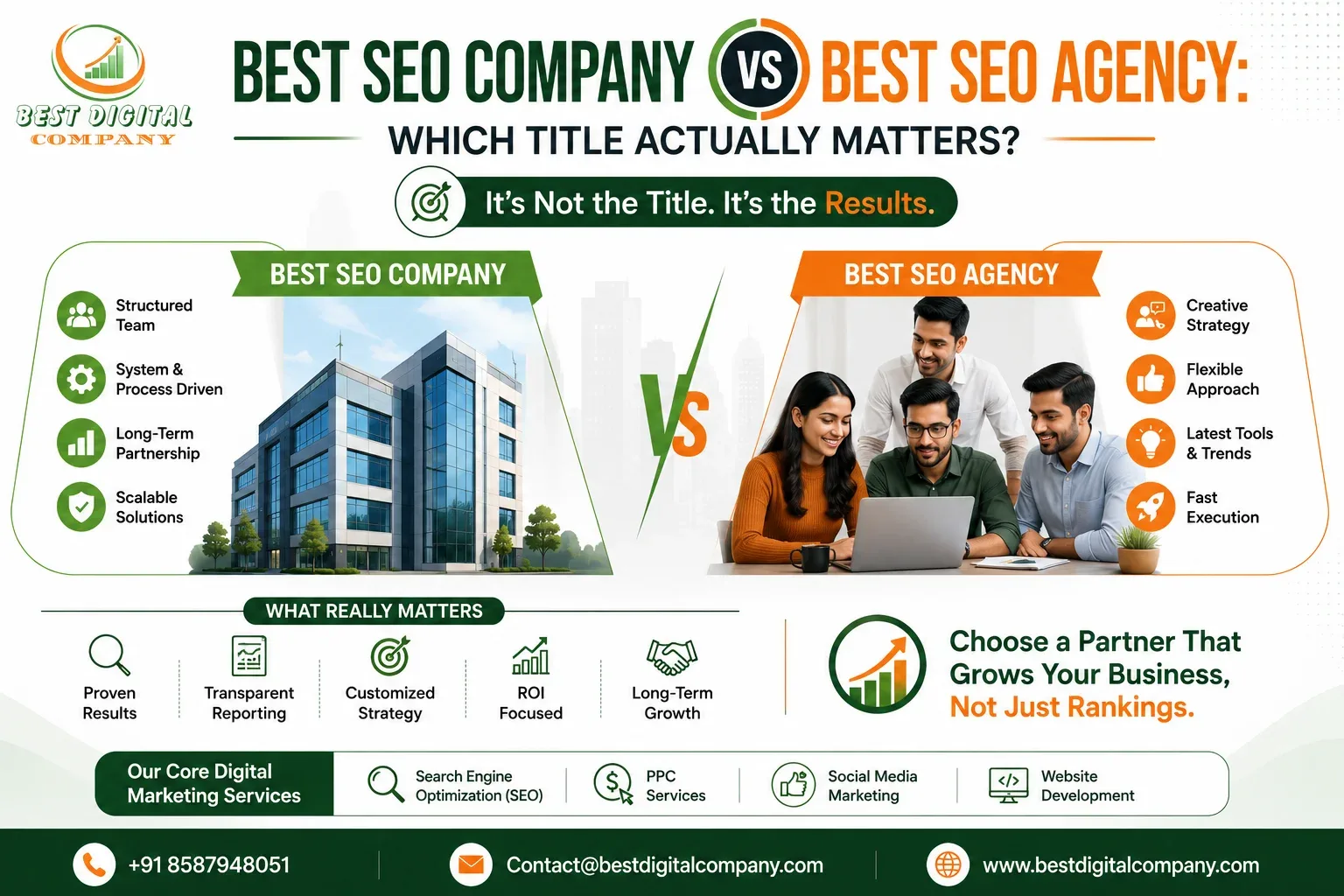
Best SEO Company vs Best SEO Agency

Best SEO Company vs Best SEO Agency: Which Title Actually Matters?

A client called us last month with a strange question. She had shortlisted three vendors for her website’s rankings project. One called itself the best SEO company in its city. Another described itself as the best SEO agency for growing brands. The third just said “SEO experts” and left it at that. Her question was simple: does the label on the homepage actually tell you anything about the work you’ll get?

It is a fair question, and one we get asked more often than you’d think. Business owners spend hours comparing pricing sheets, reading testimonials, and scrolling through portfolios, but very few stop to ask whether the words “company” and “agency” carry any real weight. So let’s settle it properly, without the jargon, using what we’ve actually seen work (and fail) across dozens of client projects.

What Do “Best SEO Company” and “Best SEO Agency” Really Mean?

Strip away the marketing gloss, and both phrases describe the same basic thing: a team of people who get paid to improve how a website performs in search results. There’s no legal registry that decides who qualifies as a “company” versus an “agency.” A one-person freelance setup can legally call itself a company. A twenty-person team with account managers, strategists, and writers can call itself an agency, or vice versa. The words are self-assigned, not government-issued.

What actually separates one provider from another isn’t the noun in their name. It is the structure behind the work: how the team is organized, what processes they follow, how they report progress, and whether they treat your business as a long-term relationship or a one-time transaction. We’ve written more on this exact distinction in our post on SEO agency vs SEO company: is there really a difference, which digs into the operational side. This piece takes a different angle. We are looking specifically at why the title itself keeps showing up in search queries, and whether chasing that title is a smart way to shortlist a partner.

Why Business Owners Search for a Best SEO Company Before Signing a Contract

People type “best SEO company” into Google for a reason that has very little to do with grammar. They are trying to reduce risk. Hiring someone to handle your website’s visibility feels like handing over the keys to your storefront if it goes wrong, you lose customers, not just money. So the word “best” becomes a shortcut for “safe,” “proven,” or “won’t disappear after the first invoice.”

The problem is that this search habit rewards marketing copy, not necessarily capability. A provider that has invested in a polished website and consistent content will rank higher for that phrase than one that’s simply better at the actual work. This is exactly why we always tell prospective clients to look past the headline and into the substance: case studies with real numbers, a documented process for search engine optimization, and clarity on what’s included at each pricing tier through something like a published SEO packages page. If a provider is transparent enough to show you exactly what you’re paying for before you even ask, that’s a stronger signal than any self-awarded title.

What Makes an SEO Agency Earn the Word “Best” Instead of Just Claiming It

If the title is self-assigned, how does anyone actually earn the description “best SEO agency”? In our experience working with clients across different industries, three things tend to separate the agencies that deserve the label from the ones that just print it on a banner.

First, they can explain their reasoning, not just their results. Anyone can show you a graph where traffic went up. Fewer providers can walk you through why it went up which pages were optimized, which keywords were targeted, and which technical issues were fixed first. When a team can explain their decisions in plain language, it usually means they understand the work rather than following a template.

Second, they adapt the strategy to the business, not the other way around. A restaurant in one neighborhood and a B2B software company have almost nothing in common in terms of what “good SEO” looks like. A provider chasing the “best agency” label with a one-size-fits-all package is optimizing for their own delivery speed, not your outcome.

Third, they treat local relevance as part of the strategy, not an afterthought. If your customers are searching from a specific city or region, generic national tactics rarely move the needle. This is where services like local SEO in Delhi or region-specific work such as SEO services in Punjab and SEO services in Haryana matter a genuinely capable agency builds location intent into the plan instead of bolting it on later.

Company vs Agency: Does the Title Change the Service You Get?

Short answer: not by itself. Longer answer: the title can hint at internal structure, but it’s not a reliable predictor.

Providers who lean on the word “company” sometimes emphasize process, documentation, and predictable deliverables think monthly reports, fixed scopes, and clear timelines. Providers who lean on “agency” sometimes emphasize creative strategy, campaign thinking, and closer collaboration with your marketing team. But these are tendencies, not rules. We’ve seen tightly-run “agencies” with better reporting discipline than some self-described “companies,” and we’ve seen the reverse just as often.

We covered this operational comparison in detail in SEO agency vs SEO company: is there really a difference worth a read if you want the nuts-and-bolts version. The short version for this article: judge the contract, the team you’ll actually work with, and the reporting cadence. Don’t judge the noun on the homepage.

Signs You are Looking at a Genuinely Strong SEO Partner, Not Just a Cheap Vendor

Price is usually the first filter people apply, and it is understandable budgets are real. But price alone tells you almost nothing about quality. Here are signals we’d actually trust, based on what tends to separate strong partners from ones that underdeliver:

  • They ask about your business before quoting a number. A provider that sends a price within minutes of your first message, without asking what you sell, who your customers are, or what “success” looks like for you, is pricing a generic package, not your situation.
  • They are upfront about timelines. Genuine search engine optimization work takes months to show compounding results. Anyone promising page-one rankings in two weeks is either exaggerating or planning to use tactics that risk a penalty later.
  • They can show you work for a business similar to yours. Not identical similar in scale and market. A provider that’s only ever worked with e-commerce brands might not have the right playbook for a local service business, and vice versa.
  • They explain content decisions, not just technical ones. Search visibility today depends heavily on whether your content actually answers what people are searching for. If a provider only talks about backlinks and meta tags and never mentions the quality or usefulness of your content, that’s a gap worth asking about.
  • Their own site practices what it preaches. If a provider’s website has SEO service in Delhi or similar pages that are genuinely well-structured, load fast, and read like they were written for humans first, that’s a small but honest signal about how they’ll treat your project.

How Experience and Real Expertise Separate a Strong Partner From the Rest

This is where the conversation moves past labels entirely. What actually protects your investment isn’t whether a provider calls itself a company or an agency. It is whether the people doing the work have genuine, demonstrable experience.

Ask direct questions: How long has this team been running search campaigns? What industries have they worked across? Who specifically will be handling your account a senior strategist or a junior executive learning on your budget? A provider that answers these questions clearly, and is willing to introduce you to the actual person managing your account, is operating with a level of transparency that self-titled “bests” rarely bother with.

We’ve built our own approach around this idea. You can read more about our background and how our team is structured on our About Us page. We’d rather a prospective client judge us on that than on any adjective in our name.

Trustworthiness also shows up in smaller, easy-to-check details: does the provider have a real, physical presence rather than just a domain name? Do they answer questions honestly, including telling you when something won’t work for your business? Do their past clients confirm what the case studies claim? None of this requires you to decode the difference between “company” and “agency” it just requires you to ask a few direct questions and pay attention to how honestly they’re answered.

Beyond Search Visibility: Why the Best Digital Partner Rarely Does Just One Thing

Here’s something that gets missed in the company-versus-agency debate: search visibility rarely operates in isolation anymore. A business that only improves its rankings but ignores everything else in its digital presence often plateaus quickly.

Paid visibility, for instance, works alongside organic growth rather than competing with it. If you’re comparing providers, it’s worth checking whether they also offer Pay Per Click management, and whether they can explain how the two strategies support each other instead of running as separate, disconnected efforts. We broke down what a paid campaign actually involves month to month in PPC services explained: what a performance marketing agency really does every month, and how to evaluate providers for that specific service in how to choose the best PPC company for your business.

The same logic applies to your social presence. Search rankings and social engagement influence each other more than most business owners realize brand searches, referral traffic, and content sharing all play a role. If audience engagement matters to your growth, it’s worth reading likes don’t pay the bills: how to pick a social media marketing agency that actually grows sales alongside your evaluation of anysocial media marketing provider.

And none of this matters if the website itself is slow, poorly structured, or hard to navigate. Rankings can only send visitors to a page that’s actually built to convert them. That is why website development is often the quiet foundation underneath every SEO conversation. We’ve written about this exact trade-off in website developer company or freelancer: an honest cost and risk comparison and in website development services: how to pick the best web designing company, both worth reading if your site needs work alongside your search strategy.

Red Flags: Titles That Sound Impressive but Mean Nothing

A few warning signs worth flagging, because they show up constantly in this industry:

  • Guaranteed rankings. No provider controls how search engines rank pages. Anyone promising a specific position by a specific date is either overpromising or planning shortcuts that could hurt your site later.
  • Vague reporting. If monthly updates are just screenshots of a dashboard with no explanation, you’re not getting a partner you are getting a subscription.
  • No mention of content quality. A provider fixated only on technical fixes and backlinks, with no plan for the actual words on your pages, is missing the part of the strategy that increasingly determines whether a page performs well at all.
  • Recycled proposals. If the strategy document they send you could apply to literally any business in any industry, it probably was written for exactly that purpose.
  • A portfolio with no verifiable clients. Case studies with blurred names, unnamed “confidential clients” across the board, or stock-photo testimonials deserve extra scrutiny.

None of these red flags have anything to do with whether the provider calls itself a company or an agency. They are about substance, and substance is genuinely checkable if you ask the right questions.

How to Actually Evaluate a Provider, Regardless of What They Call Themselves

If you are currently comparing options, here’s a practical sequence that tends to work better than searching for a title:

  1. List what you actually need. Is it purely organic visibility, or do you also need paid campaigns, social management, or a website rebuild? Clarity here prevents you from being upsold on services you don’t need.
  2. Ask for a strategy specific to your business, not a generic package. If they can’t produce one without weeks of “discovery calls” and payment upfront, be cautious.
  3. Request references, not just testimonials. A quick call with an existing client tells you more than any homepage badge.
  4. Clarify who does the actual work. Some providers sell you on senior expertise, then hand your account to someone with far less experience.
  5. Check their reporting sample. Ask to see an anonymized version of a monthly report before signing anything.
  6. Compare pricing structures honestly, using something like our breakdown in SEO services vs SEO packages: what should you actually pay for as a reference point for what reasonable inclusions look like.

This process takes an extra hour or two, but it protects a budget that will otherwise run for months before you find out whether it was working.

Our Take: Does the Title Actually Matter?

Honestly, no not in the way most people assume. The word on the homepage tells you how a provider wants to be perceived, not how they’ll actually perform. What matters is the evidence behind the claim: real client history, a documented process, honest communication about timelines, and a team willing to explain their thinking instead of hiding behind jargon.

If there’s one thing worth taking from this article, it’s this: stop searching for the “best” title and start searching for proof. Ask for it directly. Any provider confident in their own work will hand it over without hesitation.

Frequently Asked Questions

Is there an official difference between an SEO company and an SEO agency?

No. Neither term is regulated or legally defined. Businesses choose whichever word fits their branding, so the label alone doesn’t indicate size, quality, or specialization.

How can I tell if a provider genuinely deserves to be called the best in their field?

Look at documented case studies with real numbers, ask for client references you can actually contact, and request a strategy tailored to your business rather than a generic package. Providers confident in their work rarely hesitate to share this information.

Should I choose based on price or experience?

Experience should weigh more heavily. A cheaper option that lacks a clear process often costs more in the long run through wasted months, missed opportunities, or corrective work needed after ineffective tactics.

Does hiring one provider for search visibility, paid ads, and social media together make sense?

Often, yes. These channels influence each other, and a team that coordinates all three tends to produce more consistent results than juggling separate vendors who don’t communicate with each other.

How long does it typically take to see results from an SEO campaign?

Meaningful, sustainable improvement usually takes a few months, depending on the competitiveness of your industry and the starting condition of your website. Anyone promising results within days should be questioned carefully.

What is the single biggest mistake businesses make when hiring an SEO partner?

Choosing based on the lowest price or the most polished-sounding title, without asking to see how the provider actually works, reports progress, and adapts strategy to different types of businesses.


Looking for a team that’s more focused on results than on titles?

Get in touch with us and we will walk you through exactly how we’d approach your website no generic packages, no guarantees we can’t back up.

SEO Agency vs SEO Company: Is There a Real Difference?

SEO Agency vs SEO Company: Is There Really a Difference?

If you have spent even ten minutes searching for help with your website’s rankings, you have probably typed both phrases into Google without thinking twice “SEO agency” and “SEO company.” You clicked on results for both, compared pricing pages that looked nearly identical, and eventually wondered if you were even searching for two different things. You are not the only one confused. Business owners ask us this question almost every week, usually right before they sign a contract and want to be sure they are picking the right kind of partner.

The short answer is that the difference is smaller than most marketing blogs make it sound. But it is not zero, and understanding where the real gap lies can save you from a frustrating year of vague reports and disappointing rankings. In this guide, we will break down what each term actually means in practice, where the lines blur, what to look for regardless of the label on the door, and how to make a confident decision for your business.

What Does an SEO Agency Actually Do?

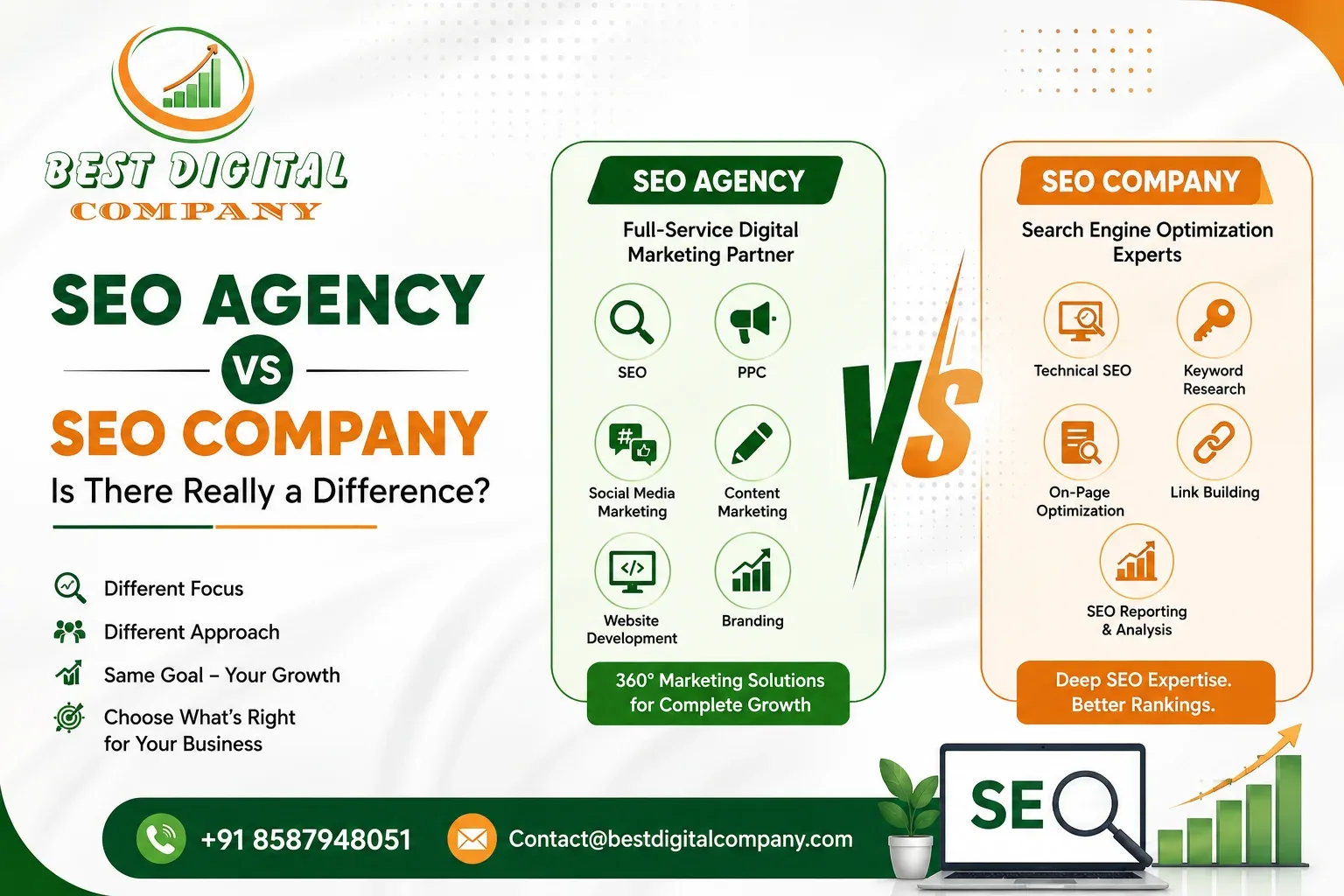
The word “agency” usually signals a full-service setup. An SEO agency tends to operate like a marketing partner rather than a single-task vendor. Alongside search optimization, many agencies also handle social media management, paid advertising, content creation, branding, and sometimes public relations. The idea is that your online presence does not live in one channel, so the people managing it should be able to move between channels without handing you off to three different vendors.

Agencies typically organize work around campaigns and strategy. You might have an account manager, a content team, a technical specialist, and someone running paid campaigns, all coordinating on the same goals. This structure suits businesses that want one point of contact for everything digital, rather than juggling separate invoices and separate strategies for search, social, and advertising.

A well-run digital marketing agency also tends to think about how channels support each other. For example, a blog post written for search visibility might get repurposed into social posts, and a paid campaign might target the same keywords the organic strategy is already targeting. That kind of cross-channel thinking is where agencies often justify their broader scope.

What Does an SEO Company Actually Do?

An “SEO company” often though not always signals a narrower, more specialized focus. Many businesses that describe themselves as SEO companies concentrate almost entirely on search visibility: technical audits, keyword research, on-page optimization, content strategy, and link building. Some do offer other services on the side, but search is usually the core competency and the reason clients hire them in the first place.

This specialization can be an advantage. A team that lives and breathes search algorithms, crawl behavior, and content structure every single day tends to catch technical issues that a generalist team might miss. If your biggest problem is that Google cannot properly index your site, or your rankings dropped after a redesign, a specialist SEO company is often better equipped to diagnose it quickly.

That said, plenty of businesses that call themselves an SEO company also offer web development, local listings management, and reporting dashboards blurring the line right back into agency territory. The label alone tells you very little; the actual service list tells you a lot more.

Where the Real Differences Show Up

Instead of treating “agency” and “company” as fixed categories, it helps to look at four practical factors that actually affect your results.

Scope of services. This is the biggest real difference. Some providers only touch your search rankings. Others manage your entire digital footprint, including social media marketing, pay-per-click advertising, and even website development and design. If your website itself has technical problems slowing it down, a provider that can only advise on keywords but cannot touch your code will only get you halfway there.

Team structure. Agencies usually assign a small team or a single account manager to coordinate multiple specialists behind the scenes. Specialist SEO companies sometimes work with a leaner, flatter structure where you speak directly to the person doing the work. Neither structure is automatically better; it depends on whether you want one relationship manager or direct access to a technical specialist.

Depth versus breadth. A specialist SEO company can usually go deeper into technical search issues because that is the entire business. A full-service agency spreads its attention across more channels, which can mean slightly less depth in any single one, but stronger coordination across your overall marketing.

Pricing structure. Full-service providers often bundle services into packages, while specialist providers may price search work on its own. Comparing a dedicated SEO package against a bundled agency retainer is genuinely comparing two different things, so it helps to ask exactly what is included before comparing numbers.

Why the Terms Get Used Interchangeably

Honestly, most of the confusion comes down to marketing, not meaning. Many businesses pick whichever term ranks better in their own search strategy or simply sounds more familiar to their audience. A one-person freelance operation might call itself an “agency” to sound established. A twenty-person full-service shop might call itself a “company” because that word feels less trendy and more trustworthy to certain industries.

This is why relying on the label alone is a weak way to evaluate a potential partner. What actually matters is the substance behind the name: their process, their past results, the people doing the work, and how clearly they can explain what they will do for your specific website. Two providers with different names on their homepage can deliver nearly identical outcomes, and two providers with the same label can deliver completely different levels of service.

Services You Should Expect From a Genuine Search Optimization Partner

Regardless of what they call themselves, a capable search engine optimization provider should be able to walk you through a fairly consistent set of deliverables:

  • Technical audits that check crawlability, site speed, mobile usability, and indexing issues before anything else is touched.
  • Keyword and intent research that matches what your actual customers are typing, not just high-volume terms with no buying intent.
  • On-page optimization covering titles, headings, internal linking, and content structure.
  • Content strategy that answers real questions your audience is asking, rather than stuffing pages with repeated phrases.
  • Off-page work, including authoritative backlinks and local citations where relevant.
  • Transparent reporting that shows you what changed and why, not just a wall of numbers. If you have ever received a report you could not make sense of, our guide on creating an SEO report clients actually understand breaks down what good reporting should look like.

If your provider agency or company cannot clearly describe how they approach each of these areas, that is a bigger warning sign than anything in their business name.

How to Choose Between an SEO Agency and an SEO Company

Instead of starting with the label, start with your actual situation.

If your website needs work across multiple channels say your social presence is inactive, your paid ads are underperforming, and your rankings have stalled a full-service agency that can coordinate all three under one strategy will likely save you time and keep your messaging consistent.

If your core problem is specifically about visibility in search results, and your social and paid channels are already handled elsewhere, a specialist SEO company that lives inside technical search work daily may get you faster, more focused results.

If you are still unsure, ask direct questions before signing anything: What exactly is included in the retainer? Who will actually be doing the work? Can you see examples of similar projects? How do you measure success beyond rankings? For a deeper walkthrough of vetting questions, our detailed breakdown on how to choose the best SEO company covers the exact questions worth asking before you commit budget.

It is also worth noting that the “versus” framing itself shows up across digital marketing, not just in search. If you have ever compared a PPC company against a performance marketing agency, you already know the pattern: the label matters less than the actual scope of work and the results attached to it.

Red Flags That Have Nothing to Do With the Label

Some warning signs apply no matter what a provider calls itself:

  • Guaranteed rankings. No legitimate provider can guarantee a specific position in search results, because ranking algorithms change constantly and depend on far more than one company’s efforts.
  • No mention of your website’s technical health. If a provider jumps straight to content or links without ever auditing your site’s speed, structure, or indexing, they are skipping a foundational step.
  • Vague reporting. If you cannot tell what actually changed month over month, you cannot tell if the work is effective.
  • One-size-fits-all packages with no adjustment for your industry, competitors, or existing site condition.
  • Outdated tactics, such as heavy keyword repetition or low-quality link schemes, which can actively hurt a site rather than help it.

These issues show up under both labels, which is exactly why the “agency versus company” question matters less than most people assume.

Why Trust and Experience Matter More Than the Name on the Website

Search engines increasingly reward content and websites that demonstrate real experience, expertise, authority, and trustworthiness. That same principle applies when you are choosing who manages your search visibility. A provider’s own credibility client history, transparent case studies, a clear team, and consistent communication tells you more than whether they picked “agency” or “company” for their own branding. We cover this in more depth in our guide on how to improve EEAT for better rankings, which applies just as much to evaluating a marketing partner as it does to writing content.

It is also worth remembering that search behavior itself keeps shifting. Tools like Google Search Console reveal patterns most business owners never look at, and newer shifts like AI-driven answer boxes are changing how people find information in the first place. If you want a primer on tracking your own visibility, our Google Search Console guide for beginners is a good starting point, and our explainer on zero-click searches covers why rising impressions do not always mean rising traffic anymore. A capable partner, whatever they call themselves, should already be adapting to these shifts rather than relying on tactics from five years ago.

Local Considerations Matter Too

If most of your customers come from a specific city or region, the agency-versus-company question becomes slightly less important than local expertise. A provider that understands local search behavior in your market whether that is SEO services in Delhi, local SEO strategies in Delhi, or search optimization tailored to Mumbai, Haryana, or Punjab will often outperform a generic national provider that treats every city the same way. Local nuance in search terms, competitor landscape, and customer intent tends to matter more than the business label on the invoice.

The Bottom Line

There is no strict industry rule separating an SEO agency from an SEO company. Some full-service agencies handle search alongside social and paid advertising. Some specialist companies focus entirely on search and nothing else. Many providers blur the line completely by offering both scopes under either name.

What actually determines your results is not the word on their homepage. It is whether they audit your site properly, build a strategy around real customer intent, communicate clearly, and adapt to how search itself keeps changing. Before signing with anyone, ask about their process, their reporting, and their past results and judge them on that, not on which of the two words happened to be in their business name.

If you are weighing your options and want a straightforward opinion on what your website actually needs, our team is happy to walk through your current setup and tell you honestly whether you need a focused search specialist or a broader marketing partner.


Frequently Asked Questions

Is an SEO agency better than an SEO company?

Neither is automatically better. An agency usually offers broader marketing services across multiple channels, while a company often specializes more narrowly in search visibility. The right choice depends on whether you need coordinated multi-channel marketing or focused, technical search work.

Do SEO agencies and SEO companies charge differently?

Pricing structures can differ because the scope of work differs. Full-service agencies often bundle search work with social media, advertising, and design into one retainer, while specialist companies may price search services on their own. Always compare what is actually included, not just the total cost.

Can a small business hire an SEO company instead of a full agency?

Yes. If your main goal is improving visibility in search results and you do not need help with social media or paid advertising right now, a specialist SEO company focused purely on search can be a practical, cost-effective choice.

How long does it take to see results from either one?

Search optimization is a gradual process regardless of who you hire. Most businesses start seeing meaningful movement within three to six months, with stronger, more stable results building over six to twelve months as technical fixes, content, and authority-building work compound.

What questions should I ask before hiring either type of provider?

Ask what services are included, who will actually manage your account, how they report progress, whether they have worked in your industry before, and how they plan to handle both search visibility and the overall health of your website.

Does the name really not matter at all when choosing a provider?

The name itself carries little weight. What matters is the provider’s process, transparency, past results, and how well their scope of services matches what your business actually needs right now.