PPC Company vs PPC Agency

PPC Company vs PPC Agency: Which Model Fits Your Ad Budget?

A few weeks ago, we sat across two proposals from a client who was comparing offers before committing to paid advertising. One provider called itself a PPC company. The other called itself a PPC agency. The pricing was different, the contracts read differently, and the client had no idea why two businesses doing what sounded like the exact same job were priced so far apart.

This mix-up is more common than most business owners realize. The terms “PPC company” and “PPC agency” get used almost interchangeably in marketing conversations, yet in practice they often describe two different ways of running paid ad campaigns different team structures, different pricing logic, and different minimum budgets to make the relationship worthwhile. Picking the wrong one for your current budget is how businesses end up either overpaying for infrastructure they don’t need yet, or underpaying for a level of hands-on strategy their ad spend actually requires.

This guide breaks down what genuinely separates a PPC company from a PPC agency, how each one prices its work, and how to match the right model to the budget you actually have not the budget you hope to have in a year.

“PPC Company” and “PPC Agency” – What the Terms Actually Mean

There’s no official rulebook that defines these two labels, which is exactly why so much confusion exists. But when you look past the branding, a pattern shows up consistently across the industry.

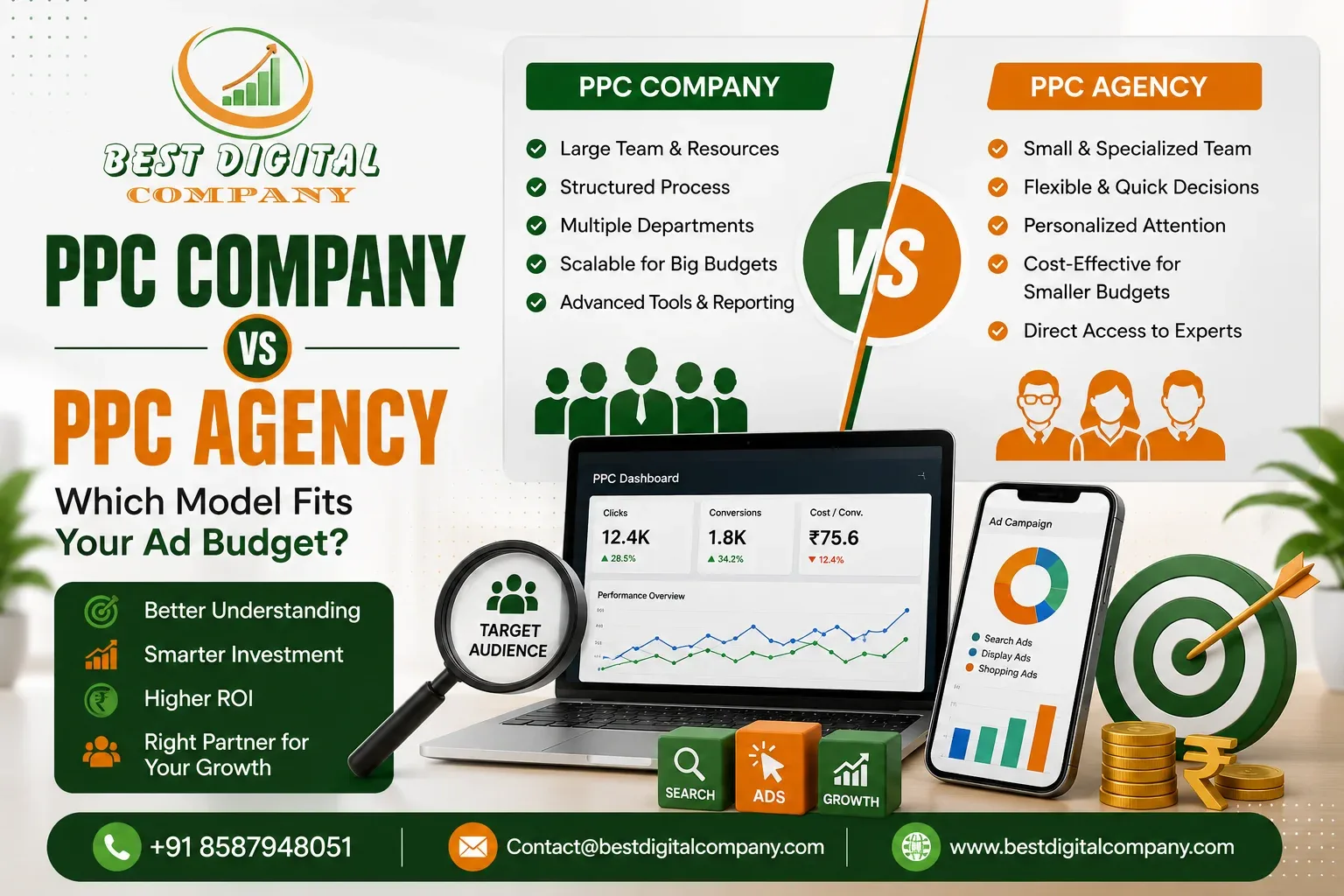
A PPC company usually refers to a larger, more process-driven organization. It typically runs paid campaigns as one service line among several SEO, web development, social media and has dedicated departments for each. You are usually assigned a named account manager who sits between you and the specialists actually touching your Google Ads or Meta Ads account.

A PPC agency, on the other hand, often leans smaller and more specialized. Some are boutique teams built entirely around paid advertising, with founders or senior strategists still directly involved in client accounts. There’s usually less internal hierarchy, which can mean faster decisions, but also a smaller bench if the team gets overloaded.

Neither structure is inherently better. They are simply built for different situations, and your ad budget is one of the clearest signals for which one you should be talking to first.

Inside a PPC Company – Team, Process, and Who Actually Touches Your Account

When you sign with a PPC company, you are usually buying into a defined process rather than a single expert’s judgment. That has real advantages once your budget crosses a certain size.

Most PPC companies structure client work in layers: an account manager who communicates with you, a strategist who plans the campaign, and specialists who handle execution across Search, Display, Shopping, or video. This layered setup means the business doesn’t grind to a halt if one team member is on leave or moves to a different project. There’s institutional memory in how campaigns are documented, reported, and handed off.

The tradeoff is that you’re often one account among many being run through a standardized playbook. Reporting formats, campaign structures, and check-in schedules tend to follow a template designed to scale across dozens of clients, not built from scratch around your specific business. For businesses with a straightforward product and a clear target audience, this rarely matters. For businesses with unusual sales cycles or niche audiences, it can feel like the process wasn’t really built with them in mind.

You can see how this kind of structured approach is usually packaged by browsing a typical PPC services offering, which is generally organized into tiers rather than fully custom scopes.

Inside a PPC Agency – Flexibility, Specialization, and Direct Access

A PPC agency tends to operate with fewer layers between you and the person actually managing your bids. In smaller, specialist agencies, it’s common to work directly with the strategist running your campaigns rather than routing every question through an account manager first.

This closeness can be a genuine advantage when your business needs fast decisions a sudden competitor move, a flash sale, a product launch that needs a campaign live within a day. Smaller agencies typically carry less internal process overhead, so changes can happen faster.

The flip side is capacity. A boutique PPC agency with a handful of specialists has a ceiling on how many accounts it can run well at once. If it takes on too many clients, response times slow down and campaigns get less attention, even though the pricing structure hasn’t changed. It’s worth asking directly how many active accounts a given specialist is currently managing before you sign anything a fair question that a confident agency should answer without hesitation.

PPC Company vs PPC Agency: Where the Cost Difference Actually Comes From

The pricing gap between these two models is not random. It comes down to overhead.

A PPC company carries the cost of account managers, dedicated reporting tools, larger office infrastructure, and multiple specialist departments. That overhead gets distributed across every client relationship, which usually means higher minimum retainers, but also more redundancy if something goes wrong internally.

A PPC agency, especially a leaner one, carries less overhead. Retainers can be lower, and some smaller agencies are willing to work with tighter monthly budgets that a bigger PPC company wouldn’t consider worth the account management time.

Both models typically charge in one of three ways: a flat monthly retainer regardless of ad spend, a percentage of your total ad spend (commonly somewhere between 10% and 20%), or a hybrid  a smaller flat fee plus a percentage once spend crosses a certain threshold. None of these structures is automatically better. A flat fee protects you as your budget scales, since the management cost doesn’t grow with it. A percentage model can align incentives, since the provider only earns more by helping you spend more effectively, though it’s worth asking how they define “effectively” before agreeing to it.

Which Model Fits a Small or Just-Starting Ad Budget

If you’re working with a modest monthly ad budget enough to test one or two campaigns rather than run a full multi-platform strategy a leaner PPC agency is usually the more practical starting point.

Larger PPC companies often set minimum retainers that make sense only once your ad spend itself is substantial enough to justify the account management layer. A smaller agency, or even a specialist freelancer working within an agency structure, can typically build a focused campaign around a tighter budget without insisting on services you don’t need yet, like dedicated creative production or multi-platform reporting dashboards.

This stage is also where getting the fundamentals right matters more than scale. If you’re building your very first customer base through digital channels, it’s worth reading our guide on how small businesses can get their first 100 customers, since paid ads at this budget level work best when paired with a clear, realistic acquisition plan rather than treated as a standalone fix.

Which Model Fits a Growing Mid-Size Budget

As your monthly ad spend grows, the conversation usually shifts from “can we afford management” to “what are we getting for it.” This is the range where the difference between a PPC company and a PPC agency starts to matter the most, because both can now justify their pricing, but the value they deliver looks different.

A PPC company tends to shine here because your budget can now support proper testing across multiple campaign types Search, Shopping, Display, and remarketing run by specialists in each area rather than one generalist handling everything. A well-run PPC agency at this budget level can compete just as effectively, but it depends heavily on whether the team has genuinely grown its capacity or is simply stretched thinner across more clients.

At this stage, reporting quality also becomes a real differentiator, since you are now making budget decisions based on the numbers you’re being shown. If a provider’s reports leave you more confused than informed, that’s worth addressing early our piece on how to create an SEO report clients actually understand covers the same reporting principles that apply just as much to paid campaigns as they do to organic performance.

It’s also the point where your landing pages start carrying real weight. A growing budget sending traffic to a page that wasn’t built to convert is money left on the table, which is why many mid-size accounts eventually pair PPC with support from a web development team to fix conversion gaps rather than just increasing ad spend to compensate.

Which Model Fits a Large or Multi-Channel Ad Budget

Once your budget supports running campaigns across several platforms at once Google, Meta, LinkedIn, YouTube a full-service PPC company generally becomes the more sustainable choice, mainly because of what it takes to run that scope well.

Multi-channel advertising isn’t just “more of the same campaign” spread across platforms. Each channel has its own bidding logic, creative requirements, and audience behavior. A PPC company with dedicated specialists per platform can manage this without one person being stretched across skill sets they only partially know. A smaller PPC agency can still deliver at this level, but only if it has genuinely built out specialist coverage rather than asking one team to cover everything.

At this budget size, paid advertising also tends to work best when it’s coordinated with your broader organic strategy rather than run in isolation. Businesses investing seriously in search engine optimization and social media marketing alongside PPC typically see paid campaigns perform better, since brand familiarity built through organic channels tends to lower the cost of paid clicks over time.

Six Questions to Ask Before You Choose a PPC Company or PPC Agency

Regardless of which model you’re leaning toward, a short list of direct questions can save you months of wasted spend:

  1. Who exactly will manage my account day to day – a named specialist, or a rotating team member depending on availability?
  2. What is your minimum monthly retainer, and does it change if my ad spend grows?
  3. How many other active accounts is my specialist currently managing?
  4. Can I see a sample report before signing, not just a description of what reporting looks like?
  5. What happens if the first month underperforms — is there a review point built into the contract, or am I locked in regardless?
  6. Do you handle landing page recommendations, or only the ad side of the campaign?

A provider that answers these clearly and specifically, rather than in vague reassurances, is usually signaling that they run a real process whether they call themselves a company or an agency.

How Best Digital Company Supports Every Budget Level

We work with businesses across this entire range, from a first-time advertiser testing a single campaign to established brands running paid ads across multiple platforms alongside SEO and social. Rather than pushing every client toward the same package, we start by understanding what your current budget can realistically support and build the campaign structure around that, not the other way around.

If your budget is still modest, we will tell you honestly whether it makes more sense to start lean and scale, rather than signing you up for a retainer sized for a bigger spend than you currently have. If you are ready to run a full multi-channel strategy, our team covers Search, Shopping, Display, Meta, and LinkedIn advertising, backed by the same reporting clarity we bring to our SEO clients. You can see current retainer structures on our PPC packages page, or reach out through our contact page for a straightforward review of what your current budget could realistically achieve before you commit to either model.


Frequently Asked Questions

Is a PPC company always more expensive than a PPC agency?

Not always, but it’s common. PPC companies carry more internal structure account managers, larger teams, dedicated reporting systems and that overhead is usually reflected in higher minimum retainers. Smaller PPC agencies often have lower minimums, though pricing varies enough that it’s worth getting quotes from both before assuming either is automatically cheaper.

Can a PPC agency handle a large, multi-platform ad budget?

Yes, if the agency has genuinely built out specialists for each platform rather than stretching a small generalist team across everything. Ask directly how many people work on each channel before assuming a smaller agency can’t scale with you.

What’s the minimum ad budget needed to work with a PPC company?

This varies by provider, but many PPC companies set retainers that only make financial sense once your ad spend itself is substantial enough to justify dedicated account management. If your budget is still small, a leaner PPC agency is usually a more practical starting point.

Do PPC companies and PPC agencies charge in the same way?

Both typically use one of three models: a flat monthly retainer, a percentage of ad spend, or a hybrid of the two. The pricing model matters more than the label ask how a provider charges before comparing them purely on the word “company” or “agency.”

Should I start with a PPC agency and move to a PPC company later?

Many businesses do exactly this. It’s common to start with a smaller, more flexible agency while testing what works, then move to a larger PPC company once ad spend and reporting needs grow beyond what a lean team can comfortably manage.

How do I know if my current provider company or agency is worth the cost?

Look past the label and focus on outcomes: are you getting account-level visibility, clear reporting tied to leads or sales, and honest communication about what’s working versus what isn’t. A provider delivering all three is worth the retainer, regardless of whether it calls itself a company or an agency.


Not sure whether a PPC company or a PPC agency fits where your business is right now? Talk to Best Digital Company for a free, no-pressure review of your current ad budget and what it can realistically support.
PPC Services Explained: What an Agency Does Monthly

PPC Services Explained: What a Performance Marketing Agency Really Does Every Month

If you have ever signed a contract with an agency for PPC services and then wondered what actually happens between the invoice and the leads showing up in your inbox, you are not alone. Most business owners know PPC stands for pay-per-click, they know Google Ads is involved, and they know a budget gets spent every day. What they rarely see is the actual month-to-month work that separates a campaign that quietly burns cash from one that turns into a predictable, repeatable source of customers.

This is the part of the job a performance marketing agency rarely explains in plain language, mostly because it sounds unglamorous when written down: research, testing, adjusting bids, rewriting ad copy, checking conversion tracking, and repeating that cycle every week. There is no secret button. There is a process, and the agencies that get results are simply the ones that run that process with discipline instead of skipping steps when things look “good enough.”

This guide walks through exactly what a performance marketing agency does for a client every month, why each step matters, and how you can tell whether the team managing your ad account is actually earning its retainer.

What Are PPC Services, Really?

At the simplest level, PPC services cover the planning, setup, and ongoing management of paid advertising campaigns where you pay a platform every time someone clicks your ad. That includes Google Search Ads, Google Shopping, Display and YouTube campaigns, Microsoft Ads (Bing), and paid social advertising on platforms like Meta and LinkedIn.

But the phrase “PPC services” undersells what is actually involved. Buying clicks is the easy part; anyone with a credit card can do that. The real work sits in three areas:

  1. Strategy — figuring out which keywords, audiences, and platforms are worth the budget in the first place.
  2. Execution — building campaigns, ad groups, and creatives that are structured to convert, not just to run.
  3. Optimization — the ongoing, weekly grind of watching data and adjusting the account so cost per lead goes down over time instead of drifting up.

A well-run account rarely looks dramatic from the outside. It looks like small, consistent improvements compounding over months. That is what separates genuine performance advertising from an account that was set up once and left alone.

Why Businesses Hire a Performance Marketing Agency Instead of Going Solo

Google Ads and Meta Ads Manager are both open to anyone. So why do businesses pay a performance marketing agency instead of just running campaigns themselves?

The honest answer is time and pattern recognition. A business owner running their own campaign is looking at one account. An agency managing dozens of accounts across industries has already seen which ad angles fail, which landing page mistakes quietly kill conversion rates, and which bidding strategies waste budget in the first thirty days before they start working. That experience is difficult to replicate from a weekend of YouTube tutorials.

There is also the matter of attention. Paid campaigns need daily or near-daily eyes on them, especially in the first few weeks. Search terms need to be reviewed so budget is not being spent on irrelevant clicks. Bids need to move as competition shifts. A business owner already running operations, sales, and hiring rarely has three hours a day to dedicate to an ad account, and campaigns that go unchecked for two weeks are usually campaigns that are quietly losing money.

If you want to understand the practical difference between hiring an independent freelancer, a generic ad-buying vendor, and a full performance marketing agency, our earlier post on choosing between a PPC company and a performance marketing partner breaks down exactly what separates the two and why the distinction matters for your budget.

Month One: Research, Audit, and Account Foundations

The first month with any new client rarely produces the best results, and any agency promising otherwise is either exaggerating or inheriting an account that was already close to optimized. Here is what actually happens before a single new ad goes live:

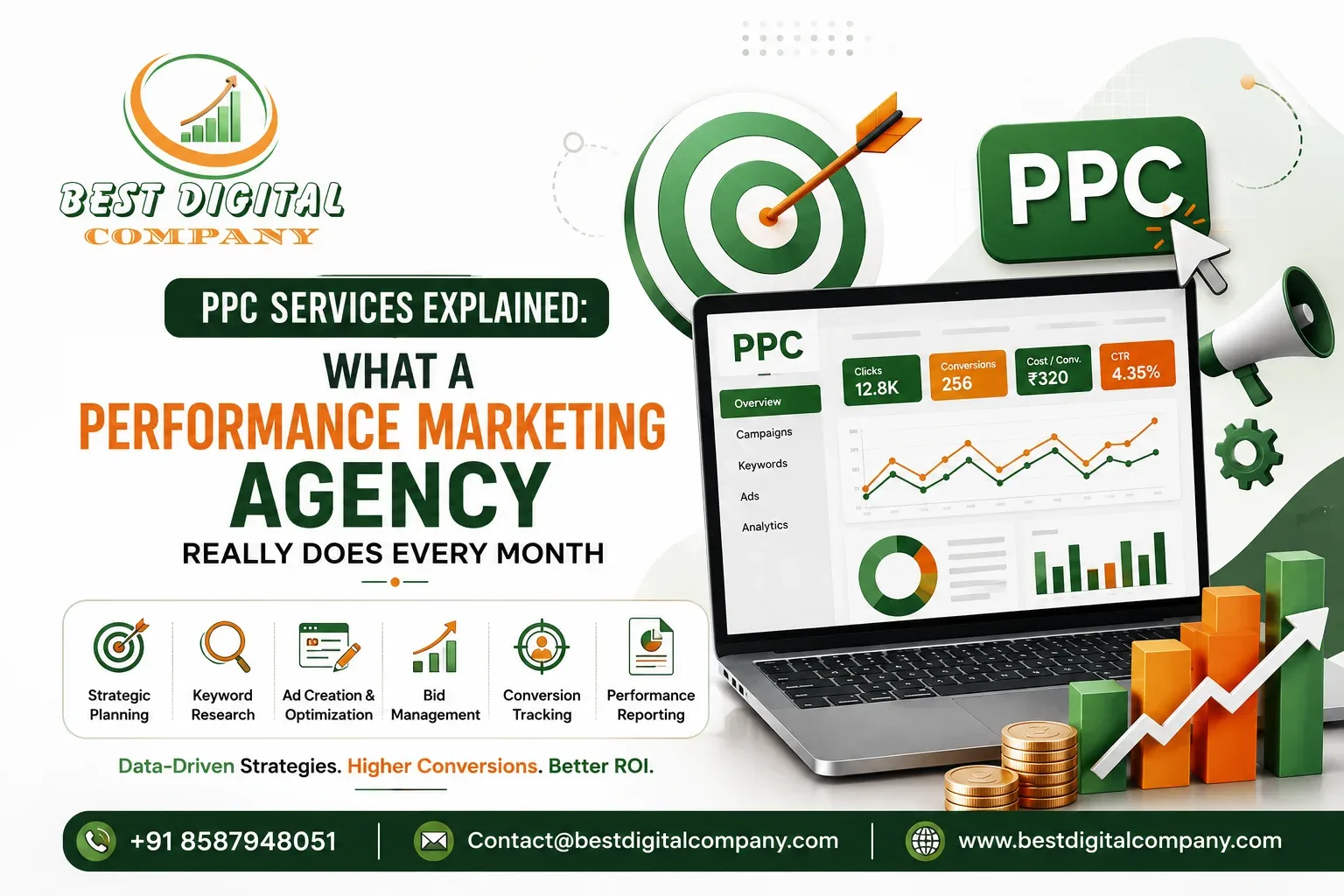
  • Account and website audit. If a client already has an existing account, the team reviews historic performance, wasted spend, conversion tracking accuracy, and account structure. If there is no existing account, the focus shifts to the website itself, checking whether the landing pages, forms, and site speed can even support paid traffic.
  • Conversion tracking setup. This step gets skipped more often than it should, and it is arguably the most important one. Without accurate tracking for calls, form fills, purchases, or bookings, every later decision is based on guesswork. Google Ads conversion tracking, call tracking, and analytics goals all need to be verified before spend increases.
  • Keyword and audience research. For search campaigns, this means identifying commercial-intent keywords, negative keywords to exclude, and realistic cost-per-click ranges based on the industry and location. For social campaigns, this means building and testing audience segments based on interests, behaviors, and lookalike data.
  • Competitor review. Understanding who else is bidding on the same terms, what their offers look like, and where gaps exist that a new campaign can exploit.
  • Campaign architecture. Structuring campaigns and ad groups around specific themes rather than dumping every keyword into one broad group, which is one of the most common reasons self-managed accounts underperform.

This foundational stage typically takes two to four weeks, and it is also where most of the ongoing PPC services relationship gets defined the goals, the target cost per acquisition, and the reporting cadence all get set here.

What a Performance Marketing Agency Does Every Single Week

Once campaigns are live, the work shifts from setup to management, and this is the part clients often never see. A functioning weekly cycle usually includes:

  • Search term review. Checking exactly what people typed before clicking the ad and adding irrelevant terms to the negative keyword list so budget stops leaking toward searches that will never convert.
  • Bid and budget adjustments. Shifting spend toward keywords, ad groups, or audiences that are converting well and pulling back from ones that are not, based on real performance data rather than gut feeling.
  • Ad performance checks. Reviewing click-through rate and conversion rate by individual ad, then pausing underperformers in favor of stronger variations.
  • Landing page and tracking checks. Confirming forms are still submitting properly, phone tracking numbers are working, and nothing broke after a website update because a technically perfect campaign sending traffic to a broken form is still a failed campaign.
  • Competitive and market monitoring. Watching for shifts in cost per click that suggest new competitors have entered the auction, or seasonal demand changes that affect how aggressively to bid.

None of this is glamorous work, but skipping it for even two or three weeks is usually visible in the numbers rising cost per lead, dropping click-through rates, and budget quietly draining into search terms that never should have triggered the ad in the first place.

Creative, Copy, and Landing Page Testing

Performance advertising is not a “set it and forget it” discipline, and the creative side of the account needs almost as much attention as the bidding side. A serious performance marketingagency typically runs structured testing every month, which includes:

  • Writing and testing multiple headline and description variations for search ads
  • Testing different offers, calls-to-action, and value propositions
  • Testing image and video creative for social and display campaigns
  • Running landing page variations to see which layout, headline, or form length converts better

The goal is never to find one winning ad and stop. Ad fatigue is real, particularly on social platforms, where the same creative shown to the same audience for too long starts converting worse regardless of how strong it originally was. A good account has a rotating pipeline of new creative being tested every few weeks, not a single ad running unchanged for six months.

This is also where the line between paid and organic marketing starts to blur. Insights from paid ad testing which headlines get clicks, which offers resonate, which pain points customers respond to often feed directly into content strategy on the search engine optimization side, and vice versa. Paid campaigns give you fast data; organic content gives you long-term compounding traffic. The strongest accounts use one to inform the other.

Budget Management and Bid Strategy

One of the least understood parts of PPC services is how budgets and bid strategies actually get set and adjusted. A few principles that separate a well-managed account from a neglected one:

  • Budget is allocated based on data, not evenly split. If one campaign is producing leads at half the cost of another, budget should shift toward it, not stay static because “that’s how it was originally set up.”
  • Bid strategies evolve as the account matures. Early on, manual or conservative automated bidding often makes sense while conversion data is still limited. Once an account has enough conversion history usually a minimum of 30 to 50 conversions per month automated bidding strategies like target cost-per-acquisition or target return on ad spend tend to perform significantly better because the algorithm has enough signal to work with.
  • Seasonality gets planned for, not reacted to. Retail businesses, for example, need budget curves that anticipate demand spikes rather than adjusting after the spike has already passed.
  • Wasted spend gets audited monthly, not annually. Device performance, location performance, and time-of-day performance all get reviewed to make sure budget is not being spent where it consistently fails to convert.

This is where the agency’s job stops being about “running ads” and starts being closer to financial management of a marketing budget, with the same level of scrutiny you would expect from anyone managing real money.

How a Performance Marketing Agency Proves ROI

Reporting is where trust either gets built or lost. A generic report full of impressions, clicks, and cost-per-click numbers tells a client almost nothing about whether the campaign is actually working for their business. What should show up in a proper monthly report instead:

  • Cost per lead or cost per acquisition, broken down by campaign
  • Conversion rate trends over time, not just a single snapshot
  • Return on ad spend where revenue data is available
  • Which keywords, audiences, or ads are driving the best-quality leads, not just the most leads
  • Clear recommendations for the following month based on what the data showed

If your reports are heavy on jargon and light on plain answers to “did this make or save the business money,” that is worth raising with your agency directly. We wrote a detailed breakdown of what makes a report genuinely useful to a business owner rather than just impressive-looking in our post on creating an SEO report clients actually understand  the same principles apply almost exactly to paid campaign reporting.

PPC Services vs SEO: How They Work Together

A question we hear constantly is whether a business should choose paid ads or organic search rather than running both. In practice, the two rarely compete for the same budget line for long once a business understands what each one is good at.

PPC services deliver traffic immediately. You launch a campaign today, and visitors start arriving today. Organic search, covered under search engine optimization, takes months to build momentum but keeps producing traffic without a per-click cost once it ranks. Businesses with an urgent need for leads a new location opening, a seasonal push, a service launch lean on paid advertising precisely because it does not require waiting.

The most efficient strategy usually uses paid campaigns to validate which offers, keywords, and messaging convert, then feeds that proven data into long-term content and SEO planning. Reliable technical tracking matters on both sides too; if you have never audited how your site performs in search beyond the ads themselves, our guide to Google Search Console for beginners is a useful starting point for understanding the organic side of that equation.

Common Mistakes Businesses Make With PPC

Having managed accounts across a wide range of industries, a handful of mistakes come up again and again when a business tries to run PPC without proper management, or hands it to a vendor that treats every account the same way:

  • Broad match keywords with no negative keyword list, which quietly spends budget on searches that have nothing to do with the business
  • No conversion tracking, which makes every optimization decision a guess
  • Sending traffic to a homepage instead of a dedicated landing page, which typically cuts conversion rates significantly
  • Never testing new ad creative, which lets performance decay quietly over months
  • Judging performance too early, often within the first one to two weeks, before the algorithm and the account have had time to gather enough data
  • Treating the campaign as separate from the rest of the marketing stack, including social media marketing and content, instead of letting insights flow between channels

Interestingly, some of the same discipline problems that hurt organic content also hurt paid accounts outdated pages, thin content, and a lack of clear intent all reduce trust with both users and platforms. If that topic interests you, our post on content pruning and why removing pages can improve results covers the organic equivalent of the same “less clutter, more focus” principle that applies just as much to a cluttered ad account.

How to Choose the Right PPC Services Partner

If you are evaluating agencies or freelancers to manage your paid campaigns, a few practical questions tend to separate serious partners from vendors who will set up a campaign once and check in occasionally:

  • Ask how often they review search terms and adjust negative keywords. Weekly is the standard for an actively managed account.
  • Ask what conversion tracking looks like before they even touch your budget. If they are not asking about your forms, calls, and analytics setup in the first conversation, that is a red flag.
  • Ask for an example of how they report results, not just what platforms they run ads on.
  • Ask how creative testing works month to month, and how many ad variations are typically running at once.
  • Compare their proposed structure against clear, published PPC packages so you know exactly what level of management, reporting, and optimization your budget is buying rather than a vague monthly retainer with no defined scope.

A trustworthy partner will also be upfront that results build over the first sixty to ninety days rather than promising instant returns from day one. Anyone guaranteeing a specific number of leads before even auditing your account or industry is worth treating with caution.

Final Thoughts

The gap between an ad account that performs and one that quietly burns through budget rarely comes down to which platform was chosen or how large the daily budget is. It comes down to whether someone is actually doing the weekly work reviewing search terms, testing creative, adjusting bids, checking tracking, and reporting honestly on what the numbers show. That is what genuine PPC services look like in practice, and it is the standard we hold every account to.

If you want a team that treats your ad budget the way it deserves to be treated, with full transparency on what happens every week and every month, our Pay Per Click team would be glad to walk through your current setup and show you exactly where the opportunities are.


Frequently Asked Questions

How much should a small business budget for PPC services each month?

There is no universal number, since it depends heavily on industry, location, and competition for your keywords. Many small businesses start in the range of a few hundred to a couple of thousand dollars per month for search advertising, then scale up once cost per lead is proven and predictable. A good agency will recommend a starting budget based on your specific market rather than a generic figure.

How long does it take to see results from a performance marketing agency?

Most accounts need 30 to 90 days to move past the initial testing phase and reach stable, optimized performance. The first few weeks are typically about gathering data and eliminating what does not work, not maximizing returns. Judging an account after one or two weeks rarely gives an accurate picture.

What is the difference between PPC and a full performance marketing agency?

PPC refers specifically to paid, per-click advertising. A performance marketing agency typically manages paid advertising as part of a broader strategy that may also include landing page optimization, conversion tracking, and coordination with organic channels like SEO and social media, all measured against actual business outcomes rather than just clicks or impressions.

Do I need a separate landing page for PPC campaigns, or can I use my homepage?

A dedicated landing page almost always outperforms a homepage for paid traffic, because it removes distractions and focuses the visitor on a single action, such as filling a form or making a call. Homepages are built to serve many different visitor intents at once, which typically lowers conversion rates for paid clicks.

Can I run PPC services and SEO at the same time?

Yes, and in most cases it is the more efficient approach. Paid campaigns can generate immediate traffic and useful data on which offers and keywords convert, while SEO builds toward long-term traffic that does not carry an ongoing cost per click. Running both allows insights from one channel to strengthen the other.

How do I know if my current PPC management is actually working?

Look past surface metrics like clicks and impressions and ask for cost per lead, conversion rate trends, and return on ad spend over at least a two to three month window. If your reports do not include this information, or your account has not seen keyword, creative, or bid changes recently, it is worth asking why.

How to Choose the Best PPC Company for Your Business in 2026

How to Choose the Best PPC Company for Your Business in 2026

If you have ever typed “PPC company near me” into Google at midnight while staring at a Google Ads dashboard that is burning money without bringing in a single lead, you already know how frustrating paid advertising can be without the right partner. Running ads is easy. Running ads that actually make money is a completely different skill, and it is the reason so many business owners eventually go looking for a performance marketing agency instead of trying to figure it out alone.

This guide walks through what a genuine performance marketing company does differently, how to separate a best PPC company from one that is simply good at selling itself, and what to check before you hand over your ad budget to any PPC advertising agency. We will also answer the questions we hear most often from business owners in our first strategy call, so by the end you will know exactly what to look for.

Why Businesses Are Turning to a Performance Marketing Agency in 2026

A few years ago, most companies split their marketing into separate buckets: one team for the website, another for social posts, and someone else handling ads whenever there was budget left over. That approach does not hold up anymore. Ad platforms have become smarter, more automated, and far more competitive, which means campaigns that “sort of work” quietly waste thousands of rupees every month without anyone noticing.

A performance marketing agency exists to close that gap. Instead of billing you for hours spent “managing” a campaign, a genuine performance-driven team ties its work to outcomes you can actually measure: cost per lead, cost per acquisition, return on ad spend, and revenue. This is a different mindset from traditional advertising, where the goal was often just visibility. With performance marketing, every rupee spent has to justify itself, and every campaign is judged by the results it produces, not the creativity of the ad copy alone.

This shift matters even more if your website already has strong organic traffic. Businesses that have invested in search engine optimization often see PPC as the fastest way to fill the gap while their organic rankings climb, since paid campaigns can start driving qualified visitors within a day or two, unlike SEO, which typically takes months to show its full impact.

What Does a PPC Company Actually Do?

At its core, a PPC company manages paid advertising campaigns on your behalf, from research and setup to daily optimization and reporting. But “managing ads” undersells the actual work involved. A capable team is doing several jobs at once:

  • Keyword and audience research to understand exactly who is searching for what you sell, and how much competitors are willing to pay for that same click.
  • Ad copywriting and creative testing so your ads stand out instead of blending into a feed of near-identical competitors.
  • Bid strategy management to make sure your budget is spent on the clicks most likely to convert, not just the ones that are cheapest.
  • Landing page alignment because even the best ad in the world will not convert if it sends traffic to a page that does not match what the person was searching for.
  • Continuous testing and reporting so decisions are based on real data rather than guesswork.

If a provider is only doing the first two items on that list, they are not really running a performance campaign. They are just placing ads and hoping.

Performance Marketing Company vs a Traditional Ad Vendor: What’s the Difference

This is one of the most common points of confusion we run into. Plenty of freelancers and small agencies will happily “run your Google Ads,” but there is a real difference between someone who sets up a campaign and someone who manages it like a growth channel.

A traditional vendor typically sets a campaign live, checks in once a month, and reports on surface-level numbers like impressions and clicks. A true performance marketing company treats every campaign as a living system. Budgets shift toward what is working. Underperforming keywords get paused. Ad copy is rewritten based on what the data shows, not what looks good on paper. And most importantly, reporting focuses on business outcomes leads, sales, bookings not vanity metrics that look impressive but do not pay the bills.

If you are also investing in content or organic visibility, it helps to work with a team that understands how paid and organic channels support each other. For example, we have written before about how to improve EEAT for better Google rankings, and the same principles of trust and credibility that Google rewards organically also influence how well your landing pages convert paid traffic.

Signs You are Working With the Best PPC Company

There is no single certificate that proves an agency is the right fit for your business, but there are patterns you can watch for. Here is what tends to separate the best PPC company for your industry from one that just sounds confident in a sales call.

They ask about your business before talking about budgets. A team that jumps straight to “how much can you spend” without understanding your margins, sales cycle, or customer lifetime value is optimizing for their own convenience, not your results.

They are honest about timelines. PPC can generate traffic almost immediately, but real optimization the kind that actually lowers your cost per lead usually takes a few weeks of data collection. Anyone who promises overnight miracles is either inexperienced or not being straight with you.

They show you the account, not just a slide deck. Transparent reporting means access to the actual Google Ads or Meta Ads dashboard, not a polished PDF summary once a month. If an agency is reluctant to give you visibility into your own account, that is worth questioning.

They connect ad performance to your website experience. Paid traffic that lands on a slow, confusing, or outdated page will always underperform, no matter how well the ad itself is written. A serious agency will flag this and, if needed, bring in support from a web development team to fix conversion bottlenecks rather than just blaming the ad.

They think beyond a single platform. Google is usually the starting point, but the right channel mix depends on your audience. B2B companies often need LinkedIn. E-commerce brands often need a strong presence on Instagram and Facebook alongside Google Shopping.

Core PPC Services Every PPC Agency Should Offer

Not every business needs every channel, but a well-rounded PPC agency should be able to support you across the platforms that matter for your industry. At a minimum, look for a provider that offers:

Google Ads management, covering Search, Display, and Shopping campaigns, since this is still where most high-intent buyers begin their search.

Social advertising across Facebook and Instagram, useful for building awareness and retargeting visitors who did not convert the first time.

YouTube advertising, which has become increasingly important as more buying research happens through video rather than text.

LinkedIn advertising for B2B companies that need to reach decision-makers directly rather than a broad consumer audience.

Remarketing campaigns that bring back visitors who browsed your site but left without taking action often some of the most cost-effective ads you will ever run, because you are advertising to people who already showed interest.

You can see the full breakdown of platforms and the step-by-step process we follow on our PPC services page, along with the packages available for different budget levels on our PPC packages page.

Why You Need a Certified Google Ads Expert on Your Team

Google Ads changes constantly. Bidding strategies, automation rules, ad formats, and Quality Score factors get updated far more often than most business owners realize, and campaigns that were optimized six months ago can quietly become inefficient without anyone touching them.

This is exactly why working with a genuine Google Ads expert matters more than it did a few years ago. Automation has made the platform more powerful, but it has also made it easier to waste money if you do not understand how the machine learning behind Smart Bidding actually behaves. A skilled account manager knows when to let automation run and when to step in manually, how to structure campaigns so Google’s algorithm gets clean signals to learn from, and how to spot early warning signs like a rising cost per click with no matching increase in conversions before they turn into a wasted month of ad spend.

If your website already ranks organically for some of your target keywords, a Google Ads expert can also help you avoid cannibalizing your own traffic, bidding smartly on terms where you are already visible in organic results while reserving more aggressive bidding for competitive terms where you have no organic presence yet.

How a Pay Per Click Company Builds Campaigns That Convert

Good campaigns rarely happen by accident. Here is roughly how a competent pay per click company approaches a new account, from the first conversation to ongoing scaling.

Step 1: Discovery. Understanding your product, your typical customer, your sales cycle, and what a “good lead” actually looks like for your business. Without this, an agency is just guessing at targeting.

Step 2: Research. Studying competitor ads, estimating realistic cost-per-click ranges, and identifying keywords with genuine buying intent rather than just high search volume.

Step 3: Build. Structuring campaigns and ad groups logically, writing ad copy that speaks directly to what the searcher needs, and making sure landing pages match the promise made in the ad.

Step 4: Launch and monitor. Watching early data closely in the first one to two weeks, since this period tells you a lot about how the algorithm is interpreting your targeting.

Step 5: Optimize. Pausing what does not work, increasing budget on what does, and testing new ad variations on a regular schedule rather than leaving campaigns untouched.

Step 6: Report and scale. Sharing clear, honest reporting and using that data to decide where additional budget will produce the best return.

This is the same structured process we follow for every client, and it is worth asking any agency you are evaluating to walk you through their own version of it. If they cannot explain their process clearly, that usually means there is not much of a process to begin with.

Choosing Between a PPC Advertising Agency and an In-House Team

Some businesses, especially larger ones, wonder whether they should hire an in-house specialist instead of outsourcing to a PPC advertising agency. Both paths can work, but they come with very different trade-offs.

An in-house hire gives you someone fully dedicated to your brand, but you are relying on one person’s skill set and their ability to keep up with a platform that changes constantly. If they are experienced only with Google Ads, you may struggle to expand into LinkedIn or YouTube without hiring again.

A PPC advertising company typically gives you access to a broader team someone focused on strategy, someone focused on creative, someone focused on data for a fraction of what it would cost to build that same team internally. You also benefit from patterns the agency has already learned across other accounts in similar industries, which an in-house hire starting from scratch simply would not have.

For small and mid-sized businesses especially, working with an established PPC advertising agency is usually the more practical starting point, with the option to build an internal team later once ad spend justifies it.

Red Flags to Avoid When Hiring a PPC Advertising Company

Before you sign a contract with any PPC advertising company, watch for a few common warning signs:

  • Vague reporting. If you cannot get a straight answer about what specific numbers you will receive and how often, assume you will be kept in the dark later too.
  • Locked-in contracts with no exit. A confident agency does not need to trap you in a twelve-month commitment to prove its value.
  • No questions about your business. As mentioned earlier, an agency that skips straight to budget talk is not planning to build a real strategy.
  • Guaranteed rankings or guaranteed leads. No one can guarantee exact outcomes on an auction-based ad platform. Anyone who promises this is either misinformed or not being honest with you.
  • One-size-fits-all packages. Your industry, competition, and audience are specific to you. A generic package rarely accounts for that.

If you have run into any of these red flags with a previous provider, you are far from alone — plenty of business owners go through one bad experience before finding a partner who actually communicates clearly and delivers measurable results.

How Best Digital Company Delivers Performance Marketing Results

At Best Digital Company, we built our PPC process around one simple idea: your ad budget should work as hard as the rest of your business does. As a full-service performance marketing agency, our team manages everything from Google Ads and social advertising to remarketing and landing page alignment, so campaigns are never running in isolation.

We also believe paid and organic growth should support each other rather than compete for attention. That is why our PPC strategy is often paired with insights from our SEO work including lessons from guides like our local SEO checklist for small businesses and our breakdown of Google Search Console for beginners so you get a complete picture of where your traffic is coming from and what to do with it.

If your business relies on local customers, whether you run a clinic, a service business, or a retail store, it is worth reading our piece on how doctors and local businesses rank on Google alongside your PPC strategy, since local intent searches often respond very differently to ads than broader, competitive keywords. And if you are just getting started and trying to build your very first customer base, our guide on how small businesses can get their first 100 customers covers how PPC fits into that early growth stage.

Whether you need a dedicated PPC company to manage an existing account that is underperforming, or you are launching paid ads for the first time, our team is happy to review your current setup and show you exactly where the gaps are, with no pressure to commit before you see the numbers for yourself.


Frequently Asked Questions

What is the difference between a performance marketing agency and a regular PPC agency?

Both manage paid ad campaigns, but a performance marketing agency ties everything back to measurable business outcomes leads, sales, and return on ad spend rather than just clicks and impressions. A regular agency may focus mainly on campaign setup without the same level of ongoing optimization.

How do I know if a PPC company is actually good, not just good at sales calls?

Ask for account-level access, not just reports. Ask how they structure campaigns, how often they optimize, and how they handle underperforming keywords. A confident, experienced team will walk you through their process without hesitation.

Is PPC better than SEO, or should I do both?

They serve different purposes. PPC delivers traffic almost immediately but stops the moment you stop paying, while SEO builds long-term, sustainable visibility that takes longer to establish. Most businesses see the best results using both together, with PPC filling the gap while organic rankings grow.

How much should I budget for PPC advertising services?

This depends heavily on your industry and competition. Many businesses start with a monthly budget in the range of ₹15,000 to ₹1,00,000, then scale based on the return they see. A good agency will help you set a realistic starting budget rather than pushing you toward the biggest number possible.

How long does it take to see results from a PPC advertising agency?

Traffic can start within a day or two of launch, but meaningful optimization the kind that lowers your cost per lead over time usually takes three to six weeks of data collection. Treat the first month as a learning period rather than a final verdict on performance.

Can a small business afford a professional PPC advertising company?

Yes. Most PPC agencies offer tiered packages designed for different budget levels, so you do not need an enterprise-sized ad spend to get professional campaign management. The key is finding a provider willing to work with your current budget rather than pushing you into a package that does not fit.

What platforms should my ads run on besides Google?

It depends on where your customers spend time. B2B businesses often benefit from LinkedIn, e-commerce brands do well on Instagram and Facebook, and service businesses with visual appeal can benefit from YouTube. A capable PPC company will recommend a platform mix based on your specific audience rather than running the same setup for every client.


Looking for a PPC company that treats your ad budget like an investment, not an expense? Get in touch with Best Digital Company for a free review of your current campaigns.