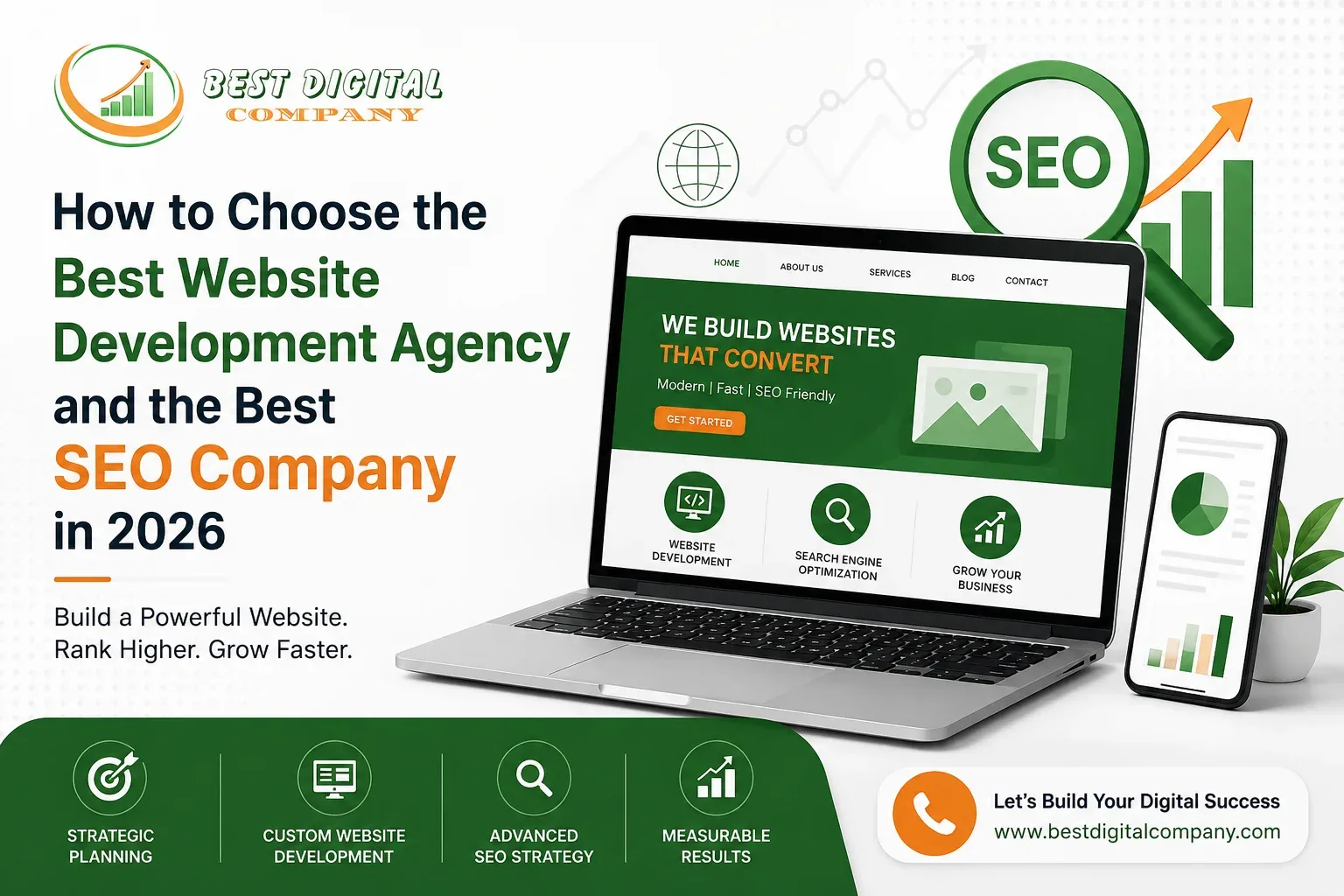
Every week, someone reaches out to us with the same underlying question, just phrased differently. Sometimes it’s “who’s the best website development agency near me,” and sometimes it’s “we need the best SEO company because our traffic has flatlined.” What’s interesting is that these two questions almost always end up connected. A site that’s built well but never gets found is a wasted investment. A site that ranks well but confuses or loses visitors the moment they land on it is just as wasteful.
We’ve worked on both sides of this problem for years, building sites from scratch and rescuing rankings on sites someone else built badly. This piece is meant to help you evaluate both types of partners honestly, without the usual sales pitch language that makes every agency sound identical on paper.
What a Website Development Agency Should Actually Deliver
A lot of businesses assume website development is just about how a site looks. It isn’t. Design is the visible 20%. The other 80% is structure, speed, mobile behavior, and how easily search engines can read the site once it’s live.
When we talk to clients about web development, we are not just talking about layouts and color palettes. We’re talking about clean code, fast load times, proper heading structure, and a site architecture that doesn’t fight against SEO later. This matters more than people expect. We’ve reviewed dozens of sites where the design team and the SEO team never once spoke to each other, and it shows in how long the site takes to rank once it’s finally live. If this sounds familiar, our guide on the website launch checklist before going live walks through exactly what typically gets missed.
A genuinely capable development team will ask you questions before they touch a single line of code .Questions about your customers, your competitors, and your growth goals for the next two years, not just the next two months. If an agency jumps straight to showing you templates, that’s usually a sign they’re building a website, not a business asset.
Signs You’re Looking at a Genuine SEO Company (Not Just a Reseller)
There are a lot of businesses calling themselves an SEO company right now, and the range in quality is enormous. Some run legitimate strategy built on content, technical fixes, and consistent link building. Others buy cheap backlink packages in bulk and hope nobody checks the results six months later.
A few things separate the two. A real SEO partner will actually audit your site before promising anything. They’ll look at your existing content, your technical setup, and your competitors before quoting you a number or a timeline. If you’re curious what a proper audit uncovers, our breakdown on how to rank a new website on Google in 90 days shows the kind of groundwork that has to happen before rankings move at all.
Another sign worth watching for is whether they talk about topical depth or just keywords. Search engines in 2026 reward sites that demonstrate real subject-matter coverage, not single pages stuffed with a phrase repeated a dozen times. We wrote in detail about this shift in our piece on building topical authority, and it’s one of the biggest reasons thin, one-off content strategies are losing ground.
If you run an online store specifically, the priorities shift slightly again product pages, category structure, and reviews all carry more weight than they do for a typical service business. Our SEO guide for e-commerce stores covers that in more depth if that’s closer to your situation.
Why the “Best” Agency Isn’t Always the One with the Biggest Portfolio
Here’s something we’ve noticed after years of client conversations: business owners often equate “best” with “biggest name” or “most case studies on the homepage.” In reality, fit matters more than size. A large agency juggling hundreds of accounts may not give a mid-sized business the attention it needs. A smaller, specialized team focused on both development and search often ends up being more responsive and more invested in the outcome.
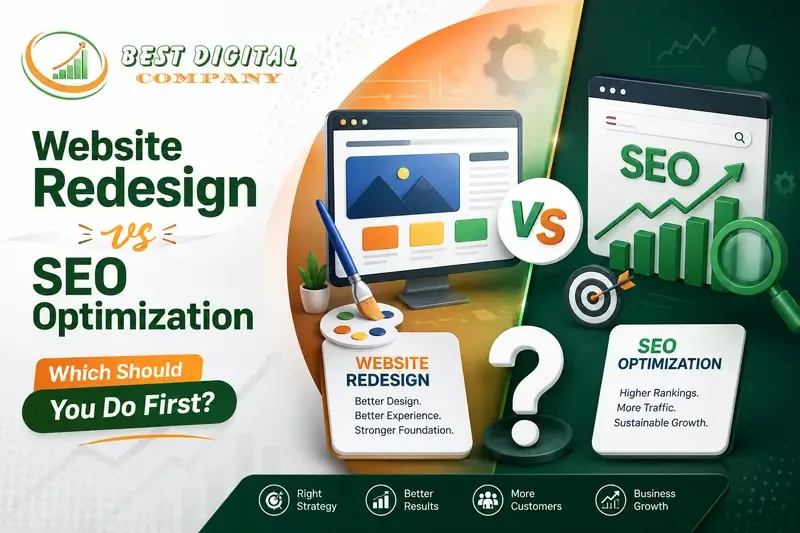
This is also why the decision between fixing your website first or investing in SEO first comes up so often. We addressed that exact dilemma in website redesign versus SEO optimization: which should you do first, because the honest answer depends on your specific starting point, not a one-size-fits-all rule.
The Cost of Treating Development and SEO as Separate Projects
We’ve seen this pattern too many times to ignore it: a business hires one team to build the site and, months later, hires a completely different team to fix the rankings. The second team then spends the first few weeks undoing decisions the first team never should have made broken URL structures, missing metadata, slow-loading images, duplicate content across pages.
When development and search strategy are planned together from day one, you skip that entire rebuilding phase. Your pay-per-clickcampaigns land on pages that are actually built to convert, your social media marketing traffic doesn’t bounce off a slow homepage, and your organic content has a technical foundation that supports it instead of working against it. Businesses that get their traffic without users ever clicking through in the traditional sense also need to think about this early. Our piece on zero-click marketing explains how visibility now extends well beyond your website itself.
What This Looks Like in Practice
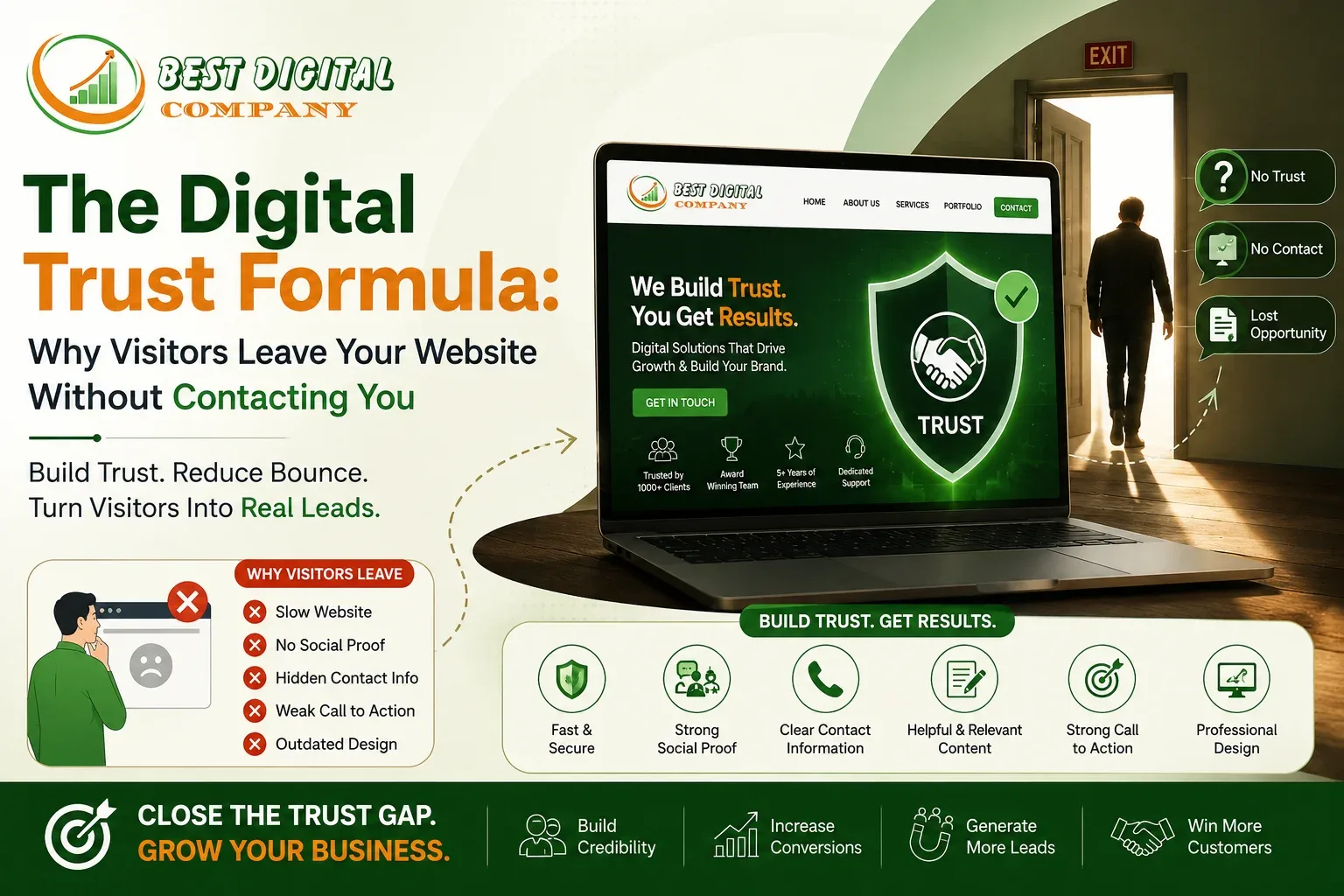
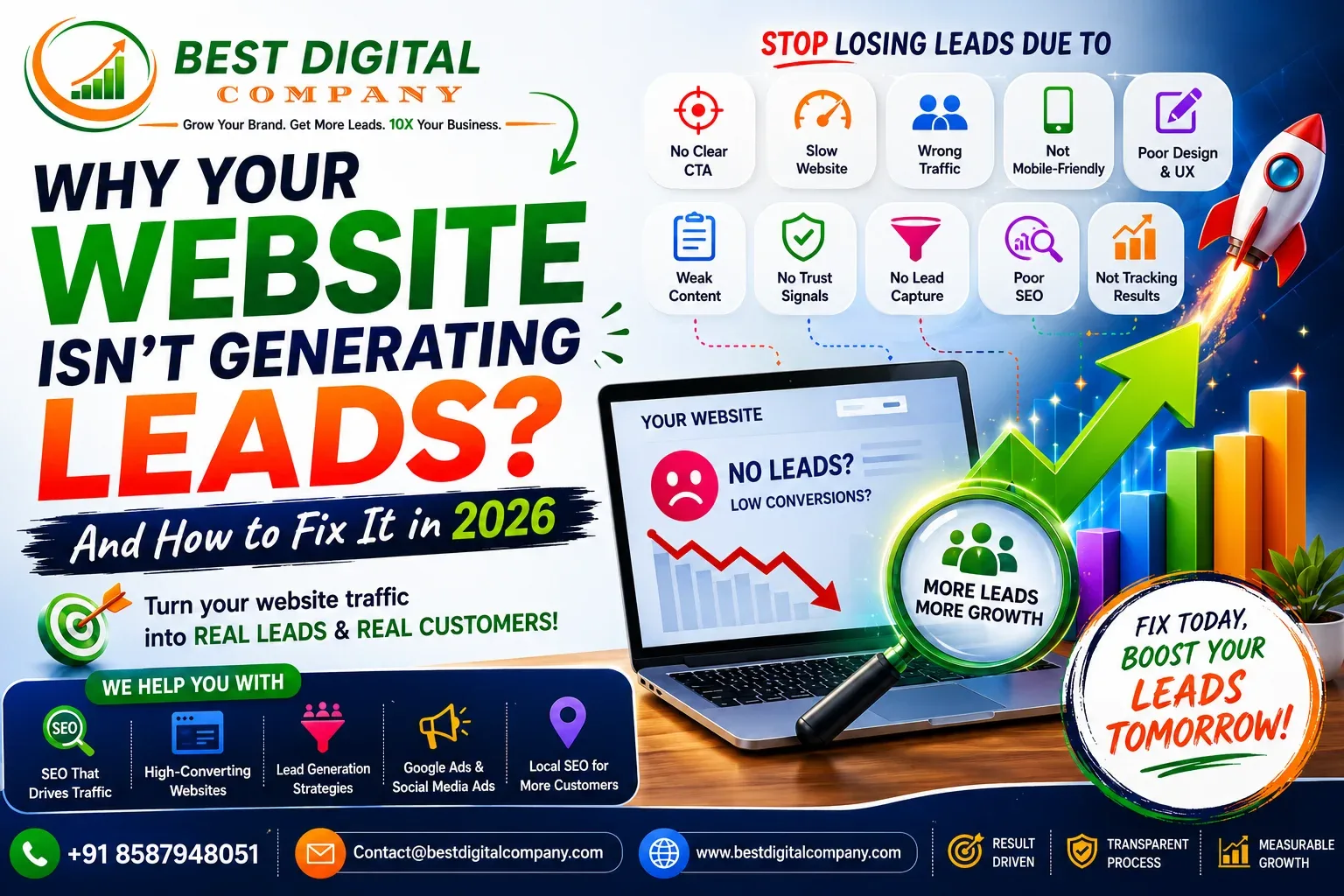
If your website currently generates visitors but very few actual inquiries, the problem is rarely traffic. It’s usually the experience once someone arrives. We’ve covered this at length in why business websites fail to generate leads, and the fixes are often smaller than business owners expect a clearer call to action, faster load speed, or a landing page actually designed around one specific goal rather than trying to say everything at once. Our guide on building SEO landing pages that convert goes into the specific structure that tends to work.
And if you’re running a regional business, location matters more in this evaluation than most owners realize. What works for a business competing nationally looks different from what works for a business trying to dominate a specific city or state something we saw play out clearly while working with businesses across Punjab building their first real digital presence.
Frequently Asked Questions
How do I know if an agency is genuinely good at both website development and SEO, or just good at one?
Ask to see examples of sites they’ve built that are also ranking well organically, not just sites that look good in a portfolio. A team that’s strong in only one area will usually have plenty of design work to show but very little proof of sustained rankings, or the reverse strong rankings on outdated, clunky websites.
Is it better to hire one agency for both development and SEO, or two separate specialists?
In most cases, one team handling both works out better because it removes the handoff gap where technical decisions made during development end up hurting SEO later. If you do go with separate teams, make sure they’re willing to actually communicate with each other during the build.
How long does it typically take to see results from SEO after a new website launch?
Most businesses start seeing measurable movement somewhere between two and four months, with stronger results building over six to twelve months. Anyone promising rankings within days is either overselling or using tactics that won’t hold up long term.
What’s a reasonable budget range for combined website development and SEO services?
This varies widely based on the size of the site, the competitiveness of your industry, and your city or region. A basic informational site with light SEO will cost far less than an e-commerce platform competing in a crowded market. It’s worth getting a scoped quote based on your actual goals rather than comparing generic package prices across agencies.
Do I need a new website if my current one already ranks reasonably well?
Not necessarily. If your site ranks decently but converts poorly, a redesign focused on user experience and conversion paths might matter more than a full rebuild. If the site has deep technical issues holding back rankings, a rebuild alongside an SEO strategy usually makes more sense than patching an outdated foundation.
How do I evaluate an SEO company’s past results without just trusting their word for it?
Ask for specific, verifiable examples a website URL, the approximate timeline, and what changed. Legitimate agencies are usually comfortable sharing this level of detail. Vague claims about “massive growth” without any specifics are worth treating with caution.
Choosing between agencies is rarely about finding the flashiest portfolio. It’s about finding a team that treats your website and your search visibility as one connected system, not two separate line items on an invoice. If you’d like a second opinion on where your current site and search strategy stand, get in touch with our team and we’ll walk you through what we’d actually prioritize first.
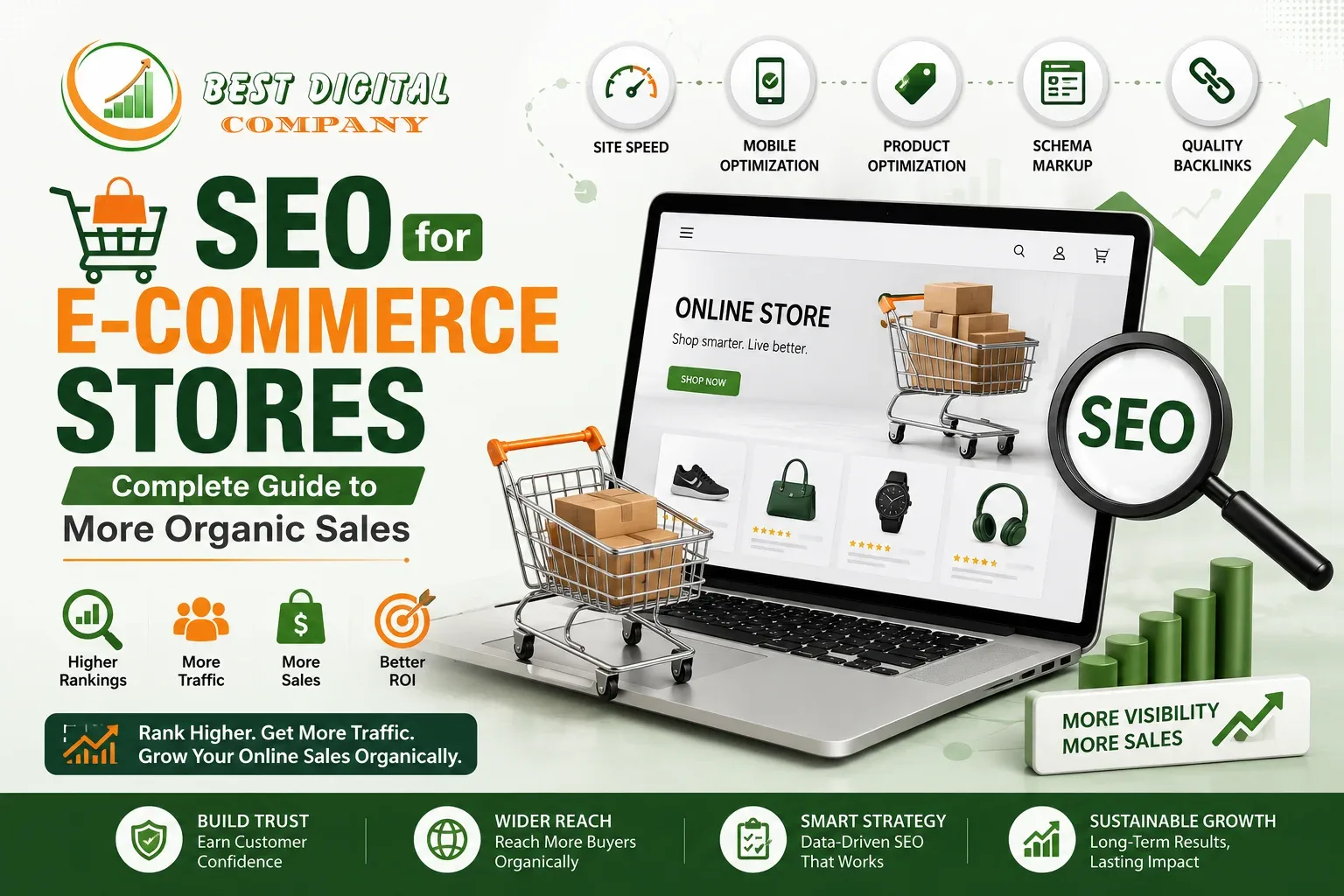
Most e-commerce owners we talk to have already tried paid ads, influencer shoutouts, and maybe a few discount campaigns to push sales. Very few have given organic search the attention it actually deserves. That’s surprising, because unlike ads, organic traffic doesn’t disappear the moment you pause spending. It compounds.
We’ve worked with enough online stores to notice a pattern: the ones struggling with sales almost never have a “marketing” problem first. They have a visibility and trust problem. Their product pages aren’t structured for search engines to understand, their category pages are thin, and their site sends mixed signals about what they actually sell. This guide walks through exactly what we fix when an e-commerce client comes to us asking why traffic isn’t converting into revenue.
Why E-commerce SEO Is Different From Regular Website SEO
A standard business website might have twenty or thirty pages. An online store can have thousands product pages, category pages, filtered views, out-of-stock pages, seasonal collections. That scale creates problems most service-based websites never deal with: duplicate content across similar products, thin pages with barely any unique text, and crawl budget getting wasted on pages that don’t matter.
This is also why generic SEO advice often falls flat for store owners. We touched on a related distinction in our article on website redesign vs SEO optimization . A store can look stunning and still be invisible to Google if the underlying structure wasn’t built with search in mind from the start.
Product Page Optimization: Where Most Stores Lose the Game
Your product page has one job: convince both a visitor and a search engine that this is the best answer to a shopper’s query. Most stores get halfway there.
Unique product descriptions — Copying manufacturer descriptions word-for-word across hundreds of products is one of the fastest ways to get lost in duplicate content. Every product needs its own voice, even if it’s just two original paragraphs.
Descriptive, keyword-aware titles — “Men’s Running Shoes – Black, Size 9” tells search engines more than “SKU-4471.”
High-quality images with proper alt text — Image search drives meaningful e-commerce traffic that many stores ignore entirely.
Customer reviews on-page — Reviews add fresh, original content automatically and strengthen trust signals.
Schema markup for products — Price, availability, and rating data displayed directly helps your listings stand out and earns more clicks.
Category Pages: The Most Underrated Ranking Opportunity
Category pages tend to rank for broader, higher-volume searches than individual products, yet most stores treat them as nothing more than a grid of items. Adding a well-written introduction above the fold, a buying guide below the products, and internal links to relevant subcategories turns a forgettable page into a genuine ranking asset.
We see this exact gap when reviewing client sites. It mirrors what we discussed in our piece on building topical authority in SEO: a single strong, well-supported page consistently outperforms a dozen shallow ones competing for the same intent.
Technical SEO for Online Stores
E-commerce platforms come with their own technical quirks, and ignoring them quietly caps your growth.
Site speed — Heavy product images and third-party scripts slow stores down constantly. Compress images and audit every plugin or app you’ve installed.
Mobile experience — A majority of e-commerce traffic now happens on mobile. If checkout feels clunky on a phone, you’re losing sales before SEO even matters.
Faceted navigation control — Filters (size, color, price) can generate thousands of near-duplicate URLs. Use canonical tags or noindex rules to stop them from confusing search engines.
Out-of-stock page handling — Don’t delete these pages outright. Redirect to a similar product or keep them live with clear messaging, so you don’t lose the ranking equity they’ve already built.
Sitemap accuracy — Make sure your sitemap updates automatically as products are added or removed.
If you’re setting up a brand-new store, much of this overlaps with our broader website launch SEO checklist .The same indexing and structural fundamentals apply, just at a larger scale.
Content Strategy: Why Blogs Still Drive Sales for Stores
A surprising number of store owners assume blogging is irrelevant to e-commerce. In practice, it’s one of the few channels that lets you capture shoppers earlier in their decision process before they’ve even chosen a specific product, while they’re still researching.
A skincare store writing about ingredient comparisons, or a furniture brand writing about choosing the right material for a humid climate, captures search intent that a product page simply can’t. Over time, this builds the kind of topical depth and trust that search engines reward, much like we explained when discussing generative engine optimizationand how research-stage content increasingly shapes buying decisions before a purchase ever happens.
Local and Regional SEO for E-commerce Brands
Even purely online stores often have a regional concentration of buyers, warehouses, or supplier relationships worth highlighting. If your store ships predominantly to certain states or runs region-specific promotions, dedicated landing pages can capture that intent directly.
We’ve built this kind of regional targeting for clients through pages like SEO Services in Mumbai, and the same approach applies to e-commerce brands with strong regional demand. A store with a large customer base across Punjab benefits from the same logic we apply with our SEO Services in Punjab work language, local references, and delivery specifics tailored to that audience. Brands serving buyers across Haryana see similar gains from the structured approach we use in our SEO Services in Haryana campaigns, where local intent and store visibility are addressed together rather than as separate efforts.
Link Building and Trust Signals for Online Stores
Search engines treat e-commerce sites with a degree of extra scrutiny, particularly around trust, given how directly they’re tied to financial transactions. Building genuine authority matters more here than in most niches.
Earn links from product review sites, niche bloggers, and industry publications rather than relying purely on directories.
Display clear policies returns, shipping, privacy prominently, since their absence is a known trust red flag.
Keep your “About Us” page genuinely informative, with real details about who runs the store.
This connects directly to the broader EEAT shift across search, something we unpacked in our guide on how to rank a new website on Google in 90 days ,trust signals now influence visibility nearly as much as keywords do.
Turning Traffic Into Actual Sales
Ranking well means nothing if your landing pages don’t convert that attention into purchases. Clear calls to action, visible shipping information, and a frictionless checkout process all determine whether organic visitors actually buy. We go deeper into this exact challenge in our article oncreating SEO landing pages that convert, which applies just as directly to product and category pages as it does to service pages.
Final Thoughts
E-commerce SEO isn’t a single tactic. It’s the sum of clean technical foundations, genuinely useful product and category pages, supporting content, and real trust signals working together. Stores that treat these as separate, occasional tasks tend to plateau. Stores that treat them as an ongoing system tend to keep growing organic sales quarter after quarter.
If you’d rather have specialists handle this end-to-end, our team at Best Digital Company works with e-commerce brands on exactly this kind of structured growth through our Search Engine Optimization services.
Frequently Asked Questions
How long does e-commerce SEO take to show results?
Most stores start seeing meaningful movement in three to six months, though this depends heavily on competition in your category and how much technical cleanup is needed upfront.
Should I write unique descriptions for every single product, even if I have thousands?
Prioritize your best-selling and highest-margin products first. Bulk manufacturer descriptions on low-priority items are less damaging than duplicate content on the products driving most of your revenue.
Do category pages really need written content, or just products?
Yes. A short, genuinely useful introduction and buying guidance gives search engines context that a product grid alone can’t provide, and it often becomes the page that ranks for broader searches.
Is paid advertising still necessary if my organic SEO is strong?
They serve different purposes. Paid ads deliver immediate, scalable traffic, while organic SEO builds a durable asset that keeps generating sales without ongoing spend. Most successful stores use both together.
What should I do with out-of-stock product pages?
Avoid deleting them. Redirect shoppers to a similar in-stock product or keep the page live with clear stock status, since the page may already hold ranking value worth preserving.
Does site speed really affect e-commerce sales that much?
Significantly. Slow-loading product pages increase bounce rates and directly hurt both conversions and how search engines evaluate the page’s quality.
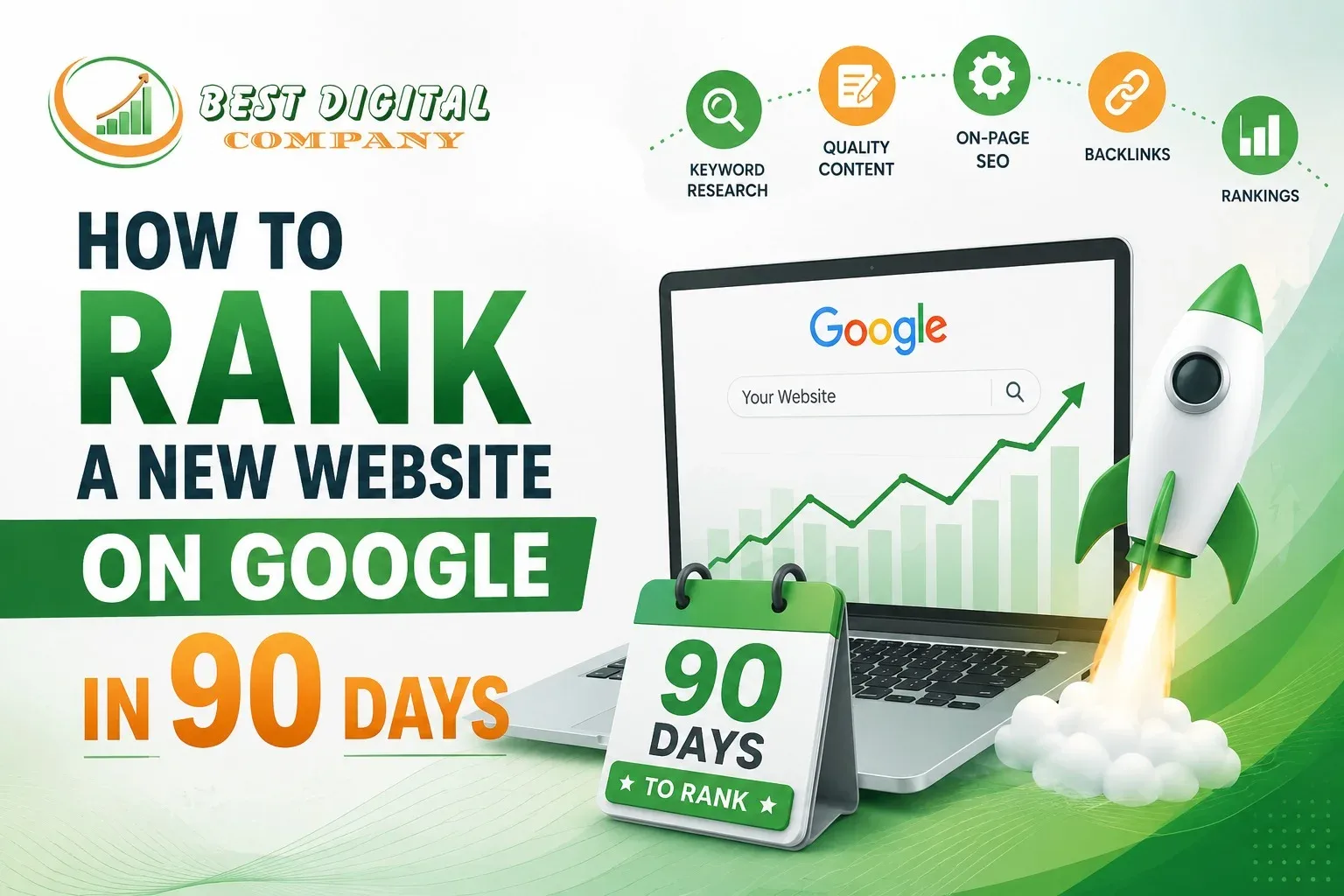
So you just launched your website. Everything looks clean, the pages load fast, and you are genuinely proud of what you built. But a week passes. Then two. And Google still has no idea you exist.
This is one of the most frustrating things in digital marketing and honestly, one of the most common questions we get asked at Best Digital Company. “We have a great website. Why is nobody finding it?”
Here is the truth: Google does not rank websites out of kindness. It ranks websites it trusts. And trust especially for a brand-new domain takes deliberate, structured effort. The good news is that 90 days is enough time to build meaningful visibility if you are focused and consistent.
This guide walks you through exactly how to do it. Not in theory. In practice.
First, Let’s Be Honest About What “Ranking” Actually Means
Before we talk strategy, let us set realistic expectations.
When someone says “rank on Google in 90 days,” they do not mean page one for “best hotel in Mumbai” from day one. That keyword has years of established competition behind it.
What you can realistically achieve in 90 days is ranking for long-tail, lower-competition keywords .The kind of searches your actual customers type when they are close to making a decision. Phrases like “affordable web design company in Delhi” or “local SEO services for restaurants in Haryana.” These queries may have lower search volume, but they bring in people who are ready to act.
Start small, build authority, and expand. That is the playbook.
Week 1–2: Lay the Technical Foundation
You cannot build rankings on a shaky foundation. Before you write a single blog post or chase a single backlink, your website needs to be technically sound.
Make Sure Google Can Find You
The very first thing to check is whether Google can crawl your website. Go to Google Search Console, verify your property, and submit your sitemap. Many new websites sit for weeks without doing this and Google has simply never crawled them yet.
Check your robots.txt file. If it is accidentally blocking search engines (a common mistake after a site launches from a staging environment), no amount of content work will help until you fix it.
Speed Is Not Optional Anymore
Google’s Core Web Vitals are a direct ranking signal. A site that takes five seconds to load on mobile is already competing at a disadvantage. Use Google’s PageSpeed Insights to check your scores and address the biggest issues first usually unoptimised images, unused JavaScript, or lack of a CDN.
If you are using WordPress, a good caching plugin and compressed images can take your score from 40 to 80+ without touching a single line of code.
HTTPS and Mobile-First Setup
Your site must be on HTTPS. If it is not, browsers flag it as unsafe and Google treats it as lower quality. Beyond that, make sure the mobile experience is genuinely good not just “technically responsive.” Over 70% of searches in India happen on mobile devices. Our detailed guide on why mobile-friendly websites with on-page SEO rank higher covers this in depth.
Week 2–3: Keyword Research That Actually Reflects How People Search
Most new websites make the same mistake: they target keywords they want to rank for instead of keywords their audience is actually searching.
Keyword research for a new website is about finding the right entry points. Queries where you have a realistic shot at visibility within 90 days.
Focus on Long-Tail Over Short-Tail
A short-tail keyword like “SEO services” is dominated by agencies with years of content, thousands of backlinks, and massive domain authority. A long-tail keyword like “how to improve local search rankings for a bakery” may have much less competition and still bring you exactly the right visitor.
Use tools like Google Keyword Planner, Ubersuggest, or Answer The Public to find questions your audience is asking. Sort by difficulty for a new site, target keywords with low-to-medium competition and clear user intent.
Map Keywords to User Intent
Every keyword represents a person trying to accomplish something. There are three main types of intent:
Informational — They want to learn something. Example: “what is on-page SEO?”Navigational — They are looking for a specific brand or page. Transactional — They are ready to act. Example: “hire SEO agency in Noida.”
For a new website trying to build visibility fast, you want a mix of all three but prioritise informational content that leads naturally toward your transactional pages.
Week 3–4: On-Page SEO That Reads Like It Was Written by a Human
Here is where many businesses go wrong. They stuff keywords into headings, repeat the same phrase seven times in a paragraph, and produce content that reads like it was written by a robot for a robot.
Google in 2026 is extraordinarily good at detecting this. With its Helpful Content System now deeply embedded across ranking signals, content that puts user experience first is consistently outperforming keyword-heavy fluff.
Write for the Person, Then Optimise for the Machine
Start with what your reader needs. If someone searches “how to rank a new website on Google,” they want a clear, practical, actionable answer not a 200-word paragraph repeating the phrase “rank a new website on Google” over and over.
Once you have written genuinely useful content, then make sure your target keyword appears naturally in:
The page title (H1)
One or two subheadings (H2s)
The first paragraph
The meta description
The URL slug
Image alt text where relevant
That is it. Natural placement, not forced insertion.
Title Tags and Meta Descriptions Still Matter
Your title tag is the first thing both humans and Google see. Keep it under 60 characters, lead with your keyword, and make it compelling enough that someone actually wants to click.
Meta descriptions do not directly affect rankings, but they affect click-through rates — which do influence how Google evaluates your content’s relevance over time.
Internal Linking Is a Ranking Multiplier
Every new page on your website is an island until you connect it to others. Internal links pass authority, help Google understand your site structure, and keep users engaged longer. Understanding why your SEO might be failing due to poor internal linking is essential reading for any new website owner.
When you publish a new page, ask yourself: which existing pages on my site are related to this topic? Add contextual links between them. Not five or ten forced links just the ones that genuinely help a reader go deeper.
Week 4–6: Content Strategy — Build a Cluster, Not Just Pages
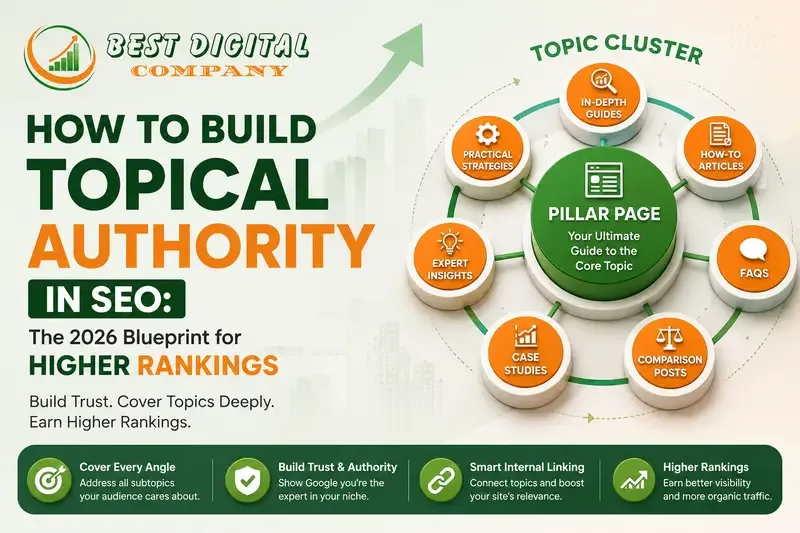
One of the most effective approaches to ranking a new website quickly is the topic cluster model. Instead of publishing random individual posts, you build a network of content around a central theme.
Here is a simple example: if you run a digital marketing agency, your pillar page might be “Complete Guide to SEO for Small Businesses.” Around it, you create supporting cluster content on topics like on-page SEO, link building, local SEO, technical audits, and content strategy all linking back to the pillar page and to each other.
This tells Google that your website has depth on this subject. It builds topical authority. And topical authority is one of the fastest ways a new website can establish trust with search engines. Our detailed breakdown of how to build topical authority in SEO explains this model in full.
How Often Should You Publish?
For a new website, consistency matters more than frequency. Two high-quality, well-researched articles per week is better than seven thin, rushed posts. Google has always favoured depth over volume and since the Helpful Content updates, that preference has become even more pronounced.
Every piece you publish should be the best answer available for that specific query. Ask yourself: if someone finds this through Google, will they get genuine value? Or will they click back and look elsewhere? That second scenario hurts your rankings.
Week 5–7: Off-Page SEO and Building Your First Backlinks
Backlinks are still one of the strongest ranking signals in Google’s algorithm. A link from a respected, relevant website tells Google: “this content is worth recommending.”
For a new website, the goal is not to get hundreds of backlinks overnight. It is to get a handful of quality links from sources that Google already trusts.
Where New Websites Should Start
Business directory listings — Submit your website to Google Business Profile, Justdial, Sulekha, IndiaMART, and other relevant directories for your industry. These create consistent NAP (Name, Address, Phone) signals and provide early crawlable links.
Guest posting — Write genuinely helpful content for industry blogs and include a contextual link back to your website. Focus on relevance, not just domain authority. A link from a smaller but highly relevant website often outperforms a link from a huge unrelated site.
Profile creation on high-authority platforms — LinkedIn, Crunchbase, and similar platforms allow you to list your website. Creating profiles on high DA PA sites is a straightforward way to start building your link profile in the early weeks.
Digital PR — If your business has a story worth telling a launch, a unique service, a local angle reach out to local news sites or industry publications. One genuine editorial mention can do more for your rankings than twenty directory submissions.
What to Avoid
Buying bulk backlinks from link farms. Paying for “1000 backlinks for $10.” Using automated tools that blast your URL across thousands of irrelevant websites. These tactics not only fail to help they can trigger manual penalties that take months to recover from.
Week 6–8: SEO Services in Mumbai – Going Local and Getting Found in Competitive Markets
If your business operates in a city or region, local SEO deserves its own dedicated focus. National rankings are a long game. Local rankings for “[service] near me” or “[service] in [city]” are significantly more achievable in a 90-day window — and they bring customers who are ready to buy.
Mumbai is one of India’s most competitive digital markets. Businesses in every category from architecture firms in Bandra to legal services in Andheri are fighting for the same local search visibility.
What separates the businesses that rank locally from those that don’t?
A fully optimised Google Business Profile. This is not optional. Your GBP listing is often the first thing a local searcher sees, even before organic results. It needs accurate hours, a complete description with relevant keywords, photos updated regularly, and critically genuine reviews from actual customers.
Location-specific landing pages. If you serve multiple areas of Mumbai, a single generic “Contact Us” page will not rank for neighbourhood-level searches. Create individual pages for Bandra, Andheri, Navi Mumbai, and so on each with unique, relevant content describing how you serve that area.
Local citations and consistency. Every mention of your business name, address, and phone number across the web needs to be identical. Inconsistencies confuse Google and suppress your local visibility. A single mismatched address across 30 directories is enough to hurt your local pack rankings.
Week 7–9: SEO Services in Punjab – Building Visibility in Emerging Digital Markets
Punjab’s business landscape is shifting rapidly. Manufacturers in Ludhiana, traders in Amritsar, and service providers across Jalandhar and Patiala are waking up to the reality that digital visibility is no longer a luxury it is survival. Our in-depth coverage of digital marketing for Punjab businessesexplores this transformation in detail.
Here is something counterintuitive: the fact that Punjab’s digital market is still maturing is actually an advantage for businesses that act now. Competition for local keywords in cities like Ludhiana, Jalandhar, and Amritsar is far lower than in Delhi or Mumbai.
A new website targeting “textile export company in Ludhiana” or “chartered accountant in Amritsar” can realistically reach page one within 60–90 days with the right content and minimal backlinking effort simply because fewer businesses are doing the work.
The practical steps for ranking in Punjab:
Start with Google Business Profile same as any local strategy. Get your listing live, verified, and populated with accurate information and photos.
Build location pages for the specific cities you serve. Do not just say “we serve Punjab.” Create a page for Ludhiana, a page for Amritsar, a page for Patiala each with genuinely localised content that a resident of that city would find useful.
Earn mentions from local business associations, trade bodies, and regional news outlets. A mention from Punjab’s business community carries strong local relevance signals that directory links cannot replicate.
Week 8–10: SEO Services in Haryana – Winning in India’s Fastest-Growing Business Corridor
Haryana sits at the intersection of India’s most active commercial zones. From Faridabad’s manufacturing belt to Gurugram’s IT and finance district, and from Panipat’s textile trade to Rohtak’s educational institutions, the diversity of business activity here is remarkable.
Gurugram, in particular, has become one of the most digitally competitive cities in India. Thousands of startups, MNCs, and established SMEs are all competing for visibility. Our complete guide to SEO services in Gurugram goes into detail about what it actually takes to stand out in that market.
For businesses in the rest of Haryana, Faridabad, Rohtak, Panipat, Sonipat, Ambala.The opportunity mirrors what we described for Punjab. The digital competition is lower, the window to rank is narrower, and the businesses that invest in local SEO now will be the ones that dominate for years.
City-specific content is the fastest win. If you are a real estate developer in Faridabad, a page targeting “2BHK flats in Faridabad near metro” will outperform a generic “Properties in Haryana” page in a fraction of the time.
Local backlinks compound over time. Reach out to Haryana-based business directories, local news outlets, and trade associations. Even one or two links from genuinely local, relevant sources can accelerate your rankings significantly.
Week 9–11: Tracking What Is Working (And What Is Not)
At the six-week mark, you should have enough data to start making informed decisions. This is where most businesses either accelerate their progress or keep spinning their wheels.
The Metrics That Actually Matter
Impressions in Google Search Console — This tells you how many times your pages appeared in search results, even if nobody clicked. Rising impressions across your target keywords means Google is starting to understand and surface your content.
Average position — If keywords are appearing at position 18, 22, or 30. You are in striking range. Those rankings respond well to targeted improvement of the page in question.
Click-through rate — A page at position 6 with a mediocre title tag will be outclicked by a compelling one. Improving CTR without changing position still drives more traffic.
Organic traffic from Google Analytics — The ultimate validation. Are real visitors arriving from organic search? Which pages are they landing on? How long are they staying?
Adjust and Iterate
If certain pages are not moving after six weeks, do not just leave them. Review the content is it genuinely the best answer for that query? Review the internal linking are other pages on your site pointing to it? Review the backlink picture does this page have any external authority?
The 90-day ranking process is not a set-and-forget exercise. It is iterative. The businesses that rank are the ones that review, learn, and improve continuously.
Week 10–12: Conversion Optimisation – Because Traffic Means Nothing Without Action
This might seem outside the scope of a ranking guide. It is not. Here is why.
Google increasingly weights user engagement signals bounce rate, time on page, pages per session, and scroll depth as indirect indicators of content quality. A page that ranks in position four but has a 90% bounce rate will eventually lose ground to a lower-ranked page that keeps visitors engaged.
Make sure every page has a clear, low-friction next step. A phone number. A contact form that works on mobile. A WhatsApp button. A compelling reason to reach out. Our breakdown of why visitors leave without contacting youcovers the trust signals that make the difference between a visitor and a customer.
The 90-Day Realistic Milestone Chart
Milestone
What to Expect
Day 1–14
Site indexed by Google, Search Console active, zero organic traffic (normal)
Day 15–30
First impressions appear in Search Console for long-tail queries
Day 30–45
Some pages begin appearing in positions 20–50
Day 45–60
2–5 keywords moving into positions 10–20
Day 60–75
First page appearances for low-competition long-tail keywords
Day 75–90
Consistent organic traffic from 5–15 keywords; 1–3 page-one rankings
These are conservative estimates. Businesses in lower-competition niches, or those investing in consistent content and quality backlinks, often outpace this timeline. Those in highly competitive industries may take longer but the foundation being built in these 90 days continues to compound for years.
Do You Need Professional SEO Services?
Honestly? You can implement much of this yourself, especially in the early stages. The strategies in this guide are not secrets. They are the building blocks of every successful SEO campaign, whether it is done in-house or by an agency.
That said, consistent execution is harder than it looks. Writing two quality articles per week, actively building backlinks, monitoring Search Console, fixing technical issues, and staying current with algorithm changes all while running a business is genuinely demanding.
If you want to move faster and with fewer mistakes, working with a team that has done this across dozens of industries and competitive markets compresses your timeline considerably. Our Search Engine Optimization services are built around exactly this kind of structured, 90-day approach to new website rankings.
We have also put together transparent SEO packages designed for businesses at different stages whether you are a startup needing foundational work or an established company trying to compete in a crowded niche.
If you want to understand what the investment looks like before committing, our guide on how much SEO costs in India in 2026 gives you a realistic picture with no fluff.
Frequently Asked Questions
How long does it really take for a new website to rank on Google?
Most new websites start seeing impressions in Google Search Console within 2–4 weeks of proper setup and indexing. Actual page-one rankings for competitive keywords typically take 6–12 months. However, long-tail keywords with low competition can often be ranked within 60–90 days with consistent content and basic link building. The timeline depends heavily on how competitive your niche is, how consistently you publish quality content, and whether your technical foundations are sound.
Does social media activity help a new website rank on Google?
Social media does not directly influence Google rankings. social shares are not a confirmed ranking signal. However, social activity helps indirectly in meaningful ways: it drives traffic to your website, increases brand searches (which Google does notice), and expands the reach of your content, increasing the likelihood of earning natural backlinks. Social Media Marketing is a valuable parallel channel for new websites, even if the ranking relationship is indirect.
How many backlinks does a new website need to start ranking?
There is no magic number. A single high-quality backlink from a trusted, relevant website can do more than a hundred low-quality directory links. For a new website targeting long-tail keywords in a low-to-medium competition niche, even 5–15 good backlinks can be enough to start seeing rankings within 90 days. Focus on quality and relevance, not volume.
Should I run Google Ads while I am waiting for organic rankings?
Yes and this is often overlooked advice. Pay Per Click advertising and SEO work extremely well together for new websites. While your organic presence is building, paid ads give you immediate visibility for your most important keywords, drive traffic that helps Google understand your site’s engagement quality, and generate leads and revenue so your business is not waiting months to see any return from its digital investment.
What is the biggest mistake new websites make with SEO?
Trying to rank for keywords that are far too competitive, far too soon. The second biggest mistake is publishing thin, generic content because it is faster and then wondering why nothing ranks. Both problems have the same solution: do your research first, write genuinely useful content that serves a specific reader, and be patient enough to see it compound. The businesses that fail at SEO almost always tried to skip steps or take shortcuts that Google’s algorithms are specifically designed to detect and discount.
Does website design affect how quickly a new site ranks?
Absolutely. A well-designed website that is fast, mobile-friendly, and easy to navigate reduces bounce rates and improves user engagement both of which contribute to how Google evaluates your content quality over time. Our Web Development and Designing servicesare specifically built to ensure that new websites launch with both visual quality and technical SEO foundations in place.
Can I rank a new website without hiring an SEO agency?
Yes if you are willing to invest the time to learn and execute consistently. The strategies in this guide are exactly what professional agencies use; the difference is experience, speed of execution, and access to tools. If you are a startup or solo entrepreneur with more time than budget, you can absolutely make meaningful progress in 90 days on your own. If your time is better spent running your business, a professional team will almost always move faster and with fewer costly mistakes.
How is ranking in 2026 different from ranking five years ago?
In several important ways. Google now heavily penalises AI-generated content that lacks genuine insight or human perspective. The 2026 Google algorithm updates reflect a clear priority: content written for people, by people with real experience, consistently outperforms technically-optimised but hollow content. E-E-A-T (Experience, Expertise, Authoritativeness, and Trustworthiness) has moved from a background consideration to a front-and-centre ranking factor. For new websites, this means showing the world who you are through author bios, case studies, real credentials, and transparent business information.
Final Thoughts
Ranking a new website on Google in 90 days is not a myth. It is not magic. It is the result of doing the right things, in the right order, consistently enough that Google starts to trust you.
It starts with a technically sound foundation. It grows through content that genuinely helps real people. It expands through earned backlinks and local signals. And it converts through a website experience that earns the trust of visitors who arrive from search.
The businesses that understand this and execute it are the ones that look back in a year and realise their website is now one of their most valuable business assets.
If you would like to talk through what a structured 90-day ranking plan looks like for your specific industry, city, or goals, we are happy to have that conversation.
Contact Best Digital Company We are based in Delhi and work with businesses across India, from Mumbai and Punjab to Haryana and beyond.
Let’s be real for a second. The days of writing one good article and hoping it ranks are long gone. Google’s systems in 2026 are far more sophisticated than they were even two years ago. They don’t just look at a single page anymore. They look at your entire website and ask one fundamental question: Does this site genuinely know what it’s talking about?
That’s topical authority in a nutshell. And if you don’t have it, you’re fighting an uphill battle against websites that do.
We’ve spent years helping businesses across India build lasting digital presence through smart, structured SEO strategies. What we’ve seen, time and again, is that the brands that win in search aren’t the ones with the most backlinks or the flashiest websites. They’re the ones who’ve built deep, trusted expertise on their topic cluster and made sure Google knows it.
This guide walks you through exactly how to do that in 2026.
What Is Topical Authority and Why Does It Matter in 2026?
Topical authority is Google’s way of measuring how comprehensively and reliably a website covers a particular subject area. It’s not just about having one great article. it’s about owning the entire conversation around a topic.
Think of it like this. If someone asked you about heart surgery, you’d trust a cardiologist over a general physician, right? Google thinks the same way. A website that has covered every angle of a subject- beginner guides, advanced strategies, case studies, FAQs, comparisons tells Google: this is the expert on this topic.
In 2026, three forces make topical authority more critical than ever:
AI Overviews in Google are pulling answers directly from sites that demonstrate deep, consistent expertise not just individual pages that match a query.
Google’s Helpful Content System has evolved to reward experience-backed, comprehensive content while penalising thin or repetitive material.
Zero-click searches mean your brand needs to be the recognised authority so users seek you out directly not just stumble upon you. We covered zero-click marketing strategies in detail in a separate post if you haven’t read it yet, it’s worth your time.
The Difference Between Topical Authority and Domain Authority
This is a question we get asked constantly, so let’s settle it clearly.
Domain Authority (DA) is a third-party metric that estimates the overall strength of your website based largely on backlinks. It’s a useful proxy, but it’s not what Google actually uses as a direct ranking signal.
Topical Authority is about content depth and relevance within a specific niche. A brand new website about one narrow topic say, industrial solar panels for factories can outrank a high-DA generalist site if it covers that topic more thoroughly and expertly.
In practical terms: you can have a DA of 70 and still lose rankings to a DA-30 site that has built genuine topical depth. We’ve seen it happen repeatedly with our clients.
Understanding Topic Clusters: The Foundation of Topical Authority
If topical authority is the destination, topic clusters are the road you build to get there.
A topic cluster consists of:
One Pillar Page — a comprehensive, long-form piece that covers a broad topic at a high level. This becomes the authority hub.
Multiple Cluster Pages — individual posts that go deep on specific subtopics related to the pillar.
Internal Links — connecting every cluster page back to the pillar and to each other, passing authority and helping Google understand the structure.
Here’s a simple example. If your pillar page is about SEO Services, your cluster pages might cover:
How on-page SEO works What is technical SEO and why it matters How to build backlinks ethically Local SEO vs national SEO: which does your business need? How to measure SEO success with the right metrics
Each cluster page links back to the pillar.The pillar links out to each cluster. Google crawls this web of content and sees a site that has genuinely mastered this subject area.
Step-by-Step: How to Build Topical Authority in 2026
Step 1 – Choose Your Core Topic With Intent
Before writing a single word, you need to define your territory. What does your business genuinely know better than anyone else?
For a digital marketing agency, the core topic might be SEO Services. For a local business, it might be very specific like plumbing repairs in your city. The narrower and more specific you can go while still having enough to say, the faster you’ll build authority.
Ask yourself: What topics does my business serve day in and day out? What questions do my actual customers ask me that I can answer better than a generic website? What subtopics exist within this space that haven’t been covered well online?
Step 2 – Map Out Every Subtopic Your Audience Needs
Once you’ve chosen your core topic, map every subtopic that exists within it. Use tools like Google’s People Also Ask, your own customer conversations, and competitor analysis.
Organise these into three categories:
Awareness topics for people who are just learning (e.g., “What is SEO?”) Consideration topics for people comparing options (e.g., “SEO vs PPC: which is better?”) Decision topics for people ready to act (e.g., “How to choose the right SEO agency”)
This maps directly to search intent which Google is increasingly using to match content to queries. If you cover all three layers, you’re speaking to your audience at every stage of their journey.
Step 3 – Create Your Pillar Page First
The pillar page is your home base. It should:
Be long-form and comprehensive (typically 3,000–5,000+ words) Cover the topic broadly but with enough depth to be genuinely useful Link out to all your cluster content Be written with clear expertise not just a list of facts, but real perspective
Your pillar page is also the place to showcase Experience, Expertise, Authoritativeness, and Trust (E-E-A-T). Include author credentials, real-world examples, specific data, and original insights. Generic content won’t cut it.
Step 4 – Write Cluster Content That Goes Deep
Each cluster post should fully answer one specific question or subtopic. Don’t try to cover too much in a single post. The magic of the cluster model is that each piece is focused and thorough and together they create a complete picture.
Every cluster post should:
Target one specific, well-researched keyword or question Include practical, actionable information not just theory Draw on real experience or case studies wherever possible Link back to the pillar page and to 2–3 related cluster posts
For example, our post on why your website isn’t generating leads is a cluster post that feeds into a broader understanding of digital marketing strategy. It’s specific enough to be deeply useful and connected enough to build authority.
Step 5 – Use Internal Linking as Your Structural Backbone
Internal links are what tie your topic cluster together. They serve two purposes: they help users navigate deeper into your content, and they help search engines understand the hierarchy and relationship between your pages.
Best practices for internal linking within a topic cluster:
Every cluster post links back to the pillar page The pillar page links to every cluster post Related cluster posts link to each other when genuinely useful Use descriptive, keyword-rich anchor text not just “click here”
Google’s quality evaluators use E-E-A-T – Experience, Expertise, Authoritativeness, and Trustworthiness as the lens through which they assess content quality. In 2026, with AI-generated content flooding the web, Google has doubled down on rewarding content that comes from real human experience.
Here’s how to demonstrate E-E-A-T practically:
Experience: Include first-hand examples, client stories, and what you’ve personally seen work and not work Expertise: Show credentials, qualifications, or professional background especially in the author bio Authoritativeness: Earn mentions and links from recognised publications and industry voices Trustworthiness: Be transparent about who you are, cite credible sources, keep content accurate and updated
Writing that sounds like it was typed by a human who genuinely understands the topic with opinions, nuances, and real context is what separates content that ranks from content that disappears.
SEO Services in Mumbai: Building Topical Authority in a Hyper-Competitive Market
Mumbai is one of India’s most competitive digital markets. Whether you’re in finance, retail, hospitality, or healthcare, the online competition is fierce. Businesses that invest in structured SEO Services in Mumbai and pair them with a genuine topical authority strategy are the ones breaking through the noise.
What works particularly well for Mumbai-based businesses is hyper-local topical clustering. Rather than trying to compete nationally on broad keywords from day one, start by becoming the definitive resource for your industry in Mumbai. Cover every question your local customers ask. Build pages that speak directly to the Mumbai market – local trends, local competition, local customer behaviour.
Once you own your city, expanding to national authority becomes a far smoother journey.
SEO Services in Punjab: How Regional Businesses Can Win With Content Depth
Punjab has seen extraordinary growth in its digital economy over the past three years. Businesses across Ludhiana, Amritsar, Jalandhar, and Chandigarh are increasingly investing in digital presence and the ones seeing the best results are those who’ve committed to content depth over time. Our SEO Services in Punjab are designed specifically for businesses in this market.
The challenge for most Punjab-based businesses is that they try to compete on the same generic keywords as national brands and lose. The smarter approach is to build topical authority around the intersection of your industry and your region.
A logistics company in Ludhiana, for example, could build an entire topic cluster around supply chain and freight management in North India with content covering local routes, regulatory requirements, cold chain logistics specific to Punjab’s agriculture sector, and seasonal demand patterns. That level of specificity is something a national brand simply cannot replicate.
SEO Services in Haryana: Turning Local Expertise Into Search Authority
Haryana’s business landscape is evolving rapidly, with significant industrial growth in Gurugram, Faridabad, Panipat, and Sonipat. Businesses here are waking up to the fact that ranking on Google isn’t about luck. it’s about strategy. Smart investment in SEO Services in Haryana combined with a well-structured topical authority approach can give regional businesses a meaningful edge over national players who aren’t addressing local needs.
The key insight for Haryana businesses: your real-world expertise is your biggest asset. The things you know about operating in this specific market seasonal factors, local regulations, customer preferences, regional competition that’s content that national websites can’t produce authentically. Document it. Publish it. Own it.
Common Mistakes That Undermine Topical Authority
We’ve worked with hundreds of businesses on their SEO strategies, and we see the same mistakes again and again.
Publishing Without a Plan
Random, disconnected blog posts don’t build topical authority. If your content calendar is just “write about whatever’s trending this week”, you’re not building a cluster you’re building a pile. Every piece of content needs a clear home in your topic structure.
Covering Topics Superficially
Thin content 400-word posts that barely scratch the surface actively hurts you in 2026. Google’s Helpful Content System is getting better at identifying content that covers a topic without truly addressing user needs. If your post on “What is backlink building?” can be bettered by a five-minute Wikipedia read, it’s not adding value.
Ignoring Existing Content
Most businesses already have content sitting on their site that could be reorganised into clusters. Before creating new content, audit what you have. A post that’s half-done on a relevant topic can often be expanded into a proper cluster page rather than starting from scratch.
Skipping the Technical Foundation
Topical authority is built on content, but it’s supported by solid technical SEO. If your site is slow to load, broken on mobile, or hard for crawlers to navigate, your cluster strategy will underperform. Our post on why mobile-friendly websites rank higher covers the essentials of what Google looks for technically.
Not Updating Content Over Time
Topical authority isn’t a set-and-forget exercise. Google rewards freshness and accuracy. Set up a schedule to review your pillar and cluster pages at least once a year updating data, expanding sections that have grown in importance, and removing anything that’s become outdated.
How Topical Authority Connects to AI Search and Generative Answers
This is where things get really interesting in 2026. If you’ve noticed that Google is now showing AI-generated summaries at the top of many results pages, you’re seeing the new frontier that topical authority directly feeds into.
AI Overviews pull information from sources that Google trusts as authoritative on a topic. If you’ve built genuine topical depth, you’re far more likely to be cited in these AI summaries which means visibility even when users don’t click through. We wrote about this in detail in our blog on how to rank in ChatGPT, Gemini and AI search results.
Similarly, our post on Generative Engine Optimization covers how to specifically optimise your content to be referenced by AI systems a strategy that works hand-in-hand with building topical authority.
The brands that win in AI-powered search aren’t the ones trying to game the system. They’re the ones who’ve become genuinely trustworthy resources on their topic which is exactly what the topical authority model is designed to create.
Topical Authority Checklist: Where Does Your Site Stand?
Use this as a quick self-assessment:
Do you have a defined primary topic that your site is focused on? Have you mapped the subtopics within your niche that your audience searches for? Do you have pillar pages for your core topics? Do you have cluster content covering each major subtopic? Are your pages interlinked in a logical, structured way? Does your content reflect genuine first-hand experience and expertise? Is your author information and E-E-A-T visible on your pages? Do you update your content regularly? Is your site technically sound mobile-friendly, fast, crawlable? Are you tracking which content is driving traffic and engagement?
If you answered “no” to more than three of these, there’s significant topical authority work to be done and it’s worth starting now rather than later.
How Professional SEO Services Accelerate Topical Authority
Building topical authority takes time but it takes far less time when it’s done with a proper strategy from the start. Most businesses that try to do this on their own spend months creating content that doesn’t connect, doesn’t rank, and doesn’t build the clusters they need.
Working with experienced SEO professionals means you start with a clear map, not a blank page. You know exactly which pillar pages to build, which cluster posts to prioritise, which keywords to target at each stage, and how to structure your internal linking so that Google sees the full picture of your expertise from day one.
Beyond content strategy, there’s the technical side making sure your website development and architecture supports crawling, indexing, and link equity flow properly. And complementary channels like social media marketing can amplify your content’s reach, bringing in the engagement signals that further reinforce your authority.
If you want to understand what professional SEO actually costs and what you should expect for your investment, our post on SEO pricing in India for 2026 gives you a clear, honest breakdown.
Frequently Asked Questions About Topical Authority in SEO
How long does it take to build topical authority?
There’s no fixed timeline, but most businesses start seeing meaningful movement within 4–8 months of consistently publishing well-structured cluster content. Full topical authority in a competitive niche typically takes 12–18 months of sustained effort. The good news: once you’ve built it, it’s very difficult for competitors to displace you quickly.
Do I need a large website to build topical authority?
Not at all. A focused website with 30 tightly structured, high-quality pages on a specific topic will outperform a 300-page site that covers everything loosely. Quality, structure, and coherence matter far more than sheer volume. Start small and go deep, then expand.
Is topical authority the same as being ranked number one?
Topical authority increases your likelihood of ranking highly across many related queries — not just one. The goal isn’t a single number-one ranking; it’s consistent, broad visibility across your entire subject area. When Google trusts you as an authority, a single strong piece of content can lift rankings for dozens of related pages.
Can topical authority be built through off-page SEO as well?
Absolutely. Backlinks from reputable publications in your industry signal to Google that external sources consider you an authority on your topic. Guest posts, expert quotes, PR coverage, and community engagement all contribute to the authority side of the equation. But these work best when your on-site content structure is already solid external signals amplify what’s already there.
What’s the role of keyword research in building topical authority?
Keyword research is the starting point for mapping your topic cluster. You’re not just looking for high-volume keywords. you’re looking for the full universe of questions, concerns, and searches that exist within your topic area. Tools like Google Search Console, Google’s auto-suggest, and People Also Ask sections are gold for this. Long-tail keywords, in particular, are often the entry points that build authority before you can compete on the broader terms.
How does topical authority help with AI-generated search results?
AI systems whether Google’s AI Overviews, ChatGPT search, or Gemini tend to cite and reference sources that have demonstrated consistent, deep coverage of a topic. If you’ve built genuine topical authority, you’re more likely to be included in the sources these systems draw from when answering user questions. This is why topical authority and the emerging field of Generative Engine Optimisation (GEO) are closely related.
Do I need to publish new content every day to maintain topical authority?
No and please don’t publish every day just for the sake of it. Consistency matters more than frequency. Publishing two or three genuinely excellent, well-researched pieces per month is far more effective than churning out daily content that adds little value. Your existing content also benefits from regular updates, which counts as fresh activity in the eyes of search algorithms.
What industries benefit most from topical authority?
Almost every industry benefits, but topical authority is particularly powerful for B2B services, professional services (legal, financial, medical, marketing), e-commerce with complex product categories, and local services where demonstrating expertise can be a genuine trust signal for prospective customers. If your customers need to trust you before they buy, topical authority accelerates that trust.
Final Thoughts: Authority Is Earned, Not Hacked
We say this to every client who comes to us looking for a quick fix: there is no shortcut to genuine authority. The websites that rank consistently and resist algorithm changes are the ones that have put in the work to truly cover their subject area not the ones that found a loophole.
The good news is that building topical authority is a strategy that compounds over time. Every piece of content you publish, every internal link you create, every cluster page you develop makes the entire site stronger. You’re not just optimising individual pages you’re building an asset.
If you’re ready to start building that kind of lasting, sustainable search presence for your business whether you’re in Delhi, Mumbai, Punjab, Haryana, or anywhere else in India .we’d love to talk. Get in touch with Best Digital Companyand let’s build something that actually lasts.
Explore our SEO Packages or learn more about our Search Engine Optimization services.
A few months ago, one of our long-term clients called us with a strange complaint. Their website traffic from Google had dropped, but their phone was ringing more than ever. New customers kept saying the same thing: “ChatGPT told me about you” or “Gemini recommended your service.” That conversation is the clearest proof we have seen that the rules of online visibility have changed. Ranking on a results page is no longer the only goal. Being the answer an AI engine gives someone is the new finish line, and that finish line has a name: Generative Engine Optimization, or GEO.
If you run a business and have spent years investing in search engine optimization, this shift can feel unsettling. The good news is that GEO does not replace everything you have built. It builds on top of it. This guide breaks down what GEO actually means, why 2026 is the year it stopped being optional, and how a business whether you run an SEO services in Mumbai operation, an SEO services in Punjab business, or an SEO services in Haryana company can adapt without starting from zero.
What Generative Engine Optimization Actually Means
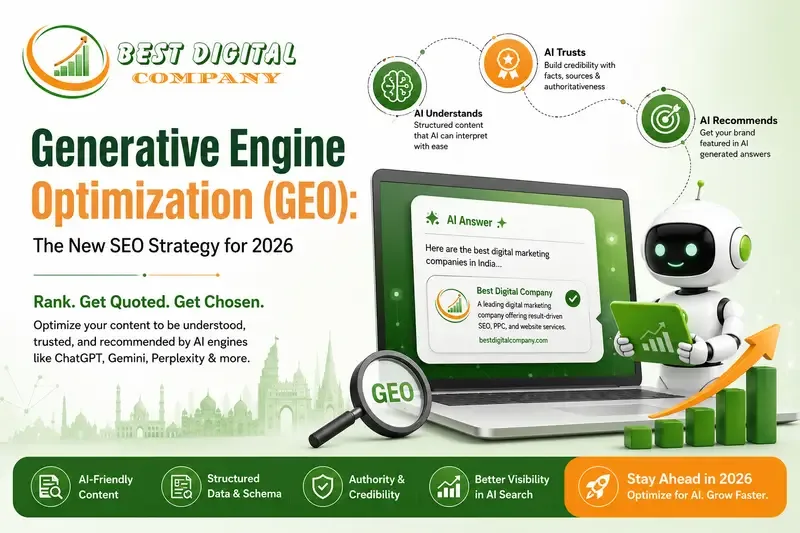
Generative Engine Optimization is the practice of structuring your website content so that AI systems like ChatGPT, Google’s AI Overviews, Gemini, Perplexity, and Claude can read it, understand it, and choose to use it when answering someone’s question. Traditional search engine optimization was built around one outcome: getting a blue link in front of someone so they click through to your site. GEO focuses on a different goal entirely getting your content selected, synthesized, and cited by AI systems when they generate answers to user questions.
Put simply, classic SEO got you ranked. GEO gets you quoted.
This is not a small distinction. When someone searches “best digital marketing company near me” the old way, they see ten listings and make their own choice. When that same person asks an AI assistant the same question, the assistant picks two or three sources, blends them into one answer, and hands the user a recommendation. If your business is not one of the sources the AI trusts, you are invisible in that conversation, even if your website is technically well optimized for Google.
Why GEO Matters More in 2026 Than It Did a Year Ago
The numbers behind this shift are hard to ignore. ChatGPT now has more than 800 million weekly users, Perplexity handles roughly 780 million monthly queries, and Google’s AI Overviews now appear in a large share of search results. Industry researchers tracking this transition have noted that AI-referred website sessions jumped 527% year-over-year in just the first five months of 2025, which tells you this is not a future trend. It is already happening in real time, inside the same browsers and apps your customers use every day.
What makes this period especially important is the overlap problem. Research from AI visibility firms has found that the overlap between top Google results and the sources AI systems actually choose to cite has dropped from around 70% to below 20%. That means ranking well on Google no longer guarantees that an AI engine will mention you at all. The two systems are starting to reward different things, and a business that only optimizes for one is leaving the other half of its potential audience untouched.
This is exactly the gap we addressed in our earlier post on zero-click marketing in 2026 more people are getting answers without ever clicking through to a website, and businesses need a plan for being part of that answer rather than competing for a click that may never come.
How GEO Is Different From Traditional SEO
It helps to think of traditional SEO and GEO as two related but separate disciplines rather than one replacing the other.
Traditional SEO is built around keywords, backlinks, page speed, and technical structure designed to satisfy a crawler and a ranking algorithm. The end goal is a position on a results page. The fundamental unit of success in classic SEO is the click a user sees a listing, clicks through, and potentially converts.
GEO works differently because the “reader” is no longer just a human scrolling a page. It is a language model trying to extract a clear, trustworthy answer in seconds. Generative engines parse meaning rather than keywords, so content built for GEO needs to be structured around clearly defined entities, claims, and relationships, using elements like structured markup, well-organized headings, explicit definitions, FAQ sections, and comparison tables. The aim shifts from being ranked to being quotable.
This also changes what counts as good content. A page that simply claims to be “a market leader” gives an AI system nothing it can use, while a page built around a specific, sourced, and verifiable claim gives the system exactly the kind of detail it needs to cite confidently. That single idea specificity over vague claims is the difference between content that gets quoted by AI tools and content that gets ignored by them.
If your team is still relying on outdated keyword-stuffing habits, it is worth revisiting our breakdown of common SEO and digital marketing mistakes in 2026, since many of those same habits actively work against GEO.
The Building Blocks of a Working GEO Strategy
A strong GEO approach is not one trick. It is a handful of fundamentals applied consistently across a website.
Structure your content around clear, extractable answers. Every important page should answer its core question directly within the first few lines, then expand with supporting detail. AI systems tend to pull the most direct, well-formed sentence from a page, so burying your answer under three paragraphs of introduction works against you.
Back up claims with specific, original data. General statements about being “trusted” or “experienced” do not give an AI model anything to cite. Numbers, dates, percentages, and named outcomes do. Strategies that work well in 2026 include answering questions directly, including original data, building author authority, earning third-party citations, and publishing consistently.
Use schema markup and clean technical structure. Best practice for 2026 includes implementing schema markup for FAQs and reviews, using clear heading hierarchies with one topic per section, ensuring content is server-side rendered rather than hidden behind JavaScript, and confirming nothing important is locked behind logins or paywalls. It is also worth checking that AI crawlers are not accidentally blocked through your robots file or CDN settings.
Build genuine topical authority. AI systems, much like search engines, tend to trust sites that demonstrate consistent depth on a subject rather than scattered, one-off posts. This is one of the reasons location-specific expertise pages matter so much for local businesses a dedicated page on SEO services in Mumbai signals real, specific authority on that market, rather than a generic national claim stretched across every city.
Maintain editorial consistency across your site. This is where Experience, Expertise, Authoritativeness, and Trust, commonly known as EEAT, becomes central. AI tools weigh whether content reflects first-hand experience and a credible author, not just polished writing. A blog post written by someone with a named author byline, supported by services pages with consistent contact details and a verifiable business address, carries more weight than anonymous, generic content.
Where Local SEO Still Fits Into the GEO Conversation
A common misconception is that GEO replaces local SEO. It does not. If anything, location-specific expertise has become more valuable, because AI systems still rely heavily on local relevance signals when someone asks a location-based question like “who offers the best SEO services in Punjab” or “which agency handles SEO services in Haryana.”
For a business serving multiple regions, this means your location pages cannot be thin, duplicated templates. Each one needs distinct, locally relevant detail: client examples from that market, region-specific challenges, and language that reflects how businesses in that area actually search and ask questions. A well-built SEO services in Mumbai page should read differently from a Punjab or Haryana page, not just swap the city name in an otherwise identical paragraph. AI systems are increasingly good at detecting templated, repeated content, and so is Google, which means duplication hurts you twice over.
Practical Steps to Start Optimizing for Generative Engines Today
You do not need to rebuild your entire website to begin adapting. A focused, staged approach works better than trying to fix everything at once.
Start by auditing your most important pages your homepage, your core service pages, and your highest-traffic blog posts and ask whether a stranger reading only the first two sentences would understand exactly what you offer and why it is credible. If the answer requires scrolling, that page needs restructuring.
Next, add an FAQ section to key pages using direct, conversational questions that match how people actually ask AI assistants for help. This is precisely why a section like the one below matters: it is not filler, it is structured for exactly how generative engines retrieve and cite answers.
Then, review your author and company information. Make sure blog posts carry a real author name, your contact details are consistent across every page, and your business information matches across your website, your Google Business listing, and any directories you appear in. Keyword stuffing is explicitly something to avoid AI systems are built to recognize and discount it, just as modern search algorithms do.
Finally, treat this as an ongoing discipline rather than a one-time project. Citation authority compounds over time in much the same way domain authority did for traditional SEO, and most brands in most industries have not started this work yet, which means the businesses that invest now are the ones AI systems will be citing well into 2027 and 2028.
If you are unsure where your own pages currently stand, our team at Best Digital Company offers a structured way to evaluate this. Our search engine optimization servicesnow fold GEO readiness into every audit we run, alongside the technical and content fundamentals that have always mattered for ranking well.
Bringing SEO and GEO Together Instead of Choosing One
The businesses that will struggle most over the next few years are the ones treating this as an either-or decision. SEO focuses on what a search engine’s crawler sees, while GEO focuses on what an AI model understands, trusts, and chooses to cite and the most effective strategies in 2026 integrate both rather than picking a side. A page with strong technical SEO and weak factual clarity will still struggle to get cited by AI tools. A page with brilliant, quotable content but broken technical fundamentals will struggle to rank at all. You need both working together.
This is also why we encourage clients to think of GEO as an extension of good content practice rather than a separate technical skill to bolt on. The core tactics behind GEO answering questions directly, building real author authority, and publishing consistently overlap heavily with what makes content genuinely useful to a human reader in the first place. Optimizing for AI engines and writing content people actually trust are, increasingly, the same job.
Whether your business operates out of Delhi, supports SEO services in Mumbai, manages SEO services in Punjab, or runs SEO services in Haryana, the underlying principle does not change by geography. Clear, specific, well-structured, and genuinely authoritative content wins in both search results and AI-generated answers. The businesses that adapt their content strategy now, rather than waiting for AI search to become unavoidable, are the ones that will still be visible and getting recommended three years from now.
Frequently Asked Questions
What is Generative Engine Optimization in simple terms?
Generative Engine Optimization is the practice of writing and structuring website content so that AI tools such as ChatGPT, Gemini, and Google’s AI Overviews can understand it clearly enough to use it when answering a user’s question. Instead of aiming for a high position on a results page, the goal is to be the source an AI system trusts and quotes.
Is GEO replacing traditional SEO completely?
No. GEO works alongside SEO rather than replacing it. Search engines still rank pages based on technical health, relevance, and authority, and a large share of website traffic still comes from traditional search. GEO simply adds a second layer of optimization aimed at how AI systems retrieve and cite information, since many user journeys now start with an AI assistant instead of a search bar.
How is GEO different from Answer Engine Optimization (AEO)?
The two terms are closely related and often used together. GEO generally refers to the broader practice of optimizing for generative AI platforms, while AEO is sometimes used to describe optimizing specifically for direct, single-answer responses. In practical terms, the techniques largely overlap: clear structure, direct answers, and verifiable claims benefit both.
Does my business need GEO if most of my customers are local?
Yes. Local searches are increasingly handled by AI assistants too, especially through voice search and conversational queries like “who provides good SEO services in Mumbai” or “best agency for SEO services in Haryana near me.” Local businesses that build clear, specific, region-focused content are well positioned to be cited in these AI-generated local recommendations.
How long does it take to see results from a GEO strategy?
There is no fixed timeline, but most businesses begin noticing early signals, such as appearing in AI-generated summaries or being mentioned by name in chatbot responses, within a few months of consistent work. Because citation authority builds over time, similar to how domain authority builds in traditional SEO, the businesses that start earlier tend to see compounding benefits later.
Can I measure whether AI engines are citing my website?
Yes, to an extent. You can track AI-referred traffic through analytics tools by monitoring referral sources from AI platforms, and you can manually test relevant questions in tools like ChatGPT and Perplexity to see whether your business or content gets mentioned. It is not as precise as traditional rank tracking yet, but the visibility is measurable.
What is the single most important first step for a business starting GEO in 2026?
Start with content clarity. Make sure your most important pages answer their core question directly within the first few lines, back up any claims with specific and verifiable detail, and ensure an FAQ section addresses the real questions your customers ask. Technical fixes matter too, but clear, trustworthy, well-structured content is the foundation everything else builds on.
Need help building a content and technical strategy that works for both search engines and AI platforms? Our team at Best Digital Company has spent the last few years adapting our SEO services for exactly this shift.
Get in touch to see where your website currently stands.
This is one of those questions that business owners argue about in boardrooms, WhatsApp groups, and late-night calls with their agency. Do you fix the house first, or do you start telling people it exists? The answer, as with most things in digital marketing, depends on what your house actually looks like right now.
Let’s be direct: there is no single answer that works for every business. A brand-new startup launching its first website has a completely different situation from a seven-year-old e-commerce company whose website still looks like it was built during the first Modi government. But there is a logical way to think through this decision and by the end of this article, you’ll know exactly which move makes sense for you.
First, Let’s Understand What Each Actually Involves
People often throw around these two terms as if they are interchangeable. They are not. They solve different problems, and confusing them leads to wasted money.
What Is a Website Redesign?
A website redesign means rebuilding or significantly restructuring your website visually, technically, or both. It could mean a new layout, a faster tech stack, a mobile-first experience, improved navigation, or a complete brand refresh. Sometimes it is cosmetic. Sometimes it goes all the way down to how the website is coded and hosted.
Our Web Development and Designing service covers everything from simple facelifts to complete ground-up rebuilds. The scope of work varies dramatically based on what the existing website looks like and what the business needs to achieve.
What Is SEO Optimization?
Search engine optimization (SEO) is the ongoing practice of improving how your website appears in organic search results. This involves keyword research, on-page content strategy, technical audits, link building, local SEO, and more. It is not a one-time task it is a long-term investment that compounds over months.
Whether you are looking at SEO Services in Mumbai, SEO Services in Punjab, or SEO Services in Haryana, the fundamentals remain the same but the competition, local search behaviour, and audience intent differ significantly by market. That is why local SEO expertise matters.
The Core Dilemma: Why Business Owners Get Stuck
Here is the situation most people find themselves in: the website is outdated and embarrassing, but it is also getting some organic traffic. If you redesign it carelessly, you might wipe out years of ranking signals. If you pour money into SEO on a broken website, you are optimising something that may never convert visitors into customers.
“We spent six months doing SEO on our old site, got rankings, and then redesigned only to lose everything because the new URLs weren’t redirected properly.” a real problem we see more often than you’d think.
This is not a hypothetical. It happens constantly. The good news is it is entirely avoidable if you approach both with a clear plan.
When to Prioritise the Website Redesign First
There are specific situations where jumping into SEO without fixing the website first is simply bad strategy. Here is when you should redesign first:
Your website does not work on mobile
Google moved to mobile-first indexing years ago, and yet there are still businesses running websites that look terrible on a phone. If your site is not mobile-responsive, all SEO efforts are being made on a foundation Google has already decided to deprioritise. Fix this before spending a rupee on organic ranking campaigns.
Your page speed is genuinely bad
Core Web Vitals Google’s page experience signals directly influence rankings. If your website takes more than four seconds to load, SEO content work alone will not rescue you. The technical foundation needs attention first.
Your website has zero existing traffic or rankings
If you are a new business, or if your website currently has no meaningful organic presence to protect, you have nothing to lose by redesigning first. Build the right thing from the start, with SEO architecture baked in from day one.
The website structure itself creates confusion
If visitors cannot figure out what you do in five seconds, or if your navigation is a maze, even the best-ranked landing page will fail to convert. High bounce rates signal poor user experience, which eventually feeds back negatively into your rankings over time.
When to Prioritise SEO Optimization First
On the other hand, there are plenty of situations where you should run SEO work before touching the design:
Your website already has decent organic traffic
If you have built up rankings over the years, even on a dated website, those rankings represent real business value. Rushing into a redesign without a proper SEO migration plan can destroy that traffic overnight. Before you change anything structural, get a full SEO audit done. Understand which pages rank, for what keywords, and map out a proper redirect plan.
You need results quickly and budget is limited
A full website redesign is expensive and takes time often three to six months from planning to launch. SEO, on the other hand, can start showing traction in four to six months with the right strategy. If you need to start building organic visibility now, SEO first makes practical financial sense.
Your core user experience is actually fine, just not optimised
Sometimes a website is perfectly usable it loads fine, it works on mobile, people can navigate it but it simply has no content strategy, no keyword targeting, and no authority signals. In this case, the structure is fine; what it needs is content optimisation, not a rebuild.
The Smartest Approach: Do Both, But in the Right Order
The businesses that win in organic search are rarely the ones who did either redesign or SEO in isolation. The ones who grow sustainably treat them as a single, coordinated project.
Here is a framework that works well in practice:
Phase 1 — Audit: Technical SEO audit plus UX review of the current site. Understand what exists, what ranks, and what is broken.
Phase 2 — Strategy: Keyword research and information architecture planning. Design the new site around how people actually search.
Phase 3 — Redesign with SEO built in: New site built with proper URL structure, schema markup, page speed, and content hierarchy already in place. No traffic loss. Launch with advantages already embedded.
Phase 4 — Ongoing SEO: Content creation, link building, local and technical SEO. Compound growth month over month.
This is the approach we use at Best Digital Company and it avoids the nightmare scenario of losing months of SEO progress to a poorly planned redesign.
How Each Affects the Other (And Why You Cannot Ignore This)
A redesign done without SEO planning can devastate your rankings
This is the most common and most painful mistake. A developer builds a beautiful new website, changes all the URLs, removes the old blog posts, restructures the navigation and within weeks, organic traffic drops by 60%. Why? Because Google had indexed the old structure, and the new site essentially looks like a different entity to search engines.
301 redirects, canonical tags, preserving backlink equity, maintaining meta data .these are not optional. They are survival requirements during any redesign.
SEO done on a technically broken website has a ceiling
On the flip side, trying to do SEO on a website with broken crawlability, duplicate content issues, or terrible load speed is like trying to race with a flat tyre. You will make some progress, but you will never reach your potential. Google’s crawlers need to be able to access your content efficiently. If they cannot, even brilliant content work will underperform.
What About PPC While You Figure This Out?
Here is something many businesses overlook: while your organic strategy is being planned and implemented, Pay Per Click advertising can keep leads coming in immediately. It is particularly useful during the transition period between an old website and a new one. you continue to appear in front of buyers while the organic strategy matures.
While redesign and SEO are being sorted, Social Media Marketingcan build brand awareness and drive direct traffic independently of search rankings. Think of it as a parallel track ,you are not waiting for SEO to kick in before you start building an audience.
The brands winning in 2026 are not choosing between channels. They are building integrated strategies where organic search, social presence, paid ads, and a well-designed website all work together. We have explored this shift in detail in our post on zero-click marketing in 2026 worth reading if you want to understand where lead generation is heading.
Regional Markets Deserve a Mention
If you are operating in specific cities or states, the competitive landscape for local search is very different from national campaigns. The decision between redesign and SEO also depends on how saturated your local market is.
For businesses in Maharashtra’s financial hub, our SEO Services in Mumbai are structured around high-competition urban keywords where technical excellence and content depth both matter enormously. In contrast, businesses exploring SEO Services in Punjab or SEO Services in Haryana often find there is less competition for local keywords meaning a well-optimised website can achieve strong results faster than it might in a metro market.
Understanding your local competitive landscape before making the redesign vs. SEO call can save you significant time and budget.
Quick Decision Guide: Which Should You Do First?
Answer these questions honestly:
Does your website load in under 3 seconds on mobile? No → Redesign first.
Does your current site have pages ranking on Google’s first page? Yes → SEO audit before redesign.
Is your website less than 2 years old and reasonably functional? Yes → SEO first.
Does your website embarrass you when you share the link? Yes → Redesign, but bring SEO into the brief.
Are you launching a brand-new business? Build with SEO from the ground up.
If you answered “both” to most of these that is probably the right answer. The best websites are designed and built with SEO in mind from the very first wireframe.
Frequently Asked Questions
Can I do website redesign and SEO at the same time?
Yes, and this is actually the ideal scenario when planned properly. The key is to integrate the SEO strategy into the redesign process not treat them as two separate projects. When keyword research, URL structure, content hierarchy, and technical requirements are defined before design begins, the new website launches already optimised rather than needing fixes after the fact.
Will a website redesign hurt my current Google rankings?
It can, if done carelessly. The most common causes of ranking drops after a redesign are changed URLs without proper 301 redirects, removed content that had backlinks pointing to it, poor page speed on the new site, and loss of structured data. A professionally managed redesign with a solid SEO migration plan should not result in long-term ranking losses.
How long does SEO take to show results?
Most businesses start seeing meaningful movement in 4 to 6 months for competitive keywords, and sometimes sooner for local or long-tail terms. SEO is a compound investment, the work done in month one starts paying off in month six, and continues growing. It is not instant, but the traffic it builds is also not dependent on ad spend.
My website is old but still gets traffic. What should I do?
Protect your existing traffic first. Get an SEO audit before you touch anything. Map all your current ranking URLs, identify which ones have backlinks or significant organic traffic, and create a detailed redirect plan. Only once that plan is in place should you proceed with the redesign. This order of operations is non-negotiable if you want to preserve what you have built.
Is SEO still worth investing in for regional businesses in Punjab, Haryana, or Mumbai?
Absolutely and in many regional markets, the opportunity is actually better than in highly saturated metros because the competition for local search terms is lower. Businesses using our SEO Services in Punjab and SEO Services in Haryana often find that consistent SEO work delivers visible results faster than national campaigns, simply because fewer local businesses have invested seriously in it yet.
What if I have a tight budget? Should I choose redesign or SEO?
If budget is the primary constraint, a targeted SEO campaign on your existing website almost always delivers a better return in the short to medium term provided the website is technically functional. You can often generate leads with solid content and local SEO while saving toward a proper redesign. However, if the existing website has fundamental technical problems, no SEO strategy will fully compensate for that.
Do I need SEO if I am running Google Ads?
These serve different purposes. Google Ads delivers immediate, paid visibility that stops the moment your budget runs out. SEO builds organic authority that keeps sending traffic without per-click costs. Businesses that rely solely on paid ads are renting their traffic, while businesses that invest in SEO are building an asset. The smartest strategy uses both paid for immediate results, organic for long-term sustainability.
How do I know if my website needs a full redesign or just SEO improvements?
Ask yourself: Does your website load quickly on mobile? Is the navigation intuitive? Does the visual design reflect your current brand and pricing level? If visitors arrive from search and immediately leave, is that because the content does not match their expectations, or because the website experience itself is off-putting? The answers will tell you whether you have a design problem, a content problem, or both. Our team can help diagnose this. Reach out via our contact page.
Final Thoughts
The redesign vs. SEO debate is a false choice in many ways. Both need to happen. The question is just about sequence and that sequence should be driven by the current state of your website, not by whoever is pitching you hardest this week.
If your website is technically broken or genuinely outdated, fix that foundation first but bring SEO into the design brief from day one. If your website is functional but invisible in search, start optimising immediately and plan a redesign for the next phase of growth. If you are building from scratch, there is no excuse for not doing both simultaneously.
And if you are unsure which category you fall into, that is exactly what we are here for. The team at Best Digital Company has worked with businesses across Delhi, Mumbai, Punjab, Haryana, and beyond helping them make smarter decisions about where to invest first.
Let’s be honest about something most agencies won’t tell you: a beautiful website is not the same as a website that works. Every week, business owners come to us frustrated . They have spent money on a sleek design, maybe even invested in some SEO, and yet the phone isn’t ringing. The enquiry form collects dust. Traffic numbers look reasonable on Google Analytics, but revenue stays flat.
This is not bad luck. It’s a pattern we see repeatedly, and once you understand why it happens, it becomes very fixable.
The Real Problem Nobody Talks About
Here’s what we’ve noticed after auditing dozens of business websites: the issue is almost never one single thing. It’s a combination of small gaps that, taken together, create a complete breakdown in the journey from “visitor lands on page” to “visitor submits enquiry.”
Think of your website as a sales conversation. If a stranger walked into your shop and you mumbled your pitch, had no price list, forced them to navigate a confusing layout to find the contact button, and couldn’t prove you’d done this before. They’d walk right out. That’s exactly what happens online, just faster.
A key insight from our client work: in most cases, fixing lead generation doesn’t require rebuilding the entire website. Small, strategic changes to copy, structure, and trust signals can produce significant improvements within 30–60 days.
The 7 Reasons Your Website Isn’t Generating Leads
Mistake 1: No Clear Value Proposition Above the Fold
When someone lands on your homepage, you have roughly five to eight seconds before they decide to stay or leave. In that window, your site needs to answer three questions instantly: What do you do? Who is it for? Why should I choose you?
Most business websites open with a vague tagline like “Transforming your digital presence” or a hero image of a handshake. These say nothing. Visitors can’t intuit what you sell from abstract language, so they leave to find a competitor who’s clearer.
The Fix: Rewrite your homepage headline to be specific. Instead of “We help businesses grow,” try: “We help Delhi-based service businesses get 3x more enquiries through SEO and targeted ad campaigns.” Be blunt. Be specific. Your ideal customer should feel immediately understood.
Mistake 2: Slow Page Speed Is Killing Conversions Quietly
Page speed is one of those issues that operates in the background, silently destroying your lead potential. A site that takes four or five seconds to load on a mobile phone will lose the majority of visitors before a single word of your pitch is read.
Beyond user experience, slow sites rank lower on Google — so you’re simultaneously getting fewer visitors and converting a smaller percentage of the ones who do arrive. It’s a double penalty.
The Fix: Run your site through Google PageSpeed Insights today. The most common issues are uncompressed images, render-blocking JavaScript, and lack of browser caching. Compressing images alone can dramatically improve load time. Aim for a Core Web Vitals score in the green on both mobile and desktop.
Mistake 3: Calls-to-Action That Don’t Actually Call Anyone to Action
A CTA is meant to guide a visitor toward a specific next step. But many business websites use language so generic it produces no emotional response: “Submit,” “Learn More,” “Click Here.” These phrases are invisible. The visitor’s eye slides right over them.
Even worse some pages have no CTA at all, expecting visitors to scroll back up to find a contact link buried in the header navigation.
The Fix: Every page on your site should have one clear, benefit-driven CTA. Use language that communicates value: “Get Your Free Website Audit,” “Book a 15-Minute Strategy Call,” “See Our Packages.” Place it above the fold, at mid-page, and at the bottom. Make buttons contrast visually with the rest of the page .they should be impossible to miss.
Mistake 4: Ignoring Mobile Users in 2026
In India, mobile internet usage has been the dominant mode of browsing for years. If your website was designed primarily for desktop and then “made mobile-friendly” as an afterthought, the experience is likely frustrating: tiny text, overlapping elements, forms that are nearly impossible to complete with a thumb.
Google’s mobile-first indexing means your mobile version is what Google primarily evaluates for ranking purposes. A poor mobile site hurts your SEO and your conversions simultaneously.
The Fix: Open your website on your phone right now and try to fill in your contact form. If it takes more than four taps or requires zooming in, it needs work. Prioritise mobile layout, larger touch targets, shorter forms, and click-to-call buttons that work with one tap.
Mistake 5: No Trust Signals And Visitors Notice Immediately
Buying from a business online requires trust, and trust has to be earned fast. When a visitor sees a website with no client testimonials, no case studies, no visible team or address, no verifiable reviews, and a generic stock photo of a smiling woman at a laptop alarm bells ring subconsciously. They may not articulate it, but they feel uncertain.
In a market where scams and fly-by-night operations exist, credibility signals are not optional extras. They’re foundational.
The Fix: Add real testimonials with names and (where possible) photos. Showcase actual results even simple before/after numbers from SEO campaigns or ad performance. Display your physical address prominently. If you have Google reviews, embed or reference them. A face behind the business whether a photo of the founder or the team goes a long way in building immediate trust.
Mistake 6: Chasing Traffic Volume Instead of Traffic Quality
This is one we see particularly with businesses that have done some SEO. They’ve managed to rank for broad, high-volume keywords and they’re proud of the traffic numbers. But the visitors arriving aren’t potential customers they’re researchers, students, competitors, or people in completely different geographies.
10,000 monthly visitors who aren’t your target audience will produce fewer leads than 500 visitors who are actively looking for exactly what you offer.
The Fix: Review your Google Search Console data and identify which search queries are actually driving relevant visitors. Focus your content and SEO on high-intent, specific keywords the kind that signal someone is ready to enquire or buy, not just browse. Localised keywords (like “digital marketing agency Delhi” rather than just “digital marketing”) are often far more valuable despite lower search volume.
Mistake 7: Contact Forms That Ask for Too Much
Every additional field in a contact form reduces the likelihood that someone will complete it. We’ve seen businesses ask for name, company, phone, email, website URL, budget range, service required, and how they heard about the company .all before a single conversation has taken place. This feels invasive and creates unnecessary friction.
People are busy. If your form looks like a job application, they’ll close the tab and find a competitor with a simpler one.
The Fix: Pare your contact form down to the essentials: name, phone or email, and a brief message. You can gather the rest once you’re in conversation. A three-field form consistently outperforms a seven-field form in our experience. Also confirm form submissions immediately with a friendly “Thank you” message so people know their enquiry was received.
The 2026 Fix: A Practical Action Plan
Now that we’ve covered what’s going wrong, here’s how to approach fixing it in a logical sequence. The goal is to make improvements that have immediate impact without requiring you to rebuild everything from scratch.
Phase 1: The Quick Audit (Week 1)
Before making any changes, understand where you stand. Run your site through Google PageSpeed Insights, look at your bounce rate in Google Analytics (anything above 70% on key pages is a red flag), and ask five people who don’t know your business to look at your homepage for ten seconds and tell you what you do. Their answers or their confusion will tell you everything.
Phase 2: The Foundation Fixes (Weeks 2–4)
Rewrite your homepage headline to be specific, benefit-driven, and audience-aware
Compress all images and eliminate render-blocking scripts to improve load speed
Add a single, prominent CTA button above the fold on every key landing page
Reduce your contact form to three fields maximum
Add your physical address, phone number, and business hours visibly on every page
Embed or link to verified client reviews (Google Reviews, Justdial, or similar)
Phase 3: Content and Trust Building (Months 2–3)
Once the structural issues are addressed, focus on content that demonstrates expertise. Write case studies about real results you’ve achieved for clients not vague success stories, but specific outcomes with numbers. Build out service pages that answer the exact questions your ideal client is Googling. Create a blog that genuinely helps your target audience, not one stuffed with keywords that adds no real value.
In 2026, Google rewards pages that demonstrate genuine expertise, real-world experience, and content written for people not search engines. Thin, AI-spun content that says nothing new is being actively devalued. The websites winning organic traffic now are those with depth, specificity, and clear authorship.
Phase 4: Ongoing Optimisation (Month 3 Onwards)
Lead generation isn’t a one-time fix it’s an ongoing process. Monitor which pages visitors spend time on and which they leave quickly. Test different CTA copy. Track which traffic sources are sending you actual enquiries versus just visitors. Over time, this data tells you exactly where to invest your energy and budget for maximum return.
One thing to be aware of: If you’re running paid ads to a website that hasn’t gone through these fixes, you’re spending money to drive people into a funnel with holes in it. Fix the website first, then scale paid traffic. The return on ad spend improves dramatically when the landing experience is solid.
Frequently Asked Questions
Why is my website getting traffic but no leads? Traffic without leads usually signals a mismatch between what visitors expect and what your site delivers. Common causes include an unclear value proposition, weak or missing calls-to-action, slow page speed, and an absence of trust signals. Your site might be attracting the right audience but failing to persuade them to take the next step. Start by looking at your bounce rate and the average time spent on key pages those numbers will point you in the right direction.
What is a good website conversion rate for lead generation? Industry averages typically land between 2% and 5% for lead generation websites. However, well-optimised sites in competitive service niches digital marketing, legal services, education, B2B can reach 8–12% with the right combination of targeted traffic, compelling copy, and friction-free forms. If you’re currently below 1%, there are structural issues to address before traffic volume becomes the focus.
How long does it take to see results after fixing a website? Quick wins fixing CTAs, improving page speed, simplifying forms, adding trust signals can produce measurable improvements within two to four weeks. Deeper changes involving content strategy, SEO restructuring, and user experience may take three to six months to translate into a consistent, growing lead pipeline. In our experience, most clients see meaningful improvement within the first 60 days when foundational issues are tackled properly.
Does website design really affect lead generation? Very much so. Design influences trust and clarity two things directly tied to whether visitors decide to reach out or leave. A cluttered layout, inconsistent branding, or confusing navigation signals unprofessionalism, even if your actual service is excellent. Research consistently shows that users make a judgment about a website’s credibility within the first few seconds, and that judgment affects whether they submit an enquiry.
Should I invest in SEO or paid ads first? If your website’s conversion fundamentals are solid, paid ads can drive immediate leads while SEO builds long-term organic authority. Used together, they’re more powerful than either alone. But if your website isn’t yet optimised for conversions, running paid traffic to it is like pouring water into a leaky bucket you’re spending money without capturing the opportunity. Fix the website first, then scale traffic.
What role does mobile optimisation play in lead generation? A critical one. In 2026, over 60% of web traffic comes from mobile devices and in India, that figure is even higher. If your contact form is hard to complete on a phone, your buttons are too small to tap, or your pages load slowly on mobile data, you’re losing the majority of potential leads before they’ve read a word of your offer. Google also uses your mobile version as the primary basis for search ranking under its mobile-first indexing policy.
How important is page speed for generating leads? It’s one of the highest-impact factors you can address. As load time increases from one second to three seconds, the probability of a visitor bouncing rises by around 32%. Beyond user experience, page speed is a confirmed Google ranking signal meaning slow sites rank lower and attract less organic traffic in the first place. Compressing images, reducing scripts, and enabling browser caching are the most commonly overlooked yet highly effective improvements.
Final Thought
The difference between a website that generates leads and one that doesn’t isn’t usually a matter of budget or design complexity. It comes down to clarity, credibility, and user experience three things that are within reach for any business willing to look at their website honestly and make deliberate improvements.
If your website is currently more of a digital brochure than a lead generation engine, the fixes outlined here are your starting point. And if you’d rather have experienced eyes take a look, our team at Best Digital Company has helped businesses across Delhi and beyond turn underperforming websites into consistent sources of new enquiries.
The best time to fix it was six months ago. The second-best time is now.
Imagine opening your shop every morning, watching hundreds of people walk in, browse your shelves, and walk right back out without saying a word. No questions. No inquiry. No purchase. That is exactly what happens on most business websites, and owners have no idea it is happening to them.
You are investing in Google Ads, social media marketing, and SEO. People are clicking. Traffic dashboards look healthy. But the phone does not ring. The contact form sits untouched. Leads are not coming.
The problem is almost never the quality of your service. Most of the time, it is something far more invisible: digital distrust. Visitors arrive on your website, sense something is off, and make a split-second decision to leave.
This blog breaks down exactly why that happens and more importantly, gives you the formula to fix it for good.
Key Statistics:
94% of first impressions are based on website design
0.05 seconds is all it takes for a visitor to form an opinion about your site
75% of users judge credibility by visual design alone
88% of users won’t return after a bad website experience
What Is the Digital Trust Gap?
The digital trust gap is the invisible distance between what your website says about you and what a visitor actually believes about you. It does not matter how good your offer is: if your website fails to close this gap, the visitor will leave and find a competitor whose website makes them feel safe enough to reach out.
“People do not buy the best product or service. They buy the one they trust the most. Your website is your trust machine and right now, it may be broken.”
Think about the last time you searched for a service online. You opened three or four websites, stayed on one for a while, and bounced off the others almost immediately. What made you stay? It probably was not the price. It was a feeling a sense of reliability, professionalism, and familiarity that made you willing to share your details.
Your website needs to manufacture thatfeeling, deliberately and strategically. That is what the Digital Trust Formula is all about.
7 Reasons Visitors Leave Without Contacting You
Let’s get specific. Here are the most common reasons real businesses lose real leads from their websites every single day.
1. Your Website Loads Too Slowly
Speed is trust. A website that takes more than three seconds to load is a website that most visitors will abandon. According to Google, a one-second delay in page load time can reduce conversions by up to 7%. Every extra second is not just an inconvenience. it is a silent signal that your business may not be reliable or professional. Google’s Core Web Vitals now directly factor page speed into your search rankings, making this a double penalty: you lose visitors and you lose visibility.
Quick check: Test your website speed at Google PageSpeed Insights right now. If your score is below 70 on mobile, you are actively losing leads every hour your site stays that way.
2. Your Website Looks Outdated or Unprofessional
Humans are visual creatures. When a visitor lands on a cluttered, visually inconsistent, or old-looking website, their brain immediately categorises it as untrustworthy often in under a second. We associate visual quality with business quality. If your website looks like it was built in 2012, the unspoken message to your visitor is: “This business does not care about its image.” That thought immediately translates to: “Will they care about me?”
3. There Are No Social Proof Signals
Humans are social creatures. We make decisions based on what others think and do. If your website has no customer reviews, no testimonials, no case studies, no recognisable client logos visitors have nothing to anchor their trust to. They are being asked to make a leap of faith, and in a crowded digital marketplace, most people simply refuse to jump.
Businesses that display genuine client testimonials with names, photos, and specific outcomes see dramatically higher contact rates than those without any social proof at all.
4. Your Contact Information Is Hidden or Hard to Find
This is shockingly common. A potential customer is interested, they want to call you and they cannot find your phone number in under five seconds. So they leave. Your phone number, email address, and physical address (if applicable) should be visible at the top of every page, in the footer, and on a dedicated contact page. If a visitor has to “hunt” for your contact details, they will simply stop hunting and go to your competitor instead.
5. Your Content Does Not Address Real Customer Questions
Visitors arrive at your website with specific questions in their minds. “Can they handle my type of project?” “How much does it cost?” “How long will it take?” “Who are the people behind this business?” If your website fails to answer these questions ,if it is full of vague, generic statements like “We provide world-class solutions” visitors feel unheard and unsatisfied. They leave to find a website that speaks directly to their situation.
6. Your Call to Action Is Weak or Confusing
Every page on your website should tell the visitor exactly what to do next. A weak call to action or worse, no call to action at all leaves visitors in a state of passive browsing. They scroll, they read, they admire your work, and then they close the tab because nothing compelled them to take the next step. Strong calls to action are specific, urgent, and benefit-driven. “Get a Free Website Audit Today” outperforms “Contact Us” every single time.
7. Your Website Is Not Mobile-Friendly
In India, over 75% of internet users browse primarily on mobile devices. If your website does not render correctly on a smartphone, if text is too small, buttons are too close together, or images break the layout mobile visitors will leave immediately. A bad mobile experience is not just inconvenient; it is a credibility killer. Google also ranks mobile-friendly websites significantly higher in search results, meaning a broken mobile experience is costing you both leads and visibility simultaneously.
The Digital Trust Formula Explained
After working with businesses across industries, a clear pattern emerges in what separates high-converting websites from those that bleed traffic without results. We call it the Digital Trust Formula:
Digital Trust = Speed + Visual Authority + Social Proof + Clear Communication + Easy Access
Each of these five elements works together. Remove any one of them, and the entire trust structure weakens. Here is what each one means:
Speed — Your site must load in under 3 seconds on mobile and desktop. Every millisecond of delay costs you trust and rankings. Optimise images, use fast hosting, and implement caching.
Visual Authority — Professional, modern design signals that you are a legitimate, active business. Consistent brand colours, high-quality images, readable fonts, and clean layouts create the psychological perception of reliability.
Social Proof — Testimonials, Google ratings, case studies, client logos, and project outcomes give visitors external validation that your business delivers what it promises. This is the most underused trust signal on most SME websites.
Clear Communication — Speak directly to your customer’s problem. Avoid jargon. Answer their questions before they ask. Tell them who you are, what you do, who you serve, and what happens when they contact you.
Easy Access — Phone numbers, WhatsApp links, email addresses, and contact forms should be visible everywhere and friction-free. The easier you make it to reach you, the higher your conversion rate will be.
Your Trust Audit Checklist
Use this checklist to audit your own website right now. Be brutally honest — your leads depend on it.
You should have these:
✅ Website loads in under 3 seconds on mobile (test with Google PageSpeed Insights)
✅ Phone number and email are visible on the homepage above the fold
✅ At least 5 genuine customer testimonials displayed with names and outcomes
✅ Website design looks modern and consistent — updated within the last 3 years
✅ Every page has a clear, specific call to action
✅ The site is fully responsive and works perfectly on smartphones
✅ An SSL certificate is installed (https:// appears in the URL)
Warning signs — fix these immediately:
❌ Relying solely on “Contact Us” without explaining what happens next
❌ Using only generic stock photography that doesn’t represent your actual business
❌ Having no Google My Business listing linked or visible on the website
❌ Hiding your pricing or service details completely — vagueness breeds mistrust
How to Fix It: Step-by-Step
Knowing what is wrong is only half the battle. Here is a practical roadmap to rebuild digital trust on your website, regardless of whether you are a new business or an established brand.
Step 1 — Conduct a Technical Health Check
Run your website through Google PageSpeed Insights and GTmetrix. Fix image sizes, enable compression, and upgrade to a faster hosting plan if needed. Aim for a performance score above 80 on mobile. This is non-negotiable in 2026.
Step 2 — Redesign or Refresh Your Visual Identity
If your website is more than three years old, it is time for a professional refresh. Focus on consistent brand colours, clean typography, high-quality images of your actual work or team, and plenty of white space. A professional website redesign is an investment with direct, measurable returns in lead generation.
Step 3 — Collect and Display Social Proof Actively
Email your best customers and ask for a short review or testimonial. Add it to your homepage, your service pages, and your about page. Embed your Google reviews directly. Display the number of clients served, years in business, or projects completed. Social proof should be impossible to miss.
Step 4 — Rewrite Your Content to Speak to Real Pain Points
Stop writing about yourself. Start writing about your customer. Replace “We are a leading digital marketing company” with “Struggling to get leads from your website? Here’s how we fix that.” Address specific problems, ask rhetorical questions your customers actually ask, and provide genuine value before asking for a contact.
Step 5 — Make Contacting You Effortless
Add a WhatsApp chat button. Put your phone number in the top navigation bar. Add a short contact form to every service page not just the contact page. The goal is to reduce the number of clicks it takes a visitor to reach you to exactly one, from anywhere on your website.
Step 6 — Invest in SEO and Ongoing Content Marketing
Trust is also built over time through visibility. A business that consistently appears in Google search results for relevant queries builds passive authority. Publishing helpful, expert blog content like this one signals to both Google and your visitors that you are an active, knowledgeable business worth trusting.
Frequently Asked Questions (FAQ)
Why do people visit my website but never fill in the contact form?
The most common reasons are a lack of trust signals (no testimonials, no reviews, no visible contact information), a weak or unclear call to action, or a contact form that feels like too much effort. Simplify your form to just name, phone, and one question. Add a trust statement next to the form :
For example, “We reply within 2 hours. No spam, ever.” and watch your submission rate improve significantly.
How long does it take to see results after improving website trust signals?
Many improvements particularly adding social proof, simplifying navigation, and adding clear contact buttons show results within days to weeks, depending on your traffic volume. Technical improvements like page speed upgrades can show an impact on bounce rate almost immediately. SEO-related trust building, such as content marketing and backlink acquisition, typically takes 3 to 6 months to show significant ranking improvements, but the compounding effect is worth every effort.
Does website design really matter for lead generation, or is it just about looks?
Design is not about aesthetics, it is about psychology. A clean, professional design communicates competence, stability, and attention to detail. It tells visitors, before they read a single word, that you are a business that takes quality seriously. Research consistently shows that 75% of consumers judge a company’s credibility based on its website design. So while design is visual, its impact is very much functional and measurable in your lead numbers.
What is the single most impactful thing I can do today to improve my website’s conversion rate?
Add genuine customer testimonials to your homepage today. If you do not have any written ones, screenshot positive WhatsApp messages or Google reviews and add them with the customer’s permission. Social proof is the single fastest trust-builder you can implement without a redesign or technical changes. Pair this with a clearly visible phone number and a simple contact form, and you will likely see an uplift in enquiries within the first week.
How important is mobile optimisation for businesses in India?
Critically important. India has over 750 million smartphone internet users, and the vast majority of web searches especially for local businesses happen on mobile devices. If your website is not fully responsive, you are effectively invisible to this audience. Google’s mobile-first indexing means a poor mobile experience also directly suppresses your search rankings. A mobile-optimised website is not a luxury in the Indian market. it is the baseline requirement for digital credibility.
What is an SSL certificate and why does it affect visitor trust?
An SSL certificate is a digital credential that encrypts the connection between your website and your visitor’s browser, indicated by the padlock icon and “https://” in the URL. Without it, browsers like Chrome display a “Not Secure” warning to visitors. This is an instant trust-killer most visitors will leave immediately upon seeing this warning. SSL certificates are now available for free through providers like Let’s Encrypt, and most reputable hosting companies include them automatically. There is no excuse for operating without one.
Should I show pricing on my website or keep it off?
This depends on your industry, but as a general rule: hiding pricing entirely creates friction and distrust. Visitors assume the worst usually that you are too expensive. If exact pricing varies by project, consider displaying a “starting from” figure or a price range, and explain what influences the final cost. Transparency around pricing is a powerful trust signal. Even saying “Pricing is customised to your needs contact us for a free quote within 24 hours” is better than complete silence on the subject.
How does SEO relate to website trust?
SEO and trust are deeply interconnected. Google’s ranking algorithm increasingly rewards websites that demonstrate E-E-A-T: Experience, Expertise, Authoritativeness, and Trustworthiness. A website that ranks on page one of Google already carries an implied endorsement visitors assume that if Google is showing it, it must be credible. Additionally, SEO best practices: fast loading speeds, mobile optimisation, clear content structure, quality backlinks overlap significantly with trust-building best practices. Investing in good SEO is, in many ways, investing in your website’s trust infrastructure.
Can a digital marketing agency really help improve my website’s lead generation?
Absolutely if you choose the right one. A good digital marketing agency will not just run ads; they will look at your entire digital ecosystem: how your website performs technically, how it communicates trust to visitors, how well it ranks for relevant search terms, and how effectively it converts visitors into leads. Look for an agency that starts with an audit of your current website, talks about conversion rate alongside traffic, and provides transparent, measurable reporting. At Best Digital Company, we approach every client engagement with this holistic lens.
Is Your Website Losing Leads Right Now?
Get a free, no-obligation website trust audit from our team. We will identify exactly what is stopping visitors from contacting you and show you how to fix it.
You have built a website. You are getting visitors. But the leads? They are just not coming in.
If this sounds familiar, you are not alone. Thousands of businesses across India from Delhi to Mumbai to Punjab invest in a website expecting it to bring in customers automatically. But traffic without conversions is just noise.
The truth is, most websites fail at lead generation not because of bad luck, but because of very specific, fixable problems. In this guide, we will break down the top 10 reasons your website is not generating leads in 2026 and give you a clear, actionable fix for each one.
Whether you’re a startup, a local business, or an established brand, this guide will help you transform your website from a digital brochure into a lead generation machine.
1. Your Website Has No Clear Call-to-Action (CTA)
This is the number one lead generation killer. Visitors arrive, read your content, appreciate your services and then have absolutely no idea what to do next.
Every page on your website must have one clear, compelling CTA. Not five. Not zero. One primary action you want visitors to take.
How to Fix It:
Place your CTA above the fold – visible without scrolling
Use action-driven language: “Get a Free Consultation,” “Request a Quote,” “Book a Call”
Repeat the CTA mid-page and at the bottom
Use a contrasting button color so it stands out visually
Test different CTA texts — “Get My Free SEO Audit” consistently outperforms “Contact Us”
A weak or absent CTA is the fastest way to lose a warm lead. If visitors don’t know what step to take next, they’ll take none.
2. Slow Page Speed Is Costing You Leads
A 1-second delay in page load time reduces conversions by 7%. A 3-second load causes 53% of mobile users to abandon your site entirely. In 2026, website speed is not a luxury. it is a baseline requirement.
Google’s Core Web Vitals also directly tie page speed to your search rankings. A slow website doesn’t just lose leads, it also loses visibility.
How to Fix It:
Compress all images and convert them to WebP format
Enable browser caching and GZIP compression
Use a Content Delivery Network (CDN)
Minimize JavaScript and CSS files
Upgrade from shared hosting to a faster server
Target an LCP (Largest Contentful Paint) score under 2.5 seconds
Our Website Development team builds fast, Core Web Vitals-optimized websites that score 90+ on Google PageSpeed Insights because speed directly translates to more leads.
3. You’re Attracting the Wrong Traffic
Getting 10,000 visitors who have no interest in buying from you is far worse than getting 500 highly targeted visitors who are actively looking for your services. Traffic quality matters infinitely more than traffic quantity.
If your content attracts informational browsers rather than ready-to-buy prospects, your lead count will always disappoint.
How to Fix It:
Shift focus from broad keywords to buyer-intent, long-tail keywords
Target phrases like “best digital marketing agency in Delhi for e-commerce” instead of “digital marketing”
Create dedicated landing pages for each service and each city you serve
Use Google Analytics 4 to identify which pages actually drive conversions — not just pageviews
Align your content with the buying stage of your ideal customer
Our Search Engine Optimization services are built around attracting visitors who convert not just visitors who browse.
4. Your Website Isn’t Mobile-Friendly
Over 61% of all web traffic in 2026 comes from mobile devices. If your website is not optimized for mobile, you are actively turning away the majority of your potential leads before they even read a word of your content.
Google uses mobile-first indexing, which means your mobile experience directly determines where you rank in search results.
How to Fix It:
Ensure all buttons are at least 44×44px for easy tapping
Use legible font sizes, minimum 16px on mobile screens
Eliminate horizontal scrolling completely
Simplify navigation with a clean hamburger menu
Make phone numbers tap-to-call links
Test on real mobile devices, not just browser emulators
A mobile-unfriendly website in 2026 is the digital equivalent of a shop with a locked front door. Our web development services include fully responsive designs built mobile-first, from the ground up.
5. Your Value Proposition Is Unclear
A visitor lands on your homepage. They have exactly 5 seconds to decide whether to stay or leave. If your headline reads something like “We Help Businesses Grow” or “Welcome to Our Website,” they’re already gone.
Your value proposition must instantly communicate what you do, who you help, and why you are the better choice in one sentence.
How to Fix It:
Replace vague mission statements with specific, outcome-focused headlines
Instead of “Digital Marketing Solutions,” try: “Generate 3x More Leads from Your Website in 90 Days”
Address your customer’s biggest pain point in the first line
Use numbers and specifics to add immediate credibility
Follow your headline with a sub-headline that reinforces the main promise
Clarity converts. Vagueness repels.
6. You Have No Trust Signals or Social Proof
Would you hand your contact details to a complete stranger with no reviews, no portfolio, and no proof of results? Neither would your website visitors.
Trust is the single biggest invisible barrier between a visitor and a lead. Without it, even the best-designed website with the fastest load time will underperform.
How to Fix It:
Display genuine client testimonials with real names, photos, and company names
Showcase case studies with specific numbers and verifiable results
Feature recognizable client logos in a “Brands We’ve Helped” section
Add Google Reviews or Clutch badges to your pages
Display total clients served, years of experience, or projects completed
Show team photos, real people build real trust
Generic stock photos and suspiciously glowing testimonials without attribution actively destroy credibility. Real, specific, verifiable proof is what converts skeptics into leads.
7. Your SEO Strategy Is Weak or Nonexistent
If your website isn’t ranking on the first page of Google for your target keywords, you are invisible to over 90% of potential customers. Most searchers never go past page one and very few make it past the top three results.
Without a strong SEO foundation, you’re entirely dependent on word-of-mouth or paid ads for leads. Both are unpredictable. SEO is not.
How to Fix It:
Conduct a full technical SEO audit and fix all crawl errors
Optimize every page’s title tag, meta description, and H1 heading
Build authoritative backlinks from relevant websites in your industry
Implement schema markup to appear in rich snippets and People Also Ask boxes
Optimize for local SEO if you serve specific cities or regions
If you serve clients in specific regions, local SEO is one of the highest-ROI investments you can make. We offer dedicated local SEO services across India:
SEO Services in Haryana — grow your local visibility across Haryana’s expanding business landscape
Our Search Engine Optimization services are designed to bring you qualified, ready-to-buy traffic from Google organically and sustainably. Explore ourSEO Packages to find the right plan for your goals.
8. You’re Sending Traffic to the Wrong Pages
Most businesses run ads or invest in SEO and then send all that hard-earned traffic straight to their homepage. The homepage is built to inform. A landing page is built to convert. These are completely different objectives.
Sending ad traffic to a generic homepage is one of the most expensive mistakes in digital marketing.
How to Fix It:
Create dedicated landing pages for every service, offer, and location
Remove the navigation menu from landing pages to eliminate distractions
Keep lead capture forms short – name, phone number, and email is enough
Every landing page should have one headline, one offer, one CTA
Add a thank-you page that sets clear expectations after form submission
A/B test headlines, CTAs, and form placements regularly
9. You’re Not Retargeting Visitors Who Left
96% of website visitors don’t convert on their first visit. That doesn’t mean they’re lost forever ,it means they need a follow-up. Retargeting lets you reconnect with these warm prospects across Google, Facebook, Instagram, and YouTube, keeping your brand in front of them until they’re ready to take action.
A visitor who has already seen your website is 70% more likely to convert than a cold audience.
How to Fix It:
Install the Google Ads tag and Meta Pixel on your website immediately
Create audience segments based on specific pages visited (e.g., service pages vs blog pages)
Show different ads to different segments with tailored messaging
Offer an incentive in retargeting ads — a free audit, consultation, or discount
Set a frequency cap to avoid oversaturating the same audience
Our Pay Per Click and Social Media Marketing teams build sophisticated retargeting campaigns that bring warm visitors back and convert them into leads. See our PPC Packages for options.
10. You Have No Lead Magnet or Offer
Simply asking visitors to “Contact Us” is no longer enough in 2026. People are protective of their inboxes and skeptical of cold outreach. A lead magnet a valuable free resource exchanged for contact information dramatically lowers the barrier to entry and fills your pipeline with qualified prospects.
How to Fix It:
Offer a free website audit, SEO health report, or 30-minute strategy call
Create a downloadable guide, checklist, or template your audience genuinely needs
Host a free webinar or workshop relevant to your industry
Provide a limited-time offer or free trial of your service
Promote your lead magnet on every high-traffic page of your website
The goal is to give value first and earn the relationship before asking for the sale.
How Best Digital Company Fixes Your Lead Generation
At Best Digital Company, we don’t just audit problems — we solve them. Our team combines technical expertise with creative strategy to turn underperforming websites into reliable lead generation engines.
Your website is your most powerful sales tool but only if it’s built and optimized correctly. The 10 reasons outlined in this guide account for the vast majority of lead generation failures across businesses in India and globally.
The good news: every single one of these problems is fixable. Start by auditing your CTAs, testing your page speed, and reviewing whether your SEO is targeting the right audience. Then move on to trust signals, mobile experience, and retargeting.
If you’d rather not tackle it alone, our team at Best Digital Company is here to help. From SEO Services in Mumbai to SEO Services in Punjab and SEO Services in Haryana, we work with businesses across India to build digital strategies that deliver real, measurable growth.
Traffic without leads usually signals a disconnect between what your visitors expect and what your website delivers. The most common causes are weak or missing CTAs, slow load times, an unclear value proposition, poor mobile experience, or targeting keywords that attract browsers rather than buyers. A professional SEO and conversion audit will identify the exact gaps and prioritize the highest-impact fixes.
How long does it take to fix a website that isn’t generating leads?
Quick fixes improving page speed, adding clear CTAs, fixing broken contact forms can show measurable improvement within 2 to 4 weeks. SEO and content strategy improvements typically take 3 to 6 months to compound into consistent lead growth. PPC campaigns, on the other hand, can start delivering leads within days of going live.
What is the most common reason websites fail to convert visitors into leads?
The single most common reason is a weak or missing call-to-action. Visitors won’t take the next step if they aren’t clearly and compellingly guided to do so. When you combine that with slow load times and a poor mobile experience, conversions drop to near zero. Fixing these three elements alone can produce a dramatic improvement in lead volume within weeks.
Does SEO help in generating leads from a website?
Absolutely. SEO is one of the most effective long-term lead generation strategies available. It attracts qualified, high-intent visitors people who are actively searching for your services right now without paying for every click. Our Search Engine Optimization services are built specifically around driving traffic that converts, not just traffic that inflates your analytics. For region-specific results, our SEO Services in Mumbai, SEO Services in Punjab, and SEO Services in Haryana deliver locally targeted lead growth.
How important is mobile optimization for lead generation?
It is absolutely critical. Over 61% of all web traffic in 2026 comes from mobile devices. If your website isn’t fully mobile-optimized, you are losing the majority of your potential leads before they even engage with your content. Google also uses mobile-first indexing, meaning poor mobile experience directly suppresses your search rankings. A professionally developed, responsive website is no longer a nice-to-have. it is foundational to any lead generation strategy.
Should I invest in PPC or SEO to generate more leads?
Both serve different but highly complementary purposes. PPC advertising delivers immediate, targeted leads through paid search and social campaigns ideal when you need results quickly. SEO builds sustainable, compounding organic traffic over time ideal for long-term growth without ongoing ad spend. For most businesses, the smartest approach is a combined strategy: PPC for short-term lead flow while SEO builds a durable, long-term foundation. Explore our SEO Packages and PPC Packages to find the right combination for your budget.
What is a good website conversion rate for lead generation?
The industry benchmark for B2B and service-based lead generation websites is 2 to 5%. Top-performing, conversion-optimized websites achieve 8 to 12% or higher through systematic CRO (Conversion Rate Optimisation) practices. If your current rate is below 1%, there are significant structural and strategic issues to address and fixing each one compounds your results progressively.
How does social media marketing support website lead generation?
Social media drives qualified, targeted traffic to your website, builds brand familiarity, and creates retargeting audiences for follow-up campaigns. Platforms like Facebook, Instagram, and LinkedIn allow highly precise demographic and interest-based targeting, putting your services directly in front of your ideal customers. Our Social Media Marketing services are designed to bridge the gap between social engagement and actual website lead conversion turning followers into enquiries.
Not long ago, the entire goal of SEO was one thing: show up on page one of Google. Today, millions of people skip the search results page altogether they ask ChatGPT, type into Gemini, or let an AI assistant pull the answer directly. If your brand isn’t part of that answer, you don’t exist in their world.
This isn’t a hypothetical future shift. It’s already happening. Businesses that rely solely on traditional SEO are noticing something uncomfortable organic traffic numbers look fine, but fewer people are actually clicking through. The answer is that they’re getting their information from AI and not visiting any website at all.
The good news? There’s a clear, practical playbook for showing up in AI-generated answers. It’s called GEO – Generative Engine Optimization and it works alongside everything you already know about SEO, not against it.
What Has Actually Changed About Search in 2026?
Let’s be honest about what’s different. Google still matters a lot. But its own AI Overviews now answer many queries before anyone scrolls to the blue links. Meanwhile, a significant portion of younger users and professionals go directly to ChatGPT or Gemini as their first stop, not Google at all.
These AI tools don’t “rank” content the way a traditional search engine does. They synthesise. They pull from dozens of sources, weigh authority and clarity, and construct a response that sounds like a knowledgeable friend explaining something. Your content either gets woven into that response or it gets ignored entirely.
The models powering ChatGPT and Gemini are trained on web content, but they also do live web retrieval in their search modes. That means two separate things need to happen: your content needs to be genuinely useful and quotable, and your brand needs to have enough credibility that the AI considers you a trustworthy source worth citing.
Generative Engine Optimization is the practice of structuring your content, brand presence, and digital footprint so that AI models include your business in their generated answers. Think of it as the evolution of SEO, same core principle (be authoritative, be clear, be useful), but adapted for systems that don’t just index content; they understand and summarise it.
A few things drive GEO success more than others:
Clarity of answers: AI models prefer content that directly answers questions in plain language. Long-winded preambles get skipped.
Topical depth: Covering a subject comprehensively across multiple pages signals expertise to both Google and generative AI models.
Structured data markup: Schema.org markup especially FAQ schema, HowTo schema, and Article schema makes it easier for AI crawlers to extract and use your content accurately.
Brand mentions across the web: When third-party websites, directories, forums, and news articles mention your brand, AI treats you as a recognised entity.
Up-to-date content: Models are increasingly pulling live search results. Content last updated in 2022 will lose to something current.
How to Rank in ChatGPT Specifically
ChatGPT, particularly in its search-enabled modes, now retrieves live web content when answering questions. But it’s not just a search engine. it’s a reasoning model that decides which sources are credible enough to cite. Here’s what actually moves the needle for ChatGPT SEO:
1. Write Content That Directly Answers Questions
ChatGPT tends to pull from pages that have a clear question-and-answer structure. Use your H2s and H3s as actual questions. Write the first 2–3 sentences of each section as a direct, concise answer before you elaborate. This format mirrors what the model is trying to do answer questions. so it naturally gravitates towards content built that way.
2. Build Entity Authority
OpenAI’s models think in terms of entities like people, companies, places, concepts. You want your brand to be a recognised entity, not just a random website. This means having a Wikipedia page if possible, a Google Business Profile, a Wikidata entry, consistent NAP (Name, Address, Phone) data across directories, and active profiles on LinkedIn, Crunchbase, and industry publications.
3. Get Mentioned in the Right Places
When established publications, industry blogs, and trusted forums reference your company, AI models treat you as more authoritative. Earned media coverage, guest posts on reputable sites, and being cited in research or comparison articles all feed into this. It’s not just about backlinks anymore. it’s about your brand being part of the conversation that AI models have trained on and continue to crawl.
Pro Tip: If you publish a well-structured, comprehensive page on a specific topic and then earn mentions of that page across 3–5 reputable external sites, ChatGPT is significantly more likely to surface your content in relevant queries. The combination of depth + external validation is what triggers citation.
How to Rank in Gemini
Google’s Gemini is deeply integrated with Search, which means traditional AI SEO signals still play a major role here. If your content already performs well in Google Search meaning it has authority, good E-E-A-T signals, and solid technical SEO Gemini is more likely to surface it.
That said, a few things stand out specifically for ranking in Gemini:
E-E-A-T Signals Are Even More Critical
Gemini, trained on and integrated with Google Search, places heavy weight on Experience, Expertise, Authoritativeness, and Trustworthiness. This means author bio pages with real credentials, citing your sources, transparent About pages, and visible contact information all contribute. For service businesses especially, having verifiable local presence matters.
Google’s Ecosystem is Your Friend
Gemini pulls from the Google Knowledge Graph, so optimising for that ecosystem pays off doubly. Keep your Google Business Profile updated, ensure your brand has a Knowledge Panel, add structured data to your site, and make sure your brand information is consistent across all Google properties. As a Digital Marketing Company based in Delhi, your local signals feed directly into how Gemini perceives your relevance for regional queries.
AI Overviews Require Featured Snippet Thinking
Gemini’s AI Overviews are built partly from featured snippet-worthy content. If you already know how to optimise for featured snippets concise definitions, numbered steps, comparison tables, direct answers to “what is”, “how to”, and “best X for Y” queries you’re already doing a chunk of GEO correctly.
The Technical Side of AI Search Optimization
Content quality gets most of the attention, but the technical layer is what makes your content machine-readable. And since AI models are effectively very sophisticated machines reading your content, this matters more than most people realise.
Implement FAQ Schema: Mark up your Q&A content with FAQPage schema. It’s one of the most direct signals that tells AI what your answers are.
Use Article / BlogPosting schema: This gives AI crawlers the metadata they need author, publish date, topic — to evaluate freshness and credibility.
Speakable schema for voice-friendly content: As voice search grows through AI assistants, marking up content as “speakable” can help it surface in audio-first AI interfaces.
Fast, clean site architecture: Core Web Vitals still matter. Slow or broken pages are crawled less frequently, which means outdated versions of your content get used.
HTTPS + clear site structure: AI crawlers, like Googlebot, trust sites with clean navigation hierarchies and valid security certificates.
The way people interact with AI search is different from the way they type into Google. They ask longer, more conversational questions. They expect a full answer, not a list of links to investigate. This changes what “good content” looks like.
Instead of writing 500-word articles optimised for a single keyword, think in terms of comprehensive topic pages. A single page answering 15–20 related questions around one subject does better in AI search than 15 separate thin pages. Depth beats breadth when AI models are deciding who the real expert is.
Write in a voice that sounds like a knowledgeable person explaining something that’s exactly what these models are trying to emulate. Avoid jargon-heavy intros, overly promotional language, and paragraph-long sentences. The best AI-cited content reads like something you’d comfortably recommend to a friend who needed a clear, trustworthy answer.
Pro Tip: One content format that consistently performs well in AI citations: “definitive guides” that cover a topic from basics to advanced, structured with numbered sections, real examples, and a clear FAQ at the bottom. AI models love having a single authoritative document they can pull multiple answers from.
Local SEO Still Matters — Especially in AI
If you’re a business serving a specific geography say, looking for SEO services in Delhi .local signals are more important than ever. When someone asks ChatGPT or Gemini “best digital marketing company in Delhi,” the models triangulate from Google Business Profile data, local citations, reviews, and the content on your website.
A few things that specifically help local AI visibility:
Consistent business name, address, and phone number across every listing (Google, Justdial, Sulekha, IndiaMART, etc.)
Location-specific landing pages with genuine, helpful content about your services in that area
Recent, authentic Google reviews — AI models factor in both the quantity and recency
Local news or blog coverage mentioning your business and location
Embedding a Google Map and using Local Business schema with your correct coordinates
Frequently Asked Questions
Q1. Is traditional SEO still relevant now that people use ChatGPT and Gemini?
Absolutely and the two are more connected than most people assume. Gemini, in particular, is built on top of Google’s search infrastructure, so performing well in traditional Google search still directly feeds into Gemini AI answers. ChatGPT’s search mode also indexes the web, which means your domain authority, backlinks, and content quality still matter enormously.
What’s changed is that traditional SEO alone isn’t enough. You need to layer GEO strategies on top structured data, conversational content formats, entity building to ensure AI systems treat your brand as a credible source worth citing. Think of it as SEO evolving, not disappearing.
Q2. How long does it take to start appearing in AI-generated answers?
There’s no single timeline, because it depends heavily on your current domain authority, the competitiveness of your niche, and how aggressively you implement changes. For sites with some existing authority, meaningful improvement in AI citation frequency can happen within 2–4 months of focused GEO work. For newer sites starting from scratch, expect 6–12 months before consistent AI visibility.
The fastest wins usually come from implementing proper schema markup (days to weeks), followed by updating existing content to have more direct Q&A structures (weeks to months), and then the slower build of external brand mentions and entity authority (months to years). Our AI Search Optimization services typically show measurable citation data within 60–90 days.
Q3. What is GEO and how is it different from regular SEO?
GEO – Generative Engine Optimization is the practice of optimising your content and brand presence specifically to appear in answers generated by AI models like ChatGPT, Gemini, Claude, and Perplexity. Regular SEO is about ranking in a list of search results. GEO is about being woven into the actual answer an AI gives.
The key differences: GEO prioritises being cited over being clicked, rewards comprehensive topical coverage over individual keyword pages, depends heavily on off-site brand signals and entity recognition, and requires content structured for machine comprehension — not just human readability. They share foundations (authority, trust, quality content) but diverge significantly in tactics.
Q4. Does having more backlinks help you rank in ChatGPT?
Indirectly, yes but the mechanism is different from traditional SEO. ChatGPT doesn’t read a link graph the way Google’s algorithm does. What it does recognise is domain authority (which backlinks influence) and the presence of your brand across credible external sources.
So a high-quality backlink from a respected publication does two things helpful for ChatGPT SEO: it raises your domain authority (which affects how often your pages are crawled and indexed), and it creates a brand mention on an authoritative site (which contributes to entity recognition). Focus on quality over quantity a link from an industry news site or a well-known blog matters far more than dozens of directory listings.
Q5. Can small businesses or startups realistically rank in AI search?
Yes, and in some cases it’s actually easier for small businesses to achieve AI visibility than to compete on page one of Google particularly in local or niche markets. If a small consultancy in Delhi publishes the most thorough, well-structured guide on a specific service topic, it can absolutely start appearing in AI-generated answers before much larger competitors who have more authority but thinner content.
The key is to pick your battles. Don’t try to rank for “digital marketing” globally. Focus on hyper-specific questions your ideal customers are asking. Write genuinely useful, direct answers to those questions. Build a few strong external mentions in your local market. Our team regularly helps small to mid-sized businesses in Delhi achieve meaningful AI search visibility through targeted SEO services without the budget of an enterprise.
Q6. Is AI-generated content bad for GEO and SEO?
Using AI to assist with content is not inherently a problem. Google’s guidance has consistently been that it evaluates content quality, not its origin. The issue is content that’s generic, unedited, and adds no real value. Pure AI-generated content pumped out at scale tends to be exactly that: it covers the same ground as thousands of other pages, has no unique insights, and doesn’t reflect real experience.
What works is using AI as a drafting or structuring tool, then enriching the output with genuine expertise, real examples, original data, and a clear editorial voice. AI models are increasingly good at detecting when content is a regurgitation of the internet versus when it represents genuine authority. If you want to rank in Gemini or ChatGPT, give the AI something worth citing.
Q7. How do I know if my content is being cited by ChatGPT or Gemini?
The most direct method: ask ChatGPT, Gemini, and Perplexity questions that your content is designed to answer, and see whether your brand or specific pages get cited. Do this in both web-connected modes (where they pull live results) and periodically across different phrasings of the same question.
You can also monitor brand mentions using tools like Google Alerts, Mention, or BrandWatch . if other sites are citing you and AI models are crawling those sites, your brand is in the training and retrieval pipeline. Third-party SEO tools are also beginning to add “AI visibility” tracking features. For a structured approach to monitoring and improving your AI SEO performance, it’s worth working with a team that tracks this actively.
Q8. What’s the single most important thing I can do today to improve AI search visibility?
If we had to pick one thing: rewrite your top 5 most important pages so that every H2 and H3 is phrased as a question, and the first paragraph beneath it is a direct, concise answer. No preamble, no filler just answer the question, clearly and completely, in the opening sentences. Then elaborate.
This single structural change makes your content dramatically more parseable by AI models. It aligns with how ChatGPT and Gemini are trying to answer queries, it helps with featured snippets on Google (which feeds Gemini), and it signals to every AI crawler that your page is built to inform rather than just to rank. It costs nothing except an afternoon of editing, and the impact can show up within weeks.
Where This Is All Heading
The shift toward AI-mediated search is accelerating, not slowing down. The businesses that adapt their content and digital strategy now rather than when it becomes impossible to ignore will have a meaningful head start. AI Search Optimization isn’t a separate discipline from marketing; it’s becoming the foundation of it.
Whether you’re a local service business trying to show up when someone asks Gemini for recommendations in Delhi, or a growing brand wanting to be cited in ChatGPT’s answers on your industry topics the path forward is the same. Build genuine authority, structure content for clarity, and show up consistently across the digital ecosystem.
If you want help putting together a concrete strategy, the team at Best Digital Company works with businesses of all sizes on exactly this.