Google Business Profile Optimization Guide 2026

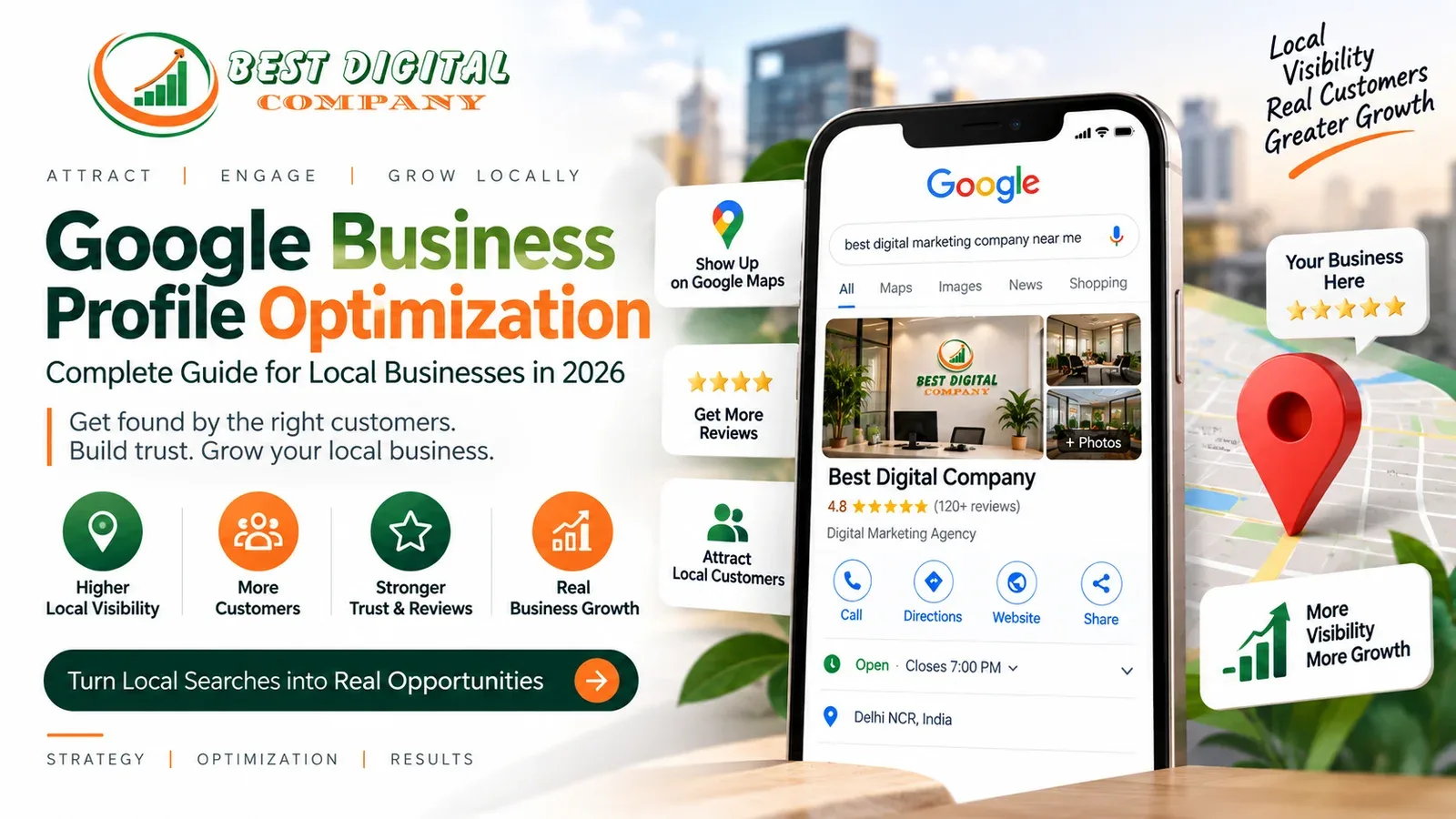
Google Business Profile Optimization: Complete Guide for Local Businesses in 2026

If you run a local business — a clinic, a restaurant, a salon, a service company, or an agency — the way people find you has quietly shifted. Fewer customers are typing your business name into Google. More of them are searching “near me,” scrolling a map with pins on it, and picking whoever looks the most credible in those first few seconds. That map result, with your name, star rating, photos, and hours, is your Google Business Profile, and in 2026 it often decides whether a customer calls you or calls your competitor instead.

Google Business Profile optimization is no longer a “nice to have” checkbox item. It is one of the fastest, cheapest ways for a local business to get in front of people who are ready to buy, book, or visit right now. This guide walks through what actually moves the needle in 2026, based on how local search and AI-driven results are behaving today, and how to build a profile that earns trust with both Google and the people reading it.

What Is Google Business Profile Optimization and Why It Matters in 2026

Google Business Profile (formerly Google My Business) is the free listing that appears when someone searches for a business by name or by category and location — think “dentist in Karol Bagh” or “best digital marketing company near me.” Optimization simply means filling out, structuring, and maintaining that listing so it ranks higher in local results and gives searchers enough reason to choose you over the next name on the list.

What has changed heading into 2026 is how much weight Google places on completeness, activity, and genuine customer signals. A profile that was set up once in 2019 and never touched again is easy to spot — thin descriptions, outdated photos, no recent posts, and reviews that trail off. Google’s local algorithm rewards profiles that look actively managed by a real business, because that is exactly the kind of listing that keeps searchers on the platform and satisfied with what they find.

There is also a bigger shift happening in how people search at all. AI-generated summaries and assistant-style answers are pulling from business data — including Business Profile information — to answer questions like “which clinic near me has good reviews for back pain treatment.” If your profile is thin or inconsistent, it simply will not get pulled into those answers. We cover this shift in more depth in our guide on how to make your business more visible in AI Overviews and AI search results, and the overlap with Business Profile optimization is significant — both reward structured, accurate, and frequently updated information.

How Google Business Profile Optimization Fits Into Your Local SEO Strategy

It helps to think of your Business Profile as one piece of a bigger picture rather than a standalone task. Google cross-checks the information on your profile against what it finds on your website, in online directories, and in customer reviews across the web. When your business name, address, and phone number match everywhere, Google gains confidence that you are a legitimate, established business — and confidence translates into rankings.

This is really where Google Business Profile optimization and local SEO become the same conversation. A profile without a properly optimized website behind it is like a shop window with nothing to show inside; people click through and leave. If your website is not built to support local search — with location pages, schema markup, and fast load times — your profile’s hard work goes to waste the moment someone clicks your website link. Our local SEO services in Delhi are built specifically to align your website, citations, and Business Profile so they reinforce each other instead of working in isolation, and the same logic applies to businesses in any city.

A quick self-check: search your own business name right now. Does the address on your profile match your website’s contact page exactly, down to the pin code? Does your phone number match across your site, your profile, and directories like Justdial or IndiaMart? Small mismatches like “Ltd.” versus “Limited,” or a missing suite number, are common reasons profiles underperform even when everything else looks fine.

Step-by-Step Google Business Profile Optimization Checklist for 2026

Here is the practical part — the actual steps, in the order most local businesses should tackle them.

1. Claim and Verify Your Profile Properly

This sounds basic, but a surprising number of businesses are operating on unclaimed or unverified listings, or worse, duplicate listings created by data aggregators years ago. Search for your business first. If a listing already exists, claim it rather than creating a new one — duplicates confuse both Google and customers, and they can actively hurt your ranking. Verification today usually happens by phone, email, video, or postcard, depending on your business category and location.

2. Get Your Business Name, Category, and Address Exactly Right

Your business name field should match your real-world signage and legal name — stuffing keywords into this field (“Best Digital Marketing Company Delhi SEO PPC”) is against Google’s guidelines and is one of the fastest ways to get a profile suspended. Choose a primary category that describes your core business as precisely as possible, then add secondary categories for everything else you genuinely offer. A dentist who also does cosmetic procedures should have “Dentist” as primary and “Cosmetic Dentist” as a secondary category, not the other way around.

3. Write a Complete, Human-Sounding Business Description

You get 750 characters to explain who you are, what you do, and who you serve. Avoid generic filler like “we are the best in the industry” — write the way you would explain your business to a new customer standing in front of you. Mention your service area, your specialties, and what makes your approach different. This is also a natural place to work in your core service terms without forcing them; if you offer several services, describe them the way a customer would search for them.

4. Add and Update Photos and Videos Regularly

Profiles with photos receive significantly more clicks and direction requests than those without. Upload real photos: your storefront, your team, your workspace, finished projects, before-and-afters where relevant. Stock photos are easy to spot and do less for trust than a slightly imperfect real photo. Add new images every few weeks rather than uploading twenty at once and forgetting the profile for a year — consistent activity is part of what signals a genuinely operating business.

5. Use Google Posts to Stay Active

Posts function almost like a mini social feed inside your profile — offers, events, new services, or general updates. They expire after seven days for most post types, which naturally pushes you toward regular activity. Businesses that post weekly tend to show more engagement signals than those that set up a profile and never return to it.

6. List Services and Products With Real Detail

Rather than one vague description, list out individual services with their own short descriptions and, where appropriate, pricing. A clinic should list each treatment; a marketing agency should list each service line separately. This also gives Google more specific text to match against specific searches — someone searching “PPC management” is more likely to be matched to a profile that explicitly lists PPC as a service than one that only mentions “digital marketing” in general terms.

7. Fill Out Every Attribute Available

Attributes are the small details — wheelchair accessible, free Wi-Fi, women-led, outdoor seating, online appointments — that Google surfaces to searchers making quick decisions. They seem minor individually, but a profile with fifteen relevant attributes filled in looks more complete and trustworthy than one with three.

8. Manage Reviews Actively — Don’t Just Collect Them

Reviews are arguably the single biggest local trust signal you control. Ask happy customers to leave one, make it easy with a direct link, and respond to every review, good or bad. A thoughtful reply to a negative review often does more for your credibility with future customers than the negative review itself does damage. Never buy fake reviews or incentivize them with discounts tied to a five-star rating — Google actively detects and penalizes this, and it undermines the exact trust the review section is meant to build.

9. Answer Questions in the Q&A Section Before Customers Have To

Anyone can post a question on your profile, and anyone can answer it — including strangers who may give wrong information. Seed the section yourself with the questions you get most often (parking, appointment booking, service area, payment methods) and answer them accurately. Monitor it regularly so incorrect answers don’t sit there unaddressed.

10. Keep Hours Accurate, Including Holidays

Nothing frustrates a searcher more than driving to a business that Google says is open, only to find it closed. Update special hours ahead of holidays and local events, and correct your regular hours immediately if they change.

Google Business Profile Optimization and the Rise of AI-Driven Search

Search in 2026 does not stop at a results page. A growing share of queries are answered directly, whether through Google’s AI-generated summaries or through assistants like ChatGPT and Gemini that pull live business information to answer questions conversationally. This is often called answer engine optimization, and it is closely tied to how well-structured and accurate your business data is across the web.

We have written in detail about this shift in our guides on what AEO means and how to get featured in AI search resultsand on the difference between GEO and traditional SEO. The short version for Business Profile purposes: AI systems favor businesses with clean, consistent, and detailed data. A profile with accurate categories, complete service listings, and a strong review history gives these systems something reliable to pull from. A sparse or inconsistent profile simply gets skipped in favor of a competitor’s.

This is also whyhow AI search is changing SEO matters even for businesses that only care about local customers. The technical foundation that helps AI systems understand your business — structured data, consistent citations, an optimized profile — is the same foundation that improves your traditional local rankings. You are not choosing between optimizing for AI search and optimizing for Google; increasingly, they are the same work.

Common Google Business Profile Optimization Mistakes Local Businesses Make

A few patterns show up again and again when businesses come to us for help after their profile stalls out:

Leaving the profile untouched for months. Google can tell the difference between a business that logs in occasionally and one that has abandoned its listing. Inactivity is a quiet way to lose ground to competitors who are posting, responding to reviews, and updating photos every week.

Inconsistent information across the web. A phone number that’s correct on the profile but outdated on an old directory listing, or an address that’s slightly different on your website footer, creates the kind of confusion that erodes trust scores over time.

Ignoring negative reviews. Silence on a bad review reads as indifference to the next hundred people who see it. A calm, specific, non-defensive response usually repairs more trust than the review took away.

Category mismatches. Choosing an overly broad category to try to rank for more searches often backfires, because it dilutes relevance for the specific searches that actually convert.

Treating the profile as a one-time setup task. This is probably the biggest one. Google Business Profile optimization is ongoing maintenance, not a project with an end date.

How Website Development Supports Your Google Business Profile

Your Business Profile is often the first impression, but your website is where the decision usually gets made. If someone clicks through from your profile and lands on a slow, outdated, or hard-to-navigate site, the trust you built in the profile can evaporate in seconds. Page speed, mobile responsiveness, clear contact information, and a design that reflects your business properly all matter here.

This is where professional website development and design becomes part of the same local visibility strategy rather than a separate project. A well-built site with proper local schema markup, embedded maps, and location-specific pages gives Google additional confirmation of the same details on your profile, which reinforces rather than contradicts your local search signals.

Using Social Media Marketing to Strengthen Your Profile

Google Business Profile optimization does not happen in isolation from the rest of your online presence. Active, consistent social media profiles — especially ones that link back to your website and mention your location — add another layer of signals that support your local credibility. Customer engagement on platforms like Instagram and Facebook also often drives people straight to your Google listing to check reviews before they commit, which means a healthy social presence indirectly feeds profile traffic.

Our social media marketing servicesare frequently paired with Business Profile optimization for exactly this reason — a customer’s journey today rarely happens on a single platform, and each one should reinforce the same consistent, trustworthy picture of your business.

Google Business Profile Optimization and Paid Ads: Where PPC Fits In

Organic Google Business Profile optimization takes time to build momentum, which is exactly where paid advertising can help in the interim. Local service ads and Google Ads campaigns that are geographically targeted can put your business in front of nearby searchers immediately, while your organic local signals are still strengthening in the background.

A well-run pay-per-click campaign can also feed data back into your local strategy — which search terms are actually converting, which locations are generating the most calls, and where your ad spend and organic optimization should focus next. Businesses that treat PPC and Business Profile optimization as connected efforts, rather than separate budgets, tend to see faster, more measurable results. Our detailed breakdown on how Google Ads generates faster leads for local businessesgoes deeper into how the two can work together.

How to Measure the Success of Your Google Business Profile Optimization

Optimization without measurement is guesswork. Google provides performance data directly inside your Business Profile dashboard, and it’s worth checking monthly at minimum. Pay attention to:

  • Search views versus map views, which show whether people are finding you by name or by browsing the map for a category.
  • Customer actions, including calls, website clicks, and direction requests — these are the metrics that actually reflect business impact, not just visibility.
  • Review volume and average rating over time, tracked monthly rather than as a single snapshot.
  • Photo views, compared against similar businesses in your category, to see whether your visual content is competitive.
  • Query strings, which show the actual searches people used to find your listing — a goldmine for understanding how customers describe what you do, often in different words than you’d expect.

If calls and direction requests are climbing month over month while your ranking for competitive local terms improves, your optimization is working. If views are up but actions are flat, the issue is usually with the profile’s content or reviews, not its visibility.

Why Businesses Choose Professional Google Business Profile Optimization Services

Some businesses manage their profile well on their own, especially with a bit of consistent effort. Others find that between running daily operations and keeping up with an increasingly technical local search environment, the profile ends up neglected within a few months. That’s usually the point where working with a specialist starts to pay for itself — not because the work is complicated in theory, but because it requires steady, ongoing attention that’s easy to deprioritize.

At Best Digital Company, Google Business Profile optimization is handled as part of a connected local search strategy rather than a one-off task, tied directly into our broader search engine optimization services. If you’re comparing agencies or exploring what full-service local support looks like, our guides on digital marketing strategy across Delhi NCR and local SEO, PPC, and social media for businesses in Noidawalk through how these pieces typically come together for businesses in the region.

Frequently Asked Questions

What is Google Business Profile optimization?


It’s the ongoing process of completing, refining, and maintaining your free Google Business Profile listing — including your description, categories, photos, posts, and reviews — so it ranks higher in local search and gives customers a clear, trustworthy reason to choose your business.

How long does it take to see results from Google Business Profile optimization?


Most businesses start noticing changes in visibility and customer actions within four to eight weeks of consistent optimization, though competitive categories and cities can take longer. Reviews and citation consistency tend to compound in value over several months rather than producing overnight jumps.

Is Google Business Profile optimization free?


Creating, verifying, and managing your profile costs nothing directly to Google. What takes investment is the time required to do it properly and consistently — writing detailed descriptions, sourcing good photos, responding to reviews, and posting regularly — which is why many businesses choose to outsource it.

How often should I update my Google Business Profile?


Aim to post at least weekly, add new photos every few weeks, and review your hours, services, and attributes at least once a month. Profiles that show regular activity tend to outperform ones that were set up once and left alone.

Do reviews really affect my local ranking?


Yes. Review count, average rating, recency, and how you respond to reviews all factor into how Google evaluates your profile’s trustworthiness, alongside how customers themselves judge whether to contact you.

Can I change my business category later?


Yes, categories can be updated at any time from your profile dashboard. It’s worth revisiting your categories periodically as your services evolve, since an outdated category can quietly cost you visibility for searches you’re now equipped to serve.

What’s the difference between Google Business Profile optimization and local SEO?


Google Business Profile optimization is one component of local SEO. Local SEO also includes your website’s structure, citations across directories, backlinks from local sources, and on-page content — all of which work together with your profile rather than replacing it.

Final Thoughts

Google Business Profile optimization in 2026 rewards businesses that treat their listing the way they’d treat a physical storefront — kept clean, kept current, and genuinely representative of what customers will actually experience. It rewards patience and consistency far more than shortcuts, and it increasingly determines whether AI-driven search tools surface your business at all, not just where you land in a traditional list of results.

If your profile has been sitting untouched, or you’re not sure whether your local signals are actually working together, our team can review it and show you exactly where the gaps are. Get in touch with Best Digital Company to talk through a local search strategy built for how people are actually searching today.
Best SEO Service Provider Checklist

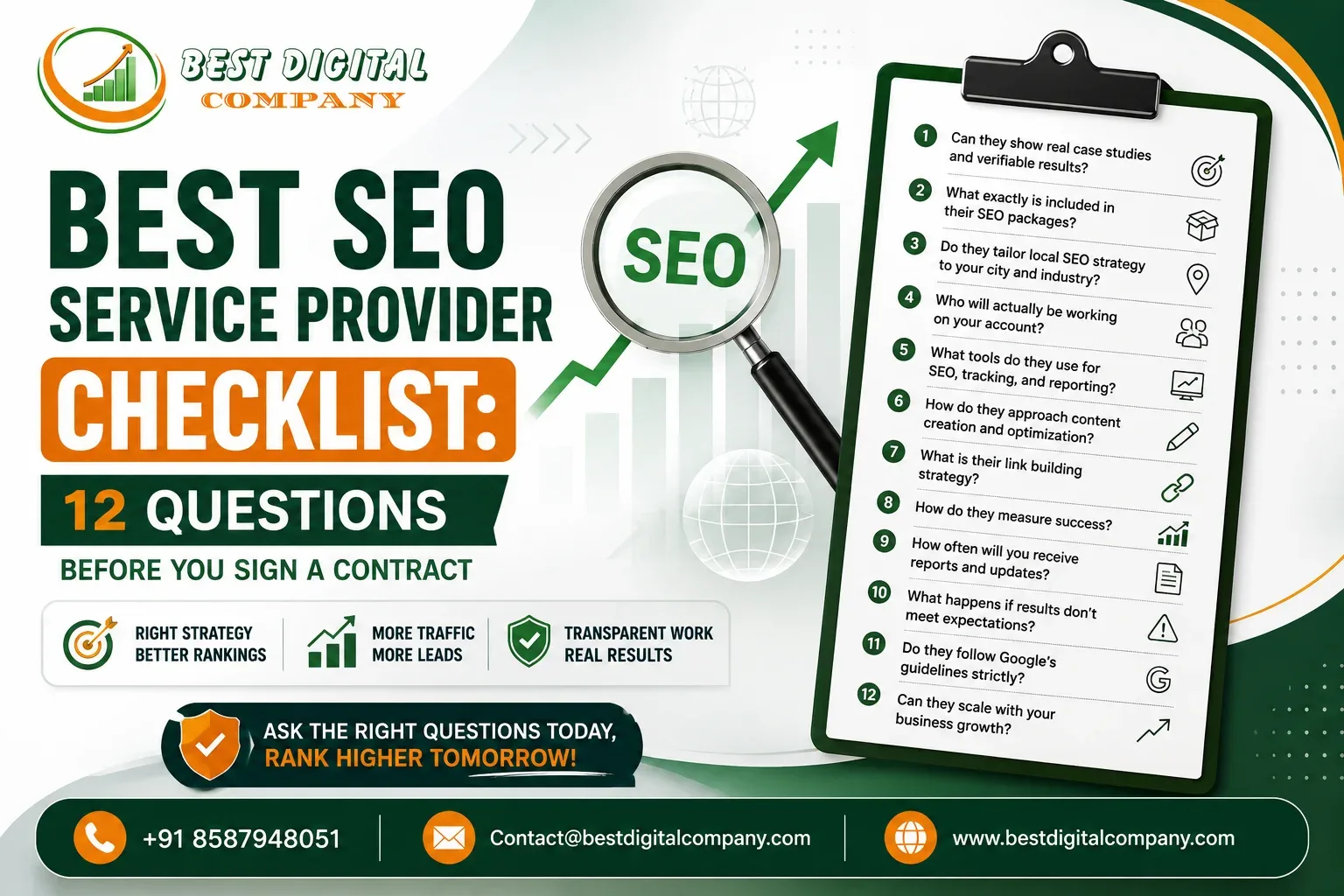
Best SEO Service Provider Checklist: 12 Questions Before You Sign a Contract

If you have ever signed an SEO contract and then spent the next six months wondering what you actually paid for, you are not the only one. It happens more often than most agencies like to admit. A business owner sees a confident sales pitch, a nice-looking proposal with a few graphs, and a promise of “page one rankings,” and signs on the dotted line without asking the questions that actually matter.

The truth is, finding the best SEO service provider for your business is not about picking the agency with the flashiest website or the lowest monthly fee. It is about asking the right questions before any money changes hands  because once you are three months into a contract with a provider who cuts corners, walking away costs you time, money, and rankings you may never fully recover.

This checklist walks you through the 12 questions worth asking any SEO agency or freelancer before you commit. Whether you are comparing a handful of quotes or just met a provider who seems promising, these questions will tell you almost everything you need to know about how they actually work.

Why Choosing the Best SEO Service Provider Matters More Than Ever

Search engines have gotten a lot better at telling the difference between genuine expertise and content churned out to game rankings. Sites that once ranked on volume alone are losing ground to competitors who invest in real research, original insight, and pages built around what searchers actually want to know. That shift changes what “good SEO” looks like in practice.

It also means the gap between an average provider and a genuinely capable one has widened. An agency using outdated tactics  keyword stuffing, low-quality backlinks, thin content  is not just wasting your budget. It can actively hold your site back or, in worse cases, get it penalized. That’s why the vetting process matters so much before you sign anything.

1. Can They Show Real Case Studies and Verifiable Results?

Ask for specifics. Not a generic slide with a rising graph, but an actual client example: what the website looked like before, what work was done, and where the traffic or rankings stand today. A provider confident in their work will happily share this, sometimes even connecting you with a past or current client for a quick reference call.

Be cautious of agencies that only show screenshots of ranking positions without any context on the client’s industry, competition level, or timeline. Rankings without context don’t tell you much. Ask instead: “What was the organic traffic before you started, and what is it now, over what period?” A provider offering genuine search engine optimization services should be able to answer this in one sentence, not a dodge.

2. What Exactly Is Included in Their SEO Packages?

This is where a lot of confusion starts. Two agencies can both say “we offer SEO for ₹25,000 a month,” yet one is doing in-depth technical audits, content strategy, and link building, while the other is running an automated tool and calling it a day.

Before you compare prices, get an itemized breakdown of what’s actually delivered each month: how many hours of work, how many pages optimized, how much original content produced, what technical fixes are covered, and how link building is approached. If you are evaluating multiple providers, it helps to understand the difference between paying for a defined scope of work versus a fixed monthly package — we covered this distinction in more detail in our post on SEO services vs SEO packages, which is worth a read if pricing structures feel confusing right now.

3. Do They Tailor Local SEO Strategy to Your City and Industry?

If most of your customers come from a specific city or region, generic national SEO advice won’t cut it. A provider who understands local SEO will ask about your service areas, set up and optimize your Google Business Profile properly, build location-specific pages, and target searches with local intent — the kind someone types in when they are ready to buy nearby, not just browsing.

Ask directly: “How would you approach my local visibility if most of my customers are searching for a business near them?” A provider offering dedicated local SEO services in Delhi, or similar city-specific SEO for your region, should walk you through citations, review strategy, and localized content without hesitation.

4. Who Will Actually Be Working on Your Account?

This question trips up more business owners than any other. The person who pitches you in the sales meeting is often not the person doing the actual work. Ask who will be assigned to your account, what their experience level is, and how much time they’ll realistically spend on your website each month.

It is also fair to ask whether any part of the work — content writing, link outreach, technical audits — gets outsourced to a third party. There is nothing wrong with a well-managed subcontracting model, but you deserve to know who is touching your website and what quality checks are in place before anything goes live.

5. What Tools and Reporting Do They Use for Transparency?

A provider that can’t show you where your traffic, rankings, and conversions currently stand is not giving you SEO — they are giving you guesswork. Ask which tools they use for tracking (Google Search Console and Google Analytics should be non-negotiable baseline access, along with a paid tool for keyword tracking and audits).

More importantly, ask how often you’ll receive reports and what those reports actually contain. A monthly PDF with vague statements like “improved visibility” isn’t useful. You want specific numbers: keyword position changes, organic traffic trends, pages published, technical issues fixed, and a clear explanation connecting the work done to the results seen.

6. Do They Follow Ethical, Search-Engine-Approved Techniques?

This is arguably the most important question on this list, because the wrong answer here can hurt your website for years. Ask the provider directly how they approach link building. If the answer involves buying links in bulk, using private blog networks, or guaranteeing a specific number of backlinks per week regardless of quality, that’s a warning sign.

Similarly, ask about their content approach. Do they write for search engines or for actual readers? A trustworthy provider will talk about relevance, search intent, and building topical authority not “keyword density” or “stuffing.” If you’ve ever compared how a full-service agency talks about strategy versus how a smaller outfit sells packages, our earlier piece on SEO agency vs SEO company breaks down how these conversations tend to differ in practice.

7. How Do They Approach Content Strategy and Quality?

Content is where a lot of budgets quietly disappear. Ask how the provider researches topics, who writes the content, and how they ensure it’s original rather than recycled from competitor pages with a few words swapped. Ask, too, whether they involve subject-matter input from your team  because a generic article written with no knowledge of your actual business rarely performs well or builds trust with your audience.

A capable provider should describe a process: keyword and intent research, an outline built around what a real reader needs, a draft written by someone with actual subject familiarity, and a review step before publishing. If they can’t describe this process in plain terms, that is a gap worth noting.

8. What’s Their Approach to Technical SEO and Website Health?

Content and links matter, but none of it works well on a site that’s slow, poorly structured, or riddled with broken pages. Ask how they handle technical audits: site speed, mobile usability, indexing issues, structured data, duplicate content, and broken internal links.

It is also worth asking whether they ever recommend removing or consolidating old, underperforming pages rather than just adding new ones endlessly. This is a more advanced but increasingly important practice, we explained why trimming a bloated site can actually improve overall performance in our article on content pruning and its effect on SEO. A provider aware of this shows they are thinking about your site holistically, not just adding volume.

9. Can They Align SEO with Other Channels Like PPC and Social Media?

SEO rarely works in isolation anymore. If your provider also understands how paid search and social channels fit into the bigger picture, campaigns tend to reinforce each other rather than compete for the same budget and attention. Ask whether they offer, or can coordinate with, PPC advertising services or social media marketing, and how they’d use data from one channel to inform the other.

For example, paid search data can reveal which keywords convert best, informing which organic terms to prioritize. If you are curious what a well-run paid campaign actually involves month to month, our breakdown of what a performance marketing agency does for PPC is a useful companion read here.

10. What Does Their Contract Length, Pricing, and Exit Process Look Like?

Read the contract terms carefully, not just the price. Ask about the minimum commitment period, what happens if you want to cancel, and whether you retain ownership of the content, backlinks, and any accounts set up on your behalf (like Google Business Profile or Search Console access).

Be wary of providers who lock you into a long-term contract with vague deliverables and no clear exit clause. A confident provider won’t need to trap you in a contract to keep your business their results should be the reason you stay.

11. How Do They Handle Website Redesigns or New Site Migrations Alongside SEO?

If you are planning a website redesign or you are currently juggling both a new site build and SEO, ask how the provider coordinates the two. A site migration done without SEO oversight can wipe out years of rankings overnight through broken redirects, lost metadata, or restructured URLs.

Ask specifically: “If I need a new website built, do you handle that in-house, and how do you make sure SEO is not disrupted during the transition?” If they also offer website development and design, find out how their design and SEO teams actually talk to each other during a project — this coordination matters more than most business owners realize until something breaks. Our guide on what’s included in website development services is a useful reference if you’re weighing a redesign alongside your SEO plans.

12. What Does Ongoing Communication and Reporting Actually Look Like?

Finally, ask what a normal month of communication looks like once the contract is signed. Will you have a dedicated point of contact? Is there a monthly call to walk through results, or do reports just land in your inbox with no explanation? How quickly do they respond if you have an urgent question or notice something odd on your website?

This question often reveals more about a provider’s culture than any of the technical questions above. Providers who treat communication as an afterthought after the sale usually treat the actual work the same way.

Putting the Checklist Into Practice

Going through all 12 questions with two or three providers before you decide takes an extra week, maybe two. That small delay is nothing compared to months lost to a provider who wasn’t equipped to deliver. When you find a best SEO service provider who answers these questions clearly, backs claims with real data, and explains their process in plain language rather than jargon, you have likely found a partner worth signing with.

If you are currently comparing quotes and want a second opinion on a proposal you have received, or you’d like a straightforward audit of where your website currently stands, our team is happy to walk through it with you no pressure, just a clear picture of where things are today and what realistic improvement looks like.


FAQ: Best SEO Service Provider

How do I know if an SEO provider is genuinely good versus just good at sales?

Ask for verifiable, specific results tied to a timeline, request a client reference, and pay close attention to how clearly they explain their process. Vague answers about “boosting visibility” without numbers or methodology are usually a sign the substance is not there.

How much should I expect to pay the best SEO service provider for my business?

Pricing varies widely based on your industry, competition, and the scope of work involved. A small local business needs a very different investment than a national e-commerce brand. What matters more than the number itself is getting an itemized breakdown of what that price actually includes each month.

How long does it typically take to see results from SEO?

Most reputable providers will tell you that meaningful, sustainable results usually take three to six months, with continued growth over the following months. Anyone promising page-one rankings within days or weeks is either overpromising or using shortcuts that risk long-term penalties.

Should I choose a provider that only does SEO, or one offering multiple services?

Both approaches can work well. A specialist may bring deeper technical expertise, while a full-service provider can align SEO with paid ads, social media, and web design under one roof, which often makes coordination easier. The right choice depends on your current setup and how much internal coordination you’re able to manage yourself.

What is a reasonable contract length for SEO services?

Month-to-month or short-term agreements (three to six months) with clear performance check-ins are generally healthier than long, rigid annual contracts, especially early in a relationship with a new provider. This gives both sides room to evaluate fit before committing longer term.

Can I switch SEO providers without losing my rankings?

Yes, in most cases, as long as the transition is handled carefully. Make sure you retain full access to your Google Search Console, Analytics, and Google Business Profile accounts, and get a full record of any work already done backlinks built, content published, and technical changes made, so your new provider can pick up smoothly.

Best SEO Consultant vs SEO Agency: Which Fits You?

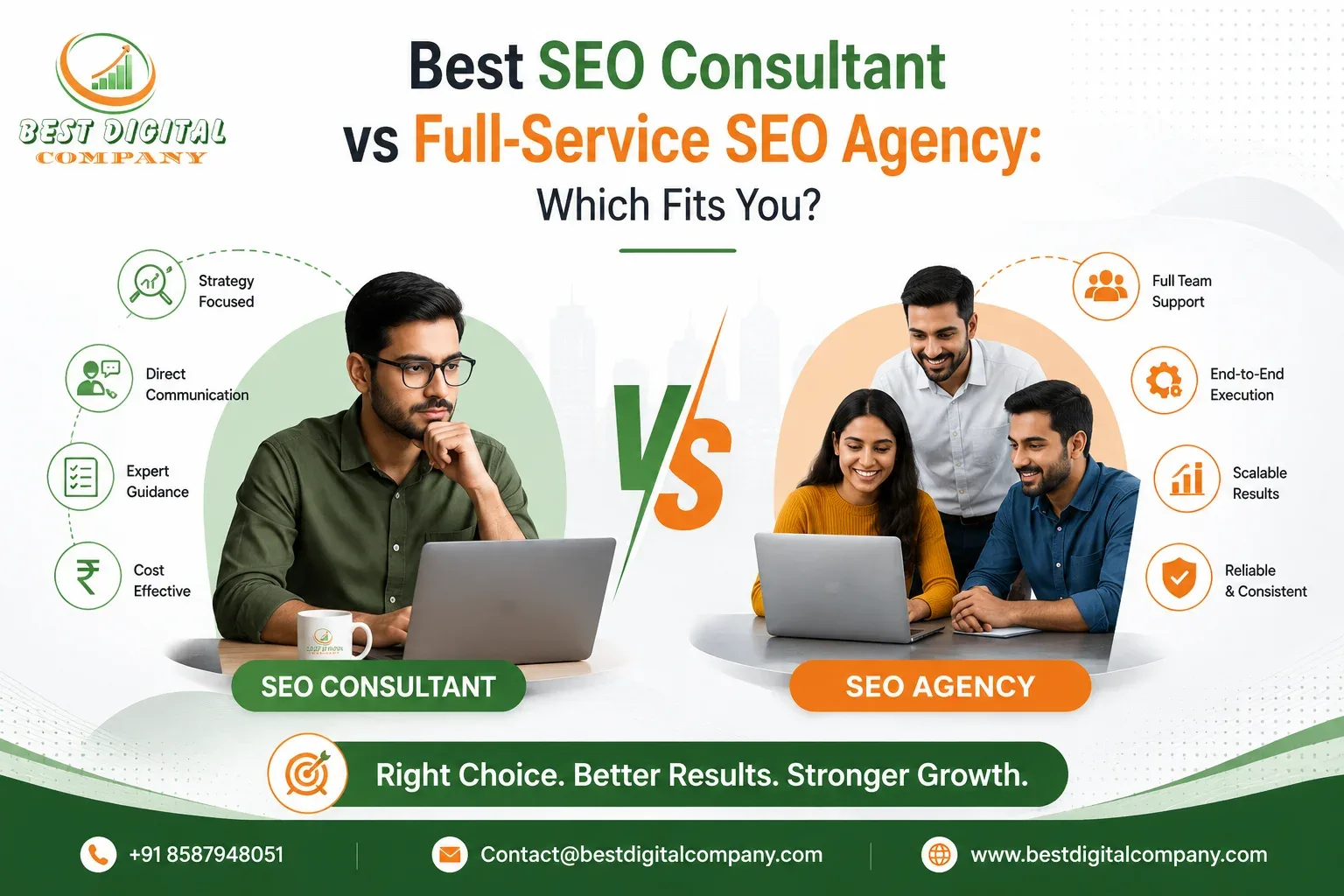
Best SEO Consultant vs Full-Service SEO Agency: Which Fits Your Business Stage?

If you have ever sat down to hire outside help for your rankings, you already know the confusion. One friend tells you to hire an individual expert because “agencies just outsource everything.” Another swears an agency saved his business because “one person can’t do it all.” Both are right, and both are wrong, depending entirely on where your business actually stands right now.

This is not a question with one correct answer. It is a question with one correct answer for you, based on your budget, your team size, your growth stage, and what “ranking better” actually means for your revenue. In this guide, we will walk through what a best SEO consultant really does, how that differs from working with a full-service agency, and how to figure out which one fits your business today not five years from now.

What Does a Best SEO Consultant Actually Do?

A consultant, in the truest sense, is a specialist. Think of them as a doctor you visit for a specific complaint rather than a full hospital staff managing every aspect of your health. A genuinely good SEO consultant typically works one-on-one with you, often as a freelancer or a small solo practice, and focuses on strategy, audits, and hands-on guidance rather than running an entire in-house production team.

Here is what that usually looks like in practice:

  • A deep technical audit of your website, covering crawlability, indexing issues, site speed, and structure
  • Keyword research and content strategy built specifically around your niche
  • On-page optimization recommendations (title tags, headers, internal linking, content gaps)
  • Direct, personal communication — you are usually talking to the same person every single time
  • Guidance on link building strategy, even if execution is outsourced separately

The appeal is obvious once you have experienced it: no account managers relaying messages, no junior staff learning on your dime, and no confusion about who is actually doing the thinking behind your strategy. When you hire a best SEO consultant, you are paying for judgment and experience concentrated in one person, not a whole department.

But that concentration is also the limitation. A single consultant, no matter how skilled, has finite hours in a day. They can tell you exactly what needs to happen on your site, but they usually cannot also write fifteen blog posts a month, manage your backlink outreach, build new landing pages, and run your Google Business Profile updates all at once. For businesses that need heavy execution alongside strategy, this becomes the deciding factor.

What Is a Full-Service SEO Agency, and How Is It Different?

A full-service agency flips the model. Instead of one expert wearing every hat, you get a team often a strategist, a content writer, a technical specialist, an outreach person, and a project manager coordinating all of them. It is less like visiting a specialist doctor and more like walking into a hospital where each department handles its own piece of your treatment.

This structure tends to work well when:

  • Your website needs both strategy and heavy execution (content production, link building, technical fixes) simultaneously
  • You want one point of contact managing multiple moving parts, including SEO alongside services like social media marketing, pay-per-click campaigns, or website development
  • You are scaling fast and need a team that can absorb more workload without you having to hire and coordinate freelancers yourself
  • You value having backup if one team member is on leave, the work doesn’t stall

The tradeoff is usually cost and, sometimes, a layer of communication between you and the people actually doing the work. Not every agency is guilty of this, but it is a common complaint: you sign on with a senior strategist during the sales call, then get handed off to a junior executive for the actual day-to-day work. That is not necessarily bad many junior team members do excellent work under supervisio but it’s worth knowing upfront so you can ask the right questions before signing anything.

If you want a deeper breakdown of how these two setups differ structurally, our earlier piece on SEO agency vs SEO company covers the terminology confusion many business owners run into during the hiring process.

Business Stage 1: Startups and Solo Founders

If you are a solo founder or running a small team with a limited monthly budget, a consultant is often the smarter starting point. At this stage, your website probably has a handful of glaring issues maybe your titles are not optimized, maybe Google can’t even crawl half your pages properly, maybe you have zero internal linking strategy. These are foundational problems, and a best SEO consultant can diagnose and fix the roadmap for these quickly without you committing to a large monthly retainer.

You also, frankly, don’t have the traffic volume yet to justify a six-person team working on your account. A consultant can set the direction, hand you a prioritized action list, and let you (or a part-time freelancer) execute the basics while your business grows into needing more support.

This is also the stage where local visibility often matters more than broad national rankings. If you are a startup serving a specific city, something likelocal SEO work getting your Google Business Profile right, building local citations, gathering reviews often delivers faster, more tangible results than a broad national SEO push. A consultant is usually well equipped to guide this without unnecessary overhead.

Business Stage 2: Growing Businesses With Some Revenue Stability

Once your business has consistent revenue and you are past the “will this even work” phase, the equation shifts. You now have money to reinvest into growth, and you likely need more than strategic advice — you need actual content published, actual outreach happening, actual technical fixes implemented on a schedule.

This is where many businesses start feeling the limits of a solo consultant. It is not that the consultant’s advice gets worse; it is that execution capacity becomes the bottleneck. If your consultant is telling you exactly what to do but you don’t have anyone to build it, the recommendations sit in a document, unused.

At this stage, some businesses hire a consultant plus a small execution team, essentially building their own hybrid model. Others make the jump to a full-service setup where strategy and execution live under one roof. If your growth also depends on paid traffic alongside organic rankings, it is worth reading how SEO services differ from SEO packages a distinction that matters a lot once you’re comparing agency proposals side by side and trying to figure out what you are actually paying for.

Business Stage 3: Established Businesses Scaling Aggressively

For businesses with an established market position looking to scale rankings across multiple locations, product lines, or service categories, a full-service agency generally becomes the more practical option. The sheer volume of content, technical maintenance, and ongoing optimization needed to compete at this level is difficult for one person to sustain long-term, even a highly skilled one.

At this stage, you’re also usually running SEO alongside other digital channels perhaps PPC campaigns to capture immediate demand while SEO builds long-term equity, or coordinated content that supports both organic search and social distribution. Managing all of this across separate freelancers becomes an operational headache. A team that can coordinate these channels together, rather than in isolated silos, tends to produce more consistent results and saves you the internal project-management burden.

This does not mean bigger is always better some established businesses continue working successfully with an experienced consultant who has, over time, built their own trusted network of writers and link builders. The point isn’t that agencies automatically outperform consultants at scale; it’s that the coordination overhead of scaling with independent freelancers becomes harder to manage yourself the bigger you get.

Cost Comparison: What You are Actually Paying For

Pricing conversations around SEO get murky fast, mostly because “SEO” means different things depending on who’s selling it. Here’s a general, honest breakdown of what to expect:

Consultants typically charge either an hourly rate, a project-based fee for an audit, or a smaller monthly retainer focused on strategy and oversight. You are paying for expertise and time, not headcount. This tends to be the more affordable entry point, especially for a first engagement.

Full-service agencies typically charge based on scope how much content is being produced, how many pages need optimization, how aggressive the link-building target is, and how many channels are being managed. Because you’re paying for a team’s combined output, monthly retainers are generally higher, but so is the volume of work being delivered.

Neither is inherently a “waste of money” or a “better deal.” A ₹15,000 monthly consultant engagement that fixes your technical foundation might deliver more real value than a ₹1,00,000 agency retainer that’s spread too thin across a hundred other clients. Cost only makes sense in the context of what deliverable you actually need right now.

Red Flags to Watch For, Regardless of Which You Choose

Whether you are evaluating a solo consultant or negotiating with an agency, some warning signs apply universally:

  • Guaranteed rankings within a fixed timeline (nobody controls search engine algorithms enough to promise this honestly)
  • Vague reporting that only shows keyword position screenshots without connecting the work to actual traffic or leads
  • Reluctance to explain their process when you ask direct questions
  • No clear communication cadence — you should not have to chase anyone for a monthly update
  • Heavy reliance on outdated tactics like exact-match anchor text stuffing or mass low-quality backlink purchases

A trustworthy provider, consultant or agency, will walk you through their reasoning, show you real examples of past work, and be upfront about what SEO can and cannot realistically achieve in your timeframe.

Can You Combine Both Models?

Yes, and many businesses do this successfully, particularly during a transition period. It’s fairly common for a business to bring in an independent consultant for a one-time technical audit or a second opinion, even while working with an agency for day-to-day execution. The consultant essentially acts as an outside check on the agency’s work, and a confident, transparent agency generally won’t have a problem with this arrangement.

Similarly, if you are currently working with a freelance web developer or a solo consultant and considering whether to bring on a bigger team, it can help to look at how this decision plays out for other services too. Our piece on hiring a website developer versus a freelancer walks through a very similar cost-versus-capacity tradeoff, and the underlying logic transfers directly to how you think about SEO staffing decisions.

How to Make the Decision for Your Business

Rather than asking “which is better,” ask yourself these questions honestly:

  1. Do I need a strategic roadmap right now, or do I need ongoing content and link-building execution at volume?
  2. Can my internal team (or I) execute recommendations if I only hire for strategy?
  3. Am I managing multiple digital channels that need to work together, or is search the only priority right now?
  4. What is my realistic monthly budget, and does it match the scope I’m expecting?
  5. Do I want one dedicated point of contact, or am I comfortable coordinating with a team?

Your honest answers will point you in the right direction far more reliably than any generic “agencies are better” or “consultants are better” advice you’ll find online. Every business’s SEO needs evolve as it grows, and it’s completely normal to start with one model and shift to the other later.

If you are still unsure which setup matches where your business stands today, our team is happy to walk through your website and goals with you and give you a straight answer even if that answer is “you don’t need us yet.” You can reach out through our contact page or explore our full search engine optimization services to see how we approach both strategy and execution for businesses at different stages.

Frequently Asked Questions

What is the difference between a best SEO consultant and an SEO agency?

A best SEO consultant is typically an individual expert who provides strategy, audits, and hands-on guidance directly, while an agency provides a full team handling strategy alongside execution like content production, technical fixes, and link building. Consultants suit businesses needing focused strategic direction; agencies suit businesses needing both strategy and heavy ongoing execution.

How much does hiring a best SEO consultant typically cost?

Costs vary widely based on experience and scope, but consultants generally charge hourly rates, flat project fees for audits, or smaller monthly retainers compared to full-service agencies, since you’re paying for individual expertise rather than a team’s combined output.

Is a best SEO consultant enough for a small business?

For most early-stage or small businesses, yes. A consultant can identify and prioritize the technical and content issues holding your rankings back, and many small businesses successfully execute those recommendations in-house or with a small freelance team before ever needing a full agency.

When should a business move from a consultant to a full-service agency?

Typically once execution capacity becomes the bottleneck meaning you have more strategic recommendations than you can realistically implement on your own, or you need SEO coordinated alongside other channels like PPC and social media at a larger scale.

Can a best SEO consultant and an agency work together?

Yes. It is common for businesses to bring in an independent consultant for a one-time audit or second opinion even while an agency handles day-to-day execution, and a transparent agency should have no issue with this kind of outside review.

How do I know if an SEO consultant is genuinely good at what they do?

Look for clear communication, honest timelines without guaranteed rankings, real examples of past audits or results, and a willingness to explain their reasoning rather than relying on vague reports of keyword positions alone.