

If you have ever signed an SEO contract and then spent the next six months wondering what you actually paid for, you are not the only one. It happens more often than most agencies like to admit. A business owner sees a confident sales pitch, a nice-looking proposal with a few graphs, and a promise of “page one rankings,” and signs on the dotted line without asking the questions that actually matter.
The truth is, finding the best SEO service provider for your business is not about picking the agency with the flashiest website or the lowest monthly fee. It is about asking the right questions before any money changes hands because once you are three months into a contract with a provider who cuts corners, walking away costs you time, money, and rankings you may never fully recover.
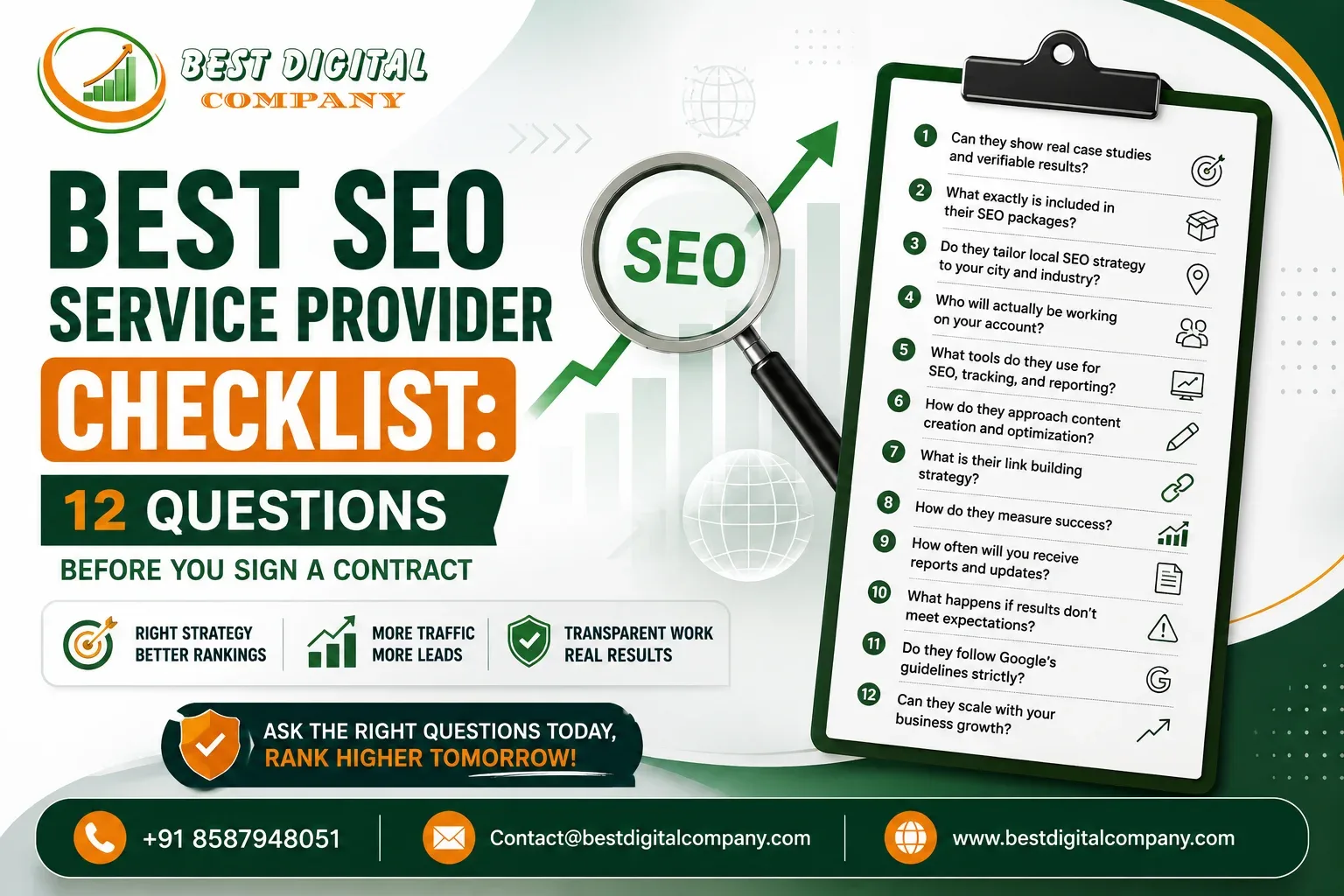
This checklist walks you through the 12 questions worth asking any SEO agency or freelancer before you commit. Whether you are comparing a handful of quotes or just met a provider who seems promising, these questions will tell you almost everything you need to know about how they actually work.
Why Choosing the Best SEO Service Provider Matters More Than Ever
Search engines have gotten a lot better at telling the difference between genuine expertise and content churned out to game rankings. Sites that once ranked on volume alone are losing ground to competitors who invest in real research, original insight, and pages built around what searchers actually want to know. That shift changes what “good SEO” looks like in practice.
It also means the gap between an average provider and a genuinely capable one has widened. An agency using outdated tactics keyword stuffing, low-quality backlinks, thin content is not just wasting your budget. It can actively hold your site back or, in worse cases, get it penalized. That’s why the vetting process matters so much before you sign anything.
1. Can They Show Real Case Studies and Verifiable Results?
Ask for specifics. Not a generic slide with a rising graph, but an actual client example: what the website looked like before, what work was done, and where the traffic or rankings stand today. A provider confident in their work will happily share this, sometimes even connecting you with a past or current client for a quick reference call.
Be cautious of agencies that only show screenshots of ranking positions without any context on the client’s industry, competition level, or timeline. Rankings without context don’t tell you much. Ask instead: “What was the organic traffic before you started, and what is it now, over what period?” A provider offering genuine search engine optimization services should be able to answer this in one sentence, not a dodge.
2. What Exactly Is Included in Their SEO Packages?
This is where a lot of confusion starts. Two agencies can both say “we offer SEO for ₹25,000 a month,” yet one is doing in-depth technical audits, content strategy, and link building, while the other is running an automated tool and calling it a day.
Before you compare prices, get an itemized breakdown of what’s actually delivered each month: how many hours of work, how many pages optimized, how much original content produced, what technical fixes are covered, and how link building is approached. If you are evaluating multiple providers, it helps to understand the difference between paying for a defined scope of work versus a fixed monthly package — we covered this distinction in more detail in our post on SEO services vs SEO packages, which is worth a read if pricing structures feel confusing right now.
3. Do They Tailor Local SEO Strategy to Your City and Industry?
If most of your customers come from a specific city or region, generic national SEO advice won’t cut it. A provider who understands local SEO will ask about your service areas, set up and optimize your Google Business Profile properly, build location-specific pages, and target searches with local intent — the kind someone types in when they are ready to buy nearby, not just browsing.
Ask directly: “How would you approach my local visibility if most of my customers are searching for a business near them?” A provider offering dedicated local SEO services in Delhi, or similar city-specific SEO for your region, should walk you through citations, review strategy, and localized content without hesitation.
4. Who Will Actually Be Working on Your Account?
This question trips up more business owners than any other. The person who pitches you in the sales meeting is often not the person doing the actual work. Ask who will be assigned to your account, what their experience level is, and how much time they’ll realistically spend on your website each month.
It is also fair to ask whether any part of the work — content writing, link outreach, technical audits — gets outsourced to a third party. There is nothing wrong with a well-managed subcontracting model, but you deserve to know who is touching your website and what quality checks are in place before anything goes live.
5. What Tools and Reporting Do They Use for Transparency?
A provider that can’t show you where your traffic, rankings, and conversions currently stand is not giving you SEO — they are giving you guesswork. Ask which tools they use for tracking (Google Search Console and Google Analytics should be non-negotiable baseline access, along with a paid tool for keyword tracking and audits).
More importantly, ask how often you’ll receive reports and what those reports actually contain. A monthly PDF with vague statements like “improved visibility” isn’t useful. You want specific numbers: keyword position changes, organic traffic trends, pages published, technical issues fixed, and a clear explanation connecting the work done to the results seen.
6. Do They Follow Ethical, Search-Engine-Approved Techniques?
This is arguably the most important question on this list, because the wrong answer here can hurt your website for years. Ask the provider directly how they approach link building. If the answer involves buying links in bulk, using private blog networks, or guaranteeing a specific number of backlinks per week regardless of quality, that’s a warning sign.
Similarly, ask about their content approach. Do they write for search engines or for actual readers? A trustworthy provider will talk about relevance, search intent, and building topical authority not “keyword density” or “stuffing.” If you’ve ever compared how a full-service agency talks about strategy versus how a smaller outfit sells packages, our earlier piece on SEO agency vs SEO company breaks down how these conversations tend to differ in practice.
7. How Do They Approach Content Strategy and Quality?
Content is where a lot of budgets quietly disappear. Ask how the provider researches topics, who writes the content, and how they ensure it’s original rather than recycled from competitor pages with a few words swapped. Ask, too, whether they involve subject-matter input from your team because a generic article written with no knowledge of your actual business rarely performs well or builds trust with your audience.
A capable provider should describe a process: keyword and intent research, an outline built around what a real reader needs, a draft written by someone with actual subject familiarity, and a review step before publishing. If they can’t describe this process in plain terms, that is a gap worth noting.
8. What’s Their Approach to Technical SEO and Website Health?
Content and links matter, but none of it works well on a site that’s slow, poorly structured, or riddled with broken pages. Ask how they handle technical audits: site speed, mobile usability, indexing issues, structured data, duplicate content, and broken internal links.
It is also worth asking whether they ever recommend removing or consolidating old, underperforming pages rather than just adding new ones endlessly. This is a more advanced but increasingly important practice, we explained why trimming a bloated site can actually improve overall performance in our article on content pruning and its effect on SEO. A provider aware of this shows they are thinking about your site holistically, not just adding volume.
9. Can They Align SEO with Other Channels Like PPC and Social Media?
SEO rarely works in isolation anymore. If your provider also understands how paid search and social channels fit into the bigger picture, campaigns tend to reinforce each other rather than compete for the same budget and attention. Ask whether they offer, or can coordinate with, PPC advertising services or social media marketing, and how they’d use data from one channel to inform the other.
For example, paid search data can reveal which keywords convert best, informing which organic terms to prioritize. If you are curious what a well-run paid campaign actually involves month to month, our breakdown of what a performance marketing agency does for PPC is a useful companion read here.
10. What Does Their Contract Length, Pricing, and Exit Process Look Like?
Read the contract terms carefully, not just the price. Ask about the minimum commitment period, what happens if you want to cancel, and whether you retain ownership of the content, backlinks, and any accounts set up on your behalf (like Google Business Profile or Search Console access).
Be wary of providers who lock you into a long-term contract with vague deliverables and no clear exit clause. A confident provider won’t need to trap you in a contract to keep your business their results should be the reason you stay.
11. How Do They Handle Website Redesigns or New Site Migrations Alongside SEO?
If you are planning a website redesign or you are currently juggling both a new site build and SEO, ask how the provider coordinates the two. A site migration done without SEO oversight can wipe out years of rankings overnight through broken redirects, lost metadata, or restructured URLs.
Ask specifically: “If I need a new website built, do you handle that in-house, and how do you make sure SEO is not disrupted during the transition?” If they also offer website development and design, find out how their design and SEO teams actually talk to each other during a project — this coordination matters more than most business owners realize until something breaks. Our guide on what’s included in website development services is a useful reference if you’re weighing a redesign alongside your SEO plans.
12. What Does Ongoing Communication and Reporting Actually Look Like?
Finally, ask what a normal month of communication looks like once the contract is signed. Will you have a dedicated point of contact? Is there a monthly call to walk through results, or do reports just land in your inbox with no explanation? How quickly do they respond if you have an urgent question or notice something odd on your website?
This question often reveals more about a provider’s culture than any of the technical questions above. Providers who treat communication as an afterthought after the sale usually treat the actual work the same way.
Putting the Checklist Into Practice
Going through all 12 questions with two or three providers before you decide takes an extra week, maybe two. That small delay is nothing compared to months lost to a provider who wasn’t equipped to deliver. When you find a best SEO service provider who answers these questions clearly, backs claims with real data, and explains their process in plain language rather than jargon, you have likely found a partner worth signing with.
If you are currently comparing quotes and want a second opinion on a proposal you have received, or you’d like a straightforward audit of where your website currently stands, our team is happy to walk through it with you no pressure, just a clear picture of where things are today and what realistic improvement looks like.
FAQ: Best SEO Service Provider
How do I know if an SEO provider is genuinely good versus just good at sales?
Ask for verifiable, specific results tied to a timeline, request a client reference, and pay close attention to how clearly they explain their process. Vague answers about “boosting visibility” without numbers or methodology are usually a sign the substance is not there.
How much should I expect to pay the best SEO service provider for my business?
Pricing varies widely based on your industry, competition, and the scope of work involved. A small local business needs a very different investment than a national e-commerce brand. What matters more than the number itself is getting an itemized breakdown of what that price actually includes each month.
How long does it typically take to see results from SEO?
Most reputable providers will tell you that meaningful, sustainable results usually take three to six months, with continued growth over the following months. Anyone promising page-one rankings within days or weeks is either overpromising or using shortcuts that risk long-term penalties.
Should I choose a provider that only does SEO, or one offering multiple services?
Both approaches can work well. A specialist may bring deeper technical expertise, while a full-service provider can align SEO with paid ads, social media, and web design under one roof, which often makes coordination easier. The right choice depends on your current setup and how much internal coordination you’re able to manage yourself.
What is a reasonable contract length for SEO services?
Month-to-month or short-term agreements (three to six months) with clear performance check-ins are generally healthier than long, rigid annual contracts, especially early in a relationship with a new provider. This gives both sides room to evaluate fit before committing longer term.
Can I switch SEO providers without losing my rankings?
Yes, in most cases, as long as the transition is handled carefully. Make sure you retain full access to your Google Search Console, Analytics, and Google Business Profile accounts, and get a full record of any work already done backlinks built, content published, and technical changes made, so your new provider can pick up smoothly.

Add a Comment