
Best SEO Consultant vs SEO Agency: Which Fits You?

Best SEO Consultant vs Full-Service SEO Agency: Which Fits Your Business Stage?

If you have ever sat down to hire outside help for your rankings, you already know the confusion. One friend tells you to hire an individual expert because “agencies just outsource everything.” Another swears an agency saved his business because “one person can’t do it all.” Both are right, and both are wrong, depending entirely on where your business actually stands right now.

This is not a question with one correct answer. It is a question with one correct answer for you, based on your budget, your team size, your growth stage, and what “ranking better” actually means for your revenue. In this guide, we will walk through what a best SEO consultant really does, how that differs from working with a full-service agency, and how to figure out which one fits your business today not five years from now.

What Does a Best SEO Consultant Actually Do?

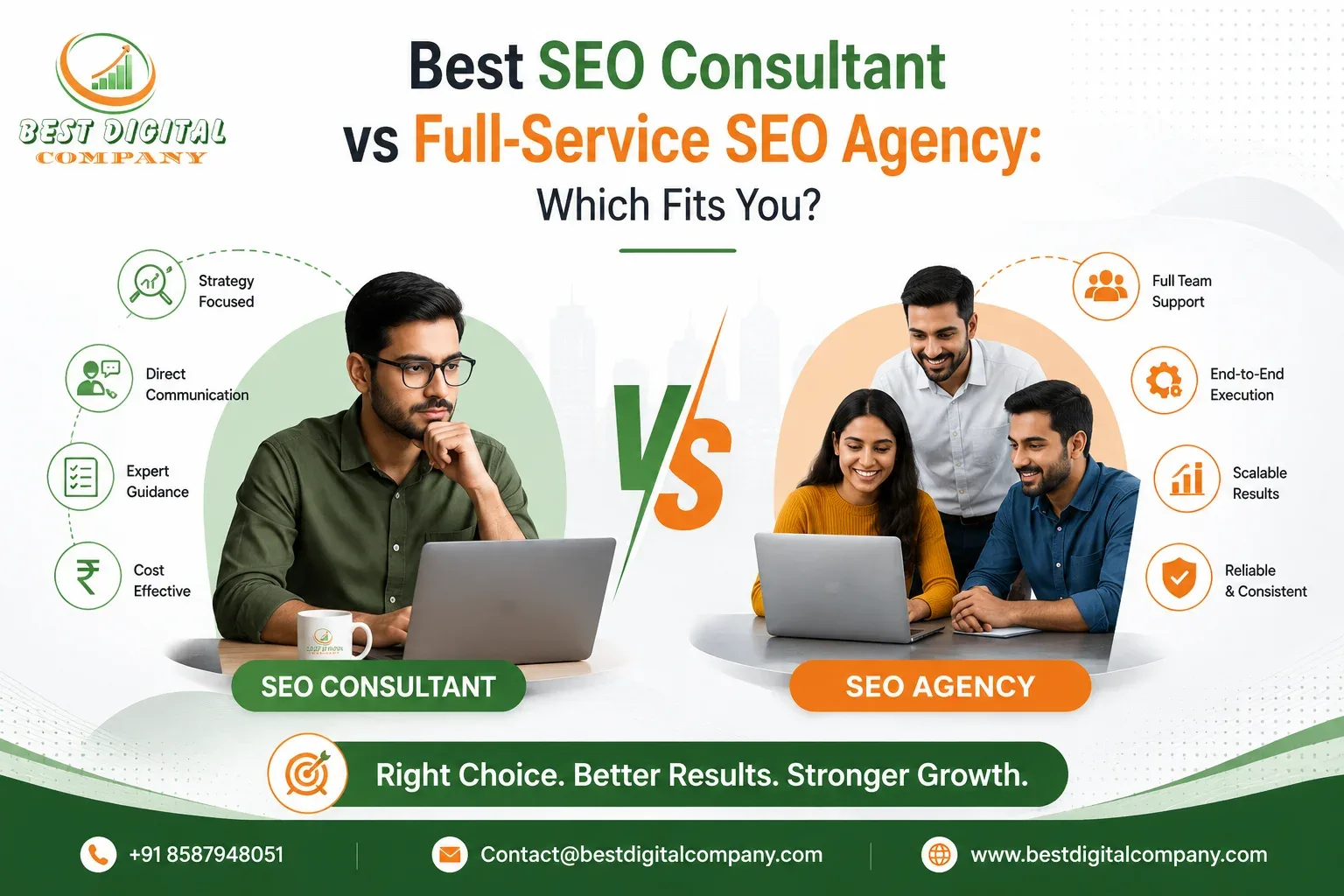
A consultant, in the truest sense, is a specialist. Think of them as a doctor you visit for a specific complaint rather than a full hospital staff managing every aspect of your health. A genuinely good SEO consultant typically works one-on-one with you, often as a freelancer or a small solo practice, and focuses on strategy, audits, and hands-on guidance rather than running an entire in-house production team.

Here is what that usually looks like in practice:

  • A deep technical audit of your website, covering crawlability, indexing issues, site speed, and structure
  • Keyword research and content strategy built specifically around your niche
  • On-page optimization recommendations (title tags, headers, internal linking, content gaps)
  • Direct, personal communication — you are usually talking to the same person every single time
  • Guidance on link building strategy, even if execution is outsourced separately

The appeal is obvious once you have experienced it: no account managers relaying messages, no junior staff learning on your dime, and no confusion about who is actually doing the thinking behind your strategy. When you hire a best SEO consultant, you are paying for judgment and experience concentrated in one person, not a whole department.

But that concentration is also the limitation. A single consultant, no matter how skilled, has finite hours in a day. They can tell you exactly what needs to happen on your site, but they usually cannot also write fifteen blog posts a month, manage your backlink outreach, build new landing pages, and run your Google Business Profile updates all at once. For businesses that need heavy execution alongside strategy, this becomes the deciding factor.

What Is a Full-Service SEO Agency, and How Is It Different?

A full-service agency flips the model. Instead of one expert wearing every hat, you get a team often a strategist, a content writer, a technical specialist, an outreach person, and a project manager coordinating all of them. It is less like visiting a specialist doctor and more like walking into a hospital where each department handles its own piece of your treatment.

This structure tends to work well when:

  • Your website needs both strategy and heavy execution (content production, link building, technical fixes) simultaneously
  • You want one point of contact managing multiple moving parts, including SEO alongside services like social media marketing, pay-per-click campaigns, or website development
  • You are scaling fast and need a team that can absorb more workload without you having to hire and coordinate freelancers yourself
  • You value having backup if one team member is on leave, the work doesn’t stall

The tradeoff is usually cost and, sometimes, a layer of communication between you and the people actually doing the work. Not every agency is guilty of this, but it is a common complaint: you sign on with a senior strategist during the sales call, then get handed off to a junior executive for the actual day-to-day work. That is not necessarily bad many junior team members do excellent work under supervisio but it’s worth knowing upfront so you can ask the right questions before signing anything.

If you want a deeper breakdown of how these two setups differ structurally, our earlier piece on SEO agency vs SEO company covers the terminology confusion many business owners run into during the hiring process.

Business Stage 1: Startups and Solo Founders

If you are a solo founder or running a small team with a limited monthly budget, a consultant is often the smarter starting point. At this stage, your website probably has a handful of glaring issues maybe your titles are not optimized, maybe Google can’t even crawl half your pages properly, maybe you have zero internal linking strategy. These are foundational problems, and a best SEO consultant can diagnose and fix the roadmap for these quickly without you committing to a large monthly retainer.

You also, frankly, don’t have the traffic volume yet to justify a six-person team working on your account. A consultant can set the direction, hand you a prioritized action list, and let you (or a part-time freelancer) execute the basics while your business grows into needing more support.

This is also the stage where local visibility often matters more than broad national rankings. If you are a startup serving a specific city, something likelocal SEO work getting your Google Business Profile right, building local citations, gathering reviews often delivers faster, more tangible results than a broad national SEO push. A consultant is usually well equipped to guide this without unnecessary overhead.

Business Stage 2: Growing Businesses With Some Revenue Stability

Once your business has consistent revenue and you are past the “will this even work” phase, the equation shifts. You now have money to reinvest into growth, and you likely need more than strategic advice — you need actual content published, actual outreach happening, actual technical fixes implemented on a schedule.

This is where many businesses start feeling the limits of a solo consultant. It is not that the consultant’s advice gets worse; it is that execution capacity becomes the bottleneck. If your consultant is telling you exactly what to do but you don’t have anyone to build it, the recommendations sit in a document, unused.

At this stage, some businesses hire a consultant plus a small execution team, essentially building their own hybrid model. Others make the jump to a full-service setup where strategy and execution live under one roof. If your growth also depends on paid traffic alongside organic rankings, it is worth reading how SEO services differ from SEO packages a distinction that matters a lot once you’re comparing agency proposals side by side and trying to figure out what you are actually paying for.

Business Stage 3: Established Businesses Scaling Aggressively

For businesses with an established market position looking to scale rankings across multiple locations, product lines, or service categories, a full-service agency generally becomes the more practical option. The sheer volume of content, technical maintenance, and ongoing optimization needed to compete at this level is difficult for one person to sustain long-term, even a highly skilled one.

At this stage, you’re also usually running SEO alongside other digital channels perhaps PPC campaigns to capture immediate demand while SEO builds long-term equity, or coordinated content that supports both organic search and social distribution. Managing all of this across separate freelancers becomes an operational headache. A team that can coordinate these channels together, rather than in isolated silos, tends to produce more consistent results and saves you the internal project-management burden.

This does not mean bigger is always better some established businesses continue working successfully with an experienced consultant who has, over time, built their own trusted network of writers and link builders. The point isn’t that agencies automatically outperform consultants at scale; it’s that the coordination overhead of scaling with independent freelancers becomes harder to manage yourself the bigger you get.

Cost Comparison: What You are Actually Paying For

Pricing conversations around SEO get murky fast, mostly because “SEO” means different things depending on who’s selling it. Here’s a general, honest breakdown of what to expect:

Consultants typically charge either an hourly rate, a project-based fee for an audit, or a smaller monthly retainer focused on strategy and oversight. You are paying for expertise and time, not headcount. This tends to be the more affordable entry point, especially for a first engagement.

Full-service agencies typically charge based on scope how much content is being produced, how many pages need optimization, how aggressive the link-building target is, and how many channels are being managed. Because you’re paying for a team’s combined output, monthly retainers are generally higher, but so is the volume of work being delivered.

Neither is inherently a “waste of money” or a “better deal.” A ₹15,000 monthly consultant engagement that fixes your technical foundation might deliver more real value than a ₹1,00,000 agency retainer that’s spread too thin across a hundred other clients. Cost only makes sense in the context of what deliverable you actually need right now.

Red Flags to Watch For, Regardless of Which You Choose

Whether you are evaluating a solo consultant or negotiating with an agency, some warning signs apply universally:

  • Guaranteed rankings within a fixed timeline (nobody controls search engine algorithms enough to promise this honestly)
  • Vague reporting that only shows keyword position screenshots without connecting the work to actual traffic or leads
  • Reluctance to explain their process when you ask direct questions
  • No clear communication cadence — you should not have to chase anyone for a monthly update
  • Heavy reliance on outdated tactics like exact-match anchor text stuffing or mass low-quality backlink purchases

A trustworthy provider, consultant or agency, will walk you through their reasoning, show you real examples of past work, and be upfront about what SEO can and cannot realistically achieve in your timeframe.

Can You Combine Both Models?

Yes, and many businesses do this successfully, particularly during a transition period. It’s fairly common for a business to bring in an independent consultant for a one-time technical audit or a second opinion, even while working with an agency for day-to-day execution. The consultant essentially acts as an outside check on the agency’s work, and a confident, transparent agency generally won’t have a problem with this arrangement.

Similarly, if you are currently working with a freelance web developer or a solo consultant and considering whether to bring on a bigger team, it can help to look at how this decision plays out for other services too. Our piece on hiring a website developer versus a freelancer walks through a very similar cost-versus-capacity tradeoff, and the underlying logic transfers directly to how you think about SEO staffing decisions.

How to Make the Decision for Your Business

Rather than asking “which is better,” ask yourself these questions honestly:

  1. Do I need a strategic roadmap right now, or do I need ongoing content and link-building execution at volume?
  2. Can my internal team (or I) execute recommendations if I only hire for strategy?
  3. Am I managing multiple digital channels that need to work together, or is search the only priority right now?
  4. What is my realistic monthly budget, and does it match the scope I’m expecting?
  5. Do I want one dedicated point of contact, or am I comfortable coordinating with a team?

Your honest answers will point you in the right direction far more reliably than any generic “agencies are better” or “consultants are better” advice you’ll find online. Every business’s SEO needs evolve as it grows, and it’s completely normal to start with one model and shift to the other later.

If you are still unsure which setup matches where your business stands today, our team is happy to walk through your website and goals with you and give you a straight answer even if that answer is “you don’t need us yet.” You can reach out through our contact page or explore our full search engine optimization services to see how we approach both strategy and execution for businesses at different stages.

Frequently Asked Questions

What is the difference between a best SEO consultant and an SEO agency?

A best SEO consultant is typically an individual expert who provides strategy, audits, and hands-on guidance directly, while an agency provides a full team handling strategy alongside execution like content production, technical fixes, and link building. Consultants suit businesses needing focused strategic direction; agencies suit businesses needing both strategy and heavy ongoing execution.

How much does hiring a best SEO consultant typically cost?

Costs vary widely based on experience and scope, but consultants generally charge hourly rates, flat project fees for audits, or smaller monthly retainers compared to full-service agencies, since you’re paying for individual expertise rather than a team’s combined output.

Is a best SEO consultant enough for a small business?

For most early-stage or small businesses, yes. A consultant can identify and prioritize the technical and content issues holding your rankings back, and many small businesses successfully execute those recommendations in-house or with a small freelance team before ever needing a full agency.

When should a business move from a consultant to a full-service agency?

Typically once execution capacity becomes the bottleneck meaning you have more strategic recommendations than you can realistically implement on your own, or you need SEO coordinated alongside other channels like PPC and social media at a larger scale.

Can a best SEO consultant and an agency work together?

Yes. It is common for businesses to bring in an independent consultant for a one-time audit or second opinion even while an agency handles day-to-day execution, and a transparent agency should have no issue with this kind of outside review.

How do I know if an SEO consultant is genuinely good at what they do?

Look for clear communication, honest timelines without guaranteed rankings, real examples of past audits or results, and a willingness to explain their reasoning rather than relying on vague reports of keyword positions alone.
SEO Agency vs SEO Company: Is There a Real Difference?

SEO Agency vs SEO Company: Is There Really a Difference?

If you have spent even ten minutes searching for help with your website’s rankings, you have probably typed both phrases into Google without thinking twice “SEO agency” and “SEO company.” You clicked on results for both, compared pricing pages that looked nearly identical, and eventually wondered if you were even searching for two different things. You are not the only one confused. Business owners ask us this question almost every week, usually right before they sign a contract and want to be sure they are picking the right kind of partner.

The short answer is that the difference is smaller than most marketing blogs make it sound. But it is not zero, and understanding where the real gap lies can save you from a frustrating year of vague reports and disappointing rankings. In this guide, we will break down what each term actually means in practice, where the lines blur, what to look for regardless of the label on the door, and how to make a confident decision for your business.

What Does an SEO Agency Actually Do?

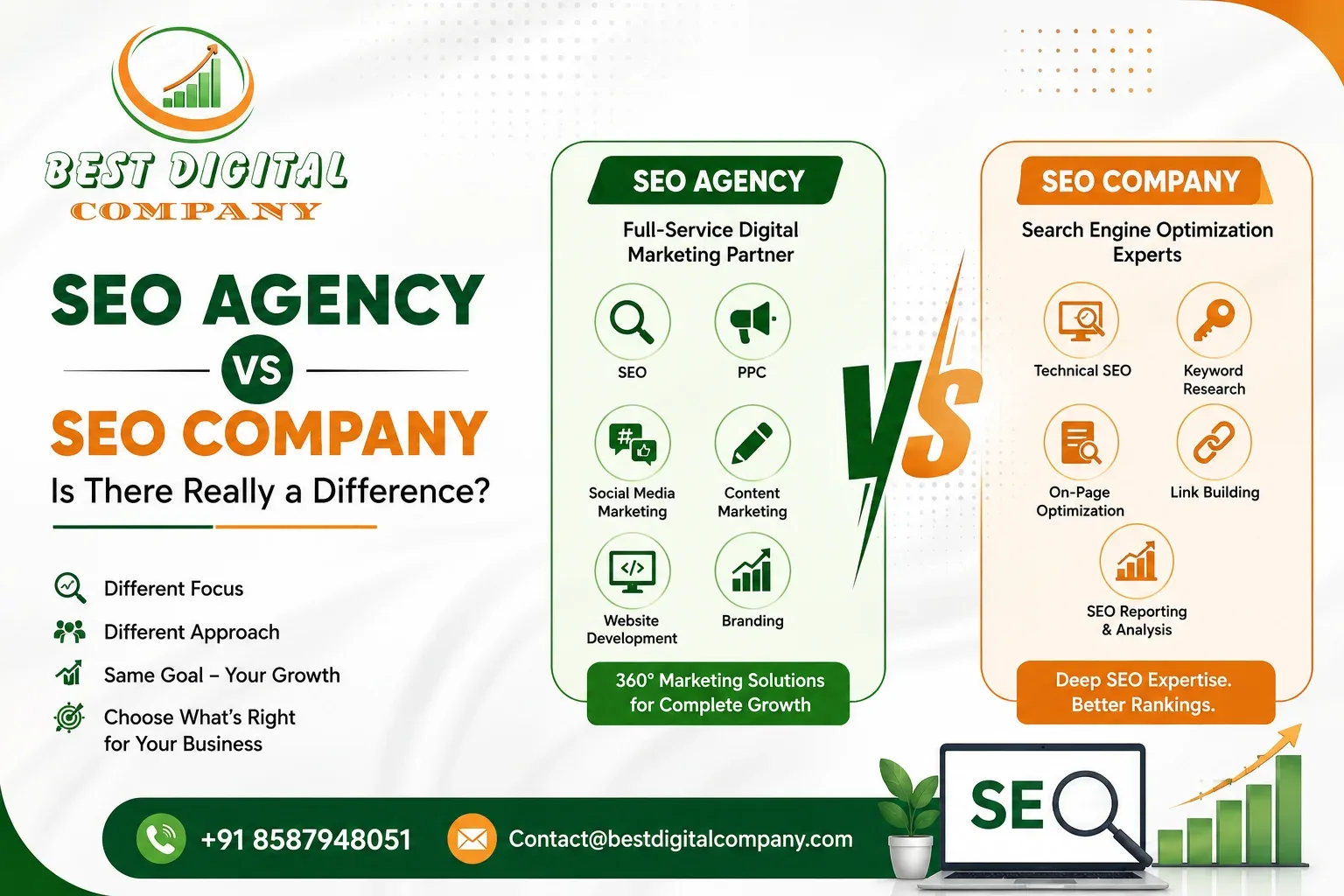
The word “agency” usually signals a full-service setup. An SEO agency tends to operate like a marketing partner rather than a single-task vendor. Alongside search optimization, many agencies also handle social media management, paid advertising, content creation, branding, and sometimes public relations. The idea is that your online presence does not live in one channel, so the people managing it should be able to move between channels without handing you off to three different vendors.

Agencies typically organize work around campaigns and strategy. You might have an account manager, a content team, a technical specialist, and someone running paid campaigns, all coordinating on the same goals. This structure suits businesses that want one point of contact for everything digital, rather than juggling separate invoices and separate strategies for search, social, and advertising.

A well-run digital marketing agency also tends to think about how channels support each other. For example, a blog post written for search visibility might get repurposed into social posts, and a paid campaign might target the same keywords the organic strategy is already targeting. That kind of cross-channel thinking is where agencies often justify their broader scope.

What Does an SEO Company Actually Do?

An “SEO company” often though not always signals a narrower, more specialized focus. Many businesses that describe themselves as SEO companies concentrate almost entirely on search visibility: technical audits, keyword research, on-page optimization, content strategy, and link building. Some do offer other services on the side, but search is usually the core competency and the reason clients hire them in the first place.

This specialization can be an advantage. A team that lives and breathes search algorithms, crawl behavior, and content structure every single day tends to catch technical issues that a generalist team might miss. If your biggest problem is that Google cannot properly index your site, or your rankings dropped after a redesign, a specialist SEO company is often better equipped to diagnose it quickly.

That said, plenty of businesses that call themselves an SEO company also offer web development, local listings management, and reporting dashboards blurring the line right back into agency territory. The label alone tells you very little; the actual service list tells you a lot more.

Where the Real Differences Show Up

Instead of treating “agency” and “company” as fixed categories, it helps to look at four practical factors that actually affect your results.

Scope of services. This is the biggest real difference. Some providers only touch your search rankings. Others manage your entire digital footprint, including social media marketing, pay-per-click advertising, and even website development and design. If your website itself has technical problems slowing it down, a provider that can only advise on keywords but cannot touch your code will only get you halfway there.

Team structure. Agencies usually assign a small team or a single account manager to coordinate multiple specialists behind the scenes. Specialist SEO companies sometimes work with a leaner, flatter structure where you speak directly to the person doing the work. Neither structure is automatically better; it depends on whether you want one relationship manager or direct access to a technical specialist.

Depth versus breadth. A specialist SEO company can usually go deeper into technical search issues because that is the entire business. A full-service agency spreads its attention across more channels, which can mean slightly less depth in any single one, but stronger coordination across your overall marketing.

Pricing structure. Full-service providers often bundle services into packages, while specialist providers may price search work on its own. Comparing a dedicated SEO package against a bundled agency retainer is genuinely comparing two different things, so it helps to ask exactly what is included before comparing numbers.

Why the Terms Get Used Interchangeably

Honestly, most of the confusion comes down to marketing, not meaning. Many businesses pick whichever term ranks better in their own search strategy or simply sounds more familiar to their audience. A one-person freelance operation might call itself an “agency” to sound established. A twenty-person full-service shop might call itself a “company” because that word feels less trendy and more trustworthy to certain industries.

This is why relying on the label alone is a weak way to evaluate a potential partner. What actually matters is the substance behind the name: their process, their past results, the people doing the work, and how clearly they can explain what they will do for your specific website. Two providers with different names on their homepage can deliver nearly identical outcomes, and two providers with the same label can deliver completely different levels of service.

Services You Should Expect From a Genuine Search Optimization Partner

Regardless of what they call themselves, a capable search engine optimization provider should be able to walk you through a fairly consistent set of deliverables:

  • Technical audits that check crawlability, site speed, mobile usability, and indexing issues before anything else is touched.
  • Keyword and intent research that matches what your actual customers are typing, not just high-volume terms with no buying intent.
  • On-page optimization covering titles, headings, internal linking, and content structure.
  • Content strategy that answers real questions your audience is asking, rather than stuffing pages with repeated phrases.
  • Off-page work, including authoritative backlinks and local citations where relevant.
  • Transparent reporting that shows you what changed and why, not just a wall of numbers. If you have ever received a report you could not make sense of, our guide on creating an SEO report clients actually understand breaks down what good reporting should look like.

If your provider agency or company cannot clearly describe how they approach each of these areas, that is a bigger warning sign than anything in their business name.

How to Choose Between an SEO Agency and an SEO Company

Instead of starting with the label, start with your actual situation.

If your website needs work across multiple channels say your social presence is inactive, your paid ads are underperforming, and your rankings have stalled a full-service agency that can coordinate all three under one strategy will likely save you time and keep your messaging consistent.

If your core problem is specifically about visibility in search results, and your social and paid channels are already handled elsewhere, a specialist SEO company that lives inside technical search work daily may get you faster, more focused results.

If you are still unsure, ask direct questions before signing anything: What exactly is included in the retainer? Who will actually be doing the work? Can you see examples of similar projects? How do you measure success beyond rankings? For a deeper walkthrough of vetting questions, our detailed breakdown on how to choose the best SEO company covers the exact questions worth asking before you commit budget.

It is also worth noting that the “versus” framing itself shows up across digital marketing, not just in search. If you have ever compared a PPC company against a performance marketing agency, you already know the pattern: the label matters less than the actual scope of work and the results attached to it.

Red Flags That Have Nothing to Do With the Label

Some warning signs apply no matter what a provider calls itself:

  • Guaranteed rankings. No legitimate provider can guarantee a specific position in search results, because ranking algorithms change constantly and depend on far more than one company’s efforts.
  • No mention of your website’s technical health. If a provider jumps straight to content or links without ever auditing your site’s speed, structure, or indexing, they are skipping a foundational step.
  • Vague reporting. If you cannot tell what actually changed month over month, you cannot tell if the work is effective.
  • One-size-fits-all packages with no adjustment for your industry, competitors, or existing site condition.
  • Outdated tactics, such as heavy keyword repetition or low-quality link schemes, which can actively hurt a site rather than help it.

These issues show up under both labels, which is exactly why the “agency versus company” question matters less than most people assume.

Why Trust and Experience Matter More Than the Name on the Website

Search engines increasingly reward content and websites that demonstrate real experience, expertise, authority, and trustworthiness. That same principle applies when you are choosing who manages your search visibility. A provider’s own credibility client history, transparent case studies, a clear team, and consistent communication tells you more than whether they picked “agency” or “company” for their own branding. We cover this in more depth in our guide on how to improve EEAT for better rankings, which applies just as much to evaluating a marketing partner as it does to writing content.

It is also worth remembering that search behavior itself keeps shifting. Tools like Google Search Console reveal patterns most business owners never look at, and newer shifts like AI-driven answer boxes are changing how people find information in the first place. If you want a primer on tracking your own visibility, our Google Search Console guide for beginners is a good starting point, and our explainer on zero-click searches covers why rising impressions do not always mean rising traffic anymore. A capable partner, whatever they call themselves, should already be adapting to these shifts rather than relying on tactics from five years ago.

Local Considerations Matter Too

If most of your customers come from a specific city or region, the agency-versus-company question becomes slightly less important than local expertise. A provider that understands local search behavior in your market whether that is SEO services in Delhi, local SEO strategies in Delhi, or search optimization tailored to Mumbai, Haryana, or Punjab will often outperform a generic national provider that treats every city the same way. Local nuance in search terms, competitor landscape, and customer intent tends to matter more than the business label on the invoice.

The Bottom Line

There is no strict industry rule separating an SEO agency from an SEO company. Some full-service agencies handle search alongside social and paid advertising. Some specialist companies focus entirely on search and nothing else. Many providers blur the line completely by offering both scopes under either name.

What actually determines your results is not the word on their homepage. It is whether they audit your site properly, build a strategy around real customer intent, communicate clearly, and adapt to how search itself keeps changing. Before signing with anyone, ask about their process, their reporting, and their past results and judge them on that, not on which of the two words happened to be in their business name.

If you are weighing your options and want a straightforward opinion on what your website actually needs, our team is happy to walk through your current setup and tell you honestly whether you need a focused search specialist or a broader marketing partner.


Frequently Asked Questions

Is an SEO agency better than an SEO company?

Neither is automatically better. An agency usually offers broader marketing services across multiple channels, while a company often specializes more narrowly in search visibility. The right choice depends on whether you need coordinated multi-channel marketing or focused, technical search work.

Do SEO agencies and SEO companies charge differently?

Pricing structures can differ because the scope of work differs. Full-service agencies often bundle search work with social media, advertising, and design into one retainer, while specialist companies may price search services on their own. Always compare what is actually included, not just the total cost.

Can a small business hire an SEO company instead of a full agency?

Yes. If your main goal is improving visibility in search results and you do not need help with social media or paid advertising right now, a specialist SEO company focused purely on search can be a practical, cost-effective choice.

How long does it take to see results from either one?

Search optimization is a gradual process regardless of who you hire. Most businesses start seeing meaningful movement within three to six months, with stronger, more stable results building over six to twelve months as technical fixes, content, and authority-building work compound.

What questions should I ask before hiring either type of provider?

Ask what services are included, who will actually manage your account, how they report progress, whether they have worked in your industry before, and how they plan to handle both search visibility and the overall health of your website.

Does the name really not matter at all when choosing a provider?

The name itself carries little weight. What matters is the provider’s process, transparency, past results, and how well their scope of services matches what your business actually needs right now.