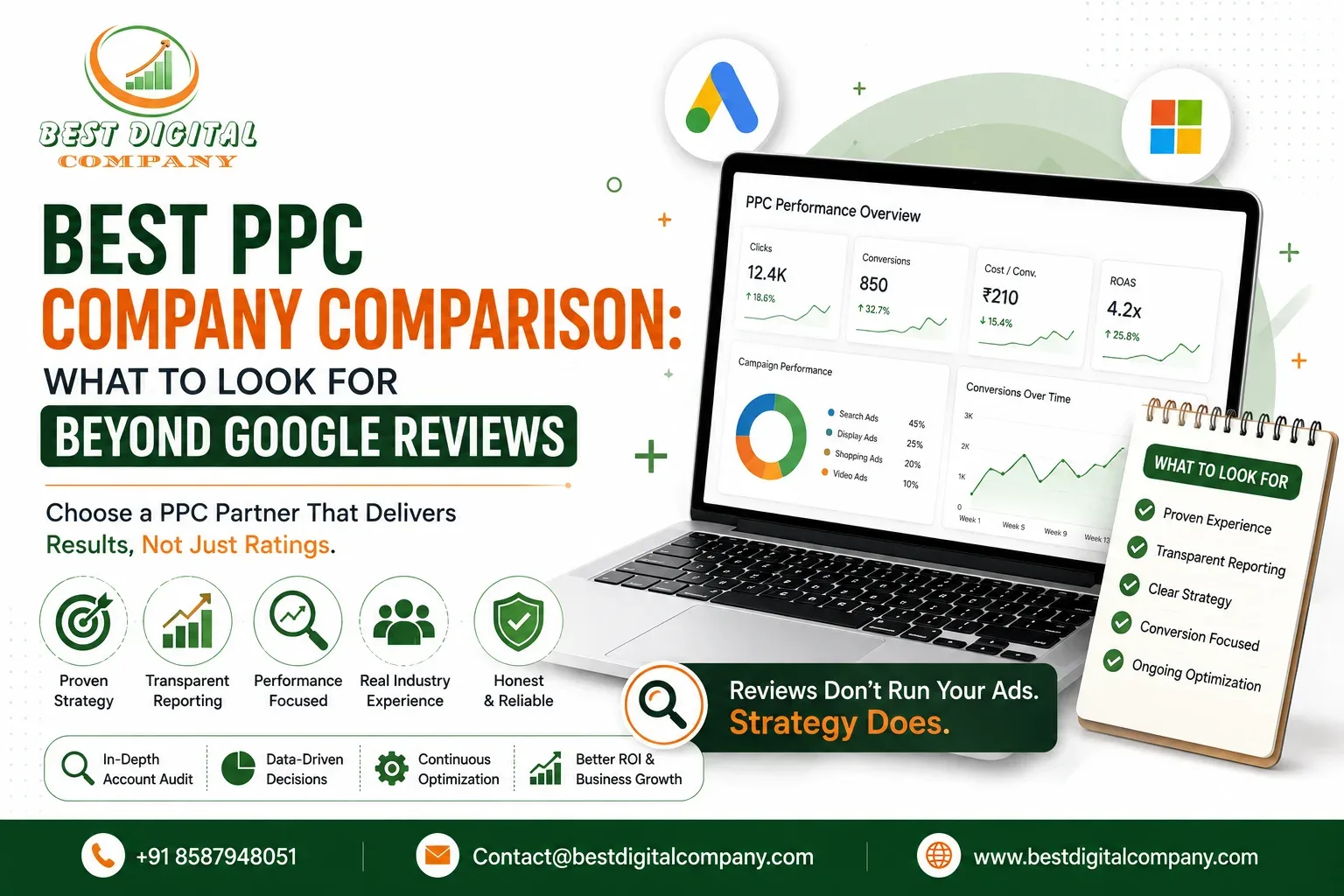
Best PPC Company Comparison: Beyond Google Reviews

Best PPC Company Comparison: What to Look for Beyond Google Reviews

If you have ever searched for the best PPC company for your business, you already know the drill. You open five tabs, skim through star ratings, read a handful of five-star reviews that sound suspiciously similar, and end up just as confused as when you started. A 4.9-star rating tells you almost nothing about whether an agency can actually manage your ad spend responsibly, structure your campaigns correctly, or explain to you in plain language why your cost per lead went up last month.

Reviews matter, but they are only one data point, and often the least reliable one. Ratings can be gamed, review requests can be sent selectively to happy clients only, and a glowing testimonial says nothing about how an agency behaves when a campaign underperforms. This guide walks through the things that actually separate a genuinely capable pay-per-click partner from one that simply looks good on paper, so you can make a decision based on substance rather than stars.

Why Star Ratings Alone Can’t Tell You Who the Best PPC Company Is

Star ratings are easy to collect and easy to inflate. An agency can ask every satisfied client for a review while quietly ignoring the accounts that didn’t go well. A handful of five-star reviews from three months ago doesn’t tell you how that same agency is managing accounts today, or whether the account manager who impressed those clients is still even with the company.

There is also a selection bias problem. Business owners who are unhappy with results rarely leave detailed public reviews explaining what went wrong; they simply leave. So the reviews you see skew positive by default, regardless of actual performance. That doesn’t mean reviews are worthless. It means they should be treated as a starting filter, not a final verdict. Use them to build a shortlist, then dig into the details covered below before signing anything.

What Pay Per Click Actually Involves Beyond Ad Creation

Search engine advertising is often reduced to “writing an ad and picking keywords,” but that’s a small fraction of what a competent Pay Per Click partner should be doing on your account every month. Real paid advertising work includes account structure planning, negative keyword management, bid strategy testing, landing page alignment, conversion tracking setup, and ongoing budget reallocation based on what’s actually converting.

Many business owners sign a contract expecting hands-on strategy and instead get a templated setup that runs on autopilot after the first two weeks. That’s usually the point where cost per click creeps up and lead quality drops, but nobody explains why. If you want a clearer picture of what should be happening behind the scenes every single month, our earlier post on what a performance marketing agency actually does for PPC breaks down the recurring tasks a proper account manager handles, from bid adjustments to conversion audits.

When comparing companies, ask directly: what does a typical week of work on my account look like? A confident answer with specifics is a good sign. A vague answer about “optimizing campaigns” is not.

Real Experience vs. Borrowed Case Studies

Anyone can post a screenshot of a dashboard showing impressive numbers. What matters is whether that experience is verifiable and relevant to your industry. Ask the agency to walk you through an account similar to yours in size, industry, or goal, and ask what specific decisions they made and why. A team with genuine hands-on experience will talk through the reasoning: why they excluded certain match types, why they shifted budget between campaigns, why a particular landing page underperformed.

Agencies that rely on second-hand case studies, industry-wide screenshots, or numbers with no context tend to struggle when asked to explain the “why” behind a result. This is where expertise becomes visible in a way no review can capture. A company that has actually managed live budgets for years will have opinions, not just templates. They will tell you when a strategy might not work for your business rather than promising results they can’t back up.

This same principle applies across service types, not just paid ads. If you are separately evaluating organic search partners, the same logic applies when weighing an SEO agency against an SEO company titles and labels matter less than demonstrated, explainable experience.

Transparency in Reporting: The Real Test of a Pay Per Click Partner

Ask any agency for a sample report before signing anything. This single step reveals more than a dozen reviews ever could. A trustworthy pay-per-click partner should show you:

  • Actual ad spend versus budget, not just “results”
  • Click-through rate, cost per click, and cost per conversion broken down by campaign
  • Which keywords or audiences are driving conversions and which are burning budget
  • Landing page performance, not just ad performance
  • Clear notes on what changed since the last reporting period and why

If a sample report only shows impressions and clicks with no mention of cost efficiency or conversion data, that is a signal the agency is optimizing for looking busy rather than for your return on investment. Full access to your own ad account (not a shared or agency-owned account you can’t see into) is also non-negotiable. If a company hesitates to give you visibility into your own campaigns, that alone should end the conversation.

PPC Packages and Pricing Structures: What They Signal

Pricing structures tell you a lot about how a company thinks about your business. Some charge a flat management fee, some take a percentage of ad spend, and some bundle a fixed number of campaigns into tiered packages. None of these models is automatically better, but the structure should match your actual needs rather than pushing you into a bracket you don’t need yet.

Before comparing quotes, it helps to look at published PPC packages to understand what is typically included at each tier: number of campaigns managed, reporting frequency, landing page support, and account access. A package that seems cheap but excludes basic reporting or campaign optimization often costs more in wasted ad spend than a slightly higher-priced package that includes proper ongoing management.

Be cautious of any pricing that locks you into a long-term contract before you’ve even seen a single month of results. A confident, capable agency should be comfortable proving value early rather than relying on a contract to keep you locked in.

PPC Company or Performance Marketing Agency: Does the Label Change Anything?

You’ll notice some companies call themselves a “PPC company,” others prefer “performance marketing agency,” and a few just say “digital marketing agency” and list paid ads as one service among many. The label itself doesn’t guarantee competence either way. What matters is whether the team has dedicated specialists managing paid campaigns full-time, or whether it’s one generalist juggling five different services for your account.

We covered this distinction in more depth in our guide on how to choose the best PPC company for your business, including the questions worth asking about team structure and specialization. The short version: ask who specifically will manage your account day to day, how many other accounts that person handles, and whether campaign strategy is reviewed by anyone senior before it goes live. A generic title on a homepage tells you nothing about the actual team behind it.

How PPC Connects to SEO, Social Media Marketing, and Website Development

Paid advertising rarely works well in isolation. If your landing pages load slowly, aren’t mobile-friendly, or don’t match the intent of the ad someone clicked on, you’ll pay for clicks that convert poorly no matter how well the campaign itself is built. This is why the best PPC company for your business is often one that either has strong website development capabilities in-house or works closely with a team that does.

Similarly, search engine optimization and paid search are not competitors, they are complementary. Organic rankings reduce your long-term dependence on ad spend, while paid campaigns can fill the gap while your organic presence builds. And a business running social media marketing alongside paid search often gets better ad performance because audiences arriving from search already have some brand familiarity from social touchpoints.

When you are comparing agencies, ask whether their paid ad recommendations account for your overall digital presence, or whether they only look at the ad account in isolation. An agency that only talks about keywords and bids, without asking about your website’s conversion rate or your brand’s social presence, is solving half a problem.

Red Flags That Won’t Show Up in a Review

Some warning signs only become visible once you’re actually talking to an agency, not while scrolling through their review section:

Vague answers about account access. If a company is cagey about giving you admin-level access to your own Google Ads account, that’s a control issue, not a technical limitation.

No willingness to explain past underperformance. Every experienced agency has had a campaign that didn’t hit target. What matters is whether they can explain what they learned and adjusted, rather than pretending every account has been a success story.

Guaranteed results language. No legitimate agency can guarantee a specific number of leads or a specific cost per click before seeing your account, your market, and your competition. Guarantees at the pitch stage are a sales tactic, not a forecast.

One-size-fits-all proposals. If the strategy document looks identical to what they’d send any business in any industry, it probably is a template.

Reluctance to name past or current clients. Agencies with real, ongoing client relationships are usually comfortable naming at least a few, subject to confidentiality where relevant. Total secrecy across the board is worth questioning.

A Practical Checklist for Comparing PPC Companies

Before making a final decision, run each shortlisted agency through the same set of questions:

  1. Can they show a sample report with cost, conversion, and efficiency data, not just clicks and impressions?
  2. Will they give you full access and ownership of your own ad account?
  3. Can they explain a real account decision and the reasoning behind it, not just a result?
  4. Do their PPC packages match your business size and goals, or are you being upsold into a tier you don’t need?
  5. Who specifically manages the account, and how many other clients does that person handle?
  6. Do they consider your website and landing pages as part of the strategy, or only the ad platform?
  7. Are they upfront about timelines, without guaranteeing exact numbers?
  8. Do they have a documented onboarding process, or does work start with no clear plan?

Answering these questions honestly, for each agency on your list, gives you a far more reliable comparison than a star rating ever could.

Making the Final Call

Choosing the best PPC company for your business is not about finding the agency with the most five-star reviews. It’s about finding a team that’s transparent about how your money is spent, willing to show you real reporting, and capable of explaining their decisions in plain language rather than jargon. Reviews can help you build a shortlist, but the conversations you have, the reports they are willing to show you, and the questions they’re willing to answer honestly are what actually determine whether an agency will protect your ad spend or waste it.

If you’d like a second opinion on a current PPC setup, or want to see what a transparent monthly report actually looks like, our team is happy to walk you through one. You can reach out through our contact page and we’ll take a look at your account with no pressure to sign anything on the spot.

Frequently Asked Questions

How do I know if a PPC company is actually good, beyond their reviews?

Ask for a sample report that shows cost per conversion and efficiency data, not just clicks. Request full access to your own ad account, and ask the team to explain a real decision they made on a past campaign and why. Agencies with genuine experience can explain their reasoning clearly; ones relying on templates usually can’t.

Should I choose a company that only does PPC or one that offers multiple services?

Both can work well, as long as there is a dedicated specialist managing your paid campaigns rather than a generalist splitting attention across five different services. If your business also needs SEO, social media, or web development support, a broader agency can offer more coordinated strategy, provided each service still gets proper specialist attention.

What’s a reasonable budget to start with for paid search advertising?

This depends heavily on your industry, competition, and average customer value, so there is no universal number. A good agency will ask about your goals and margins before recommending a starting budget, rather than pushing you toward a fixed package regardless of your business type.

How long should I wait before judging whether a PPC campaign is working?

Most campaigns need at least four to six weeks of data before meaningful conclusions can be drawn, since search platforms need time to gather conversion data and optimize delivery. Be cautious of any agency promising strong results within the first week or two.

Is it a bad sign if an agency won’t guarantee a specific number of leads?

No, it’s actually a good sign. No legitimate agency can guarantee exact lead numbers or cost per click before analyzing your account, market, and competitors in detail. Guarantees offered during the initial sales pitch, before any account analysis, are a red flag rather than reassurance.

Do I need to also invest in SEO if I’m already running PPC ads?

Not immediately, but it is worth considering over time. Paid search delivers faster visibility while organic search takes longer to build but reduces long-term dependence on ad spend. Many businesses run both together so that paid campaigns fill the gap while organic rankings grow.
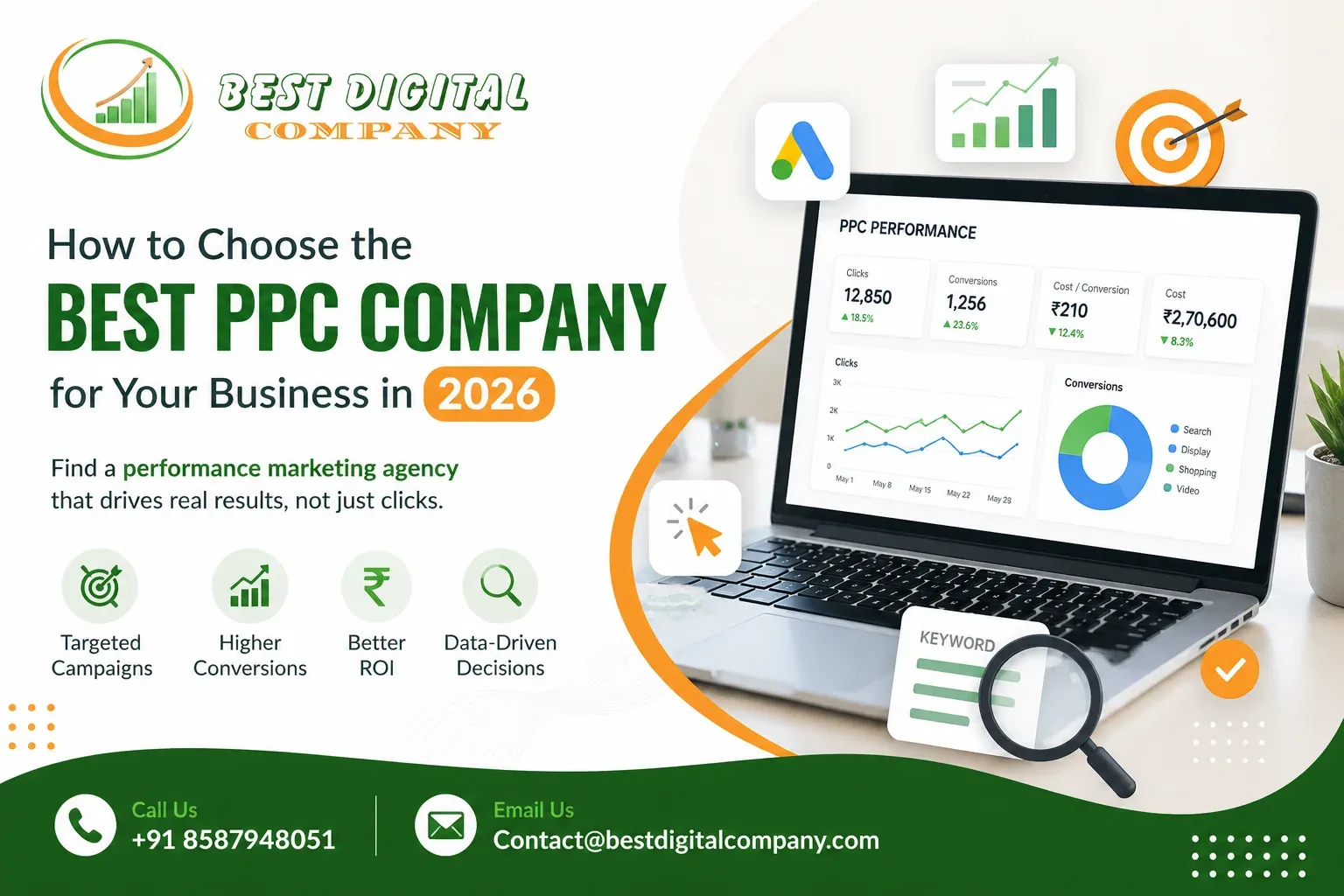
How to Choose the Best PPC Company for Your Business in 2026

How to Choose the Best PPC Company for Your Business in 2026

If you have ever typed “PPC company near me” into Google at midnight while staring at a Google Ads dashboard that is burning money without bringing in a single lead, you already know how frustrating paid advertising can be without the right partner. Running ads is easy. Running ads that actually make money is a completely different skill, and it is the reason so many business owners eventually go looking for a performance marketing agency instead of trying to figure it out alone.

This guide walks through what a genuine performance marketing company does differently, how to separate a best PPC company from one that is simply good at selling itself, and what to check before you hand over your ad budget to any PPC advertising agency. We will also answer the questions we hear most often from business owners in our first strategy call, so by the end you will know exactly what to look for.

Why Businesses Are Turning to a Performance Marketing Agency in 2026

A few years ago, most companies split their marketing into separate buckets: one team for the website, another for social posts, and someone else handling ads whenever there was budget left over. That approach does not hold up anymore. Ad platforms have become smarter, more automated, and far more competitive, which means campaigns that “sort of work” quietly waste thousands of rupees every month without anyone noticing.

A performance marketing agency exists to close that gap. Instead of billing you for hours spent “managing” a campaign, a genuine performance-driven team ties its work to outcomes you can actually measure: cost per lead, cost per acquisition, return on ad spend, and revenue. This is a different mindset from traditional advertising, where the goal was often just visibility. With performance marketing, every rupee spent has to justify itself, and every campaign is judged by the results it produces, not the creativity of the ad copy alone.

This shift matters even more if your website already has strong organic traffic. Businesses that have invested in search engine optimization often see PPC as the fastest way to fill the gap while their organic rankings climb, since paid campaigns can start driving qualified visitors within a day or two, unlike SEO, which typically takes months to show its full impact.

What Does a PPC Company Actually Do?

At its core, a PPC company manages paid advertising campaigns on your behalf, from research and setup to daily optimization and reporting. But “managing ads” undersells the actual work involved. A capable team is doing several jobs at once:

  • Keyword and audience research to understand exactly who is searching for what you sell, and how much competitors are willing to pay for that same click.
  • Ad copywriting and creative testing so your ads stand out instead of blending into a feed of near-identical competitors.
  • Bid strategy management to make sure your budget is spent on the clicks most likely to convert, not just the ones that are cheapest.
  • Landing page alignment because even the best ad in the world will not convert if it sends traffic to a page that does not match what the person was searching for.
  • Continuous testing and reporting so decisions are based on real data rather than guesswork.

If a provider is only doing the first two items on that list, they are not really running a performance campaign. They are just placing ads and hoping.

Performance Marketing Company vs a Traditional Ad Vendor: What’s the Difference

This is one of the most common points of confusion we run into. Plenty of freelancers and small agencies will happily “run your Google Ads,” but there is a real difference between someone who sets up a campaign and someone who manages it like a growth channel.

A traditional vendor typically sets a campaign live, checks in once a month, and reports on surface-level numbers like impressions and clicks. A true performance marketing company treats every campaign as a living system. Budgets shift toward what is working. Underperforming keywords get paused. Ad copy is rewritten based on what the data shows, not what looks good on paper. And most importantly, reporting focuses on business outcomes leads, sales, bookings not vanity metrics that look impressive but do not pay the bills.

If you are also investing in content or organic visibility, it helps to work with a team that understands how paid and organic channels support each other. For example, we have written before about how to improve EEAT for better Google rankings, and the same principles of trust and credibility that Google rewards organically also influence how well your landing pages convert paid traffic.

Signs You are Working With the Best PPC Company

There is no single certificate that proves an agency is the right fit for your business, but there are patterns you can watch for. Here is what tends to separate the best PPC company for your industry from one that just sounds confident in a sales call.

They ask about your business before talking about budgets. A team that jumps straight to “how much can you spend” without understanding your margins, sales cycle, or customer lifetime value is optimizing for their own convenience, not your results.

They are honest about timelines. PPC can generate traffic almost immediately, but real optimization the kind that actually lowers your cost per lead usually takes a few weeks of data collection. Anyone who promises overnight miracles is either inexperienced or not being straight with you.

They show you the account, not just a slide deck. Transparent reporting means access to the actual Google Ads or Meta Ads dashboard, not a polished PDF summary once a month. If an agency is reluctant to give you visibility into your own account, that is worth questioning.

They connect ad performance to your website experience. Paid traffic that lands on a slow, confusing, or outdated page will always underperform, no matter how well the ad itself is written. A serious agency will flag this and, if needed, bring in support from a web development team to fix conversion bottlenecks rather than just blaming the ad.

They think beyond a single platform. Google is usually the starting point, but the right channel mix depends on your audience. B2B companies often need LinkedIn. E-commerce brands often need a strong presence on Instagram and Facebook alongside Google Shopping.

Core PPC Services Every PPC Agency Should Offer

Not every business needs every channel, but a well-rounded PPC agency should be able to support you across the platforms that matter for your industry. At a minimum, look for a provider that offers:

Google Ads management, covering Search, Display, and Shopping campaigns, since this is still where most high-intent buyers begin their search.

Social advertising across Facebook and Instagram, useful for building awareness and retargeting visitors who did not convert the first time.

YouTube advertising, which has become increasingly important as more buying research happens through video rather than text.

LinkedIn advertising for B2B companies that need to reach decision-makers directly rather than a broad consumer audience.

Remarketing campaigns that bring back visitors who browsed your site but left without taking action often some of the most cost-effective ads you will ever run, because you are advertising to people who already showed interest.

You can see the full breakdown of platforms and the step-by-step process we follow on our PPC services page, along with the packages available for different budget levels on our PPC packages page.

Why You Need a Certified Google Ads Expert on Your Team

Google Ads changes constantly. Bidding strategies, automation rules, ad formats, and Quality Score factors get updated far more often than most business owners realize, and campaigns that were optimized six months ago can quietly become inefficient without anyone touching them.

This is exactly why working with a genuine Google Ads expert matters more than it did a few years ago. Automation has made the platform more powerful, but it has also made it easier to waste money if you do not understand how the machine learning behind Smart Bidding actually behaves. A skilled account manager knows when to let automation run and when to step in manually, how to structure campaigns so Google’s algorithm gets clean signals to learn from, and how to spot early warning signs like a rising cost per click with no matching increase in conversions before they turn into a wasted month of ad spend.

If your website already ranks organically for some of your target keywords, a Google Ads expert can also help you avoid cannibalizing your own traffic, bidding smartly on terms where you are already visible in organic results while reserving more aggressive bidding for competitive terms where you have no organic presence yet.

How a Pay Per Click Company Builds Campaigns That Convert

Good campaigns rarely happen by accident. Here is roughly how a competent pay per click company approaches a new account, from the first conversation to ongoing scaling.

Step 1: Discovery. Understanding your product, your typical customer, your sales cycle, and what a “good lead” actually looks like for your business. Without this, an agency is just guessing at targeting.

Step 2: Research. Studying competitor ads, estimating realistic cost-per-click ranges, and identifying keywords with genuine buying intent rather than just high search volume.

Step 3: Build. Structuring campaigns and ad groups logically, writing ad copy that speaks directly to what the searcher needs, and making sure landing pages match the promise made in the ad.

Step 4: Launch and monitor. Watching early data closely in the first one to two weeks, since this period tells you a lot about how the algorithm is interpreting your targeting.

Step 5: Optimize. Pausing what does not work, increasing budget on what does, and testing new ad variations on a regular schedule rather than leaving campaigns untouched.

Step 6: Report and scale. Sharing clear, honest reporting and using that data to decide where additional budget will produce the best return.

This is the same structured process we follow for every client, and it is worth asking any agency you are evaluating to walk you through their own version of it. If they cannot explain their process clearly, that usually means there is not much of a process to begin with.

Choosing Between a PPC Advertising Agency and an In-House Team

Some businesses, especially larger ones, wonder whether they should hire an in-house specialist instead of outsourcing to a PPC advertising agency. Both paths can work, but they come with very different trade-offs.

An in-house hire gives you someone fully dedicated to your brand, but you are relying on one person’s skill set and their ability to keep up with a platform that changes constantly. If they are experienced only with Google Ads, you may struggle to expand into LinkedIn or YouTube without hiring again.

A PPC advertising company typically gives you access to a broader team someone focused on strategy, someone focused on creative, someone focused on data for a fraction of what it would cost to build that same team internally. You also benefit from patterns the agency has already learned across other accounts in similar industries, which an in-house hire starting from scratch simply would not have.

For small and mid-sized businesses especially, working with an established PPC advertising agency is usually the more practical starting point, with the option to build an internal team later once ad spend justifies it.

Red Flags to Avoid When Hiring a PPC Advertising Company

Before you sign a contract with any PPC advertising company, watch for a few common warning signs:

  • Vague reporting. If you cannot get a straight answer about what specific numbers you will receive and how often, assume you will be kept in the dark later too.
  • Locked-in contracts with no exit. A confident agency does not need to trap you in a twelve-month commitment to prove its value.
  • No questions about your business. As mentioned earlier, an agency that skips straight to budget talk is not planning to build a real strategy.
  • Guaranteed rankings or guaranteed leads. No one can guarantee exact outcomes on an auction-based ad platform. Anyone who promises this is either misinformed or not being honest with you.
  • One-size-fits-all packages. Your industry, competition, and audience are specific to you. A generic package rarely accounts for that.

If you have run into any of these red flags with a previous provider, you are far from alone — plenty of business owners go through one bad experience before finding a partner who actually communicates clearly and delivers measurable results.

How Best Digital Company Delivers Performance Marketing Results

At Best Digital Company, we built our PPC process around one simple idea: your ad budget should work as hard as the rest of your business does. As a full-service performance marketing agency, our team manages everything from Google Ads and social advertising to remarketing and landing page alignment, so campaigns are never running in isolation.

We also believe paid and organic growth should support each other rather than compete for attention. That is why our PPC strategy is often paired with insights from our SEO work including lessons from guides like our local SEO checklist for small businesses and our breakdown of Google Search Console for beginners so you get a complete picture of where your traffic is coming from and what to do with it.

If your business relies on local customers, whether you run a clinic, a service business, or a retail store, it is worth reading our piece on how doctors and local businesses rank on Google alongside your PPC strategy, since local intent searches often respond very differently to ads than broader, competitive keywords. And if you are just getting started and trying to build your very first customer base, our guide on how small businesses can get their first 100 customers covers how PPC fits into that early growth stage.

Whether you need a dedicated PPC company to manage an existing account that is underperforming, or you are launching paid ads for the first time, our team is happy to review your current setup and show you exactly where the gaps are, with no pressure to commit before you see the numbers for yourself.


Frequently Asked Questions

What is the difference between a performance marketing agency and a regular PPC agency?

Both manage paid ad campaigns, but a performance marketing agency ties everything back to measurable business outcomes leads, sales, and return on ad spend rather than just clicks and impressions. A regular agency may focus mainly on campaign setup without the same level of ongoing optimization.

How do I know if a PPC company is actually good, not just good at sales calls?

Ask for account-level access, not just reports. Ask how they structure campaigns, how often they optimize, and how they handle underperforming keywords. A confident, experienced team will walk you through their process without hesitation.

Is PPC better than SEO, or should I do both?

They serve different purposes. PPC delivers traffic almost immediately but stops the moment you stop paying, while SEO builds long-term, sustainable visibility that takes longer to establish. Most businesses see the best results using both together, with PPC filling the gap while organic rankings grow.

How much should I budget for PPC advertising services?

This depends heavily on your industry and competition. Many businesses start with a monthly budget in the range of ₹15,000 to ₹1,00,000, then scale based on the return they see. A good agency will help you set a realistic starting budget rather than pushing you toward the biggest number possible.

How long does it take to see results from a PPC advertising agency?

Traffic can start within a day or two of launch, but meaningful optimization the kind that lowers your cost per lead over time usually takes three to six weeks of data collection. Treat the first month as a learning period rather than a final verdict on performance.

Can a small business afford a professional PPC advertising company?

Yes. Most PPC agencies offer tiered packages designed for different budget levels, so you do not need an enterprise-sized ad spend to get professional campaign management. The key is finding a provider willing to work with your current budget rather than pushing you into a package that does not fit.

What platforms should my ads run on besides Google?

It depends on where your customers spend time. B2B businesses often benefit from LinkedIn, e-commerce brands do well on Instagram and Facebook, and service businesses with visual appeal can benefit from YouTube. A capable PPC company will recommend a platform mix based on your specific audience rather than running the same setup for every client.


Looking for a PPC company that treats your ad budget like an investment, not an expense? Get in touch with Best Digital Company for a free review of your current campaigns.