How to Choose the Best Website Development Agency and the Best SEO Company in 2026

How to Choose the Best Website Development Agency and the Best SEO Company in 2026

Every week, someone reaches out to us with the same underlying question, just phrased differently. Sometimes it’s “who’s the best website development agency near me,” and sometimes it’s “we need the best SEO company because our traffic has flatlined.” What’s interesting is that these two questions almost always end up connected. A site that’s built well but never gets found is a wasted investment. A site that ranks well but confuses or loses visitors the moment they land on it is just as wasteful.

We’ve worked on both sides of this problem for years, building sites from scratch and rescuing rankings on sites someone else built badly. This piece is meant to help you evaluate both types of partners honestly, without the usual sales pitch language that makes every agency sound identical on paper.

What a Website Development Agency Should Actually Deliver

A lot of businesses assume website development is just about how a site looks. It isn’t. Design is the visible 20%. The other 80% is structure, speed, mobile behavior, and how easily search engines can read the site once it’s live.

When we talk to clients about web development, we are not just talking about layouts and color palettes. We’re talking about clean code, fast load times, proper heading structure, and a site architecture that doesn’t fight against SEO later. This matters more than people expect. We’ve reviewed dozens of sites where the design team and the SEO team never once spoke to each other, and it shows in how long the site takes to rank once it’s finally live. If this sounds familiar, our guide on the website launch checklist before going live walks through exactly what typically gets missed.

A genuinely capable development team will ask you questions before they touch a single line of code .Questions about your customers, your competitors, and your growth goals for the next two years, not just the next two months. If an agency jumps straight to showing you templates, that’s usually a sign they’re building a website, not a business asset.

Signs You’re Looking at a Genuine SEO Company (Not Just a Reseller)

There are a lot of businesses calling themselves an SEO company right now, and the range in quality is enormous. Some run legitimate strategy built on content, technical fixes, and consistent link building. Others buy cheap backlink packages in bulk and hope nobody checks the results six months later.

A few things separate the two. A real SEO partner will actually audit your site before promising anything. They’ll look at your existing content, your technical setup, and your competitors before quoting you a number or a timeline. If you’re curious what a proper audit uncovers, our breakdown on how to rank a new website on Google in 90 days shows the kind of groundwork that has to happen before rankings move at all.

Another sign worth watching for is whether they talk about topical depth or just keywords. Search engines in 2026 reward sites that demonstrate real subject-matter coverage, not single pages stuffed with a phrase repeated a dozen times. We wrote in detail about this shift in our piece on building topical authority, and it’s one of the biggest reasons thin, one-off content strategies are losing ground.

If you run an online store specifically, the priorities shift slightly again product pages, category structure, and reviews all carry more weight than they do for a typical service business. Our SEO guide for e-commerce stores covers that in more depth if that’s closer to your situation.

Why the “Best” Agency Isn’t Always the One with the Biggest Portfolio

Here’s something we’ve noticed after years of client conversations: business owners often equate “best” with “biggest name” or “most case studies on the homepage.” In reality, fit matters more than size. A large agency juggling hundreds of accounts may not give a mid-sized business the attention it needs. A smaller, specialized team focused on both development and search often ends up being more responsive and more invested in the outcome.

This is also why the decision between fixing your website first or investing in SEO first comes up so often. We addressed that exact dilemma in website redesign versus SEO optimization: which should you do first, because the honest answer depends on your specific starting point, not a one-size-fits-all rule.

The Cost of Treating Development and SEO as Separate Projects

We’ve seen this pattern too many times to ignore it: a business hires one team to build the site and, months later, hires a completely different team to fix the rankings. The second team then spends the first few weeks undoing decisions the first team never should have made broken URL structures, missing metadata, slow-loading images, duplicate content across pages.

When development and search strategy are planned together from day one, you skip that entire rebuilding phase. Your pay-per-clickcampaigns land on pages that are actually built to convert, your social media marketing traffic doesn’t bounce off a slow homepage, and your organic content has a technical foundation that supports it instead of working against it. Businesses that get their traffic without users ever clicking through in the traditional sense also need to think about this early. Our piece on zero-click marketing explains how visibility now extends well beyond your website itself.

What This Looks Like in Practice

If your website currently generates visitors but very few actual inquiries, the problem is rarely traffic. It’s usually the experience once someone arrives. We’ve covered this at length in why business websites fail to generate leads, and the fixes are often smaller than business owners expect a clearer call to action, faster load speed, or a landing page actually designed around one specific goal rather than trying to say everything at once. Our guide on building SEO landing pages that convert goes into the specific structure that tends to work.

And if you’re running a regional business, location matters more in this evaluation than most owners realize. What works for a business competing nationally looks different from what works for a business trying to dominate a specific city or state something we saw play out clearly while working with businesses across Punjab building their first real digital presence.

Frequently Asked Questions

How do I know if an agency is genuinely good at both website development and SEO, or just good at one?

Ask to see examples of sites they’ve built that are also ranking well organically, not just sites that look good in a portfolio. A team that’s strong in only one area will usually have plenty of design work to show but very little proof of sustained rankings, or the reverse strong rankings on outdated, clunky websites.

Is it better to hire one agency for both development and SEO, or two separate specialists?

 In most cases, one team handling both works out better because it removes the handoff gap where technical decisions made during development end up hurting SEO later. If you do go with separate teams, make sure they’re willing to actually communicate with each other during the build.

How long does it typically take to see results from SEO after a new website launch?

Most businesses start seeing measurable movement somewhere between two and four months, with stronger results building over six to twelve months. Anyone promising rankings within days is either overselling or using tactics that won’t hold up long term.

What’s a reasonable budget range for combined website development and SEO services?

 This varies widely based on the size of the site, the competitiveness of your industry, and your city or region. A basic informational site with light SEO will cost far less than an e-commerce platform competing in a crowded market. It’s worth getting a scoped quote based on your actual goals rather than comparing generic package prices across agencies.

Do I need a new website if my current one already ranks reasonably well?

Not necessarily. If your site ranks decently but converts poorly, a redesign focused on user experience and conversion paths might matter more than a full rebuild. If the site has deep technical issues holding back rankings, a rebuild alongside an SEO strategy usually makes more sense than patching an outdated foundation.

How do I evaluate an SEO company’s past results without just trusting their word for it?

 Ask for specific, verifiable examples a website URL, the approximate timeline, and what changed. Legitimate agencies are usually comfortable sharing this level of detail. Vague claims about “massive growth” without any specifics are worth treating with caution.


Choosing between agencies is rarely about finding the flashiest portfolio. It’s about finding a team that treats your website and your search visibility as one connected system, not two separate line items on an invoice. If you’d like a second opinion on where your current site and search strategy stand, get in touch with our team and we’ll walk you through what we’d actually prioritize first.
Zero-Click Marketing in 2026: How to Generate Leads When Users Never Visit Your Website

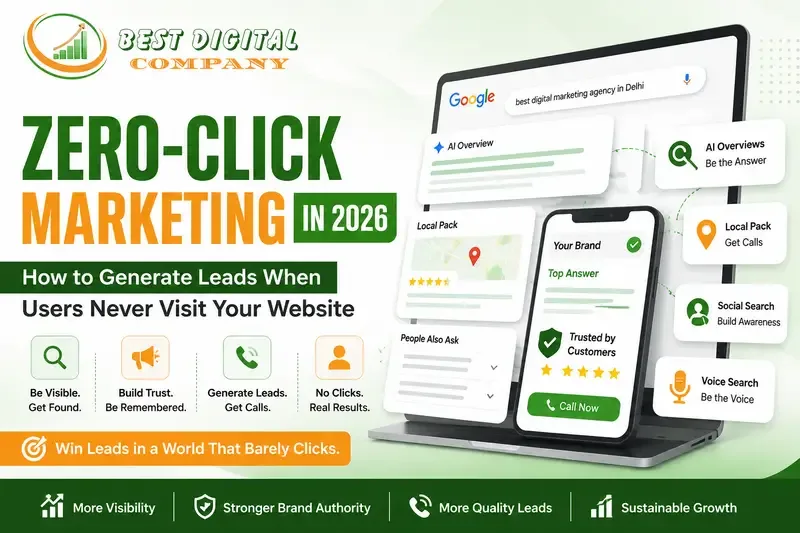
Zero-Click Marketing in 2026: How to Generate Leads When Users Never Visit Your Website

Here’s something that would have sounded absurd five years ago: your best lead today may have found you, decided to trust you, and is ready to call you without ever landing on your website. Welcome to the reality of zero-click marketing in 2026.

Roughly 65% of all Google searches now end without a single click. People get business hours from Knowledge Panels, find answers in AI Overviews, read product comparisons in featured snippets, and discover brands through short-form videos, all without touching your domain. If your strategy still defines success purely by traffic analytics, you’re measuring the wrong thing.

This blog breaks down what zero-click marketing actually means for businesses today, which channels and tactics genuinely work, and how our services from Search Engine Optimisation to Pay Per Click advertising can be repositioned to win leads in a world that barely clicks through.


1. What Is Zero-Click Marketing And Why It Matters Right Now

Zero-click marketing is the practice of generating brand awareness, authority, and inbound leads through digital touchpoints where the user never actually visits your website. The interaction happens entirely on Google’s SERP, on a social platform, inside a voice assistant, or through a brand impression that stays in memory until the person is ready to buy.

This isn’t a loophole or a workaround. It is simply where consumer attention has moved. Google’s AI Overviews, Position Zero featured snippets, Local Packs, People Also Ask boxes, and social search are now the first and sometimes only stop before a purchase decision.

For a digital marketing agency like ours, based in Delhi and working with businesses across India, the shift means our clients need to think about presence, not just placement. Ranking number one is still important. But being the brand that shows up authoritatively in answer boxes, maps, knowledge graphs, and social feeds that is the new lead funnel.


2. The Channels Driving Zero-Click Lead Generation in 2026

2.1 Google Featured Snippets and AI Overviews

When someone types ‘best digital marketing agency in Delhi’ or ‘how much does SEO cost in India,’ Google frequently pulls a direct answer from a webpage and displays it at the top sometimes without the user needing to scroll further. Your goal is to be that source.

Structured, well-formatted content that directly answers specific questions tends to earn these positions. Writing in clear Q&A formats, using concise definitions followed by detail, and organising content with semantic HTML all contribute. It’s disciplined writing not keyword stuffing that gets you there.

2.2 Google Business Profile and Local Pack

For service-based businesses, especially those targeting local markets, the three-pack of local results above organic listings often drives more enquiry calls than a full website visit would. Someone searching ‘PPC agency near me’ on mobile sees your rating, phone number, hours, and reviews and calls directly. That lead is zero-click from a website perspective, but it is a very real conversion.

Maintaining an accurate, review-rich Google Business Profile has become as important as having a well-built website. If you haven’t already, explore our Digital Marketing Services in Delhi to understand how local visibility fits into a broader strategy.

2.3 Social Search – Instagram, YouTube, and LinkedIn

Younger demographics increasingly use Instagram and YouTube as search engines. A business that shows up in a relevant Reel, a YouTube short explaining a service, or a LinkedIn thought-leadership post is generating brand awareness and leads without the user ever needing to visit a domain. The discovery happens on-platform.

This is precisely why our Social Media Marketing service now centres on searchable content, not just engagement content. Every post, caption, and hashtag is treated as an SEO asset.

2.4 Voice Search and Conversational AI

Smart speakers and AI assistants read out a single answer when someone asks a voice question. There is no second result. Optimising for conversational long-tail queries, local intent, and FAQ-structured content increases the probability that your business is the one answer Alexa, Google Assistant, or an AI chatbot returns.

2.5 Knowledge Panels and Brand SERPs

When users search your brand name directly, what does Google show them? A Knowledge Panel with accurate details and positive reviews builds enormous trust even if they never click. Managing your brand’s SERP through consistent NAP (Name, Address, Phone) data, authoritative backlinks, and structured data is a form of zero-click reputation management.


3. How to Build a Zero-Click Lead Generation Strategy

Step 1 — Audit Your Current SERP Presence

Before optimising for zero-click, understand where you currently appear. Search for your core service keywords and note: do you appear in featured snippets? Does your GBP show up in the local pack? Is your brand Knowledge Panel accurate? This baseline tells you where the gaps are.

Step 2 — Structure Content to Answer Questions Directly

Google’s crawlers are looking for content that answers a user’s question in the first 40–60 words of a section. This means leading with your answer, then providing supporting context. Use H2 and H3 headings that mirror real search queries. Include FAQ sections (like the one at the end of this article) because People Also Ask boxes heavily pull from structured FAQ schema.

Step 3 — Invest in Local SEO and GBP Optimisation

For businesses in Delhi and across India, local intent searches convert at the highest rate. A fully optimised Google Business Profile with updated services, photos, Q&A responses, and a steady stream of genuine reviews will generate enquiries without a single website visit. Pair this with our SEO Packages designed for local dominance.

Step 4 — Make Social Media Content Searchable

Think of every social post as a micro-webpage. Use descriptive captions, relevant hashtags treated as keywords, and on-screen text in videos. YouTube descriptions should be treated like blog introductions. When your social content is optimised for search intent, it appears in both social search and sometimes in Google’s own video carousel doubling your zero-click surface area.

Step 5 — Use Paid Ads to Own the SERP Real Estate

PPC campaigns through Google Ads can claim top-of-SERP real estate for branded and competitor keywords, ensuring that even zero-click searchers see your name, your messaging, and your credibility. Callout extensions, site links, and structured snippet extensions deliver information directly on the SERP the user learns who you are before clicking. Our PPC Services are designed to maximise this brand impression value, not just cost-per-click.

Step 6 — Implement Schema Markup Across Your Site

Schema markup tells Google exactly what your content means whether it’s a business address, a product price, a FAQ answer, or a review rating. Rich results generated by schema (stars, prices, event dates) appear directly on the SERP and increase your brand’s perceived credibility even in a zero-click environment. Your website may not get the visit, but it earns the trust.


4. Measuring Success When Clicks Aren’t the Metric

The hardest part of zero-click marketing is convincing stakeholders that the strategy is working when organic traffic numbers don’t move dramatically. Here are the metrics that actually matter:

  • Direct traffic and branded search volume — rising numbers here indicate growing off-SERP awareness
  • Google Business Profile insights — calls, direction requests, and message enquiries
  • SERP feature appearances — track featured snippet wins, local pack placements, and Knowledge Panel accuracy using tools like SEMrush or Ahrefs
  • Social media reach and saves — content saved or shared indicates informational value even without a click
  • Lead quality and source attribution — more leads identifying your brand by name, from referrals or word-of-mouth, often trace back to zero-click impressions
  • Phone call volume — particularly relevant for local businesses; this is often the most direct zero-click conversion signal

The mindset shift is this: you’re not trying to bring people to your website in Step 1 of the funnel. You’re building enough trust through zero-click touchpoints that by Step 3 or 4, they already know who you are and come directly.


5. What This Means for Small and Mid-Sized Businesses

We work with businesses across Delhi and beyond from dental clinics to e-commerce startups to professional service firms. As we noted in our blog on Digital Marketing for Small Businesses, the biggest challenge for smaller brands isn’t budget  it’s attention. Zero-click marketing levels that playing field to a surprising degree.

A well-optimised Google Business Profile costs nothing beyond time. Earning a featured snippet is achievable with strong content, not a big ad spend. Appearing in local voice search results is primarily a function of accurate data and consistent reviews. These are accessible advantages for businesses that invest in smart strategy over brute-force spending.

Even niche industries benefit. We’ve seen this firsthand with healthcare. Our Digital Marketing approach for dental clinics shows how local knowledge panels and GBP reviews drive a significant portion of new patient enquiries before a prospective patient ever reaches the clinic’s website.


6. The Role of Website Development in a Zero-Click World

You might wonder: if users aren’t visiting the site, does web development still matter? Absolutely and here’s why.

Your website is the engine that powers your SERP presence. Fast load speeds, clean technical architecture, proper structured data, and mobile optimisation all signal authority to Google which determines whether you appear in zero-click features at all. A slow, poorly structured site won’t earn featured snippets no matter how good the content is. Our Website Development & Design service builds sites designed to both convert visitors and perform well in zero-click environments.

Additionally, when a zero-click lead does decide to visit perhaps after seeing you in a featured snippet three times over two weeks.They’ll land on a site that confirms the authority they’ve already begun to associate with your brand. The website is still the conversion asset. It just no longer needs to be the first touchpoint.


Frequently Asked Questions (FAQ)

What is zero-click search and how is it different from zero-click marketing?

Zero-click search refers to a Google search that ends on the results page the user gets their answer from a snippet, knowledge panel, or local pack without clicking any link. Zero-click marketing is the strategic practice of designing your content, local presence, and social media to capitalise on these moments, generating brand awareness and leads through those on-SERP interactions rather than through website traffic.

Can zero-click marketing actually generate real leads?

Yes and for many local and service businesses, it already does. Phone calls from the Google local pack, messages through Google Business Profile, direct brand searches after seeing a featured snippet, and social DMs after a searchable video are all lead-generation events that trace back to zero-click touchpoints. They’re harder to track in a traditional GA4 dashboard, which is why attribution strategy matters alongside the zero-click tactics themselves.

Does investing in SEO still make sense if fewer people are clicking through?

More than ever. SEO today is about earning authority across the entire SERP featured snippets, local packs, image carousels, video results, and People Also Ask boxes are all SEO-driven surfaces. Ranking well still drives clicks for higher-intent, research-heavy queries. And the technical and content foundation required for good SEO is the same foundation that earns you zero-click features. See our Search Engine Optimisation service for how we approach this holistically.

How long does it take to see results from a zero-click strategy?

For local GBP optimisation and review building, you can see improved call volume within 4–8 weeks. For featured snippets and AI Overview placements, the content typically needs 3–6 months to gain enough authority and indexing signals. PPC-driven SERP impressions can begin immediately. A blended approach combining quick wins from local SEO and paid ads with longer-term content and technical SEO investments gives you results across both timeframes.

What types of content earn featured snippets most reliably?

Content that directly and concisely answers a specific question at the start of a clearly labelled section. Paragraph snippets (definitions and explanations), list snippets (step-by-step guides and ranked items), and table snippets (comparisons and data) are the three main formats Google pulls. FAQ sections using FAQ schema markup like this one significantly increase the probability of appearing in People Also Ask boxes on relevant queries.

Do PPC ads help with zero-click marketing?

Yes. PPC ads at the top of Google’s results page dominate visual real estate. Even users who scroll past without clicking absorb your brand name, your headline, and your value proposition. Over repeated exposures, this builds the brand familiarity that makes a future direct search or referral more likely. Extensions like callouts, structured snippets, and location extensions deliver information directly on the SERP which is itself a form of zero-click lead engagement. Explore our PPC Packages for options suited to different budgets.

Is zero-click marketing suitable for e-commerce businesses?

It depends on the intent stage. For top-of-funnel awareness and research-phase queries, yes zero-click strategies build the brand trust that influences purchase decisions later. For bottom-of-funnel transactional queries (‘buy running shoes online’), users typically do click through to browse and purchase, so traditional SEO and PPC with strong landing page conversion optimisation remains essential. A well-rounded strategy combines both.

How can Best Digital Company help with zero-click marketing?

We offer a fully integrated approach from technical SEO and schema implementation to content strategy, Google Business Profile management, social media marketing, and paid search. All of these services now incorporate zero-click considerations by default, because ignoring this shift isn’t a strategic option anymore. Contact us to discuss how we can build a presence strategy for your business that generates leads wherever your customers actually are not just on your website.


Final Thoughts

Zero-click marketing isn’t about giving up on your website. It’s about understanding that your website is one node in a much larger presence ecosystem and optimising all the other nodes too.

The businesses that will win in the next two to three years are those that show up authoritatively in featured snippets, maintain a well-reviewed local profile, create searchable social content, and use paid ads to own the SERP impression even when the click never comes. These aren’t separate strategies. They are a single, coherent approach to being visible where your audience’s attention actually lives.

If you’re ready to rethink your digital strategy for a zero-click world, we’d love to have that conversation. Explore our full range of Digital Marketing Services or get in touch with our team today.