
If you have ever asked three different social media agencies for a quote and gotten three completely different numbers, you already know how confusing this decision can be. One agency quotes ₹15,000 a month. Another wants ₹75,000. A third won’t even give you a number until you have sat through a 45-minute discovery call. So which one is actually fair, and which one is just testing how much you’re willing to pay without asking?
This is one of the most common questions we hear at Best Digital Company when business owners first reach out about working with a social media agency. There isn’t a single “correct” retainer figure that applies to every business, but there is a fair range, and there are clear signals that tell you whether a quote reflects real value or just guesswork. This guide breaks down what actually goes into social media pricing in 2026, why the range is so wide, and how to know if the number in front of you is reasonable for what you’re getting.
Why Social Media Agency Pricing Varies So Much
Before getting into numbers, it helps to understand why the range is so wide in the first place. Two businesses in the same city, same industry, even the same street, can get retainer quotes that differ by four or five times, and both quotes can be legitimate.
Pricing depends on a handful of variables that most business owners don’t think to ask about upfront:
Number of platforms managed. Running Instagram alone costs less than running Instagram, Facebook, LinkedIn, and Pinterest together, because each platform needs its own content style, posting cadence, and community management approach.
Content production load. A retainer built around four static posts a month looks nothing like one that includes weekly reels, motion graphics, and photography shoots. Video content in particular takes significantly more time to script, shoot, and edit than a carousel graphic.
Strategy versus execution. Some agencies just post what you send them. Others build a content calendar around your business goals, research your audience, track competitor activity, and adjust the plan monthly based on performance. That strategic layer is where a large part of the cost difference comes from.
Paid promotion management. If the retainer includes managing an ad budget on top of organic posting, expect the fee to rise, since running paid campaigns properly requires ongoing testing, audience research, and reporting that organic-only management doesn’t.
Reporting and account management. Agencies that provide detailed monthly reports, a dedicated account manager, and regular strategy calls typically charge more than those offering a bare-bones “we’ll post for you” service.
Location and agency size. A boutique freelancer working from home will price differently than an established agency with a full creative team, and both can produce good work depending on your needs.
Once you understand these variables, the wide range in quotes starts to make a lot more sense. The question isn’t “what’s the average price,” it’s “what am I actually paying for at this price.”
What a Typical Monthly Retainer Looks Like in 2026
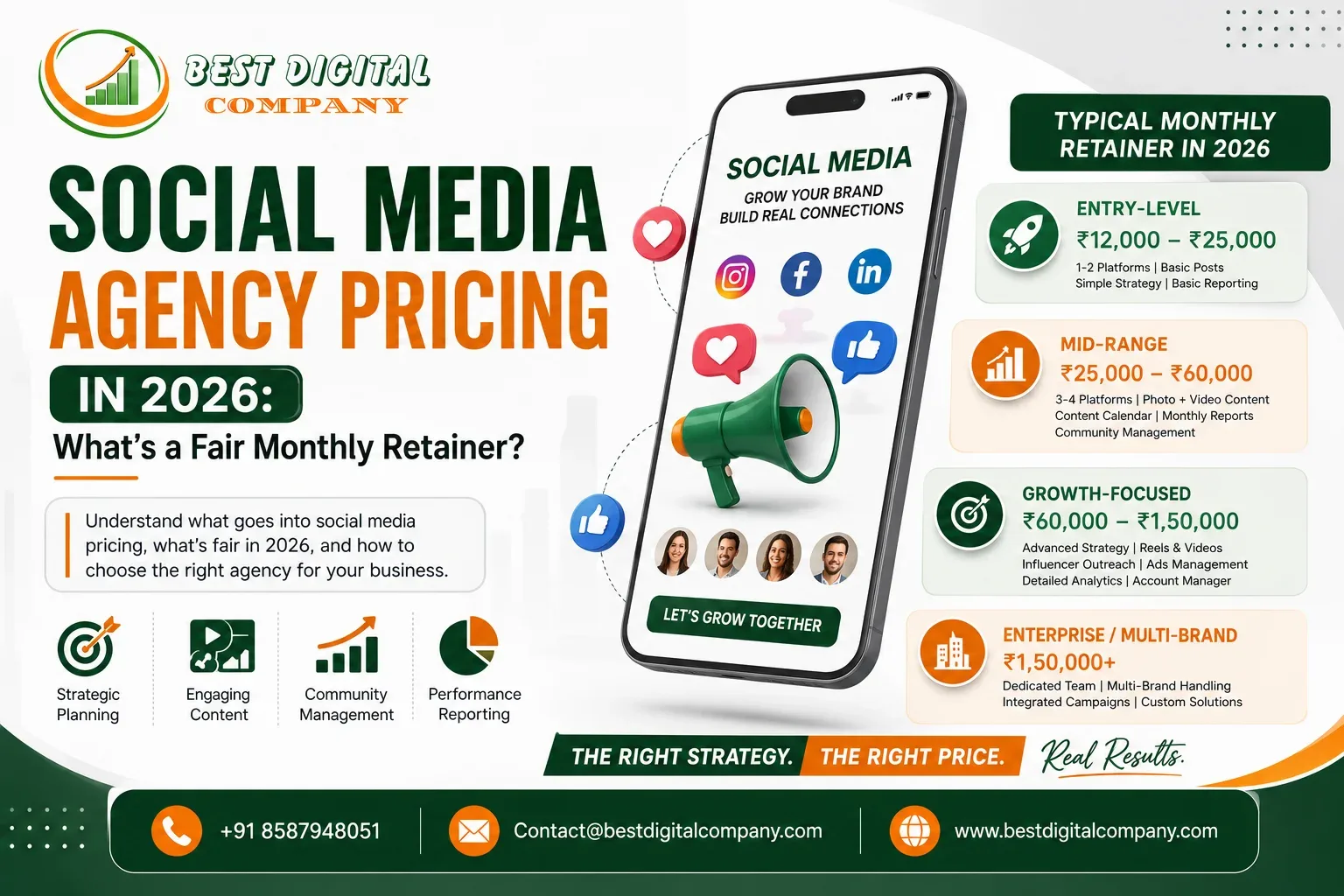
With those variables in mind, here is a realistic breakdown of what businesses in India are commonly paying for ongoing social media management this year. These figures assume organic management (ad spend is separate and billed on top).
Entry-level management (₹12,000–₹25,000/month): This tier usually covers one or two platforms, a handful of static posts and stories each week, basic captions, and minimal strategy work. It suits very small businesses or solo founders who mainly need consistency rather than a full growth plan. Reporting at this level is often just a simple monthly summary.
Mid-range management (₹25,000–₹60,000/month): This is where most small and mid-sized businesses land. It typically includes three to four platforms, a mix of static and video content, a documented content calendar, community management (responding to comments and messages), and monthly performance reporting with some strategic input.
Growth-focused management (₹60,000–₹1,50,000/month): At this level, agencies usually provide dedicated account managers, in-house content creation (photography, videography, editing), influencer outreach, competitor analysis, and closer alignment with sales or lead-generation goals. This tier makes sense for businesses that treat social media as a real revenue channel, not just a brand presence.
Enterprise or multi-brand management (₹1,50,000+/month): Larger companies managing multiple brands, locations, or markets often need a bigger team behind the account, more frequent reporting cycles, and integration with broader marketing campaigns. Pricing here is usually customized rather than packaged.
These numbers reflect the general market in 2026, but the exact figure for your business should come down to the scope of work, not a flat industry number someone quoted you once. That’s why we structure our own SMO packages around scope tiers rather than a single fixed price, so a business only pays for the platforms, content volume, and strategy depth it actually needs.
What Should Be Included in a Fair Retainer
A retainer that looks cheap on paper can turn out expensive if half the work you assumed was included actually costs extra. Before agreeing to a monthly fee, it’s worth confirming exactly what’s covered.
Content Planning and Calendar
A fair retainer should include an actual content calendar, not just a promise to “post regularly.” You should know roughly what will go up, when, and why, tied to some kind of theme or business goal for the month.
Content Creation
Clarify whether the agency is designing original graphics and shooting original video, or repurposing templates and stock content. Original content generally justifies a higher price point because it takes more time and reflects your brand more accurately.
Community Management
Responding to comments, direct messages, and reviews is often left out of cheaper packages, yet it’s one of the most important parts of building trust with an audience. If this isn’t included, ask what it would cost as an add-on.
Performance Reporting
You should receive a monthly report that goes beyond vanity metrics like follower count. Reach, engagement rate, click-throughs, and (where relevant) leads or conversions attributed to social media give a clearer picture of whether the spend is working.
Strategy Reviews
A good social media agency doesn’t run the same plan every month regardless of results. Ask how often the strategy gets reviewed and adjusted, and whether that’s included in the retainer or billed separately.
If a proposal is vague on any of these five points, that’s usually a sign the price is lower because the scope is thinner, not because you’re getting a discount.
Red Flags: When a Quote Is Too Low or Too High
Signs a Quote Is Unrealistically Low
If a retainer promises daily posting across five platforms, professional video editing, paid ad management, and detailed reporting for under ₹10,000 a month, be cautious. At that price, something has to give, usually quality, consistency, or the amount of actual human time going into your account. Some agencies subcontract this work overseas at very low rates or use heavily templated content that isn’t tailored to your brand.
Signs a Quote Is Overpriced
On the other end, a high price doesn’t automatically mean better service. If an agency can’t clearly explain what’s included in a ₹2,00,000/month retainer, or the answer is vague industry jargon rather than specific deliverables, ask for a breakdown. Paying more only makes sense if you can see where the extra money goes, whether that’s a larger creative team, better reporting, or more platforms covered.
The fairest way to evaluate any quote is to ask the agency to walk you through exactly what a typical month looks like: how many posts, how many hours of video editing, how many strategy touchpoints, and what reporting looks like. A transparent answer is a good sign regardless of the number attached to it.
Agency Retainer vs In-House Team: A Cost Comparison Worth Making
Before committing to any retainer, it is worth comparing it against the cost of hiring in-house. A full-time social media manager in India typically costs anywhere from ₹25,000 to ₹60,000 a month in salary alone, before accounting for design tools, video editing software, stock photography subscriptions, or a second hire for content creation if the manager isn’t also a designer.
An agency retainer often works out cheaper once you factor in these hidden costs, because you’re getting access to a whole team, strategist, designer, video editor, copywriter, without paying full-time salaries for each role. That said, an in-house hire offers more day-to-day control and faster turnaround for time-sensitive requests. We have laid out this comparison in more depth in our earlier post on social media marketing company vs in-house team, which is worth a read if you’re weighing both options seriously.
How to Tell If You are Actually Getting Value, Not Just a Low Price
Price alone does not tell you whether a retainer is fair. Value comes from the outcome relative to the spend. Here are a few practical ways to judge that:
Ask for past client results, not just a portfolio of pretty posts. Growth in followers means little if it doesn’t translate into inquiries, bookings, or sales. A results-oriented agency should be able to show engagement or conversion trends from real client accounts (even anonymized).
Check how they define success. If an agency’s only metric is “more followers,” that’s a warning sign. Followers are one data point among many, and honestly, one of the least useful ones for judging business impact. We wrote more about why chasing likes alone doesn’t move the needle in our post on picking a social media agency that actually grows sales, which digs into this exact problem.
Compare the retainer to your monthly marketing budget as a whole. A retainer that eats 60% of your total marketing spend probably needs to justify itself with strong, trackable results, not just consistent posting.
Ask what happens if results plateau. A fair agency partnership includes a process for adjusting strategy when something isn’t working, rather than continuing to bill the same amount for the same underperforming plan month after month.
Why Working With a Full-Service Digital Partner Often Makes More Sense
Social media rarely works in isolation. A well-run account can drive traffic to your website, but if that website is slow or poorly designed, the visitors bounce before converting. Similarly, social proof and paid promotion often perform best when they’re coordinated rather than managed by separate, disconnected vendors.
This is where working with an agency that also handles search engine optimization, pay per click, and website development alongside social media can be genuinely more cost-effective than juggling separate vendors for each channel. When one team understands your whole marketing picture, from the ad campaign driving traffic to the landing page it lands on, the strategy tends to be more coherent, and reporting is easier to make sense of because it is not scattered across five different dashboards.
If you are also currently comparing paid advertising vendors, our breakdown of what a performance marketing agency actually does each month covers a lot of the same “what am I actually paying for” questions from the paid media side, and it’s a useful companion read to this one.
A Simple Framework for Deciding What to Pay
If you’re still unsure where your business fits, here’s a straightforward way to think it through:
- Start with your goal. Are you building brand awareness, generating leads, or driving direct sales through social channels? The goal shapes how much strategy and paid promotion support you actually need.
- List your must-have platforms. Don’t pay for five platforms if your audience really only lives on two of them.
- Decide how much original content you need. If your brand depends heavily on visuals (say, a restaurant, a fashion label, or a design studio), budget more for photography and video.
- Ask three agencies for a detailed scope-based quote, not just a number. Compare what’s actually included, not just the total.
- Reassess after 90 days. A fair retainer should show measurable movement in the first quarter, even if full results take longer. If there’s nothing to point to after three months, that’s worth a conversation with your agency.
Following this kind of process protects you from both overpaying for a bloated retainer you don’t need and underpaying for a service that’s too thin to move the needle.
Final Thoughts
There’s no single “correct” number for social media agency pricing in 2026, because the fair price depends entirely on what your business actually needs and what the agency is genuinely delivering for that fee. A retainer between ₹25,000 and ₹60,000 a month covers most small and mid-sized businesses looking for consistent, strategic management, while smaller operations can start lower and larger, growth-focused brands will reasonably pay more.
The real test of fairness isn’t the number on the invoice, it is whether you can clearly see what that number buys you: how many posts, how much original content, what kind of reporting, and how the strategy adapts over time. If an agency can answer those questions clearly and back them up with real client outcomes, the price, whatever it is, is easier to trust.
If you’d like a scope-based quote for your own business rather than a generic industry number, our team at Best Digital Company is happy to walk you through exactly what a monthly retainer would include for your goals. You can explore our social media marketing services or get in touch directly to talk through your specific requirements.
Frequently Asked Questions
What is a fair monthly retainer for a social media agency in 2026?
For most small and mid-sized businesses, a fair retainer typically falls between ₹25,000 and ₹60,000 per month for organic management across three to four platforms, including content creation, community management, and monthly reporting. Businesses with heavier content needs or paid promotion built into the scope should expect to pay more.
Why do social media agency quotes vary so much between providers?
Pricing depends on the number of platforms managed, how much original content is produced, whether paid advertising is included, the depth of strategy and reporting provided, and the size and experience level of the team behind the account. Two quotes that look very different can both be fair once you compare the actual scope of work.
Does a higher retainer always mean better results?
Not necessarily. A higher price should come with a clear explanation of what it covers, more original content, a larger team, deeper reporting, or additional strategic support. If an agency can’t explain where the extra cost goes, price alone isn’t a reliable indicator of quality.
Is it cheaper to hire an in-house social media manager instead of an agency?
It depends on your needs. A full-time in-house hire in India often costs ₹25,000 to ₹60,000 a month in salary alone, without covering design tools or additional roles like video editing. An agency retainer frequently works out more cost-effective because it includes access to a full team rather than one individual.
What should be included in a social media retainer besides posting content?
A fair retainer should include a documented content calendar, original content creation, community management (replying to comments and messages), monthly performance reporting, and periodic strategy reviews. If a quote only covers posting with no reporting or strategy input, it’s likely priced lower because the scope is limited.
How long does it take to see results from a social media agency?
Most businesses start seeing measurable movement in engagement and reach within the first 60 to 90 days, though lead generation and sales impact can take longer depending on the industry and how competitive the space is. A fair agency partnership should be able to show some data-backed progress by the end of the first quarter.