How to Choose the Best Website Development Agency and the Best SEO Company in 2026

How to Choose the Best Website Development Agency and the Best SEO Company in 2026

Every week, someone reaches out to us with the same underlying question, just phrased differently. Sometimes it’s “who’s the best website development agency near me,” and sometimes it’s “we need the best SEO company because our traffic has flatlined.” What’s interesting is that these two questions almost always end up connected. A site that’s built well but never gets found is a wasted investment. A site that ranks well but confuses or loses visitors the moment they land on it is just as wasteful.

We’ve worked on both sides of this problem for years, building sites from scratch and rescuing rankings on sites someone else built badly. This piece is meant to help you evaluate both types of partners honestly, without the usual sales pitch language that makes every agency sound identical on paper.

What a Website Development Agency Should Actually Deliver

A lot of businesses assume website development is just about how a site looks. It isn’t. Design is the visible 20%. The other 80% is structure, speed, mobile behavior, and how easily search engines can read the site once it’s live.

When we talk to clients about web development, we are not just talking about layouts and color palettes. We’re talking about clean code, fast load times, proper heading structure, and a site architecture that doesn’t fight against SEO later. This matters more than people expect. We’ve reviewed dozens of sites where the design team and the SEO team never once spoke to each other, and it shows in how long the site takes to rank once it’s finally live. If this sounds familiar, our guide on the website launch checklist before going live walks through exactly what typically gets missed.

A genuinely capable development team will ask you questions before they touch a single line of code .Questions about your customers, your competitors, and your growth goals for the next two years, not just the next two months. If an agency jumps straight to showing you templates, that’s usually a sign they’re building a website, not a business asset.

Signs You’re Looking at a Genuine SEO Company (Not Just a Reseller)

There are a lot of businesses calling themselves an SEO company right now, and the range in quality is enormous. Some run legitimate strategy built on content, technical fixes, and consistent link building. Others buy cheap backlink packages in bulk and hope nobody checks the results six months later.

A few things separate the two. A real SEO partner will actually audit your site before promising anything. They’ll look at your existing content, your technical setup, and your competitors before quoting you a number or a timeline. If you’re curious what a proper audit uncovers, our breakdown on how to rank a new website on Google in 90 days shows the kind of groundwork that has to happen before rankings move at all.

Another sign worth watching for is whether they talk about topical depth or just keywords. Search engines in 2026 reward sites that demonstrate real subject-matter coverage, not single pages stuffed with a phrase repeated a dozen times. We wrote in detail about this shift in our piece on building topical authority, and it’s one of the biggest reasons thin, one-off content strategies are losing ground.

If you run an online store specifically, the priorities shift slightly again product pages, category structure, and reviews all carry more weight than they do for a typical service business. Our SEO guide for e-commerce stores covers that in more depth if that’s closer to your situation.

Why the “Best” Agency Isn’t Always the One with the Biggest Portfolio

Here’s something we’ve noticed after years of client conversations: business owners often equate “best” with “biggest name” or “most case studies on the homepage.” In reality, fit matters more than size. A large agency juggling hundreds of accounts may not give a mid-sized business the attention it needs. A smaller, specialized team focused on both development and search often ends up being more responsive and more invested in the outcome.

This is also why the decision between fixing your website first or investing in SEO first comes up so often. We addressed that exact dilemma in website redesign versus SEO optimization: which should you do first, because the honest answer depends on your specific starting point, not a one-size-fits-all rule.

The Cost of Treating Development and SEO as Separate Projects

We’ve seen this pattern too many times to ignore it: a business hires one team to build the site and, months later, hires a completely different team to fix the rankings. The second team then spends the first few weeks undoing decisions the first team never should have made broken URL structures, missing metadata, slow-loading images, duplicate content across pages.

When development and search strategy are planned together from day one, you skip that entire rebuilding phase. Your pay-per-clickcampaigns land on pages that are actually built to convert, your social media marketing traffic doesn’t bounce off a slow homepage, and your organic content has a technical foundation that supports it instead of working against it. Businesses that get their traffic without users ever clicking through in the traditional sense also need to think about this early. Our piece on zero-click marketing explains how visibility now extends well beyond your website itself.

What This Looks Like in Practice

If your website currently generates visitors but very few actual inquiries, the problem is rarely traffic. It’s usually the experience once someone arrives. We’ve covered this at length in why business websites fail to generate leads, and the fixes are often smaller than business owners expect a clearer call to action, faster load speed, or a landing page actually designed around one specific goal rather than trying to say everything at once. Our guide on building SEO landing pages that convert goes into the specific structure that tends to work.

And if you’re running a regional business, location matters more in this evaluation than most owners realize. What works for a business competing nationally looks different from what works for a business trying to dominate a specific city or state something we saw play out clearly while working with businesses across Punjab building their first real digital presence.

Frequently Asked Questions

How do I know if an agency is genuinely good at both website development and SEO, or just good at one?

Ask to see examples of sites they’ve built that are also ranking well organically, not just sites that look good in a portfolio. A team that’s strong in only one area will usually have plenty of design work to show but very little proof of sustained rankings, or the reverse strong rankings on outdated, clunky websites.

Is it better to hire one agency for both development and SEO, or two separate specialists?

 In most cases, one team handling both works out better because it removes the handoff gap where technical decisions made during development end up hurting SEO later. If you do go with separate teams, make sure they’re willing to actually communicate with each other during the build.

How long does it typically take to see results from SEO after a new website launch?

Most businesses start seeing measurable movement somewhere between two and four months, with stronger results building over six to twelve months. Anyone promising rankings within days is either overselling or using tactics that won’t hold up long term.

What’s a reasonable budget range for combined website development and SEO services?

 This varies widely based on the size of the site, the competitiveness of your industry, and your city or region. A basic informational site with light SEO will cost far less than an e-commerce platform competing in a crowded market. It’s worth getting a scoped quote based on your actual goals rather than comparing generic package prices across agencies.

Do I need a new website if my current one already ranks reasonably well?

Not necessarily. If your site ranks decently but converts poorly, a redesign focused on user experience and conversion paths might matter more than a full rebuild. If the site has deep technical issues holding back rankings, a rebuild alongside an SEO strategy usually makes more sense than patching an outdated foundation.

How do I evaluate an SEO company’s past results without just trusting their word for it?

 Ask for specific, verifiable examples a website URL, the approximate timeline, and what changed. Legitimate agencies are usually comfortable sharing this level of detail. Vague claims about “massive growth” without any specifics are worth treating with caution.


Choosing between agencies is rarely about finding the flashiest portfolio. It’s about finding a team that treats your website and your search visibility as one connected system, not two separate line items on an invoice. If you’d like a second opinion on where your current site and search strategy stand, get in touch with our team and we’ll walk you through what we’d actually prioritize first.
Internal Linking Strategy in 2026: Improve Rankings & SEO

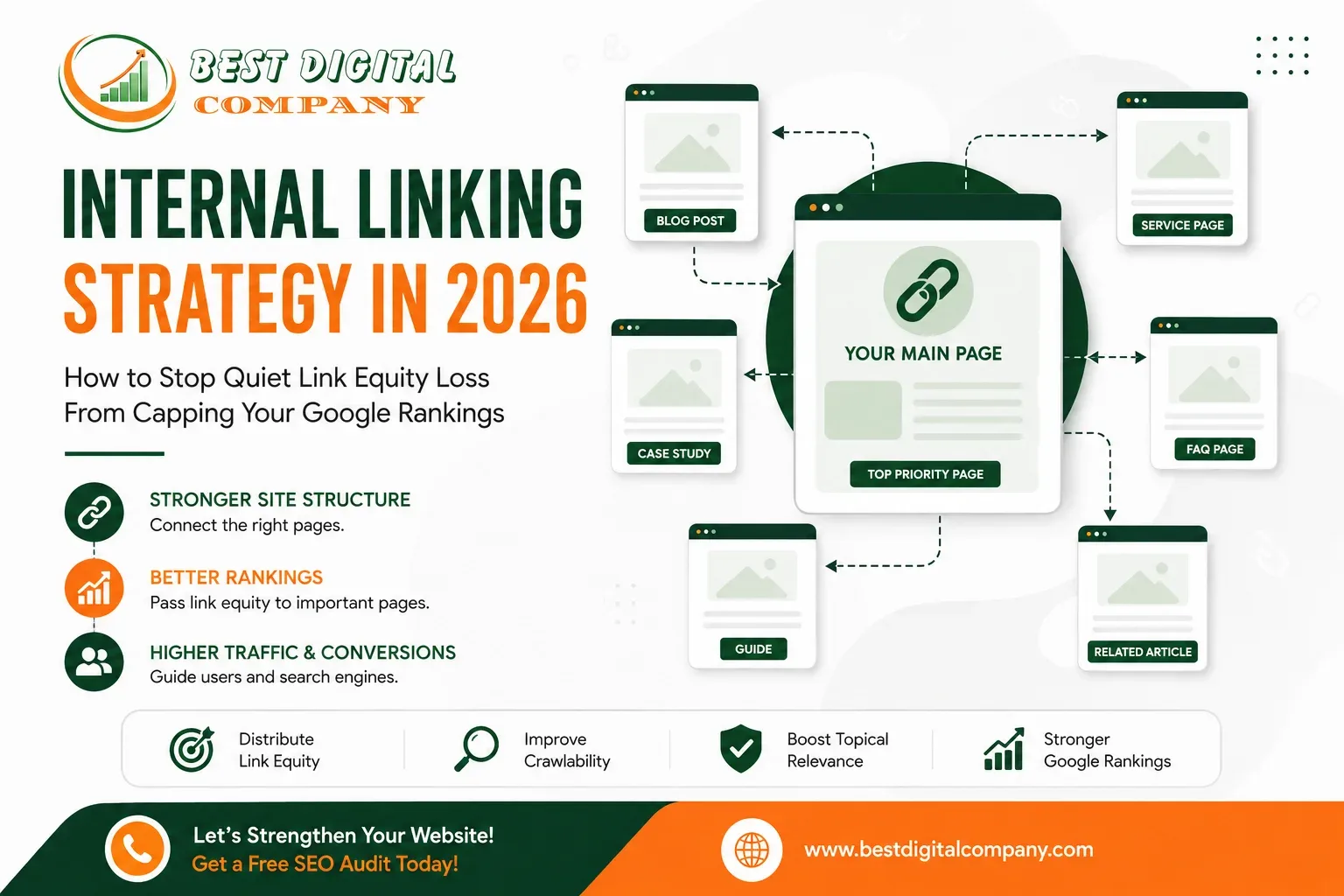
Internal Linking Strategy in 2026: How to Stop Quiet Link Equity Loss From Capping Your Google Rankings

Not every page deserves equal water pressure. Your homepage, primary service pages, and best-converting content should sit at the top of that flow. The problem is that most sites do the opposite by default: new blog posts link to the newest blog posts, while the commercial pages that actually drive revenue get steadily cut off from new internal signals. Over time, search engines start treating the freshest content as the most important content simply because it’s the only thing still receiving internal support.

Internal Link Decay: A Three-Year Snapshot

This is the slow-moving problem most audits uncover, and it rarely trips any alarm in standard SEO tools.

Year one –

Ten blog posts go live, each linking to the core service page. The structure is clean and easy to follow.

Year two –

Fifty more posts publish. Writers link to whatever was published most recently, since that’s top of mind. Nobody circles back to update the original ten. The service page’s share of internal links starts shrinking relative to the rest of the site.

Year three –

Another hundred posts arrive. The earliest content is now several pages deep in the blog archive. Authority that should be concentrating on commercial pages is instead scattered across dozens of low-priority articles.

Nothing breaks. No crawl error appears. The site simply becomes structurally weaker, one publishing cycle at a time.

Nine Reasons Internal Link Value Erodes

Publishing without revisiting older content.

Most editorial calendars are built entirely around new output, with no recurring step for strengthening what’s already live.

Site redesigns.

Navigation, footers, and category pages often get rebuilt for aesthetics or usability, and the SEO impact on internal link flow is an afterthought rather than a planning input.

Unclustered content.

Without topic clusters, related articles compete against each other for the same keywords instead of reinforcing one clear cornerstone page.

Internal links that still point at redirected URLs.

Redirects technically work, but every hop adds friction. Pointing links directly at the final URL is cleaner for both crawlers and users.

Orphan pages.

A page with zero internal links pointing to it is nearly invisible to both visitors and crawlers, regardless of how good the content is.

Pagination soaking up authority.

On large blogs or ecommerce catalogs, deep paginated archives can absorb more internal link equity than the priority pages they’re meant to support.

Generic anchor text.

“Click here” and “learn more” tell search engines almost nothing about the destination page; descriptive, specific anchor text does real work.

An overgrown footprint of low-value URLs.

Tag archives, author pages, and duplicate filtered URLs quietly consume crawl budget and link equity without returning much ranking value.

Treating publication as the finish line.

Content that’s never revisited gradually falls out of the internal link graph, even if the information in it is still accurate.

How This Shows Up in Your Rankings

Weak internal linking rarely produces a dramatic ranking drop that’s part of why it goes unnoticed. Instead, you tend to see a plateau: important pages stop gaining ground, new content takes longer to index, organic traffic becomes inconsistent without an obvious cause, and conversion pages see fewer visits even as overall traffic looks stable.

The instinct in this situation is usually to buy more backlinks. In our experience, restructuring internal links first is the faster, cheaper fix you’re reallocating authority you already have rather than trying to acquire more from scratch.

Signs Worth Checking on Your Own Site

A few patterns we look for during audits: older posts that haven’t been touched in over a year, service or product pages with very few internal links pointing to them, redirect chains scattered through the site, valuable pages buried more than three clicks from the homepage, and new articles that never reference your cornerstone content. Any one of these is common; several together usually points to a structural problem worth fixing.

Frequently Asked Questions

What is an internal linking strategy?

It’s the deliberate process of connecting related pages on your site with relevant hyperlinks, so both visitors and search engines can navigate your content efficiently and understand which pages matter most.

Why do internal links matter for SEO?

They help search engines discover new pages, understand how topics relate, and decide which pages deserve the most visibility while also improving on-site navigation and engagement for real visitors.

What exactly is internal link decay?

It’s the gradual loss of internal link support to important pages as a site grows and publishes new content without maintaining older pages, which weakens authority distribution over time.

How often should internal links be audited?

Every three to six months is a reasonable cadence for most sites frequent enough to catch orphan pages and redirect chains before they accumulate.

How many internal links should one blog post include?

There’s no fixed quota. Aim for links that genuinely help the reader, which in practice tends to land somewhere between five and fifteen for a thorough article.

Do internal links directly improve rankings?

Not on their own but they materially improve how search engines crawl, understand, and prioritize your content, which supports rankings when paired with solid content and technical SEO.

What’s an orphan page, and does it need fixing?

It’s a page with no internal links pointing to it, making it hard for crawlers and users to find regardless of content quality. Linking it from relevant pages is usually a quick, high-value fix.

How does Best Digital Company approach this?

We run structural audits to map orphan pages, redirect chains, and weak linking patterns, then build a prioritized plan to redirect internal authority toward the pages that actually drive business results as part of our broader SEO Services in Delhi and beyond.


This article reflects audit methodology used at Best Digital Company as of 2026. For a site-specific internal linking audit, reach out to our team.

By Naveen Kumar,

Senior SEO Strategist at Best Digital Company

8+ years auditing enterprise and small-business websites across India, the UK, and the US.

Why Every Business Needs a Website in 2026?

Why Every Business Needs a Website in 2026?

Let me ask you something honest: if someone hears about your business today from a friend, a social media post, or even just a passing ad , what’s the first thing they’re going to do? They’re going to Google you. And if they land on nothing, or worse, a half-abandoned Facebook page from three years ago, that’s a lead you’ve already lost.

This isn’t a scare tactic. It’s just the reality of doing business in 2026. A website isn’t a luxury or a “nice to have” anymore. It is the foundation of every serious business, regardless of size or industry. Let’s break down exactly why and why now matters more than ever.


Why Is Your Website the First Impression Your Business Makes?

Think about the last time you looked up a restaurant, a dentist, or a local service. If their website looked outdated or didn’t load properly on your phone, did you stay? Probably not.

In 2026, consumers have higher expectations than ever. They expect a clean, fast, mobile-friendly experience within the first few seconds. A professionally designed website signals that your business is real, trustworthy, and worth their time. Without it, you’re asking potential customers to take a leap of faith and most won’t.

“Your website works for you 24 hours a day, 7 days a week, 365 days a year without taking a lunch break or a day off.”


What Happens If Your Business Is Not Searchable Online?

Here’s the brutal truth: your competitors who have websites are showing up on Google. You’re not. Every day without a website is another day you’re handing over potential customers to businesses that made the investment you haven’t yet.

Search engine optimisation (SEO) is what helps your website climb those rankings and get found by people actively searching for what you offer. A well-built website paired with smart SEO can completely transform how many people discover your business organically without spending a single rupee on ads.

If you’re a business in Maharashtra, our SEO Services in Mumbai are designed to put you in front of customers who are already searching for what you do.


Is Social Media Alone Really Enough for Your Business?

Many small business owners think, “I have Instagram and Facebook that’s enough.” And while social media is absolutely a powerful marketing tool, it should never be your only digital home.

Here’s the problem with relying solely on social platforms:

  • Algorithm changes can cut your reach overnight, without any warning.
  • You don’t own your audience the platform does.
  • Accounts can be suspended, hacked, or deleted at any time.
  • You can’t fully control the design, messaging, or user experience.
  • Many professional buyers and B2B clients won’t take you seriously without a website.

Your website, on the other hand, is yours. It’s the one digital property you own completely. It’s where you set the rules, tell your full story, and convert visitors into paying customers on your own terms.


Can Your Website Generate Leads Even While You Sleep?

This is one of the most underappreciated benefits of having a proper business website. With the right structure, a clear call to action, a contact form, a lead magnet, or even a WhatsApp button your website can be generating enquiries around the clock.

Imagine waking up to three new leads in your inbox that came in overnight. That’s what an optimised website does. It’s not just a digital brochure; it’s a sales machine that works even when you’ve clocked out for the day.

Pro Tip: Adding a simple contact form, a click-to-call button, and a clear “What We Do” section to your homepage can increase enquiries significantly. Make it easy for people to reach you.


How Can Local Businesses Compete with Big Brands Online?

Here’s something that surprises a lot of business owners: with the right website and local SEO strategy, a small business in Punjab or Haryana can outrank a national chain for searches in their own area. That’s the real power of local digital visibility.

When someone in Ludhiana searches “best interior designer near me” or someone in Gurugram types “affordable CA firm in Haryana,” Google is going to show results based on local relevance and website authority not just company size or marketing budget.

That’s why location-specific SEO is so important. Our SEO Services in Punjab help local businesses rank for the exact terms their customers are searching and our SEO Services in Haryana do the same for businesses across cities like Gurugram, Faridabad, Ambala, and beyond.


How Does a Website Help You Understand Your Customers Better?

One massive advantage of a website is access to real data. Tools like Google Analytics tell you exactly who is visiting your site ,where they’re from, what pages they spend the most time on, what they searched before finding you, and where they drop off.

This information is gold. It helps you understand what your audience actually wants, refine your marketing strategy, and make smarter business decisions every month. Social media gives you some of this, but nothing as detailed or actionable as your own website analytics.


Is Building a Business Website More Affordable Than You Think?

A common reason businesses delay getting a website is cost. But in 2026, getting a clean, professional website built and optimised for search doesn’t require a massive budget. And when you consider what a single new customer is worth to your business, the return on investment becomes very obvious, very quickly.

Think of it this way: if your website brings in even two or three new clients a month that you wouldn’t have had otherwise, it has already paid for itself several times over. And unlike a newspaper ad or a billboard, your website keeps working for you month after month, year after year.


How Does a Website Build Long-Term Brand Trust?

People do business with people they trust. And trust, in the digital age, is largely built online. A well-maintained website with genuine testimonials, case studies, a clear “About Us” section, and useful blog content tells a visitor that you’re the real deal, experienced, professional, and worth working with.

Over time, your website becomes an asset that grows in authority and credibility. The longer it’s live and the more consistently it’s updated, the stronger your position becomes both in the eyes of search engines and in the minds of your potential customers.

“In 2026, not having a website isn’t being ‘traditional.’ It’s being invisible and invisibility is the fastest way to fall behind.”


What Is the Bottom Line for Businesses in 2026?

Whether you run a small shop in Delhi, a service business in Punjab, a startup in Haryana, or a growing enterprise in Mumbai, a website is not optional in 2026. It is the single most important investment you can make in your digital future.

The businesses growing fastest right now aren’t necessarily the biggest or the oldest. They’re the ones that showed up online, built a credible presence, and made it easy for customers to find and trust them. That can be you and it starts with a website.

At Best Digital Company, we help businesses across India build that foundation from website design and development to full-scale SEO and digital marketing. If you’re ready to stop being invisible online, we’d love to talk.

📞 +91 8587948051 ✉️ Contact@bestdigitalcompany.com 🌐 www.bestdigitalcompany.com


Frequently Asked Questions

Why does every business need a website in 2026?

In 2026, consumers search online before making almost any purchase decision. A website gives your business credibility, 24/7 visibility, and a direct channel to reach customers without depending on any third-party platform that can change its rules at any time.


Can a small business survive without a website in 2026?
It’s extremely difficult. Without a website, you’re invisible to the majority of potential customers who search online. Even a simple, well-optimised website can dramatically increase your enquiries and sales within just a few months of going live.


How does SEO help a business website in 2026?
SEO helps your website rank higher on Google, making it easier for customers to find you organically without paying for ads every single day. It drives consistent, long-term traffic and builds your authority over time. Whether you’re in Mumbai, Punjab, or Haryana, localised SEO makes all the difference in getting found by nearby customers.


Is social media enough instead of a website?

No. Social media platforms can change their algorithms or suspend accounts without warning. Your website is the only digital property you truly own and control. It’s also far more powerful for long-term lead generation, brand authority, and showing up on Google searches.


How much does a business website cost in India in 2026?

The cost varies depending on your requirements, but a professional, functional website is far more affordable than most business owners expect and the return on investment is real and measurable.

Reach out to us at Contact@bestdigitalcompany.com for a free consultation and quote tailored to your business.


How long does it take to see results from a business website?

A well-built website with paid advertising can start generating traffic within days. Organic SEO typically shows strong, consistent results within 3 to 6 months. The key is having the right strategy from the very beginning which is where an experienced digital marketing partner like Best Digital Company makes a genuine difference.


What makes a good business website in 2026?

A good business website in 2026 needs to be mobile-friendly, fast-loading, easy to navigate, and optimised for search engines. It should clearly communicate what you do, who you serve, and how people can contact you. Adding a blog, testimonials, and a strong call to action takes it even further.


Does my business need a website if I already rank on Google Maps?

Google Maps visibility is great, but it’s not a replacement for a website. A website allows you to rank for a much wider range of keywords, share detailed information, showcase your work, collect leads, and build long-term authority ,all things a Maps listing simply cannot do on its own.