
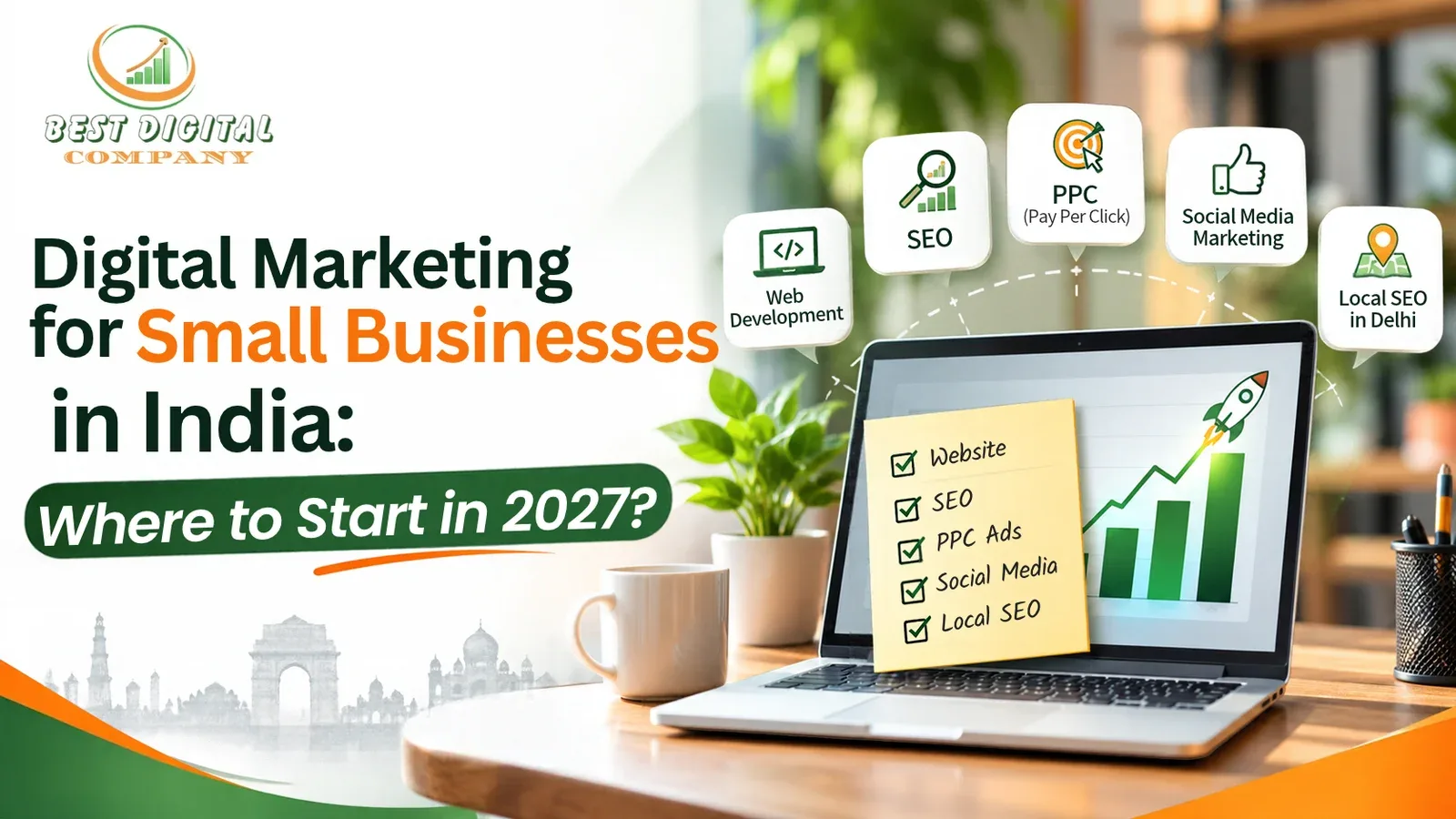
Most small business owners we speak to don’t lack ambition. They lack a starting point. One cousin says Instagram is the answer. A vendor says Google Ads. A friend says “just get a website made.” Everyone sounds confident, and nobody explains the order in which these things should happen.
That order matters more than any single tactic. A shop owner who runs ads to a slow, confusing website pays for clicks that never turn into calls. A clinic that posts daily on social media but has no Google listing loses patients who were already searching for it.
This guide is for owners and managers who run a business with a modest budget, a small team and little spare time. It covers where to begin, what to postpone and how to tell whether your money is working. The advice comes from our day-to-day work with Indian businesses at Best Digital Company, and it does not assume you have an in-house marketing team.
What Digital Marketing for Small Business Really Means in 2027
Digital marketing for small business is the work of being found, trusted and contacted by people who are already looking for what you sell. It is not about going viral or having the most followers.
In practice, it comes down to three jobs:
- Being easy to find. When someone searches for your service on Google or Maps, or asks an AI assistant, you should appear.
- Looking credible once found. Your website, reviews and social profiles should agree with each other and look like a real, reliable business.
- Making it simple to act. A visible phone number, a WhatsApp button, a short enquiry form or a clear address.
Everything else, whether SEO, ads, social posts or email, supports one of these three jobs. When you feel overwhelmed, ask which job a tactic serves. If it serves none of them, skip it for now.
The Indian context adds a few realities. Most of your customers search on a phone, often on a mobile network. Many prefer WhatsApp to email, and many search in Hindi, English or a mix of both. Trust is also built locally: a neighbour’s recommendation or a review from someone in your area often counts for more than a polished brand film.
Four Questions to Answer Before You Spend a Rupee
Skipping this step is the most expensive mistake we see. Spend an hour on these questions, ideally with a notebook.
Who exactly buys from you? “Everyone in Delhi” is not an answer. A coaching centre in Janakpuri, a wedding caterer in Gurugram and an industrial packaging supplier in Ludhiana all reach very different people through very different channels.
What do those people type or ask when they need you? Write down ten real phrases a customer would use. “Dentist near me,” “AC repair in Noida,” “CA for GST filing” and “birthday cake delivery Dwarka” are all examples. These phrases become the foundation of your content, your Google listing and your ads.
What counts as a win? Decide whether you want calls, walk-ins, form fills, WhatsApp chats or online orders. Pick one primary goal. If you can’t say what a good month looks like, no agency or tool can prove it delivered one.
What can you actually afford, and for how long? Marketing that works needs a few months of patience, so don’t commit money you will need to pull back in week six.
Once these four answers are written down, the rest of the plan becomes much simpler.
Step One: Get Your Website and Web Development Basics Right
A website does not have to be elaborate, but it has to work. Before you pay for traffic from anywhere, make sure the place you send people is ready.
For a small business, a good site has:
- A fast load time on a mid-range phone
- A clear statement of what you do and where, visible without scrolling
- Real photos of your team, shop or work rather than generic stock images
- A phone number and WhatsApp link that can be tapped
- Separate pages for each main service, instead of one long page covering everything
- Your address, hours and a map
- Genuine testimonials, ideally with names and the type of work done
If your current site is slow, outdated or hard to use on a phone, our web development team can rebuild it so that it loads quickly, reads clearly and turns visitors into enquiries. If you are comparing options, the web development packages page shows what is included at each level.
One note from experience: do not rebuild for the sake of rebuilding. If your site is a few years old, loads reasonably fast and has decent content, fixing specific problems is often better than starting over.
Step Two: Claim and Complete Your Google Business Profile Optimization
If we could give a small local business only one piece of advice, this would be it. Your Google Business Profile is free, and it is often the first thing a nearby customer sees.
A complete profile includes the correct business name, a precise category, service areas, opening hours, a phone number, products or services, photos you update regularly and answers to questions customers commonly ask. Many owners fill in half of it and then wonder why a competitor appears above them.
We cover every field in our guide to Google Business Profile optimization, including the small details that quietly affect visibility. If you do only one thing from this article this week, work through that checklist.
A few habits make a real difference:
- Choose a primary category that matches your main service, not the broadest one available.
- Add photos from your actual premises and work, and refresh them each month.
- Use the posts and updates features to share offers or news.
- Keep your details identical everywhere online. A different phone number on a directory listing confuses both people and Google.
Google Business Profile vs Website: You Need Both, but Not Equally at First
Owners often ask which one to invest in first. The honest answer is that it depends on how people find you, and we have written a longer comparison in Google Business Profile vs website.
A rough rule of thumb: if customers need to visit you or have you visit them, such as a clinic, salon, repair service or restaurant, start with the profile. If you sell across the country, take orders online or serve business clients who research carefully, start with the website. In either case, the two should support each other. The profile earns the click, and the website closes the deal.
How to Rank Higher on Google Maps in 2027 Without Gimmicks
Map results are where many local decisions happen. Someone searches “best physiotherapist near me,” sees three businesses with ratings and photos, and calls one of them. The rest never get a look.
Google has said that local results depend mainly on relevance, distance and prominence. You can’t change where a customer is standing, but you can influence the other two. Be specific about what you do, keep your listing complete and build a visible reputation through reviews and mentions.
Our walkthrough on how to rank higher on Google Maps in 2027 goes into the practical steps. If your listing is missing altogether, start with why your business is not showing on Google Maps, because verification problems, duplicate listings and category mistakes are fixable once you know what to look for.
Reviews decide close contests
When two businesses are equally relevant and equally close, reviews often tip the balance. Ask every happy customer, soon after the work is done, with a direct link to your review page. Reply to every review, including the critical ones, in a calm and specific way. Never pay for reviews or offer rewards in exchange for positive ratings, because that violates Google’s rules and can put your whole profile at risk. We explain the safe approach in how to get more Google reviews.
Search Engine Optimization: The Slow Engine That Compounds
Search Engine Optimization is the long game of digital marketing for small business. Unlike ads, it does not switch off when you stop paying. But it does take time, usually several months before the pattern becomes visible, and anyone promising first-page rankings in a few weeks is not being straight with you.
For a small business, effective Search Engine Optimization usually has four parts:
- Page-level relevance. Each service gets its own page, titled and written around the words customers use.
- Technical health. The site is fast, mobile-friendly, secure and free of broken pages.
- Helpful content. Pages and articles answer real questions in plain language, drawing on your own experience rather than generic text.
- Trust signals. Reviews, mentions on genuine local sites, clear contact information and an honest “About” page showing who is behind the business.
That last part connects to what Google calls experience, expertise, authoritativeness and trustworthiness. In simple terms, show that a real person with real experience runs this business. Put names and photos on your pages, share examples of work you have done and explain how you do things instead of just claiming you are the best.
Does SEO still work in 2027?
It does, although it looks different from a few years ago. We looked at this in detail in does SEO still work in 2027. The short version is that low-effort, copied or machine-churned content has little value now, while specific, experience-based pages that solve a real problem still earn attention.
SEO vs AEO vs GEO and AI Overviews: What a Small Business Should Do About Them
You may have heard these terms from an agency and wondered whether you need three separate strategies. For a small business, you don’t.
AEO and GEO describe optimising for answer engines and AI-generated summaries. If you want the full picture, we broke it down in SEO vs AEO vs GEO, and our post on AI Overviews optimization covers how businesses become visible in those summaries. If you want to know how the broader shift is changing things, read how AI search is changing SEO in 2027.
For a small business, the practical takeaway is this: AI tools and search engines both favour clear, accurate, well-organised information from sources they can trust. That means:
- Write pages that directly answer the questions customers ask.
- Keep your business details consistent across the web.
- Show real expertise with named authors, examples and honest detail.
- Earn mentions and reviews from real customers.
If you do these well, you are already doing most of what matters for all three. Don’t pay extra for a separate “AI strategy” until your basics are solid.
Local SEO in Delhi and Beyond: Winning Customers in Your Own Area
If you serve a specific city or region, location matters in everything you do. Our Local SEO in Delhi service exists because a bakery in Karol Bagh and a bakery in Lajpat Nagar compete on different streets, and their marketing should reflect that.
Local work means building pages and profiles around the areas you actually serve, collecting reviews from local customers and making sure your name, address and phone number match everywhere. If you are based in the capital and want broader support, our SEO service in Delhi covers it.
We also work with businesses in other regions, so if you operate elsewhere, these pages may be useful:
One caution: creating dozens of near-identical “service in [city]” pages to catch every area is a poor idea. Create a location page only when you genuinely serve that area and have something specific to say about it.
Pay Per Click: When Paid Ads Make Sense for a Small Business
Pay Per Click advertising gives you speed. You can appear in front of people searching for your service this week, not six months from now. That makes it valuable for new businesses, seasonal offers and services with high enquiry value.
But paid ads punish sloppiness quickly. Before running Google Ads, check that:
- Your landing page matches the ad and makes it easy to act
- You can track calls and form submissions
- You have a daily budget you can sustain for at least a month so the account can learn
- You exclude irrelevant searches, because wasted clicks add up fast
A sensible way to begin is a small, tightly focused campaign on your most profitable service and your core area. Watch cost per enquiry, not just clicks. Expand only when the numbers hold. If you’d like a clearer idea of what is typically included and what you might spend, see our PPC packages.
A fair warning: ads and SEO are not rivals. Ads give you quick feedback on which phrases bring real enquiries, and that knowledge can guide your longer-term SEO work.
Social Media Marketing: Choose One or Two Platforms and Do Them Properly
Social Media Marketing is where many small businesses burn out. They try to post everywhere, run out of ideas by week three and go silent.
A better approach is to choose the platform where your customers already spend time. Instagram and Facebook suit most consumer businesses, such as food, fashion, salons, fitness and events. LinkedIn tends to work for consultants, B2B services and professional firms. YouTube suits businesses that benefit from showing their work, such as interiors, repairs or training. Add WhatsApp Business to any plan, because in India that is where many deals are actually closed.
What to post matters more than how often. Share things people find genuinely useful or interesting:
- Before and after results
- Short answers to questions customers ask you every week
- A look at how your product or service is made or delivered
- Customer stories, shared with permission
- Honest updates such as new offers, new timings or new team members
Consistency beats volume. Three well-made posts a week that you can keep up for a year are better than daily posts you abandon in a month. If you prefer to hand this off, our SMO packages outline the options.
A Realistic Budget and a 90-Day Starting Plan
Budgets vary widely by industry and city, so treat any number you read online, including ours, as a starting point for your own thinking. A common rule is to put a modest percentage of your revenue into marketing, and to put more in if you are growing or newly launched.
How you divide it matters as much as the total. For a local service business just beginning, a reasonable split might put most of the money into your website, Google listing and foundational SEO, a smaller share into paid ads for quick feedback and the remainder into social content. For an online-first business, the balance may shift toward ads and content.
Here is a simple 90-day outline you can adapt.
Days 1 to 15: Foundations
- Answer the four questions earlier in this article.
- Claim and fully complete your Google Business Profile.
- Fix the biggest issues on your website: speed, mobile layout, contact details.
- Set up Google Analytics and Google Search Console so you can track results.
Days 16 to 45: Build visibility
- Create or improve one page for each core service.
- Start collecting reviews systematically.
- Post regularly on your one or two chosen social platforms.
- Check your listing details across directories for consistency.
Days 46 to 75: Add acceleration
- Launch a small, focused Google Ads campaign if the budget allows.
- Publish two or three helpful articles that answer real customer questions.
- Review which pages and posts bring enquiries, and do more of that.
Days 76 to 90: Review and refine
- Compare enquiries and cost per enquiry against your starting point.
- Drop what is not working and put that money into what is.
- Decide what to scale in the next quarter.
Notice that this plan doesn’t demand perfection. It asks for steady progress and honest measurement.
Common Mistakes That Waste a Small Business’s Budget
We see the same problems again and again.
Chasing every channel at once. Spreading a small budget across five platforms leaves each one underfunded.
Buying followers, reviews or cheap backlinks. These can harm trust and put your accounts or rankings at risk.
Ignoring the phone and WhatsApp. If enquiries arrive and nobody replies for two days, the best marketing in the world can’t help.
Copying competitors word for word. Customers and search engines can both tell. Your own experience is your biggest advantage.
Measuring the wrong things. Likes and impressions feel good, but enquiries, bookings and sales pay the bills.
Expecting overnight results. Paid ads move fast, but SEO and reputation take months, and that is normal.
How to Tell Whether Your Marketing Is Working
You don’t need a complicated dashboard. Track a handful of numbers each month:
- Number of enquiries (calls, forms, WhatsApp messages)
- Where those enquiries came from, by simply asking “How did you hear about us?”
- Google Business Profile views, calls and direction requests
- Website visitors and which pages they visit
- Cost per enquiry for any paid campaigns
- New reviews and average rating
If these move in the right direction over a quarter, your plan is working. If they don’t, look at the weak link rather than abandoning everything. Perhaps people find you but don’t call, which points to a website or trust problem. Or perhaps they never find you, which points to visibility.
Choosing Help: DIY, Freelancer or Agency?
You can absolutely do the early steps yourself. Claiming your Google listing, collecting reviews, posting on social media and answering messages promptly need your knowledge of the business more than technical skill.
Consider outside help when you lack the time, when a specialised task such as technical SEO or ad management is beyond you, or when you’ve plateaued. Whoever you choose, ask them to explain what they will do in plain language, how they will report results and what they will need from you. Be cautious of anyone who guarantees rankings or won’t show examples of real work.
If you’d like to see what structured support looks like, our packages page lists the options, including SEO packages, and you can contact us for suggestions based on your situation.
Frequently Asked Questions About Digital Marketing for Small Business
Where should a small business start with digital marketing?
Start with the foundations: a clear idea of your customer, a complete Google Business Profile and a website that works well on mobile. These cost little compared with ads and make every later step more effective.
How much should a small business spend on digital marketing in India?
There’s no single correct figure. Many businesses set aside a modest share of their revenue and adjust it according to goals, competition and growth stage. Begin with an amount you can sustain for at least three to six months, then increase it based on results you can measure.
Is SEO or paid advertising better for a small business?
They do different jobs. Paid ads bring quick visibility and useful data, while SEO builds lasting visibility over time. Many small businesses use ads for early traction and invest steadily in SEO alongside them.
How long does it take to see results?
Paid campaigns can produce enquiries within days if set up properly. Google Business Profile improvements may show effects within weeks. SEO usually takes several months to show steady gains, and the timeline depends on your competition.
Do I need a website if I have a Google Business Profile and social media pages?
Yes, in almost all cases. A website is the one place you fully control, and it gives customers detail and proof that a profile can’t. It also supports your search visibility and gives your ads somewhere reliable to send people.
Which social media platform is best for a small business?
The one where your customers already are. Instagram and Facebook suit many consumer businesses, LinkedIn suits many B2B services, and WhatsApp Business is useful for almost everyone in India for handling enquiries.
Can I do digital marketing myself without an agency?
Yes, especially at the start. Many of the most valuable tasks, such as completing your listing, asking for reviews and sharing real examples of your work, depend on your own knowledge. Bring in specialists when the tasks become technical or time-consuming.
Does AI search mean small businesses should stop doing SEO?
No. AI-generated answers draw on the same kind of clear, trustworthy, well-structured information that good SEO produces. Focus on accurate content, consistent business details and genuine reviews.
How do I know if an agency is trustworthy?
Look for clear explanations, honest timelines, real examples and transparent reporting. Avoid anyone who guarantees top rankings, can’t explain their methods or pressures you into long contracts before understanding your business.
Final Thoughts: Start Small, Start in the Right Order
The best digital marketing for small business is rarely the flashiest. It is the work done in sensible order: understand your customer, make your business easy to find on Google and Maps, give people a website they can trust, then add search optimisation, ads and social media as your capacity grows.
You don’t need to do everything this quarter. Pick the next step on the list, finish it properly and measure what happens. If you’d like a second opinion on where your business stands today, the Best Digital Company team is happy to take a look.
Reach out through our contact page or call us on +91 8587948051.

Add a Comment