
If you have ever sat across from a marketing vendor and heard “you must run Instagram ads” in one meeting and “Google Ads is the only thing that works” in the next, you already know how confusing this decision feels. Both claims come with confidence. Neither comes with context.
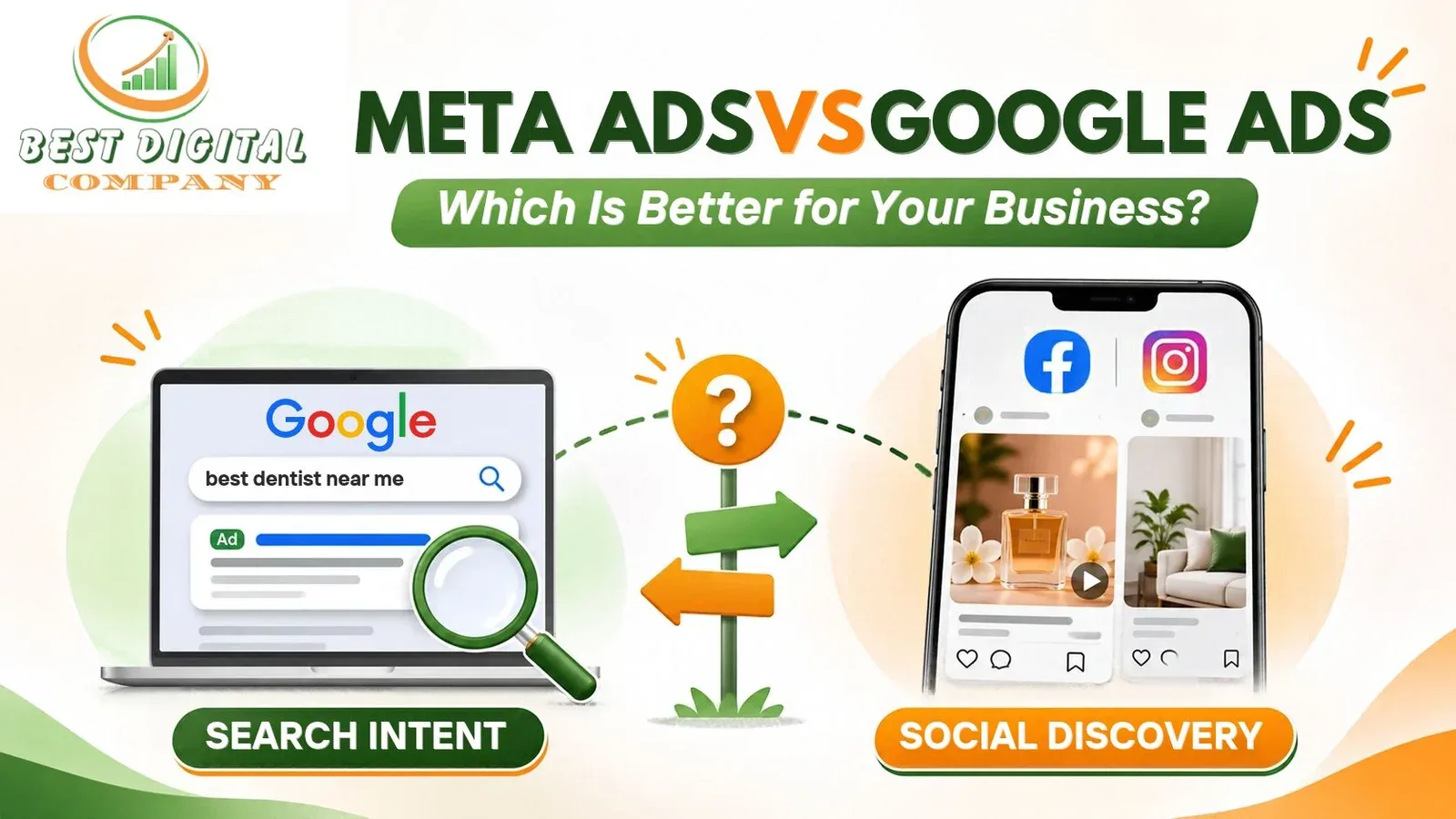
The truth about Meta Ads vs Google Ads is less dramatic. They are two different tools built for two different moments in a customer’s life. One catches people who are already searching for what you sell. The other puts your business in front of people who were scrolling and had no idea they needed you yet. Which one is “better” depends on what you sell, who buys it, how quickly you need enquiries, and how much money you can afford to test with.
This guide walks through how each platform works, what they cost in practice, where each one tends to win, and how to decide without guessing. We run paid campaigns for small and mid-sized businesses across India, so the examples below come from the kinds of accounts we actually see: clinics, coaching institutes, local service companies, online stores and B2B firms.
Meta Ads vs Google Ads: The Short Answer
If you want a quick verdict before the detail, here it is.
- Choose Google Ads first when people already search for your product or service, and you need enquiries from buyers who are ready to act. Think “dentist in Preet Vihar”, “CA for GST filing” or “industrial water tank supplier”.
- Choose Meta Ads first when your product is visual, impulse-friendly or needs to be introduced to people, or when few people search for it by name. Think fashion, home decor, a new restaurant, a course launch or a new D2C brand.
- Use both when you have the budget and want to cover the full journey, from first awareness to final purchase.
Notice that nothing in that list says one platform is superior. A well-run Google campaign for the wrong business will lose money, and so will a well-designed Instagram campaign for the wrong offer. The platform is only half the decision. The other half is fit.
How Google Ads Works: Capturing Demand That Already Exists
Google Ads is built around intent. A person types a question or a need into Google, and your ad can appear alongside the results if your keywords, bids and ad quality line up. You are paying to be visible at the exact moment someone raises their hand.
The main campaign types you will meet are:
- Search campaigns: text ads shown against specific searches. These are usually the best starting point for lead generation.
- Shopping campaigns: product listings with images and prices, useful for online stores.
- Performance Max: an automated campaign type that runs across Google’s properties, including Search, YouTube, Maps and Display.
- YouTube and Demand Gen: video and visual formats for reaching people earlier in their decision process.
The strength of Google is that a click often comes from someone with a real problem and a short timeline. The weakness is that you are limited by search volume. If nobody searches for what you sell, there is no demand for Google to capture, and you will struggle to scale.
There is also a skill element. Keyword match types, negative keywords, quality of the landing page and conversion tracking all influence your cost. Many accounts we audit are not failing because Google Ads “doesn’t work”. They are failing because the setup is leaking money in the background. If you want a team to handle that part, our PPC services cover search, shopping and remarketing campaigns with proper conversion tracking from day one.
How Meta Ads Works: Creating Interest Before the Search
Meta Ads run across Facebook, Instagram, Messenger and WhatsApp placements. Instead of waiting for someone to search, you show your message to a defined audience based on interests, behaviour, location, demographics, customer lists or people who have already visited your website.
This is a very different psychology. Nobody on Instagram is thinking “let me find a physiotherapist”. They are watching reels, checking a friend’s story or browsing a product. Your ad has to earn attention in a second or two, which is why creative quality matters far more on Meta than it does on a text-based Google ad.
Common Meta formats include:
- Short video and reels placements
- Single image and carousel ads
- Lead forms that open inside the app
- Click-to-WhatsApp and click-to-message ads
- Retargeting ads aimed at past website visitors or engaged followers
The strength of Meta is reach and discovery. You can introduce a brand to thousands of relevant people at a low cost per impression, and you can build an audience before they are ready to buy. The weakness is that attention is not the same as intent. A lot of people will scroll past, and some will click out of curiosity without being serious buyers. That is why lead quality needs active management.
Because Meta rewards creative and consistent brand presence, it works best when your organic profiles are in good shape too. Our social media marketing work usually starts with the page itself, since a weak profile wastes the traffic your ads send it.
Meta Ads vs Google Ads: Side-by-Side Comparison
Here is how the two compare on the points that matter most when you are choosing.
| Factor | Google Ads | Meta Ads |
| Buyer mindset | Actively searching | Browsing and scrolling |
| Best for | Ready-to-buy leads, local services, high-intent products | Awareness, visual products, offers, retargeting |
| Main format | Text, shopping, video | Image, video, reels, lead forms |
| Speed to enquiries | Often faster for urgent needs | Can be quick, but quality varies |
| Lead quality | Usually higher intent | Mixed, depends on creative and form design |
| Audience size limit | Capped by search volume | Very large, scalable |
| Creative effort | Moderate | High and ongoing |
| Learning curve | Keyword and tracking heavy | Creative and audience heavy |
Treat this table as a starting point, not a rule. A beautifully targeted Meta campaign can outperform a sloppy Google campaign every day of the week.
Cost: What You Actually Pay on Each Platform
Budget is usually the first real question, and the honest answer is that costs vary widely. Cost per click and cost per lead depend on your industry, city, competition, season, ad quality and landing page. A clinic in South Delhi will pay a very different amount from a local tutor in a smaller town.
Some patterns hold true across most accounts we manage:
- Google clicks are often more expensive per click in competitive categories such as education, real estate, legal and finance, because many advertisers are bidding for the same high-intent searches.
- Meta clicks are often cheaper, but the cost per qualified lead can end up similar or higher if the audience is loosely targeted.
- Cheap leads are not good leads. A low cost per lead means little if nobody picks up the phone.
The number to track is not cost per click. It is cost per sale or cost per qualified enquiry. If Google gives you ten leads at a higher price and four become customers, while Meta gives you thirty leads at a lower price and two become customers, Google is the cheaper channel for you, even though it looks more expensive on the dashboard.
For a starting budget, most small businesses do better by committing enough to learn something useful rather than spreading a tiny amount across both platforms. Run one platform properly for a few weeks, read the data, then expand. If you want to see how ad management is usually structured, our PPC packages and SMO packages show what is typically included at each level.
Which Is Better for Lead Generation?
For most service businesses that need phone calls and form fills, Google Ads is the safer first choice. The person searching “AC repair near me” is not browsing for fun. They have a broken AC and a hot afternoon. That kind of intent turns into calls quickly.
Meta can still be a strong lead source, particularly when the service is something people are persuaded into rather than actively hunting for, such as interior design, wedding photography, fitness programmes, skincare treatments or admissions campaigns. In these cases, a good offer and a clear creative do the persuading that a search query cannot.
What makes the difference is what happens after the click. If you are new to this, our guide on how to generate leads online for a small business in India explains the full path from visitor to enquiry, including the follow-up habits that many owners skip. In our experience, a business that replies to every enquiry within minutes will often beat a competitor with a bigger ad budget.
Google Ads vs Facebook Ads for Local Businesses
If your customers come from a specific neighbourhood or city, the decision gets more specific.
Google Ads works well for local businesses because people use phrases like “near me” and “in [area name]” constantly. Your ads can sit alongside map results, and call extensions let someone phone you directly from the search page. Meta works for local businesses too, but in a different way: it helps you announce an offer, a new branch or a seasonal promotion to people living within a few kilometres.
However, paid ads are only one side of local visibility. Your free listing matters just as much, and a weak one will quietly undermine your spending. If you are not sure how you appear on the map, start with our post on why your business is not showing on Google Maps and how to fix it, then read the Google Business Profile optimization guide to tidy up the basics. If you want to rank without paying per click, the strategies in how to rank higher on Google Maps in 2026 are worth following alongside your ads.
Businesses in Delhi can also pair paid campaigns with our local SEO in Delhi service so that both paid and free channels push in the same direction. And if you want to understand how people actually search for nearby services, near me SEO and how to rank for those searches is a useful read before you set your Google Ads keywords.
Meta Ads vs Google Ads for Ecommerce and D2C Brands
Online stores sit in an interesting middle ground.
Meta is excellent for discovery. A new skincare brand, a handmade jewellery label or a kids’ clothing store can show products to people who never searched for them, using strong visuals and video. Many D2C brands in India build their first wave of sales this way.
Google is excellent for harvest. Once people know the category, they search for specific products, brands and comparisons. Shopping ads and branded search campaigns capture buyers who are close to purchase.
A sensible pattern for ecommerce is to use Meta to create demand and Google to collect it. Retargeting makes this stronger: someone who viewed a product on your site can see it again on Instagram a day later, which often brings them back to complete the order.
Before spending on either, check that your website is not the weak link. Slow pages, confusing checkout steps and poor mobile layouts will waste any budget you send them. Our web development team often finds that fixing page speed and form flow lifts results more than changing the ad itself.
Which Works Better for B2B and High-Ticket Services?
For B2B companies, consultants, manufacturers and professional services, Google Ads tends to be the primary channel because decision-makers search when they have a defined problem: “ERP software for small manufacturers” or “company registration consultant”.
Meta plays a supporting role. It can keep your brand visible to people who visited your site, promote webinars or downloadable guides, and warm up prospects who are not ready to enquire yet. For long sales cycles, this steady presence matters. Someone may look at your service today and only contact you six weeks later, and you want to be familiar by then.
LinkedIn is often discussed for B2B as well, but cost per lead there can be steep for smaller budgets, so many Indian SMEs begin with Google and add Meta retargeting afterwards.
Using Meta Ads and Google Ads Together
Running both is not about doubling your spend. It is about letting each platform do what it is good at.
A simple way to think about it:
- Awareness: Meta introduces your brand through video or a strong offer.
- Consideration: people who engaged see follow-up ads with proof, such as reviews, results or before-and-after content.
- Decision: when they search for you or your service on Google, your search ad and listing are waiting.
- Retention: Meta and email bring past customers back.
You will often notice that after Meta campaigns start, searches for your brand name on Google increase. That is the two channels supporting each other. It also means you should not judge Meta only by last-click conversions, since part of its value shows up later in Google.
A caution, though: if your budget is small, do not try to run everything at once. A tight, well-tracked campaign on one platform will teach you more than four half-funded ones.
Where SEO Fits In With Paid Ads
Paid ads switch off the day you stop paying. Search engine optimisation keeps working in the background, so the two are best seen as partners rather than rivals. Ads give you speed. SEO gives you steadiness and lowers your dependence on paid clicks over time.
If you are weighing how much to invest in each, our search engine optimization service is built to complement paid campaigns, and businesses in the capital can look at our SEO service in Delhi page for the local approach. It also helps to understand how search itself is changing. Our posts on whether SEO still works in 2026 and SEO vs AEO vs GEO explain why organic visibility and paid visibility now overlap more than they used to.
Common Mistakes That Make Both Platforms Look Bad
Most “ads don’t work” stories trace back to a handful of avoidable errors.
- No conversion tracking. If you cannot see which clicks led to calls or sales, you are optimising blind.
- Sending traffic to the homepage. A focused landing page with one clear action almost always beats a general homepage.
- Judging results too early. Both platforms need a learning period. Switching strategy every three days resets that learning.
- Targeting everyone. Broad targeting with a vague message produces clicks, not customers.
- Ignoring lead follow-up. Leads left unanswered for hours go cold fast.
- Copying a competitor. Their margins, sales process and audience are not yours.
- Neglecting reviews and profiles. People check your ratings before they call. Our guide on how to get more Google reviews without breaking Google’s rules helps here.
One more point worth making: your Google Business Profile and your website do different jobs, and ads depend on both. If you have ever wondered which deserves priority, Google Business Profile vs website breaks that down clearly.
How to Choose Between Meta Ads and Google Ads
Instead of picking by trend, run through these five questions.
1. Do people search for what I sell? Type your service into Google and look at the ads and suggestions. If there is clear activity, Google deserves a test. If the results feel empty, Meta may be the better start.
2. Is my product visual or emotional? Things people want rather than need, such as fashion, food, travel, home styling and events, usually respond well to Meta.
3. How fast do I need enquiries? Urgent services lean toward Google. Brand-building and launches lean toward Meta.
4. What is my sales process? If you can follow up quickly by phone or WhatsApp, both platforms can work. If follow-up is slow, fix that before spending more.
5. What can I afford to test? Set a fixed testing budget, a time window and a success measure before launching. Then let the data decide.
If you are still near the beginning of your online journey, our article on digital marketing for small businesses in India: where to start in 2027 lays out a sensible order of priorities, so you are not buying ads before the basics are ready.
Our Practical Recommendation
Here is how we usually advise clients, and you are welcome to adapt it.
- Local service business with a phone-based sales process: begin with Google Search ads and a well-optimised Business Profile. Add Meta retargeting after a month or two.
- Ecommerce or D2C brand: begin with Meta for discovery and add Google Shopping and branded search as sales grow.
- B2B company: begin with Google Search, then use Meta to retarget website visitors and promote content.
- New business with a very small budget: pick one platform, go narrow, and track every enquiry carefully. Expand only when you can say what each lead costs.
Whatever you choose, treat the first month as research. The best campaigns we have run were not perfect on day one. They improved because someone kept reading the numbers, cutting what did not work and putting more behind what did.
Frequently Asked Questions About Meta Ads vs Google Ads
Which is better for a small business, Meta Ads or Google Ads?
Neither is better in every case. Google Ads is usually the safer first choice for service businesses where customers already search for the service. Meta Ads suit visual products, offers and brand discovery. Match the platform to how your customers actually find and decide on your business.
Is Google Ads more expensive than Meta Ads?
Google clicks often cost more in competitive industries, but click price alone is misleading. What matters is the cost of a qualified lead or a sale. A more expensive click that turns into a customer can be cheaper overall than a low-cost click that never does.
Can I run Meta Ads and Google Ads at the same time?
Yes, and many businesses do. Meta introduces your brand and keeps it visible, while Google captures people searching when they are ready to act. If your budget is limited, start with one platform and add the second once you have reliable tracking.
Which platform gives better quality leads?
Google Search leads generally come with stronger intent because the person searched for a solution. Meta leads can be just as valuable, but they depend heavily on creative, offer and form design, and they usually need quicker follow-up.
How much should I spend to test each platform?
There is no universal figure. Choose a budget large enough to gather meaningful data over several weeks, since a very small spend rarely teaches you anything. Your industry, location and competition will shape the right amount.
How long before I see results from paid ads?
You can see clicks and enquiries within days, but stable performance usually takes a few weeks of testing and adjustment. Judging a campaign after two or three days often leads to poor decisions.
Do I need a website to run ads?
Google Ads normally needs a landing page. Meta can send people to a lead form, WhatsApp or a profile, but a proper website builds trust and converts better. A fast, mobile-friendly site makes every rupee of ad spend work harder.
Should I choose ads or SEO?
They solve different problems. Ads bring quick visibility and are easy to scale up or down. SEO builds lasting visibility and reduces long-term reliance on paid clicks. Most growing businesses use both, with the balance depending on timeline and budget.
Final Thoughts: Choosing the Platform That Fits Your Business
The debate around Meta Ads vs Google Ads often assumes a winner exists. In practice, the better platform is simply the one that matches your customer’s behaviour right now. People who are searching are best reached through Google. People who are scrolling are best reached through Meta. Many businesses eventually need both.
Start with the platform that fits your product and your sales process, track every enquiry honestly, and let real numbers guide your next step. If you would like a second opinion on your current campaigns or help planning a first one, you can contact our team for a straightforward conversation about what would suit your business.

Add a Comment