

If you have ever sat down to hire outside help for your rankings, you already know the confusion. One friend tells you to hire an individual expert because “agencies just outsource everything.” Another swears an agency saved his business because “one person can’t do it all.” Both are right, and both are wrong, depending entirely on where your business actually stands right now.
This is not a question with one correct answer. It is a question with one correct answer for you, based on your budget, your team size, your growth stage, and what “ranking better” actually means for your revenue. In this guide, we will walk through what a best SEO consultant really does, how that differs from working with a full-service agency, and how to figure out which one fits your business today not five years from now.
What Does a Best SEO Consultant Actually Do?
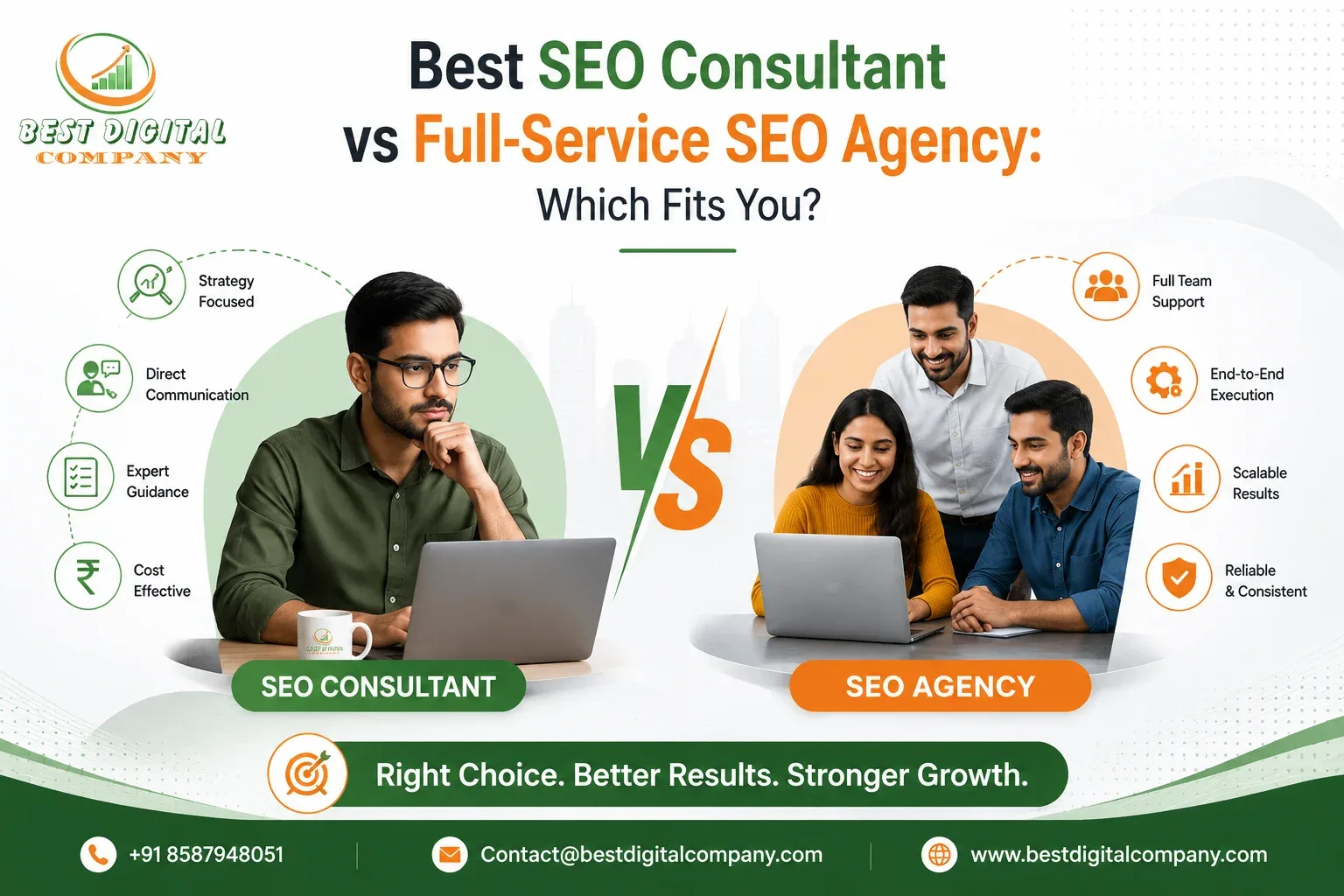
A consultant, in the truest sense, is a specialist. Think of them as a doctor you visit for a specific complaint rather than a full hospital staff managing every aspect of your health. A genuinely good SEO consultant typically works one-on-one with you, often as a freelancer or a small solo practice, and focuses on strategy, audits, and hands-on guidance rather than running an entire in-house production team.
Here is what that usually looks like in practice:
- A deep technical audit of your website, covering crawlability, indexing issues, site speed, and structure
- Keyword research and content strategy built specifically around your niche
- On-page optimization recommendations (title tags, headers, internal linking, content gaps)
- Direct, personal communication — you are usually talking to the same person every single time
- Guidance on link building strategy, even if execution is outsourced separately
The appeal is obvious once you have experienced it: no account managers relaying messages, no junior staff learning on your dime, and no confusion about who is actually doing the thinking behind your strategy. When you hire a best SEO consultant, you are paying for judgment and experience concentrated in one person, not a whole department.
But that concentration is also the limitation. A single consultant, no matter how skilled, has finite hours in a day. They can tell you exactly what needs to happen on your site, but they usually cannot also write fifteen blog posts a month, manage your backlink outreach, build new landing pages, and run your Google Business Profile updates all at once. For businesses that need heavy execution alongside strategy, this becomes the deciding factor.
What Is a Full-Service SEO Agency, and How Is It Different?
A full-service agency flips the model. Instead of one expert wearing every hat, you get a team often a strategist, a content writer, a technical specialist, an outreach person, and a project manager coordinating all of them. It is less like visiting a specialist doctor and more like walking into a hospital where each department handles its own piece of your treatment.
This structure tends to work well when:
- Your website needs both strategy and heavy execution (content production, link building, technical fixes) simultaneously
- You want one point of contact managing multiple moving parts, including SEO alongside services like social media marketing, pay-per-click campaigns, or website development
- You are scaling fast and need a team that can absorb more workload without you having to hire and coordinate freelancers yourself
- You value having backup if one team member is on leave, the work doesn’t stall
The tradeoff is usually cost and, sometimes, a layer of communication between you and the people actually doing the work. Not every agency is guilty of this, but it is a common complaint: you sign on with a senior strategist during the sales call, then get handed off to a junior executive for the actual day-to-day work. That is not necessarily bad many junior team members do excellent work under supervisio but it’s worth knowing upfront so you can ask the right questions before signing anything.
If you want a deeper breakdown of how these two setups differ structurally, our earlier piece on SEO agency vs SEO company covers the terminology confusion many business owners run into during the hiring process.
Business Stage 1: Startups and Solo Founders
If you are a solo founder or running a small team with a limited monthly budget, a consultant is often the smarter starting point. At this stage, your website probably has a handful of glaring issues maybe your titles are not optimized, maybe Google can’t even crawl half your pages properly, maybe you have zero internal linking strategy. These are foundational problems, and a best SEO consultant can diagnose and fix the roadmap for these quickly without you committing to a large monthly retainer.
You also, frankly, don’t have the traffic volume yet to justify a six-person team working on your account. A consultant can set the direction, hand you a prioritized action list, and let you (or a part-time freelancer) execute the basics while your business grows into needing more support.
This is also the stage where local visibility often matters more than broad national rankings. If you are a startup serving a specific city, something likelocal SEO work getting your Google Business Profile right, building local citations, gathering reviews often delivers faster, more tangible results than a broad national SEO push. A consultant is usually well equipped to guide this without unnecessary overhead.
Business Stage 2: Growing Businesses With Some Revenue Stability
Once your business has consistent revenue and you are past the “will this even work” phase, the equation shifts. You now have money to reinvest into growth, and you likely need more than strategic advice — you need actual content published, actual outreach happening, actual technical fixes implemented on a schedule.
This is where many businesses start feeling the limits of a solo consultant. It is not that the consultant’s advice gets worse; it is that execution capacity becomes the bottleneck. If your consultant is telling you exactly what to do but you don’t have anyone to build it, the recommendations sit in a document, unused.
At this stage, some businesses hire a consultant plus a small execution team, essentially building their own hybrid model. Others make the jump to a full-service setup where strategy and execution live under one roof. If your growth also depends on paid traffic alongside organic rankings, it is worth reading how SEO services differ from SEO packages a distinction that matters a lot once you’re comparing agency proposals side by side and trying to figure out what you are actually paying for.
Business Stage 3: Established Businesses Scaling Aggressively
For businesses with an established market position looking to scale rankings across multiple locations, product lines, or service categories, a full-service agency generally becomes the more practical option. The sheer volume of content, technical maintenance, and ongoing optimization needed to compete at this level is difficult for one person to sustain long-term, even a highly skilled one.
At this stage, you’re also usually running SEO alongside other digital channels perhaps PPC campaigns to capture immediate demand while SEO builds long-term equity, or coordinated content that supports both organic search and social distribution. Managing all of this across separate freelancers becomes an operational headache. A team that can coordinate these channels together, rather than in isolated silos, tends to produce more consistent results and saves you the internal project-management burden.
This does not mean bigger is always better some established businesses continue working successfully with an experienced consultant who has, over time, built their own trusted network of writers and link builders. The point isn’t that agencies automatically outperform consultants at scale; it’s that the coordination overhead of scaling with independent freelancers becomes harder to manage yourself the bigger you get.
Cost Comparison: What You are Actually Paying For
Pricing conversations around SEO get murky fast, mostly because “SEO” means different things depending on who’s selling it. Here’s a general, honest breakdown of what to expect:
Consultants typically charge either an hourly rate, a project-based fee for an audit, or a smaller monthly retainer focused on strategy and oversight. You are paying for expertise and time, not headcount. This tends to be the more affordable entry point, especially for a first engagement.
Full-service agencies typically charge based on scope how much content is being produced, how many pages need optimization, how aggressive the link-building target is, and how many channels are being managed. Because you’re paying for a team’s combined output, monthly retainers are generally higher, but so is the volume of work being delivered.
Neither is inherently a “waste of money” or a “better deal.” A ₹15,000 monthly consultant engagement that fixes your technical foundation might deliver more real value than a ₹1,00,000 agency retainer that’s spread too thin across a hundred other clients. Cost only makes sense in the context of what deliverable you actually need right now.
Red Flags to Watch For, Regardless of Which You Choose
Whether you are evaluating a solo consultant or negotiating with an agency, some warning signs apply universally:
- Guaranteed rankings within a fixed timeline (nobody controls search engine algorithms enough to promise this honestly)
- Vague reporting that only shows keyword position screenshots without connecting the work to actual traffic or leads
- Reluctance to explain their process when you ask direct questions
- No clear communication cadence — you should not have to chase anyone for a monthly update
- Heavy reliance on outdated tactics like exact-match anchor text stuffing or mass low-quality backlink purchases
A trustworthy provider, consultant or agency, will walk you through their reasoning, show you real examples of past work, and be upfront about what SEO can and cannot realistically achieve in your timeframe.
Can You Combine Both Models?
Yes, and many businesses do this successfully, particularly during a transition period. It’s fairly common for a business to bring in an independent consultant for a one-time technical audit or a second opinion, even while working with an agency for day-to-day execution. The consultant essentially acts as an outside check on the agency’s work, and a confident, transparent agency generally won’t have a problem with this arrangement.
Similarly, if you are currently working with a freelance web developer or a solo consultant and considering whether to bring on a bigger team, it can help to look at how this decision plays out for other services too. Our piece on hiring a website developer versus a freelancer walks through a very similar cost-versus-capacity tradeoff, and the underlying logic transfers directly to how you think about SEO staffing decisions.
How to Make the Decision for Your Business
Rather than asking “which is better,” ask yourself these questions honestly:
- Do I need a strategic roadmap right now, or do I need ongoing content and link-building execution at volume?
- Can my internal team (or I) execute recommendations if I only hire for strategy?
- Am I managing multiple digital channels that need to work together, or is search the only priority right now?
- What is my realistic monthly budget, and does it match the scope I’m expecting?
- Do I want one dedicated point of contact, or am I comfortable coordinating with a team?
Your honest answers will point you in the right direction far more reliably than any generic “agencies are better” or “consultants are better” advice you’ll find online. Every business’s SEO needs evolve as it grows, and it’s completely normal to start with one model and shift to the other later.
If you are still unsure which setup matches where your business stands today, our team is happy to walk through your website and goals with you and give you a straight answer even if that answer is “you don’t need us yet.” You can reach out through our contact page or explore our full search engine optimization services to see how we approach both strategy and execution for businesses at different stages.
Frequently Asked Questions
What is the difference between a best SEO consultant and an SEO agency?
A best SEO consultant is typically an individual expert who provides strategy, audits, and hands-on guidance directly, while an agency provides a full team handling strategy alongside execution like content production, technical fixes, and link building. Consultants suit businesses needing focused strategic direction; agencies suit businesses needing both strategy and heavy ongoing execution.
How much does hiring a best SEO consultant typically cost?
Costs vary widely based on experience and scope, but consultants generally charge hourly rates, flat project fees for audits, or smaller monthly retainers compared to full-service agencies, since you’re paying for individual expertise rather than a team’s combined output.
Is a best SEO consultant enough for a small business?
For most early-stage or small businesses, yes. A consultant can identify and prioritize the technical and content issues holding your rankings back, and many small businesses successfully execute those recommendations in-house or with a small freelance team before ever needing a full agency.
When should a business move from a consultant to a full-service agency?
Typically once execution capacity becomes the bottleneck meaning you have more strategic recommendations than you can realistically implement on your own, or you need SEO coordinated alongside other channels like PPC and social media at a larger scale.
Can a best SEO consultant and an agency work together?
Yes. It is common for businesses to bring in an independent consultant for a one-time audit or second opinion even while an agency handles day-to-day execution, and a transparent agency should have no issue with this kind of outside review.
How do I know if an SEO consultant is genuinely good at what they do?
Look for clear communication, honest timelines without guaranteed rankings, real examples of past audits or results, and a willingness to explain their reasoning rather than relying on vague reports of keyword positions alone.

Add a Comment