

If you have ever handed your Instagram or Facebook page to an agency and quietly wondered whether anything was actually going to change, you are asking the right question. Most business owners have a folder full of monthly reports filled with reach numbers and impressions that never quite explain why the phone is not ringing. We hear this constantly from new clients: “Our last agency posted every day, but engagement barely moved.”
This case study is our answer to that frustration. It walks through exactly what we did for a real client over a 90-day period, the mistakes we found in their existing setup, the specific changes we made, and the numbers that came out the other side engagement essentially doubled in three months, without inflating the budget or resorting to bot followers and giveaway spam.
We’re sharing this not just to show off a result, but because the process behind it is repeatable. Whether you run the account yourself, work with an in-house team, or are comparing agencies right now, the steps below will give you a clear, honest picture of what real social media marketing services look like when they’re done properly.
Why We are Publishing This as the Best Social Media Marketing Agency Case Study
There is no shortage of agencies claiming to be the best social media marketing agency in their city or niche. Almost every homepage says some version of “we grow your engagement” or “we build your brand.” The problem is that claims like these are impossible to verify from the outside, and business owners are understandably tired of vague promises.
We wanted to do something different: show the actual before-and-after numbers, explain the reasoning behind each decision, and be transparent about what took longer than expected. Good case studies are not marketing fluff, they are proof of process. If an agency can’t walk you through why a strategy worked, they probably can’t repeat it for your brand either.
The Starting Point: A Familiar, Frustrating Situation
Our client came to us running a mid-sized retail and lifestyle brand with roughly 40,000 combined followers across Instagram and Facebook. On paper, that sounds like a healthy audience. In practice, their engagement rate was sitting under 1%, which is low even by conservative industry standards.
Here’s what we found during the audit:
- Posting was inconsistent — sometimes five posts a week, sometimes none for ten days
- Captions were generic and rarely invited any interaction
- Almost no use of Reels or short-form video, despite it being the format platforms were actively pushing
- No content pillars or themes, so the feed felt scattered
- Community management was reactive at best; comments and DMs often went unanswered for days
- Paid boosting was used randomly on whichever post “felt important” that week, with no clear targeting logic
None of this is unusual. It’s actually the default state for most brands managing social media without a dedicated strategy, whether that’s an overworked in-house employee juggling five roles or a previous vendor coasting on a retainer. We’ve written before about this exact tension in Social Media Marketing Company vs In-House Team: Which One Actually Grows Your Brand?, and this client’s situation matched almost every red flag described there.
Setting a Clear, Measurable Goal
Before touching a single post, we sat down with the client to define what “engagement” actually meant for their business. Vanity metrics like follower count were explicitly taken off the table. Instead, we agreed to track:
- Engagement rate (likes, comments, shares, saves divided by reach)
- Comment quality and response time
- Share and save rate, since these signal that content is genuinely useful or relatable, not just visible
- Click-throughs to the website from social profiles and posts
- DM inquiries that could be tied back to specific campaigns
Setting these benchmarks mattered because it gave both sides a shared definition of success. This is a step that gets skipped far too often, and it is the reason many businesses feel like their social media marketing services are not delivering nobody agreed on what “working” meant in the first place.
The 90-Day Strategy: What We Actually Changed
Month 1: Foundation and Content Architecture
The first 30 days were spent rebuilding the structure the account was missing. We introduced four content pillars tied directly to what the brand’s audience cared about: product education, behind-the-scenes stories, customer transformations, and light entertainment tied to trending audio and formats.
We also fixed the posting cadence. Instead of sporadic bursts, we moved to a consistent schedule of five feed posts and four Reels per week, timed against when the client’s actual audience was online not generic “best time to post” advice pulled from a blog somewhere.
Captions were rewritten to end with a genuine question or prompt rather than a flat call to action like “shop now.” Small change, noticeably different comment behavior almost immediately.
Month 2: Doubling Down on What Worked
By week five, the data was already telling us something useful: Reels featuring the founder speaking directly to camera outperformed polished product shots by a wide margin, both in reach and in saves. Most agencies would keep the content mix “balanced” out of habit. We didn’t. We shifted the ratio toward more founder-led video content and used the freed-up time to invest in faster community management comments answered within a few hours instead of a few days, and DMs handled with real, non-templated responses.
We also introduced a small, tightly targeted paid boost budget behind only the top-performing organic posts, rather than spreading spend thin across everything. This is a principle that carries over from paid search work too we cover the logic behind it in PPC Services Explained: What a Performance Marketing Agency Really Does Every Month, and it applies just as much to social ad spend as it does to Google Ads.
Month 3: Scaling and Consistency
By the final month, the format was proven, so the focus shifted to scaling it without losing quality. We built a lightweight content calendar the client’s internal team could eventually maintain themselves, ran two small collaborations with adjacent micro-influencers in the same city, and started repurposing top comments and DMs into new content ideas effectively letting the audience write the content roadmap for us.
The Results After 90 Days
Here is what the numbers looked like at the end of the three-month engagement, compared to the 90 days before we started:
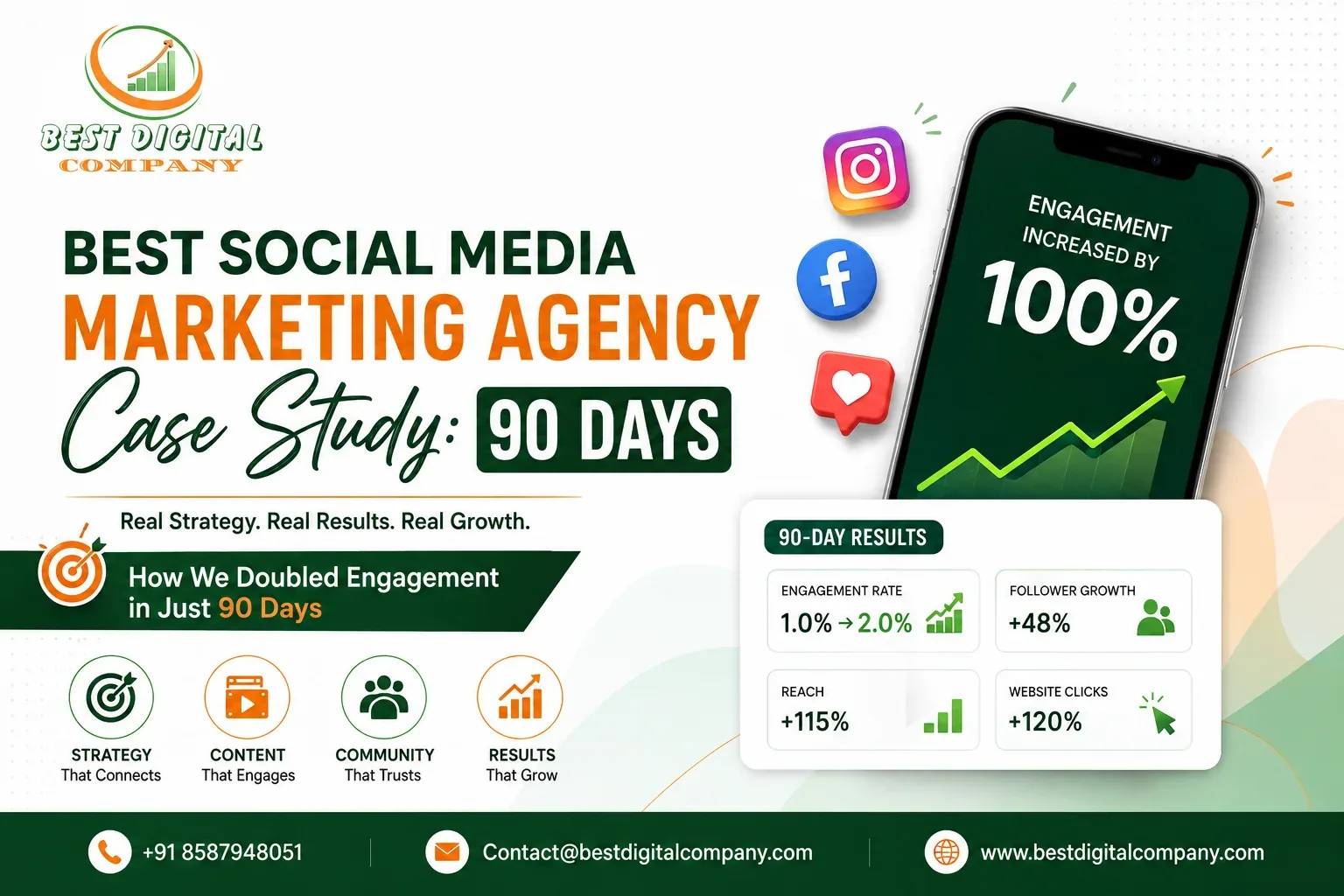
- Engagement rate rose from 0.9% to 1.9% — essentially doubling, and well above the retail industry benchmark
- Reel views increased by 340%, driven almost entirely by the founder-led video format
- Saves and shares grew by 210%, which mattered more to the client than raw likes because it signaled content people actually valued enough to revisit or pass along
- Website click-throughs from social profiles increased by 85%
- DM inquiries tied to specific promotions rose by 60%, several of which converted into actual sales
Follower count did grow, by around 18%, but that was treated as a side effect of better content, not the goal itself. This distinction is worth repeating: engagement grew because the content earned attention, not because we bought a bigger audience.
What Made the Difference: Lessons Behind the Numbers
A few principles from this project apply to almost any brand looking to improve results, regardless of industry or platform.
Consistency beats intensity. A steady five-post weekly schedule outperformed the previous inconsistent bursts, even though the total monthly post count barely changed.
Video-first content is not optional anymore. Every major platform algorithm currently favors short-form video, and brands that resist this format are handing reach to competitors who don’t.
Community management is not an afterthought. Responding quickly and genuinely to comments and DMs had a measurable effect on how the algorithm distributed later posts, likely because early engagement signals are weighted heavily in the first hour after publishing.
Data should change the plan mid-flight. The willingness to shift the content ratio in month two, based on real performance rather than a rigid content calendar, was arguably the single biggest driver of the final result.
If any of this sounds familiar from other areas of digital marketing you have worked with, that is not a coincidence. The same discipline that improves search engine optimization results testing, measuring, adjusting based on real data instead of assumptions applies directly to social platforms as well.
How to Apply This Without Hiring an Agency Immediately
Not every business is ready to hand social media over to an outside team, and that’s a fair position. If you want to test a few of these principles yourself before making that decision, start here:
- Pick two to three content pillars and stick to them for at least a month before judging results
- Commit to a realistic, sustainable posting schedule rather than an ambitious one you’ll abandon in two weeks
- Respond to every comment and DM within a few hours, not days
- Track saves and shares alongside likes, since they’re a better signal of content quality
- Review performance every two weeks and be willing to shift your content mix based on what the data shows, not what you personally prefer
If you’d rather compare the tradeoffs of doing this in-house versus bringing in outside help, our earlier breakdown in Social Media Marketing Company vs In-House Team: Which One Actually Grows Your Brand? walks through the cost, time, and skill gaps most businesses run into either way.
What to Look for When Choosing a Social Media Marketing Agency
This case study is a good example of what should be a baseline standard, not an exception. When you’re evaluating who should manage your brand’s social presence, ask for specifics rather than accepting broad promises:
- Ask what metrics they track beyond followers and reach
- Ask to see an example of how they adjusted a strategy mid-campaign based on real performance data
- Ask how quickly they respond to comments and DMs on the accounts they manage
- Ask whether their content strategy is tailored to your audience or templated across every client they have
We go deeper into how to vet a vendor properly in Likes Don’t Pay the Bills: How to Pick a Social Media Marketing Agency That Actually Grows Sales, which pairs well with the process outlined here.
Why This Matters Beyond a Single Case Study
It’s tempting to treat one client’s 90-day results as a one-off success story, but the underlying process is what matters. Every step in this case study the audit, the goal-setting, the content restructuring, the mid-campaign adjustments is a repeatable framework, not a lucky break tied to one brand’s audience or niche.
That is also the standard we hold ourselves to across every service we offer, from SEO and PPC to website development: set clear metrics upfront, be transparent about what’s working and what isn’t, and adjust the plan based on real data instead of guesswork.
Frequently Asked Questions
How long does it typically take to see engagement improve on social media?
Most brands start seeing measurable movement within four to six weeks, provided posting is consistent and content is adjusted based on early performance data. A full 90-day window, like the one in this case study, is usually enough to establish a repeatable pattern rather than a temporary spike.
Do I need a large budget to double my engagement rate?
Not necessarily. In this case, the paid budget was small and focused entirely on boosting already-proven organic content rather than being spread across every post. Strategy and consistency mattered more than ad spend.
What is the difference between reach and engagement, and which one should I care about more?
Reach tells you how many people saw a post; engagement tells you how many people actually cared enough to interact with it. A high-reach, low-engagement account usually signals content that isn’t resonating, even if the follower count looks impressive. Engagement is generally the better indicator of a healthy, growing brand relationship with its audience.
Should every business be posting Reels or short-form video?
For most platforms and industries, yes. Algorithms currently favor short-form video for distribution, and audiences increasingly expect it. That said, the format needs to fit your brand’s voice forced or awkward video content can hurt more than it helps, which is why testing a few formats early is worth the effort.
How do I know if my current social media management is actually working?
Look past follower count and vanity metrics. Track engagement rate, saves, shares, and any direct business outcomes like website clicks or DM inquiries. If those numbers are flat or declining while your posting volume stays the same, it’s a sign the strategy needs a real audit rather than more of the same content.
Is it better to manage social media in-house or work with a specialized agency?
It depends on your team’s bandwidth and expertise. In-house teams offer closer brand familiarity, but often lack the time or platform-specific experience to test and iterate quickly. Agencies bring dedicated strategy and cross-client pattern recognition, but need clear communication to stay aligned with your brand voice. We break this comparison down in more detail in our guide on social media marketing company vs in-house team.
If your current social media presence looks similar to where this client started inconsistent posting, flat engagement, and reports that do not translate into real business results it may be worth an honest audit before committing to another quarter of the same approach. Our team works with brands across industries to build the kind of social media marketing services that are measured by real engagement and business outcomes, not vanity numbers.

Add a Comment