

If you have spent even ten minutes searching for help with your website’s rankings, you have probably typed both phrases into Google without thinking twice “SEO agency” and “SEO company.” You clicked on results for both, compared pricing pages that looked nearly identical, and eventually wondered if you were even searching for two different things. You are not the only one confused. Business owners ask us this question almost every week, usually right before they sign a contract and want to be sure they are picking the right kind of partner.
The short answer is that the difference is smaller than most marketing blogs make it sound. But it is not zero, and understanding where the real gap lies can save you from a frustrating year of vague reports and disappointing rankings. In this guide, we will break down what each term actually means in practice, where the lines blur, what to look for regardless of the label on the door, and how to make a confident decision for your business.
What Does an SEO Agency Actually Do?
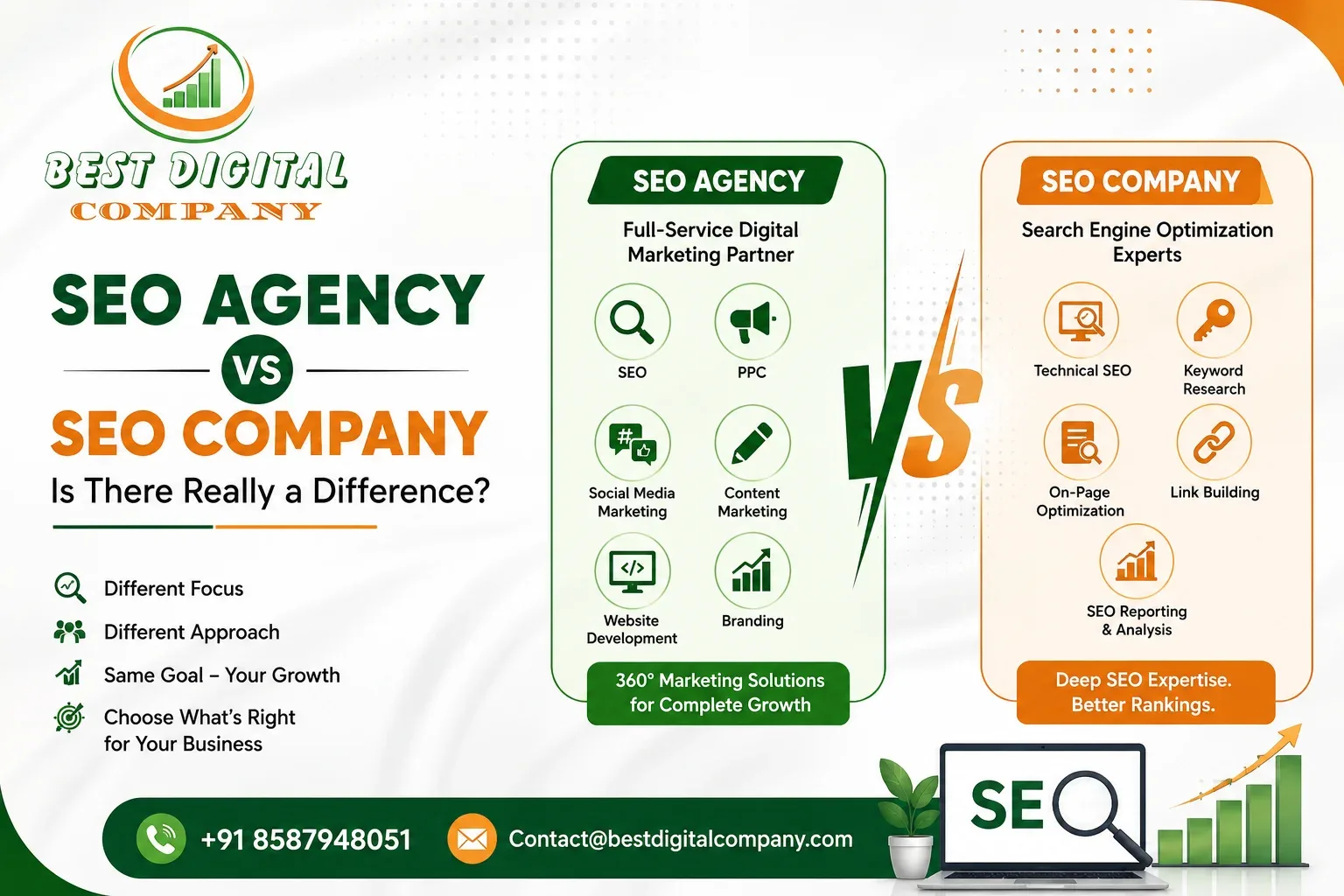
The word “agency” usually signals a full-service setup. An SEO agency tends to operate like a marketing partner rather than a single-task vendor. Alongside search optimization, many agencies also handle social media management, paid advertising, content creation, branding, and sometimes public relations. The idea is that your online presence does not live in one channel, so the people managing it should be able to move between channels without handing you off to three different vendors.
Agencies typically organize work around campaigns and strategy. You might have an account manager, a content team, a technical specialist, and someone running paid campaigns, all coordinating on the same goals. This structure suits businesses that want one point of contact for everything digital, rather than juggling separate invoices and separate strategies for search, social, and advertising.
A well-run digital marketing agency also tends to think about how channels support each other. For example, a blog post written for search visibility might get repurposed into social posts, and a paid campaign might target the same keywords the organic strategy is already targeting. That kind of cross-channel thinking is where agencies often justify their broader scope.
What Does an SEO Company Actually Do?
An “SEO company” often though not always signals a narrower, more specialized focus. Many businesses that describe themselves as SEO companies concentrate almost entirely on search visibility: technical audits, keyword research, on-page optimization, content strategy, and link building. Some do offer other services on the side, but search is usually the core competency and the reason clients hire them in the first place.
This specialization can be an advantage. A team that lives and breathes search algorithms, crawl behavior, and content structure every single day tends to catch technical issues that a generalist team might miss. If your biggest problem is that Google cannot properly index your site, or your rankings dropped after a redesign, a specialist SEO company is often better equipped to diagnose it quickly.
That said, plenty of businesses that call themselves an SEO company also offer web development, local listings management, and reporting dashboards blurring the line right back into agency territory. The label alone tells you very little; the actual service list tells you a lot more.
Where the Real Differences Show Up
Instead of treating “agency” and “company” as fixed categories, it helps to look at four practical factors that actually affect your results.
Scope of services. This is the biggest real difference. Some providers only touch your search rankings. Others manage your entire digital footprint, including social media marketing, pay-per-click advertising, and even website development and design. If your website itself has technical problems slowing it down, a provider that can only advise on keywords but cannot touch your code will only get you halfway there.
Team structure. Agencies usually assign a small team or a single account manager to coordinate multiple specialists behind the scenes. Specialist SEO companies sometimes work with a leaner, flatter structure where you speak directly to the person doing the work. Neither structure is automatically better; it depends on whether you want one relationship manager or direct access to a technical specialist.
Depth versus breadth. A specialist SEO company can usually go deeper into technical search issues because that is the entire business. A full-service agency spreads its attention across more channels, which can mean slightly less depth in any single one, but stronger coordination across your overall marketing.
Pricing structure. Full-service providers often bundle services into packages, while specialist providers may price search work on its own. Comparing a dedicated SEO package against a bundled agency retainer is genuinely comparing two different things, so it helps to ask exactly what is included before comparing numbers.
Why the Terms Get Used Interchangeably
Honestly, most of the confusion comes down to marketing, not meaning. Many businesses pick whichever term ranks better in their own search strategy or simply sounds more familiar to their audience. A one-person freelance operation might call itself an “agency” to sound established. A twenty-person full-service shop might call itself a “company” because that word feels less trendy and more trustworthy to certain industries.
This is why relying on the label alone is a weak way to evaluate a potential partner. What actually matters is the substance behind the name: their process, their past results, the people doing the work, and how clearly they can explain what they will do for your specific website. Two providers with different names on their homepage can deliver nearly identical outcomes, and two providers with the same label can deliver completely different levels of service.
Services You Should Expect From a Genuine Search Optimization Partner
Regardless of what they call themselves, a capable search engine optimization provider should be able to walk you through a fairly consistent set of deliverables:
- Technical audits that check crawlability, site speed, mobile usability, and indexing issues before anything else is touched.
- Keyword and intent research that matches what your actual customers are typing, not just high-volume terms with no buying intent.
- On-page optimization covering titles, headings, internal linking, and content structure.
- Content strategy that answers real questions your audience is asking, rather than stuffing pages with repeated phrases.
- Off-page work, including authoritative backlinks and local citations where relevant.
- Transparent reporting that shows you what changed and why, not just a wall of numbers. If you have ever received a report you could not make sense of, our guide on creating an SEO report clients actually understand breaks down what good reporting should look like.
If your provider agency or company cannot clearly describe how they approach each of these areas, that is a bigger warning sign than anything in their business name.
How to Choose Between an SEO Agency and an SEO Company
Instead of starting with the label, start with your actual situation.
If your website needs work across multiple channels say your social presence is inactive, your paid ads are underperforming, and your rankings have stalled a full-service agency that can coordinate all three under one strategy will likely save you time and keep your messaging consistent.
If your core problem is specifically about visibility in search results, and your social and paid channels are already handled elsewhere, a specialist SEO company that lives inside technical search work daily may get you faster, more focused results.
If you are still unsure, ask direct questions before signing anything: What exactly is included in the retainer? Who will actually be doing the work? Can you see examples of similar projects? How do you measure success beyond rankings? For a deeper walkthrough of vetting questions, our detailed breakdown on how to choose the best SEO company covers the exact questions worth asking before you commit budget.
It is also worth noting that the “versus” framing itself shows up across digital marketing, not just in search. If you have ever compared a PPC company against a performance marketing agency, you already know the pattern: the label matters less than the actual scope of work and the results attached to it.
Red Flags That Have Nothing to Do With the Label
Some warning signs apply no matter what a provider calls itself:
- Guaranteed rankings. No legitimate provider can guarantee a specific position in search results, because ranking algorithms change constantly and depend on far more than one company’s efforts.
- No mention of your website’s technical health. If a provider jumps straight to content or links without ever auditing your site’s speed, structure, or indexing, they are skipping a foundational step.
- Vague reporting. If you cannot tell what actually changed month over month, you cannot tell if the work is effective.
- One-size-fits-all packages with no adjustment for your industry, competitors, or existing site condition.
- Outdated tactics, such as heavy keyword repetition or low-quality link schemes, which can actively hurt a site rather than help it.
These issues show up under both labels, which is exactly why the “agency versus company” question matters less than most people assume.
Why Trust and Experience Matter More Than the Name on the Website
Search engines increasingly reward content and websites that demonstrate real experience, expertise, authority, and trustworthiness. That same principle applies when you are choosing who manages your search visibility. A provider’s own credibility client history, transparent case studies, a clear team, and consistent communication tells you more than whether they picked “agency” or “company” for their own branding. We cover this in more depth in our guide on how to improve EEAT for better rankings, which applies just as much to evaluating a marketing partner as it does to writing content.
It is also worth remembering that search behavior itself keeps shifting. Tools like Google Search Console reveal patterns most business owners never look at, and newer shifts like AI-driven answer boxes are changing how people find information in the first place. If you want a primer on tracking your own visibility, our Google Search Console guide for beginners is a good starting point, and our explainer on zero-click searches covers why rising impressions do not always mean rising traffic anymore. A capable partner, whatever they call themselves, should already be adapting to these shifts rather than relying on tactics from five years ago.
Local Considerations Matter Too
If most of your customers come from a specific city or region, the agency-versus-company question becomes slightly less important than local expertise. A provider that understands local search behavior in your market whether that is SEO services in Delhi, local SEO strategies in Delhi, or search optimization tailored to Mumbai, Haryana, or Punjab will often outperform a generic national provider that treats every city the same way. Local nuance in search terms, competitor landscape, and customer intent tends to matter more than the business label on the invoice.
The Bottom Line
There is no strict industry rule separating an SEO agency from an SEO company. Some full-service agencies handle search alongside social and paid advertising. Some specialist companies focus entirely on search and nothing else. Many providers blur the line completely by offering both scopes under either name.
What actually determines your results is not the word on their homepage. It is whether they audit your site properly, build a strategy around real customer intent, communicate clearly, and adapt to how search itself keeps changing. Before signing with anyone, ask about their process, their reporting, and their past results and judge them on that, not on which of the two words happened to be in their business name.
If you are weighing your options and want a straightforward opinion on what your website actually needs, our team is happy to walk through your current setup and tell you honestly whether you need a focused search specialist or a broader marketing partner.
Frequently Asked Questions
Is an SEO agency better than an SEO company?
Neither is automatically better. An agency usually offers broader marketing services across multiple channels, while a company often specializes more narrowly in search visibility. The right choice depends on whether you need coordinated multi-channel marketing or focused, technical search work.
Do SEO agencies and SEO companies charge differently?
Pricing structures can differ because the scope of work differs. Full-service agencies often bundle search work with social media, advertising, and design into one retainer, while specialist companies may price search services on their own. Always compare what is actually included, not just the total cost.
Can a small business hire an SEO company instead of a full agency?
Yes. If your main goal is improving visibility in search results and you do not need help with social media or paid advertising right now, a specialist SEO company focused purely on search can be a practical, cost-effective choice.
How long does it take to see results from either one?
Search optimization is a gradual process regardless of who you hire. Most businesses start seeing meaningful movement within three to six months, with stronger, more stable results building over six to twelve months as technical fixes, content, and authority-building work compound.
What questions should I ask before hiring either type of provider?
Ask what services are included, who will actually manage your account, how they report progress, whether they have worked in your industry before, and how they plan to handle both search visibility and the overall health of your website.
Does the name really not matter at all when choosing a provider?
The name itself carries little weight. What matters is the provider’s process, transparency, past results, and how well their scope of services matches what your business actually needs right now.

Add a Comment