

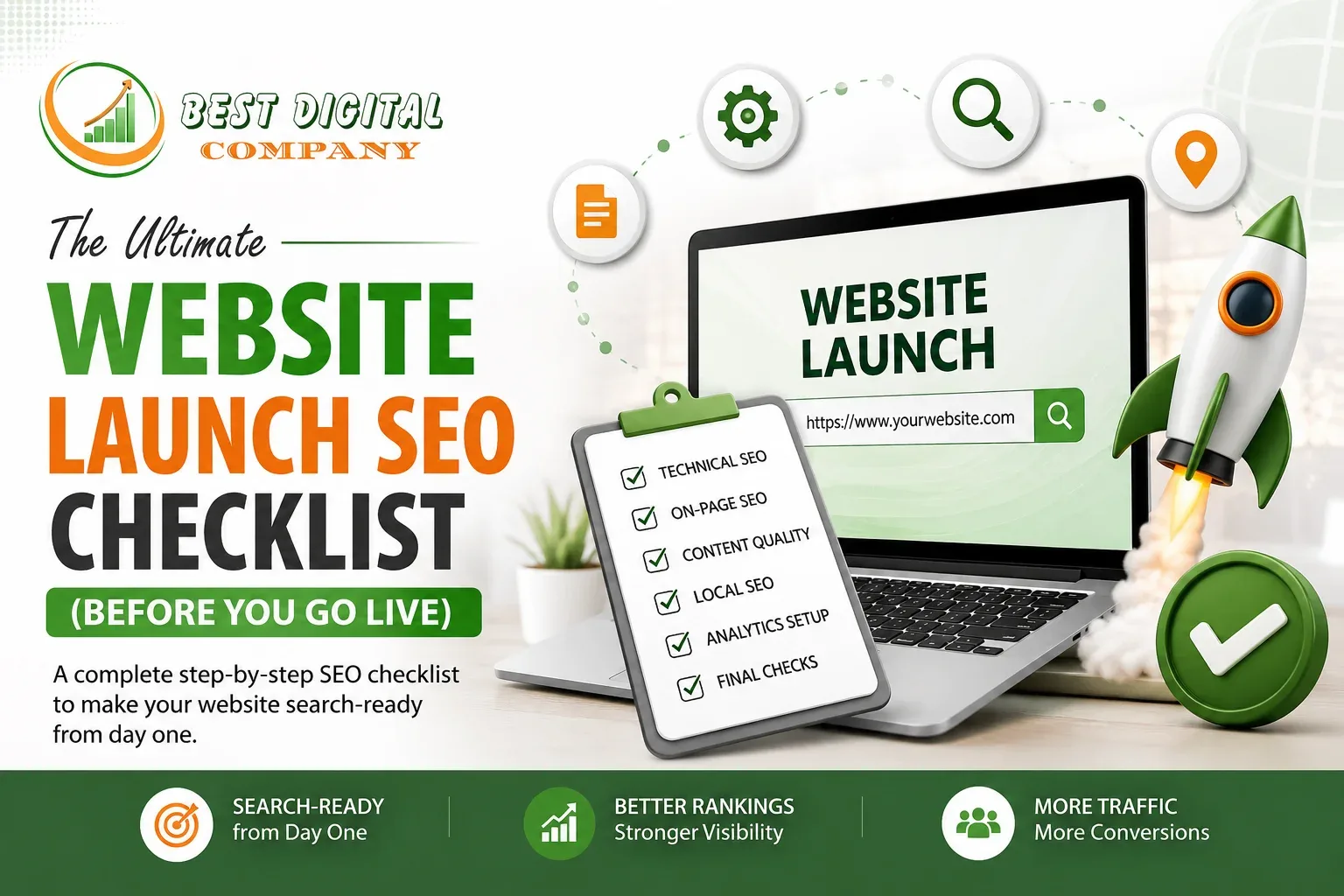
Launching a new website feels like a finish line. In reality, it’s the starting block. We’ve sat through this exact conversation with dozens of clients. The design is signed off, the developers have moved on to the next project, and someone finally asks, “So when do we go live?” That question almost always arrives before anyone has asked the more important one: “Is this site actually ready to be found, indexed, and trusted by Google?”
A website that launches without a proper SEO foundation doesn’t just rank slowly. It can lose months of momentum it never gets back. We’ve written before about how to rank a new website on Google in 90 days, and almost every delay we’ve traced back to one root cause: technical or structural issues that existed from day one and went unnoticed until traffic stalled.
This checklist is the one we personally run through with every client before a single page goes public. It’s not theoretical. It’s the exact sequence we follow internally, broken into the stages that actually matter.
Why Pre-Launch SEO Matters More Than Post-Launch Fixes
Here’s something most business owners don’t realize until it’s too late: Google forms early impressions of a domain the same way a person forms an early impression of a new acquaintance. The first crawl, the first set of indexed pages, the first backlinks all of it shapes how quickly your site is trusted afterward.
Fixing a broken canonical tag or a missing meta description after launch is possible, but it costs you time you can’t buy back. Search engines need to re-crawl, re-evaluate, and in some cases, this delay stretches into weeks. Getting it right before go-live is simply cheaper, both in time and in lost opportunity.
This is also where many businesses confuse two separate problems. We covered this exact dilemma in our piece on website redesign vs SEO optimization. A fresh design and a search-ready structure are not the same thing, and assuming one guarantees the other is where most pre-launch checklists fall short.
Technical Foundations: The Checklist Nobody Skips (But Everyone Forgets Something)
Before content even enters the conversation, the technical skeleton of your site needs to be sound.
- Robots.txt and indexing settings — Confirm your staging site’s “noindex” tag has been removed before launch. We’ve seen entire sites stay invisible to Google for weeks because a developer forgot to flip this one setting.
- XML sitemap — Generate it, validate it, and submit it through Google Search Console the moment the site is live.
- SSL certificate — HTTPS isn’t optional anymore; it’s a baseline trust signal.
- Mobile responsiveness — Test on actual devices, not just browser resize tools.
- Page speed — Run your homepage and top category pages through PageSpeed Insights. Anything scoring poorly on Core Web Vitals should be addressed before launch, not after.
- Broken links and 404s — Crawl the entire site with a tool like Screaming Frog before it goes public.
- 301 redirects — If this is a redesign or migration, every old URL needs a mapped redirect to its new equivalent.
- Structured data (schema markup) — Add appropriate schema for your business type, articles, FAQs, and reviews where relevant.
Getting these fundamentals wrong is one of the quiet reasons we discussed in our article on why businesses fail to generate leads from their websites. The traffic problem often starts as a technical problem that nobody diagnosed correctly.
On-Page SEO: Setting Up Every Page to Earn Its Place
Once the technical layer is solid, every page needs its own identity in the eyes of search engines.
- Unique title tags and meta descriptions for every page no duplicates, no placeholder text left over from development.
- One clear H1 per page, with a logical heading hierarchy beneath it.
- Keyword-aligned URLs that are short, readable, and free of unnecessary parameters.
- Internal linking between related pages, so both users and crawlers can move through your site logically.
- Image optimization — compressed file sizes, descriptive alt text, and proper file naming.
- Canonical tags set correctly to avoid duplicate content issues, especially on e-commerce or filtered category pages.
If your business serves a specific region, your location-based pages deserve particular attention at launch. A client of ours expanding into western India needed their SEO Services in Mumbaipage fully optimized with local schema and city-specific content before the campaign could even start gaining traction. The same logic applies whether you’re targeting SEO Services in Punjab or SEO Services in Haryana regional intent has to be built into the page from the first crawl, not bolted on six months later.
Content Quality: What Google Actually Rewards in 2026
Search engines today are far less interested in keyword density and far more interested in whether your content demonstrates genuine experience, expertise, authority, and trustworthiness. This shift has changed what a “ready to launch” page actually looks like.
Before going live, ask honestly:
- Does each page answer a real question a real visitor would have?
- Is there a visible author, business address, and contact information?
- Does the content avoid thin, recycled descriptions that could appear on any competitor’s site?
- Are claims backed by specifics — case studies, data, or named processes — rather than vague promises?
We explored this shift in depth in our guide on building topical authority in SEO, and the same principle applies at launch: a handful of genuinely useful, well-researched pages will outperform dozens of shallow ones every time.
Landing Pages and Conversion Readiness
A site can rank well and still fail to generate business if the pages people land on don’t guide them anywhere. Before launch, every key landing page should have a clear next step- a contact form, a call button, a quote request placed where visitors will actually see it.
We go into this in detail in our article on creating SEO landing pages that convert, but the short version for a pre-launch checklist is this: traffic without a clear path to action is wasted traffic, no matter how well the page ranks.
Local SEO and Google Business Profile Setup
If your business serves specific cities or states, your Google Business Profile should be claimed, verified, and fully filled out before launch not weeks after. Match your business name, address, and phone number exactly across your website and your profile. Inconsistencies here quietly undermine local trust signals that take months to rebuild once damaged.
This matters especially for region-specific service pages. A business investing in SEO Services in Haryana or SEO Services in Punjab needs its local citations and Business Profile live and consistent from day one, since local search results often reward established, consistent listings over brand-new ones.
Analytics and Tracking: Don’t Launch Blind
It’s surprisingly common for a site to go live without analytics properly installed and by the time someone notices, weeks of launch-period data are gone for good. Before going public, confirm:
- Google Analytics 4 is installed and firing correctly across all key pages.
- Google Search Console is verified and connected.
- Conversion goals (form submissions, calls, purchases) are configured and tested.
- A tag manager setup, if used, is firing events correctly without duplication.
Without this data, you’re flying blind during the most critical early weeks when search engines are deciding how much to trust your new domain.
A Quick Pre-Launch Sanity Check
Right before you flip the switch, run through this final pass:
- Search Console and Analytics are connected and verified.
- Sitemap is submitted and robots.txt allows crawling.
- Every page has a unique title, meta description, and H1.
- Mobile experience has been tested on real devices.
- All forms and conversion points have been tested end-to-end.
- Redirects are in place if migrating from an old site.
- Core Web Vitals scores are within acceptable ranges.
Final Thoughts
A strong launch isn’t about rushing live the moment the design looks finished. It’s about making sure search engines and visitors both arrive to a site that’s technically sound, genuinely useful, and built to earn trust from the very first crawl. Skipping steps here doesn’t save time — it borrows it from your future self, usually with interest.
If you’d rather have this entire checklist handled by people who run it daily, our team at Best Digital Company manages pre-launch SEO audits as part of every web project we take on, alongside ongoing Search Engine Optimization support once you’re live.
Frequently Asked Questions
How long before launch should I start working on SEO?
Ideally, SEO planning should begin alongside the design and development phase, not after the site is built. Site structure, URL planning, and content strategy are far easier to set correctly from the start than to retrofit later.
Will my site rank immediately after launch if I follow this checklist?
No checklist guarantees instant rankings. What this process does is remove the avoidable delays technical errors, missing indexing, weak on-page setup that commonly push rankings back by weeks or months.
Do I need a Google Business Profile if I only operate online?
If you serve any specific geographic area, even partially, a verified profile still helps with local trust signals and can appear in relevant local search results.
What’s the single most common mistake businesses make at launch?
Forgetting to remove the “noindex” tag from a staging environment before pushing the site live. It’s a small technical detail with a large, often unnoticed, impact on visibility.
Should I migrate an old site’s content as-is, or rewrite it for the new launch?
If the old content already serves users well and has earned some trust over time, redirect and preserve it. If it’s thin or outdated, a launch is often the right moment to improve it rather than carry old problems forward.
How often should I revisit this checklist after launch?
Treat it as a living document. Revisit core items Search Console performance, Core Web Vitals, broken links on a monthly basis during the first few months after going live.

Add a Comment