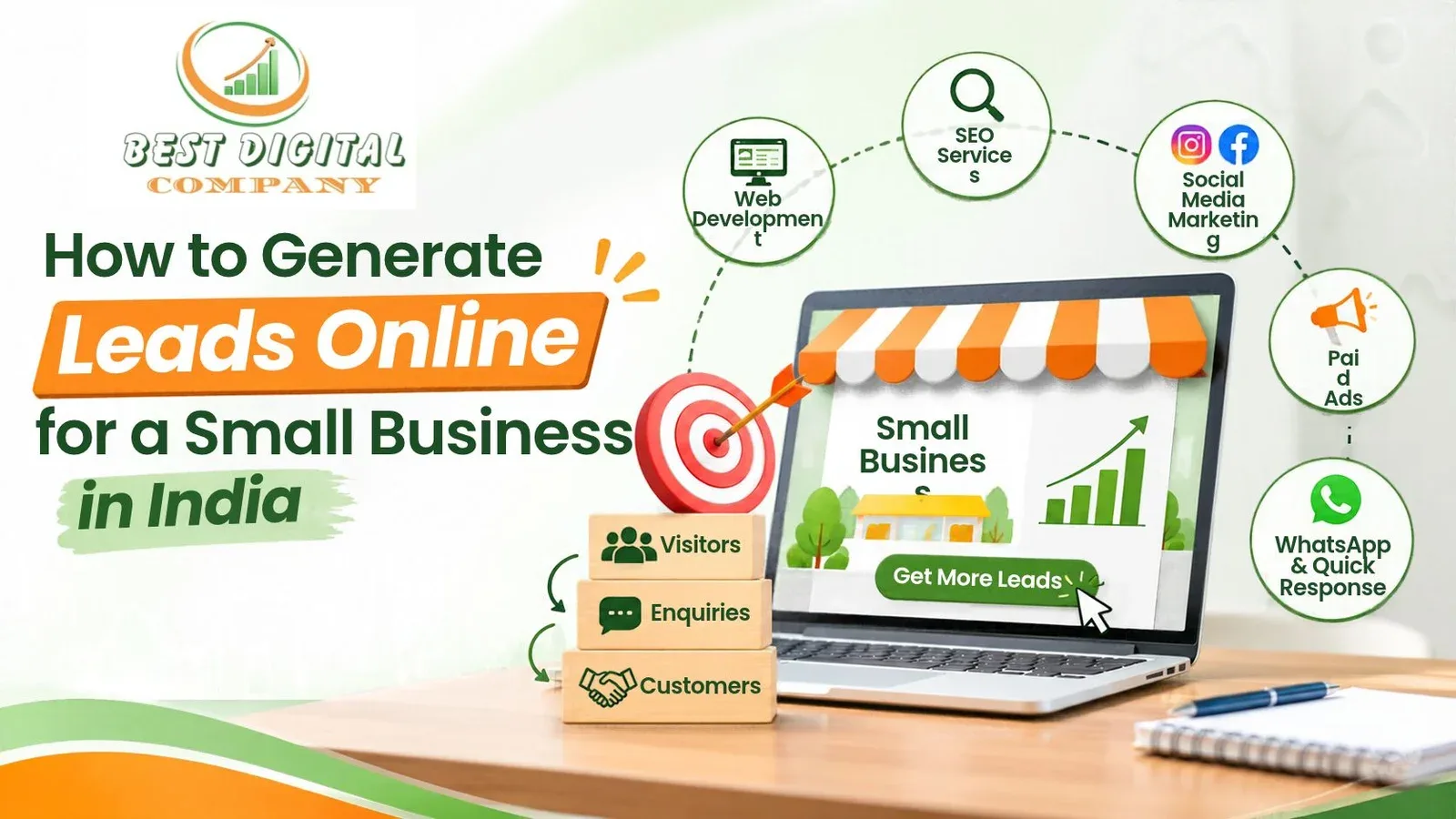
Most small business owners we speak to do not have a traffic problem. They have an enquiry problem. The website gets a few visits, the Instagram page has a decent number of followers, and the phone still stays quiet. If that sounds familiar, you are in the right place.
This guide explains lead generation for small business in practical terms: what works in India, in what order, and what is worth skipping when your budget is limited. It is based on the kind of conversations we have every week with clinic owners, shopkeepers, coaching centres, home-service providers and local agencies. You will not find a magic trick here. You will find a sequence that makes sense, and a way to check whether it is working.
What Lead Generation for Small Business Actually Means
A lead is a real person who has shown interest in what you sell and has given you a way to reach them. That could be a phone call, a form submission, a WhatsApp message or a booking request. A like on a post is not a lead. A website visit is not a lead. They are signals, and they only matter if they turn into a conversation.
This distinction sounds obvious, but it changes how you spend money. When a business measures reach and followers, it ends up buying more reach and followers. When it measures enquiries, it starts fixing the things that stop people from enquiring.
For a small business in India, lead generation usually comes down to four questions:
- Can people who need you find you when they search?
- When they land on your page or profile, do they trust you enough to act?
- Is it easy to contact you in the way they prefer, which in India often means WhatsApp or a phone call?
- When someone does reach out, do you reply fast and follow up properly?
Every section below maps to one of these questions. If you answer all four well, leads follow. If one of them is broken, spending more on the other three will not rescue it.
Fix the Foundation First: Web Development That Converts
Before paying for ads or content, look at the place where all that attention will land. In our experience, this is the most common reason small business marketing disappoints. People arrive, feel unsure, and leave.
A website that generates leads does a few plain things well:
- It loads quickly on a mid-range phone. A large share of Indian visitors browse on mobile data, sometimes on a weak connection. Heavy sliders, uncompressed images and auto-playing videos cost you visitors before they read a word.
- It says what you do in the first screen. “Dental clinic in Laxmi Nagar, Delhi. Book a consultation” beats a vague line about excellence and passion.
- It makes contact effortless. A visible phone number, a WhatsApp button, a short form with three or four fields. Every extra field costs you enquiries.
- It shows proof. Real photos of your team and premises, customer reviews, certifications, the number of years you have been operating, and examples of past work. People in India are cautious about paying a stranger online, and proof lowers that hesitation.
- It has one clear action per page. A service page should lead toward one thing, such as a call or a quote request, not five competing buttons.
If your current site is slow, outdated or hard to use on a phone, a rebuild may be a better first investment than any campaign. Our web development work focuses on exactly this: fast, mobile-first pages with clear calls to action. If you are comparing options, the web development packages page lists what is included at each level so you can plan without surprises.
One practical test: ask a friend who does not know your business to find your phone number or booking option on your site using only their phone. If it takes more than a few seconds, you have found your first fix.
SEO Services: Building a Lead Source That Keeps Paying
Search engine optimisation is slower than advertising, and honest agencies will tell you that. It is also the channel where the effort you put in today can keep producing enquiries for years, without a per-click bill.
The idea is simple. When someone searches for what you offer, you want your business to be among the options they see. For a small business, the most useful approach is usually to target specific, high-intent searches instead of broad ones. A physiotherapist does better chasing “knee pain physiotherapy near Mayur Vihar” than “physiotherapy”. A caterer does better with “wedding catering in Ghaziabad for 300 guests” than “catering services”.
Here is how we usually think about it with clients:
Start with the pages that match buying intent. One dedicated page for each core service, written for the person who is ready to enquire. Include what the service is, who it suits, how it works, how long it takes, rough pricing guidance where you can, and how to get started. Thin pages with a few generic paragraphs rarely earn visibility or trust.
Write for people, then check the technical side. Clear headings, plain language, honest answers to the questions customers actually ask. Then make sure the site is crawlable, loads fast and works on mobile.
Be patient and track the right things. SEO typically takes a few months before the effect becomes visible, and the timeline depends on competition, your site’s history and how consistently you publish and improve. Track enquiries from organic search, not only rankings.
If you want expert help, our search engine optimization service covers on-page work, content, technical fixes and link building, and the SEO packages page outlines the options. We also run regional work, including SEO services in Delhi, SEO services in Mumbai, SEO services in Haryana and SEO services in Punjab, because what works in one city’s market does not always transfer to another.
Search itself is also changing. AI-generated summaries now appear above traditional listings for many queries, and that affects how businesses get discovered. We have explained this in detail in how AI search is changing SEO and in our guide on AI Overviews optimization. If you are still wondering whether it is worth investing at all, our piece on whether SEO still works in 2026 gives a straight answer. For the bigger picture of how traditional, answer-based and AI-driven visibility fit together, read SEO vs AEO vs GEO.
Local SEO in Delhi and Your City: Winning “Near Me” Searches
If customers come from within a few kilometres of your location, local search is likely your highest-value channel. Think of clinics, salons, restaurants, repair shops, tutors, gyms, lawyers, interior designers and home-service businesses.
When someone searches “dentist near me” or “AC repair in Dwarka”, Google shows a map section with a few businesses. Many people call from there without ever visiting a website. That makes your Google Business Profile one of the most important marketing assets you own, and it costs nothing to set up.
What tends to make the difference:
- A complete, accurate profile. Correct business name, address, phone number, hours, categories, services and photos. Inconsistent details across the web confuse both customers and Google.
- Reviews, collected the right way. Ask happy customers at the right moment, make it easy with a direct link, and reply to every review, including the critical ones. We wrote a full walkthrough on how to get more Google reviews without breaking Google’s rules, which matters because shortcuts like buying reviews can get a profile suspended.
- Fresh activity. Posting updates, adding new photos and keeping services up to date signals that the business is active.
- Consistent listings elsewhere. The same name, address and phone number on directories and your own site.
If you are not appearing at all, start with our checklist on why your business is not showing on Google Maps. Once the basics are in place, the guides on Google Business Profile optimization and how to rank higher on Google Maps go deeper into the details.
A question we hear often is whether you need a profile or a website. You need both, and they do different jobs. We covered the trade-offs in Google Business Profile vs website. In short, the profile gets you discovered locally, and the website is where you build enough trust to turn interest into action.
For businesses based in the capital, our local SEO in Delhi service is built around exactly these steps.
Pay Per Click Services: Getting Enquiries This Week
SEO builds slowly. If you need enquiries soon, paid search is the faster route. With Google Ads, you bid to appear when someone searches for a specific term, and you pay when they click.
Paid search works well for lead generation because it captures people at the moment they are looking. Someone typing “best interior designer for 2BHK in Noida” has a need right now. That is a very different audience from someone scrolling past an ad on social media.
It can also drain a small budget quickly if set up carelessly. These are the mistakes we see most often:
- Targeting broad keywords. Bidding on “interior designer” brings clicks from students, job seekers and people in other cities. Specific, location-based and service-based terms bring buyers.
- Sending traffic to the homepage. A person who clicked an ad for “emergency plumber in Rohini” should land on a page about exactly that, with a phone number at the top.
- Skipping negative keywords. Without them, you pay for irrelevant searches such as “free”, “jobs”, “course” or “DIY”.
- Not tracking calls and form submissions. If you only look at clicks, you cannot tell which campaigns produce business.
- Switching things off too early. Campaigns need some time and data to settle. Judging after three days is usually premature, but running for months without review is just as costly.
As a starting point, many small businesses begin with a modest monthly test budget focused on two or three high-intent services in one area, then scale what produces real enquiries. The right figure depends on your industry, since a click for legal or medical services costs far more than a click for a local grocery delivery.
Our pay per click services cover campaign setup, ad copy, landing pages and ongoing optimisation, and you can compare plans on the PPC packages page.
Social Media Marketing for Lead Generation
Social media works differently from search. People are not actively looking for you, so your job is to be useful, visible and trustworthy until they need what you offer. It is a slower route to a lead than search ads, but for many businesses it is where the relationship starts.
The platform matters less than the match with your customers:
- Instagram and Facebook suit consumer businesses such as salons, restaurants, fitness studios, boutiques, education and home services. Short videos showing real work, before-and-after results and customer stories tend to outperform polished brand graphics.
- LinkedIn suits B2B services, consultants, agencies, manufacturers and professionals. Thoughtful posts from the founder often outperform the company page.
- YouTube suits businesses with complex products or services where people research before buying, such as solar installation, real estate, or education.
- WhatsApp Business is less a social platform than a sales channel in India. A catalogue, quick replies and a clear greeting message can turn it into a lead desk.
A few habits make a real difference. Show actual people and actual work, because stock images build no trust. End posts with a specific next step, such as “message us on WhatsApp for a quote”. Respond to comments and direct messages quickly, since a slow reply loses leads that were warm an hour earlier. If you run paid social, use lead forms or click-to-WhatsApp ads and keep the offer specific.
If you want a team to handle this, our social media marketing service covers content, community management and paid campaigns, and the SMO packages show how engagement is structured month by month.
Content That Builds Trust Before the Enquiry
People rarely hire or buy the moment they first hear about you. They compare, read, ask friends and look for reassurance. Content is how you stay in the room during that decision.
Useful content for a small business is not complicated. It answers the questions your customers ask you in person:
- How much does this usually cost, and what changes the price?
- How long will it take?
- What can go wrong, and how do you handle it?
- How is your service different from the cheaper option down the road?
- What should I prepare before I come to you?
Write these answers from experience. If you are a physiotherapist, describe what a typical first session looks like. If you are an electrician, explain how to tell a minor fault from a safety risk. Specific, first-hand detail is what separates helpful content from filler, and it is also what readers and search engines increasingly reward. Add the author’s name and credentials, show real photos, and keep information current.
A good rhythm for a small team is one solid article or detailed service page per month, plus short videos or posts drawn from the same material. That is more sustainable than publishing daily and running out of ideas by week three.
Capture and Follow Up: Where Most Leads Quietly Disappear
This is the least glamorous part of the process and often the most profitable to fix. Many businesses generate enquiries and then lose them through slow or inconsistent follow-up.
Consider what happens in practice. Someone fills in a form at 9 pm. The owner sees it the next afternoon and calls once. No answer, so the lead is forgotten. Meanwhile, the customer has already spoken to a competitor who replied in ten minutes.
A few simple rules prevent this:
- Reply fast. Aim for minutes, not hours. An automatic acknowledgement message on WhatsApp or email helps when you cannot respond immediately.
- Use the channel the customer used. If they messaged on WhatsApp, reply there before calling.
- Follow up more than once. Many sales happen on the second or third contact. Space them out and add something useful each time, such as a quote, a photo, or an answer to an unspoken doubt.
- Keep a simple record. A spreadsheet with name, number, source, date, status and next step is enough to begin with. A basic CRM is a good upgrade once volume grows.
- Ask lost leads why. A short, polite question about why they chose someone else teaches you more than a month of guessing.
Tracking What Works: The Numbers That Matter
You do not need a complicated dashboard. You need to know where enquiries come from and what they cost.
Start with these:
- Number of leads per channel (organic search, Google Maps, paid search, social, referral, direct).
- Cost per lead for any paid channel.
- Lead-to-customer rate, meaning how many enquiries become paying customers.
- Cost per customer, which is the figure that tells you whether a channel is truly profitable.
- Response time, because it quietly drives all the others.
Set up call tracking and form tracking so you can attribute enquiries properly. Ask every new customer how they found you, and record the answer. Self-reported data is imperfect, but it catches things analytics miss, like a customer who saw your Instagram, searched your name on Google and then called.
Review monthly. Double down on channels producing customers, fix or pause those that only produce clicks.
A Realistic 90-Day Plan for a Small Business
Here is a sequence we often recommend when a business is starting from a modest base. Adjust it to your industry and budget.
Month 1: Foundations. Audit the website for speed, mobile usability and contact options. Claim and complete the Google Business Profile. Add a WhatsApp button and a click-to-call option. Create or improve pages for your top two or three services. Set up tracking.
Month 2: Visibility. Publish service pages and one in-depth article that answers a common customer question. Start collecting reviews with a simple process. Launch a small, tightly targeted paid search campaign for your most profitable service. Begin posting consistent, real content on the one or two social platforms your customers use.
Month 3: Refine and expand. Review which channels produced enquiries and which produced customers. Move budget toward what works. Improve landing pages based on how visitors behave. Add follow-up routines and, if volume justifies it, a basic CRM. Plan the next quarter’s content.
By the end of this period you should have a clearer picture of your cost per lead, and a base that supports longer-term growth through search.
Mistakes That Hold Small Businesses Back
A short list from what we see repeatedly:
- Starting with ads while the website is slow or unconvincing.
- Trying every platform at once instead of doing two things well.
- Buying followers, reviews or cheap backlinks. These shortcuts tend to cause harm later.
- Copying competitors’ content word for word, which adds nothing for the reader.
- Measuring likes and impressions instead of enquiries and customers.
- Expecting overnight results from SEO or giving up on it after six weeks.
- Ignoring leads after the first missed call.
Which Channel Should You Start With?
There is no single answer, but a few patterns hold up:
- Local service or walk-in business (clinic, salon, repair, restaurant): start with Google Business Profile and local SEO, then add paid search for urgent-intent services.
- Service business serving a wider area (consultants, agencies, contractors): invest in SEO-driven service pages and paid search, and add LinkedIn if you sell to businesses.
- Visual or lifestyle brands (fashion, food, fitness, decor): lead with Instagram and Facebook, supported by a fast website and Google Maps for local discovery.
- High-consideration purchases (education, real estate, solar, healthcare): combine detailed content, reviews, paid search and strong follow-up, because the decision takes time.
If you are unsure, a short audit of your current website, profile and competitors usually points to the best starting point. You can reach us through the contact page or learn more about our team.
Frequently Asked Questions About Lead Generation for Small Business
What is the fastest way to generate leads online for a small business?
Paid search through Google Ads is usually the fastest, because it places you in front of people already searching for your service. Pair it with a focused landing page and a quick follow-up process. Setting up and completing your Google Business Profile is also fast and free, and often produces local calls within weeks.
How much should a small business in India spend on lead generation?
There is no fixed number. It depends on your industry, location, average order value and how much competition you face. A sensible approach is to start with a modest test budget, measure cost per lead and cost per customer, and increase spending only on channels that return more than they cost.
Is SEO or paid advertising better for small business leads?
They serve different purposes. Paid advertising brings enquiries quickly but stops when you stop paying. SEO takes longer but can produce steady enquiries over time at a lower ongoing cost. Many small businesses use paid search to get early results while SEO matures.
How long does it take to see results from SEO?
Most businesses begin to see movement within a few months, and stronger results come with consistent work over six months or longer. Timelines vary with competition, your website’s current condition and the quality of the content you publish.
Can I generate leads without a website?
Yes, to an extent. A Google Business Profile, WhatsApp Business and social media can bring in enquiries. Still, a website gives you a place to build trust, explain your services in depth and rank for searches. Over time, businesses with a good website tend to convert more of the attention they earn.
Which social media platform is best for lead generation in India?
It depends on your customers. Instagram and Facebook suit most consumer-facing businesses, LinkedIn suits B2B, and YouTube suits businesses where buyers research before deciding. Pick the one or two platforms where your customers already spend time rather than trying to be everywhere.
How do I know if my leads are good quality?
Track how many leads become paying customers and how much each customer costs you. A channel that sends many enquiries but few customers is not working, even if the lead count looks impressive. Tighter targeting and better qualifying questions on your forms usually improve quality.
Do Google reviews really help generate leads?
Yes. Reviews influence both where you appear in local results and whether people choose you once they see you. Collect them honestly, reply to all of them, and never buy or fake reviews.
Should I hire an agency or manage lead generation myself?
If you have the time to learn and test, you can handle the basics yourself, such as your Google Business Profile, a simple site and organic social posts. An agency becomes useful when you need specialist work like technical SEO, ad management or a website rebuild, or when your time is better spent running the business.
How often should I review my lead generation results?
Check leads weekly so you can respond to problems quickly, and do a deeper review monthly to decide where to invest next.
Final Thoughts
Lead generation for small business is not about doing everything. It is about getting the basics right and building on them in a sensible order: a trustworthy website, a complete local presence, content that answers real questions, advertising that targets real intent, and a follow-up habit that does not let warm enquiries go cold.
If you would like a second opinion on where your business stands, the team at Best Digital Company is happy to review your website, profile and current marketing and suggest a starting point. Call us on +91 8587948051, write to Contact@bestdigitalcompany.com, or visit our contact page to begin.