PPC Advertising Agency vs Company

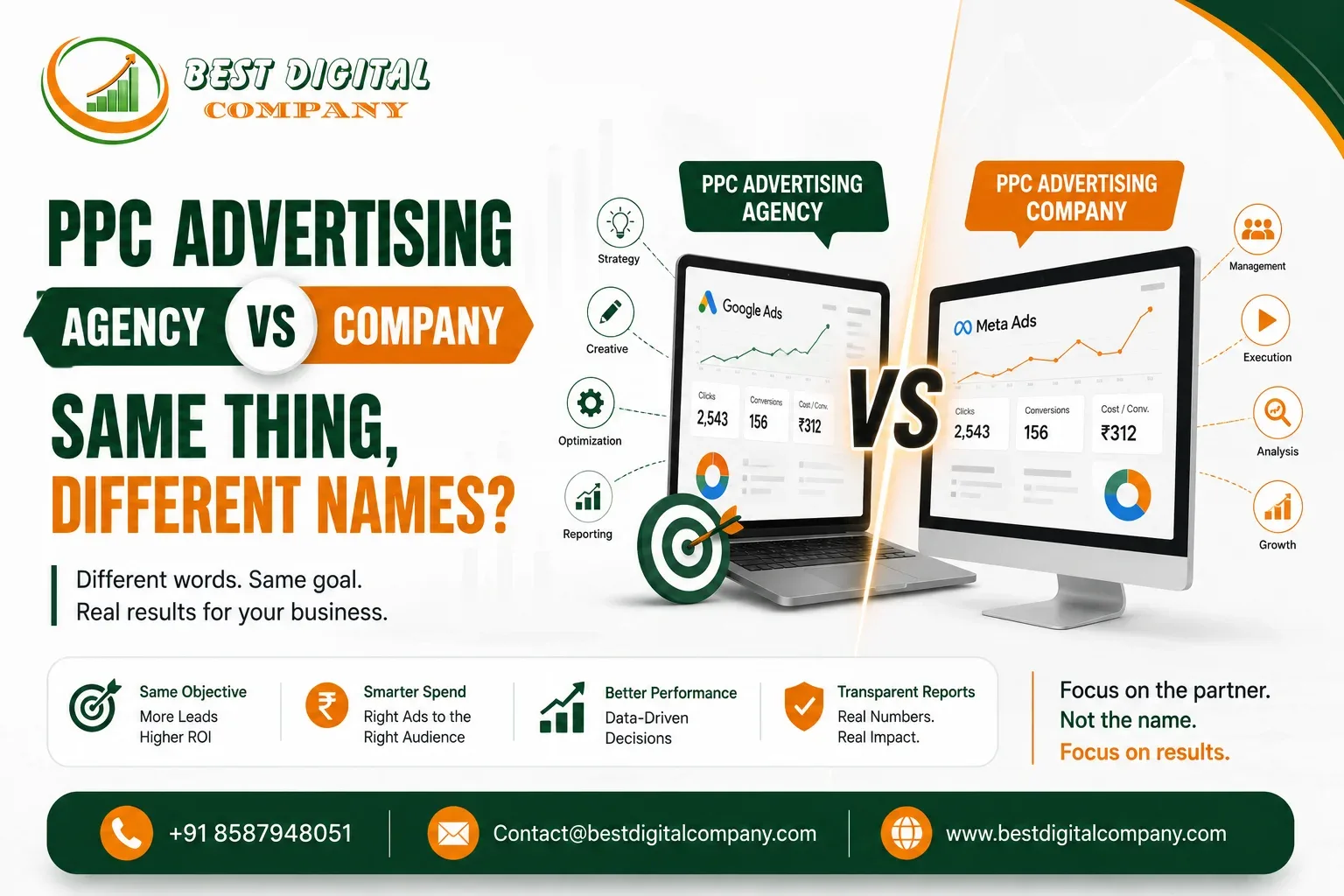
PPC Advertising Agency vs PPC Advertising Company: Same Thing, Different Names?

If you have ever searched for paid advertising help online, you have probably typed both phrases into Google without giving it a second thought  “PPC advertising agency” and “PPC advertising company.” You clicked on results for both. You compared pricing pages that looked almost identical. You may have even filled out two contact forms just to see if the replies sounded different. They probably didn’t.

This happens to almost every business owner who is new to paid search. You assume there must be some hidden distinction, some technical difference that separates one from the other, the way a “clinic” differs from a “hospital.” So you keep digging, hoping the next Google search will finally explain it.

Here is the honest answer: in the world of pay-per-click advertising, the terms PPC advertising agency and PPC advertising company are used interchangeably by almost everyone in the industry, including the businesses that hire them. There is no legal, regulatory, or universally accepted rulebook that says one label means something different from the other. What actually matters is not the word on the homepage. It is what happens after you sign the contract.

This article breaks down where the terms overlap, where subtle differences sometimes show up in practice, and what you should actually be evaluating when you’re choosing a partner to manage your Google Ads or Meta Ads budget.

What Does a PPC Advertising Agency Actually Do?

When most people say “agency,” they are picturing a team: strategists, ad copywriters, a data analyst who lives inside spreadsheets, and an account manager who calls you back when something goes wrong. The word “agency” carries a slightly more collaborative, creative connotation. It suggests a group of specialists working together on your campaigns rather than a single person running your ads between other tasks.

In practice, a PPC advertising agency typically handles:

  • Keyword research and competitor analysis before a single rupee is spent
  • Campaign structure across Google Ads, Bing Ads, and social platforms
  • Ad copywriting and creative testing
  • Landing page feedback (even if they don’t build the page themselves)
  • Bid management and budget pacing
  • Weekly or monthly reporting tied to actual business outcomes, not just clicks

The agency model tends to work well for businesses that want a partner involved in strategy, not just execution. If you want someone asking “why” before they start spending your budget, this is usually the structure you are looking for.

What Does a PPC Advertising Company Really Mean?

“Company” is a broader, more formal business term. It simply describes a registered business entity that offers PPC as one of its services which, technically, describes almost every agency too. A company might be a large operation with multiple departments, or it could be a smaller outfit that prefers the word “company” because it sounds more established to conservative, traditional clients.

There is a small but real pattern worth noting: some businesses that call themselves a “company” lean slightly more transactional. You give them a budget and a goal, they manage the account, and reporting is more standardized. This is not a rule plenty of companies are just as strategic and hands-on as any agency but if you are comparing two nearly identical-looking websites and trying to guess their working style from the name alone, don’t. The name tells you almost nothing reliable about how they’ll actually run your campaigns.

PPC Advertising Agency vs PPC Advertising Company: Where the Real Differences Show Up

Since the terminology itself won’t tell you much, here is where you should actually be looking for differences before signing anything.

1. Team Structure Behind Your Account

Ask directly: will one person manage my account, or will I have access to a strategist, a copywriter, and an analyst? Some smaller “companies” run PPC as a side service with one generalist handling everything. Larger “agencies” often split responsibilities across specialists. Neither structure is automatically better a skilled generalist who lives and breathes your account can outperform a fragmented team but you need to know what you’re paying for.

2. Reporting Transparency

A trustworthy partner, whether they call themselves an agency or a company, will show you real numbers: cost per lead, conversion rate, return on ad spend, and wasted spend on irrelevant search terms. If a business regardless of the label on their homepage only sends you screenshots of “impressions” and “clicks” without tying them to leads or revenue, that’s a red flag that has nothing to do with naming.

3. Platform Certifications and Experience

Google Ads certifications, Google Partner badges, and case studies with real client names and numbers matter far more than whether the word “agency” or “company” appears in the footer. Ask how long they’ve managed accounts in your industry, and ask for at least one reference you can actually call.

4. Contract Flexibility

Some companies push long, rigid annual contracts. Some agencies offer month-to-month terms because they are confident in their results. This variation exists across both types of businesses and is a much better filter than the name itself.

Why the Confusion Exists in the First Place

Part of the confusion comes from how these businesses market themselves. A single-person freelancer might register as “XYZ Company” simply because it sounds more credible on a proposal. Meanwhile, a 40-person operation might keep the word “agency” purely because that’s what their original founders chose in year one, long before the business grew into something bigger.

Search behavior adds to the confusion too. People searching for “PPC advertising agency” and people searching for “PPC advertising company” are, in most cases, looking for the exact same outcome: someone to manage their paid ads profitably. Because of this overlapping intent, most businesses including ours use both terms across their website simply to be found by people using either phrase, not because the words describe two different services.

How Pay Per Click Services Fit Into the Bigger Picture

Regardless of which label a business uses, what you are really buying is Pay Per Click management the ongoing, hands-on work of running paid campaigns so that your ad spend turns into actual leads and sales instead of vanishing into clicks that never convert. This includes campaign setup, audience targeting, ongoing bid adjustments, negative keyword management, and conversion tracking.

If you are comparing costs across different providers, it also helps to look at how they structure pricing. Some offer flat monthly retainers bundled into PPC Packages, while others quote custom pricing based on your ad spend and campaign complexity. Neither approach is wrong, but you should understand exactly what’s included account setup, monthly management, reporting, and ad creative before comparing two quotes side by side.

It is also worth remembering that PPC rarely works in isolation. A paid campaign sending traffic to a slow, poorly designed landing page will underperform no matter how well the ads themselves are built. This is where Website Development & Designing plays a supporting role  your ad quality score and conversion rate both depend partly on the page people land on after clicking. Similarly, businesses running paid ads alongside organic efforts like Search Engine Optimization or Social Media Marketing tend to see paid campaigns perform better, because brand familiarity from other channels makes people more likely to click and convert when they see your ad.

Signs You are Working With the Right Partner, Whatever They Call Themselves

Instead of worrying about the label, watch for these signals during your first few conversations with any potential PPC partner:

They ask about your business before quoting a price. A generic proposal sent within minutes of your first message, with no questions about your margins, average order value, or sales cycle, usually means you’ll get a generic campaign too.

They explain their reporting cadence upfront. Weekly check-ins, monthly deep-dive reports, or a shared live dashboard any of these work, as long as it’s clearly defined before you sign anything.

They’re honest about timelines. PPC can generate traffic almost immediately, but meaningful optimization the kind that actually lowers your cost per lead usually takes 60 to 90 days of data collection and testing. Anyone promising instant, dramatic results in week one is setting expectations that rarely hold up.

They show you real account data, not just claims. Ask to see anonymized screenshots of an actual Google Ads account they manage. A confident, experienced team will have no hesitation showing you.

They talk about your business goals, not just clicks. Clicks and impressions are vanity metrics if they don’t translate into leads, calls, or sales. The right partner ties every recommendation back to your bottom line.

PPC Advertising Agency or Company: How to Choose the Right One for Your Business

Here’s a practical way to approach the decision without getting stuck on terminology:

  1. Shortlist three to five providers, regardless of whether they call themselves an agency or a company.
  2. Request a short discovery call with each one. Notice who asks better questions about your business — that usually predicts who will run better campaigns.
  3. Compare their reporting samples, not just their pricing sheets.
  4. Ask about account ownership. You should always retain ownership of your own Google Ads account, even if the agency or company manages it day to day. If a provider insists on keeping the account under their own login with no transfer option, treat that as a serious warning sign.
  5. Start with a trial period if possible — a three-month engagement is usually enough to judge communication, transparency, and early performance trends before committing to a longer contract.

The label on their website should be the last thing on your checklist, not the first.

How This Compares to Other “Agency vs Company” Debates

This naming confusion isn’t unique to paid advertising. The same question comes up constantly in SEO, where business owners wonder whether an “SEO agency” ranks websites any differently than an “SEO company.” It does not the same logic applies: look past the label and focus on process, transparency, and results.

The debate also shows up in social media marketing, where businesses often struggle to decide between hiring an outside team or building things in-house, a comparison covered in more detail in our piece on social media marketing company vs in-house team. And if you’ve ever wondered what actually separates a results-driven social media partner from one that just posts for the sake of posting, our guide on choosing a social media marketing agency walks through exactly what to look for.

If you want a deeper look specifically at what happens after you sign a PPC contract the actual monthly work involved in managing campaigns. We have broken that down in PPC Services Explained: What a Performance Marketing Agency Really Does Every Month. And if you’re still comparing your options at a broader level, our guide on how to choose the best PPC company for your business covers additional evaluation criteria beyond what’s discussed here.

Final Verdict: Same Thing, Different Names?

Yes for all practical purposes, a PPC advertising agency and a PPC advertising company are the same thing wearing different labels. The terms describe the same core service: managing paid advertising campaigns so that your ad spend turns into measurable business results. The word choice usually comes down to branding preference, not a meaningful difference in capability, pricing, or working style.

What genuinely separates a strong PPC partner from a weak one has nothing to do with whether “agency” or “company” appears in their domain name. It comes down to their transparency around reporting, their willingness to let you keep ownership of your own ad accounts, their honesty about realistic timelines, and their track record with businesses similar to yours.

When you are ready to compare quotes, spend less time reading footers and more time asking direct questions about process, past results, and account ownership. That’s where the real answers live not in the label.

If you’d like a no-pressure conversation about your current paid advertising setup, or you are comparing providers and want a second opinion on a proposal you’ve already received, feel free to contact us. We are happy to walk through what a realistic PPC strategy would look like for your specific business and budget.


Frequently Asked Questions

Is a PPC advertising agency more expensive than a PPC advertising company?

Not inherently. Pricing depends on the scope of work, your ad spend, and the complexity of your campaigns not on whether the provider calls itself an agency or a company. Always compare what’s actually included in the quote: setup, management, reporting, and ad creative.

Which one should I choose for a small business — an agency or a company?

Choose based on the team’s experience with businesses your size, their communication style, and their reporting transparency. The label itself won’t tell you whether they’re a good fit; a short discovery call will.

Do PPC advertising agencies only manage Google Ads?

No. Most agencies and companies manage campaigns across multiple platforms, including Google Ads, Bing Ads, Meta Ads (Facebook and Instagram), and increasingly LinkedIn Ads for B2B businesses. Ask specifically which platforms are included in your package.

How long does it take to see results from PPC advertising?

Traffic can start almost immediately after launch, but meaningful optimization where cost per lead starts dropping and conversion rates improve typically takes 60 to 90 days as the account gathers enough data to make informed adjustments.

Should I own my own Google Ads account, or is it fine if the agency owns it?

You should always retain ownership of your own advertising accounts, even when an agency or company manages them on your behalf. This protects your data, your ad history, and your ability to switch providers without starting from zero.

What is the difference between PPC packages and custom PPC pricing?

Packages bundle a fixed set of services at a set monthly rate, which works well for businesses with predictable, smaller budgets. Custom pricing is usually based on a percentage of ad spend or a tailored scope, which tends to suit businesses with larger or more complex campaigns.
PPC Company vs PPC Agency

PPC Company vs PPC Agency: Which Model Fits Your Ad Budget?

A few weeks ago, we sat across two proposals from a client who was comparing offers before committing to paid advertising. One provider called itself a PPC company. The other called itself a PPC agency. The pricing was different, the contracts read differently, and the client had no idea why two businesses doing what sounded like the exact same job were priced so far apart.

This mix-up is more common than most business owners realize. The terms “PPC company” and “PPC agency” get used almost interchangeably in marketing conversations, yet in practice they often describe two different ways of running paid ad campaigns different team structures, different pricing logic, and different minimum budgets to make the relationship worthwhile. Picking the wrong one for your current budget is how businesses end up either overpaying for infrastructure they don’t need yet, or underpaying for a level of hands-on strategy their ad spend actually requires.

This guide breaks down what genuinely separates a PPC company from a PPC agency, how each one prices its work, and how to match the right model to the budget you actually have not the budget you hope to have in a year.

“PPC Company” and “PPC Agency” – What the Terms Actually Mean

There’s no official rulebook that defines these two labels, which is exactly why so much confusion exists. But when you look past the branding, a pattern shows up consistently across the industry.

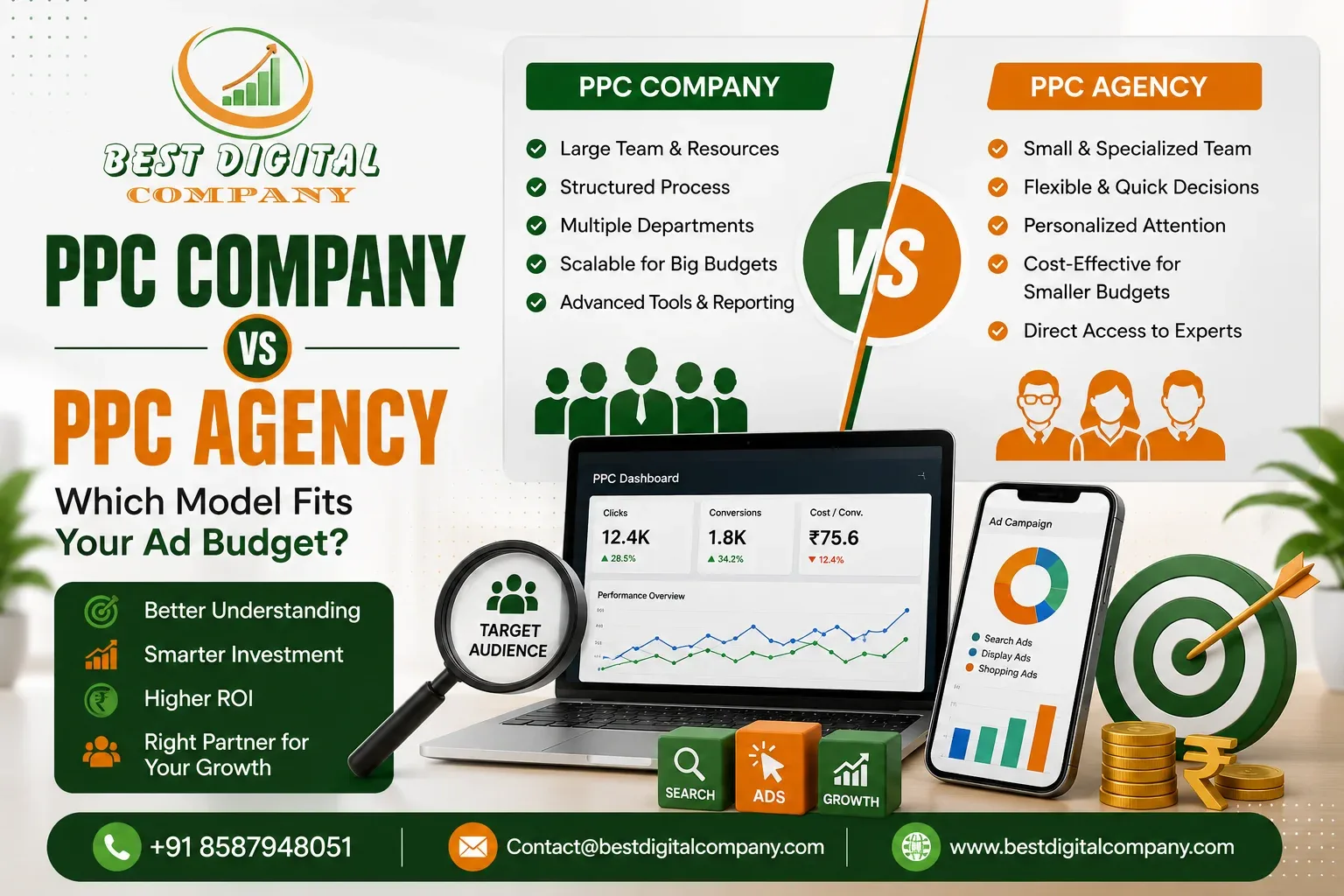
A PPC company usually refers to a larger, more process-driven organization. It typically runs paid campaigns as one service line among several SEO, web development, social media and has dedicated departments for each. You are usually assigned a named account manager who sits between you and the specialists actually touching your Google Ads or Meta Ads account.

A PPC agency, on the other hand, often leans smaller and more specialized. Some are boutique teams built entirely around paid advertising, with founders or senior strategists still directly involved in client accounts. There’s usually less internal hierarchy, which can mean faster decisions, but also a smaller bench if the team gets overloaded.

Neither structure is inherently better. They are simply built for different situations, and your ad budget is one of the clearest signals for which one you should be talking to first.

Inside a PPC Company – Team, Process, and Who Actually Touches Your Account

When you sign with a PPC company, you are usually buying into a defined process rather than a single expert’s judgment. That has real advantages once your budget crosses a certain size.

Most PPC companies structure client work in layers: an account manager who communicates with you, a strategist who plans the campaign, and specialists who handle execution across Search, Display, Shopping, or video. This layered setup means the business doesn’t grind to a halt if one team member is on leave or moves to a different project. There’s institutional memory in how campaigns are documented, reported, and handed off.

The tradeoff is that you’re often one account among many being run through a standardized playbook. Reporting formats, campaign structures, and check-in schedules tend to follow a template designed to scale across dozens of clients, not built from scratch around your specific business. For businesses with a straightforward product and a clear target audience, this rarely matters. For businesses with unusual sales cycles or niche audiences, it can feel like the process wasn’t really built with them in mind.

You can see how this kind of structured approach is usually packaged by browsing a typical PPC services offering, which is generally organized into tiers rather than fully custom scopes.

Inside a PPC Agency – Flexibility, Specialization, and Direct Access

A PPC agency tends to operate with fewer layers between you and the person actually managing your bids. In smaller, specialist agencies, it’s common to work directly with the strategist running your campaigns rather than routing every question through an account manager first.

This closeness can be a genuine advantage when your business needs fast decisions a sudden competitor move, a flash sale, a product launch that needs a campaign live within a day. Smaller agencies typically carry less internal process overhead, so changes can happen faster.

The flip side is capacity. A boutique PPC agency with a handful of specialists has a ceiling on how many accounts it can run well at once. If it takes on too many clients, response times slow down and campaigns get less attention, even though the pricing structure hasn’t changed. It’s worth asking directly how many active accounts a given specialist is currently managing before you sign anything a fair question that a confident agency should answer without hesitation.

PPC Company vs PPC Agency: Where the Cost Difference Actually Comes From

The pricing gap between these two models is not random. It comes down to overhead.

A PPC company carries the cost of account managers, dedicated reporting tools, larger office infrastructure, and multiple specialist departments. That overhead gets distributed across every client relationship, which usually means higher minimum retainers, but also more redundancy if something goes wrong internally.

A PPC agency, especially a leaner one, carries less overhead. Retainers can be lower, and some smaller agencies are willing to work with tighter monthly budgets that a bigger PPC company wouldn’t consider worth the account management time.

Both models typically charge in one of three ways: a flat monthly retainer regardless of ad spend, a percentage of your total ad spend (commonly somewhere between 10% and 20%), or a hybrid  a smaller flat fee plus a percentage once spend crosses a certain threshold. None of these structures is automatically better. A flat fee protects you as your budget scales, since the management cost doesn’t grow with it. A percentage model can align incentives, since the provider only earns more by helping you spend more effectively, though it’s worth asking how they define “effectively” before agreeing to it.

Which Model Fits a Small or Just-Starting Ad Budget

If you’re working with a modest monthly ad budget enough to test one or two campaigns rather than run a full multi-platform strategy a leaner PPC agency is usually the more practical starting point.

Larger PPC companies often set minimum retainers that make sense only once your ad spend itself is substantial enough to justify the account management layer. A smaller agency, or even a specialist freelancer working within an agency structure, can typically build a focused campaign around a tighter budget without insisting on services you don’t need yet, like dedicated creative production or multi-platform reporting dashboards.

This stage is also where getting the fundamentals right matters more than scale. If you’re building your very first customer base through digital channels, it’s worth reading our guide on how small businesses can get their first 100 customers, since paid ads at this budget level work best when paired with a clear, realistic acquisition plan rather than treated as a standalone fix.

Which Model Fits a Growing Mid-Size Budget

As your monthly ad spend grows, the conversation usually shifts from “can we afford management” to “what are we getting for it.” This is the range where the difference between a PPC company and a PPC agency starts to matter the most, because both can now justify their pricing, but the value they deliver looks different.

A PPC company tends to shine here because your budget can now support proper testing across multiple campaign types Search, Shopping, Display, and remarketing run by specialists in each area rather than one generalist handling everything. A well-run PPC agency at this budget level can compete just as effectively, but it depends heavily on whether the team has genuinely grown its capacity or is simply stretched thinner across more clients.

At this stage, reporting quality also becomes a real differentiator, since you are now making budget decisions based on the numbers you’re being shown. If a provider’s reports leave you more confused than informed, that’s worth addressing early our piece on how to create an SEO report clients actually understand covers the same reporting principles that apply just as much to paid campaigns as they do to organic performance.

It’s also the point where your landing pages start carrying real weight. A growing budget sending traffic to a page that wasn’t built to convert is money left on the table, which is why many mid-size accounts eventually pair PPC with support from a web development team to fix conversion gaps rather than just increasing ad spend to compensate.

Which Model Fits a Large or Multi-Channel Ad Budget

Once your budget supports running campaigns across several platforms at once Google, Meta, LinkedIn, YouTube a full-service PPC company generally becomes the more sustainable choice, mainly because of what it takes to run that scope well.

Multi-channel advertising isn’t just “more of the same campaign” spread across platforms. Each channel has its own bidding logic, creative requirements, and audience behavior. A PPC company with dedicated specialists per platform can manage this without one person being stretched across skill sets they only partially know. A smaller PPC agency can still deliver at this level, but only if it has genuinely built out specialist coverage rather than asking one team to cover everything.

At this budget size, paid advertising also tends to work best when it’s coordinated with your broader organic strategy rather than run in isolation. Businesses investing seriously in search engine optimization and social media marketing alongside PPC typically see paid campaigns perform better, since brand familiarity built through organic channels tends to lower the cost of paid clicks over time.

Six Questions to Ask Before You Choose a PPC Company or PPC Agency

Regardless of which model you’re leaning toward, a short list of direct questions can save you months of wasted spend:

  1. Who exactly will manage my account day to day – a named specialist, or a rotating team member depending on availability?
  2. What is your minimum monthly retainer, and does it change if my ad spend grows?
  3. How many other active accounts is my specialist currently managing?
  4. Can I see a sample report before signing, not just a description of what reporting looks like?
  5. What happens if the first month underperforms — is there a review point built into the contract, or am I locked in regardless?
  6. Do you handle landing page recommendations, or only the ad side of the campaign?

A provider that answers these clearly and specifically, rather than in vague reassurances, is usually signaling that they run a real process whether they call themselves a company or an agency.

How Best Digital Company Supports Every Budget Level

We work with businesses across this entire range, from a first-time advertiser testing a single campaign to established brands running paid ads across multiple platforms alongside SEO and social. Rather than pushing every client toward the same package, we start by understanding what your current budget can realistically support and build the campaign structure around that, not the other way around.

If your budget is still modest, we will tell you honestly whether it makes more sense to start lean and scale, rather than signing you up for a retainer sized for a bigger spend than you currently have. If you are ready to run a full multi-channel strategy, our team covers Search, Shopping, Display, Meta, and LinkedIn advertising, backed by the same reporting clarity we bring to our SEO clients. You can see current retainer structures on our PPC packages page, or reach out through our contact page for a straightforward review of what your current budget could realistically achieve before you commit to either model.


Frequently Asked Questions

Is a PPC company always more expensive than a PPC agency?

Not always, but it’s common. PPC companies carry more internal structure account managers, larger teams, dedicated reporting systems and that overhead is usually reflected in higher minimum retainers. Smaller PPC agencies often have lower minimums, though pricing varies enough that it’s worth getting quotes from both before assuming either is automatically cheaper.

Can a PPC agency handle a large, multi-platform ad budget?

Yes, if the agency has genuinely built out specialists for each platform rather than stretching a small generalist team across everything. Ask directly how many people work on each channel before assuming a smaller agency can’t scale with you.

What’s the minimum ad budget needed to work with a PPC company?

This varies by provider, but many PPC companies set retainers that only make financial sense once your ad spend itself is substantial enough to justify dedicated account management. If your budget is still small, a leaner PPC agency is usually a more practical starting point.

Do PPC companies and PPC agencies charge in the same way?

Both typically use one of three models: a flat monthly retainer, a percentage of ad spend, or a hybrid of the two. The pricing model matters more than the label ask how a provider charges before comparing them purely on the word “company” or “agency.”

Should I start with a PPC agency and move to a PPC company later?

Many businesses do exactly this. It’s common to start with a smaller, more flexible agency while testing what works, then move to a larger PPC company once ad spend and reporting needs grow beyond what a lean team can comfortably manage.

How do I know if my current provider company or agency is worth the cost?

Look past the label and focus on outcomes: are you getting account-level visibility, clear reporting tied to leads or sales, and honest communication about what’s working versus what isn’t. A provider delivering all three is worth the retainer, regardless of whether it calls itself a company or an agency.


Not sure whether a PPC company or a PPC agency fits where your business is right now? Talk to Best Digital Company for a free, no-pressure review of your current ad budget and what it can realistically support.