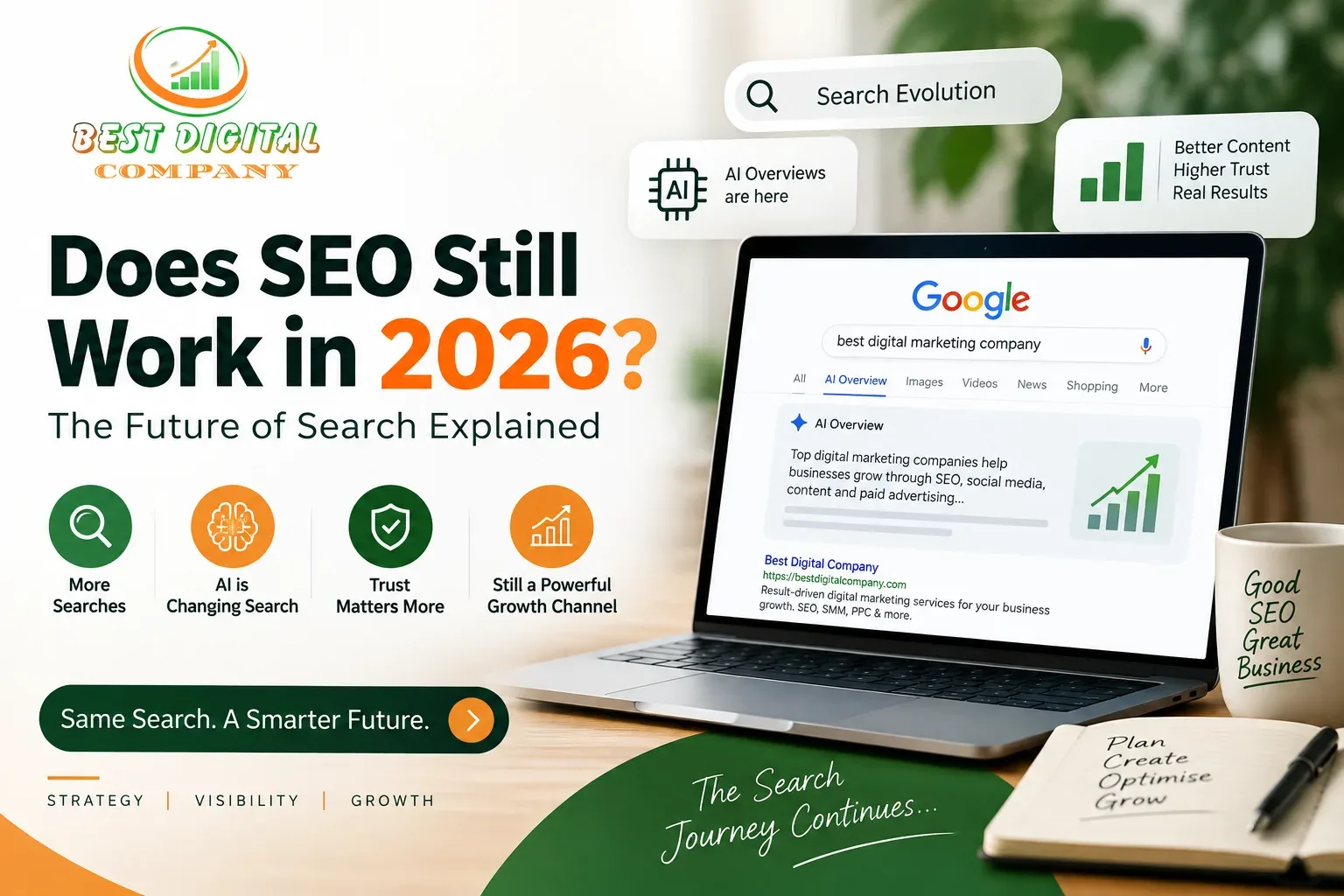
Does SEO Still Work in 2026? The Future of Search

Does SEO Still Work in 2026? The Future of Search Explained

Every few years, someone declares SEO dead. It happened when social media exploded, again when voice assistants arrived, and now it’s happening because of AI chatbots and AI-generated answers sitting right at the top of the search results page. So it’s a fair question to ask in the middle of 2026: does SEO still work, or has the game actually moved on without it?

The short answer is that SEO in 2026 is not dead, but it has changed shape. Search behaviour has shifted, Google’s algorithms have gotten far better at understanding intent, and the businesses winning visibility today aren’t the ones stuffing keywords into blog posts. They’re the ones building genuinely useful, well-structured, trustworthy websites. If you run a business and you’re wondering whether it’s still worth investing in search visibility, this guide walks through exactly what has changed, what still matters, and how to build an approach to SEO in 2026 that actually holds up.

Why People Keep Asking If SEO Is Dead

The doubt isn’t coming from nowhere. Over the last two years, Google has rolled out AI-powered summaries that answer many queries directly on the results page, reducing the number of clicks that go to individual websites. Chatbots like ChatGPT and Gemini have become a starting point for research that used to begin with a Google search. Naturally, business owners started asking whether ranking on page one even matters anymore.

Here’s the part that gets missed in that panic: people are still typing (and speaking) billions of queries into Google every single day, and most commercial searches — the ones where someone wants to buy something, book a service, or find a local business — still lead to a list of websites, maps results, and organic listings. AI overviews have changed how informational queries get answered, but they haven’t replaced the need for a business to be found, evaluated, and chosen online. If anything, the businesses with strong SEO foundations are the ones AI tools pull their answers from in the first place.

Is SEO in 2026 Still Worth the Investment?

This is really the question underneath everything else, so let’s answer it directly: yes, SEO in 2026 is still one of the highest-return, most durable marketing channels available to a business — but only when it’s done the way search engines now expect.

The old playbook of publishing thin, keyword-stuffed pages and building a pile of low-quality backlinks stopped working years ago, and it’s even less effective now. What still works is a website that clearly demonstrates expertise, gets structured correctly for both traditional search and AI-driven answers, earns links because people genuinely want to reference it, and keeps loading fast and working properly on mobile. That’s a longer list of requirements than it used to be, which is exactly why SEO in 2026 rewards businesses that treat it as an ongoing discipline rather than a one-time project.

We’ve seen this play out first-hand while managing campaigns for clients across different cities — our recent work on digital marketing strategy for businesses in Delhi NCR is a good example of how SEO, social, and paid channels now have to work together rather than sit in separate silos.

How Google’s AI Overviews Changed the Search Results Page

The single biggest shift affecting SEO in 2026 is the way Google now answers questions directly within the search results page, using AI-generated summaries pulled from multiple sources. For simple, factual queries — “what time zone is Tokyo in,” “how many ounces in a cup” — this means fewer people click through to a website at all.

But there’s a nuance that gets lost in most of the doom-and-gloom takes: these AI summaries are built by pulling information from pages that already rank well and are structured clearly. A business with no organic visibility doesn’t suddenly get pulled into an AI summary — it has to already be recognised as a credible, relevant source. In practice, this means the fundamentals of SEO (clear content, proper headings, fast pages, credible signals) matter just as much as before. What’s changed is that ranking on page one is now a prerequisite for being cited by AI tools, not a separate goal.

For queries with commercial intent — anything close to “near me,” a service name, or a product comparison — actual website listings, reviews, and map results still dominate the page, which is exactly the kind of search where local and service-based businesses need to show up.

E-E-A-T: Why Trust Matters More Than Experience Ever Did

Google’s quality guidelines revolve around a framework it calls E-E-A-T: Experience, Expertise, Authoritativeness, and Trustworthiness. It’s not a ranking factor you can tick off with a plugin — it’s a lens Google’s systems and human quality raters use to judge whether content deserves to be shown to real people.

In 2026, this framework has become more important, not less, precisely because AI-generated content has made it easier than ever to produce large volumes of generic, low-effort articles. Google’s systems have gotten noticeably better at spotting content that reads like it was written to target a keyword rather than to genuinely help someone. The sites that keep ranking are the ones that show real experience — actual case studies, specific numbers, named authors, and details that couldn’t have been written by someone who’s never worked in the field.

Practically, this means:

  • Experience: Writing from direct, hands-on knowledge rather than summarising what other articles already say.
  • Expertise: Demonstrating a genuine understanding of the subject, not just surface-level familiarity.
  • Authoritativeness: Being recognised by other credible sites and sources as a go-to reference in your field.
  • Trustworthiness: Accurate information, transparent business details, secure browsing, and honest claims.

For a local business, this is where working with an established SEO service in Delhi or a similar specialist actually pays off — it’s far easier to build authority and trust signals with someone who understands how Google evaluates a business website than to guess at it alone.

Human-Written Content Is Winning Back the Search Results Page

There’s a reason Google keeps pushing content quality updates: the internet got flooded with AI-generated filler content almost overnight, and a lot of it was designed purely to rank rather than to inform anyone. Google’s response has been to reward content that reads like it was written by a person who actually knows the topic — content with opinions, specific examples, a clear point of view, and information that isn’t just a rehash of the ten articles already ranking above it.

This doesn’t mean AI tools have no place in content creation. Plenty of good writers use them for research or first drafts. What it means is that publishing content without a human editing, fact-checking, and adding real insight to it is a losing strategy for SEO in 2026. Search engines are specifically trying to identify and de-rank content that adds nothing new, repeats the same points in different words, or answers a question without actually answering it.

If you’re building out a content plan, the goal should be to answer the question a real person is asking, in a way only your business (with your specific experience) could write it — not to hit a word count or a keyword density target.

Local and Voice Search Are Reshaping SEO in 2026

Two search behaviours have grown fast enough to change how local businesses need to think about visibility this year: local search and voice/conversational search.

Local search — someone typing “digital marketing agency near me” or asking their phone the same thing out loud — depends heavily on a well-optimised Google Business Profile, consistent business information across the web, and genuine customer reviews. This is a different discipline from traditional SEO, and it’s why we treat it as its own workstream in our local SEO services in Delhi, separate from broader national campaigns.

Voice and conversational search — driven by smart speakers and AI assistants — tends to favour content written in a natural, question-and-answer style, because that’s closer to how people actually speak their queries. This is part of why FAQ sections, clear headings phrased as questions, and conversational writing have become genuinely useful SEO tactics rather than just a nice-to-have.

We’ve seen these patterns play out consistently across markets — the strategies we outlined for SEO services in Gurugram and for businesses comparing an SEO company in Gurugram versus an SEO agency in Gurgaon both come back to the same fundamentals: accurate local listings, review generation, and content that matches how people actually search in that city.

Technical SEO and Website Experience Still Decide Who Ranks

No amount of good content saves a website that loads slowly, breaks on mobile, or confuses search engines with a messy structure. Technical SEO has actually grown in importance in 2026, because Google now evaluates page experience — loading speed, visual stability, mobile usability, and secure connections — as a direct part of how it ranks pages.

This is also where structured data (schema markup) has become far more valuable than it used to be. Marking up your content correctly helps search engines and AI systems understand exactly what a page is about, who wrote it, what a product costs, or what a service includes — which increases the odds of being pulled into rich results or AI-generated answers.

A slow, outdated, or poorly structured website undermines every other SEO effort you make, which is why we always pair search strategy with proper website development and design rather than treating the two as separate projects. You can publish the best content in your industry, but if the site takes six seconds to load on a phone, most of that work goes to waste.

SEO in 2026 Doesn’t Work Alone Anymore

One thing that genuinely has changed is how isolated SEO can afford to be. A few years ago, a business could run SEO as a standalone channel and see steady results. In 2026, the businesses getting the best outcomes are combining organic search with paid advertising and social visibility, because each channel now reinforces the others.

Paid search fills the gap while organic rankings are still building, and it gives you fast data on which keywords actually convert. Our breakdown of how PPC and Google Ads can generate faster leads covers this in more detail — the short version is that PPC services and SEO complement each other rather than compete for budget.

Social signals also feed into how discoverable and trustworthy a brand appears, both to users and, indirectly, to search engines evaluating a brand’s overall footprint. We’ve written about this in our guide to how SMO supports business growth, and it’s a big part of why social media marketing now sits inside most integrated SEO strategies rather than off to the side.

Building a Future-Proof SEO Strategy in 2026

If you’re planning search visibility for the year ahead, here’s what an approach built for SEO in 2026 actually looks like in practice:

1. Start with real search intent, not just keywords. Before writing anything, understand what the person searching actually wants — information, a comparison, or a business to hire. Content that matches intent gets rewarded; content that just repeats a keyword phrase doesn’t.

2. Invest in original, experience-backed content. Case studies, original data, and specific examples from your own work carry far more weight than generic advice that could apply to any business anywhere.

3. Fix the technical foundation first. Page speed, mobile usability, and clean site structure aren’t optional extras — they’re the baseline Google expects before it even evaluates your content quality.

4. Build genuine authority signals. Earn links and mentions from credible sources in your industry rather than chasing volume through low-quality directories.

5. Treat local presence as its own project. If you serve a specific city or region, your Google Business Profile, reviews, and local content need dedicated attention — this is exactly the kind of work covered instructured SEO packages built around measurable local outcomes.

6. Track what actually moves the needle. Rankings alone don’t pay the bills — traffic, leads, and conversions do. A strategy built for 2026 needs to track the full path from a search to an actual customer.

Common Mistakes Businesses Still Make With SEO in 2026

Even with all this shift toward quality and trust, a lot of businesses keep repeating the same mistakes:

  • Treating SEO as a one-time task. A website optimised once and left untouched for a year will lose ground to competitors who keep publishing and refining.
  • Publishing content no one asked for. Articles written to hit a keyword rather than answer a real question tend to underperform, no matter how well they’re optimised technically.
  • Ignoring page experience. A beautifully written page on a slow, cluttered website still struggles to rank or convert.
  • Skipping local optimisation. Businesses that serve a specific city but never invest in local search lose a huge share of nearby, ready-to-buy customers to competitors who do.
  • Expecting overnight results. SEO in 2026 still takes months to show its full impact — it rewards patience and consistency over quick fixes.

We’ve walked through a lot of these patterns while comparing options for business owners, including in our look at choosing between an SEO expert and a freelancer in Bangalore and our guide on what to ask before hiring an SEO agency in Lucknow the mistakes are strikingly consistent across cities and industries.

So, Does SEO Still Work in 2026?

Yes — but it works differently than it did even three years ago. Search engines have gotten better at rewarding genuine expertise and penalising shortcuts, AI-generated answers have raised the bar for what “ranking” actually means, and local, technical, and content strategies now have to work together instead of separately. Businesses that adapt to these shifts, rather than trying to relive 2019-era SEO tactics, are still seeing strong, sustainable growth from organic search.

The businesses struggling with SEO in 2026 usually aren’t struggling because the channel stopped working — they’re struggling because they haven’t adjusted their approach to match how search actually functions today. Whether you’re just getting started or trying to recover lost visibility, teams that understand search engine optimisation at this level of detail can usually get things back on track faster than trying to guess at it in-house.


Frequently Asked Questions About SEO in 2026

Is SEO still relevant in 2026, or has AI search replaced it?

SEO is still very relevant in 2026. AI-generated answers on the search results page have changed how some queries get answered, but they pull their information from well-ranked, trustworthy websites — so strong SEO is now a requirement for being included in AI answers, not a separate, outdated channel.

How long does it take to see results from SEO in 2026?

Most businesses start seeing meaningful movement in three to six months, with stronger, compounding results after nine to twelve months of consistent work. Highly competitive industries or cities can take longer, which is one reason pairing SEO with paid search often makes sense in the early stages.

What matters most for SEO in 2026: content, backlinks, or technical setup?

All three matter, but they’re no longer separate checkboxes. Content needs to demonstrate real experience and answer intent clearly, backlinks need to come from genuinely credible sources, and the technical foundation (speed, mobile experience, structured data) has to be solid enough for search engines to trust and understand the site in the first place.

Does AI-generated content hurt SEO rankings?

Content that is purely AI-generated, unedited, and adds nothing new tends to underperform, because search engines are specifically trying to identify and reduce visibility for generic, low-effort content. AI tools used for research or drafting are fine, but the published result needs human review, fact-checking, and genuine expertise added on top.

Is local SEO different from regular SEO in 2026?

Yes. Local SEO focuses on your Google Business Profile, reviews, local citations, and location-specific content, while broader SEO focuses on the wider website. Businesses that serve a specific city or region typically need both working together for full visibility.

Should a small business still invest in SEO in 2026, or focus on paid ads instead?

Both channels serve different purposes, and most businesses benefit from combining them. Paid ads deliver faster, immediate visibility, while SEO builds a lasting asset that keeps generating traffic without an ongoing cost per click. A small business with a limited budget often gets the best return by using paid search to generate quick leads while SEO builds up in the background.

Digital Marketing Agency in Delhi NCR: SEO, SMO & PPC

Digital Marketing Agency in Delhi NCR: SEO, SMO & PPC Strategy Explained

Delhi NCR is one of the most crowded digital markets in the country. Walk through Nehru Place on any given afternoon and you’ll pass more IT vendors and marketing consultants than you can count. Add Gurugram’s corporate towers, Noida’s IT parks, and Faridabad’s manufacturing belt, and you get a region where practically every business from a two-person D2C brand to a 200-crore manufacturing house — is trying to be found online by the same customer. That customer is scrolling on a phone, comparing three or four options in under a minute, and rarely giving anyone a second chance to make a first impression.

This is exactly why so many business owners in the region start searching for a Digital Marketing Agency In Delhi Ncr the moment their website traffic plateaus or their ad spend stops converting. But “digital marketing” has become such a broad, overused term that it rarely means anything specific anymore. Ask ten agencies what they do and you’ll get ten different answers wrapped in the same buzzwords — growth, ROI, engagement, virality.

In this guide, we’re going to break that down properly. We’ll walk through what SEO, SMO, and PPC actually do, how a serious Digital Marketing Company In Delhi Ncr builds a strategy around them, what separates a good agency from a mediocre one, and how you should evaluate any partner before signing a contract. No fluff, no recycled definitions — just how this actually works when it’s done right.

Why Businesses in Delhi NCR Need a Structured Digital Strategy

Delhi NCR isn’t one market — it’s several markets stitched together. A clinic in Dwarka competes locally with three other clinics within two kilometres. A B2B manufacturing firm in Faridabad is competing nationally, sometimes internationally, for procurement leads. A fashion D2C brand based out of Gurugram is fighting for attention on Instagram against thousands of similar accounts. Each of these businesses needs a different mix of channels, yet they’re all searching for the same thing: visibility that converts into revenue.

This is where a lot of businesses go wrong. They pick one channel usually social media, because it’s the most visible and pour their entire budget into it without a supporting search or advertising strategy. Six months later, they have followers but no leads, or leads but no repeat business, because nothing was built to work together.

A properly structured approach ties three things together:

  • Search Engine Optimization (SEO) to build long-term, compounding visibility on Google
  • Social Media Optimization (SMO) to build trust, brand recall, and community
  • Pay Per Click (PPC) to generate immediate, measurable traffic and leads while the other two mature

None of these works particularly well in isolation. SEO takes months to show results, so PPC fills that gap. Social media builds trust that improves ad performance and conversion rates on your website. And a strong SEO foundation makes your paid campaigns cheaper over time because your landing pages are already optimised. Any Digital Marketing Agency Delhi businesses hire without understanding this interplay usually ends up running three disconnected campaigns instead of one growth engine.

SEO Strategy: The Foundation That Compounds Over Time

Search Engine Optimization is often treated as a checklist — add keywords, build backlinks, wait. In practice, it’s closer to running a long campaign with several moving parts that all need to stay aligned.

Technical Foundation First

Before a single blog post gets written, a serious agency audits the technical health of the website: page speed, mobile responsiveness, indexing errors, broken links, duplicate content, and site architecture. A beautifully written article on a slow, poorly structured website rarely ranks well, no matter how good the content is. This is the unglamorous work that most freelancers skip because it doesn’t show up in a monthly report the way “10 new backlinks” does — but it’s often the difference between a page that ranks and one that quietly sits on page four forever.

On-Page and Content Strategy

Once the technical base is solid, the focus shifts to matching content with what people are actually typing into Google. This isn’t about stuffing a page with keywords — that approach stopped working years ago and can actively hurt rankings today. It’s about understanding search intent: is someone looking for information, comparing options, or ready to buy? A page built for someone still researching should read very differently from a page built for someone ready to hire.

For a business offering Digital Marketing Service In Delhi, this might mean building separate pages for different service lines SEO, SMO, PPC, web development each answering the specific questions a buyer at that stage would have, rather than one generic “we do everything” page that ranks for nothing in particular.

Local SEO for a Region Like NCR

Because Delhi NCR spans multiple cities and sub-markets, local SEO deserves special attention. A well-optimised Google Business Profile, consistent business listings, location-specific landing pages, and genuine customer reviews all feed into how visible a business is when someone nearby searches for a relevant service. We’ve covered this in more depth in our piece on local SEO in Delhi and how to get found on Google Maps, which is worth reading if your customers are searching for you by neighbourhood rather than by brand name.

It’s also worth noting that SEO priorities shift slightly depending on which part of NCR you’re targeting. A business in Noida’s IT corridor has different competition and search behaviour than one in central Delhi, which is why we have written separate breakdowns for SEO services in Noida and general SEO services in Delhi — the fundamentals stay the same, but the competitive landscape doesn’t.

Link Building and Authority

Backlinks still matter, but the game has changed from “get as many as possible” to “get relevant, trustworthy ones.” A single mention from an industry publication or a respected local directory does more for your authority than fifty low-quality directory submissions. Agencies that still push volume over relevance are usually the ones stuck using outdated tactics from a decade ago.

SMO Strategy: Building Trust Before You Ask for a Sale

Social Media Optimization often gets confused with just “posting content,” but the two aren’t the same thing. Posting is an activity. Optimization is a strategy — deciding which platforms your actual customers use, what kind of content earns attention on each one, and how that attention eventually turns into trust and, later, revenue.

Platform Selection Isn’t One-Size-Fits-All

A B2B manufacturing company in Faridabad probably doesn’t need to be chasing trends on Instagram Reels. LinkedIn, industry groups, and even WhatsApp Business often do more for them. A fashion or lifestyle brand in Gurugram, on the other hand, lives and dies by Instagram and increasingly by short-form video. Part of a good agency’s job is telling a client where not to spend energy, which is a harder conversation than it sounds because most business owners assume more platforms automatically means more reach.

Content That Reflects the Brand, Not a Template

Generic, templated social content is easy to spot and even easier to scroll past. What actually builds engagement is content that reflects a brand’s real voice — behind-the-scenes work, actual customer stories, founder insights, or genuinely useful tips relevant to the audience. This is also where authenticity plays into how platforms themselves reward content; algorithms increasingly favour posts that generate real conversation over posts that are purely promotional.

Community Management Is Part of the Strategy, Not an Afterthought

Responding to comments, handling questions in DMs, and managing reviews all shape how trustworthy a brand appears to someone scrolling past for the first time. A page with thousands of followers but no replies to comments signals a brand that isn’t really present — and today’s buyers notice that gap.

Paid Social as a Bridge

Organic social builds trust over time, but paid social (boosted posts, lead-generation ads, retargeting campaigns) can accelerate visibility while that trust is being built. The two should work together rather than being treated as separate budgets managed by different people.

PPC Strategy: Immediate, Measurable Growth

Pay Per Click is the channel most business owners understand the fastest, because the connection between spend and result is direct — you pay, you get clicks, and ideally those clicks turn into leads or sales. But “running ads” and “running a profitable PPC strategy” are two very different things.

Keyword and Intent Research Before Spending a Rupee

The biggest mistake businesses make with PPC is bidding on broad, expensive keywords without understanding buyer intent. Someone searching “what is digital marketing” is not the same buyer as someone searching for a Digital Marketing Agency In Delhi Ncr with a phone number visible in the ad. A good PPC strategy separates these searches, bids appropriately on each, and doesn’t waste budget chasing traffic that was never going to convert.

Landing Pages Matter More Than the Ad Itself

An ad can be perfectly written, but if it sends traffic to a generic homepage instead of a page built specifically around that search, conversion rates drop sharply. Dedicated landing pages — with clear messaging, a visible call to action, and content that matches exactly what the ad promised — routinely outperform generic pages by a significant margin. This is one of the most overlooked parts of paid advertising, and it’s often where agencies that only “manage the ad account” fall short, because landing page work usually falls outside their scope.

Budget Allocation and Testing

Effective PPC management means constant testing — different headlines, different offers, different audiences — and reallocating budget toward what’s actually converting rather than what looks good on a dashboard. Impressions and clicks are vanity metrics if they don’t translate into actual leads or sales. A transparent agency will show you cost-per-lead and conversion data, not just traffic numbers.

Remarketing to Recover Lost Visitors

Most visitors don’t convert on their first visit — that’s normal, not a failure. Remarketing campaigns bring those visitors back with tailored messaging, and for many businesses in Delhi NCR’s competitive service and retail sectors, remarketing ends up delivering some of the cheapest, highest-converting leads in the entire campaign.

How SEO, SMO, and PPC Work Together

Here’s where most explanations stop short: they describe each channel in isolation and never explain how they’re supposed to connect. In a functioning strategy, they reinforce each other constantly.

  • PPC data reveals which keywords actually convert into paying customers — that same data should inform which pages your SEO team prioritises for content and optimisation.
  • Social proof (reviews, follower counts, engagement) built through SMO efforts improves trust signals that indirectly support both organic rankings and ad conversion rates, because people are more likely to click and buy from a brand that looks established.
  • Content built for SEO purposes — blog posts, guides, service pages — gives your social media team something genuinely useful to share, instead of recycling the same three promotional graphics every week.
  • Retargeting audiences for PPC campaigns can be built from your organic and social traffic, meaning every visitor who doesn’t convert immediately still has a second and third chance to come back.

A Digital Marketing Company In Delhi Ncr that treats these as three separate departments, run by three separate people with no shared reporting, is leaving a lot of performance on the table. The agencies that get real results are the ones running all three under one strategy, with one clear view of what’s working.

How to Choose the Right Agency in Delhi NCR

With hundreds of agencies operating across the region — some genuinely skilled, others running on outdated tactics and inflated promises — picking the right partner is arguably harder than the marketing itself. A few things worth checking before you commit:

Ask for real case studies, not just testimonials. Testimonials are easy to write. A case study with actual traffic, ranking, or lead numbers over a defined period tells you far more about what an agency can actually deliver.

Understand who will actually work on your account. Some agencies sell you a senior strategist during the pitch and then hand your account to a junior team once the contract is signed. Ask directly who will be managing day-to-day work.

Look for transparency in reporting. You should be able to see what’s being done each month — content published, technical changes made, ad spend and results — not just a generic PDF with a few charts.

Check whether they understand your specific market. An agency that has worked across different pockets of NCR — from Delhi’s service sector to Noida’s IT firms to Gurugram’s D2C brands — will usually design a more grounded strategy than one applying the same playbook everywhere. If you’re evaluating agencies specifically for the Noida market, our guide on how to evaluate an SEO agency before hiring in Noida covers several of these questions in more detail and applies just as well across the wider NCR region.

Be wary of guaranteed rankings. No legitimate agency can guarantee a #1 position on Google — search algorithms change too often, and anyone promising a guaranteed rank is either inexperienced or being dishonest with you.

What Realistic Results Look Like

It’s worth setting expectations honestly, because a lot of businesses get discouraged when results don’t appear overnight. SEO typically starts showing meaningful movement in three to six months, with stronger compounding results after that. PPC can generate leads within days of launch, but optimising cost-per-lead down to a sustainable number usually takes four to eight weeks of testing. SMO builds gradually — follower growth and engagement improve steadily, but the real payoff shows up in how it supports trust and conversion across your other channels over time.

Any agency promising instant results across all three channels simultaneously is either overselling or planning to cut corners somewhere. Sustainable growth in a competitive market like Delhi NCR takes a coordinated, patient strategy — not shortcuts.

Final Thoughts

Digital marketing in Delhi NCR isn’t about picking one trendy channel and hoping it works. It’s about building SEO, SMO, and PPC into one connected system where each channel strengthens the others — search visibility that compounds, social presence that builds trust, and paid campaigns that convert efficiently because the groundwork is already in place. Whether you’re a local service business trying to dominate your neighbourhood searches or a growing brand competing across the entire NCR region, the strategy has to be built around your specific market, your specific customers, and honest, measurable reporting.

If you are currently comparing options and want a strategy built around your actual business rather than a generic package, take a look at our SEO, social media marketing, and PPC services to see how we approach each channel, or get in touch directly to talk through what would actually work for your business.


Frequently Asked Questions

How is a Digital Marketing Agency In Delhi Ncr different from a general marketing consultant?

A specialised agency brings dedicated teams and tools for SEO, social media, and paid advertising, along with hands-on experience navigating the specific competitive dynamics of the NCR market — local search behaviour, regional competitors, and platform trends relevant to Delhi, Gurugram, Noida, and Faridabad. A general consultant typically offers broader strategic advice without the execution capability across all three channels.

How long does SEO take to show results for a business in Delhi NCR?

Most businesses start seeing measurable movement in rankings and organic traffic within three to six months, depending on competition levels, the current state of the website, and how consistently content and technical work are executed. Highly competitive keywords in crowded sectors can take longer, while local, niche searches often move faster.

Is PPC or SEO better for a new business just starting out?

They serve different purposes rather than competing with each other. PPC delivers faster visibility and leads while your organic presence is still developing, whereas SEO builds sustainable, long-term traffic that doesn’t disappear the moment you pause spending. Most new businesses benefit from running both together rather than choosing one over the other.

What does a Digital Marketing Company In Delhi Ncr typically include in a monthly package?

This varies by agency, but a reasonable package usually includes a defined scope of work such as keyword-targeted content, technical SEO fixes, social media content and posting, ad campaign management, and monthly reporting on traffic, rankings, and lead numbers. Always ask for a clear breakdown before signing, rather than a vague list of “SEO and social media services.”

Why do businesses across Delhi NCR need different strategies even within the same city?

Delhi NCR isn’t a single market — search behaviour, competition, and customer expectations differ significantly between areas like South Delhi, Gurugram’s corporate sector, and Noida’s IT belt. A strategy that works for a retail store in Karol Bagh won’t necessarily work for a B2B firm in Sector 62, which is why location-specific research matters before any campaign is built.

How much should a Digital Marketing Service In Delhi cost?

Pricing depends on the scope of work, competition in your industry, and whether you need one channel or a combined SEO, SMO, and PPC strategy. Rather than choosing based on the lowest quote, it’s worth comparing what’s actually included in each proposal — deliverables, reporting frequency, and team experience matter more than price alone in the long run.

Can a Digital Marketing Agency Delhi businesses hire also help with website development?

Many full-service agencies offer website development and design alongside marketing services, which can be an advantage since your site’s structure and speed directly affect both SEO performance and ad conversion rates. Working with one team across both areas usually reduces the back-and-forth that happens when marketing and development are handled separately.

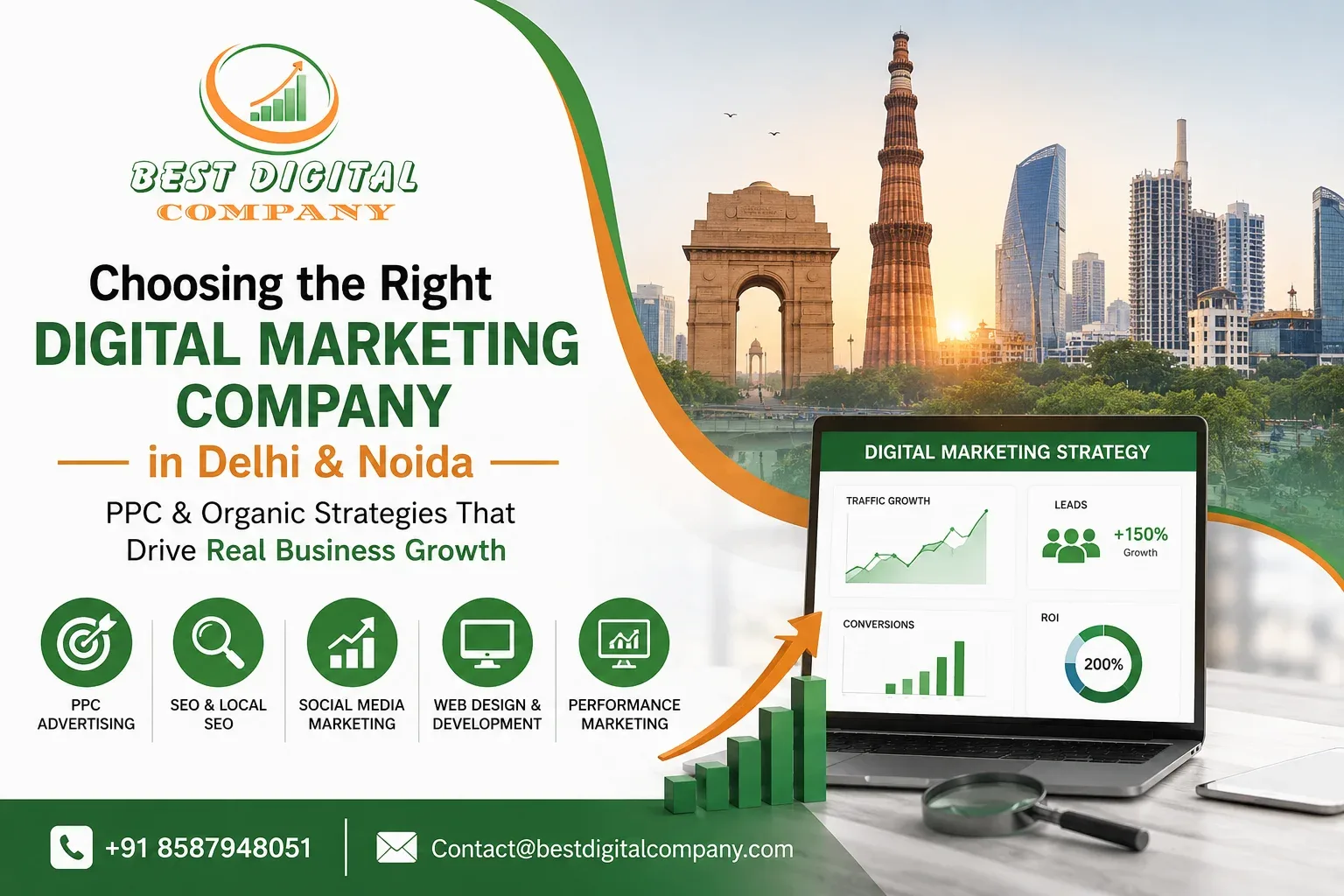
Choosing the Right Digital Marketing Company in Delhi & Noida:

Choosing the Right Digital Marketing Company in Delhi & Noida:

Every second business owner we meet in Delhi and Noida has already worked with an agency before us and not always happily. Wasted ad spend, generic monthly reports, and promises of “guaranteed rankings” that never materialized. If that sounds familiar, you’re not alone, and you’re also not wrong to be cautious.

This guide walks through what actually matters when you’re hiring a digital marketing company in Delhi, how PPC and organic strategies differ, and the questions you should be asking before you sign anything. No fluff, no jargon for the sake of sounding smart just what we’ve learned from running campaigns for businesses across Delhi NCR.

What a Digital Marketing Agency in Delhi Should Actually Deliver

A digital marketing agency in Delhi worth its fee does three things well: it understands your local market, it builds a strategy around your specific business goals (not a template), and it reports results in numbers you can act on leads, calls, and revenue, not just “impressions.”

Delhi is a crowded, competitive market. Whether you run a clinic in South Delhi, a manufacturing unit in Okhla, or a retail brand in Karol Bagh, your competitors are already investing in search visibility and paid ads. A good digital marketing service in Delhi doesn’t just chase rankings for the sake of it it ties every SEO and ad decision back to what actually grows your business. If you want to see how we approach this end-to-end, our Search Engine Optimization services page breaks down the process in more detail.

Digital Marketing Company in Delhi NCR: Why Location Still Matters

Even in a digital-first world, location context matters more than people assume. A digital marketing company in Delhi NCR that understands the buying behavior across Gurugram, Faridabad, Noida, and Delhi proper can build campaigns that speak to each audience differently. A B2B software company in Gurugram doesn’t need the same messaging as a home services business in Ghaziabad.

This is also where local SEO plays a bigger role than most business owners expect. If you’ve recently launched a new site or are rebuilding one, it’s worth reading our post on how to rank a new website on Google in 90 days. It covers the groundwork that has to happen before any agency’s promises hold weight.

A digital marketing agency in New Delhi should also be transparent about what’s realistic. Nobody can promise a first-page ranking in two weeks. What they can promise is a documented plan, consistent execution, and monthly proof of progress.

Digital Marketing Company in Noida: What Makes the Market Different

Noida has grown into its own ecosystem IT parks, startups, real estate developers, and a growing base of D2C brands. A digital marketing company in Noida needs to understand this mix, because the strategy for a SaaS startup in Sector 62 looks nothing like the strategy for a real estate developer targeting NRI buyers.

When businesses ask us what separates an average digital marketing agency in Noida from a genuinely good one, it usually comes down to depth of reporting and willingness to say “this isn’t working, let’s pivot” instead of continuing a campaign just because a contract says so.

If you’re evaluating who to work with, look at how a prospective best digital marketing company in Noida talks about failure. Every campaign has underperforming elements at some point. The honest agencies flag them early instead of burying them in a 40-slide monthly deck. Our breakdown on why business websites fail to generate leads is a good starting point if your site is getting traffic but not conversions.

PPC Services in Delhi: The Fastest Way to Test Demand

Search engine optimization takes time to compound. If you need visibility now a product launch, a seasonal push, a new location opening  PPC services in Delhi are usually the faster route. Pay-per-click lets you show up at the top of results the moment a campaign goes live, and you only pay when someone actually clicks.

The catch is that PPC is unforgiving of bad setup. Wrong keyword match types, missing negative keywords, and poorly structured campaigns burn through budgets fast without producing leads. This is where working with an actual PPC agency in Delhi not a freelancer running one campaign template for every client  makes the difference. You can see how we structure paid campaigns on our Pay Per Click services page.

What a Google AdWords Expert in Delhi Should Be Checking Weekly

A genuine Google AdWords expert in Delhi isn’t someone who sets up a campaign and checks it once a month. Search terms reports, quality score trends, impression share, and conversion tracking accuracy all need regular attention  ideally weekly, especially in the first 60 to 90 days of a new account.

Ask any agency claiming AdWords expertise these specific questions:

  • How do you structure campaigns — by product, by service, or by match type?
  • What’s your process for finding and adding negative keywords?
  • How do you validate that conversion tracking is actually firing correctly?
  • Do you A/B test ad copy, or run one version indefinitely?

If they can’t answer these clearly, they’re not managing your account with the rigor a ppc expert in delhi should bring.

How to Identify the Best PPC Agency in Delhi

There’s no shortage of agencies claiming to be the best PPC agency in Delhi. What separates the credible ones from the rest usually shows up in three places:

  1. Transparency on spend — you should always know exactly where your budget is going, down to the campaign level.
  2. Realistic timelines — anyone promising instant, massive ROI on day one is either exaggerating or hasn’t set proper expectations.
  3. Landing page involvement — running ads to a weak landing page wastes budget. A serious ppc agency in delhi will flag this and either fix it or work with your web team. Our guide on creating SEO landing pages that actually convert explains why this step gets skipped so often, and what it costs businesses when it does.

PPC Services in Delhi NCR: Managing Campaigns Across a Spread-Out Market

Delhi NCR isn’t one market, it’s several stitched together. PPC services in Delhi NCR need geo-targeting precision, because a campaign that performs well in Central Delhi might completely underperform in Noida or Gurugram due to different competition levels and cost-per-click benchmarks.

This is one of the more overlooked parts of paid advertising in this region. Businesses often run one flat campaign across the entire NCR and wonder why results are inconsistent. Segmenting by location, adjusting bids by area performance, and reviewing device-level data separately for each zone usually solves this.

Performance Marketing Agency Delhi: Looking Past Vanity Metrics

There’s a meaningful difference between an agency that runs ads and a performance marketing agency Delhi businesses actually see growth from. Performance marketing means every rupee spent is tracked back to a business outcome a form fill, a call, a sale not just clicks or impressions.

This requires proper analytics setup, conversion tracking across platforms, and a willingness to kill underperforming campaigns quickly instead of letting them run because “it’s early days” for the third month in a row. If your current setup feels more like guesswork than a system, it might be worth revisiting your overall digital foundation our post on website redesign vs SEO optimization covers a related decision many businesses face before scaling ad spend.

SEO and PPC Work Better Together, Not in Isolation

One thing we tell every client: don’t treat organic search and paid ads as separate departments. The keywords that convert well in PPC often tell you exactly what to target organically, and vice versa. A digital marketing agency Delhi businesses trust will look at both channels together, not run them as two disconnected services billed separately with no shared data.

If you’re building out a longer-term content and search strategy alongside paid campaigns, our piece on building topical authority in SEO is a useful companion read, especially if you’re trying to reduce paid dependency over time.

Questions to Ask Before Hiring Any Agency

Before signing with any digital marketing company in Delhi, Noida, or anywhere in the NCR region, ask for:

  • A sample of past reporting (not just a pitch deck)
  • Direct access to your own ad accounts and analytics — you should own your data
  • A clear breakdown of what’s included in the monthly fee versus ad spend
  • References from clients in a similar industry or business size to yours

Agencies that hesitate on any of these are worth a second thought.


Frequently Asked Questions

How much does a digital marketing agency in Delhi typically charge?

Costs vary widely based on scope a small business running local SEO and basic PPC might spend far less than an enterprise brand running multi-channel campaigns. Most agencies offer tiered packages, so it’s worth comparing what’s actually included rather than just the headline price. You can check our PPC packages for a sense of typical structuring.

What’s the difference between SEO and PPC services in Delhi?

SEO builds long-term, unpaid visibility in search results through content, technical optimization, and authority building .It takes months to show full results but keeps delivering without ongoing ad spend. PPC gets you immediate visibility through paid ads, but visibility stops the moment you pause spending. Most businesses benefit from running both together.

How do I know if a PPC agency in Delhi is managing my account properly?

Ask for regular access to your Google Ads account, request search term reports, and check whether they’re actively adding negative keywords and adjusting bids. If reporting is vague or infrequent, that’s a warning sign.

Is a digital marketing company in Noida different from one based in Delhi?

Not fundamentally in service quality, but a team familiar with the Noida business landscape. IT companies, startups, real estate tends to build more relevant strategies for that specific audience compared to a generic, one-size-fits-all approach.

How long does it take to see results from digital marketing in Delhi NCR?

PPC can show traffic and leads within days of launch. SEO typically needs three to six months for meaningful, sustained movement, depending on competition and the current state of your website. Anyone promising instant organic rankings isn’t being upfront with you.

Do I need both an SEO and a PPC expert, or can one team handle both?

A team with dedicated specialists for each channel who still collaborate closely usually performs better than a single generalist handling everything, especially once your budget and traffic grow.

What should I look for in a Google AdWords expert in Delhi?

Look for someone who talks about conversion tracking accuracy, quality score, and campaign structure not just “we run ads for you.” Ask how they’ve handled underperforming campaigns for past clients.


Have questions about setting up SEO, PPC, or a combined growth strategy for your business in Delhi or Noida? Get in touch with our team and we’ll walk you through what a realistic plan looks like for your budget.