near me SEO

Near Me SEO: How Businesses Can Rank for “Near Me” Searches in 2026

Think about the last time you searched for “pharmacy near me” or “AC repair near me.” You probably didn’t scroll far. You looked at the first few results, checked the ratings, maybe tapped call or directions, and moved on within a minute.

That minute is where local businesses win or lose customers. People who search this way usually aren’t browsing. They have a problem and want it solved close to home, often today.

Near me SEO is the work of making sure your business is one of the few options Google shows at that moment. This guide explains how it works in 2026, what actually affects your visibility, and what to do about it, based on what we see while working with local businesses in Delhi and across India.

What Is Near Me SEO, and Why Does It Matter in 2026?

Near me SEO means optimizing your business so it appears when someone searches with a nearby intent. That includes phrases like “dentist near me,” but also searches that never contain those words, such as “best salon in Laxmi Nagar” or “plumber open now.” Google treats all of these as the same kind of question: who can help me, close to where I am, right now?

Three things make this more important than it was a few years ago.

Most of these searches happen on phones. People are standing in a market, sitting in a car, or walking down a street. They want a phone number, opening hours, and directions, not a long article.

The intent is strong. Someone searching “car service near me” is much closer to buying than someone searching “how often should I service my car.” Local searches tend to end in a call, a visit, or a booking.

Google shows fewer choices than it used to. A map section with three businesses, plus an occasional AI-generated summary, takes up most of the first screen. If you’re not in that group, you’re easy to miss.

If you’ve been wondering whether traditional optimization still holds up with all these changes, our piece on whether SEO still works in 2026 covers that in detail. The short version for local businesses is yes, but the details have shifted.

How Google Decides Who Appears for Near Me Searches

Google has been fairly open about this. Local results are based on three things: relevance, distance, and prominence.

Relevance is how well your business matches what the person asked for. A profile that clearly says you’re a pediatric dental clinic will beat a vague “healthcare services” listing for the search “child dentist near me.”

Distance is how far you are from the searcher, or from the area they named in the search. You can’t change where your shop is, and this is the part that frustrates people most. But understanding it helps you set realistic goals. If you’re in Preet Vihar, you probably won’t show up for someone standing in Dwarka, and that’s fine. You want to win your own neighborhood first.

Prominence is how well-known and trusted your business appears. Reviews, mentions across the web, the strength of your website, and how consistently your business details appear online all feed into this.

You control relevance and prominence almost entirely. Most of the rest of this guide is about those two.

Start With Google Business Profile Optimization

If you only have time to fix one thing, fix your Google Business Profile. It’s the foundation of everything else, and it’s where most near me visibility is won.

Here’s what we check first when a new client comes to us.

Business name. It should be exactly what appears on your signboard. Adding keywords like “Best Dentist in Delhi” to the name violates Google’s guidelines, and it’s one of the quickest ways to get a profile suspended.

Categories. Your primary category matters more than almost any other field. Pick the one that most precisely describes your main service, then add secondary categories for anything else you genuinely offer. A restaurant that lists itself as “Restaurant” when it’s really a “North Indian restaurant” is leaving relevance on the table.

Services and products. Fill these in properly, with short plain-language descriptions. Don’t skip them because they feel optional.

Hours. Keep them accurate, including holiday hours. Nothing loses trust faster than a customer arriving at a closed shop that Google said was open.

Photos. Real photos of your shop front, interior, team, and work. Customers do check them, and a profile with recent, genuine images feels alive. Stock photos don’t help.

Posts and updates. Share offers, new services, or events now and then. They’re not a magic ranking lever, but they show the profile is actively managed.

We’ve written a full walkthrough in our Google Business Profile optimization guide for 2026, which goes field by field if you want to work through your own listing.

Google Maps Ranking: Why Some Businesses Win the Top Three

Most near me searches end at the map results. So it’s worth understanding what separates the businesses at the top from everyone else.

In our experience, the businesses that hold those top spots usually have a few things in common. Their profiles are complete and accurate. They have a steady flow of recent reviews. Their name, address, and phone number match everywhere online. And their websites back up what the profile claims.

What they usually don’t have is a trick. Over the years we’ve seen business owners try fake reviews, extra listings at made-up addresses, and keyword-stuffed names. Those shortcuts sometimes bring a short burst of visibility, and then a suspension. Recovering a suspended profile takes far longer than building a clean one would have.

If you want a deeper breakdown of the signals involved, we put together a guide on how to rank higher on Google Maps in 2026 that goes through the practical steps.

Why Your Business Is Not Showing on Google Maps

Before you try to rank higher, make sure you’re actually eligible to appear. A surprising number of businesses we speak to are invisible for basic reasons, not competitive ones.

The common causes are:

  • The profile isn’t verified. Unverified profiles rarely show in map results.
  • The profile was suspended or flagged because of a guideline issue, often something small like a name mismatch.
  • The category is wrong or too generic, so Google can’t connect the business to the search.
  • The address is unclear. In Indian cities, landmark-based addresses and inconsistent formatting cause real confusion. “Near Lal Mandir” means something to locals and very little to an algorithm.
  • Duplicate listings split your signals and sometimes trigger filters.
  • The listing is a service-area business but has been set up as a storefront, or the other way around.

If you’ve searched your own business name and come up empty, start there. Our post on why your business is not showing on Google Maps and how to fix it walks through each of these problems and how to check for them.

Google Reviews: The Trust Signal Nearby Customers Check First

When someone is choosing between three nearby options, reviews are often the deciding factor. They’re also a major part of how Google judges prominence.

What matters isn’t just the star rating. Google and customers both look at:

  • How many reviews you have
  • How recent they are
  • Whether they mention specific services and locations naturally
  • Whether you respond to them

A business with 40 reviews from the past six months often looks more credible than one with 200 reviews that all date back to 2022.

The best way to get reviews is the simplest one: ask. Ask in person after a good experience. Send a short message with your review link. Put a QR code at the counter. Don’t offer discounts or gifts in exchange for reviews, and don’t write them yourself or ask friends to. Google’s policies are clear on this, and fake reviews get removed, sometimes along with your ranking.

Respond to every review, including the negative ones. A calm, specific reply to a complaint tells future customers more about your business than ten five-star ratings. We cover the full approach in our guide onhow to get more Google reviews without breaking Google’s rules.

Google Business Profile vs Website: You Need Both

Some owners believe a good profile makes a website unnecessary. Others spend everything on the website and ignore the profile. Both are mistakes.

The profile gets you into the map results. The website gives Google the depth it needs to understand what you do, where you do it, and why you can be trusted. When the two disagree or the website is thin, rankings tend to stall.

We once worked with a clinic in East Delhi that had hundreds of reviews and a strong profile, but a website that was a single page with a phone number. Their map visibility was decent, yet they lost people at the next step. Visitors who clicked through found almost nothing to reassure them. Fixing the website, not the profile, is what changed the picture.

If you’re deciding where to put your time and budget first, our comparison of Google Business Profile vs website for local SEO lays out which one matters more in different situations.

Local SEO in Delhi: Building Location Pages That Match Real Intent

A single “Contact Us” page can’t carry your whole local presence. If you serve more than one area, or offer more than one service, you’ll usually need dedicated pages.

Good local landing pages have a few things in common:

  • They’re written for one service in one area. “Dental implants in Janakpuri” is more useful than a page that lists every service and every neighborhood.
  • They contain information only you could write. Mention the areas you actually serve, how to reach you, which landmarks are nearby, real examples of your work, and questions customers in that area genuinely ask.
  • They include clear contact details, an embedded map, and a visible phone number.
  • They don’t copy each other. Swapping the area name on an otherwise identical page is thin content, and Google is good at spotting it.

Only create pages for areas you genuinely serve. If you have no presence in a neighborhood, a page about it helps no one.

This is also the kind of work that benefits from local experience. When we handle local SEO in Delhi for clients, a big part of the job is understanding how people in specific parts of the city actually describe their needs, which words they use, and which landmarks they navigate by. That detail is hard to fake.

On-Page Basics That Support Near Me SEO

Your website still needs to be easy for Google to read and for customers to use. These are the fundamentals worth getting right.

Title tags and headings. Include your main service and your location in a natural way. “Pediatric Dentist in Rohini | Clinic Name” reads better than a stack of keywords.

Business details in text. Your address and phone number should appear as real text, ideally in the header or footer, not only inside an image.

Local schema markup. Structured data for your business type, address, hours, and reviews helps search engines confirm the details they’ve found elsewhere.

Original content. Write about the problems your customers actually bring to you. A clinic can explain what to expect at a first visit. A repair shop can explain what a typical fault costs to fix. This kind of helpful, specific writing builds trust and covers the questions nearby customers type.

Clear next steps. A phone button, a booking form, a visible WhatsApp link. Make the action easy.

These are all part of what we’d call goodsearch engine optimization generally, and near me work simply points them toward a local audience.

Web Development Decisions That Affect Local Rankings

Many near me searches happen on a mid-range phone with a patchy connection. If your site is slow or awkward on mobile, people leave before they’ve seen anything.

A few web development basics make a real difference:

  • Fast loading on mobile, including compressed images and clean code
  • A mobile layout where buttons are easy to tap and text is readable without zooming
  • Secure browsing (HTTPS) on every page
  • Simple navigation, so a visitor can find your address, hours, and services within seconds
  • Click-to-call on every key page

We see sites that look impressive on a desktop but are painful on a phone. Since most local searches start on a phone, that’s the version Google and your customers are judging. If your site needs rebuilding or a serious cleanup, our web development team focuses on exactly this kind of speed and usability.

Citations and Consistent Business Information

Your business name, address, and phone number (often called NAP) should look the same everywhere they appear: your website, your Google profile, directories, social pages, and industry listings.

Small differences cause bigger problems than people expect. “Shop No. 4” in one place and “Shop 4” in another isn’t usually fatal. But a different phone number on an old directory, or an outdated address after a move, sends mixed signals.

A sensible approach:

  1. Pick one exact format for your name, address, and phone number.
  2. List it on the major platforms and the directories that are relevant to your industry and city.
  3. Search for old or duplicate listings and correct or remove them.
  4. Update everything immediately if anything changes.

Quality matters more than quantity here. Twenty accurate, relevant listings are worth more than two hundred random ones.

Near Me SEO and AI Overviews

Search results now often include an AI-generated summary, and many local searches trigger some version of it, especially for questions like “which clinic near me is best for back pain.”

You can’t control whether an AI summary appears, but you can make your business easier to understand and trust. The same things that help traditional local rankings help here: accurate profile data, strong reviews, clear and specific website content, and consistent information across the web.

Where AI summaries differ is in how they favor direct, well-organized answers. Pages that clearly explain who you serve, what you offer, what it costs (even roughly), and how to reach you tend to be easier for these systems to draw from. Our guide on how to make your business visible in AI Overviews goes deeper on this, and if the terminology is confusing, our explainer on SEO vs AEO vs GEO breaks down how the three overlap.

How Pay Per Click and Social Media Marketing Support Local Visibility

Organic ranking takes time. While you build it, two other channels can keep nearby customers finding you.

Pay per click. Local ads appear above or alongside the map results and can bring calls quickly. They’re useful for new businesses, for competitive categories, or for promoting a specific service in a specific area. Good pay per click management is about tight location targeting, sensible budgets, and tracking calls rather than just clicks.

Social media. Customers often check your Instagram or Facebook page before visiting. A page with recent photos, genuine customer posts, and responses to comments gives them confidence. Done consistently, social media marketing also helps people in your area remember your name, which leads to more direct and branded searches over time.

Neither replaces local SEO, but they cover gaps while it builds momentum.

Common Near Me SEO Mistakes We See Again and Again

After working with many local businesses, the same errors keep appearing.

Stuffing “near me” into everything. Writing “best dentist near me near me” on a page reads badly and doesn’t help. Google already knows where the searcher is. Write for people and mention real locations.

Ignoring reviews after the first few. Reviews are a habit, not a one-time project.

Using a virtual office or fake address. Google verifies these more strictly than before, and it often ends in suspension.

Creating many near-identical location pages. More pages don’t mean more rankings.

Leaving the profile unattended. Wrong hours, outdated services, or unanswered questions quietly hurt trust.

Expecting results in a week. For most local businesses, meaningful movement takes a few months of steady work. Anyone promising top three rankings in days is either exaggerating or planning something risky.

How to Measure Whether Near Me SEO Is Working

You don’t need a complicated dashboard. Track a handful of things every month:

  • Calls, direction requests, and website clicks from your Google Business Profile
  • Search queries that show your profile, which your profile insights reveal
  • Local rankings for your key services across a few nearby areas, ideally checked in a private browser or with a grid-style tracking tool
  • Review count and average rating
  • Website traffic from local searches, and how many of those visitors contact you

The most useful number is the simplest one: how many new customers say they found you on Google. Ask people when they call or walk in. It’s low-tech, and it tells you more than most reports.

Choosing the Right SEO Services in Delhi for Near Me Growth

Some businesses can do much of this themselves, especially if they have time and a small number of locations. Others find it easier to hand it over.

If you decide to hire help, ask a few direct questions:

  • Can they show results for businesses similar to yours, in similar areas?
  • Do they explain what they’re doing, or hide behind jargon?
  • Do they avoid guaranteeing rankings?
  • Will you own your Google Business Profile and website, or will the agency control them?
  • Do they follow Google’s guidelines on reviews and listings?

Good SEO services in Delhi should feel like a working partnership, with clear reporting and honest timelines. If you’d like to see what’s typically included at different budgets, our SEO packages page lays it out, and you can always talk to our team if you’d like an honest opinion on where your business stands.

A Simple Near Me SEO Checklist to Start With

If you want a clear starting point, work through these in order:

  1. Claim and verify your Google Business Profile.
  2. Choose accurate primary and secondary categories.
  3. Fill in services, hours, and photos.
  4. Fix any inconsistent or duplicate listings.
  5. Start a simple, rule-following review routine.
  6. Make sure your website loads fast and works well on phones.
  7. Build location or service pages with genuinely useful, original content.
  8. Add local schema markup.
  9. Track calls, directions, and reviews monthly.
  10. Keep everything current as your business changes.

None of these steps is glamorous. That’s the point. Near me SEO rewards businesses that are accurate, active, and genuinely useful to the people nearby, and that’s something you can build with steady effort.

Frequently Asked Questions About Near Me SEO

What is near me SEO?

Near me SEO is the process of optimizing your business so it appears when people search for products or services close to their location. It covers your Google Business Profile, your website, reviews, and online listings, all of which help Google decide whether to show you to a nearby searcher.

How long does near me SEO take to show results?

It depends on competition and your starting point. A business with a neglected profile can sometimes see improvement within a few weeks of fixing basic issues. Competitive categories in busy areas usually take three to six months or longer of consistent work. Anyone promising instant top rankings should be treated with caution.

Do I need a website to rank for near me searches?

You can appear in map results with only a Google Business Profile, but a good website makes ranking easier and helps turn visitors into customers. A strong profile and a helpful website work better together than either does alone.

Should I add “near me” to my website content?

Not as a keyword to repeat. Google already uses the searcher’s location, so it’s better to mention your actual city, neighborhood, and landmarks naturally. Write for the people you want to serve, and let the location details do the work.

How many reviews do I need to rank in the top three?

There’s no fixed number. What matters is having more recent, genuine reviews than the competitors around you, along with a good rating and replies from you. Look at the businesses currently ranking in your area and aim to match or beat their review activity.

Can I rank for near me searches without a physical shop?

Yes, if you’re a service-area business, such as a plumber or a home tutor, and you set up your profile that way. You’ll need to define the areas you serve honestly. You shouldn’t list a false address or a virtual office to appear in places you don’t actually operate.

Is near me SEO different from local SEO?

They overlap heavily. Local SEO is the broader practice of improving visibility for location-based searches. Near me SEO focuses on the “close to me, right now” type of search, which depends strongly on proximity, your profile, and reviews.
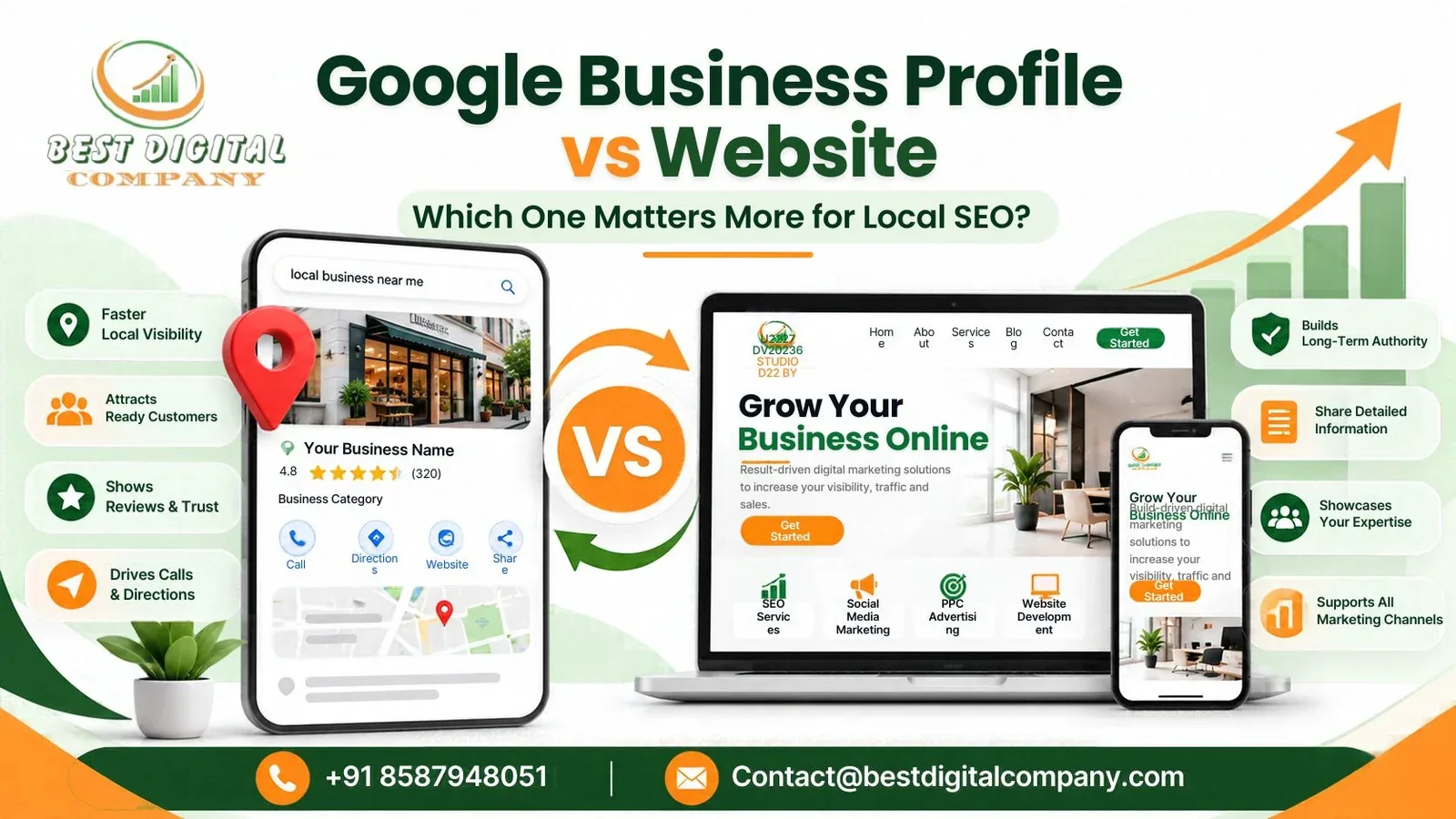
Google Business Profile vs Website

Google Business Profile vs Website: Which One Matters More for Local SEO?

A few months ago, a clinic owner from East Delhi called us with a complaint that sounded strange at first. His Google Business Profile had more than 200 reviews and sat comfortably in the map results for his area. His website, built by a cousin years ago, had four pages and a contact form that no longer sent emails. “Phone calls are fine,” he said, “but nobody books online. Which one is actually broken?”

Neither was broken, exactly. They were doing different jobs, and only one of them was being looked after.

That is the real question behind Google Business Profile vs website. Business owners usually frame it as a contest, as if you must pick a winner and abandon the other. This guide explains what each one does, how Google treats them, which deserves your time first, and how to run both without doubling your workload.

Google Business Profile vs Website: The Short Answer

For businesses that serve customers in a specific area, a Google Business Profile usually brings faster local visibility, while a website builds long-term authority and gives you full control. Neither replaces the other.

If you are starting from zero and need calls within weeks, set up and complete your profile first. If you already have a profile and your growth has stalled, the website is almost always the missing piece.

Think of it this way. Your profile is your shopfront window on a busy street. Your website is the shop itself, where people decide whether to trust you and buy. A great window with an empty shop loses customers at the door. A great shop on a hidden lane never gets found.

What a Google Business Profile Actually Does for Local SEO

Your profile is the free listing that appears when someone searches for a service near them or looks up your business by name. It feeds the map results, the local panel on the right side of the page, and a good share of “near me” searches.

Google has said for years that local ranking rests on three ideas: relevance, distance, and prominence. Your profile influences all three.

  • Relevance comes from your primary category, secondary categories, services list, and business description. Choosing “Dentist” when you are really an orthodontist quietly costs you visibility.
  • Distance is mostly out of your hands. It reflects how far the searcher is from your address, which is why a precise, verified location matters.
  • Prominence reflects how well known you appear. Reviews, review replies, photos, and mentions around the web all feed into it.

What a profile does best is capture people who are ready to act. Someone searching for a chemist, a car repair shop, or a coaching centre at 9 p.m. wants an address, opening hours, a phone number, and a quick sense of whether others were happy. The profile delivers all four in a single glance.

Where it falls short is depth. You cannot explain your process on a profile, publish a detailed comparison, show a full price range, or build an argument for why you are the right choice. You also do not own it. Google can suspend a profile, merge it with a duplicate, or change how listings look, and you get limited say in any of it.

What Your Website Does That a Profile Cannot

A website is the only online property you fully control. That sounds like a slogan, but it has practical consequences.

First, it answers the questions that decide a purchase. How much does a root canal cost? How long does a kitchen renovation take? Do you serve Ghaziabad as well as Delhi? A profile gives you a few lines; a website gives you room to explain properly.

Second, it ranks for searches a profile cannot touch. A person typing “how to choose a physiotherapist after knee surgery” is not looking at a map. They are reading. Your site can answer that, earn their trust, and be remembered when they are ready to book.

Third, it is where proof lives. Case studies, certifications, doctor or founder bios, detailed testimonials, before-and-after work, and press mentions all belong on a site. This is also where Google looks for signals of experience, expertise, authoritativeness, and trustworthiness. A profile with 200 reviews is helpful. A site that shows who you are, what you have done, and how to verify it is stronger.

Finally, the website is the destination for nearly everything else you do. Ads, social posts, directory listings, and email all point to it. If it is slow, confusing, or outdated, every other channel leaks.

How Google Uses Both to Rank Local Businesses

Google does not treat these as separate worlds. It cross-checks them.

The website link on your profile tells Google which page represents your business. Google reads that page to confirm your services, your location, and your name match what the profile claims. When the two agree, confidence rises. When your profile says you offer “bridal makeup” and your site never mentions it, the mismatch weakens both.

The reverse also holds. Strong organic rankings for your website can support your local prominence, because Google treats a business that appears across many searches as better known. And a well-optimised profile sends real visitors, calls, and direction requests, which are the kind of everyday engagement that points to a genuine, active business.

This is why we tell clients to stop asking which one “ranks higher” and start asking whether the two tell the same story.

Local SEO in Delhi: Where the Two Work Together

Delhi is a good place to see this play out, because the competition is dense. In areas like Laxmi Nagar, Lajpat Nagar, or Karol Bagh, dozens of businesses sell almost identical services within a few hundred metres of each other. Distance alone cannot separate them.

In our experience with local businesses across the city, the ones who pull ahead tend to do a handful of unglamorous things consistently:

  • They keep their name, address, and phone number identical everywhere, down to the way “Gali No. 15” or “Block C” is written.
  • They create a separate page on their website for each main service and each area they actually serve, rather than one vague “Services” page.
  • They ask for reviews after every job and reply to each one, including the unhappy ones.
  • They add real photos of their premises and team, not stock images.

If you want a closer look at how this works for businesses in the capital, our page on local SEO in Delhi explains how we handle both the profile side and the on-site side together. And if you operate across the wider region, our breakdown of the digital marketing agency in Delhi NCR approach shows how SEO, social, and ads can share one plan instead of three.

Which One Matters More at Different Stages of a Business

The honest answer depends on where you are right now.

You are brand new or have no online presence. Start with the profile. Verification, correct categories, hours, services, and a handful of genuine reviews can make you findable within weeks. Put up a simple but accurate website at the same time, even five pages, so the profile has somewhere credible to send people.

You are established but flat. Your profile probably looks fine and your site is the bottleneck. Thin service pages, no location content, slow loading, and no proof of expertise are common culprits. This is where most of the long-term gain sits.

You serve customers beyond one neighbourhood. A profile is tied to a physical location or a defined service area, so it only goes so far. Your website is what lets you compete for searches in other localities, other cities, or across a whole region.

You are a purely online or appointment-based business. If customers never visit you, a website carries most of the weight. A profile may still help for brand searches, but it will not drive discovery the way it does for a shop.

You are in a high-trust field such as healthcare, legal, finance, or education. Here the website matters more than usual. Google holds this kind of content to a higher standard, and visitors want to see credentials, named professionals, and clear, accurate information before they act.

SEO Services in Delhi: Why the Website Side Needs Real Work

Optimising a profile is something an owner can largely do alone in an afternoon. Optimising a website takes longer, and that is where professional SEO services in Delhi tend to earn their keep.

The work typically covers a few areas:

  1. Page-level relevance. Each service gets its own page with a clear purpose, written for a specific search intent, not a keyword-stuffed paragraph on the home page.
  2. Technical health. Mobile speed, clean structure, working links, and pages that Google can crawl and understand without fuss.
  3. Local signals on the site. Embedded map, consistent contact details, location pages, and structured data that spells out your business details in a form search engines read easily.
  4. Authority. Mentions and links from relevant local sources, industry directories, and associations.
  5. Content that shows real experience. Answers written by someone who has done the work, not recycled summaries.

If you are comparing providers, our SEO packages lay out what is included at each level, so you can match the scope to your stage. For a broader view of how we approach organic growth, see our search engine optimization page.

Website Development: Fixing the Pages Your Profile Sends People To

Here is something we see often. A business invests in a polished profile, gets a steady stream of clicks to its site, and then loses most of those visitors in the first five seconds.

The cause is rarely dramatic. It is usually a slow page, a phone number that cannot be tapped, a layout that breaks on smaller screens, or a form buried three scrolls down. Since most local searches happen on phones, those small frictions decide whether the call happens.

Good website development for a local business does not have to be elaborate. It needs:

  • A home page that states what you do and where within a few seconds
  • Individual service pages with prices or ranges where possible
  • A contact page with a tap-to-call number, address, hours, and a map
  • Genuine photos, team details, and proof of your work
  • Fast loading on average mobile connections

If your current site falls short, our web development packages are a straightforward starting point. And if you are in the Delhi NCR region and weighing local agencies, our guide to a digital marketing company in Noida shows what to look for when comparing providers.

Pay Per Click and Social Media Marketing: Where They Fit In

Organic and map visibility build slowly. If you need enquiries this month, paid search can fill the gap while the longer-term work catches up.

Here the profile and the website play different roles again. Google Ads can pull in details from your profile, such as your address and phone number, which makes your ads more useful for nearby searchers. The landing page, though, is part of your website, and a weak one wastes the click you paid for. That is why we see pay per click and site quality as linked problems, not separate ones. Our piece on PPC services in Delhi walks through how local campaigns are usually structured and where budgets leak.

Social platforms behave differently. People rarely find a plumber through Instagram, but they often check a business’s social pages before trusting it. Active, honest social media marketing reinforces your reputation and gives your profile and website fresh material to share. For Delhi-specific tactics, our article on SMO services in Delhi covers how local businesses use social channels to support enquiries.

AI Overviews, GEO and AEO: Why the Profile vs Website Debate Is Changing

Search looks different from how it did even two years ago. Many people now read an AI-generated summary at the top of the page, or ask a chatbot for a recommendation, before they ever see a list of links.

This changes the profile-versus-website question in a useful way. AI systems draw on many sources to decide which businesses to mention. Your profile data, your reviews, your website content, and mentions elsewhere on the web all feed that picture. A business with a complete profile but a thin website gives these systems very little to work with. A business with strong, specific, well-organised website content gives them plenty.

If this is new territory, three of our earlier articles go deeper. Start with how to improve your visibility in AI Overviews, then read our explanation of what AEO is and how it works. If you are wondering whether this replaces traditional optimisation, our comparison of GEO vs SEO answers that directly. For the practical side, here is how to optimise your website for ChatGPT and Gemini.

The takeaway is simple. Whatever the format of search becomes, clear, accurate, consistent information across your profile and your website remains the foundation.

A Practical 30-Day Plan to Strengthen Both

You do not need a large budget to make real progress. Here is a realistic month.

Week 1: Audit and fix the basics. Claim and verify your profile if you have not. Check your primary category, hours, phone number, and service list. Make sure the name, address, and number match your website exactly.

Week 2: Build out the profile. Add real photos of your premises, team, and work. Write a clear business description in plain language. List each service you offer. Start a simple routine for asking happy customers for reviews.

Week 3: Improve the website pages that matter. Pick your top three services and give each a proper page: what it is, who it is for, how it works, rough pricing, and a clear next step. Add a contact section with a map and tap-to-call number.

Week 4: Connect and measure. Link your profile to the most relevant page, not always the home page. Add tracking so you can see calls, direction requests, and website visits separately. Review what happened and decide where to focus next month.

Then repeat. Local visibility tends to reward steady effort more than one-time pushes.

Common Mistakes That Hold Local Businesses Back

A few patterns come up again and again when we review businesses.

  • Treating the profile as “set and forget.” Outdated hours, closed-down services, and unanswered reviews quietly erode trust.
  • Using a keyword-stuffed business name. Adding “Best Cheap AC Repair Delhi” to your name violates Google’s guidelines and can lead to suspension.
  • Pointing the profile to a weak home page. If your most relevant page for a service is deeper in the site, link there.
  • Buying reviews or asking friends to leave glowing ones. Google detects patterns, and customers can tell. Real, imperfect reviews carry more weight.
  • Ignoring the website because “calls are fine.” Calls today do not protect you from a competitor who invests in a stronger site next year.
  • Using different contact details in different places. Inconsistent information confuses both Google and customers.

Frequently Asked Questions

Is Google Business Profile or a website more important for local SEO?

For quick local visibility, the profile usually has more immediate impact because it feeds map results directly. For long-term growth, authority, and control, the website matters more. Most businesses need both, and the stronger one depends on your stage.

Can I rank on Google without a website if I have a Google Business Profile?

Yes, you can appear in local map results with only a profile, and many small businesses do. However, you will be limited to a narrow set of searches, and you will depend entirely on a listing you do not own. A website widens your reach and gives you stability.

Does my website affect my Google Business Profile ranking?

Indirectly, yes. Google compares the details on your site with your profile and uses your website’s content and reputation to understand your business better. A website that clearly supports your profile’s categories and services helps.

Should my profile link to my home page or a service page?

It depends. If you offer one main service, the home page works. If you offer several, link to the page that best represents your core offering, and make sure it loads quickly and includes your contact details.

How often should I update my Google Business Profile?

Check it at least once a month. Update holiday hours promptly, add new photos regularly, respond to reviews as they come in, and revise your services whenever they change.

Do reviews matter more than website content?

They do different jobs. Reviews strongly influence local prominence and customer confidence. Website content helps Google understand what you do and lets you rank for informational searches. Neither makes up for the absence of the other.

How long does it take to see results from local SEO?

Profile improvements can show changes within a few weeks. Website-based gains typically take several months, depending on competition, your starting point, and how consistently you publish and improve content. Anyone promising overnight results should be treated with caution.

Is it worth hiring an agency, or can I manage this myself?

Plenty of owners manage their profile well on their own. The website side, including technical fixes, content planning, and link building, is where outside expertise tends to save time and avoid costly mistakes. The right choice depends on your time, budget, and comfort with the work.

Will AI search tools make Google Business Profile or websites irrelevant?

Unlikely. AI-driven results still rely on trusted, structured information from profiles, websites, and reviews. Keeping both accurate and complete improves your chances of being mentioned.

Final Thoughts: Treat Them as One System

Google Business Profile vs website is a useful question only until you hear the answer. They are two halves of the same job. The profile gets you noticed at the moment of need; the website earns the trust that turns attention into customers.

If you had to pick one place to spend your next hour, look at which half is weaker today and fix that first. For most established businesses, that turns out to be the website. For brand-new ones, it is the profile.

If you would like a second pair of eyes on yours, the Best Digital Company team can review your profile and site together and tell you plainly where the gaps are. You can reach us through our contact page or call +91 8587948051.

get more Google reviews

How to Get More Google Reviews for Your Business Without Breaking Google’s Rules.

A few years ago, a business owner told us something that stuck. Their shop had been open for eleven years, customers loved it, and yet a competitor who opened eight months earlier was outranking them on Google Maps. The difference wasn’t service quality. The competitor simply had 140 reviews, and our client had nine.

That gap is common. Happy customers rarely write reviews on their own, and unhappy ones often do. If you leave reviews to chance, your online reputation ends up reflecting your loudest critics rather than your typical customer.

This guide explains how to get more Google reviews in a way that is honest, repeatable, and safe for your Business Profile. We’ll cover what Google allows, what it doesn’t, how to ask without feeling awkward, and how to use reviews once you have them.

Why It’s Worth Your Effort to Get More Google Reviews

Reviews do three jobs at once.

They influence the decision. When someone searches for a plumber, a dentist, or a coaching center, they compare a handful of options within seconds. Star rating, review count, and the wording of recent reviews often decide who gets the call.

They support local visibility. Google has said that local results are based on relevance, distance, and prominence, and that review count and score are part of prominence. Reviews are not the only factor, but a profile with steady, recent feedback tends to look more established than one with none.

They give you free market research. Customers describe your business in their own words. Those phrases, such as “arrived on time,” “explained everything clearly,” or “fair pricing,” show you what people actually value, and they’re worth echoing on your website.

None of this works if the reviews are manufactured. That brings us to the rules.

What Google Allows and What It Doesn’t

Google’s policies on user-generated content change from time to time, so read the current version in the Google Business Profile Help Center before building a process around it. The core principles have stayed consistent, though.

You can:

  • Ask customers to leave a review, as long as you ask everyone and not just those you expect to be happy.
  • Share your direct review link by email, text, QR code, or on a printed card.
  • Reply publicly to every review, positive or negative.
  • Report reviews that break the policies, such as spam, fake content, or content with no connection to a real experience.

You can’t:

  • Offer discounts, gifts, cash, or entries into a prize draw in exchange for reviews.
  • Write reviews for your own business, or ask staff, relatives, or friends to do it.
  • Pay a third party to post reviews on your behalf.
  • Filter who you ask based on how you think they’ll rate you. This practice, often called review gating, goes against Google’s guidance.
  • Post reviews in bulk from one device or account.
  • Pressure unhappy customers to remove or change a review.

Regulators are also paying attention. In the US, the Federal Trade Commission finalized a rule in 2024 that targets fake and misleading reviews, and similar consumer-protection moves exist in the UK, the EU, and India. Even setting policy aside, a profile caught with fake reviews risks having reviews removed, losing visibility, and damaging trust that took years to build.

The safe approach is also the simplest: serve real customers well, then make it easy for them to tell others about it.

Step One: Get Your Google Business Profile Ready

Before you ask anyone for a review, make sure the page they land on represents you well.

  • Claim and verify the profile if you haven’t already.
  • Check the basics: business name exactly as it appears on your signage, address, phone number, hours, and category.
  • Add real photos of your team, premises, and work.
  • List your services clearly so reviewers can mention them by name.

A complete profile builds credibility before anyone reads a single review. It’s also the foundation of local search work, which we cover in more detail in our approach to SEO services.

How to Create Your Google Review Link

You don’t need special software to make this easy for customers.

  1. Sign in to the Google account that manages your Business Profile.
  2. Search for your business name on Google, or open your profile from Google Maps.
  3. Select the option to ask for reviews (it appears as a “Get more reviews” or “Share review form” button, depending on your account view).
  4. Copy the link that opens the review box directly.

Save this link somewhere easy to reach. Then create two or three versions of how to deliver it: a short URL for texts, a QR code for printed material, and a clickable button for emails.

A direct link matters more than most owners expect. Every extra tap between “I’d be happy to” and “I’ve posted it” loses a share of your customers.

The Best Times to Ask for a Google Review

Timing shapes response rates more than wording does. The best moment is when the customer has just experienced the value you delivered.

  • Service businesses: right after the job is completed and the customer has confirmed they’re satisfied.
  • Restaurants and cafes: at the end of the meal, or by a follow-up message the same evening.
  • Clinics and professional services: after a successful appointment or a resolved issue, following any privacy rules that apply to your profession.
  • Online stores: a few days after delivery, once the product has actually been used.
  • Agencies and consultants: after a milestone result, such as a report, launch, or completed project.

One practical habit helps: build the request into your normal workflow, such as a line in your invoice email or a step in your closing checklist. Consistency beats one-off campaigns. Five reviews a month for a year gets you further than a burst of fifty followed by silence.

Ways to Ask for Reviews That Feel Natural

The goal is to make a real person feel comfortable, not to run a script.

In person

When a customer thanks you or compliments your work, that’s your opening. Something like: “I’m glad that worked out. If you have a minute, a Google review would really help other people find us. I can send you the link right now.”

Keep it light, and never push. If they’d rather not, say thanks and move on.

By text or WhatsApp

Short messages perform best, especially in markets where WhatsApp is the main way people communicate. A good template:

“Hi Priya, thank you for choosing us today. If you were happy with the service, would you mind sharing a quick Google review? Here’s the link: [link]. It helps a small business like ours more than you’d think.”

Notice that this invites an honest opinion and doesn’t tell the customer what to say.

By email

Email works well after a project or purchase. Put the request in its own short message, or at the top of a thank-you email, with a single button. Avoid burying it under promotional content.

With a QR code

Print a QR code on receipts, packaging, table cards, or the counter. This suits walk-in businesses where customers have a phone in hand and a spare minute.

Through your website

A simple “Leave us a review” link in your footer or on your contact page can catch people who already like you. If you’re updating your site anyway, our web development work often includes this kind of trust-building element, such as a reviews section that pulls in genuine feedback.

What to Say, and What Not to Say

Do keep your request open: “share your experience,” “tell us how it went,” or “let others know what you thought.”

Don’t use wording that steers the outcome, such as “leave us five stars” or “please give us a perfect rating.” Don’t hand customers pre-written reviews to copy, either. Reviews written in a customer’s own voice are more believable to readers, and Google’s systems are better at spotting copied patterns than most people assume.

It’s also worth telling customers, truthfully, that you read every review. People are more likely to write when they know someone will actually see it.

How to Get More Google Reviews Using Your Social Channels

Your existing audience is often the quickest source of reviews, because they already know your name.

Posting a thank-you message that mentions your review link is a reasonable and allowed approach, as long as you aren’t promising anything in return. Sharing a screenshot of a recent review (with the reviewer’s permission, if you name them) can encourage others to add theirs.

If you’re active on Instagram, Facebook, or LinkedIn, social media marketing can reinforce this: behind-the-scenes posts, customer stories, and gentle reminders that reviews help local businesses are all fair content. Keep it occasional so it doesn’t feel like begging.

Responding to Reviews: Where Trust Is Actually Built

Many owners treat replies as an afterthought. They shouldn’t. Prospective customers read your responses as closely as they read the reviews themselves.

Replying to positive reviews

Thank the reviewer by name, mention something specific from their comment, and keep it short. A reply like “Thanks, Rahul. We’re glad the delivery timeline worked for your event” shows you read it. A generic “Thanks for your feedback!” repeated across fifty reviews looks automated.

Replying to negative reviews

This is where your reputation gets decided. A few principles help:

  • Wait before responding if you’re upset. A reply written in anger can do more damage than the review itself.
  • Acknowledge the problem without arguing or revealing private details.
  • Offer a way to continue offline, with a phone number or email.
  • Fix the issue if you can. Customers sometimes update their review after a good resolution, but never ask them to.

A thoughtful response to a one-star review often does more for your credibility than ten glowing ones, because it shows how you behave when things go wrong.

Reviews that break the rules

If a review is clearly fake, from a competitor, or contains hate speech or conflicts of interest, you can flag it through your profile. Keep your own records, such as order history or booking logs, in case you need to explain why the review looks suspicious. Google decides whether to remove it, and that can take time. A calm public reply meanwhile is better than a heated one.

Make Review Collection a System, Not a Task

One-time efforts fade. A simple system keeps reviews arriving without anyone having to remember.

  1. Assign an owner. One person on your team is responsible for requesting and replying to reviews.
  2. Add it to the workflow. Include the review link in invoices, follow-up emails, and closing messages.
  3. Set a rhythm. Check your profile weekly, reply within a couple of days, and note recurring themes.
  4. Train your team. Make sure staff know what’s allowed, particularly the rule against offering rewards.
  5. Track the numbers. Count new reviews per month, average rating, and response time.

Small teams can do this in under thirty minutes a week.

Mistakes That Quietly Hurt Your Profile

Some errors are easy to make with good intentions.

Asking only your happiest customers. It feels harmless, but it’s review gating, and it also skews the picture of your business.

Exchanging reviews with other businesses. “You review us, we’ll review you” patterns look unnatural, and they put both profiles at risk.

Sending a flood of requests at once. A sudden spike of reviews after months of silence can look suspicious. Steady pacing is more believable and more sustainable.

Reviewing from the office. Reviews posted from your own premises or devices by staff can look like conflicts of interest.

Ignoring older reviews. Replies to older feedback still show up, and they tell new visitors you’ve been paying attention for a long time.

Reviews and Your Wider Local Search Work

Reviews are one part of a bigger local picture. They work best alongside:

  • an optimized Google Business Profile with accurate, consistent details
  • location and service pages on your website that match what customers search for
  • consistent business name, address, and phone number across directories
  • helpful content that answers real questions in your area

If you run a small company and want to see how these pieces fit together, our guide to choosing a digital marketing agency for small business walks through how local visibility, advertising, and website quality support each other.

Reviews can also improve your paid campaigns. Star ratings and review content can strengthen trust signals for people who click your ads, and understanding that connection is part of managing pay per click campaigns effectively. If a customer has just read three recent five-star reviews, they’re far more likely to convert after clicking an ad.

Using Your Reviews to Improve the Business

Don’t stop at collecting reviews. Read them as feedback.

  • Look for patterns. If five people mention slow response times, that’s a process to fix, not a one-off complaint.
  • Note the language. Phrases customers use repeatedly can inform your website copy and service descriptions.
  • Share good feedback with your team. Recognition motivates people, and it reinforces the behavior that earned the review.
  • Share the criticism, too. It’s the cheapest training material you’ll ever get.

A business that learns from reviews tends to earn better ones over time, which is the most sustainable way to get more Google reviews in the long run.

A Realistic Timeline

Owners often ask how quickly results come. It varies by industry, customer volume, and how many people you serve each week. As a rough guide:

  • First month: set up the link, the workflow, and the team habit. Expect a modest trickle.
  • Months two to three: reviews become more regular, and you start spotting themes.
  • Months four to six: a consistent flow builds up, and replies and ratings begin to look more established.

Avoid promises of overnight jumps from anyone, including agencies. Genuine reviews accumulate through genuine customer relationships.

Frequently Asked Questions

Is it legal to ask customers for Google reviews?

Yes. Asking is allowed and common. What matters is how you ask: invite all customers, don’t offer incentives, and don’t script what they should say.

Can I offer a discount in exchange for a review?

No. Google prohibits reviews in exchange for rewards, even small ones. Instead, thank customers sincerely and focus on making the process easy.

How many reviews do I need to rank higher in local results?

There’s no fixed number. Rankings depend on relevance, distance, and prominence, and reviews are only one signal among many. Aim for steady growth and quality over a target figure, and compare your profile with the competitors who appear for your main searches.

What should I do about a fake or unfair review?

Flag it through your Business Profile and reply politely in public. Keep any evidence, like order records. Removal isn’t guaranteed or immediate, so don’t rely on it as your only response.

Can I ask only satisfied customers for reviews?

You shouldn’t filter based on expected sentiment. Asking everyone, or asking all customers at a consistent point in your process, keeps you within Google’s guidance and gives you more honest feedback.

How often should I ask for reviews?

Make it part of every completed job or sale, so requests are steady rather than bursty. Don’t message the same customer repeatedly. One polite follow-up is enough.

Should I respond to every review?

Ideally, yes, especially in the early days. Replies show that real people run the business, and they influence how new customers see you. Keep responses specific and varied.

Does it help to hire a company to manage this?

It can, if the company works within Google’s rules and focuses on process and customer experience, not purchased reviews. Be cautious of anyone promising a guaranteed number of five-star reviews. That’s a sign of trouble.

Final Thoughts

There’s no secret trick to getting more reviews. The businesses that do it well treat it as a normal part of customer care: they deliver good work, ask politely and consistently, make the process easy, reply with care, and learn from what they hear.

If you’d like help building the wider foundation, including your local presence, your website, and your advertising, the team at Best Digital Company works with small and growing businesses on search engine optimization and related services. You can get in touch to talk through what makes sense for your situation.

Why Your Business Is Not Showing on Google Maps & Fix

Why Your Business Is Not Showing on Google Maps & How to Fix It

If you have typed your own business name into Google and felt that small drop in your stomach when nothing came up on the map, you are not alone. Every week, we get calls from shop owners, clinics, restaurants, and service providers who say some version of the same thing: “We used to show up, and now we don’t,” or “My competitor two streets away is ranking, and I’m nowhere to be found.”

It is a frustrating problem because, on the surface, it feels random. You have a real shop, real customers, and a real address — so why is Google treating you like you do not exist? The good news is that this almost never happens by accident. Google Maps rankings follow a fairly consistent set of rules, and once you understand what is going wrong, fixing it is usually straightforward.

In this guide, we will walk through exactly why a business is not showing on Google Maps, the technical and content-related reasons behind it, and the practical steps you can take to get back in front of local customers. This comes from years of hands-on local optimization work with businesses across Delhi, Noida, and Gurugram, so the fixes here are based on what has actually worked, not just theory.

What It Really Means When a Business Is Not Showing on Google Maps

Before jumping into fixes, it helps to understand what “not showing up” actually looks like in practice, because it is rarely all-or-nothing.

Sometimes it means your listing does not appear at all when someone searches your business name directly. Other times, it means you are missing from the local map pack — that group of three businesses with pins that appears above the regular results when someone searches something like “electrician near me” or “dentist in Sector 62.” And occasionally, it means your listing shows up, but only when people search your exact business name, never for the services or products you actually offer.

Each of these situations points to a different underlying cause, and understanding which one applies to you is the first step toward a real fix, not a guess.

Common Reasons Your Business Is Not Showing on Google Maps

There is rarely a single cause. In our experience working with local businesses, it is usually a combination of two or three of the following issues stacking on top of each other.

1. Your Google Business Profile Is Incomplete or Unverified

This is the most common reason, by far. Google needs a certain baseline of information before it will confidently place your business on the map for relevant searches. If your profile is missing your business category, hours, phone number, website, or photos, Google has less reason to trust and display it. An unverified listing is treated even more cautiously — in many cases, it will not show up in map results at all until verification is complete.

2. Your Business Category Is Wrong or Too Broad

Choosing “Store” instead of “Bakery,” or “Consultant” instead of “Tax Preparation Service,” seems harmless, but it directly affects which searches your listing is eligible to appear for. Google matches searcher intent to business categories very literally. If your primary category does not match what people are actually searching for, you will be invisible for those exact queries even if everything else about your profile is perfect.

3. Inconsistent Business Information Across the Web

Google cross-checks your business name, address, and phone number (often called NAP) against other places it finds your business mentioned online — directories, your own website, social profiles, and citation sites. If your address is written one way on your website and a different way on a directory listing, that inconsistency chips away at Google’s confidence in your listing, which can quietly suppress your visibility.

4. No Reviews, or a Review Pattern That Looks Unnatural

Businesses with zero reviews, or with a handful of reviews all posted on the same day, tend to rank lower and can, in some cases, trigger extra scrutiny from Google. Reviews are one of the strongest trust signals Google uses to decide who deserves a spot in local results.

5. Weak or Missing Local Signals on Your Website

Your Google Business Profile does not operate in isolation. Google also looks at your actual website to confirm the business is legitimate, active, and relevant to the area it serves. A site with no mention of your service area, thin content, or missing structured data around your business location weakens the connection between your website and your map listing.

6. Suspensions, Guideline Violations, or Duplicate Listings

Sometimes a listing gets suspended for violating Google’s guidelines — this can happen from keyword-stuffing your business name (for example, adding “best plumber Delhi” into your actual business name field) or having duplicate listings for the same location. If this has happened, your listing may be hidden entirely until the issue is resolved.

7. You Are New, and Google Simply Has Not Built Trust Yet

If your listing is genuinely new, it can take a few weeks of consistent activity — reviews coming in, photos being added, a complete profile — before Google starts showing it reliably. This is normal, and patience combined with the right groundwork usually resolves it.

How Local SEO Fixes the Problem Long-Term

Once you know why your business is not showing on Google Maps, the fix almost always runs through a structured local SEO approach rather than a single quick tweak. This is one of the reasons we built our Local SEO services in Delhi around exactly this problem — businesses that look strong on paper but are invisible where it counts, in local map results.

Local SEO is not just about the Google Business Profile itself. It involves aligning three things at once: your Google listing, your website, and the mentions of your business across the web. When these three pieces are consistent and complete, Google’s confidence in your listing grows, and visibility tends to follow. Trying to fix only one piece — say, adding more photos to your profile while your website still has no address or service pages — rarely produces lasting results, because Google is looking at the whole picture, not just one part of it.

Optimizing Your Google Business Profile the Right Way

If you take away one action item from this guide, make it this: your Google Business Profile deserves the same attention you would give your actual storefront.

Start with the basics. Fill in every field Google offers — business hours, service areas, attributes (such as wheelchair accessibility or outdoor seating), and a detailed business description that naturally mentions what you do and where you serve customers, without stuffing it with repeated keywords. Choose your primary category carefully, and add secondary categories only if they genuinely apply.

Photos matter more than most owners realize. Listings with a healthy number of recent, real photos tend to get more attention from both Google’s algorithm and actual customers browsing results. Add pictures of your storefront, your team, your products, and your workspace, and update them periodically rather than uploading a batch once and forgetting about it.

Verification should be completed properly and promptly. If your listing has been sitting unverified, that alone could explain your absence from map results.

Finally, treat your Google Business Profile as a living page, not a one-time setup. Post updates, respond to questions, and keep hours accurate, especially around holidays. Google rewards activity because it signals that a business is real and currently operating.

The Role of On-Page SEO and Website Signals

Your website plays a bigger role in Google Maps visibility than most business owners expect. Search engines look for confirmation that the address on your Google profile matches a real, active business with a real web presence.

This is where solid SEO services in Delhi make a measurable difference. A well-optimized website includes clear location pages, an embedded map, your NAP information in the footer, and content that naturally references the neighborhoods or cities you serve. If your website currently has none of this, it is one of the more overlooked reasons your business is not showing on Google Maps, even if your profile itself looks fine.

Schema markup is another piece worth mentioning here, even briefly. Adding LocalBusiness structured data to your website gives search engines a clean, machine-readable confirmation of your name, address, phone number, and hours, which reinforces everything your Google Business Profile is already telling them.

Why Reviews and Local Citations Matter More Than You Think

Reviews do two jobs at once: they build trust with the algorithm, and they build trust with actual customers deciding between you and the business next to you on the map.

A simple, sustainable system works best here. Ask satisfied customers for reviews at the natural moment after a good experience — right after a completed service, a successful purchase, or a positive interaction. Respond to every review, positive or negative, because that response activity itself is a signal Google tracks. Avoid review gating or incentivized reviews that violate platform policies, since this is one of the fastest ways to trigger a suspension.

Citations — mentions of your business name, address, and phone number on other reputable sites like local directories, industry associations, or news mentions — reinforce the same information Google already has. The goal is not volume for its own sake; the goal is consistency. Ten accurate citations will do more for you than fifty inconsistent ones.

How Social Media Activity Supports Local Visibility

It is easy to think of social media and Google Maps as unrelated, but they work together more than people assume. An active, consistent social presence signals that a business is genuinely operating, which indirectly supports the trust signals Google is already evaluating.

This is part of why we pair local optimization work with Social Media Marketing services for many of our Delhi-based clients. When your business is visibly active on Instagram or Facebook, sharing real photos, responding to comments, and maintaining consistent branding and location tagging, it reinforces the same story your Google profile is telling. It also gives customers another path to find and recognize your business, which supports the overall picture Google is trying to build about your legitimacy.

If you want a deeper look at how this plays out specifically in Delhi, our earlier piece on SMO services in Delhi breaks down how local businesses are using social platforms to support their growth beyond just search visibility.

Using Paid Ads While Your Local SEO Builds Momentum

Local SEO takes time. Even when everything is fixed correctly, it can take several weeks for Google to fully recognize the changes and reflect them in map rankings. If you need visibility right now — for a new location opening, a seasonal push, or simply because leads have dried up —Pay Per Click advertising through Google’s Local Services or Local Search campaigns can put you in front of nearby customers immediately while the organic groundwork is still being laid.

Think of this as a bridge rather than a replacement. Paid visibility gets you seen today; local SEO makes sure you keep being seen once the campaign budget runs out.

Why Your Website Itself Needs to Be in Good Shape

A business is not showing on Google Maps for another reason that gets overlooked constantly: the website linked to the profile is slow, outdated, broken, or simply does not load properly on a phone. Google factors in the overall health and credibility of the website connected to a business listing, and a poor website experience undercuts the trust you have worked to build everywhere else.

If your site has not been touched in years, was built on an outdated platform, or does not work well on mobile devices, it is worth revisiting through proper Website Development and Designing. A clean, fast, mobile-friendly site with clear service and location pages does more than convert visitors — it reinforces every other signal you are sending to Google about your business being active and legitimate.

The Bigger Picture: AI Search and How Local Discovery Is Changing

It is worth mentioning that local discovery is not staying static. Search behavior is shifting toward AI-driven answers and summaries, and this is starting to influence how people find local businesses too. We covered this shift in detail in our post on how AI search is changing SEO, and the same principles apply here: consistent, accurate, well-structured business information is becoming even more important, not less, as AI systems pull together answers from multiple sources.

If you are curious about how traditional optimization compares with these newer approaches, our breakdown of GEO vs SEO explains where the two overlap and where they differ. The short version for local businesses: get your Google Business Profile, website, and citations right first. That foundation is exactly what both traditional search and newer AI-driven discovery tools rely on.

A Practical Checklist to Fix Google Maps Visibility

Here is a condensed sequence you can work through, roughly in order of impact:

  1. Confirm your Google Business Profile is verified and fully complete, including category, hours, description, and service areas.
  2. Correct your business category if it does not match what customers actually search for.
  3. Audit your business name, address, and phone number across your website and any directories, and fix inconsistencies.
  4. Add recent, genuine photos and keep them updated.
  5. Build a steady, honest flow of customer reviews and respond to all of them.
  6. Check your website for a clear address, embedded map, and location-specific content.
  7. Add LocalBusiness schema markup to your website if it is missing.
  8. Make sure your website loads quickly and works properly on mobile devices.
  9. Stay active on social media with consistent branding and location details.
  10. Consider a short-term paid campaign if you need visibility immediately while these fixes take effect.

None of these steps are complicated on their own. The difficulty is usually in doing all of them consistently and in the right order, which is exactly where a lot of business owners run out of time.

When It Makes Sense to Bring in Professional Help

Some business owners can work through this checklist themselves over a weekend. Others are running a business full-time and simply do not have the hours to audit citations, fix schema markup, and manage a review strategy on top of everything else.

If you are in the second group, working with an experienced local team can shorten the timeline significantly. Our Digital Marketing Agency covering Delhi NCR has handled this exact situation repeatedly for businesses across Delhi, Noida, and Gurugram, combining local SEO, website fixes, and social presence into one coordinated plan instead of treating each piece separately.

Frequently Asked Questions

Why is my business not showing on Google Maps at all, even when I search the exact name?

This usually points to a verification issue, a suspended listing, or a duplicate profile competing for the same business. Start by checking your Google Business Profile dashboard for any alerts or pending verification steps.

How long does it take for a business to start showing on Google Maps after fixing these issues?

It varies, but most businesses see meaningful movement within two to six weeks after completing their profile, correcting citations, and building a steady stream of reviews. Newer businesses or ones recovering from a suspension may take a bit longer.

Can a wrong business category really stop me from appearing in local searches?

Yes. Category selection directly affects which searches your listing is eligible to appear in, so an inaccurate or overly generic category can quietly keep you out of relevant results even if the rest of your profile looks complete.

Does having no reviews mean my business will not show up on Google Maps?

Not having reviews will not automatically hide your listing, but it does put you at a disadvantage compared to competitors with an active review history, since reviews are one of the stronger trust signals Google uses when ranking local results.

Is it possible to fix Google Maps visibility without touching my website?

You can make some progress by optimizing the Google Business Profile alone, but lasting results usually require your website to reinforce the same information — matching address details, location-relevant content, and basic technical health like mobile speed.

Should I run paid ads if my business is not showing on Google Maps?

Paid campaigns can help you stay visible to nearby customers while your organic local optimization takes effect, but they work best as a short-term supplement rather than a permanent replacement for fixing the underlying visibility issues.

What is the fastest single fix if I only have time to do one thing this week?

Completing and verifying your Google Business Profile, including an accurate category and a filled-out business description, tends to produce the most noticeable improvement for the least effort.

Final Thoughts

Being invisible on Google Maps is almost never a sign that something is fundamentally wrong with your business — it is usually a handful of fixable gaps between what Google needs to see and what it is currently seeing. Complete your profile, get your business information consistent everywhere it appears, keep collecting honest reviews, and make sure your website backs up the story your listing is telling.

If you have worked through the checklist above and are still not seeing movement, it may be worth a second set of eyes on your profile and website to spot what is being missed. That is exactly the kind of audit our team runs for local businesses every week, and it is often faster to fix than owners expect once the real cause is identified.

How to Rank Higher on Google Maps in 2026 | Local SEO

How to Rank Higher on Google Maps in 2026: Local SEO Strategies That Work

If you run a local business, you already know the drill. Someone nearby searches for “dentist near me” or “best cafe in Karol Bagh,” Google shows three map pins with reviews and directions, and most people never scroll past that box. If your business isn’t one of those three pins, you’re invisible to a huge chunk of nearby customers even if your website ranks decently in the regular results below.

This is exactly why so many business owners now ask the same question: how do you actually rank higher on Google Maps? Not in theory, but in a way that holds up in 2026, when Google has gotten far better at reading real signals of trust and quality, and far less forgiving of shortcuts that used to work.

We manage local listings for clients across Delhi, Noida, and several other cities, and the pattern is consistent. Businesses that rank at the top of the map pack aren’t necessarily the biggest or the oldest — they’re the ones that have been deliberate about a specific set of signals, month after month. This guide walks through exactly what those signals are, what changed heading into 2026, and how to build a plan you can actually execute.

What “Ranking Higher on Google Maps” Actually Means

Before diving into tactics, it helps to understand what Google is trying to do. When someone searches for a local service, Google’s algorithm looks at three broad factors to decide which businesses to show and in what order:

  1. Relevance — how well your business profile matches what the person is searching for
  2. Distance — how close your business location is to the searcher (or the area they specified)
  3. Prominence — how well-known and well-reviewed your business is, both online and offline

You can’t do much about distance — that’s determined by where the searcher is standing or which area they typed in. But relevance and prominence are almost entirely within your control, and that’s where local SEO work actually pays off. Businesses that rank higher on Google Maps consistently tend to have a fully completed, accurately categorized profile, a steady stream of genuine reviews, consistent business information across the web, and content that signals real local authority. None of that happens by accident.

Why Google Maps Rankings Matter More in 2026

A few years ago, ranking in the regular web results was the main prize. That’s shifted. More searches now happen on mobile, more of them carry local intent (“near me,” a neighborhood name, a city), and Google increasingly answers those queries directly inside the map pack before a person ever taps through to a website.

There’s also a bigger shift happening around how people search altogether. AI-powered search experiences are pulling answers from structured, trustworthy local data, which means the businesses with clean, verified, well-reviewed profiles are the ones getting pulled into those answers too. We’ve written about this shift in more detail in our piece on how AI search is changing SEO in 2026, and it’s worth understanding alongside your Maps strategy, because the two are becoming more connected than most business owners realize.

For a local business — a clinic, a restaurant, a salon, a service provider — this means your Google Business Profile has become one of the most valuable pieces of digital real estate you own. It’s often the very first thing a potential customer sees about you.

Step 1: Fully Optimize Your Google Business Profile

This sounds obvious, but the majority of businesses we audit have profiles that are only half-filled. Google rewards completeness because it makes the platform more useful to searchers, and it penalizes gaps because they signal an unmaintained, less trustworthy listing.

Here’s what a fully optimized profile includes:

Accurate business name. Use your real business name exactly as it appears on your signage and paperwork. Don’t stuff keywords into the name field (“Best Digital Company – SEO Delhi NCR”) — Google’s guidelines explicitly prohibit this, and it can get your listing suspended.

Correct primary category, plus relevant secondary categories. Your primary category carries the most weight in how you get matched to searches. Spend time researching which category your competitors are using and pick the one that most precisely describes your core service.

Complete address and service area. If you serve customers at a physical location, your address needs to be exact. If you’re a service-area business without a public storefront, define your service areas carefully rather than leaving them broad and vague.

Business hours, including special hours for holidays. Incorrect hours are one of the fastest ways to lose customer trust — someone shows up to a “closed” business and won’t come back.

Phone number and website that match what’s listed everywhere else. This consistency matters more than people think, and we’ll come back to it in the next section.

High-quality photos, updated regularly. Listings with recent, real photos of the interior, exterior, team, and products consistently earn more clicks and calls than listings with generic or outdated images.

A complete business description that naturally reflects what you do and where you do it, without keyword stuffing.

If you’re not sure where to start, our team’sLocal SEO services in Delhi walk through profile optimization as one of the first steps for every new client, because it’s the foundation everything else builds on.

Step 2: Get Your NAP Consistency Right

NAP stands for Name, Address, and Phone number. It’s a simple concept that a surprising number of businesses get wrong. If your business is listed as “ABC Traders” on your website, “ABC Traders Pvt Ltd” on Justdial, and “ABC Trader” on Facebook, that inconsistency creates confusion — not just for customers, but for Google’s systems trying to verify that all these mentions refer to the same real business.

Consistent NAP data across directories, social profiles, and citation sites builds trust signals that support your ability to rank higher on Google Maps. Here’s a practical way to tighten this up:

  • Pick one exact format for your business name, address, and phone number, and write it down somewhere your whole team can reference it
  • Search your business name across major directories (Justdial, Sulekha, IndiaMart, Facebook, Instagram) and note every place your details are inconsistent
  • Update each listing one by one, prioritizing the highest-traffic directories first
  • Set a recurring reminder to check this every few months, since directories occasionally revert listings during their own data updates

This kind of cleanup is tedious, which is exactly why so many businesses skip it — and exactly why the businesses that do it well have an edge.

Step 3: Build a Genuine Review Strategy

Reviews are one of the strongest ranking and trust signals Google uses for local search, and this hasn’t changed heading into 2026 — if anything, it’s grown more important as fake and low-quality reviews have become easier for Google’s spam systems to detect and filter out.

A strong review strategy in 2026 looks like this:

Ask consistently, not sporadically. The businesses that build a steady flow of reviews are the ones that ask every satisfied customer, not just the ones they remember to follow up with. A simple system — a QR code at checkout, a follow-up text or email after service — works better than relying on memory.

Respond to every review, good and bad. A thoughtful response to a negative review often does more for your credibility than a dozen five-star reviews with no owner engagement. It shows future customers — and Google — that a real person is managing the business.

Never buy reviews or incentivize them with discounts. This violates Google’s policies, and detection has improved significantly. A profile that gets flagged for review manipulation can lose most of its visibility overnight, and recovering from that is a slow, painful process.

Encourage detailed reviews naturally. Reviews that mention specific services, products, or locations give Google more context to match your listing against relevant searches. You don’t need to script this for customers — just make it easy for them to leave feedback, and detail tends to follow naturally from a genuinely satisfied customer.

Step 4: Create Location-Specific Content That Supports Your Maps Presence

Your Google Business Profile doesn’t exist in isolation. Google cross-references your listing against your website and the content on it to judge how relevant and authoritative you actually are for a given area. This is where a lot of businesses leave value on the table — they optimize the profile itself but never build supporting content on their website.

Location pages, service-area pages, and locally-focused blog content all reinforce the same signals Google is already trying to verify from your Business Profile. For example, a company offering services across multiple cities benefits from dedicated pages for each region — something we cover in depth in our guide to being a digital marketing company in Noida and our breakdown of digital marketing strategy across Delhi NCR. The same principle applies to any local business — a clinic, a salon, a repair shop — that serves more than one neighborhood or city.

Blog content also helps here. Publishing genuinely useful, locally relevant content — answering questions your customers actually ask, referencing neighborhoods and landmarks naturally, sharing case studies from real local projects — builds the kind of topical depth and authority that supports your broader visibility, including on Maps. It’s slower than a quick profile tweak, but it compounds over time in a way shortcuts never do.

Step 5: Earn Local Citations and Backlinks

A citation is any mention of your business name, address, and phone number on another website, even without a link back to you. Local directories, industry associations, chambers of commerce, and local news sites are all common sources. Backlinks — actual links pointing to your website from other relevant, trustworthy sites — carry even more weight.

Both signal to Google that your business is a real, recognized part of your local community, not just a name in its own database. A few ways to build this out:

  • List your business accurately on major and niche-relevant directories in your industry
  • Partner with local organizations, sponsor community events, or collaborate with complementary local businesses in ways that naturally earn a mention or link
  • Get featured in local news coverage or industry publications when you have something genuinely newsworthy to share
  • Join local business associations that maintain member directories with backlinks

This is closely related to broader off-page SEO work. If you want a deeper look at how search engines evaluate a website’s overall authority, our Search Engine Optimization services page covers how technical SEO, content, and link building work together as a system rather than isolated tactics.

Step 6: Use Google Posts and Q&A Actively

Two underused features inside Google Business Profile are Posts and the Questions & Answers section. Both give you a direct way to add fresh, relevant content to your listing — something Google’s systems read as a sign of an active, well-maintained business.

Google Posts let you share updates, offers, events, and new products directly on your listing. Businesses that post at least once every week or two tend to show up as more active and engaged than listings that go months without an update.

Q&A allows anyone to ask a question about your business, and anyone — including you — can answer. Proactively seeding this section with the questions customers actually ask (parking availability, appointment booking, specific services offered) means potential customers get accurate answers from you, not from a stranger’s guess.

Step 7: Don’t Ignore the Technical Side of Your Website

Your Google Business Profile can only take you so far if the website it links to is slow, hard to navigate, or not built with local search in mind. Google does check the destination, especially for competitive searches where several businesses have similarly strong profiles.

A well-structured website with local schema markup, fast load times, mobile-friendly design, and clear location information reinforces everything your Business Profile is telling Google. If your site was built years ago and hasn’t been touched since, it may be worth a review — our Website Development & Designing team regularly rebuilds sites specifically with local search performance in mind, not just visual design.

Common Mistakes That Hold Businesses Back

Even with a solid strategy, a few recurring mistakes quietly undermine local rankings:

  • Ignoring duplicate listings. Multiple Business Profiles for the same location split your reviews and confuse Google. Search for your business name to check, and merge or remove duplicates.
  • Keyword-stuffing the business name or description. This looks aggressive to both Google and customers, and it’s one of the more common reasons listings get suspended.
  • Letting information go stale. Old hours, outdated photos, and unanswered questions all signal neglect.
  • Treating Maps optimization as a one-time task. Local search is not “set it and forget it.” Competitors are actively working on their own listings, and rankings shift accordingly.
  • Overlooking the connection to broader SEO efforts. A strong Maps presence works best alongside a healthy overall SEO strategy, not as a replacement for one.

Building a Realistic Timeline

One thing worth setting expectations on: none of this happens overnight. Profile optimization can show early movement within a few weeks, especially for less competitive categories. Review growth and citation building tend to show meaningful impact over two to three months of consistent effort. Content and backlink signals, which support long-term authority, typically take three to six months to fully mature.

Businesses that see the fastest, most durable results are usually the ones that work on all these pieces in parallel rather than tackling them one at a time in isolation. That’s also why local SEO tends to work best as an ongoing, managed process rather than a single project you complete and move on from.

Final Thoughts

Ranking higher on Google Maps in 2026 isn’t about finding a clever workaround — those windows close fast, and the businesses chasing them are usually the same ones dealing with suspended listings a few months later. It’s about consistently doing the fundamentals well: a complete and accurate profile, genuine reviews handled with care, consistent information everywhere your business is mentioned, supporting content on your website, and a technical foundation that doesn’t get in the way.

If that feels like a lot to manage on top of actually running your business, that’s a fair reaction — most owners feel the same way, which is why they eventually bring in a team that handles it day to day. If you’d like a hands-on look at where your listing currently stands and what’s realistically holding it back, our team is happy to walk through it with you.

Frequently Asked Questions

How long does it take to rank higher on Google Maps?

Most businesses start seeing measurable movement within four to eight weeks of consistent profile optimization and review activity, though competitive categories in dense markets can take longer. Sustainable, top-of-pack rankings usually build over three to six months.

Do I need a physical address to show up on Google Maps?

Not necessarily. Service-area businesses without a public storefront can still create a Business Profile and define the areas they serve, though businesses with a verified physical location generally have an easier time building trust and prominence.

Does responding to reviews actually affect rankings?

Yes, indirectly. Google doesn’t confirm an exact ranking boost for owner responses, but active engagement is associated with stronger prominence signals, and it clearly influences whether potential customers choose to contact you.

Can paid ads help me rank higher on Google Maps?

Local Services Ads and Google Ads can place your business above the organic map pack for certain searches, but they don’t change your actual organic ranking. Many businesses combine paid visibility with organic local SEO for the strongest overall presence something our Pay Per Click team can help you plan alongside your Maps strategy.

Is it worth hiring a professional for Google Maps optimization?

If you have the time to learn the platform, monitor it regularly, and stay current with policy changes, it’s possible to manage on your own. Most business owners find it more efficient to work with a team that manages this daily across many listings, especially once the business is juggling reviews, citations, content, and technical SEO at the same time.


Looking for hands-on help getting your business to the top of the map pack? Get in touch with our team for a straightforward look at what’s working, what isn’t, and what it would take to fix it.

Google Business Profile Optimization Guide 2026

Google Business Profile Optimization: Complete Guide for Local Businesses in 2026

If you run a local business — a clinic, a restaurant, a salon, a service company, or an agency — the way people find you has quietly shifted. Fewer customers are typing your business name into Google. More of them are searching “near me,” scrolling a map with pins on it, and picking whoever looks the most credible in those first few seconds. That map result, with your name, star rating, photos, and hours, is your Google Business Profile, and in 2026 it often decides whether a customer calls you or calls your competitor instead.

Google Business Profile optimization is no longer a “nice to have” checkbox item. It is one of the fastest, cheapest ways for a local business to get in front of people who are ready to buy, book, or visit right now. This guide walks through what actually moves the needle in 2026, based on how local search and AI-driven results are behaving today, and how to build a profile that earns trust with both Google and the people reading it.

What Is Google Business Profile Optimization and Why It Matters in 2026

Google Business Profile (formerly Google My Business) is the free listing that appears when someone searches for a business by name or by category and location — think “dentist in Karol Bagh” or “best digital marketing company near me.” Optimization simply means filling out, structuring, and maintaining that listing so it ranks higher in local results and gives searchers enough reason to choose you over the next name on the list.

What has changed heading into 2026 is how much weight Google places on completeness, activity, and genuine customer signals. A profile that was set up once in 2019 and never touched again is easy to spot — thin descriptions, outdated photos, no recent posts, and reviews that trail off. Google’s local algorithm rewards profiles that look actively managed by a real business, because that is exactly the kind of listing that keeps searchers on the platform and satisfied with what they find.

There is also a bigger shift happening in how people search at all. AI-generated summaries and assistant-style answers are pulling from business data — including Business Profile information — to answer questions like “which clinic near me has good reviews for back pain treatment.” If your profile is thin or inconsistent, it simply will not get pulled into those answers. We cover this shift in more depth in our guide on how to make your business more visible in AI Overviews and AI search results, and the overlap with Business Profile optimization is significant — both reward structured, accurate, and frequently updated information.

How Google Business Profile Optimization Fits Into Your Local SEO Strategy

It helps to think of your Business Profile as one piece of a bigger picture rather than a standalone task. Google cross-checks the information on your profile against what it finds on your website, in online directories, and in customer reviews across the web. When your business name, address, and phone number match everywhere, Google gains confidence that you are a legitimate, established business — and confidence translates into rankings.

This is really where Google Business Profile optimization and local SEO become the same conversation. A profile without a properly optimized website behind it is like a shop window with nothing to show inside; people click through and leave. If your website is not built to support local search — with location pages, schema markup, and fast load times — your profile’s hard work goes to waste the moment someone clicks your website link. Our local SEO services in Delhi are built specifically to align your website, citations, and Business Profile so they reinforce each other instead of working in isolation, and the same logic applies to businesses in any city.

A quick self-check: search your own business name right now. Does the address on your profile match your website’s contact page exactly, down to the pin code? Does your phone number match across your site, your profile, and directories like Justdial or IndiaMart? Small mismatches like “Ltd.” versus “Limited,” or a missing suite number, are common reasons profiles underperform even when everything else looks fine.

Step-by-Step Google Business Profile Optimization Checklist for 2026

Here is the practical part — the actual steps, in the order most local businesses should tackle them.

1. Claim and Verify Your Profile Properly

This sounds basic, but a surprising number of businesses are operating on unclaimed or unverified listings, or worse, duplicate listings created by data aggregators years ago. Search for your business first. If a listing already exists, claim it rather than creating a new one — duplicates confuse both Google and customers, and they can actively hurt your ranking. Verification today usually happens by phone, email, video, or postcard, depending on your business category and location.

2. Get Your Business Name, Category, and Address Exactly Right

Your business name field should match your real-world signage and legal name — stuffing keywords into this field (“Best Digital Marketing Company Delhi SEO PPC”) is against Google’s guidelines and is one of the fastest ways to get a profile suspended. Choose a primary category that describes your core business as precisely as possible, then add secondary categories for everything else you genuinely offer. A dentist who also does cosmetic procedures should have “Dentist” as primary and “Cosmetic Dentist” as a secondary category, not the other way around.

3. Write a Complete, Human-Sounding Business Description

You get 750 characters to explain who you are, what you do, and who you serve. Avoid generic filler like “we are the best in the industry” — write the way you would explain your business to a new customer standing in front of you. Mention your service area, your specialties, and what makes your approach different. This is also a natural place to work in your core service terms without forcing them; if you offer several services, describe them the way a customer would search for them.

4. Add and Update Photos and Videos Regularly

Profiles with photos receive significantly more clicks and direction requests than those without. Upload real photos: your storefront, your team, your workspace, finished projects, before-and-afters where relevant. Stock photos are easy to spot and do less for trust than a slightly imperfect real photo. Add new images every few weeks rather than uploading twenty at once and forgetting the profile for a year — consistent activity is part of what signals a genuinely operating business.

5. Use Google Posts to Stay Active

Posts function almost like a mini social feed inside your profile — offers, events, new services, or general updates. They expire after seven days for most post types, which naturally pushes you toward regular activity. Businesses that post weekly tend to show more engagement signals than those that set up a profile and never return to it.

6. List Services and Products With Real Detail

Rather than one vague description, list out individual services with their own short descriptions and, where appropriate, pricing. A clinic should list each treatment; a marketing agency should list each service line separately. This also gives Google more specific text to match against specific searches — someone searching “PPC management” is more likely to be matched to a profile that explicitly lists PPC as a service than one that only mentions “digital marketing” in general terms.

7. Fill Out Every Attribute Available

Attributes are the small details — wheelchair accessible, free Wi-Fi, women-led, outdoor seating, online appointments — that Google surfaces to searchers making quick decisions. They seem minor individually, but a profile with fifteen relevant attributes filled in looks more complete and trustworthy than one with three.

8. Manage Reviews Actively — Don’t Just Collect Them

Reviews are arguably the single biggest local trust signal you control. Ask happy customers to leave one, make it easy with a direct link, and respond to every review, good or bad. A thoughtful reply to a negative review often does more for your credibility with future customers than the negative review itself does damage. Never buy fake reviews or incentivize them with discounts tied to a five-star rating — Google actively detects and penalizes this, and it undermines the exact trust the review section is meant to build.

9. Answer Questions in the Q&A Section Before Customers Have To

Anyone can post a question on your profile, and anyone can answer it — including strangers who may give wrong information. Seed the section yourself with the questions you get most often (parking, appointment booking, service area, payment methods) and answer them accurately. Monitor it regularly so incorrect answers don’t sit there unaddressed.

10. Keep Hours Accurate, Including Holidays

Nothing frustrates a searcher more than driving to a business that Google says is open, only to find it closed. Update special hours ahead of holidays and local events, and correct your regular hours immediately if they change.

Google Business Profile Optimization and the Rise of AI-Driven Search

Search in 2026 does not stop at a results page. A growing share of queries are answered directly, whether through Google’s AI-generated summaries or through assistants like ChatGPT and Gemini that pull live business information to answer questions conversationally. This is often called answer engine optimization, and it is closely tied to how well-structured and accurate your business data is across the web.

We have written in detail about this shift in our guides on what AEO means and how to get featured in AI search resultsand on the difference between GEO and traditional SEO. The short version for Business Profile purposes: AI systems favor businesses with clean, consistent, and detailed data. A profile with accurate categories, complete service listings, and a strong review history gives these systems something reliable to pull from. A sparse or inconsistent profile simply gets skipped in favor of a competitor’s.

This is also whyhow AI search is changing SEO matters even for businesses that only care about local customers. The technical foundation that helps AI systems understand your business — structured data, consistent citations, an optimized profile — is the same foundation that improves your traditional local rankings. You are not choosing between optimizing for AI search and optimizing for Google; increasingly, they are the same work.

Common Google Business Profile Optimization Mistakes Local Businesses Make

A few patterns show up again and again when businesses come to us for help after their profile stalls out:

Leaving the profile untouched for months. Google can tell the difference between a business that logs in occasionally and one that has abandoned its listing. Inactivity is a quiet way to lose ground to competitors who are posting, responding to reviews, and updating photos every week.

Inconsistent information across the web. A phone number that’s correct on the profile but outdated on an old directory listing, or an address that’s slightly different on your website footer, creates the kind of confusion that erodes trust scores over time.

Ignoring negative reviews. Silence on a bad review reads as indifference to the next hundred people who see it. A calm, specific, non-defensive response usually repairs more trust than the review took away.

Category mismatches. Choosing an overly broad category to try to rank for more searches often backfires, because it dilutes relevance for the specific searches that actually convert.

Treating the profile as a one-time setup task. This is probably the biggest one. Google Business Profile optimization is ongoing maintenance, not a project with an end date.

How Website Development Supports Your Google Business Profile

Your Business Profile is often the first impression, but your website is where the decision usually gets made. If someone clicks through from your profile and lands on a slow, outdated, or hard-to-navigate site, the trust you built in the profile can evaporate in seconds. Page speed, mobile responsiveness, clear contact information, and a design that reflects your business properly all matter here.

This is where professional website development and design becomes part of the same local visibility strategy rather than a separate project. A well-built site with proper local schema markup, embedded maps, and location-specific pages gives Google additional confirmation of the same details on your profile, which reinforces rather than contradicts your local search signals.

Using Social Media Marketing to Strengthen Your Profile

Google Business Profile optimization does not happen in isolation from the rest of your online presence. Active, consistent social media profiles — especially ones that link back to your website and mention your location — add another layer of signals that support your local credibility. Customer engagement on platforms like Instagram and Facebook also often drives people straight to your Google listing to check reviews before they commit, which means a healthy social presence indirectly feeds profile traffic.

Our social media marketing servicesare frequently paired with Business Profile optimization for exactly this reason — a customer’s journey today rarely happens on a single platform, and each one should reinforce the same consistent, trustworthy picture of your business.

Google Business Profile Optimization and Paid Ads: Where PPC Fits In

Organic Google Business Profile optimization takes time to build momentum, which is exactly where paid advertising can help in the interim. Local service ads and Google Ads campaigns that are geographically targeted can put your business in front of nearby searchers immediately, while your organic local signals are still strengthening in the background.

A well-run pay-per-click campaign can also feed data back into your local strategy — which search terms are actually converting, which locations are generating the most calls, and where your ad spend and organic optimization should focus next. Businesses that treat PPC and Business Profile optimization as connected efforts, rather than separate budgets, tend to see faster, more measurable results. Our detailed breakdown on how Google Ads generates faster leads for local businessesgoes deeper into how the two can work together.

How to Measure the Success of Your Google Business Profile Optimization

Optimization without measurement is guesswork. Google provides performance data directly inside your Business Profile dashboard, and it’s worth checking monthly at minimum. Pay attention to:

  • Search views versus map views, which show whether people are finding you by name or by browsing the map for a category.
  • Customer actions, including calls, website clicks, and direction requests — these are the metrics that actually reflect business impact, not just visibility.
  • Review volume and average rating over time, tracked monthly rather than as a single snapshot.
  • Photo views, compared against similar businesses in your category, to see whether your visual content is competitive.
  • Query strings, which show the actual searches people used to find your listing — a goldmine for understanding how customers describe what you do, often in different words than you’d expect.

If calls and direction requests are climbing month over month while your ranking for competitive local terms improves, your optimization is working. If views are up but actions are flat, the issue is usually with the profile’s content or reviews, not its visibility.

Why Businesses Choose Professional Google Business Profile Optimization Services

Some businesses manage their profile well on their own, especially with a bit of consistent effort. Others find that between running daily operations and keeping up with an increasingly technical local search environment, the profile ends up neglected within a few months. That’s usually the point where working with a specialist starts to pay for itself — not because the work is complicated in theory, but because it requires steady, ongoing attention that’s easy to deprioritize.

At Best Digital Company, Google Business Profile optimization is handled as part of a connected local search strategy rather than a one-off task, tied directly into our broader search engine optimization services. If you’re comparing agencies or exploring what full-service local support looks like, our guides on digital marketing strategy across Delhi NCR and local SEO, PPC, and social media for businesses in Noidawalk through how these pieces typically come together for businesses in the region.

Frequently Asked Questions

What is Google Business Profile optimization?


It’s the ongoing process of completing, refining, and maintaining your free Google Business Profile listing — including your description, categories, photos, posts, and reviews — so it ranks higher in local search and gives customers a clear, trustworthy reason to choose your business.

How long does it take to see results from Google Business Profile optimization?


Most businesses start noticing changes in visibility and customer actions within four to eight weeks of consistent optimization, though competitive categories and cities can take longer. Reviews and citation consistency tend to compound in value over several months rather than producing overnight jumps.

Is Google Business Profile optimization free?


Creating, verifying, and managing your profile costs nothing directly to Google. What takes investment is the time required to do it properly and consistently — writing detailed descriptions, sourcing good photos, responding to reviews, and posting regularly — which is why many businesses choose to outsource it.

How often should I update my Google Business Profile?


Aim to post at least weekly, add new photos every few weeks, and review your hours, services, and attributes at least once a month. Profiles that show regular activity tend to outperform ones that were set up once and left alone.

Do reviews really affect my local ranking?


Yes. Review count, average rating, recency, and how you respond to reviews all factor into how Google evaluates your profile’s trustworthiness, alongside how customers themselves judge whether to contact you.

Can I change my business category later?


Yes, categories can be updated at any time from your profile dashboard. It’s worth revisiting your categories periodically as your services evolve, since an outdated category can quietly cost you visibility for searches you’re now equipped to serve.

What’s the difference between Google Business Profile optimization and local SEO?


Google Business Profile optimization is one component of local SEO. Local SEO also includes your website’s structure, citations across directories, backlinks from local sources, and on-page content — all of which work together with your profile rather than replacing it.

Final Thoughts

Google Business Profile optimization in 2026 rewards businesses that treat their listing the way they’d treat a physical storefront — kept clean, kept current, and genuinely representative of what customers will actually experience. It rewards patience and consistency far more than shortcuts, and it increasingly determines whether AI-driven search tools surface your business at all, not just where you land in a traditional list of results.

If your profile has been sitting untouched, or you’re not sure whether your local signals are actually working together, our team can review it and show you exactly where the gaps are. Get in touch with Best Digital Company to talk through a local search strategy built for how people are actually searching today.

SEO vs AEO vs GEO: Complete Search Visibility Guide

SEO vs AEO vs GEO: Complete Search Visibility Guide for Businesses

If you run a business and someone on your marketing team recently asked, “Should we still be worried about SEO, or do we need AEO and GEO now too?” — you’re not alone. Search has quietly split into three overlapping disciplines, and most business owners haven’t been told what changed or why it matters to their revenue.

For almost twenty years, being found online meant one thing: rank high on Google’s results page. Today, that’s only part of the picture. People still type keywords into Google, but they also ask ChatGPT for recommendations, get instant answers from Google’s AI Overviews without clicking anything, and rely on Gemini or Perplexity to compare options before they ever visit a website. Each of these behaviors is served by a different discipline — SEO, AEO, and GEO.

This guide breaks down what SEO, AEO, and GEO actually mean, how they’re different, where they overlap, and how a business should combine all three to stay visible in 2026 and beyond. Whether you’re a founder, a marketing manager, or someone simply trying to make sense of the terminology before hiring an agency, this is meant to be the one page you need to read.

What Is SEO (Search Engine Optimization)?

SEO, or Search Engine Optimization, is the practice of improving a website so that search engines like Google and Bing understand it, trust it, and rank it higher for relevant queries. It covers technical site health, keyword-focused content, backlinks, page speed, mobile usability, and dozens of smaller signals that together decide where a page lands when someone searches.

SEO has always been about earning organic visibility without paying for every click. A well-optimized website keeps generating traffic long after the work is done, which is why it remains the foundation of almost every digital growth plan. If you’re unfamiliar with how this works in practice, our detailed breakdown of Search Engine Optimization covers the technical, on-page, and off-page pieces that go into a real SEO strategy, and our SEO services in Delhi page shows how this is applied for local businesses specifically.

SEO typically includes:

  • Keyword research – understanding what your audience is actually typing into search engines
  • On-page optimization – titles, headers, internal links, content structure, and image alt text
  • Technical SEO – site speed, mobile-friendliness, crawlability, and secure hosting
  • Off-page SEO – backlinks and brand mentions that signal authority to search engines
  • Local SEO – optimizing for “near me” searches and Google Business Profile visibility, something we cover in depth on our Local SEO in Delhi page

SEO isn’t going away. It’s still the backbone that AEO and GEO are built on top of — but it’s no longer the whole story.

What Is AEO (Answer Engine Optimization)?

AEO, or Answer Engine Optimization, is the practice of structuring content so it gets pulled directly into featured snippets, voice assistant answers, and the “answer box” style results that sit above traditional organic listings. Instead of optimizing purely to rank a page, AEO optimizes to become the answer itself.

Think about how often you ask a smart speaker a question, or how frequently a short answer box appears right at the top of Google before any website links show up. That box didn’t get there by accident — the content behind it was written in a format answer engines could easily lift: a direct question, followed by a clear, concise answer, often supported by a list or a short paragraph.

AEO leans heavily on:

  • Direct, well-structured answers to specific questions, usually in the first sentence or two
  • FAQ sections and schema markup that make it easy for algorithms to extract and display content
  • Conversational phrasing that matches how people actually speak and ask questions, especially through voice search
  • Clear headers that mirror real user questions

This is a discipline that’s still fairly new to most businesses, which is exactly why we put together a dedicated guide on what AEO is and how to get featured in AI search results. If your competitor’s content is showing up as the answer to a question and yours isn’t, AEO is usually the reason.

What Is GEO (Generative Engine Optimization)?

GEO, or Generative Engine Optimization, is the newest of the three, and it’s built specifically for how generative AI tools — ChatGPT, Gemini, Perplexity, Claude, and Google’s AI Overviews — pull together information to answer a question in a written, conversational response rather than a list of links.

Here’s the shift GEO responds to: when someone asks a generative AI tool “which digital marketing agency should I hire in Delhi,” the tool doesn’t hand back ten blue links. It reads across multiple sources, synthesizes an answer, and often names two or three businesses by name — sometimes without the user ever visiting a website at all. GEO is about making sure your business is one of the sources that gets cited, quoted, or recommended in that generated response.

GEO focuses on:

  • Topical authority – covering a subject thoroughly enough that AI models recognize your site as a credible source
  • Clear, factual, well-organized content – generative models favor content that’s easy to extract and summarize accurately
  • Brand mentions across the web – AI tools weigh how often and how consistently your business is referenced elsewhere, not just on your own site
  • Original data, expert opinions, and specificity – generic content is far less likely to be cited than content with real insight behind it

We’ve written a full comparison of GEO vs SEO and which one your business actually needs, along with a broader look at how AI search is changing SEO in 2026. Both are worth reading if you want to go deeper into how generative engines are reshaping discovery.

SEO vs AEO vs GEO: The Core Differences

It’s easier to understand these three disciplines side by side. Here’s how SEO, AEO, and GEO compare across the factors that matter most to a business owner deciding where to invest.

FactorSEOAEOGEO
Primary goalRank higher on traditional search resultsGet selected as a direct answer or featured snippetGet cited or recommended inside AI-generated responses
PlatformsGoogle, Bing organic listingsFeatured snippets, voice assistants, answer boxesChatGPT, Gemini, Perplexity, AI Overviews
Content styleKeyword-optimized, comprehensive pagesShort, direct answers to specific questionsWell-structured, factual, citation-worthy content
Success metricRankings, organic traffic, click-through rateSnippet ownership, voice search appearancesBrand mentions, citations, AI-driven referral traffic
User outcomeUser clicks through to your websiteUser gets the answer instantly, may or may not clickUser gets a recommendation and may never visit your site
Time horizonMedium to long term, compoundingMedium term, dependent on content structureEmerging, requires ongoing authority building

The biggest mental shift for most businesses is this: SEO earns clicks, but AEO and GEO increasingly earn visibility without a click. Your business can be “found” and even trusted by a potential customer before they ever land on your website — which changes how you should measure success and how you should write your content in the first place.

Where SEO, AEO, and GEO Overlap

None of these three exist in isolation, and treating them as separate projects is one of the most common mistakes businesses make. In reality, they share a foundation:

  • Quality content is non-negotiable across all three. Thin, generic pages don’t rank well in traditional search, don’t get pulled into answer boxes, and definitely don’t get cited by generative AI tools that are specifically trying to avoid low-value sources.
  • Site structure and technical health matter everywhere. A slow, poorly organized website hurts SEO rankings, makes it harder for answer engines to parse your content, and gives AI crawlers a worse experience overall.
  • Authority and trust signals carry weight in all three systems. Backlinks, consistent business information across the web, and genuine expertise influence how Google ranks you, how answer engines select you, and how generative models decide whether to cite you.
  • Search intent still drives everything. Whether someone types a query into Google, asks a voice assistant, or prompts ChatGPT, they’re trying to solve the same underlying problem. Content that genuinely answers the question performs better across every channel.

This overlap is good news. It means a business doesn’t need three completely separate strategies — it needs one strong content and authority foundation, adapted slightly for how each system consumes and surfaces information.

Why Businesses Can’t Rely on SEO Alone Anymore

A few years ago, ranking on page one of Google was the finish line. That’s no longer true, and the data backs this up: a growing share of searches now end without a single click, because the user’s question gets answered directly on the results page or inside an AI chat window.

This has real consequences for businesses that have only ever invested in traditional SEO:

  1. Zero-click searches are rising. If your content isn’t structured to appear in an answer box, you may be losing visibility even when you technically rank well.
  2. AI Overviews are becoming the default experience. Google now shows AI-generated summaries for a large portion of informational queries, and businesses that don’t optimize for this are invisible in that summary regardless of their traditional ranking. We break this down further in our guide on making your business visible in AI Overviews and AI search results.
  3. Generative AI is becoming a discovery channel, not just a chatbot. People are starting to ask ChatGPT and Gemini for recommendations the way they used to ask a friend or search Google — and if your business isn’t part of the data these tools were trained on or actively crawl, you simply won’t come up.
  4. Voice search continues to grow, and voice results almost always come from a single, well-structured answer rather than a list of ranked pages.

None of this means SEO has lost its value. It means SEO is now the foundation that AEO and GEO are built on, rather than the entire strategy on its own. For a practical look at adapting your existing site, our guide on optimizing your website for ChatGPT, Gemini, and Google AI search walks through the specific changes that help.

How to Build a Search Visibility Strategy That Covers SEO, AEO, and GEO

Bringing all three together doesn’t require a complete overhaul of your marketing. It requires a shift in how content is planned, written, and structured. Here’s a practical approach.

1. Start with genuinely useful, well-researched content

Every discipline rewards content that actually helps the reader. Vague, keyword-stuffed pages written purely to rank no longer perform well anywhere — not on Google, not in answer boxes, and definitely not in AI-generated responses that are built to filter out low-quality sources. Write for a real person with a real question first, then optimize.

2. Structure content around questions, not just keywords

Instead of building a page around a single keyword phrase, build it around the actual questions your customers ask. Use clear H2 and H3 headers phrased as questions, followed by direct, concise answers. This single change improves your odds across SEO, AEO, and GEO simultaneously.

3. Add FAQ sections with structured markup

FAQ sections aren’t just good for user experience — they’re one of the most effective tools for both AEO and GEO because they present information in a format that’s easy for machines to extract, summarize, and cite accurately.

4. Build topical authority, not just isolated pages

Publishing one article about a topic rarely earns you a citation in an AI-generated answer. Publishing a genuinely thorough cluster of content around a subject — the way we’ve approached search visibility topics on our own blog — builds the kind of depth that both search engines and generative AI models recognize as expertise.

5. Strengthen your presence beyond your own website

Generative engines and answer engines pull signals from across the web, not just from your homepage. Consistent business information, credible mentions, reviews, and social proof all feed into how trustworthy your business appears. This is where Social Media Marketing plays a bigger role than most businesses realize — an active, consistent social presence reinforces the same authority signals that AEO and GEO depend on.

6. Keep technical SEO healthy

None of this matters if your site is slow, poorly structured, or difficult to crawl. A clean technical foundation — the kind covered under proper Website Development & Designing makes it easier for every type of search and AI system to access and understand your content.

7. Use paid visibility to fill the gaps while organic strategies mature

AEO and GEO take time to build, especially the authority component. In the meantime, a well-targetedPay Per Click campaign keeps your business visible and generating leads while your organic and AI-search presence grows in the background.

Common Mistakes Businesses Make With SEO, AEO, and GEO

  • Treating them as competing strategies instead of complementary ones. You don’t choose SEO or AEO or GEO — you build one strong foundation that supports all three.
  • Ignoring structure in favor of length. A 3,000-word article with no clear headers, no direct answers, and no logical flow will underperform a well-organized 1,200-word page in both answer engines and generative AI results.
  • Forgetting to update existing content. Older pages written purely for traditional SEO often need restructuring — added FAQs, clearer headers, more direct answers — to compete in an AI-driven search environment.
  • Assuming rankings alone equal visibility. A page can rank on the first page and still be invisible in an AI Overview or a ChatGPT response if it isn’t structured for extraction.
  • Skipping measurement. Most businesses still only track clicks and rankings. Tracking brand mentions in AI tools, featured snippet ownership, and referral patterns from AI platforms is quickly becoming just as important.

Bringing It All Together

SEO, AEO, and GEO aren’t three separate battles for visibility — they’re three lenses on the same goal: being found, trusted, and chosen by the right people at the moment they’re looking for what you offer. SEO gets your website in front of search engines. AEO gets your content selected as the direct answer. GEO gets your business mentioned inside the AI-generated responses that a growing number of people now trust as their starting point for research and decisions.

Businesses that treat these as one connected strategy — built on genuinely useful content, solid technical foundations, and consistent authority across the web — are the ones who will stay visible no matter how people choose to search over the next few years.

If you’d like help auditing where your business currently stands across search engines and AI platforms, our team can walk you through a practical, prioritized plan. You can explore our full range of digital marketing services or get in touch with our team to start the conversation.

Frequently Asked Questions

What is the difference between SEO, AEO, and GEO?

SEO focuses on ranking your website higher on traditional search results through keywords, technical optimization, and backlinks. AEO focuses on getting your content selected as a direct answer in featured snippets and voice search. GEO focuses on getting your business cited or recommended inside AI-generated responses from tools like ChatGPT and Gemini.

Does a business need to choose between SEO, AEO, and GEO?

No. These three disciplines share the same foundation — quality content, technical health, and authority — and work best when combined into a single strategy rather than pursued separately.

Is SEO still worth investing in with the rise of AI search?

Yes. SEO remains the foundation that AEO and GEO are built on. Without solid on-page and technical SEO, it’s much harder for answer engines or generative AI tools to find, understand, and trust your content in the first place.

How long does it take to see results from AEO and GEO?

AEO can show results faster, sometimes within a few weeks, since it often involves restructuring existing content with clearer answers and FAQ sections. GEO typically takes longer because it depends on building broader topical authority and consistent mentions across the web, which compounds over several months.

Can small or local businesses benefit from AEO and GEO, or is this only for large companies?

Small and local businesses can benefit significantly, especially since many AI-driven searches are local in nature — such as “best digital marketing agency near me.” A focused strategy combining local SEO with clear, well-structured content often works well even on a limited budget.

How can I check if my business is showing up in AI search results?

Try asking tools like ChatGPT, Gemini, and Google’s AI Overviews the kinds of questions your customers would ask, and see whether your business appears in the response. If it doesn’t, that’s usually a sign your content needs better structure, more depth, or stronger authority signals across the web.

Does SEO Still Work in 2026? The Future of Search

Does SEO Still Work in 2026? The Future of Search Explained

Every few years, someone declares SEO dead. It happened when social media exploded, again when voice assistants arrived, and now it’s happening because of AI chatbots and AI-generated answers sitting right at the top of the search results page. So it’s a fair question to ask in the middle of 2026: does SEO still work, or has the game actually moved on without it?

The short answer is that SEO in 2026 is not dead, but it has changed shape. Search behaviour has shifted, Google’s algorithms have gotten far better at understanding intent, and the businesses winning visibility today aren’t the ones stuffing keywords into blog posts. They’re the ones building genuinely useful, well-structured, trustworthy websites. If you run a business and you’re wondering whether it’s still worth investing in search visibility, this guide walks through exactly what has changed, what still matters, and how to build an approach to SEO in 2026 that actually holds up.

Why People Keep Asking If SEO Is Dead

The doubt isn’t coming from nowhere. Over the last two years, Google has rolled out AI-powered summaries that answer many queries directly on the results page, reducing the number of clicks that go to individual websites. Chatbots like ChatGPT and Gemini have become a starting point for research that used to begin with a Google search. Naturally, business owners started asking whether ranking on page one even matters anymore.

Here’s the part that gets missed in that panic: people are still typing (and speaking) billions of queries into Google every single day, and most commercial searches — the ones where someone wants to buy something, book a service, or find a local business — still lead to a list of websites, maps results, and organic listings. AI overviews have changed how informational queries get answered, but they haven’t replaced the need for a business to be found, evaluated, and chosen online. If anything, the businesses with strong SEO foundations are the ones AI tools pull their answers from in the first place.

Is SEO in 2026 Still Worth the Investment?

This is really the question underneath everything else, so let’s answer it directly: yes, SEO in 2026 is still one of the highest-return, most durable marketing channels available to a business — but only when it’s done the way search engines now expect.

The old playbook of publishing thin, keyword-stuffed pages and building a pile of low-quality backlinks stopped working years ago, and it’s even less effective now. What still works is a website that clearly demonstrates expertise, gets structured correctly for both traditional search and AI-driven answers, earns links because people genuinely want to reference it, and keeps loading fast and working properly on mobile. That’s a longer list of requirements than it used to be, which is exactly why SEO in 2026 rewards businesses that treat it as an ongoing discipline rather than a one-time project.

We’ve seen this play out first-hand while managing campaigns for clients across different cities — our recent work on digital marketing strategy for businesses in Delhi NCR is a good example of how SEO, social, and paid channels now have to work together rather than sit in separate silos.

How Google’s AI Overviews Changed the Search Results Page

The single biggest shift affecting SEO in 2026 is the way Google now answers questions directly within the search results page, using AI-generated summaries pulled from multiple sources. For simple, factual queries — “what time zone is Tokyo in,” “how many ounces in a cup” — this means fewer people click through to a website at all.

But there’s a nuance that gets lost in most of the doom-and-gloom takes: these AI summaries are built by pulling information from pages that already rank well and are structured clearly. A business with no organic visibility doesn’t suddenly get pulled into an AI summary — it has to already be recognised as a credible, relevant source. In practice, this means the fundamentals of SEO (clear content, proper headings, fast pages, credible signals) matter just as much as before. What’s changed is that ranking on page one is now a prerequisite for being cited by AI tools, not a separate goal.

For queries with commercial intent — anything close to “near me,” a service name, or a product comparison — actual website listings, reviews, and map results still dominate the page, which is exactly the kind of search where local and service-based businesses need to show up.

E-E-A-T: Why Trust Matters More Than Experience Ever Did

Google’s quality guidelines revolve around a framework it calls E-E-A-T: Experience, Expertise, Authoritativeness, and Trustworthiness. It’s not a ranking factor you can tick off with a plugin — it’s a lens Google’s systems and human quality raters use to judge whether content deserves to be shown to real people.

In 2026, this framework has become more important, not less, precisely because AI-generated content has made it easier than ever to produce large volumes of generic, low-effort articles. Google’s systems have gotten noticeably better at spotting content that reads like it was written to target a keyword rather than to genuinely help someone. The sites that keep ranking are the ones that show real experience — actual case studies, specific numbers, named authors, and details that couldn’t have been written by someone who’s never worked in the field.

Practically, this means:

  • Experience: Writing from direct, hands-on knowledge rather than summarising what other articles already say.
  • Expertise: Demonstrating a genuine understanding of the subject, not just surface-level familiarity.
  • Authoritativeness: Being recognised by other credible sites and sources as a go-to reference in your field.
  • Trustworthiness: Accurate information, transparent business details, secure browsing, and honest claims.

For a local business, this is where working with an established SEO service in Delhi or a similar specialist actually pays off — it’s far easier to build authority and trust signals with someone who understands how Google evaluates a business website than to guess at it alone.

Human-Written Content Is Winning Back the Search Results Page

There’s a reason Google keeps pushing content quality updates: the internet got flooded with AI-generated filler content almost overnight, and a lot of it was designed purely to rank rather than to inform anyone. Google’s response has been to reward content that reads like it was written by a person who actually knows the topic — content with opinions, specific examples, a clear point of view, and information that isn’t just a rehash of the ten articles already ranking above it.

This doesn’t mean AI tools have no place in content creation. Plenty of good writers use them for research or first drafts. What it means is that publishing content without a human editing, fact-checking, and adding real insight to it is a losing strategy for SEO in 2026. Search engines are specifically trying to identify and de-rank content that adds nothing new, repeats the same points in different words, or answers a question without actually answering it.

If you’re building out a content plan, the goal should be to answer the question a real person is asking, in a way only your business (with your specific experience) could write it — not to hit a word count or a keyword density target.

Local and Voice Search Are Reshaping SEO in 2026

Two search behaviours have grown fast enough to change how local businesses need to think about visibility this year: local search and voice/conversational search.

Local search — someone typing “digital marketing agency near me” or asking their phone the same thing out loud — depends heavily on a well-optimised Google Business Profile, consistent business information across the web, and genuine customer reviews. This is a different discipline from traditional SEO, and it’s why we treat it as its own workstream in our local SEO services in Delhi, separate from broader national campaigns.

Voice and conversational search — driven by smart speakers and AI assistants — tends to favour content written in a natural, question-and-answer style, because that’s closer to how people actually speak their queries. This is part of why FAQ sections, clear headings phrased as questions, and conversational writing have become genuinely useful SEO tactics rather than just a nice-to-have.

We’ve seen these patterns play out consistently across markets — the strategies we outlined for SEO services in Gurugram and for businesses comparing an SEO company in Gurugram versus an SEO agency in Gurgaon both come back to the same fundamentals: accurate local listings, review generation, and content that matches how people actually search in that city.

Technical SEO and Website Experience Still Decide Who Ranks

No amount of good content saves a website that loads slowly, breaks on mobile, or confuses search engines with a messy structure. Technical SEO has actually grown in importance in 2026, because Google now evaluates page experience — loading speed, visual stability, mobile usability, and secure connections — as a direct part of how it ranks pages.

This is also where structured data (schema markup) has become far more valuable than it used to be. Marking up your content correctly helps search engines and AI systems understand exactly what a page is about, who wrote it, what a product costs, or what a service includes — which increases the odds of being pulled into rich results or AI-generated answers.

A slow, outdated, or poorly structured website undermines every other SEO effort you make, which is why we always pair search strategy with proper website development and design rather than treating the two as separate projects. You can publish the best content in your industry, but if the site takes six seconds to load on a phone, most of that work goes to waste.

SEO in 2026 Doesn’t Work Alone Anymore

One thing that genuinely has changed is how isolated SEO can afford to be. A few years ago, a business could run SEO as a standalone channel and see steady results. In 2026, the businesses getting the best outcomes are combining organic search with paid advertising and social visibility, because each channel now reinforces the others.

Paid search fills the gap while organic rankings are still building, and it gives you fast data on which keywords actually convert. Our breakdown of how PPC and Google Ads can generate faster leads covers this in more detail — the short version is that PPC services and SEO complement each other rather than compete for budget.

Social signals also feed into how discoverable and trustworthy a brand appears, both to users and, indirectly, to search engines evaluating a brand’s overall footprint. We’ve written about this in our guide to how SMO supports business growth, and it’s a big part of why social media marketing now sits inside most integrated SEO strategies rather than off to the side.

Building a Future-Proof SEO Strategy in 2026

If you’re planning search visibility for the year ahead, here’s what an approach built for SEO in 2026 actually looks like in practice:

1. Start with real search intent, not just keywords. Before writing anything, understand what the person searching actually wants — information, a comparison, or a business to hire. Content that matches intent gets rewarded; content that just repeats a keyword phrase doesn’t.

2. Invest in original, experience-backed content. Case studies, original data, and specific examples from your own work carry far more weight than generic advice that could apply to any business anywhere.

3. Fix the technical foundation first. Page speed, mobile usability, and clean site structure aren’t optional extras — they’re the baseline Google expects before it even evaluates your content quality.

4. Build genuine authority signals. Earn links and mentions from credible sources in your industry rather than chasing volume through low-quality directories.

5. Treat local presence as its own project. If you serve a specific city or region, your Google Business Profile, reviews, and local content need dedicated attention — this is exactly the kind of work covered instructured SEO packages built around measurable local outcomes.

6. Track what actually moves the needle. Rankings alone don’t pay the bills — traffic, leads, and conversions do. A strategy built for 2026 needs to track the full path from a search to an actual customer.

Common Mistakes Businesses Still Make With SEO in 2026

Even with all this shift toward quality and trust, a lot of businesses keep repeating the same mistakes:

  • Treating SEO as a one-time task. A website optimised once and left untouched for a year will lose ground to competitors who keep publishing and refining.
  • Publishing content no one asked for. Articles written to hit a keyword rather than answer a real question tend to underperform, no matter how well they’re optimised technically.
  • Ignoring page experience. A beautifully written page on a slow, cluttered website still struggles to rank or convert.
  • Skipping local optimisation. Businesses that serve a specific city but never invest in local search lose a huge share of nearby, ready-to-buy customers to competitors who do.
  • Expecting overnight results. SEO in 2026 still takes months to show its full impact — it rewards patience and consistency over quick fixes.

We’ve walked through a lot of these patterns while comparing options for business owners, including in our look at choosing between an SEO expert and a freelancer in Bangalore and our guide on what to ask before hiring an SEO agency in Lucknow the mistakes are strikingly consistent across cities and industries.

So, Does SEO Still Work in 2026?

Yes — but it works differently than it did even three years ago. Search engines have gotten better at rewarding genuine expertise and penalising shortcuts, AI-generated answers have raised the bar for what “ranking” actually means, and local, technical, and content strategies now have to work together instead of separately. Businesses that adapt to these shifts, rather than trying to relive 2019-era SEO tactics, are still seeing strong, sustainable growth from organic search.

The businesses struggling with SEO in 2026 usually aren’t struggling because the channel stopped working — they’re struggling because they haven’t adjusted their approach to match how search actually functions today. Whether you’re just getting started or trying to recover lost visibility, teams that understand search engine optimisation at this level of detail can usually get things back on track faster than trying to guess at it in-house.


Frequently Asked Questions About SEO in 2026

Is SEO still relevant in 2026, or has AI search replaced it?

SEO is still very relevant in 2026. AI-generated answers on the search results page have changed how some queries get answered, but they pull their information from well-ranked, trustworthy websites — so strong SEO is now a requirement for being included in AI answers, not a separate, outdated channel.

How long does it take to see results from SEO in 2026?

Most businesses start seeing meaningful movement in three to six months, with stronger, compounding results after nine to twelve months of consistent work. Highly competitive industries or cities can take longer, which is one reason pairing SEO with paid search often makes sense in the early stages.

What matters most for SEO in 2026: content, backlinks, or technical setup?

All three matter, but they’re no longer separate checkboxes. Content needs to demonstrate real experience and answer intent clearly, backlinks need to come from genuinely credible sources, and the technical foundation (speed, mobile experience, structured data) has to be solid enough for search engines to trust and understand the site in the first place.

Does AI-generated content hurt SEO rankings?

Content that is purely AI-generated, unedited, and adds nothing new tends to underperform, because search engines are specifically trying to identify and reduce visibility for generic, low-effort content. AI tools used for research or drafting are fine, but the published result needs human review, fact-checking, and genuine expertise added on top.

Is local SEO different from regular SEO in 2026?

Yes. Local SEO focuses on your Google Business Profile, reviews, local citations, and location-specific content, while broader SEO focuses on the wider website. Businesses that serve a specific city or region typically need both working together for full visibility.

Should a small business still invest in SEO in 2026, or focus on paid ads instead?

Both channels serve different purposes, and most businesses benefit from combining them. Paid ads deliver faster, immediate visibility, while SEO builds a lasting asset that keeps generating traffic without an ongoing cost per click. A small business with a limited budget often gets the best return by using paid search to generate quick leads while SEO builds up in the background.

AI Overviews Optimization: Make Your Business Visible

How to Make Your Business More Visible in AI Overviews & AI Search Results

Search behavior has changed more in the last two years than it did in the previous decade. People no longer type a query and scroll through ten blue links. Instead, they read a short AI-generated summary at the top of the page, get their answer, and move on. If your business isn’t part of that summary, you’re invisible to a growing share of potential customers — even if you still rank well the old-fashioned way.

This shift is exactly why AI Overviews optimization has become one of the most important priorities for any business that wants to stay discoverable in 2026 and beyond. Whether you run a local service business, an e-commerce store, or a B2B company, the way you structure and present your content now directly affects whether Google’s AI, ChatGPT, Perplexity, or Copilot mentions your brand when someone asks a relevant question.

In this guide, we’ll break down what AI Overviews actually are, why they matter, and the practical steps you can take — from content structure to technical setup — to improve your chances of being featured. We’ll also look at how core digital marketing disciplines like SEO, website development, and social media marketing all play a role in this new search landscape.

What Are AI Overviews and Why They Matter for Your Business

AI Overviews are the AI-generated summaries that now appear at the top of many search results. Instead of listing links for the user to click through, the search engine reads across multiple trusted sources, synthesizes the information, and presents a direct answer — often with a few source links attached.

This matters for three reasons:

  1. Reduced click-through rates. When a searcher gets their answer directly in the overview, they may never click through to a website at all. If your competitor is cited and you aren’t, they get the visibility and the trust, even if your content is just as good.
  2. New ranking signals. Being included in an AI Overview depends less on traditional keyword density and more on how clearly your content answers a specific question, how trustworthy your site appears, and how well your information is structured for machines to read.
  3. A shrinking window of opportunity. Early adopters who optimize now will have an advantage, since AI systems tend to favor sources they’ve already learned to trust over time.

In short, if your business isn’t showing up in AI-generated answers, you’re losing visibility at the exact moment a customer is deciding who to trust.

How AI Search Is Different from Traditional Search Results

Traditional search rewarded pages that matched a keyword closely and had strong backlink profiles. AI search still cares about relevance and authority, but it adds a layer of interpretation on top. The AI has to understand the intent behind a question, not just the words used, and then decide which sources are reliable enough to summarize.

A few practical differences worth understanding:

  • Answers are extracted, not just linked. The AI pulls a sentence or paragraph out of your page and rewrites it in its own words. This means your content needs to contain clear, self-contained answers, not just vague marketing language.
  • Multiple sources are blended. An AI Overview often draws from three, five, or even ten different pages to build one answer. Your goal isn’t to “win” the top spot outright — it’s to be one of the sources the AI trusts enough to include.
  • Freshness and consistency matter more. AI models weigh how consistently a fact appears across multiple credible sources. If your business information is inconsistent across your website, directories, and social profiles, it becomes harder for AI systems to confidently cite you.

Understanding this shift is the foundation of any real AI Overviews optimization strategy — it’s not a trick or a shortcut, it’s a change in how you present expertise.

AI Overviews Optimization: The Core Principles You Need to Follow

Once you understand how AI-driven search works, the actual optimization process becomes much clearer. Here are the principles that consistently make a difference:

1. Answer the question directly, early, and clearly.

Every page should open with a clear, concise answer to the core question it targets, ideally within the first two or three sentences. Save the elaboration, examples, and context for after the direct answer.

2. Structure content for extraction.

Use descriptive subheadings, short paragraphs, numbered steps, and bullet points. AI systems parse structured content far more easily than long, unbroken blocks of text.

3. Cover the topic completely, not just the keyword.

AI Overviews tend to favor pages that thoroughly address a topic — including related questions, common objections, and practical next steps — over pages that only skim the surface to target a single phrase.

4. Keep facts accurate and consistent everywhere.

Your business name, services, pricing information, and claims should match across your website, Google Business Profile, social channels, and any directories you’re listed in.

5. Update content regularly.

Stale pages lose trust over time. Revisiting older posts, refreshing statistics, and adding new insights signals to AI systems (and human readers) that your information is current.

None of this replaces solid fundamentals — it builds on them. A technically sound, well-structured, genuinely useful website is still the backbone of visibility in AI-driven search results.

Building E-E-A-T to Earn a Place in AI Answers

Google has been public about the importance of Experience, Expertise, Authoritativeness, and Trustworthiness (E-E-A-T) for years, and this framework matters even more in an AI-driven search environment. AI systems are cautious about which sources they cite, because citing an unreliable source damages the credibility of the answer itself. That means your business needs to actively demonstrate why it should be trusted.

Practical ways to strengthen E-E-A-T on your site:

  • Show real experience. Share case studies, client results, and behind-the-scenes insights that only someone who has actually done the work could write. Generic, recycled advice is easy for AI systems to deprioritize because it adds nothing new.
  • Highlight expertise with author bios. Attach a real name, credentials, and a short bio to your blog content. Anonymous, unattributed content is far less likely to be treated as authoritative.
  • Build authority through consistent publishing. A single great article won’t move the needle much. A steady stream of useful, well-researched content across your blog builds topical authority over time.
  • Earn trust signals. Secure hosting (HTTPS), clear contact information, transparent pricing where possible, genuine customer reviews, and an easy-to-find About Us page all contribute to how trustworthy your site appears — both to human visitors and to AI crawlers evaluating your content.

E-E-A-T isn’t a checkbox exercise. It’s the difference between a website that reads like it was written to please an algorithm and one that reads like it was written by people who genuinely know what they’re talking about — which, not coincidentally, is exactly what both human readers and AI systems are looking for.

Content Structure Tips That Help AI Systems Understand Your Business

Beyond E-E-A-T, there are specific formatting choices that make your content easier for AI systems to read, summarize, and cite accurately.

  • Use question-based subheadings. Phrasing an H2 or H3 as a question (e.g., “How much does website development cost?”) makes it far easier for an AI system to match your section to a user’s actual query.
  • Front-load the answer, then explain. Don’t bury the useful information under three paragraphs of introduction. Say what the reader needs to know, then support it with detail.
  • Use lists and tables where they genuinely help. Steps, comparisons, and pricing breakdowns are exactly the kind of content AI Overviews like to pull from.
  • Add structured data (schema markup). FAQ schema, article schema, and organization schema give search engines explicit, machine-readable signals about what your content covers and who published it.
  • Keep paragraphs short. Dense blocks of text are harder to parse and less likely to be extracted cleanly.

This kind of structural work is technical, but it’s also very much a content and writing discipline — which is why AI Overviews optimization sits at the intersection of SEO, content strategy, and web development.

The Role of SEO Services in AI Visibility

Traditional SEO services haven’t become irrelevant in the age of AI search — they’ve become the foundation it’s built on. AI Overviews still rely heavily on a site’s existing search performance, indexation, and topical relevance to decide which sources are worth summarizing.

A few SEO fundamentals that directly support AI visibility:

  • Keyword and intent research to understand exactly what questions your audience is asking, not just what terms they type.
  • On-page optimization, including title tags, meta descriptions, header structure, and internal linking, so both traditional and AI crawlers can understand your content hierarchy.
  • Technical SEO health, such as fast page speed, mobile-friendliness, and clean indexing, since AI systems are far less likely to cite a site that’s difficult to crawl.
  • Backlink building, because external validation from other trusted sites still signals authority to AI-driven ranking systems.

If your business hasn’t invested in solid SEO practices yet, AI Overviews optimization will be much harder to achieve, because you’d essentially be trying to build a second floor without a first one.

Why Website Development and Design Impact AI Overviews Optimization

It’s easy to think of AI visibility as purely a content problem, but the technical foundation of your website plays a huge role. A poorly built site — slow load times, broken navigation, missing metadata, non-responsive design — makes it harder for both search engines and AI crawlers to access and understand your content in the first place.

Good website development and design supports AI Overviews optimization by:

  • Ensuring pages load quickly on mobile and desktop, since speed affects crawl efficiency and user experience alike.
  • Providing clean, semantic HTML so headings, lists, and key information are properly tagged rather than styled with generic text.
  • Making navigation and internal linking logical, so crawlers can find and connect related content easily.
  • Supporting the structured data (schema) that helps AI systems understand what type of content each page contains.

A visually appealing site that’s technically weak underneath won’t perform well in AI search. The two need to work together.

Using Social Media Marketing to Support AI Search Visibility

While AI Overviews primarily draw from indexed web content, social signals still play a supporting role in building the kind of brand presence and consistency that AI systems (and human searchers) trust.

Social media marketing contributes to AI Overviews optimization in a few indirect but meaningful ways:

  • Brand consistency. When your business name, services, and messaging are consistent across social platforms and your website, it reinforces the same facts AI systems are trying to verify.
  • Content distribution. Sharing blog content on social channels increases the chances of engagement, mentions, and links — all of which feed back into your site’s authority signals.
  • Real-time relevance. Active social profiles show that a business is operational, current, and engaged with its audience, which supports the “trustworthiness” side of E-E-A-T.

Social media won’t replace strong website content, but it amplifies it — and amplification matters when AI systems are weighing which sources deserve to be cited.

How Paid Campaigns Complement Your AI Visibility Strategy

Paid advertising and AI Overviews optimization serve different purposes, but they work well together. While organic AI visibility takes time to build, paid campaigns can drive immediate traffic and conversions while your long-term content and authority-building efforts take hold.

A well-run paid strategy can also indirectly support AI visibility by:

  • Driving more visitors to your best-performing content, increasing engagement signals like time on page.
  • Testing which headlines, offers, and messaging resonate most, insights you can then apply to the organic content you’re optimizing for AI Overviews.
  • Keeping your brand visible and consistent across the search results page while your organic AI presence is still developing.

If you’re exploring how paid and organic strategies fit together for your business, our digital marketing packages are built to combine both.

Local Business Visibility in AI Search Results

For local businesses, AI Overviews optimization has an added layer: local intent. When someone searches for a service “near me” or in a specific city, AI-generated answers often pull from Google Business Profiles, local citations, and reviews, alongside website content.

To improve local AI visibility:

  • Keep your Google Business Profile complete, accurate, and regularly updated with posts, photos, and correct hours.
  • Maintain consistent name, address, and phone number (NAP) details across every directory and citation source.
  • Encourage genuine customer reviews and respond to them — review content is frequently referenced in local AI-generated answers.
  • Publish location-specific content that answers real questions your local customers are asking, rather than generic, copy-paste service pages.

Local businesses that get these basics right often see AI visibility improvements faster than larger, more generic competitors, simply because the local data ecosystem is smaller and easier to dominate with consistent, accurate information.

Measuring Success: Tracking Your AI Overviews Optimization Progress

Because AI Overviews are still a relatively new feature, measurement tools are evolving quickly. Here’s how to track progress in a practical way:

  • Monitor impressions and click data in Google Search Console for queries where an AI Overview appears, watching for shifts in visibility even when clicks decline.
  • Track brand mentions by periodically asking AI tools like ChatGPT, Gemini, or Perplexity questions relevant to your industry, and noting whether your business is mentioned.
  • Watch engagement metrics, such as time on page and scroll depth, since these often correlate with the kind of content AI systems prefer to cite.
  • Audit content consistency across your website, directories, and social profiles on a regular schedule, rather than only when something breaks.

Treat this as an ongoing process rather than a one-time project. AI search behavior will keep evolving, and your optimization approach needs to evolve with it.

Common Mistakes Businesses Make with AI Search Optimization

A few patterns show up repeatedly among businesses that struggle to gain AI visibility:

  • Writing for algorithms instead of people. Keyword-stuffed, repetitive content might have worked years ago, but it actively hurts your chances now. AI systems are specifically designed to favor genuinely helpful, human-sounding writing.
  • Ignoring technical fundamentals. No amount of great writing matters if your site is slow, poorly structured, or difficult to crawl.
  • Inconsistent business information. Conflicting details across platforms make it harder for AI systems to confidently cite your business.
  • Treating this as a one-time fix. AI Overviews optimization isn’t a project you complete once. It requires ongoing content updates, technical maintenance, and monitoring.
  • Neglecting the basics of trust. Missing author information, no clear contact details, and thin “About” pages all quietly undermine your credibility in the eyes of both readers and AI systems.

Avoiding these mistakes is often just as valuable as actively optimizing, since a single trust or technical issue can undo months of good content work.

How Best Digital Company Can Help

Improving visibility in AI-driven search results touches nearly every part of digital marketing — content strategy, technical SEO, website performance, social presence, and paid campaigns all need to work together. That’s a lot to manage on your own, especially while running a business.

Our team works with businesses to build this kind of integrated visibility strategy, combining SEO services, website development, content creation, and social media marketing into one coordinated approach. If you’d like a clearer picture of where your business currently stands in AI search results and what it would take to improve it, get in touch with us and we’ll walk you through it.

Frequently Asked Questions

What is AI Overviews optimization?

AI Overviews optimization is the practice of structuring and writing website content so it’s more likely to be selected, summarized, and cited by AI-generated search answers, such as Google’s AI Overviews or other AI search assistants.

Is AI Overviews optimization different from regular SEO?

Not entirely. It builds on solid SEO fundamentals — technical health, relevant keywords, quality backlinks — but adds an emphasis on clear, extractable answers, strong E-E-A-T signals, and information consistency across the web.

Can small or local businesses realistically compete in AI search results?

Yes. AI systems favor accurate, well-structured, trustworthy content over sheer brand size. A local business with consistent, complete information and genuinely useful content can outperform larger competitors with weaker or inconsistent online presence.

How long does it take to see results from AI Overviews optimization?

It varies by industry and competition, but most businesses start noticing shifts in visibility within a few months of consistent content improvements, technical fixes, and authority-building work. Ongoing effort tends to compound over time.

Do I need to abandon traditional SEO to focus on AI search?

No. Traditional SEO and AI Overviews optimization aren’t competing strategies — they reinforce each other. A technically strong, well-optimized site is the foundation that makes AI visibility possible in the first place.

Does social media affect AI Overviews visibility?

Indirectly, yes. Social media supports brand consistency, distribution, and engagement, all of which contribute to the trust signals that AI systems weigh when deciding which sources to cite.

What’s the biggest mistake businesses make when trying to appear in AI Overviews?

Writing content that’s optimized for keywords rather than for genuinely answering a reader’s question. AI systems are built to prioritize clear, helpful, human-sounding content, so anything that reads as manipulative or thin tends to be filtered out.

AI Search SEO 2026: How It's Changing SEO for Business

How AI Search Is Changing SEO in 2026: What Businesses Need to Know

Type a question into Google today and there is a good chance you will not click a single blue link before you get an answer. An AI-generated summary sits right at the top, pulling information from several sources at once, and a growing number of people stop reading right there. Add to that the rise of ChatGPT, Perplexity, and Copilot as everyday research tools, and it becomes clear that the way people “search” has quietly changed shape.

For business owners who spent years learning how to rank a page on Google, this shift can feel unsettling. The rules that worked in 2020 or even 2023 do not fully apply anymore. But this is not the end of search visibility — it is a new phase of it. Understanding AI search SEO now is what will separate businesses that keep showing up in front of customers from those that quietly disappear from view over the next couple of years.

This guide breaks down what has actually changed, why it matters, and what a business whether it runs a single local shop or manages a national brand should be doing differently in 2026.

What Is AI Search SEO and Why 2026 Is a Turning Point

AI search SEO refers to the practice of optimizing content, structure, and authority signals so that a brand gets picked up not just in traditional organic listings, but also inside AI-generated answers, chat-based assistants, and summary boxes that appear before or instead of a standard list of website links.

The difference sounds small until you look at the numbers. Search engines are no longer just indexing pages and ranking them by relevance and links. They are reading, summarizing, and synthesizing information from multiple pages to construct a single answer. That answer often satisfies the user’s question completely, which means there is no guarantee of a click at all.

2026 is being treated as a turning point for a few reasons:

  • AI-generated summaries now appear on a large share of everyday queries, not just complex research questions.
  • Conversational assistants have become a genuine alternative entry point for shopping, comparing services, and getting recommendations.
  • Search engines are placing far more weight on demonstrated expertise and trustworthiness, not just keyword matching.
  • Voice search and multi-step conversational queries are pushing content to answer follow-up questions, not just the first one.

None of this means classic SEO principles are dead. It means the target has expanded. You are no longer optimizing for one results page — you are optimizing for how machines understand, trust, and repeat what you say about your own business.

How AI Search Engines Actually Decide What to Show

It helps to understand the mechanics before changing a content strategy. AI-powered search tools generally work in two overlapping ways.

Retrieval-based answers. Tools like Google’s AI Overviews and Bing’s Copilot pull from indexed web pages in real time (or near real time), select the passages that best answer the query, and stitch them into a readable summary with citations. This means your page still needs strong traditional optimization clear headings, fast load times, structured data because the AI has to find and understand your content before it can use it.

Trained knowledge plus retrieval. Tools like ChatGPT and Perplexity blend what they learned during training with live web lookups. For a business, this means your reputation across the internet reviews, mentions in industry publications, consistent business information, social proof  matters just as much as your own website content. The AI is not only asking “what does this page say,” it is effectively asking “how many trustworthy places already say the same thing about this business.”

This is why AI search SEO is less about chasing a single trick and more about building a consistent, well-documented, genuinely useful presence across your website and the wider internet.

Why Old-School SEO Tactics Alone No Longer Work

A lot of businesses are still running the same playbook they used five years ago: stuff a keyword into a title tag, publish a few hundred words, build some backlinks, wait. That approach used to be enough to get a page ranking on a results page. It is no longer enough to get a business mentioned inside an AI-generated answer.

Here is what has changed on the ground:

  • Thin content gets skipped. AI systems are trained to summarize genuinely useful information. A page that repeats the keyword five times but says very little tends to get ignored in favor of a competitor’s more detailed, well-organized page.
  • Generic, templated writing is easy to detect. Search engines have gotten noticeably better at identifying content that reads like it was mass-produced without a real person’s input, and they now actively favor pages that show original thinking, direct experience, and a clear point of view.
  • Keyword density matters far less than clarity of intent. AI models are built to understand meaning, not just match words. A page that clearly answers “how much does SEO cost in Delhi” in plain language will often outperform a page dense with keyword repetition but light on a direct answer.
  • Backlinks alone don’t build trust the way they used to. Links still matter, but AI search tools also weigh things like consistent business details across the web, credible mentions, and demonstrated expertise in the subject.

The businesses adapting well right now are the ones treating their website like a genuine resource for their audience not a container for keywords.

What AI Search SEO Means for Content Strategy in 2026

If AI tools are summarizing your content instead of just linking to it, your content has to be built differently.

Answer the actual question, early and clearly. Structure content so the core answer appears near the top, with supporting detail underneath. AI summarization tools tend to favor content that states its point plainly rather than building up to it over several paragraphs.

Write like a person who has actually done the work. Specific numbers, real examples, and small details that only come from direct experience are what make content genuinely useful — and they are also what current search systems are actively trying to reward, as part of a broader push toward human-written, experience-based content rather than generic filler.

Structure for scanning and citation. Use clear headings, short paragraphs, and organized lists where they genuinely help the reader. AI systems tend to pull cleanly formatted sections into their summaries far more easily than dense blocks of text.

Cover the full topic, not just the headline keyword. If someone is researching AI search SEO, they are also likely wondering about related questions cost, timeline, tools, risks. Covering these naturally within one well-organized piece, rather than spreading thin content across a dozen shallow pages, tends to perform better.

Update content regularly. AI systems favor pages that reflect current information. A page written in 2022 that still references outdated statistics or old platform names signals staleness, both to readers and to the systems evaluating trustworthiness.

The Growing Role of Professional SEO Services in an AI-First World

A common misconception is that AI search reduces the need for SEO expertise. In practice, it has raised the bar. Getting a business surfaced inside an AI-generated answer requires technical groundwork (structured data, crawlability, page speed), consistent content strategy, and ongoing authority-building all at once.

This is exactly why working with an experienced Search Engine Optimization partner matters more now than it did a few years ago. A capable SEO team is not just chasing rankings on a results page anymore; it is managing how a brand is represented across the entire information ecosystem that AI models draw from your website, your Google Business Profile, third-party reviews, and industry mentions.

For businesses that operate across multiple cities, this also means location-specific strategy still has a place. Companies exploring SEO services in Haryana or comparing options like an SEO company in Gurugram versus an SEO agency in Gurgaon are often trying to solve the same underlying problem: how do we stay visible when the way people search keeps shifting under our feet. The city-level detail changes, but the fundamentals of AI search SEO — clarity, trust signals, and consistent information apply everywhere.

Why Local SEO Still Matters in the Age of AI Search

It’s tempting to assume that AI search is a global, generic phenomenon that erases the value of local optimization. The opposite is closer to the truth. When someone asks an AI assistant “who’s a reliable digital marketing agency near me” or “best SEO company in my city,” the assistant still relies heavily on localized signals Google Business Profile accuracy, local reviews, and location-specific content to shape its answer.

This is why local SEO in Delhi remains a distinct discipline rather than something AI search has made irrelevant. If your business information is inconsistent across directories, or your Google Business Profile hasn’t been updated in a year, AI-driven answers are less likely to trust or recommend you regardless of how good your website content is.

Businesses researching options like SEO services in Punjab, or comparing an SEO expert in Bangalore against a freelancer, are usually trying to answer the same question from a different city: who can actually keep our business visible as search itself keeps changing. The honest answer is that local groundwork accurate listings, genuine local reviews, location-relevant content is now a foundation for AI search SEO, not a separate, optional add-on.

How Social Media Signals Influence AI Search Visibility

Search and social media used to be treated as separate channels with separate strategies. That line has blurred considerably. AI search tools increasingly factor in social proof mentions, engagement patterns, and brand consistency across platforms when deciding how much to trust a business.

This doesn’t mean a viral post will get you cited in an AI answer. It means that an active, consistent, and credible social presence contributes to the overall trust picture that AI systems are trying to build about your brand. A well-run Social Media Marketing strategy that keeps your business name, offerings, and customer interactions consistent across Instagram, Facebook, and LinkedIn adds another layer of verifiable information that supports your visibility in AI-driven search.

Businesses that have historically treated their SMO strategy as separate from their SEO efforts are increasingly finding value in aligning the two same messaging, same service descriptions, same location details because that consistency is now part of what determines whether AI models treat a brand as a credible source.

Pay Per Click and AI Search: Do Ads Still Matter?

With AI-generated answers taking up more space at the top of results pages, many business owners are asking whether paid advertising is still worth the investment. The short answer is yes, but its role is shifting.

As organic visibility becomes harder to guarantee inside AI summaries especially in competitive industries Pay Per Click advertising offers something AI search SEO cannot: a controlled, immediate placement in front of ready-to-buy customers. Businesses that have used Google Ads to generate faster leads are finding that a combined strategy solid organic content built for AI search alongside targeted PPC campaigns provides more consistent visibility than relying on either channel alone.

Think of it this way: AI search SEO builds long-term trust and visibility that compounds over time. PPC fills the gap while that trust is being built, and continues to deliver targeted traffic even after your organic presence matures.

Website Development, Technical SEO, and AI Crawlability

Content quality matters, but AI-driven search tools also need to physically access and understand your website before any of that content can help you. This is where technical foundations come back into focus.

A slow, poorly structured, or outdated website creates real friction for both traditional search crawlers and the newer AI systems trying to retrieve information. Clean HTML structure, fast load times, mobile responsiveness, and properly implemented structured data (schema markup) all make it easier for AI tools to correctly interpret what your business does and who it serves.

This is precisely why Website Development and Designing has become inseparable from a modern SEO strategy rather than a one-time setup task. A business with excellent content sitting on a slow, cluttered, or badly coded website is fighting an uphill battle that no amount of writing can fully offset.

Building E-E-A-T for AI Search SEO Success

Google’s long-standing quality framework experience, expertise, authoritativeness, and trustworthiness has become even more central in an AI-driven search environment. These four elements are essentially what AI systems are trying to measure, in different forms, when they decide which sources to trust and cite.

A few practical ways businesses can strengthen this:

  • Show real experience. Case studies, project results, and specific outcomes (not vague claims) demonstrate that you’ve actually done the work you’re writing about.
  • Credit real authors. Content attributed to a named person with relevant background carries more weight than anonymous or generic “admin” posts.
  • Keep information accurate and current. Outdated statistics, dead links, or old service details undermine trust quickly.
  • Earn mentions from credible third parties. Reviews, press mentions, and citations from other reputable sites all feed into how trustworthy your business appears to both human readers and AI systems.
  • Be transparent about who you are. Clear “About Us” information, verifiable contact details, and a consistent business address across the web all contribute to trust signals that AI-driven evaluation increasingly relies on.

None of this is new advice, exactly but it has moved from “good practice” to genuinely essential as AI systems take on a larger role in deciding which businesses get recommended.

Practical Steps Businesses Should Take Right Now

Rather than trying to overhaul everything at once, most businesses see the best results by working through a few priorities in order:

  1. Audit existing content for genuine usefulness. Identify thin, outdated, or purely keyword-stuffed pages and either rewrite them with real depth or remove them.
  2. Fix technical gaps. Confirm your site loads quickly, works well on mobile, and has proper schema markup so AI crawlers can understand it easily.
  3. Strengthen local listings. Make sure your business name, address, phone number, and service details are identical across your website, Google Business Profile, and directories.
  4. Build a consistent cross-channel presence. Align your website content with your social media messaging so AI systems see one consistent story about your business.
  5. Invest in original, experience-based content. Prioritize depth and real examples over volume. A handful of thorough, well-researched pages will outperform dozens of shallow ones.
  6. Monitor how your brand appears in AI answers. Periodically ask AI tools questions related to your industry and location to see whether and how your business shows up.

Businesses that treat this as an ongoing process, rather than a one-time fix, are the ones building durable visibility as AI search continues to evolve through 2026 and beyond.

Frequently Asked Questions

What exactly is AI search SEO?

AI search SEO is the practice of optimizing a website’s content, structure, and off-site reputation so that it gets picked up not only by traditional search rankings but also by AI-generated answers, summaries, and conversational search tools like AI Overviews, ChatGPT, and Perplexity.

Is traditional SEO no longer relevant in 2026?

Traditional SEO fundamentals quality content, technical performance, and backlinks are still relevant. What has changed is that they are no longer sufficient on their own. Businesses now also need to focus on clarity, demonstrated expertise, and consistent trust signals across the web to be picked up by AI-driven search.

Will AI search reduce website traffic?

For some types of informational queries, yes — users may get their answer directly from an AI summary without clicking through. However, businesses that build genuinely useful, well-structured content often still get cited and clicked, particularly for queries where the user wants more detail, pricing, or a specific local recommendation.

How long does it take to see results from AI search optimization?

Similar to traditional SEO, meaningful results typically take a few months of consistent effort, since AI systems rely partly on accumulated trust signals reviews, mentions, and content depth  that build up gradually rather than overnight.

Does local SEO still matter if AI handles most searches now?

Yes. AI assistants rely heavily on accurate, localized information business listings, reviews, and location-specific content to answer location-based queries. Local SEO remains a core part of getting recommended by AI tools for “near me” type searches.

Should small businesses worry about AI search changes?

Small and local businesses are actually well positioned to benefit, since AI search tools tend to favor genuine, specific, experience-based content over generic corporate copy something smaller businesses can often produce more naturally than larger competitors.

Final Thoughts

AI search is not replacing the need for good SEO — it is raising the standard for what “good” actually means. The businesses that will do well through the rest of 2026 are the ones building genuinely useful content, keeping their technical foundation solid, staying consistent across every channel where customers might encounter them, and treating trust as something to be earned deliberately rather than assumed.

If you are unsure where your business currently stands in this shifting landscape, a practical first step is a clear-eyed audit of your website, content, and online presence followed by a strategy built around how people (and the AI tools they now use) actually search today.