
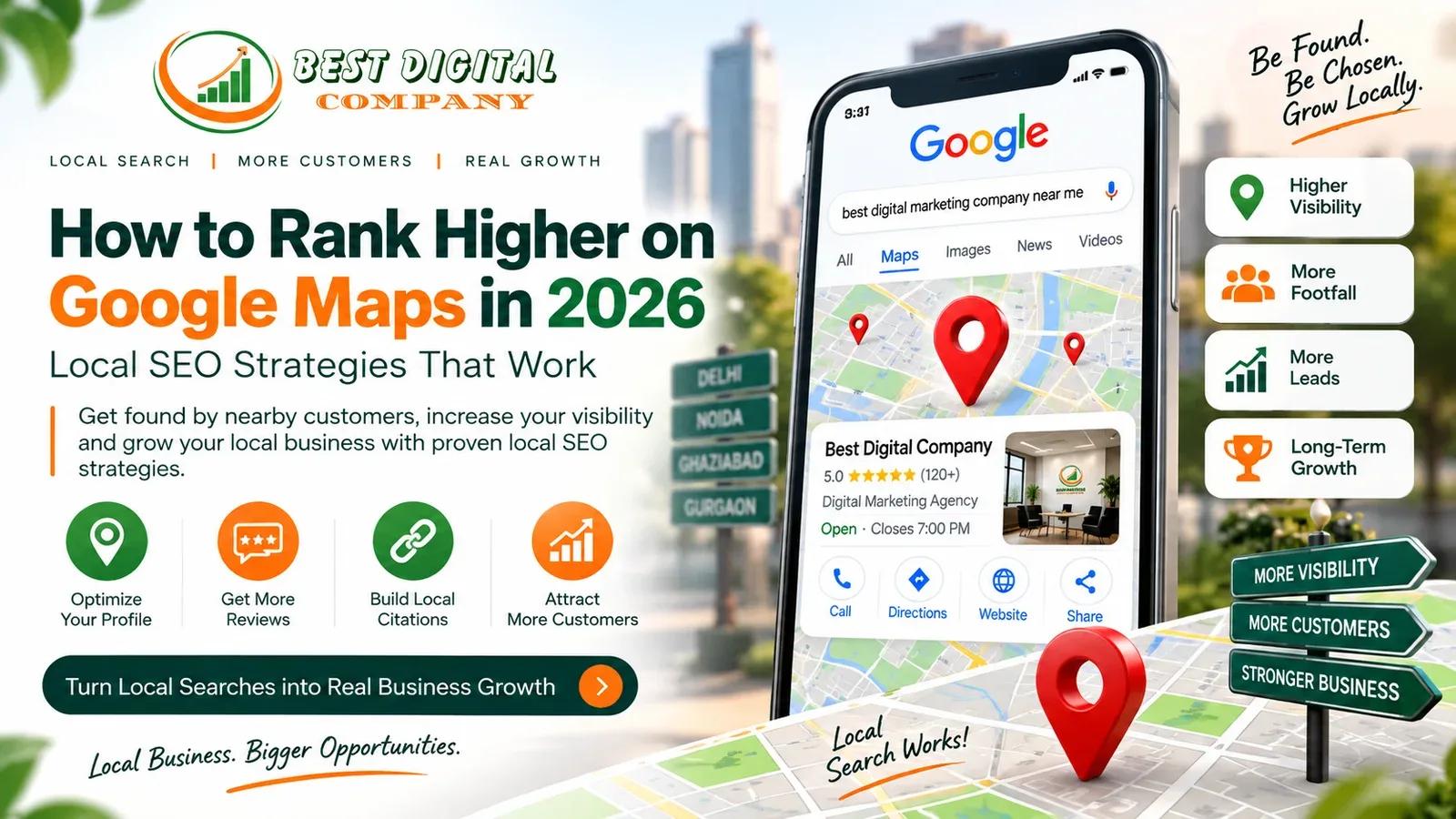
If you run a local business, you already know the drill. Someone nearby searches for “dentist near me” or “best cafe in Karol Bagh,” Google shows three map pins with reviews and directions, and most people never scroll past that box. If your business isn’t one of those three pins, you’re invisible to a huge chunk of nearby customers even if your website ranks decently in the regular results below.
This is exactly why so many business owners now ask the same question: how do you actually rank higher on Google Maps? Not in theory, but in a way that holds up in 2026, when Google has gotten far better at reading real signals of trust and quality, and far less forgiving of shortcuts that used to work.
We manage local listings for clients across Delhi, Noida, and several other cities, and the pattern is consistent. Businesses that rank at the top of the map pack aren’t necessarily the biggest or the oldest — they’re the ones that have been deliberate about a specific set of signals, month after month. This guide walks through exactly what those signals are, what changed heading into 2026, and how to build a plan you can actually execute.
What “Ranking Higher on Google Maps” Actually Means
Before diving into tactics, it helps to understand what Google is trying to do. When someone searches for a local service, Google’s algorithm looks at three broad factors to decide which businesses to show and in what order:
- Relevance — how well your business profile matches what the person is searching for
- Distance — how close your business location is to the searcher (or the area they specified)
- Prominence — how well-known and well-reviewed your business is, both online and offline
You can’t do much about distance — that’s determined by where the searcher is standing or which area they typed in. But relevance and prominence are almost entirely within your control, and that’s where local SEO work actually pays off. Businesses that rank higher on Google Maps consistently tend to have a fully completed, accurately categorized profile, a steady stream of genuine reviews, consistent business information across the web, and content that signals real local authority. None of that happens by accident.
Why Google Maps Rankings Matter More in 2026
A few years ago, ranking in the regular web results was the main prize. That’s shifted. More searches now happen on mobile, more of them carry local intent (“near me,” a neighborhood name, a city), and Google increasingly answers those queries directly inside the map pack before a person ever taps through to a website.
There’s also a bigger shift happening around how people search altogether. AI-powered search experiences are pulling answers from structured, trustworthy local data, which means the businesses with clean, verified, well-reviewed profiles are the ones getting pulled into those answers too. We’ve written about this shift in more detail in our piece on how AI search is changing SEO in 2026, and it’s worth understanding alongside your Maps strategy, because the two are becoming more connected than most business owners realize.
For a local business — a clinic, a restaurant, a salon, a service provider — this means your Google Business Profile has become one of the most valuable pieces of digital real estate you own. It’s often the very first thing a potential customer sees about you.
Step 1: Fully Optimize Your Google Business Profile
This sounds obvious, but the majority of businesses we audit have profiles that are only half-filled. Google rewards completeness because it makes the platform more useful to searchers, and it penalizes gaps because they signal an unmaintained, less trustworthy listing.
Here’s what a fully optimized profile includes:
Accurate business name. Use your real business name exactly as it appears on your signage and paperwork. Don’t stuff keywords into the name field (“Best Digital Company – SEO Delhi NCR”) — Google’s guidelines explicitly prohibit this, and it can get your listing suspended.
Correct primary category, plus relevant secondary categories. Your primary category carries the most weight in how you get matched to searches. Spend time researching which category your competitors are using and pick the one that most precisely describes your core service.
Complete address and service area. If you serve customers at a physical location, your address needs to be exact. If you’re a service-area business without a public storefront, define your service areas carefully rather than leaving them broad and vague.
Business hours, including special hours for holidays. Incorrect hours are one of the fastest ways to lose customer trust — someone shows up to a “closed” business and won’t come back.
Phone number and website that match what’s listed everywhere else. This consistency matters more than people think, and we’ll come back to it in the next section.
High-quality photos, updated regularly. Listings with recent, real photos of the interior, exterior, team, and products consistently earn more clicks and calls than listings with generic or outdated images.
A complete business description that naturally reflects what you do and where you do it, without keyword stuffing.
If you’re not sure where to start, our team’sLocal SEO services in Delhi walk through profile optimization as one of the first steps for every new client, because it’s the foundation everything else builds on.
Step 2: Get Your NAP Consistency Right
NAP stands for Name, Address, and Phone number. It’s a simple concept that a surprising number of businesses get wrong. If your business is listed as “ABC Traders” on your website, “ABC Traders Pvt Ltd” on Justdial, and “ABC Trader” on Facebook, that inconsistency creates confusion — not just for customers, but for Google’s systems trying to verify that all these mentions refer to the same real business.
Consistent NAP data across directories, social profiles, and citation sites builds trust signals that support your ability to rank higher on Google Maps. Here’s a practical way to tighten this up:
- Pick one exact format for your business name, address, and phone number, and write it down somewhere your whole team can reference it
- Search your business name across major directories (Justdial, Sulekha, IndiaMart, Facebook, Instagram) and note every place your details are inconsistent
- Update each listing one by one, prioritizing the highest-traffic directories first
- Set a recurring reminder to check this every few months, since directories occasionally revert listings during their own data updates
This kind of cleanup is tedious, which is exactly why so many businesses skip it — and exactly why the businesses that do it well have an edge.
Step 3: Build a Genuine Review Strategy
Reviews are one of the strongest ranking and trust signals Google uses for local search, and this hasn’t changed heading into 2026 — if anything, it’s grown more important as fake and low-quality reviews have become easier for Google’s spam systems to detect and filter out.
A strong review strategy in 2026 looks like this:
Ask consistently, not sporadically. The businesses that build a steady flow of reviews are the ones that ask every satisfied customer, not just the ones they remember to follow up with. A simple system — a QR code at checkout, a follow-up text or email after service — works better than relying on memory.
Respond to every review, good and bad. A thoughtful response to a negative review often does more for your credibility than a dozen five-star reviews with no owner engagement. It shows future customers — and Google — that a real person is managing the business.
Never buy reviews or incentivize them with discounts. This violates Google’s policies, and detection has improved significantly. A profile that gets flagged for review manipulation can lose most of its visibility overnight, and recovering from that is a slow, painful process.
Encourage detailed reviews naturally. Reviews that mention specific services, products, or locations give Google more context to match your listing against relevant searches. You don’t need to script this for customers — just make it easy for them to leave feedback, and detail tends to follow naturally from a genuinely satisfied customer.
Step 4: Create Location-Specific Content That Supports Your Maps Presence
Your Google Business Profile doesn’t exist in isolation. Google cross-references your listing against your website and the content on it to judge how relevant and authoritative you actually are for a given area. This is where a lot of businesses leave value on the table — they optimize the profile itself but never build supporting content on their website.
Location pages, service-area pages, and locally-focused blog content all reinforce the same signals Google is already trying to verify from your Business Profile. For example, a company offering services across multiple cities benefits from dedicated pages for each region — something we cover in depth in our guide to being a digital marketing company in Noida and our breakdown of digital marketing strategy across Delhi NCR. The same principle applies to any local business — a clinic, a salon, a repair shop — that serves more than one neighborhood or city.
Blog content also helps here. Publishing genuinely useful, locally relevant content — answering questions your customers actually ask, referencing neighborhoods and landmarks naturally, sharing case studies from real local projects — builds the kind of topical depth and authority that supports your broader visibility, including on Maps. It’s slower than a quick profile tweak, but it compounds over time in a way shortcuts never do.
Step 5: Earn Local Citations and Backlinks
A citation is any mention of your business name, address, and phone number on another website, even without a link back to you. Local directories, industry associations, chambers of commerce, and local news sites are all common sources. Backlinks — actual links pointing to your website from other relevant, trustworthy sites — carry even more weight.
Both signal to Google that your business is a real, recognized part of your local community, not just a name in its own database. A few ways to build this out:
- List your business accurately on major and niche-relevant directories in your industry
- Partner with local organizations, sponsor community events, or collaborate with complementary local businesses in ways that naturally earn a mention or link
- Get featured in local news coverage or industry publications when you have something genuinely newsworthy to share
- Join local business associations that maintain member directories with backlinks
This is closely related to broader off-page SEO work. If you want a deeper look at how search engines evaluate a website’s overall authority, our Search Engine Optimization services page covers how technical SEO, content, and link building work together as a system rather than isolated tactics.
Step 6: Use Google Posts and Q&A Actively
Two underused features inside Google Business Profile are Posts and the Questions & Answers section. Both give you a direct way to add fresh, relevant content to your listing — something Google’s systems read as a sign of an active, well-maintained business.
Google Posts let you share updates, offers, events, and new products directly on your listing. Businesses that post at least once every week or two tend to show up as more active and engaged than listings that go months without an update.
Q&A allows anyone to ask a question about your business, and anyone — including you — can answer. Proactively seeding this section with the questions customers actually ask (parking availability, appointment booking, specific services offered) means potential customers get accurate answers from you, not from a stranger’s guess.
Step 7: Don’t Ignore the Technical Side of Your Website
Your Google Business Profile can only take you so far if the website it links to is slow, hard to navigate, or not built with local search in mind. Google does check the destination, especially for competitive searches where several businesses have similarly strong profiles.
A well-structured website with local schema markup, fast load times, mobile-friendly design, and clear location information reinforces everything your Business Profile is telling Google. If your site was built years ago and hasn’t been touched since, it may be worth a review — our Website Development & Designing team regularly rebuilds sites specifically with local search performance in mind, not just visual design.
Common Mistakes That Hold Businesses Back
Even with a solid strategy, a few recurring mistakes quietly undermine local rankings:
- Ignoring duplicate listings. Multiple Business Profiles for the same location split your reviews and confuse Google. Search for your business name to check, and merge or remove duplicates.
- Keyword-stuffing the business name or description. This looks aggressive to both Google and customers, and it’s one of the more common reasons listings get suspended.
- Letting information go stale. Old hours, outdated photos, and unanswered questions all signal neglect.
- Treating Maps optimization as a one-time task. Local search is not “set it and forget it.” Competitors are actively working on their own listings, and rankings shift accordingly.
- Overlooking the connection to broader SEO efforts. A strong Maps presence works best alongside a healthy overall SEO strategy, not as a replacement for one.
Building a Realistic Timeline
One thing worth setting expectations on: none of this happens overnight. Profile optimization can show early movement within a few weeks, especially for less competitive categories. Review growth and citation building tend to show meaningful impact over two to three months of consistent effort. Content and backlink signals, which support long-term authority, typically take three to six months to fully mature.
Businesses that see the fastest, most durable results are usually the ones that work on all these pieces in parallel rather than tackling them one at a time in isolation. That’s also why local SEO tends to work best as an ongoing, managed process rather than a single project you complete and move on from.
Final Thoughts
Ranking higher on Google Maps in 2026 isn’t about finding a clever workaround — those windows close fast, and the businesses chasing them are usually the same ones dealing with suspended listings a few months later. It’s about consistently doing the fundamentals well: a complete and accurate profile, genuine reviews handled with care, consistent information everywhere your business is mentioned, supporting content on your website, and a technical foundation that doesn’t get in the way.
If that feels like a lot to manage on top of actually running your business, that’s a fair reaction — most owners feel the same way, which is why they eventually bring in a team that handles it day to day. If you’d like a hands-on look at where your listing currently stands and what’s realistically holding it back, our team is happy to walk through it with you.
Frequently Asked Questions
How long does it take to rank higher on Google Maps?
Most businesses start seeing measurable movement within four to eight weeks of consistent profile optimization and review activity, though competitive categories in dense markets can take longer. Sustainable, top-of-pack rankings usually build over three to six months.
Do I need a physical address to show up on Google Maps?
Not necessarily. Service-area businesses without a public storefront can still create a Business Profile and define the areas they serve, though businesses with a verified physical location generally have an easier time building trust and prominence.
Does responding to reviews actually affect rankings?
Yes, indirectly. Google doesn’t confirm an exact ranking boost for owner responses, but active engagement is associated with stronger prominence signals, and it clearly influences whether potential customers choose to contact you.
Can paid ads help me rank higher on Google Maps?
Local Services Ads and Google Ads can place your business above the organic map pack for certain searches, but they don’t change your actual organic ranking. Many businesses combine paid visibility with organic local SEO for the strongest overall presence something our Pay Per Click team can help you plan alongside your Maps strategy.
Is it worth hiring a professional for Google Maps optimization?
If you have the time to learn the platform, monitor it regularly, and stay current with policy changes, it’s possible to manage on your own. Most business owners find it more efficient to work with a team that manages this daily across many listings, especially once the business is juggling reviews, citations, content, and technical SEO at the same time.
Looking for hands-on help getting your business to the top of the map pack? Get in touch with our team for a straightforward look at what’s working, what isn’t, and what it would take to fix it.

Add a Comment