

If you have sat through a pitch meeting recently, you have probably heard both phrases thrown around like they mean the same thing. “We are a full-service agency.” “We are performance-driven.” “We focus on ROI.” Somewhere in that word salad, most business owners quietly nod along and hope the invoice at the end of the month will explain what they actually bought.
It won’t.
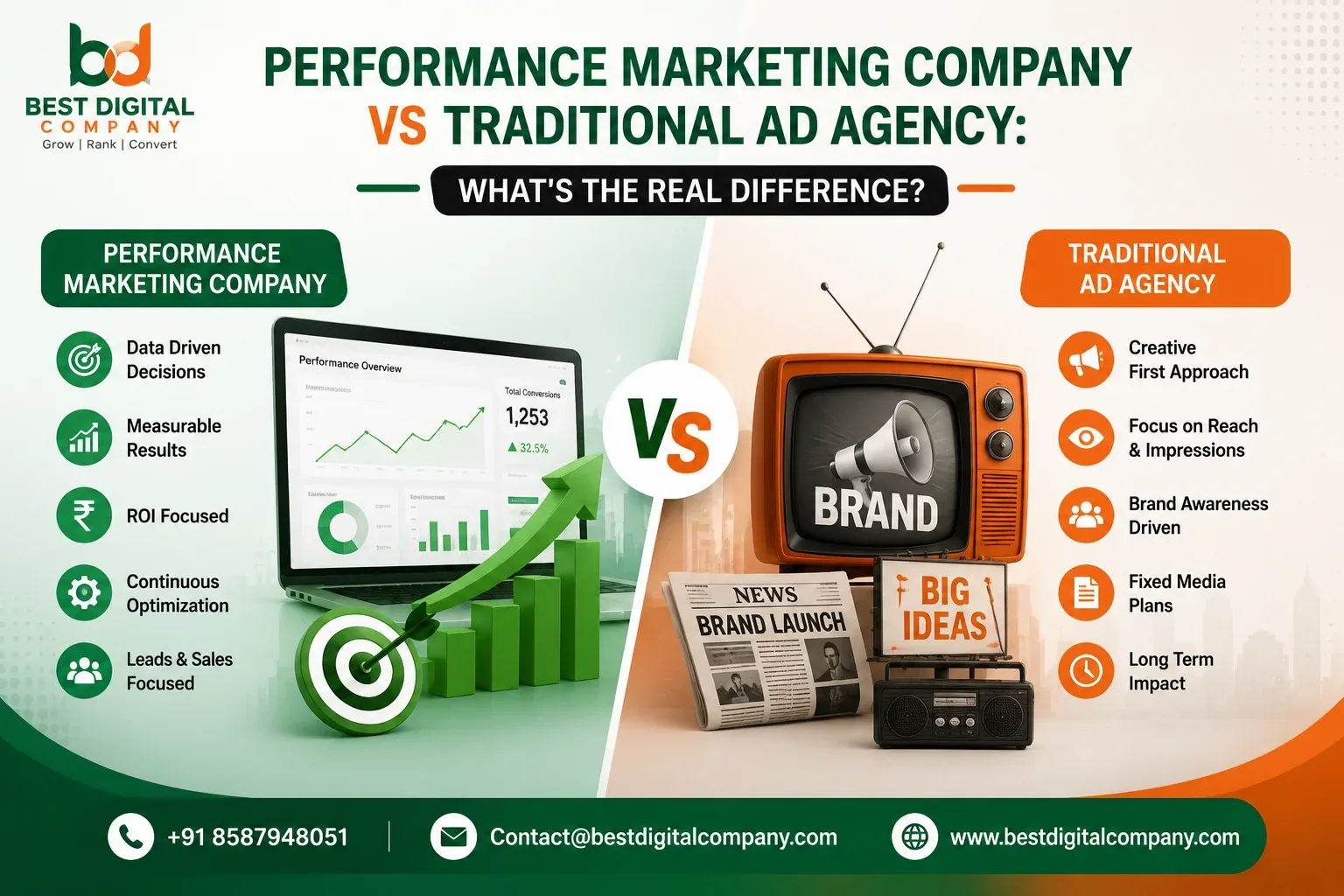
The confusion is understandable. Traditional ad agencies and a performance marketing company both promise to grow your brand, both build campaigns, and both send you decks full of charts. But the way they get paid, the way they measure success, and the way they treat your budget are fundamentally different. One is built around a philosophy of “creative first, measure later.” The other is built around a philosophy of “measure everything, then create around what works.” Confusing the two can cost you months of budget and a marketing plan that looks good in a boardroom but does nothing for your bank account.
This article breaks down exactly how these two models differ, where each one genuinely shines, and how to figure out which approach actually fits the stage your business is at right now.
What a Performance Marketing Company Actually Does
A performance marketing company builds every campaign around a measurable action: a lead form filled, a product purchased, a call placed, an app installed. Nothing gets a green light unless it can be tracked back to a number. If a social post, a landing page, or an ad creative isn’t contributing to that number, it gets changed or dropped, usually within days rather than months.
This is a very different mindset from “brand awareness” campaigns, where success is judged by impressions, reach, or how many people saw the ad. A performance-focused team treats visibility as a means to an end, not the end itself. The question is never “did people see this?” It’s “did people act on this, and can we afford to keep doing it at scale?”
In practice, this usually means combining a few disciplines under one roof:
- Paid advertising across Google, Meta, and other platforms, managed with tight budget controls and daily optimization
- Landing page testing to see which version actually converts visitors into leads or customers
- Search visibility work so that organic traffic supports paid spend instead of competing against it
- Analytics and attribution to trace every rupee spent back to a result
If any of that sounds familiar, it is because it overlaps heavily with services like pay per click management and search engine optimization except the performance model ties them together under one shared scoreboard: revenue, not vanity metrics.
What a Traditional Ad Agency Actually Does
A traditional ad agency has a different starting point. The work usually begins with a brand strategy session, mood boards, a creative concept, and a media plan built around reach and frequency. The goal is to build recognition and emotional association with a brand over time, the kind of work you see in television commercials, billboards, and large-scale brand campaigns.
There is real craft in this. A good traditional agency can shape how a brand sounds, looks, and feels across every touchpoint. Automobile launches, FMCG brands, and large consumer campaigns still rely heavily on this model because the goal isn’t an immediate click, it’s staying power in a customer’s memory.
The tradeoff is measurement. Reach, impressions, and brand recall studies are far harder to tie directly to sales. A traditional campaign might genuinely be working, shaping perception and consideration, while looking “flat” on a spreadsheet for months. That’s fine for a company with a large budget and a long runway. It’s much riskier for a business that needs leads or sales this quarter, not brand equity in three years.
Performance Marketing Company vs Traditional Ad Agency: The Core Differences
Let is put the two side by side, because the differences show up in almost every part of how the work actually happens.
How Success Gets Measured
A performance marketing company reports on cost per lead, cost per acquisition, conversion rate, and return on ad spend. A traditional ad agency reports on reach, impressions, brand recall, and share of voice. Neither number is “fake,” but they answer completely different questions. One tells you whether the campaign made money. The other tells you whether people noticed.
How Budgets Are Handled
Performance budgets are usually flexible and reallocated weekly, sometimes daily, based on what’s converting. If a Google Ads keyword group is outperforming a Meta campaign, budget shifts there almost immediately. Traditional ad agency budgets tend to be locked into a media plan for a full quarter or campaign cycle, because television slots, print placements, and large creative productions don’t allow for that kind of daily flexibility.
How Pricing Works
This is one of the biggest practical differences. Traditional agencies commonly charge a retainer or a percentage of ad spend, regardless of the direct outcome. A performance marketing company is far more likely to tie at least part of its fee to results, whether that’s cost per lead targets or agreed conversion benchmarks. This alone changes the incentive structure of the entire relationship.
Speed of Optimization
A performance team might test five ad variations in a week and kill the two that underperform by day three. A traditional agency, working within a bigger creative and production cycle, usually can’t move that fast, and honestly, isn’t trying to. Big brand campaigns need consistency, not constant tweaking.
The Skills Involved
Traditional agencies lean heavily on creative directors, copywriters, and media planners. Performance marketing companies lean on paid media specialists, conversion rate optimizers, and analysts who live inside dashboards. Some businesses actually need both, which is why understanding what a google ads expert does day to day versus what a full agency team handles can help you decide who to bring in first.
Why This Distinction Matters More in 2026
A few years ago, this line was blurrier because most agencies claimed to do everything. But tighter marketing budgets, more advanced tracking tools, and increased pressure to show real business impact have pushed the industry to specialize. Business owners today are asking sharper questions before signing contracts: what did last month’s spend actually generate, and can you prove it.
That shift favors performance-based models because they were built for exactly this kind of scrutiny. A performance marketing company lives and dies by dashboards that show, in real time, whether spend is translating into leads or sales. There’s nowhere to hide behind a nicely produced brand video if the conversion numbers aren’t there.
This doesn’t mean brand-building is dead. It means most small and mid-sized businesses, especially those without a multi-year runway, are better served starting with performance-driven work and adding brand campaigns once there’s steady revenue to protect.
Where a Traditional Ad Agency Still Makes Sense
It would be misleading to say the traditional model is obsolete, because it is not. There are situations where it is genuinely the smarter choice:
- Large product launches that need mass awareness before any purchase intent even exists
- Established brands protecting market position rather than chasing immediate conversions
- Categories with long sales cycles, like real estate or enterprise software, where a single ad rarely leads to an instant sale
- Businesses with the budget and patience to invest in recall and reputation over a longer horizon
If your business fits one of these, blending brand-building with performance tactics, rather than picking only one, often produces the best long-term outcome.
Where a Performance Marketing Company Wins
On the other hand, a performance-first approach tends to be the better fit when:
- You need leads or sales within weeks, not quarters
- Your budget is limited and every rupee needs to be justified
- You are a local business, e-commerce store, or service provider competing on visibility and conversions rather than mass brand recognition
- You want clear reporting that ties spend directly to outcomes rather than abstract reach numbers
This is also where the overlap with a company’s broader digital presence matters. Paid campaigns rarely perform in isolation. A performance marketing company usually pairs paid ads with organic visibility work, active social media marketing, and a website that’s actually built to convert the traffic being paid for. Sending expensive clicks to a slow, cluttered, or outdated site is one of the fastest ways to waste an ad budget, which is why website development and design often ends up being part of the same conversation, not a separate project handled months later.
A Practical Example
Picture two businesses running the exact same monthly ad budget.
Business A hires a traditional ad agency. They get a polished campaign concept, a media plan spread across a few platforms, and monthly reporting focused on impressions and reach. Three months in, brand awareness has genuinely improved, but leads are inconsistent, and nobody can say with certainty which specific ad or platform is driving actual inquiries.
Business B hires a performance marketing company. Within the first two weeks, three ad variations are tested, the underperforming ones are paused, and budget is shifted toward the landing page generating the most form fills. By month two, the cost per lead has dropped, and the reporting shows exactly which keyword, ad, and platform combination is producing the best return.
Neither business made a wrong choice in principle, they just had different goals. But if Business B actually needed sales this quarter, the performance approach clearly served that need faster and more transparently.
Red Flags to Watch For, Regardless of Which Model You Choose
Whether you’re evaluating a traditional agency or a performance marketing company, a few warning signs apply across the board. Vague reporting that only shows impressions when you asked about leads. Long-term contracts with no clear exit or review point. A refusal to explain exactly how your budget is being spent across platforms. These issues aren’t unique to one model, they’re signs of a vendor relationship that isn’t built on transparency. If any of this sounds familiar from past experience, it is worth reading through common warning signs when evaluating a pay-per-click partner before signing another contract.
How to Choose the Right Fit for Your Business
Instead of asking “which one is better,” a more useful question is: what does my business actually need right now?
If you need measurable leads, tighter cost control, and fast optimization, a performance marketing company is almost certainly the better starting point. If you’re building a long-term brand with a bigger budget and a longer timeline, blending brand strategy with performance tactics tends to work better than choosing purely one lane.
The businesses that get the most value usually don’t treat this as a permanent, one-time decision either. They start with performance-focused work to build a stable base of leads and revenue, then layer in brand-building campaigns once there’s enough consistent income to support a longer-term investment.
Final Thoughts
The difference between a performance marketing company and a traditional ad agency isn’t just terminology, it’s a difference in philosophy, pricing, speed, and accountability. One is built to prove its worth in numbers you can check weekly. The other is built to shape how your brand is remembered over time. Neither approach is automatically wrong, but picking the one that matches your business stage, budget, and timeline will save you months of second-guessing and a lot of unclear invoices.
If you’re trying to figure out which model fits your business, or you want a team that can move between performance-driven campaigns and long-term brand growth as your needs change, it helps to talk through your specific goals with a team that works across search engine optimization, paid media, social platforms, and website performance, rather than one narrow specialty.
Frequently Asked Questions
What exactly is a performance marketing company?
It’s an agency or team that builds campaigns around measurable actions, like leads, sales, or app installs, rather than general brand visibility. Every rupee spent is expected to tie back to a trackable result.
Is a performance marketing company cheaper than a traditional ad agency?
Not necessarily cheaper, but usually more efficient with budget in the short term, since underperforming campaigns get cut quickly instead of running for a full quarter regardless of results.
Can a traditional ad agency also do performance marketing?
Some can, if they have dedicated paid media and analytics teams. But many traditional agencies are structured around creative and media planning, not real-time optimization, so it’s worth asking directly how they handle tracking and reporting before assuming they can.
How fast can I expect results from a performance marketing company?
Early signals, like click-through rates and initial lead volume, often show up within the first two to three weeks. Meaningful, stable results usually take six to eight weeks as campaigns are tested and refined.
Do small businesses need a traditional ad agency at all?
Most small and mid-sized businesses are better served starting with performance-driven work, since it delivers measurable leads faster on a limited budget. Brand-building campaigns tend to make more sense once there’s steady revenue to protect.
What should I ask before hiring either type of agency?
Ask exactly how success will be measured, how often budgets are reviewed, what reporting looks like, and whether there’s a minimum contract lock-in. Clear answers to these questions usually separate a trustworthy partner from a vague one.

Add a Comment