
If you have ever searched for paid advertising help online, you have probably typed both phrases into Google without giving it a second thought “PPC advertising agency” and “PPC advertising company.” You clicked on results for both. You compared pricing pages that looked almost identical. You may have even filled out two contact forms just to see if the replies sounded different. They probably didn’t.
This happens to almost every business owner who is new to paid search. You assume there must be some hidden distinction, some technical difference that separates one from the other, the way a “clinic” differs from a “hospital.” So you keep digging, hoping the next Google search will finally explain it.
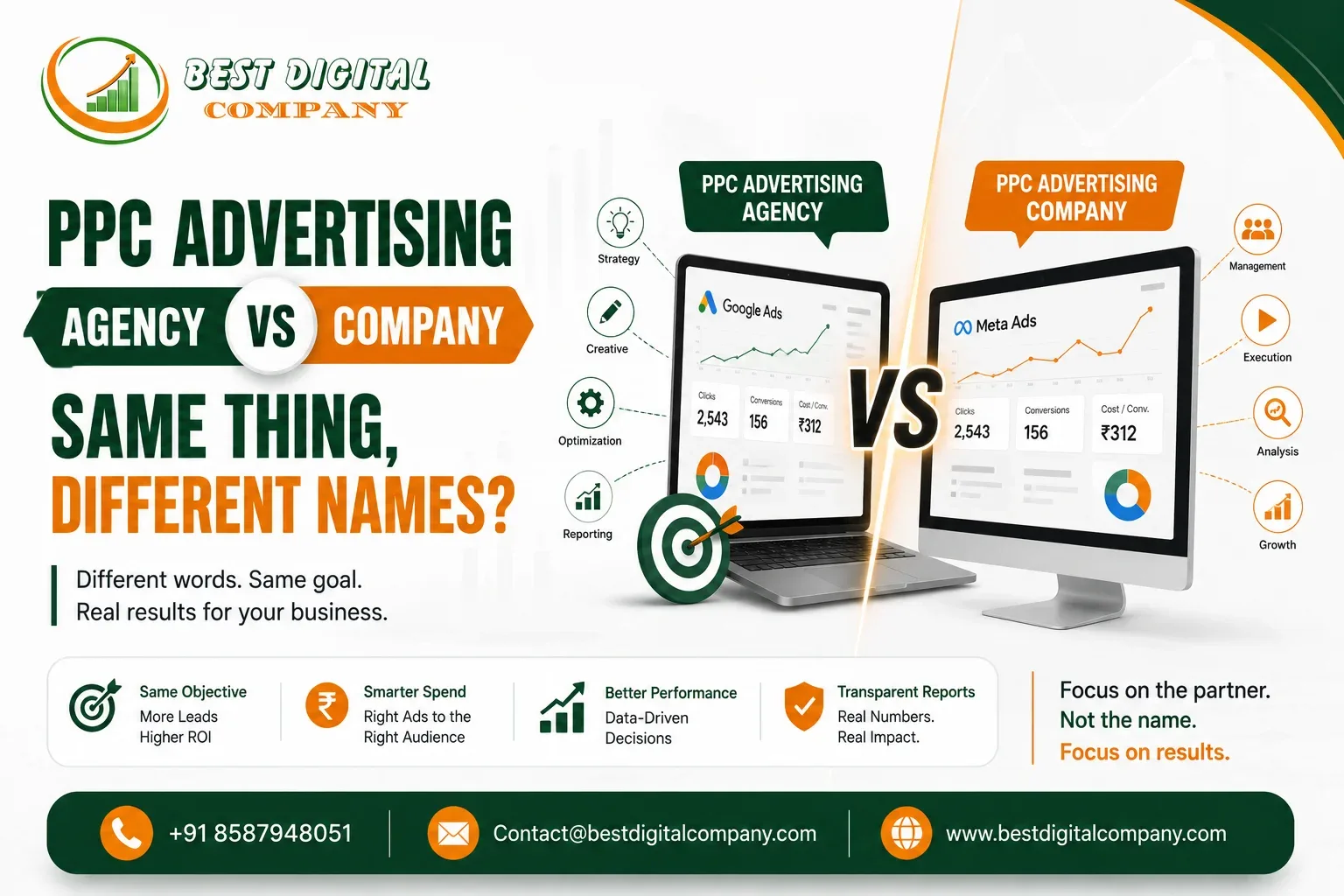
Here is the honest answer: in the world of pay-per-click advertising, the terms PPC advertising agency and PPC advertising company are used interchangeably by almost everyone in the industry, including the businesses that hire them. There is no legal, regulatory, or universally accepted rulebook that says one label means something different from the other. What actually matters is not the word on the homepage. It is what happens after you sign the contract.
This article breaks down where the terms overlap, where subtle differences sometimes show up in practice, and what you should actually be evaluating when you’re choosing a partner to manage your Google Ads or Meta Ads budget.
What Does a PPC Advertising Agency Actually Do?
When most people say “agency,” they are picturing a team: strategists, ad copywriters, a data analyst who lives inside spreadsheets, and an account manager who calls you back when something goes wrong. The word “agency” carries a slightly more collaborative, creative connotation. It suggests a group of specialists working together on your campaigns rather than a single person running your ads between other tasks.
In practice, a PPC advertising agency typically handles:
- Keyword research and competitor analysis before a single rupee is spent
- Campaign structure across Google Ads, Bing Ads, and social platforms
- Ad copywriting and creative testing
- Landing page feedback (even if they don’t build the page themselves)
- Bid management and budget pacing
- Weekly or monthly reporting tied to actual business outcomes, not just clicks
The agency model tends to work well for businesses that want a partner involved in strategy, not just execution. If you want someone asking “why” before they start spending your budget, this is usually the structure you are looking for.
What Does a PPC Advertising Company Really Mean?
“Company” is a broader, more formal business term. It simply describes a registered business entity that offers PPC as one of its services which, technically, describes almost every agency too. A company might be a large operation with multiple departments, or it could be a smaller outfit that prefers the word “company” because it sounds more established to conservative, traditional clients.
There is a small but real pattern worth noting: some businesses that call themselves a “company” lean slightly more transactional. You give them a budget and a goal, they manage the account, and reporting is more standardized. This is not a rule plenty of companies are just as strategic and hands-on as any agency but if you are comparing two nearly identical-looking websites and trying to guess their working style from the name alone, don’t. The name tells you almost nothing reliable about how they’ll actually run your campaigns.
PPC Advertising Agency vs PPC Advertising Company: Where the Real Differences Show Up
Since the terminology itself won’t tell you much, here is where you should actually be looking for differences before signing anything.
1. Team Structure Behind Your Account
Ask directly: will one person manage my account, or will I have access to a strategist, a copywriter, and an analyst? Some smaller “companies” run PPC as a side service with one generalist handling everything. Larger “agencies” often split responsibilities across specialists. Neither structure is automatically better a skilled generalist who lives and breathes your account can outperform a fragmented team but you need to know what you’re paying for.
2. Reporting Transparency
A trustworthy partner, whether they call themselves an agency or a company, will show you real numbers: cost per lead, conversion rate, return on ad spend, and wasted spend on irrelevant search terms. If a business regardless of the label on their homepage only sends you screenshots of “impressions” and “clicks” without tying them to leads or revenue, that’s a red flag that has nothing to do with naming.
3. Platform Certifications and Experience
Google Ads certifications, Google Partner badges, and case studies with real client names and numbers matter far more than whether the word “agency” or “company” appears in the footer. Ask how long they’ve managed accounts in your industry, and ask for at least one reference you can actually call.
4. Contract Flexibility
Some companies push long, rigid annual contracts. Some agencies offer month-to-month terms because they are confident in their results. This variation exists across both types of businesses and is a much better filter than the name itself.
Why the Confusion Exists in the First Place
Part of the confusion comes from how these businesses market themselves. A single-person freelancer might register as “XYZ Company” simply because it sounds more credible on a proposal. Meanwhile, a 40-person operation might keep the word “agency” purely because that’s what their original founders chose in year one, long before the business grew into something bigger.
Search behavior adds to the confusion too. People searching for “PPC advertising agency” and people searching for “PPC advertising company” are, in most cases, looking for the exact same outcome: someone to manage their paid ads profitably. Because of this overlapping intent, most businesses including ours use both terms across their website simply to be found by people using either phrase, not because the words describe two different services.
How Pay Per Click Services Fit Into the Bigger Picture
Regardless of which label a business uses, what you are really buying is Pay Per Click management the ongoing, hands-on work of running paid campaigns so that your ad spend turns into actual leads and sales instead of vanishing into clicks that never convert. This includes campaign setup, audience targeting, ongoing bid adjustments, negative keyword management, and conversion tracking.
If you are comparing costs across different providers, it also helps to look at how they structure pricing. Some offer flat monthly retainers bundled into PPC Packages, while others quote custom pricing based on your ad spend and campaign complexity. Neither approach is wrong, but you should understand exactly what’s included account setup, monthly management, reporting, and ad creative before comparing two quotes side by side.
It is also worth remembering that PPC rarely works in isolation. A paid campaign sending traffic to a slow, poorly designed landing page will underperform no matter how well the ads themselves are built. This is where Website Development & Designing plays a supporting role your ad quality score and conversion rate both depend partly on the page people land on after clicking. Similarly, businesses running paid ads alongside organic efforts like Search Engine Optimization or Social Media Marketing tend to see paid campaigns perform better, because brand familiarity from other channels makes people more likely to click and convert when they see your ad.
Signs You are Working With the Right Partner, Whatever They Call Themselves
Instead of worrying about the label, watch for these signals during your first few conversations with any potential PPC partner:
They ask about your business before quoting a price. A generic proposal sent within minutes of your first message, with no questions about your margins, average order value, or sales cycle, usually means you’ll get a generic campaign too.
They explain their reporting cadence upfront. Weekly check-ins, monthly deep-dive reports, or a shared live dashboard any of these work, as long as it’s clearly defined before you sign anything.
They’re honest about timelines. PPC can generate traffic almost immediately, but meaningful optimization the kind that actually lowers your cost per lead usually takes 60 to 90 days of data collection and testing. Anyone promising instant, dramatic results in week one is setting expectations that rarely hold up.
They show you real account data, not just claims. Ask to see anonymized screenshots of an actual Google Ads account they manage. A confident, experienced team will have no hesitation showing you.
They talk about your business goals, not just clicks. Clicks and impressions are vanity metrics if they don’t translate into leads, calls, or sales. The right partner ties every recommendation back to your bottom line.
PPC Advertising Agency or Company: How to Choose the Right One for Your Business
Here’s a practical way to approach the decision without getting stuck on terminology:
- Shortlist three to five providers, regardless of whether they call themselves an agency or a company.
- Request a short discovery call with each one. Notice who asks better questions about your business — that usually predicts who will run better campaigns.
- Compare their reporting samples, not just their pricing sheets.
- Ask about account ownership. You should always retain ownership of your own Google Ads account, even if the agency or company manages it day to day. If a provider insists on keeping the account under their own login with no transfer option, treat that as a serious warning sign.
- Start with a trial period if possible — a three-month engagement is usually enough to judge communication, transparency, and early performance trends before committing to a longer contract.
The label on their website should be the last thing on your checklist, not the first.
How This Compares to Other “Agency vs Company” Debates
This naming confusion isn’t unique to paid advertising. The same question comes up constantly in SEO, where business owners wonder whether an “SEO agency” ranks websites any differently than an “SEO company.” It does not the same logic applies: look past the label and focus on process, transparency, and results.
The debate also shows up in social media marketing, where businesses often struggle to decide between hiring an outside team or building things in-house, a comparison covered in more detail in our piece on social media marketing company vs in-house team. And if you’ve ever wondered what actually separates a results-driven social media partner from one that just posts for the sake of posting, our guide on choosing a social media marketing agency walks through exactly what to look for.
If you want a deeper look specifically at what happens after you sign a PPC contract the actual monthly work involved in managing campaigns. We have broken that down in PPC Services Explained: What a Performance Marketing Agency Really Does Every Month. And if you’re still comparing your options at a broader level, our guide on how to choose the best PPC company for your business covers additional evaluation criteria beyond what’s discussed here.
Final Verdict: Same Thing, Different Names?
Yes for all practical purposes, a PPC advertising agency and a PPC advertising company are the same thing wearing different labels. The terms describe the same core service: managing paid advertising campaigns so that your ad spend turns into measurable business results. The word choice usually comes down to branding preference, not a meaningful difference in capability, pricing, or working style.
What genuinely separates a strong PPC partner from a weak one has nothing to do with whether “agency” or “company” appears in their domain name. It comes down to their transparency around reporting, their willingness to let you keep ownership of your own ad accounts, their honesty about realistic timelines, and their track record with businesses similar to yours.
When you are ready to compare quotes, spend less time reading footers and more time asking direct questions about process, past results, and account ownership. That’s where the real answers live not in the label.
If you’d like a no-pressure conversation about your current paid advertising setup, or you are comparing providers and want a second opinion on a proposal you’ve already received, feel free to contact us. We are happy to walk through what a realistic PPC strategy would look like for your specific business and budget.
Frequently Asked Questions
Is a PPC advertising agency more expensive than a PPC advertising company?
Not inherently. Pricing depends on the scope of work, your ad spend, and the complexity of your campaigns not on whether the provider calls itself an agency or a company. Always compare what’s actually included in the quote: setup, management, reporting, and ad creative.
Which one should I choose for a small business — an agency or a company?
Choose based on the team’s experience with businesses your size, their communication style, and their reporting transparency. The label itself won’t tell you whether they’re a good fit; a short discovery call will.
Do PPC advertising agencies only manage Google Ads?
No. Most agencies and companies manage campaigns across multiple platforms, including Google Ads, Bing Ads, Meta Ads (Facebook and Instagram), and increasingly LinkedIn Ads for B2B businesses. Ask specifically which platforms are included in your package.
How long does it take to see results from PPC advertising?
Traffic can start almost immediately after launch, but meaningful optimization where cost per lead starts dropping and conversion rates improve typically takes 60 to 90 days as the account gathers enough data to make informed adjustments.
Should I own my own Google Ads account, or is it fine if the agency owns it?
You should always retain ownership of your own advertising accounts, even when an agency or company manages them on your behalf. This protects your data, your ad history, and your ability to switch providers without starting from zero.
What is the difference between PPC packages and custom PPC pricing?
Packages bundle a fixed set of services at a set monthly rate, which works well for businesses with predictable, smaller budgets. Custom pricing is usually based on a percentage of ad spend or a tailored scope, which tends to suit businesses with larger or more complex campaigns.

Add a Comment