
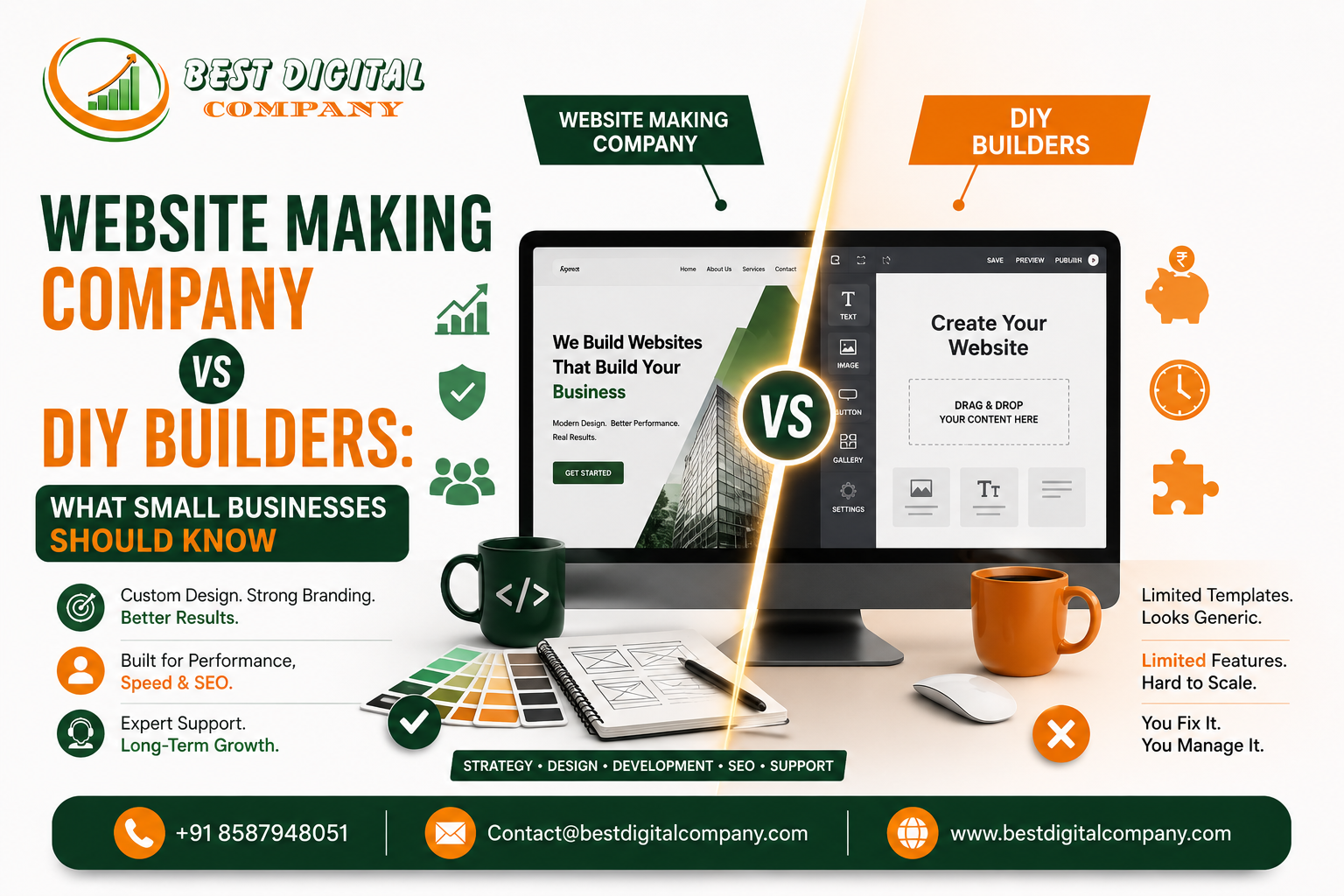
If you run a small business, you have probably had this exact debate with yourself at 11 PM: pay a website making company to build your site properly, or just drag-and-drop your way through a DIY builder over the weekend. Both options promise the same thing, a website that brings in customers. Only one of them usually delivers on that promise once you look past the first three months.
We have built and rescued enough small business websites at Best Digital Company to know that this decision is rarely about money alone. It is about time, technical comfort, how fast you want to grow, and what happens when something breaks at 9 PM on a Friday. This article walks through the honest trade-offs, so you can pick the option that actually fits your business instead of the one that just looked cheaper in a Google ad.
What Is a Website Making Company, and What Does It Actually Do?
A website making company is a team of designers, developers, and strategists who plan, build, and maintain your website as a service not a tool you operate yourself. Instead of choosing templates and typing in your own text, you hand over your goals, your brand, and your content, and the team turns that into a functioning site built around your business, not around a generic layout.
This is different from a freelancer working solo or a piece of software you subscribe to monthly. A proper company brings in several skill sets at once: someone who understands layout and user experience, someone who writes clean code, someone who thinks about how the site will rank on search engines, and often someone who thinks about how the site connects to your marketing further down the line. If you are weighing this option against hiring a single person instead, our earlier post on website developer company or freelancer breaks down that specific comparison in more detail.
At Best Digital Company, our Website Development & Designing team handles this end to end from the first wireframe to the final launch, and the ongoing updates after that.
What Are DIY Builders, and Why Do So Many Small Businesses Start There?
DIY website builders think of the drag-and-drop platforms that let you pick a template, swap in your logo, and publish within an afternoon exist because they solve a real problem: getting something online, fast, without needing to know any code. For a business that is just testing an idea, or a solo founder who needs a placeholder site while they focus on sales calls, this can be genuinely useful.
The appeal is obvious. Low upfront cost. No waiting on anyone else’s schedule. Full control over every button and colour. For a one-page portfolio or a simple menu site for a local café, a DIY builder might honestly be enough, and we would tell you that even though it is not our service to sell.
The trouble starts when a business tries to scale past that first simple page adding products, integrating booking systems, ranking on Google for competitive local searches, or making sure the site looks and loads well on every device a customer might use.
Cost Comparison: What You Pay Upfront vs What You Pay Over Time
This is where most small business owners get surprised, because the sticker price and the real price are rarely the same number.
DIY builders usually advertise a low monthly subscription often less than the cost of a business lunch. But once you add a custom domain, remove builder branding, unlock e-commerce features, add apps for bookings or reviews, and eventually pay for a plugin or a freelancer to fix something the platform cannot do natively, that “cheap” plan adds up month after month, indefinitely, with no asset to show for it if you ever switch platforms.
A website making company typically charges a larger amount upfront (and sometimes a smaller recurring fee for hosting or maintenance), but you own a purpose-built asset designed around your business goals, not a rented template. We laid out actual cost ranges and what is typically included in our post on website development services costs and inclusions, which is worth reading before you get quotes from anyone.
The honest way to think about it: DIY is renting a small, generic space. Hiring a company is building your own space, sized and shaped for what you actually sell.
Design and Branding: Template Freedom vs Custom Identity
DIY builders give you templates. Thousands of other small businesses are using the exact same templates, sometimes in your own city, sometimes in your own industry. You can change colours and swap photos, but the underlying structure, spacing, and interaction patterns are shared across every user of that platform.
A website making company builds your site around your brand specifically your logic for how a customer moves from “just browsing” to “ready to buy,” your colour system, your tone of voice reflected in layout choices, not just text. This matters more than most business owners expect, because customers form a trust judgement about your business within seconds of landing on a page, and a site that looks like a template often reads, subconsciously, as a business that has not fully arrived yet.
If your business also depends on how you look and sound on social platforms, it is worth reading how brand consistency plays out there too our post on social media marketing company vs in-house team covers a related decision many small businesses face right after the website is live.
SEO and Visibility: The Part DIY Builders Rarely Explain Well
Here is the part that catches almost every DIY user off guard: building a website and getting that website found on Google are two completely different skills.
DIY builders have improved their basic search tools over the years you can usually edit a page title or add an image description. But real visibility work involves site structure, internal linking, page speed, mobile performance, schema markup, and a content strategy built around what your actual customers are typing into Google. Most builder platforms were not designed with this level of technical control in mind, and some actively limit how much you can adjust under the hood.
A website making company builds search visibility into the site from day one instead of bolting it on afterward. This is also why so many small businesses that start with a DIY site eventually pay a company to rebuild it once they realize the site is not showing up for the searches that matter. Our guide on how to pick the best web designing company explains what to look for specifically if visibility is a priority for you, and our Search Engine Optimization service is where we handle this work directly for clients whose site already exists but is not being found.
If you want a deeper sense of how SEO gets delivered month to month once a company takes it on, our comparison of an SEO agency vs SEO company is a useful next read, as is the breakdown of SEO services vs SEO packages if you are trying to understand what you should actually be paying for.
Speed, Performance, and Mobile Experience
More than half of small business website traffic today comes from a phone screen, often on an ordinary mobile connection, not office WiFi. A slow-loading site does not just annoy visitors it actively pushes them back to the search results before they even see what you offer.
DIY builders run on shared, generalized infrastructure designed to serve millions of different sites through the same system. This is efficient for the platform but often means your site is carrying code and features it does not even use, which can slow things down. A website making company builds with only what your site needs, optimizes images and code specifically for your pages, and tests real load times on real devices before launch.
This difference sounds small until you notice how often a visitor leaves a slow site within the first few seconds long before they ever read your pitch.
Functionality: What Happens When Your Business Grows
A DIY builder is often perfectly fine for a business that will always look roughly the way it does today. But most small businesses do not stay still. You add online booking. You start selling products directly. You want a customer portal, a quote calculator, or an integration with your accounting software.
DIY platforms cap out here. Their app marketplaces can bolt on some functionality, but combining several third-party apps often creates a site that is slower, buggier, and harder to manage than one built with those features in mind from the start.
A website making company can build exactly the functionality your business needs, and expand it later without starting from scratch. This is one of the biggest hidden costs of DIY: many small businesses eventually rebuild their entire site with a professional team anyway, meaning the “cheap” DIY years were really just a delay, not a saving.
Support, Security, and What Happens When Something Breaks
DIY builders offer customer support, but it is support for the platform, not for your specific business. If your booking form stops working two days before a big promotion, you are in a support queue with everyone else on that platform, explaining your problem to someone who has never seen your site before.
A website making company, especially one managing your ongoing hosting and maintenance, already knows your site’s structure, your integrations, and your history. Fixes tend to be faster because there is no explaining required. Security is handled the same way updates, backups, and monitoring built around your specific setup rather than a generic patch pushed to millions of sites at once.
For businesses relying on paid traffic to a DIY-built site, this risk multiplies. Downtime during an active ad campaign is money burned with nothing to show for it, which is part of why our post on PPC services explained stresses how closely paid advertising and site reliability are connected. Our Pay Per Click team sees this pattern often: strong ad spend undone by a site that cannot handle the traffic it generates.
So, Which One Should Your Small Business Actually Choose?
Here is the honest, unbranded answer: if your business is a personal side project, a test idea, or something you genuinely expect to stay tiny and simple, a DIY builder can be a reasonable starting point. There is no shame in starting lean.
But if your website is meant to generate leads, process sales, build long-term trust with customers, or rank for the searches your competitors are already chasing, a website making company is very likely the better investment not because DIY tools are bad, but because they were built for simplicity, not for growth.
A useful way to test this for your own business: ask yourself whether your website is a hobby project or a growth engine. If it is the second one, treat it like the asset it is, not like a template you are borrowing.
If you are still deciding, our team atBest Digital Company is happy to look at your current site or your business goals and give you an honest read on what actually makes sense even if that answer is not “hire us.”
FAQ
Is a website making company worth it for a very small or new business?
It depends on your goals more than your size. If you need a site quickly to test an idea with almost no budget, a DIY builder can work temporarily. But if the website is meant to generate real customers from day one, a website making company saves you from rebuilding later and gets you found on search engines much sooner.
How long does it take a website making company to build a small business site?
Most straightforward small business websites take between two and six weeks, depending on how much content, design work, and functionality is involved. Complex sites with bookings, e-commerce, or custom features naturally take longer.
Can a website making company fix or improve a site I already built myself on a DIY platform?
Yes, this is a common request. Many companies, including ours, will assess your existing DIY site and either improve specific weak points like SEO structure or load speed or recommend a full rebuild if the platform itself is holding your growth back.
Do I lose control over my website if I hire a company instead of using a DIY builder?
No, a reputable website making company should give you access to edit your own content, hand over ownership of the design files and domain, and explain exactly what you can update yourself versus what requires their support.
What is the biggest mistake small businesses make when choosing between the two options?
Comparing only the upfront price. The real comparison should include SEO performance, load speed, ongoing support, and how much the site can grow with the business because a cheaper site that needs replacing in a year is rarely the cheaper option in the end.

Add a Comment