

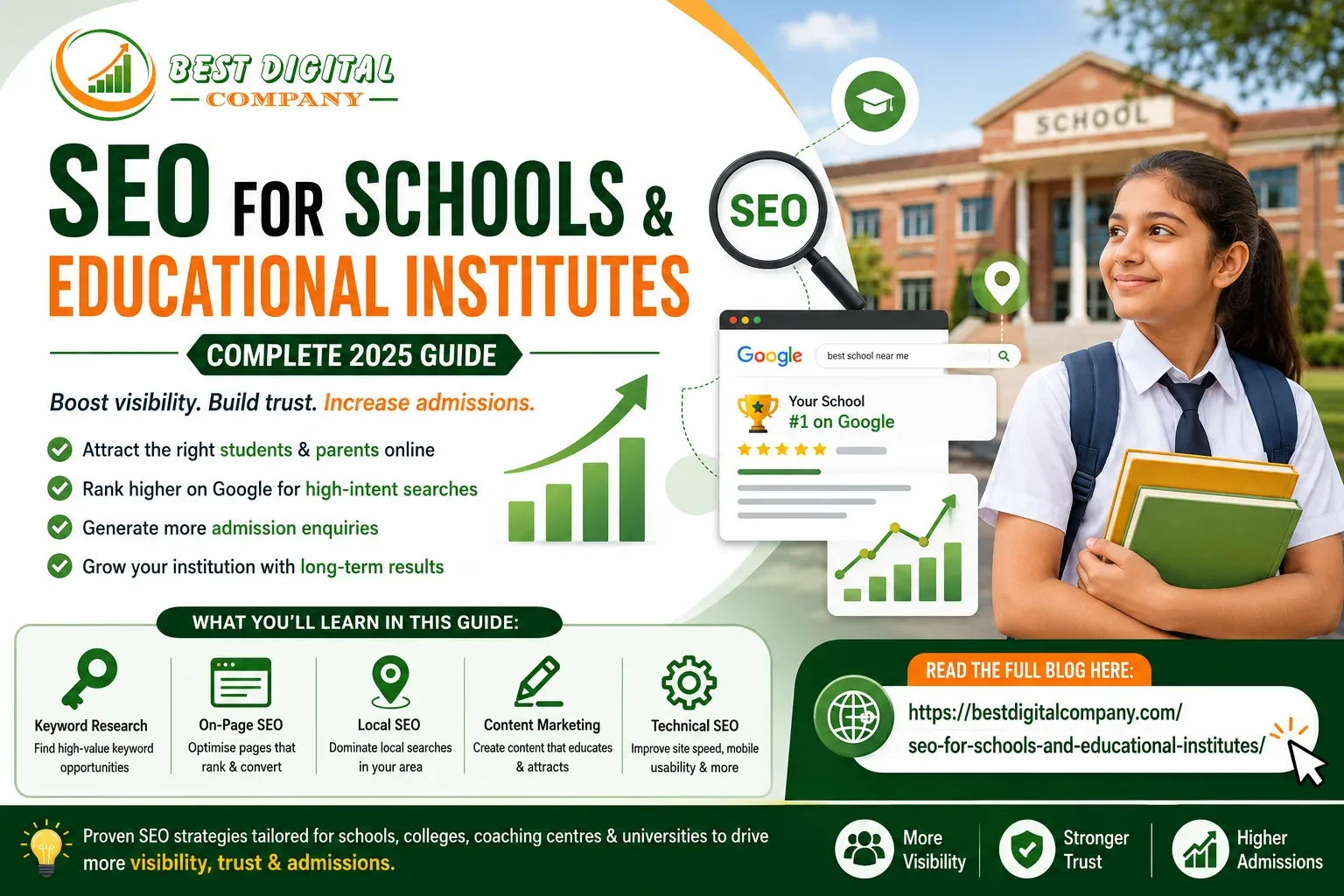
When a parent types “best CBSE school in Delhi” or a student searches “MBA colleges with placement near me”, the institutions that appear on page one win. Those that don’t exist on Google simply don’t exist in the minds of prospective students.
Unlike paid advertising, SEO builds compounding returns. A well-optimised blog post or admission page can drive enquiries for years without ongoing ad spend. For schools operating with tight marketing budgets, this makes SEO the highest-ROI digital marketing channel available.
Quick Summary:
Educational institutes face unique SEO challenges seasonal search spikes, hyper-local intent, and a parent-student dual audience. This guide covers keyword strategy, on-page optimisation, local SEO, content marketing, and technical SEO tailored specifically for schools, colleges, coaching centres, and universities.
Why SEO Matters for Educational Institutes
Over 93% of parents research schools online before visiting in person. Yet most educational institutes still rely on word-of-mouth and print advertising alone. The institutions investing in SEO today are quietly capturing every prospective admission that their competitors are missing.
Here is why SEO is the most powerful long-term marketing investment for any school or educational institute:
Targeted Visibility:
SEO puts your institution in front of parents and students who are actively searching for exactly what you offer high intent, zero wastage, and no cost per click.
Credibility and Trust:
Parents associate top Google rankings with institutional quality. A school that ranks on page one is subconsciously perceived as more credible, established, and trustworthy than one buried on page three.
Long-Term Admissions Growth:
Unlike paid ads that stop delivering the moment you stop paying, organic traffic compounds over time. A page optimised today can drive admission enquiries for the next three to five years.
Multi-Location Reach:
Institutes with multiple campuses can target each location independently with dedicated landing pages and localised SEO strategies, multiplying their organic footprint.
Cost Efficiency:
The cost per lead from organic SEO is consistently three times lower than paid advertising over a 12-month period making it the smartest allocation of a school’s limited marketing budget.
Keyword Research for Educational Institutes
Effective keyword research for schools requires understanding three types of search intent. Informational intent covers queries like “how to apply for school admissions.” Navigational intent covers branded searches like your school’s name. Transactional intent covers high-value queries like “CBSE school admissions open near me” where the parent is ready to act.
High-Value Keyword Categories
Local Brand Keywords – Example: “best school in Delhi” or “top institute in Noida” — These are transactional, high-competition, and highest priority. These are the keywords that directly drive admission enquiries.
Course and Board Specific Keywords – Example: “CBSE school Delhi admissions 2025” or “IB curriculum school South Delhi” , High intent, moderate competition, and excellent for dedicated landing pages.
Proximity Keywords – Example: “school near me” or “coaching centre nearby” — These are local searches with immediate intent. Winning these requires strong Google Business Profile optimisation.
Informational Keywords – Example: “how to choose a good school for my child” or “difference between CBSE and ICSE” , Lower competition, builds brand authority, and attracts parents early in their research phase.
Comparison Keywords – Example: “CBSE vs ICSE which is better for engineering”. These high-volume informational queries are perfect for long-form blog content that builds topical authority.
Long-Tail Niche Keywords – Example: “IB schools with hostel facilities in South Delhi” — Very low competition, very high conversion. Parents using these searches know exactly what they want.
Pro Tip -Target Admission Season Keywords Early:
Search volumes for “school admissions 2025–26” spike sharply between October and January in India. Begin your SEO campaign three to four months before admission season to build ranking momentum before the peak traffic window opens.
On-Page SEO for School Websites
On-page SEO transforms your website pages from static digital brochures into admission-generating assets. Every page from the homepage to individual department and programme pages must be systematically optimised.
1. Optimise Title Tags and Meta Descriptions
Each page on your website needs a unique, keyword-rich title tag between 50 and 60 characters and a meta description between 150 and 160 characters. The meta description should include a clear value proposition and a call-to-action like “Explore admissions 2026–27” or “Book a school tour today.”
2. Use Proper Heading Hierarchy
Use one H1 per page containing the primary keyword. Use H2 headings for major content sections and H3 headings for subsections. A clear heading structure helps Google understand your page content and improves accessibility for screen readers.
3. Create Dedicated Admission Landing Pages
A single generic admissions page severely limits your SEO potential. Create separate landing pages for each programme, board, grade group, or academic year. A page titled “Class 1 to 5 Admissions 2026–27 — XYZ School Delhi” will outperform a generic admissions page for nearly every relevant long-tail search.
4. Optimise All Images with Descriptive Alt Text
Every campus photograph, classroom image, event photo, and infographic needs descriptive alt text. A good example: “Annual sports day celebration at XYZ School Rohini Delhi 2026.” This helps Google index your images and improves accessibility compliance.
5. Build a Strong Internal Linking Structure
Link from blog posts to relevant admission pages. Link from your homepage to department pages and course-specific pages. Internal linking passes SEO authority between pages and guides visitors naturally toward conversion points like the enquiry form or contact page.
6. Implement Structured Data Markup
Add EducationalOrganization, Course, FAQPage, and Event schema markup to your key pages. Rich results generated by schema markup can boost click-through rates from search results by up to 30% , a significant competitive advantage during admission season.
Local SEO: The Most Powerful Tool for Schools
The vast majority of school-related searches carry local intent. Parents want a good school near them. Winning the Google Local Pack, the map-based results that appear above organic listings can dramatically increase calls, campus visits, and admission form submissions.
Google Business Profile Optimisation Checklist
Claim and verify your Google Business Profile with the correct and consistent Name, Address, and Phone number (NAP).
Select an accurate primary business category such as “School,” “Private school,” “University,” or “Coaching centre.”
Add all services your institution offers: Nursery, Primary, Secondary, Senior Secondary, Extracurricular activities, Hostel, and Transport.
Upload a minimum of 20 high-quality photographs: classrooms, science labs, sports facilities, library, canteen, and event coverage.
Publish regular GBP posts covering admission updates, exam results, upcoming events, and institutional achievements. Google rewards active profiles with higher local rankings.
Respond to every review positive and negative within 24 to 48 hours. Your responses are publicly visible and shape the perception of prospective parents.
Pre-populate the Q&A section with answers to the most common admission questions so parents get instant information.
Ensure your NAP is completely consistent across all online directories including JustDial, Sulekha, IndiaEducation, SchoolMyKids, and CollegeDekho.
Reviews Are Ranking Signals: Google’s local search algorithm weights review quantity, recency, and sentiment heavily. Proactively encourage satisfied parents to leave Google Reviews after positive touchpoints graduation ceremonies, parent-teacher meetings, result announcements, or sports events.
Content Marketing Strategy for Educational Institutes
Content marketing serves a dual purpose: it educates and assists your target audience while simultaneously signalling topical expertise to Google’s ranking algorithms. Schools that publish consistently useful content outrank competitors by a wide margin and they do so without paying for every click.
Blog and Content Ideas That Drive Organic Traffic
Admission Guides: “How to Apply for Class 1 Admission in Delhi 2025–26” is a high-intent query that parents search every admission season. A detailed, accurate guide positions your school as the authority and the destination.
Board Comparison Articles: “CBSE vs ICSE vs IB: Which Board is Best for Your Child?” This type of evergreen comparative content attracts enormous search volume from parents in the research phase of their school selection journey.
Achievement and Success Stories: Toppers, national sports champions, alumni career achievements, and scholarship winners , this content builds social proof, earns natural backlinks from local news websites, and keeps your site fresh with new content.
Event Recaps and School News: Annual day coverage, science fair results, inter-school competition wins, and cultural events. Regular event content signals to Google that your institution is active, growing, and community-engaged.
Career Guidance Articles: “Best Career Options After Class 12 Science” or “How to Prepare for JEE 2026”, these high-traffic informational articles attract students and parents researching academic decisions and position your institution as a trusted advisor.
Parent Resource Guides: “10 Questions to Ask During a School Admission Interview” or “How to Evaluate a School’s Infrastructure Before Enrolling”, practical guides that help parents make decisions earn enormous trust and social shares.
Aim for a consistent publishing schedule of four to six blog posts per month, targeting a mix of informational and transactional keywords. Over twelve months, this compounds into a significant and durable organic traffic advantage over competitors who publish rarely or not at all.
Technical SEO Fundamentals
Technical SEO ensures that search engine crawlers can efficiently find, crawl, index, and rank every important page on your website. Many school websites suffer from preventable technical issues that cap their organic search potential entirely.
Page Speed: Target a Core Web Vitals score above 90 on both mobile and desktop. Compress and convert all images to WebP format, enable browser caching, use a Content Delivery Network, and minify CSS and JavaScript. Parents abandon slow-loading websites within three seconds and Google penalises them in rankings.
Mobile-First Design: Over 75% of education-related searches in India happen on mobile devices. Google’s indexing is mobile-first by default, meaning it evaluates the mobile version of your website for ranking purposes. A non-responsive website is a critical SEO liability.
HTTPS Security: An SSL certificate is non-negotiable. Browsers display “Not Secure” warnings on HTTP websites, an immediate trust-killer for parents considering your institution.
XML Sitemap: Submit a complete, current XML sitemap to Google Search Console so all important pages are discovered and indexed promptly. Update the sitemap whenever new admission pages or blog posts are published.
Canonical Tags: Implement canonical tags to prevent duplicate content issues between www and non-www versions of your site, and across filtered category or pagination pages.
Structured Data: Implement EducationalOrganization and FAQPage schema on relevant pages to qualify for Google rich results, which significantly improve click-through rates from search results.
Broken Link Audits: Run monthly checks to identify and fix 404 errors. This is especially critical for admission pages that change URLs or are retired at the end of each academic year broken admission pages cost real enquiries.
Link Building for Schools
Backlinks remain one of Google’s top three ranking factors. For educational institutes, earning high-quality inbound links is more achievable than in most industries, thanks to natural community credibility and consistent news-generating activity.
Local News Coverage: Press releases about student achievements, sports victories, academic results, and community events get picked up by local news websites and portals — earning high-authority, geographically relevant backlinks at no cost.
Education Directories: List your institution on SchoolMyKids, CollegeDekho, JustDial Education, Sulekha, IndiaEducation.net, and similar authoritative education directories. These are trusted sources that pass genuine link equity and drive direct referral traffic.
Guest Articles and Thought Leadership: Principals, academic directors, and department heads writing for parenting blogs, education portals, and local newspapers builds personal and institutional authority and earns natural editorial backlinks in the process.
Alumni Networks: Encourage active alumni to feature their alma mater on LinkedIn profiles, personal websites, and professional portfolios. Over time, alumni-generated mentions and links create a consistent stream of trust signals for your domain.
Community Partnerships: Sponsor local events, partner with NGOs for educational initiatives, or collaborate with government literacy programmes. These partnerships consistently generate backlinks from government and non-profit domains, which carry exceptional authority.
Frequently Asked Questions
Why is SEO important for schools?
SEO helps schools appear at the top of search results when parents and students search for educational institutes nearby. It drives organic admissions enquiries, builds institutional credibility, and reduces dependence on paid advertising delivering consistently better ROI over 12 months and beyond.
How long does SEO take to show results for educational institutes?
Typically 3 to 6 months for meaningful ranking improvements on competitive keywords. Local SEO results, Google Maps visibility and the local pack can appear within 4 to 8 weeks with consistent Google Business Profile optimisation and citation building.
What keywords should schools target for SEO?
Focus on local intent keywords: “best school in [city]”, “CBSE school near me”, “top coaching institute in [area]”, and course-specific terms like “MBA college admissions Delhi 2025”. Long-tail keywords like “IB schools with hostel in South Delhi” have lower competition and significantly higher conversion rates.
Is local SEO different from regular SEO for educational institutes?
Yes. Local SEO targets geographically specific searches and focuses on Google Business Profile optimisation, local citations, online reviews, and location-based keywords. It is essential for schools that serve a defined geographic catchment area and want to appear prominently in “near me” and map-based searches.
Do schools need a blog for SEO?
Absolutely. A consistently updated blog signals topical authority to Google, attracts long-tail search traffic, and helps answer the questions parents and students ask during the admission research phase. Schools that blog regularly generate up to three times more organic traffic than those with static websites.
How can Best Digital Company help my school with SEO?
Best Digital Company offers end-to-end SEO services for educational institutes including keyword strategy, on-page optimisation, technical SEO audits, Google Business Profile management, content creation, link building, and monthly performance reporting. Contact us for a free SEO audit of your school’s website.

Add a Comment